Published: November 2025 | Last updated: May 2026 | Editorial review and quality control: Martina N.
In February 2026, the Minnesota Department of Health issued a statewide health advisory about a cluster of cases of a sexually transmitted fungal infection that several public-health outlets described as one of the largest known US clusters to date. Because TMVII (the fungus involved) is not a nationally reportable condition, exact cluster comparisons across states are difficult, but the Minnesota notice was significant enough to prompt clinician alerts in multiple cities. The culprit was a fungal strain called TMVII, short for Trichophyton mentagrophytes genotype VII, the first dermatophyte formally recognized as spreading primarily through sexual contact. More than 30 confirmed or suspected cases had clustered in the Twin Cities metropolitan area since July 2025, and the infection had already been quietly confirmed in New York City, San Francisco, and several other major US cities.
The reason it spread so far before being caught is the same reason it is so hard to manage once identified: it looks almost exactly like something far more ordinary. TMVII causes painful, coin-shaped ringworm rashes on the genitals, buttocks, inner thighs, face, and trunk. It spreads through direct skin-to-skin contact during sex, survives on shared towels and bedding, and will not respond to the antifungal cream you pick up at the pharmacy. Treating it with a corticosteroid cream actively makes it worse. If you have a rash that looks like jock itch but has not budged after two weeks of treatment, this article is for you.
Key Takeaways
- TMVII is a new sexually transmitted fungal infection that looks like jock itch but does not respond to over-the-counter creams; treatment requires prescription oral antifungals.
- Corticosteroid creams (hydrocortisone) make TMVII worse by suppressing the local immune response; if a rash near your genitals has not cleared after two weeks of treatment, see a clinician.
What Happened in Minnesota, and Why It Matters Nationally
On February 11, 2026, the Minnesota Department of Health issued a formal advisory after tracking more than 30 confirmed or suspected TMVII cases concentrated in the Twin Cities. The state's first confirmed case appeared in July 2025, when a Twin Cities resident sought care for a genital rash that refused to respond to standard treatment. By the time officials issued the February alert, MDH was sending notices to hospitals, urgent care centers, emergency departments, dermatology clinics, and sexual health providers across the state asking them to watch for it.
Minnesota was not where TMVII started in the US. The first American case was identified in New York City in June 2024, in a man who reported multiple male sexual partners while traveling in Europe. By October 2024, the CDC had formally documented those early New York cases in the Morbidity and Mortality Weekly Report. By January 2026, San Francisco had confirmed two cases in male patients with no recent international travel, meaning domestic transmission was already happening independently. According to a 2025 study published in the CDC's Emerging Infectious Diseases journal, among 117 polled infectious disease clinicians, only a minority had experience diagnosing or treating TMVII. For every cluster that gets identified, there are likely cases being logged as treatment-resistant jock itch and left uninvestigated.
- More than 30 confirmed or suspected TMVII cases in the Twin Cities metro area as of the February 11, 2026 MDH advisory.
- First US case identified in New York City in June 2024; San Francisco confirmed domestic transmission in January 2026 before the Minnesota cluster was identified.
- Among 117 surveyed infectious disease clinicians, only a minority reported experience diagnosing or treating TMVII.
- TMVII is not a nationally reportable condition, so cluster-size comparisons across states are inexact.
What TMVII Actually Is, and Why It Is Not Regular Ringworm
Ringworm, despite the name, has nothing to do with worms. It is a fungal skin infection caused by organisms called dermatophytes, and the "ring" refers to the circular shape the rash tends to take, with a slightly raised darker edge around a lighter center. Jock itch, athlete's foot, and nail infections all belong to the same dermatophyte family. Standard ringworm, in almost all its forms, responds well to over-the-counter topical antifungal creams within two to four weeks. TMVII does not.
What sets TMVII apart comes down to a few specific differences that together make it harder to clear and more likely to keep spreading. The infection is caused by a specific variant, genotype VII, of Trichophyton mentagrophytes, a species that has existed for a long time but whose genotype VII form appears to have only recently begun moving between humans through sexual contact. Genotype VII does not clear reliably with topical antifungals because the fungal spores penetrate more deeply into the skin than typical dermatophytes. Without systemic oral treatment, the infection persists, spreads to new areas of the body, and can cause scarring and secondary bacterial infections if left untreated long enough.
The transmission profile is also distinct. Standard ringworm picks up easily from gym mats, shared towels, and animal contact, and you can get it without any skin-to-skin contact at all. TMVII does all of that, but its primary route is direct sexual contact. The sustained skin pressure during sex creates exactly the right conditions for the fungus to transfer from an active rash to a new host. Because TMVII rashes can appear on the face, abdomen, and legs, not just the genitals, transmission risk is not limited to genital contact. According to the CDC's clinician brief on emerging ringworm, TMVII is the dermatophyte most closely associated with sexual transmission, and it is the first fungal pathogen formally recognized as spreading primarily through sexual contact.
| Condition | Appearance | Location | Responds to Topical Cream? | Key Difference |
|---|---|---|---|---|
| TMVII | Round, coin-shaped, raised edges, bumps or pimples on top | Genitals, buttocks, thighs, face, abdomen, legs | No, worsens with corticosteroids; oral treatment required | Spreads through sexual contact; recent new partner is a red flag |
| Jock itch (tinea cruris) | Red, ring-shaped, scaly, itchy edges | Inner thighs, groin, buttocks | Yes, clears with OTC antifungal in 2 to 4 weeks | Not sexually transmitted; responds normally to standard topicals |
| Eczema | Dry, cracked, inflamed patches; may weep or crust | Anywhere; arms, legs, neck are common | Improves with corticosteroids | Not infectious; no ring shape; a chronic condition |
| Psoriasis | Thick, silvery-scaled plaques on a red base | Elbows, knees, scalp, lower back | Improves with corticosteroids | Not infectious; scale is thicker and silvery; chronic condition |
What the Rash Looks Like, and Why It Keeps Getting Missed
The typical story goes like this. A week or two after a sexual encounter, you notice a round, red patch near your inner thigh. It is slightly raised at the edge, a little itchy, not dramatically painful yet. It looks like jock itch, or maybe a heat rash, or friction from clothing. You grab an antifungal cream at the pharmacy. A week later it is still there, maybe slightly larger. You use more cream. Nothing. By that point, weeks have gone by and the infection has likely spread to adjacent skin.
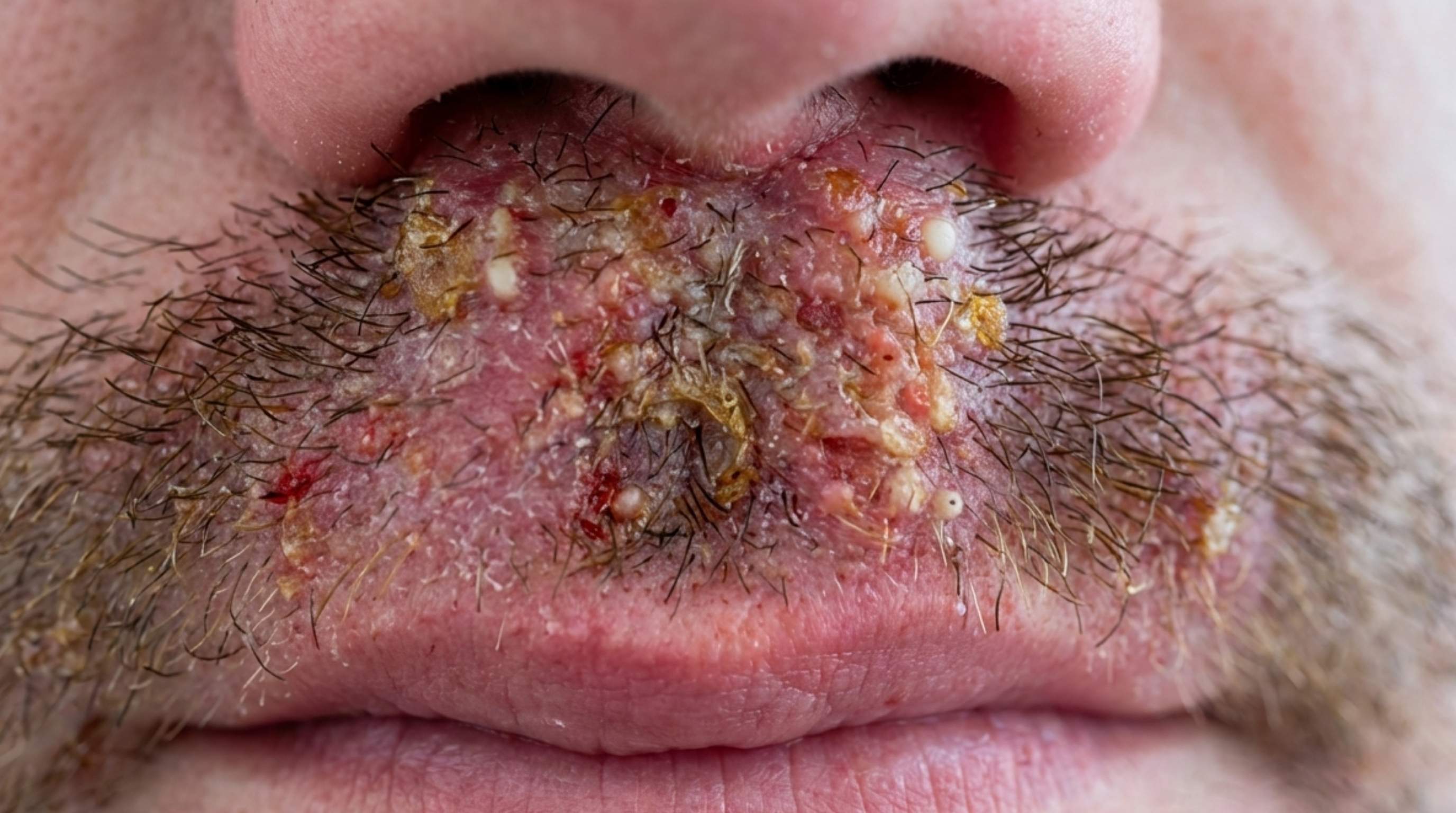
That sequence is why TMVII has traveled as far as it has. The rash it produces is clinically indistinguishable from several common conditions without laboratory testing. Features of a TMVII rash typically include round, coin-shaped lesions with red, irritated edges; raised bumps or pimple-like spots on the surface of the rash; and involvement anywhere on the body, including genitals, buttocks, the area around the anus, inner thighs, abdomen, legs, arms, and face. In more advanced or untreated cases, the rash becomes painful, develops blisters, crusts over, and can leave permanent scarring. The fact that a TMVII rash can appear on the face, including around the mouth, catches many people off guard. It is not where anyone expects an STI to show up, and it is often dismissed as a skin irritation with no connection to sexual history.
Two things drive most misdiagnoses. First, TMVII at onset looks almost identical to eczema and psoriasis, both of which are treated with corticosteroid creams. Applying a corticosteroid to a TMVII infection actively worsens it because the steroid suppresses the local immune response that would otherwise help contain the fungus. The rash may appear to calm briefly while the infection spreads under the skin. Second, standard topical antifungals that handle jock itch reliably do not work on TMVII. A patient who tries an over-the-counter treatment, sees no improvement, and decides the rash must be something non-fungal is now pointing themselves in exactly the wrong direction. The most reliable early signal that a rash might be TMVII rather than a lookalike is simply the absence of treatment response. A rash that does not clear after two weeks of topical antifungal treatment, or that gets worse after corticosteroid application, warrants evaluation at a sexual health or dermatology clinic.
How TMVII Spreads, and Who Is Most at Risk
The primary transmission route is direct skin-to-skin contact with an active rash during sexual activity. Because TMVII lesions can appear anywhere on the body, the risk extends well beyond genital-to-genital contact. Any skin that presses against an active rash during sex is a potential entry point for fungal spores, which is why rashes on the face, abdomen, and thighs all carry transmission risk during close physical contact.
Beyond direct sexual contact, TMVII spores survive on surfaces and fabric. Shared towels, bed linens, clothing, sex toys, and razors have all been identified as potential transmission routes in the epidemiological data from both the Minnesota outbreak and earlier European case series. The Minnesota Department of Health advises washing all clothing and linens on high heat to kill spores and disinfecting shared items with diluted bleach or benzalkonium chloride. This matters even during treatment. If shared items are not properly cleaned, reinfection can continue after sexual contact has stopped.
The current US outbreak has occurred predominantly among men who have sex with men, which reflects the population where TMVII first entered the country and where active surveillance has been most concentrated. The Minnesota Department of Health specifically identifies MSM, people who use anonymous dating apps, and people with a history of prior STIs as the groups currently at highest risk. Infectious disease specialists at Duke Global Health Institute have been direct about this: anyone can contract TMVII regardless of gender, sexual orientation, or relationship structure. The risk is tied entirely to skin contact with an active rash. As awareness grows and surveillance expands in other US cities and other populations, the concentration in MSM networks today reflects where the infection entered the US and how those sexual networks are structured, not any biological susceptibility.
Trichophyton mentagrophytes type VII is an emerging dermatophyte that appears to spread through sexual contact, and clinicians should consider it in patients with treatment-resistant ringworm.
Testing for TMVII, and the Co-Infections That Travel With It
TMVII itself is not something you can test for at home. Diagnosing it requires an in-person clinical assessment. A healthcare provider at a sexual health clinic or dermatology practice needs to scrape a skin sample from the active rash, examine it under a microscope for fungal elements, and attempt a fungal culture. DNA sequencing to confirm the TMVII genotype can take additional weeks to return, which is why both the Minnesota Department of Health and the CDC recommend that clinicians begin treatment based on the clinical picture and exposure history rather than waiting on full laboratory confirmation. If you have a rash that matches the profile and it has not responded to standard topical treatment, that is enough clinical justification to begin evaluation and empiric treatment.
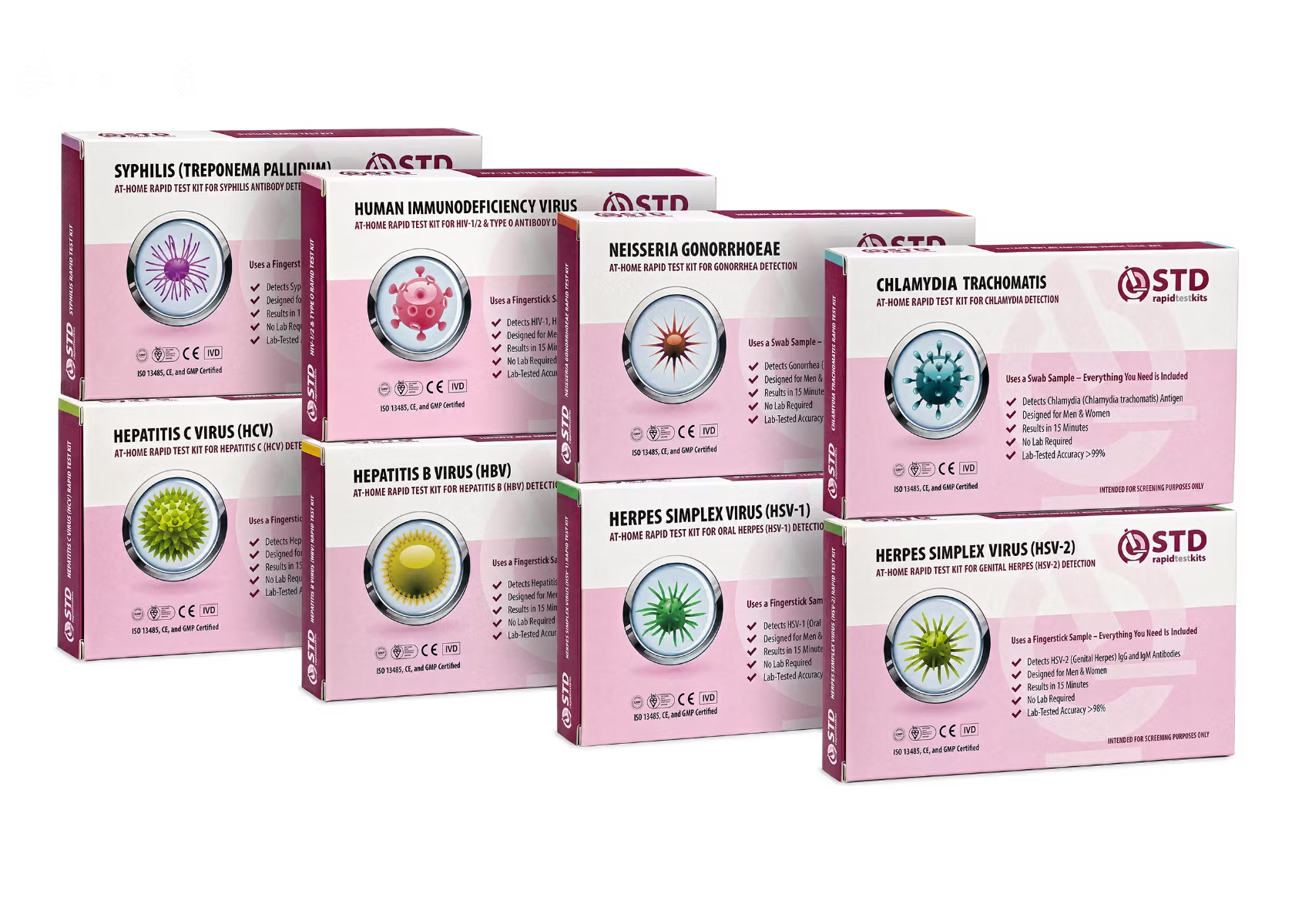
What at-home rapid testing covers, importantly, is everything that tends to travel alongside TMVII. The people most at risk right now are sexually active individuals with recent new partners, and that exact exposure history is the same situation that warrants a full STI screening. TMVII will not appear on a standard STI panel, but HIV, syphilis, gonorrhea, chlamydia, herpes, and hepatitis do, and co-infection rates among people diagnosed with one STI are consistently higher than in the general population. Catching a co-infection early changes outcomes meaningfully.
Timing your tests correctly matters. For HIV, the CDC's HIV testing guidance gives detection windows in days: antigen/antibody lab tests detect HIV from about 18 to 45 days after exposure (roughly 3 to 6 weeks), and standard antibody tests detect HIV from 23 to 90 days (about 3 to 13 weeks). In practical at-home terms, a negative result around the 6-week mark is a strong early indicator, and a confirmed negative at 12 to 13 weeks rules out HIV from that exposure. For syphilis, test from 6 weeks after exposure; the antibody response needs time, and testing earlier carries a genuine false-negative risk. Test for chlamydia from 14 days after exposure, and gonorrhea from 3 weeks after exposure. For herpes HSV-1 and HSV-2, test from 6 weeks after exposure. For hepatitis B, test from 6 weeks after exposure. For hepatitis C, test from 8 to 11 weeks; testing before 8 weeks carries real false-negative risk, and a negative result after 11 weeks is considered conclusive.
Disclosure: stdrapidtestkits.com sells at-home rapid test kits for several of the infections in the table below. The 8-in-1 panel covers the most relevant co-infection screen for the same exposure context that puts someone at risk for TMVII.
| Infection | Test From | Negative Result Means | Positive Result Means |
|---|---|---|---|
| HIV | 6 weeks (first indicator); retest at 12 to 13 weeks for certainty | Negative at 12 to 13 weeks rules out HIV from that exposure | Virus is present; connect with a healthcare provider immediately |
| Syphilis | 6 weeks after exposure | No syphilis detected; retest at 12 weeks if ongoing concern | Infection present; curable with prompt treatment |
| Chlamydia | 14 days after exposure | No chlamydia detected; retest if new exposure occurs | Bacterial infection present; treatable |
| Gonorrhea | 3 weeks after exposure | No gonorrhea detected from that exposure | Infection present; requires prompt treatment |
| Herpes HSV-1 & HSV-2 | 6 weeks after exposure | No herpes antibodies detected from that exposure | Antibodies detected; indicates current or past infection |
| Hepatitis B | 6 weeks after exposure | No infection detected; reliable given shorter incubation period | Active infection; requires medical follow-up |
| Hepatitis C | 8 to 11 weeks after exposure | Conclusive after 11 weeks | Infection present; now curable in most cases |
What To Do If You Think You Have TMVII
If a rash near your genitals, buttocks, inner thighs, or face appeared within days to a few weeks of a new sexual partner and has not cleared after two weeks of standard topical antifungal cream, see a sexual health clinic or dermatology provider. Do not apply corticosteroid cream, hydrocortisone, or any other steroid product. Corticosteroids worsen TMVII by suppressing the local immune response that is partially limiting the spread, and the rash may look temporarily calmer while the infection advances underneath.
While you have an active rash, avoid sexual contact and close skin-to-skin contact with others. Wash all clothing, towels, and bed linens on high heat. Do not share towels, razors, or sex toys. Notify recent sexual partners so they can be evaluated. TMVII can spread from an active rash even before it becomes painful enough to drive someone to seek care, and partners may be infected without realizing it. The Minnesota Department of Health advises that fungal spores can be killed with common disinfectants, including diluted bleach (about a quarter cup per gallon of water) or benzalkonium chloride applied to hard surfaces.
Treatment requires oral antifungal medication prescribed by a healthcare provider. The specific agent and course length depend on the severity of the infection and how it responds, but courses typically run from six weeks to three months. Completing the full course matters. Stopping treatment when the rash appears to clear risks relapse because fungal spores can remain viable in the skin even after visible symptoms resolve. There is no at-home test for TMVII itself. Evaluation and confirmation require in-person clinical assessment, skin scraping, fungal culture, and in some cases DNA sequencing at a laboratory. What you can do at home is test for the co-infections that consistently appear alongside TMVII in the same risk contexts, and do it at the right window so the results actually mean something.
Hydrocortisone and other corticosteroid creams suppress the local immune response that is helping contain TMVII. The rash can look calmer for a few days while the fungus spreads more aggressively under the skin. If your rash has not cleared after two weeks of standard antifungal cream, see a clinician for assessment before adding anything else.
Why TMVII Keeps Getting Missed: The Diagnostic Gap, Explained
The diagnostic gap around TMVII is not a failure of individual clinicians. It is a structural problem with how new infections enter the healthcare system. TMVII was first formally identified as a human pathogen circulating through sexual networks in Europe in the early 2020s, with the first US case documented in 2024. That means most practicing clinicians in the US trained and built their diagnostic instincts in a world where sexually transmitted fungal infections did not exist as a category. When a patient presents with a genital rash, a clinician's first mental list of possibilities (herpes, syphilis, molluscum, contact dermatitis, jock itch) does not include a fungal infection acquired through sex, because until very recently, that was not a category that existed.
Standard fungal cultures used in most clinical laboratories can detect that a Trichophyton species is present, but cannot identify TMVII specifically. Confirming the genotype requires advanced molecular testing, specifically DNA sequencing, which is only available at select reference laboratories and can take weeks to return results. This creates a situation where even a clinician who suspects TMVII cannot get fast confirmation, and must make treatment decisions based on clinical presentation and exposure history while waiting on laboratory results.
The surveillance gap compounds the diagnostic one. TMVII is not a nationally reportable infection in most US states, meaning there is no mandatory case-counting system tracking how broadly it has spread. The Minnesota cluster was identified because alert clinicians recognized an unusual pattern and proactively contacted the state health department, not because an automated surveillance system flagged it.
As of February 2026, the CDC recommends that providers begin treatment for TMVII based on symptoms and sexual history without waiting for genotype confirmation when the clinical picture is consistent. DNA sequencing to confirm genotype can take weeks at select reference laboratories, and waiting risks letting the infection spread further before therapy starts.
Why This Matters for Sexual Health More Broadly
TMVII's emergence in the US is not an isolated event. It is part of a broader pattern that public health officials have been tracking for years. Infectious diseases circulate globally through interconnected sexual networks, and dating apps have made it structurally easier for skin-contact pathogens to travel further and faster than historical STI patterns would have predicted. TMVII circulated in Europe for years before reaching the US, and the same pattern (European circulation among MSM, then spread through international sexual contact, then eventual domestic transmission) has been documented for other infections.
The lesson here is not panic. TMVII is treatable. It has not been associated with serious systemic illness in immunocompetent people, and the oral antifungal medications used to treat it appear effective based on the case data collected so far. The lesson is that a rash which does not respond to standard treatment is not something to keep self-managing with pharmacy products. Two weeks of topical antifungal cream with no improvement is the signal to seek clinical evaluation, not to try a different cream. Any new sexual contact is also a reasonable prompt to run a comprehensive at-home STI screen. TMVII itself will not show up on the panel, and that is fine; the value is in catching HIV, syphilis, gonorrhea, chlamydia, herpes, or hepatitis early enough to make a real difference for outcomes, partner notification, and your own peace of mind.
- TMVII has not been associated with serious systemic illness in immunocompetent people, and it is treatable with prescription oral antifungals.
- A rash that does not clear after two weeks of topical antifungal treatment is the signal to seek clinical evaluation, not to try a different cream.
- Comprehensive at-home STI testing after new sexual contact catches the co-infections that travel alongside TMVII; results in about 15 to 20 minutes.
Frequently asked questions
- What is TMVII?
- TMVII stands for Trichophyton mentagrophytes genotype VII, the first dermatophyte formally recognized as spreading primarily through sexual contact. It causes painful, coin-shaped ringworm rashes that can appear on the genitals, buttocks, face, inner thighs, and trunk, and it requires oral antifungal treatment to clear. It does not respond to the topical antifungal creams you can buy without a prescription.
- Why is TMVII in the news right now?
- In February 2026, the Minnesota Department of Health issued a statewide advisory about a cluster of TMVII cases in the Twin Cities metro area that some public-health outlets described as one of the largest known US clusters to date. Because TMVII is not a nationally reportable condition, exact comparisons across states are difficult. The Minnesota advisory was the latest in a series of clusters that started with New York City cases in 2024, and it prompted the CDC and state health departments to issue clinical advisories asking providers to watch for it.
- How does TMVII spread?
- Primarily through direct skin-to-skin contact with an active rash during sexual activity. Because the rash can appear anywhere on the body, including the face, abdomen, and legs, transmission is not limited to genital contact. The fungal spores also survive on shared towels, bed linens, clothing, razors, and sex toys, which means household transmission is possible without ongoing sexual contact if those items are not properly cleaned.
- Can jock itch cream fix TMVII?
- No. Standard over-the-counter antifungal creams that handle jock itch reliably do not work on TMVII. The infection requires oral antifungal medication prescribed by a healthcare provider, typically for anywhere from six weeks to three months. If a rash in or near the genital area has not improved after two weeks of topical treatment, that is your signal to see a clinician, not to try a different cream.
- Can the wrong treatment make TMVII worse?
- Yes, and this is one of the most important points about TMVII. Corticosteroid creams (like hydrocortisone), commonly used for eczema and skin inflammation, suppress the local immune response that helps contain the fungus. Applying a corticosteroid to a TMVII rash can make it look temporarily calmer while allowing the infection to spread more aggressively underneath. Do not use steroid creams on a genital or perianal rash until TMVII has been ruled out.
- Who is most at risk of TMVII right now?
- The Minnesota Department of Health currently lists men who have sex with men, people who use anonymous dating apps, and people with a history of previous STIs as the highest-risk groups in the current outbreak. Infectious disease experts from Duke Global Health Institute have been clear that anyone can contract TMVII through skin contact with an active rash. The current concentration in MSM networks reflects where the infection entered the US and how those networks are structured, not any biological predisposition.
- Is there an at-home test for TMVII?
- No, TMVII requires in-person clinical evaluation: a skin scraping, microscopy, fungal culture, and in many cases DNA sequencing at a reference lab to confirm the genotype. There is no rapid at-home test for TMVII. However, at-home rapid tests do exist for the STIs that commonly co-occur in the same exposure contexts as TMVII, including HIV, syphilis, chlamydia, gonorrhea, herpes, hepatitis B, and hepatitis C, and getting those tests at the right timing window is genuinely useful.
- What STI tests should I get if I was in the same risk situation as TMVII exposure?
- Start with the shortest detection windows first. Chlamydia is detectable from 14 days post-exposure, gonorrhea from 3 weeks. Syphilis, herpes (HSV-1 and HSV-2), and hepatitis B are detectable from 6 weeks. For HIV, the CDC's guidance is that antigen/antibody lab tests detect HIV from 18 to 45 days (about 3 to 6 weeks) and antibody tests detect HIV from 23 to 90 days (about 3 to 13 weeks); a confirmed negative at 12 to 13 weeks rules out HIV from that exposure. Hepatitis C needs 8 to 11 weeks; a negative result after 11 weeks is considered conclusive. TMVII itself is not covered by any at-home rapid test; in-person clinical evaluation is required to diagnose it.
Our article was constructed based on current advice from the most prominent public health and medical organizations, and then molded into simple language based on the situations that people actually experience, such as treatment, reinfection by a partner, no-symptom exposure, and the uncomfortable question of whether it came back. In the background, our pool of research included more diverse public health advice, clinical advice, and medical references, but the following are the most pertinent and useful for readers who want to verify our claims for themselves.
- Center for Infectious Disease Research and Policy (CIDRAP), University of Minnesota: Minnesota Health Officials Warn of Sexually Transmitted Fungal Infection Outbreak, February 2026. CIDRAP reporting on the February 11, 2026 MDH advisory; the source notes that it is unclear whether the Minnesota cluster is the largest known US outbreak because TMVII is not a reportable infection and surveillance data varies across jurisdictions.
- U.S. Centers for Disease Control and Prevention, Emerging Infectious Diseases journal: Emerging Sexual Transmission of Trichophyton mentagrophytes Genotype VII Infections, United States, 2025. Source for the clinician-survey statistic on diagnostic familiarity (117 polled clinicians, minority experienced) and the US case timeline.
- U.S. Centers for Disease Control and Prevention, Clinician Brief: Emerging Ringworm. Source for the TMVII transmission profile, clinical recognition guidance, and the dermatophyte-most-closely-associated-with-sexual-transmission framing.
- U.S. Centers for Disease Control and Prevention: Emerging Types of Ringworm. Background on emerging dermatophyte strains in the United States, including TMVII and Trichophyton indotineae.
- Duke Global Health Institute: A New STI Is Spreading in the US, What You Should Know, 2026. Source for risk-group framing, clinical commentary, and the public-health interpretation of the current outbreak pattern.
- U.S. Centers for Disease Control and Prevention: HIV Testing. Source for HIV detection windows used in this article; the CDC page presents windows in days (antigen/antibody lab tests detect HIV from 18 to 45 days post-exposure; antibody tests from 23 to 90 days). Week conversions in the article body are reader-friendly translations of these CDC day-ranges.
- U.S. Centers for Disease Control and Prevention: About Chlamydia. Background reference on chlamydia clinical course; the CDC page notes that symptoms 'may not appear until several weeks after' exposure. Specific 14-day at-home rapid test windows used in this article reflect standard clinical at-home rapid test guidance rather than a direct CDC figure.
- U.S. Centers for Disease Control and Prevention: About Hepatitis C. Background reference for HCV; the CDC page states that symptoms, when they occur, appear 2 to 12 weeks after infection. The 8 to 11 week at-home rapid testing window used in this article reflects standard antibody-seroconversion timing for HCV.
