
Published: September 2025 | Last updated: April 2026 | Editorial review and quality control: Martina N.
Home STD testing is one of the most-searched sexual health topics in the U.S., and the reasons are practical: clinic visits take time, sometimes feel intimidating, and aren't always private. A test kit that arrives in plain packaging, runs on your bathroom counter, and costs less than a typical co-pay is an obvious alternative. Before you click 'add to cart', the questions worth answering are simpler than they sound: how accurate are these tests really, what infections do they catch, and how soon after exposure can you trust the result?
Can I really test for STDs at home and trust the result?
Yes. Quality rapid home STD tests typically report 97 to 99.7 percent sensitivity and specificity depending on the infection (per the per-infection data published on each <a href="https://www.stdrapidtestkits.com/" target="_blank" rel="noopener">product page</a>), using the same lateral-flow chemistry that runs in many clinics. The single most important factor is timing: test after the correct window period for that specific infection (14 days for chlamydia, around 6 weeks for a first read on HIV antibody with a confirmatory retest at 90 days, 8 to 11 weeks for hepatitis C). Testing earlier than the window can produce a false negative even when infection is present. A positive result on any home test should be confirmed with a clinic-grade follow-up before treatment.
Key takeaways
- Quality home rapid STD tests are accurate when used correctly, typically 97 to 99.7 percent depending on the infection (per published per-infection data on each product page).
- Timing matters more than technique. Testing inside the window period (e.g., before day 14 for chlamydia, before 90 days for a conclusive HIV antibody result) is the most common cause of a false negative.
What Is a Home STD Test and How Does It Work?
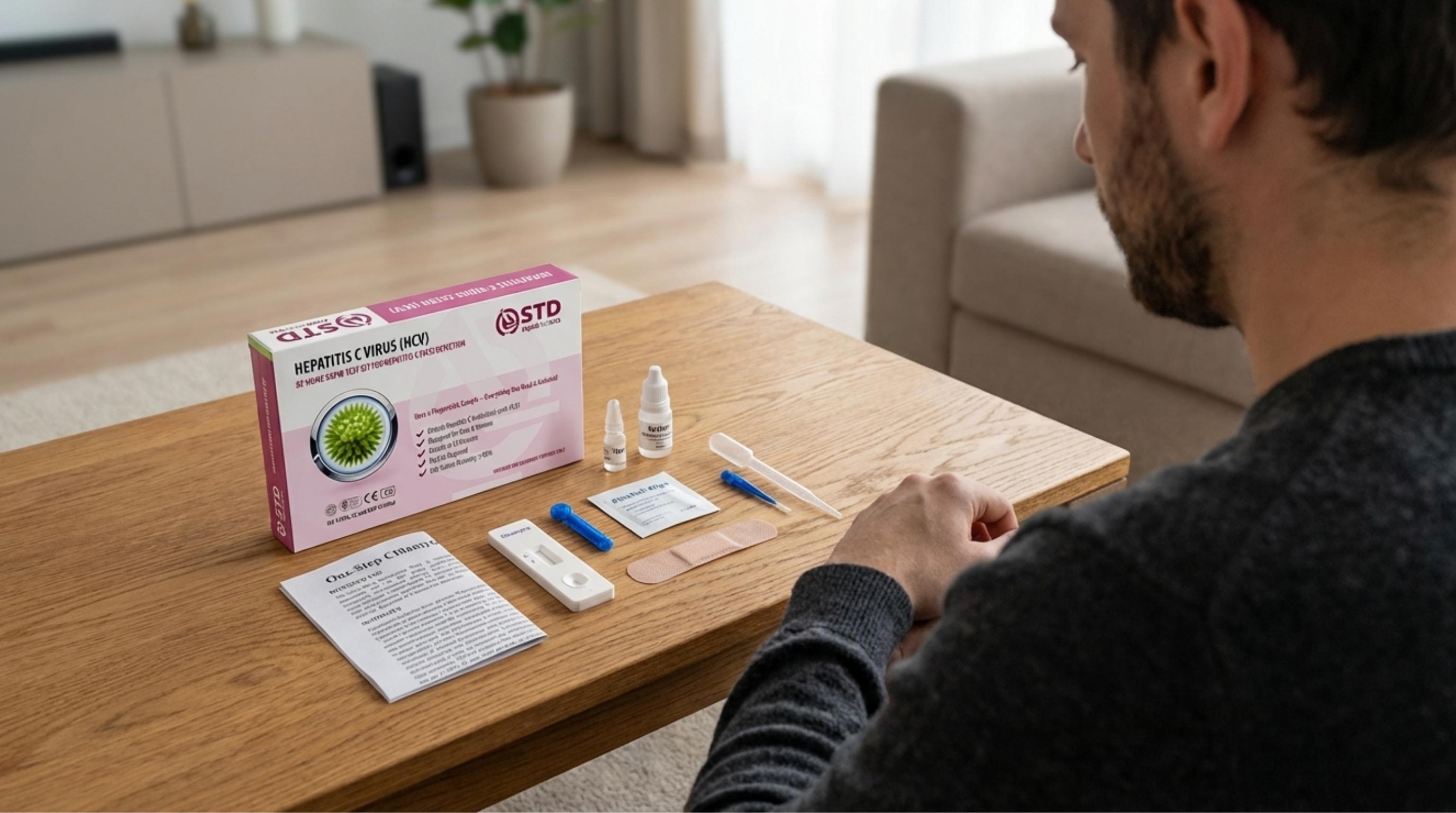
A home STD test is exactly what it sounds like: a kit you use yourself, in private, without a healthcare provider in the room. You collect a small sample (a fingerstick blood drop, a urine specimen, or a self-collected swab depending on the infection), follow the instructions on the cassette, and either read the result yourself within 15 to 20 minutes or mail the sample to a certified lab and wait several days for an online result.
The most useful distinction is between rapid at-home tests and mail-in lab panels. Rapid tests, like the lateral-flow cassettes available at STDRapidTestKits.com, give you an answer in your hands within about a quarter of an hour. There's no courier, no lab queue, no follow-up email. The trade-off is that you read the cassette yourself rather than having a trained technician interpret it. (Disclosure: the rapid kits referenced throughout this article are sold by STDRapidTestKits.com, the publisher of this site. Recommendations reflect fit-for-purpose for the reader's concern, not commercial benefit.) Mail-in tests ship samples to a certified laboratory; turnaround is usually three to seven days, panels can be broader, and the readout is performed by lab equipment. Both approaches have value; they serve different situations.
For most people testing after a specific possible exposure, or maintaining routine sexual-health screening, a high-quality rapid kit covers the ground that matters. The thing to look for is documented per-infection accuracy data and a clear sample-collection guide; a vague 'FDA-cleared' badge on the box doesn't tell you much by itself.
| Feature | Rapid Home Test | Mail-In Lab Test |
|---|---|---|
| Result time | 15 to 20 minutes | 3 to 7 days |
| Where the result is read | At home, by you | Certified lab, online portal |
| Sample types | Fingerstick blood, urine, swab | Urine, swab, blood |
| Coverage | Single-infection or combo panels | Broader multi-panel options |
| Best for | Fast answers after a specific exposure | Routine screening, complex panels |
| Privacy level | Highest, no third party reads result | High, discreet packaging, secure portal |
Which STDs Can You Actually Test for at Home?
The list has expanded a lot in the last decade. You no longer need a clinic visit for HIV, chlamydia, gonorrhea, syphilis, herpes (HSV-1 and HSV-2), hepatitis B, hepatitis C, HPV, or trichomoniasis. That covers the overwhelming majority of STIs that affect adults in the United States. The CDC's 2022 national STI surveillance reporting tracked more than 2 million combined cases of chlamydia, gonorrhea, and syphilis, and most chlamydia cases produce no obvious symptoms (CDC STI Surveillance). For someone who's symptom-free, running a test is the only way to learn their status.
Single-infection kits make sense when you have a specific exposure in mind. A partner discloses a positive chlamydia test and that's the one thing you need to check. Combo kits make sense for routine screening because many STIs travel together. Chlamydia and gonorrhea share transmission routes and often share a body; testing for one without the other leaves the other invisible. The same logic applies to the bloodborne panel. HIV, hepatitis B, and hepatitis C share several transmission pathways, so screening them as a set is more informative than running just one.
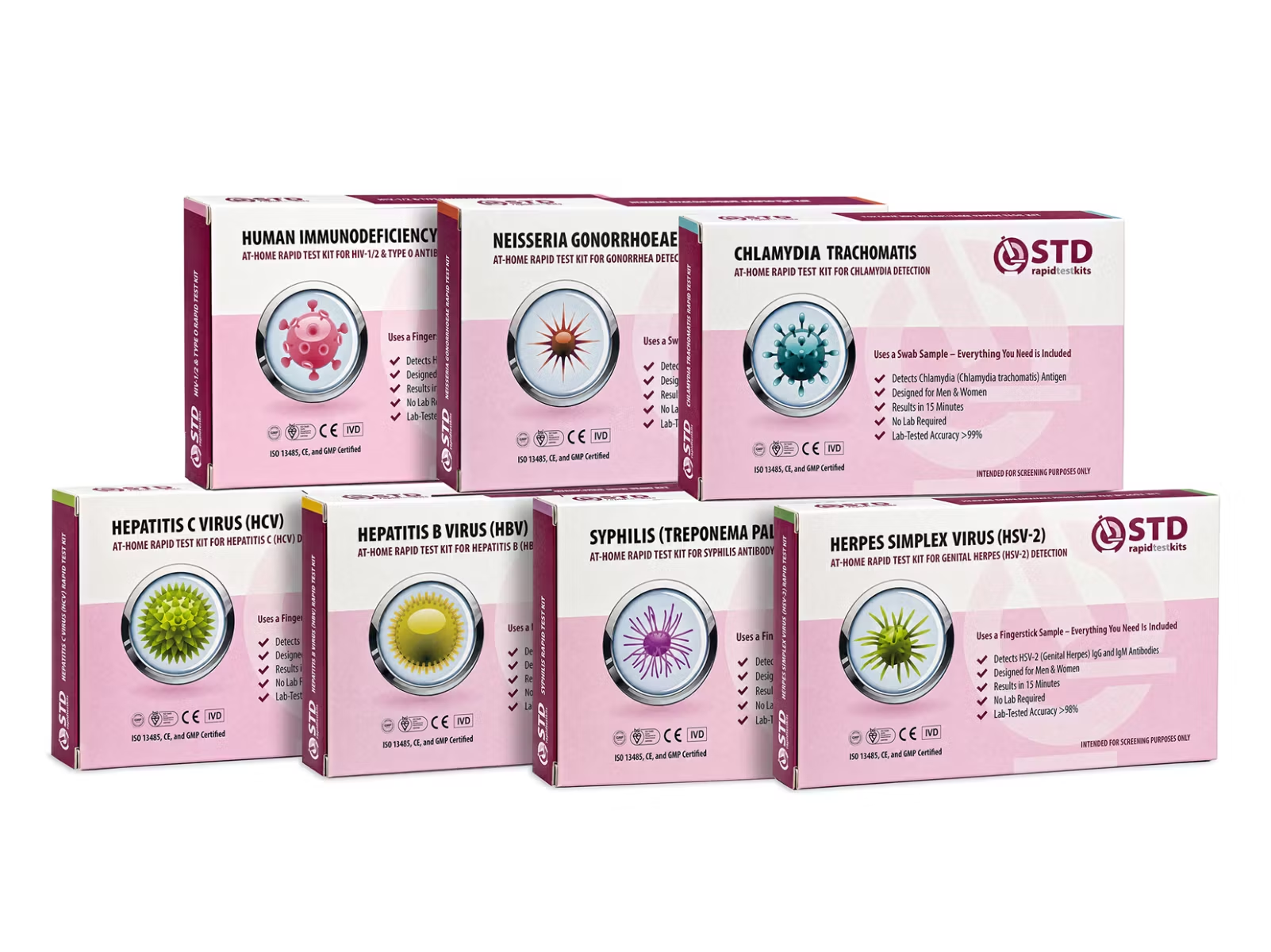
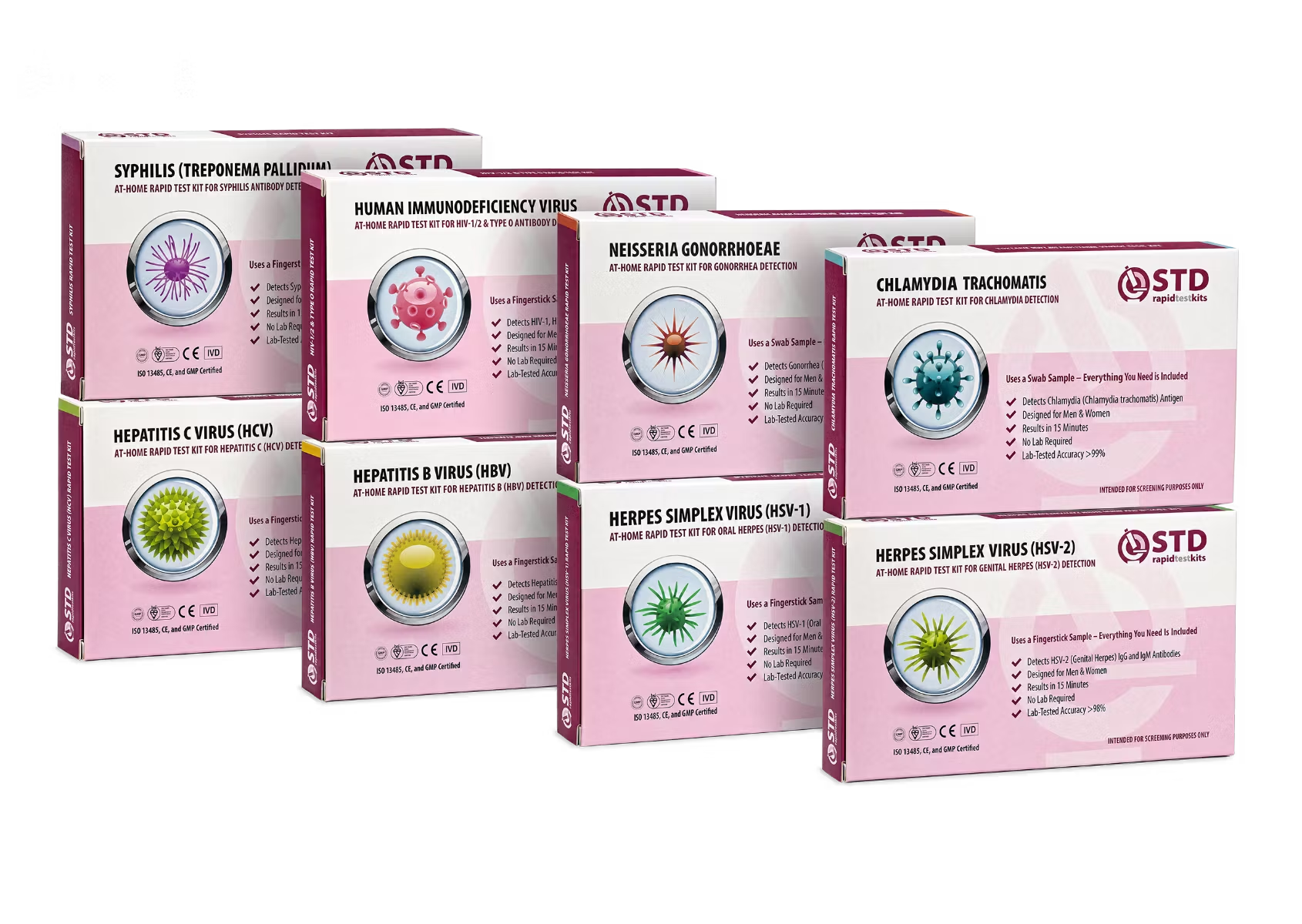
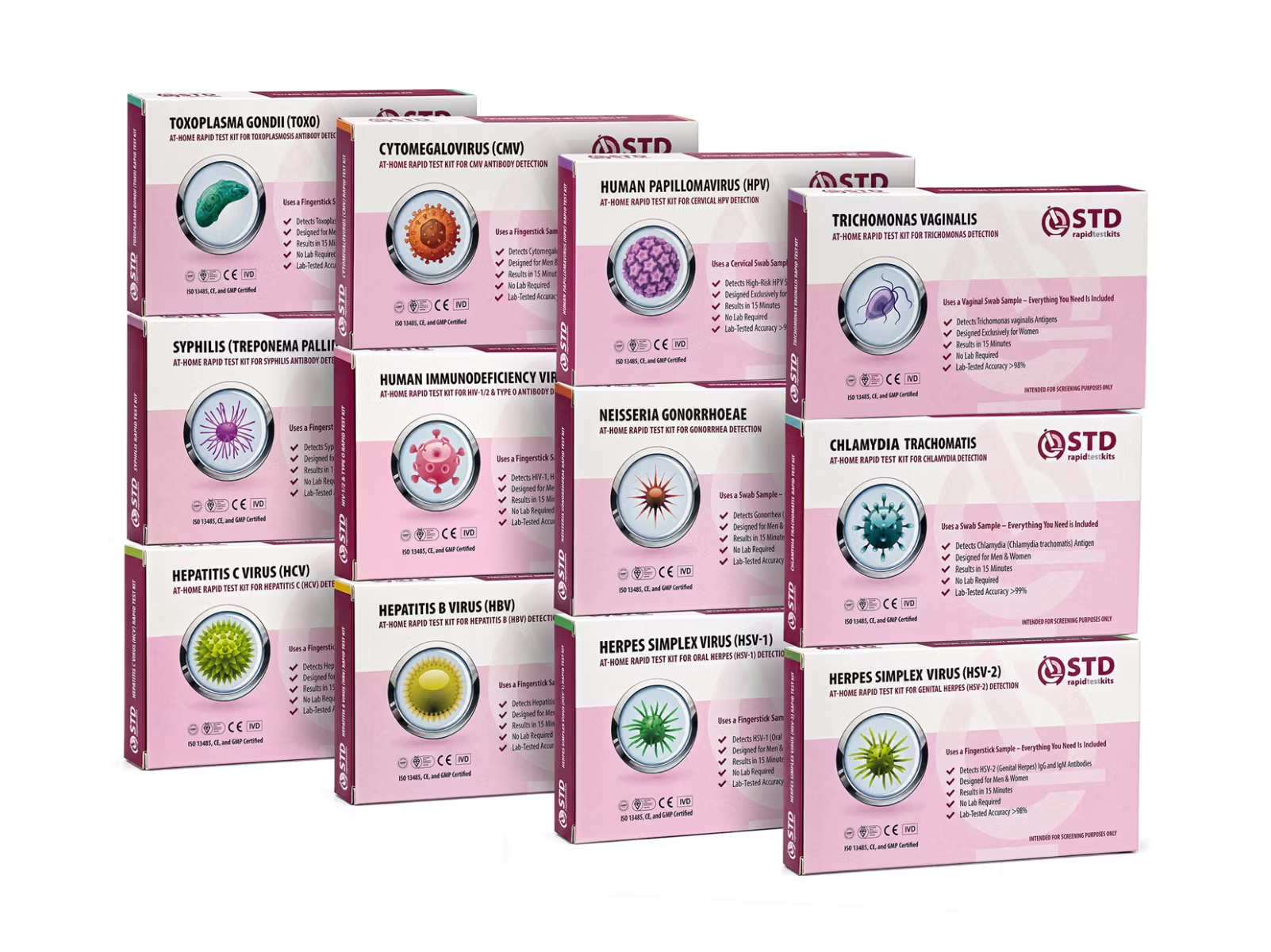
For comprehensive coverage in a single sitting, multi-panel kits are the practical choice. The 7-in-1 Complete At-Home Rapid Test Kit covers HSV-2, chlamydia, gonorrhea, syphilis, HIV, hepatitis B, and hepatitis C. The 8-in-1 Kit adds HSV-1 for full herpes coverage. The Women's 10-in-1 Kit adds trichomoniasis and HPV (validated for vaginal self-swab only; men needing a trichomoniasis or HPV test should see a clinic, since we don't sell a male-compatible version of either kit).
One honest limit on the technology itself: home rapid kits are lateral-flow immunoassays. They are excellent screening tools, and their chemistry is the same as the rapid tests used in many clinic settings. They are not, however, the same technology as a laboratory NAAT (nucleic-acid amplification test), which has slightly higher analytical sensitivity in asymptomatic infection. The two are complementary. A positive at home is information worth confirming with a NAAT before treatment; a negative at home, taken at the right time, is reliable for most people.
How Accurate Are Home STD Tests Really?
This is the question that matters, and the honest version of the answer takes a paragraph, not a single percentage. Quality rapid home STD test kits report sensitivity and specificity figures between roughly 97 and 99.7 percent depending on the specific infection. Those numbers reflect the underlying lateral-flow immunoassay chemistry, which performs the same way on a kitchen counter as it does in a clinic so long as the sample is collected correctly. They are not marketing language; they map to per-infection performance data the manufacturer publishes for each test in the panel.
'Accuracy' by itself is a vague word, and two more precise terms are worth knowing. Sensitivity is the test's ability to correctly identify an infection that's present (high sensitivity means few false negatives). Specificity is the test's ability to correctly rule out an infection that isn't present (high specificity means few false positives). For example, the syphilis rapid test sold here reports 99.4 percent overall accuracy on its product page, which means the cassette correctly classifies the great majority of samples it sees. When a kit publishes a single 'accuracy' figure like that, it is generally a blended summary of sensitivity and specificity; if you want the cleaner read on false-negative versus false-positive risk, ask for the per-infection breakdown.
The two real-world risks to home-test accuracy aren't the chemistry. They are poor sample collection and testing inside the window period. A blood test that uses too little blood, or a swab that doesn't reach the right tissue, produces unreliable results regardless of how good the cassette is. Read the instructions in full before opening anything. Most user errors happen when people skim and assume the process is more intuitive than it is. It isn't complicated, but it does want your attention for ten minutes.
The window-period section below is where most false negatives originate.
Most home-test users who get a false negative didn't have a defective kit. They tested too early. Antibody-based tests need time after exposure for your immune system to produce enough antibody to register, and antigen tests need enough viral or bacterial protein in the sample. The window-period table below is the practical reference. Respect it and the published accuracy figures hold for your sample as well.
When Should You Test? The Window Period Matters More Than Anything
The window period is the gap between possible exposure and the point where a test can reliably detect the infection. Every STI has one. It exists because the test is measuring either the pathogen itself (or a piece of it) or your immune response to it, and both take time to reach detectable levels in your blood, urine, or swab sample. Testing inside the window doesn't mean you're fine; it means the chemistry hasn't had enough material to work with yet. This single fact is the most common reason a home test produces a false negative.
You're three days out from a possible exposure, lying awake running through every worst case. The pull to test now is completely understandable. For most STIs, though, a test that early returns nothing useful. Knowing the window for the specific infection you're worried about is the difference between a result you can trust and one that gives you false reassurance. The CDC publishes window-period guidance for clinic-administered tests, and home rapid tests use the same biology and similar windows (CDC HIV testing window guidance).
| Infection | Test from | Notes |
|---|---|---|
| Chlamydia | 14 days after exposure | Often symptom-free; one of the most common bacterial STIs in the U.S. |
| Gonorrhea | 1 to 3 weeks after exposure | Symptoms can appear sooner, but reliable detection takes a couple of weeks. |
| Syphilis | 3 to 6 weeks after exposure | Primary chancre may appear earlier than antibody seroconversion. |
| HIV (rapid antibody) | 23 days for first possible signal; retest at 90 days for a definitive negative | CDC states the antibody window runs to 90 days; a negative before that is encouraging, not conclusive. |
| Herpes HSV-1 and HSV-2 antibody | 6 to 12 weeks after exposure | Antibody seroconversion takes time regardless of whether symptoms appear. |
| Hepatitis B (HBsAg) | 3 to 6 weeks after exposure | Surface antigen typically becomes detectable within this window. |
| Hepatitis C (antibody) | 8 to 11 weeks after exposure | Longer window; retest at 6 months if initial result is negative with a high-risk exposure. |
How to Use a Rapid Home STD Test, Step by Step
Rapid home STD testing is intentionally simple. The process generally takes ten to twenty minutes from start to result, and the hands-on time is less than five. The instructions in your specific kit override anything generic; what follows is the typical pattern for the lateral-flow tests sold by reputable U.S. retailers.
Start by checking the expiration date on the cassette. An expired test can produce unreliable lines regardless of technique. Wash your hands. Lay out everything in the kit (cassette, lancet or swab, buffer solution, dropper, and the timing card or app) before opening the cassette pouch. Having every component in reach prevents the mid-process scramble that's a frequent cause of contamination.
Sample collection is the most important step, and it varies by test type. Fingerstick blood: pierce the side of a fingertip rather than the pad, and apply the specified number of blood drops to the well on the cassette. Squeeze gently from the base of the finger toward the tip. Urine: collect midstream urine in the provided cup and transfer the specified volume with the dropper. Self-swab: follow the depth and rotation instructions exactly. A swab that grazes the surface won't collect adequate cellular material, and that's the single most common cause of an invalid result on swab tests.
Add buffer as instructed, then start the timer. Most rapid cassettes call for a 15 to 20 minute read window. Reading too early can miss a faint developing line; reading too late can produce evaporation artifacts that look like positives. Read inside the window stated on the instruction sheet.
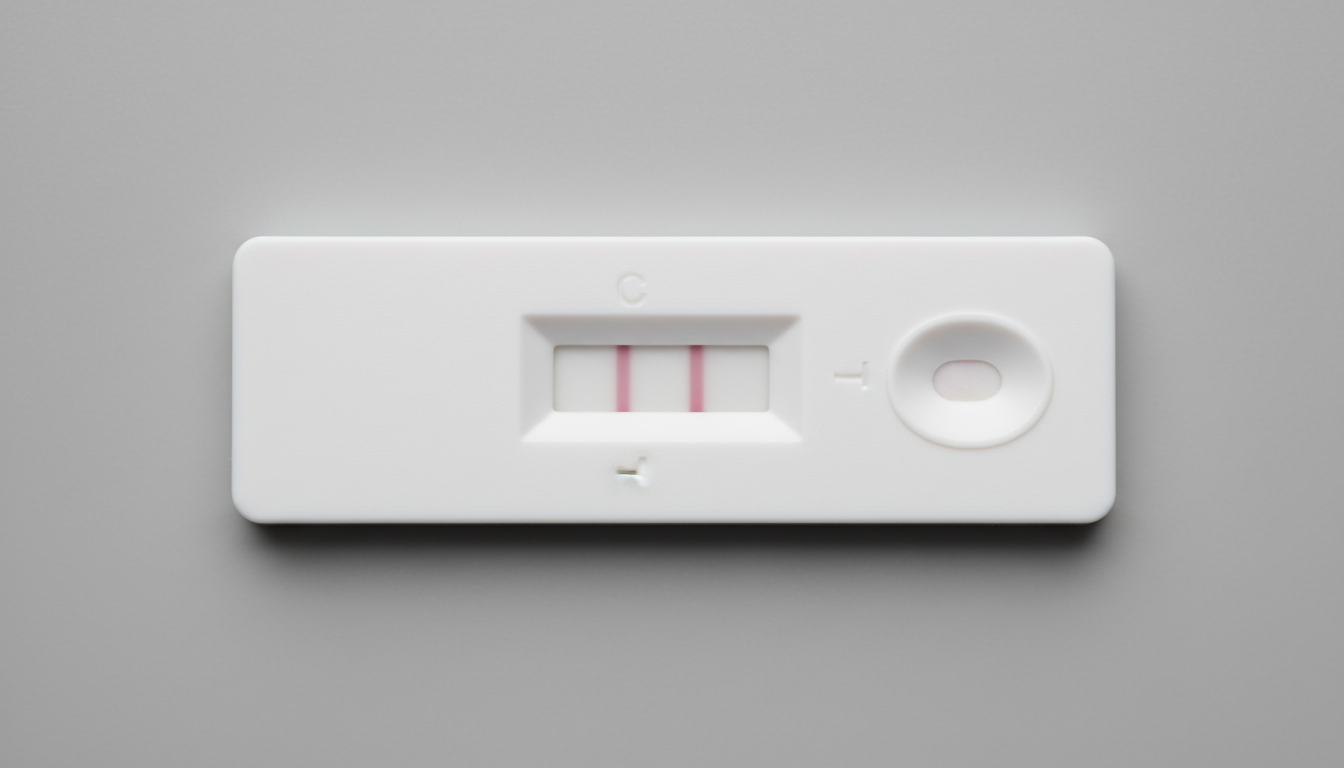
The line logic is the same across nearly all rapid immunoassay cassettes: one line in the control band only means negative. Two lines, including a faint second line, means positive. No control line means the test was invalid and should be repeated with a fresh cassette. A faint second line is still a line; rapid tests are designed so that any visible test-band signal indicates antibody or antigen detection.
Which Home Test Kit Fits Your Situation?
The right kit depends on why you're testing.
You had a specific exposure and want to check the most likely infections from that encounter. Targeted combo kits cover this efficiently. The Chlamydia & Gonorrhea 2-in-1 covers the two most common bacterial STIs, both transmitted the same way and both often symptom-free. The 3-in-1 adds syphilis, which has been rising sharply in the U.S. for several years.
You want a full baseline. Maybe you haven't tested recently, you've had multiple partners, or you're entering a new relationship and you and your partner agreed to clear the air with a test before unprotected sex. The 7-in-1 Complete At-Home Kit covers chlamydia, gonorrhea, syphilis, HIV, hepatitis B, hepatitis C, and HSV-2. The 8-in-1 Kit adds HSV-1 (the form usually associated with oral herpes) for complete herpes coverage.
You're female and want the most comprehensive panel available. The Women's 10-in-1 Kit adds trichomoniasis and HPV (vaginal self-swab; high-risk strains 16 and 18) on top of the 8-in-1 panel. Trichomoniasis is one of the most common curable STIs worldwide, and it's frequently asymptomatic, so it's easy to miss without explicit testing.
Whatever kit you choose, look for per-infection accuracy data, not a single blanket 'accuracy' number. Reputable manufacturers publish sensitivity and specificity for each individual test in a panel because the data is real and the differences between infections matter.
What Your Results Mean: Positive, Negative, or Invalid
A negative result, taken at the correct time after exposure, means the test found no detectable evidence of that specific infection in your sample. That's a real result, not a hedge. What it doesn't mean is 'I'm clear of every STI' or 'I never have to test again'. A negative is a snapshot of your status at that moment, for the infections in that specific kit. It doesn't cover anything outside the panel, and it doesn't predict the future.
A positive result means the test detected the infection. It is not a verdict. The vast majority of STIs covered by rapid home kits are either curable (chlamydia, gonorrhea, syphilis, trichomoniasis) or highly manageable with modern treatment (HIV, herpes, hepatitis B, hepatitis C). A positive at home is information that lets you act. The next step is to follow up with a clinic for confirmatory testing before treatment begins. For HIV and syphilis especially, a confirmatory clinic test using a different method is standard practice; rapid antibody false positives, while rare, do happen, and treatment decisions should be made on a confirmed result.
An invalid result, the case where no control line appears, almost always points to a sample-collection issue: too little blood, contaminated buffer, or a swab that didn't make adequate contact. An invalid reading means the chemistry didn't run; it isn't a positive or negative finding. Repeat with a fresh cassette, paying extra attention to the sample step, and the second run almost always produces a clean read.
Don't start treatment from a home test alone. Confirm with a clinic-grade test, especially for HIV and syphilis where confirmation using a different testing method is standard practice. Confirmation reflects normal screening protocol for any antibody-based result; it adds a second data point before treatment commitment, not a vote of no confidence in the home cassette.
Home Testing vs Clinic Testing: Where Each Wins
For the infections covered by quality rapid home kits, the accuracy gap between home and clinic testing is small when the home test is used correctly. Self-collected vaginal swabs for chlamydia and gonorrhea consistently produce results comparable to clinician-collected swabs in published comparison studies. Fingerstick blood rapid tests for HIV achieve sensitivity above 99 percent after the window period, the same range as clinic-administered rapid antibody testing.
Where clinics have a clear edge is in sample quality. A trained clinician collecting a swab is going to collect an adequate sample almost every time. At home, there's a small but real risk of inadequate self-collection, which is the main reason quality kits use the most forgiving sample type for each infection (fingerstick blood for HIV, syphilis, and the hepatitis tests; self-collected swab for chlamydia and gonorrhea, vaginal for women and penile/urethral for men; and vaginal self-swab only for trichomoniasis and HPV).
Clinics also offer immediate counseling, partner-notification support, and on-site treatment. None of those things travel in a test kit. For someone who tests positive at home, the path forward involves a clinic visit anyway. What home testing changes is the first step: you find out your status privately, on your own schedule, without explaining yourself in a waiting room or asking a provider who may or may not take your concern seriously. Home testing doesn't replace healthcare. It gives you a faster first answer, and a positive result still routes you back to a clinic for confirmation and any treatment that follows.
Many sexually transmitted infections cause no symptoms, so testing is the only way to know your status. Routine testing is recommended for all sexually active adults.
Frequently asked questions
- Are home STD tests as accurate as clinic tests?
- For the infections covered by quality rapid home kits, the accuracy is comparable to clinic-based rapid testing. Sensitivity and specificity for the lateral-flow chemistry typically run between 97 and 99.7 percent depending on the infection, and self-collected samples for chlamydia and gonorrhea perform on par with clinician-collected samples in published studies. The main caveats are sample-collection technique and respecting the window period after exposure.
- How soon after sex can I test for STDs at home?
- It depends on the infection, and HIV is usually the most anxiety-producing question, so start there: give a rapid HIV antibody test 90 days for a definitive negative, with a first read possible from around day 23 onward. For chlamydia, 14 days is enough. For hepatitis C, wait 8 to 11 weeks. The body table above lists the rest (gonorrhea, syphilis, herpes, hepatitis B). Testing earlier than the window can produce a false negative even when infection is present.
- What happens if I test positive on a home STD test?
- A positive result means the test detected that infection in your sample. The next step is to follow up with a healthcare provider for confirmation testing, especially for HIV and syphilis where a confirmatory test using a different method is standard practice before treatment begins. Most STIs detected by rapid home kits are curable or highly manageable with treatment, so a positive result is information that leads to resolution.
- Can I test for every STD with one home kit?
- Combo kits cover a wide range. The 7-in-1 and 8-in-1 kits cover the most medically significant bloodborne and bacterial infections. The Women's 10-in-1 kit adds trichomoniasis and HPV. No single kit tests for every possible STI; some infections (mycoplasma genitalium, pubic lice, certain non-genital infections) need different testing approaches. If you have a specific concern not covered by standard panels, ask a clinic about targeted testing.
- What does a faint line on a rapid STD test mean?
- A faint second line is still a positive result. Rapid immunoassay cassettes are designed so that any visible test-band signal indicates antibody or antigen detection. The intensity of the line doesn't correlate with how much pathogen is present or how severe the infection is. If you see two lines, treat the result as positive and follow up with a confirmatory clinic test.
- Can I get a false negative on a home STD test?
- Yes, but mostly in two situations: testing before the window period has passed, or significant user error in sample collection. A test taken at the correct time after exposure with a properly collected sample has a very low false-negative rate, generally under 3 percent for most infections covered by quality rapid kits. If you test negative but still have symptoms or ongoing exposure risk, retesting after the window or visiting a clinic makes sense.
- Do I need a prescription for a home STD test?
- No. Home STD test kits are over-the-counter products in the U.S. They can be ordered online, ship in plain packaging, and don't require an appointment, referral, or insurance claim. The privacy is one of the main reasons home testing has grown so quickly.
- How often should I test if I'm sexually active?
- The CDC recommends annual STI screening for all sexually active adults, with more frequent testing (every 3 to 6 months) for people with multiple partners, men who have sex with men, or anyone with higher exposure risk. If you're entering a new sexually exclusive relationship, testing before unprotected sex gives both partners a clear baseline. Routine testing isn't a sign that something is wrong; it's a normal part of taking care of your health.
- U.S. Centers for Disease Control and Prevention. National STI surveillance data, including reported cases of chlamydia, gonorrhea, and syphilis.
- U.S. Centers for Disease Control and Prevention. STI hub covering testing, screening, and prevention guidance for U.S. adults.
- U.S. Centers for Disease Control and Prevention. HIV testing guidance, including the 23 to 90 day antibody window for rapid antibody and antigen-antibody tests.
- World Health Organization. Global fact sheet on sexually transmitted infections, prevalence, and testing.
- U.K. National Health Service. Overview of sexually transmitted infections, symptoms, testing, and treatment options.
- American Sexual Health Association. Consumer guide to at-home STI testing options and what to expect.
