Published: July 2025 | Last updated: May 2026 | Editorial review and quality control: Martina N.
Can testicle pain after sex be an STD?
Sometimes. Chlamydia and gonorrhea are the most common STIs behind testicle pain in men, usually a one-sided ache that builds over a few days from epididymitis. Most post-sex discomfort, though, is mechanical and fades within hours. Sudden, severe pain is an emergency. Swab-test about 14 days after the exposure you are worried about.
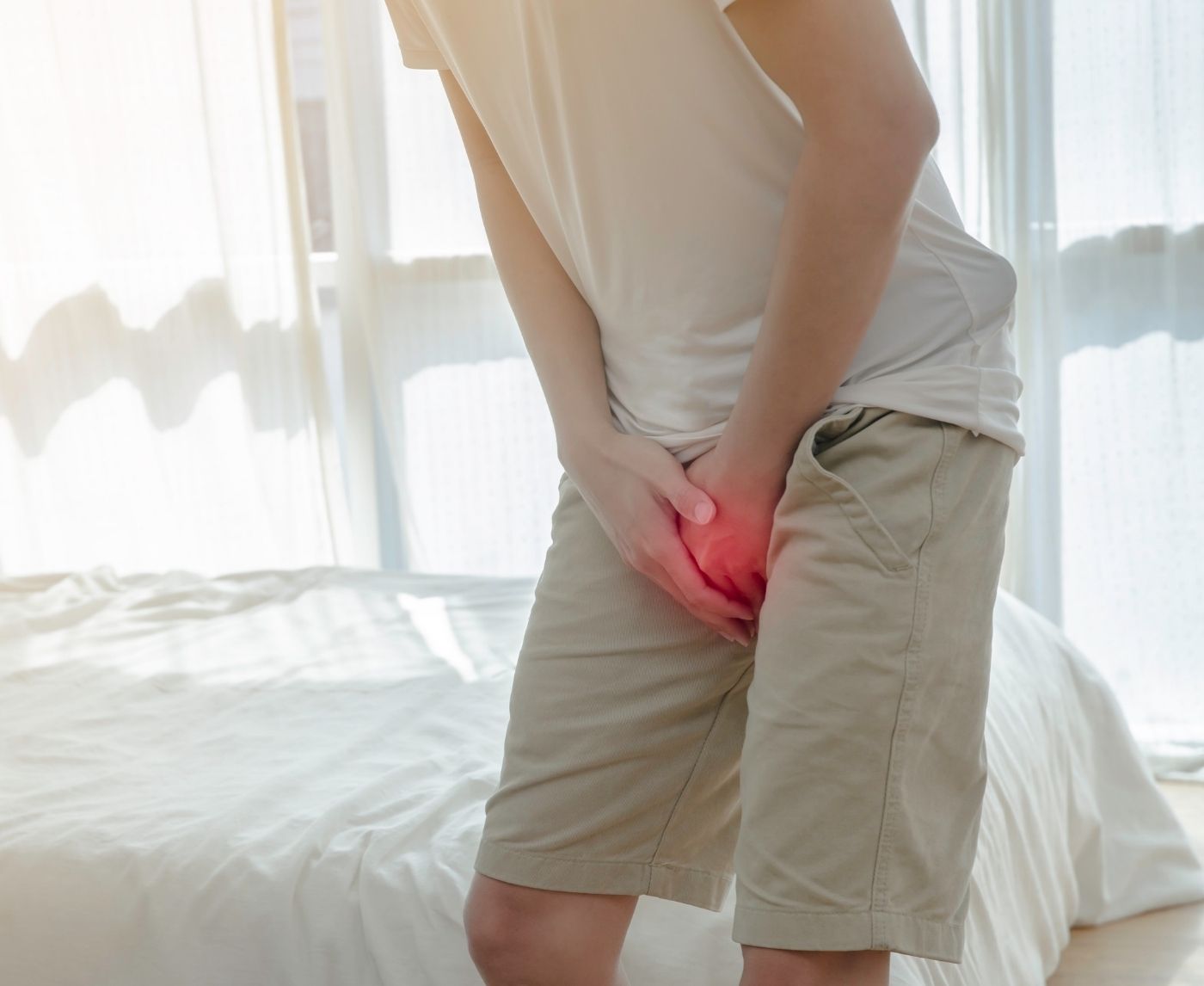
Testicular pain after sex is something a lot of men quietly type into a search bar before deciding whether to mention it to anyone. The pain might be a dull ache that lingers for an hour, a sharp pulse on one side, or a heaviness that spreads into the groin. The useful first question is what kind of pain it is, how long it lasts, and whether anything else is happening alongside it: discharge, burning during urination, scrotal swelling, or fever.
Most post-sex testicular discomfort is short-lived and mechanical. It comes from prolonged arousal without ejaculation, pelvic-floor tension, or simple physical strain. A real share of cases, especially in sexually active men under 35, is caused by infections that started in the urethra and traveled backward into the epididymis. The clinical name for that inflammation is epididymitis, and chlamydia and gonorrhea cause most of the sexually transmitted versions, per the CDC's STI treatment guidelines.
This guide walks through what is normal, what warrants testing, when testicle pain is an actual emergency, how the timing of any test affects whether the result is reliable, and how to handle a positive result with a partner.
If your pain is mild, started during a long session of arousal without finishing, and is already easing as you read this, that is the most common reason for post-sex testicular discomfort. It is uncomfortable, not dangerous. The rest of this guide is here for the cases where the pain lingers, returns after every encounter, or comes with other symptoms.
Key Takeaways
- Testicular pain that lasts more than a couple of hours after sex, returns after every encounter, or comes with discharge, burning urination, or scrotal swelling is the clearest reason to test for chlamydia and gonorrhea.
- Sudden severe testicle pain that comes on without warning is a medical emergency. Testicular torsion needs surgery within roughly six hours to save the testicle, so go to the ER and do not wait for any test result.
When the pain is mechanical, not infectious
The most common reasons your testicles can ache after sex have nothing to do with infection. Prolonged arousal without ejaculation creates pressure inside the testicles and the surrounding venous system. Doctors call this epididymal hypertension, and most people call it blue balls. The pain is usually dull, generalized, and felt on both sides. It tends to fade within an hour or two on its own.
Pelvic-floor tension can also refer pain into the testicles. The muscles of the pelvic floor sit just behind the perineum and they share innervation with the scrotum. When those muscles spasm during or after climax, the pain can radiate down. Trauma during intercourse, including direct impact, hard friction, or unusually vigorous sex, can also cause short-lived testicular soreness that resolves with rest.
Muscle and tendon strain from energetic sex is more common than it sounds. The cremaster muscle (which raises and lowers the testicles), the iliopsoas, the adductors, and the lower abdominal wall can all get pulled during intense activity. The pain often refers into the groin and the upper testicle. It is usually one-sided, follows a specific movement, and improves with rest, ice, and time.
Mechanical pain is short-lived (usually under a few hours), felt on both sides, dull, and tied to the activity that caused it. It improves with rest and does not return on its own. Infection-driven pain tends to persist, escalate over a day or two, and arrive with company: penile discharge, burning urination, or scrotal warmth and swelling. The pattern, more than the location, is what separates them.
Epididymitis is the most common STD-linked cause
The epididymis is the tightly coiled tube that sits behind each testicle. It is about six meters long when uncoiled, packed against the back of the testicle, and it stores and matures sperm before they leave through the vas deferens. When it gets inflamed, the inflammation is called epididymitis. The CDC's STI treatment guidelines list chlamydia and gonorrhea among the sexually transmitted causes of epididymitis, and Cleveland Clinic's epididymitis page notes that in men under 35, STIs such as gonorrhea or chlamydia are the most common cause. In men over 35, urinary tract pathogens like E. coli become the more common cause.
According to Cleveland Clinic, the typical presentation is gradually worsening pain in one testicle, often with swelling, sometimes with discharge or burning during urination, sometimes with fever. Symptoms tend to build over a day or two rather than appearing all at once:
- Aching or sharp pain in one or both testicles, often worse on one side
- Swelling, redness, or warmth in the scrotum
- Pain during ejaculation or urination
- Penile discharge in some cases
- Low-grade fever or chills if the infection is more advanced
Untreated bacterial epididymitis can progress. Mayo Clinic's epididymitis guidance notes possible complications including abscess formation, chronic pain, and reduced fertility. Treatment is typically a short course of targeted antibiotics, and the pain usually starts to ease within a few days of starting treatment.
Bacterial epididymitis responds well to antibiotics when caught early. The longer it sits, the higher the chance of an abscess forming or the inflammation scarring the epididymis in ways that affect fertility. If you have testicular pain plus any urinary symptom or penile discharge, treat it as a reason to test now rather than next week.
How chlamydia and gonorrhea reach the testicles
Both chlamydia and gonorrhea start as urethral infections. The bacteria move up the urethra and can climb backward through the vas deferens, the tube that connects the testicle to the urethra. From there they reach the epididymis. The trip typically takes one to three weeks of unchecked infection in the urethra before the bacteria reach the epididymis and produce pain. Once they settle in, the inflammation produces the post-sex pain pattern: a flare during or after ejaculation, when fluid and pressure move through the inflamed tube.
The complication people miss most often is that early urethral infections are frequently silent. The CDC's chlamydia page notes that chlamydia often causes no symptoms, and the CDC's gonorrhea page says the same about gonorrhea. The UK's NHS agrees that most people with chlamydia have no symptoms, while still listing pain and swelling in the testicles among the signs men can develop. So the infection that ends up causing testicular pain may have started weeks earlier with nothing obvious to flag it.
If you have had unprotected vaginal or receptive anal sex with a new partner in the past several weeks and you are now feeling testicular pain, especially with any urinary symptoms, getting screened with an at-home chlamydia and gonorrhea test or a clinic visit is a reasonable next step.
A note on transparency: this article is published by stdrapidtestkits.com, which sells the at-home rapid lateral-flow STI kits linked throughout. We recommend tests based on fit for the reader's concern, not commercial benefit.
Chlamydia and gonorrhea can sit silently in the urethra for weeks before producing any testicular symptoms. A partner's positive test result is sometimes the first indication of your own infection, which is one reason routine screening after a new partner is more reliable than waiting for symptoms to declare themselves.
Non-STD causes worth knowing about
STIs are not the only thing that can produce post-sex testicular pain. The differential diagnoses worth knowing:
- Varicocele. Enlarged veins in the scrotum, similar to varicose veins in the leg. The ache is dull, more pronounced when standing and lighter when lying down, and the veins can feel like a bag of worms when palpated. They worsen with prolonged standing, exertion, or sexual activity, and they occur more often on the left side.
- Inguinal hernia. A weakness in the abdominal wall lets soft tissue bulge into the groin. The pain can refer into the testicle during exertion or sex. A small hernia can be watched; a larger or strangulated one needs surgical repair.
- Prostatitis. Inflammation of the prostate produces pain that radiates into the testicles, perineum, and lower back. It can be bacterial or non-bacterial, and chronic pelvic pain syndrome (a non-bacterial form) is common.
- Pelvic-floor dysfunction. Chronic tension in the pelvic-floor muscles can refer pain into the testicles, especially after ejaculation. It tends to come and go and rarely produces fever or swelling. Pelvic-floor physical therapy, not antibiotics, is the right answer here.
- Hydrocele or spermatocele. Fluid-filled sacs near the testicle that produce a heavy or full feeling. They are usually painless but can ache after physical activity.
- Testicular torsion. The testicle twists on the spermatic cord, cutting off blood supply. Sudden, severe, and a surgical emergency. More on this below.
When "just blue balls" is something else
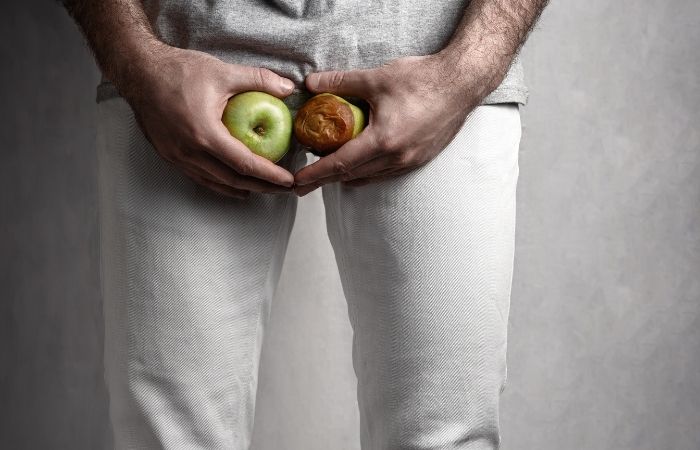
Blue balls is a real phenomenon. The clinical term is epididymal hypertension. Prolonged arousal without ejaculation increases blood flow to the testicles, the veins dilate, and pressure builds. The result is a dull, generalized ache that resolves on its own after arousal fades or after ejaculation. The discomfort is real but rarely lasts more than an hour or two, and it does not cause lasting damage.
The problem with the meme is that it teaches men to dismiss any post-sex testicular pain as "just blue balls" when the symptom pattern is actually different. Pain that does not fit the blue-balls pattern is not blue balls. It is some combination of infection, structural issue, or, in the worst case, torsion.
Warning signs that aren't blue balls
- Pain that lasts more than two hours after the encounter ended
- Sharp or stabbing quality rather than dull pressure
- Swelling, warmth, or redness in the scrotum
- Pain that worsens after every encounter rather than improving with rest
- Discharge from the penis, burning urination, or fever alongside the testicular pain
Why pain on just one side still warrants testing
A common assumption is that if only one testicle hurts, it must be mechanical (an impact, a strain, a hernia) rather than infection. That is wrong. Most cases of bacterial epididymitis affect just one testicle, typically the left.
The reason is anatomical. The left spermatic vein drains into the left renal vein at a sharper angle and at higher pressure than the right side, which drains directly into the inferior vena cava. That difference makes the left side slightly more prone to congestion and inflammation when bacteria reach the epididymis. Varicoceles also occur disproportionately on the left for the same reason.
One-sided pain after sex is therefore a perfectly consistent presentation of an STI-linked epididymitis. It is also consistent with a varicocele, a hernia, or torsion. The clearest diagnostic clue is duration plus onset: one-sided pain that builds gradually over a day or two and lasts more than 24 hours points toward infection. One-sided pain that came on suddenly and severely points toward torsion. One-sided pain that comes and goes with standing or activity points toward a varicocele or hernia.
Symptoms that should push you to test
The symptom combinations below are the most reliable signals that an STI test is the right next step. You do not need all of these to test. Testicular pain plus any one of the urinary or discharge symptoms is enough reason to screen.
Test if you have any of these alongside the pain
Testicular pain plus any one of these is reason enough to screen. Having one or more does not confirm infection; only a test can do that.
- Testicular pain that has lasted more than a couple of hours after sex Common
- Pain that returns after every sexual encounter for several in a row Common
- Swelling, warmth, redness, or tenderness in the scrotum Common
- Penile discharge of any color (clear, white, yellow, or green) Common
- Burning sensation during urination or ejaculation Common
- Increased urinary frequency or urgency Less common
- Low-grade fever or chills accompanying scrotal pain Less common
- A new sexual partner or unprotected encounter in the past few weeks Common
When testicle pain is a medical emergency
Testicular torsion is the emergency to know. The testicle twists on the spermatic cord and the blood supply gets pinched off. Without restored circulation within a window of roughly six hours, the testicle starts to die. The classic torsion presentation is sudden severe one-sided pain, often with nausea or vomiting, sometimes with the affected testicle sitting visibly higher in the scrotum, per Mayo Clinic's testicular torsion guidance.
Torsion is most common in younger men, especially teenagers, but it can happen at any age. Sex is not a typical trigger; torsion can happen during sleep, during sport, or for no obvious reason. If your pain is sudden, severe, and one-sided, do not wait for a home test. Go to the emergency department.
Other red-flag symptoms that warrant urgent care rather than waiting for a screening test:
- High fever (over 101 degrees F or 38.3 degrees C)
- Visible scrotal swelling that is rapidly worsening
- Inability to urinate
- Blood in the urine or semen
- Severe pelvic or lower-abdominal pain alongside testicular pain
When to test, and why timing matters
Testing too early gives you a false negative. The body needs time after exposure for bacteria to reach detectable levels in a swab sample, and for antibodies (in blood tests for syphilis, HIV, and herpes) to build up to a threshold the test can pick up. Test on day one or two and you can be carrying an infection that will not show up for another week or two.
The window periods below are based on CDC guidance and FDA-cleared assay information. They apply to standard NAAT (nucleic acid amplification testing) at a lab and, for the bacterial swab tests, also to lateral-flow rapid screening at home in roughly the same timeframe.
| Infection | Common Test Type | Earliest Reliable Result | Best Accuracy Window |
|---|---|---|---|
| Chlamydia | Swab (lab NAAT or home rapid) | 5 to 7 days post-exposure | 14 days and beyond |
| Gonorrhea | Swab (lab NAAT or home rapid) | 5 to 7 days post-exposure | 14 days and beyond |
| Syphilis | Blood antibody test | About 3 weeks | 6 to 12 weeks |
| HIV | Antibody-only rapid blood test | About 23 to 90 days | 90 days for definitive negative |
What testing actually involves
The default screening for chlamydia and gonorrhea in men is a urine NAAT (nucleic acid amplification test) processed by a clinical lab. NAAT is the laboratory gold standard because it detects the genetic material of the bacteria directly. The CDC's epididymitis guidance reflects this, noting that urine cultures are insensitive for chlamydial and gonococcal infection.
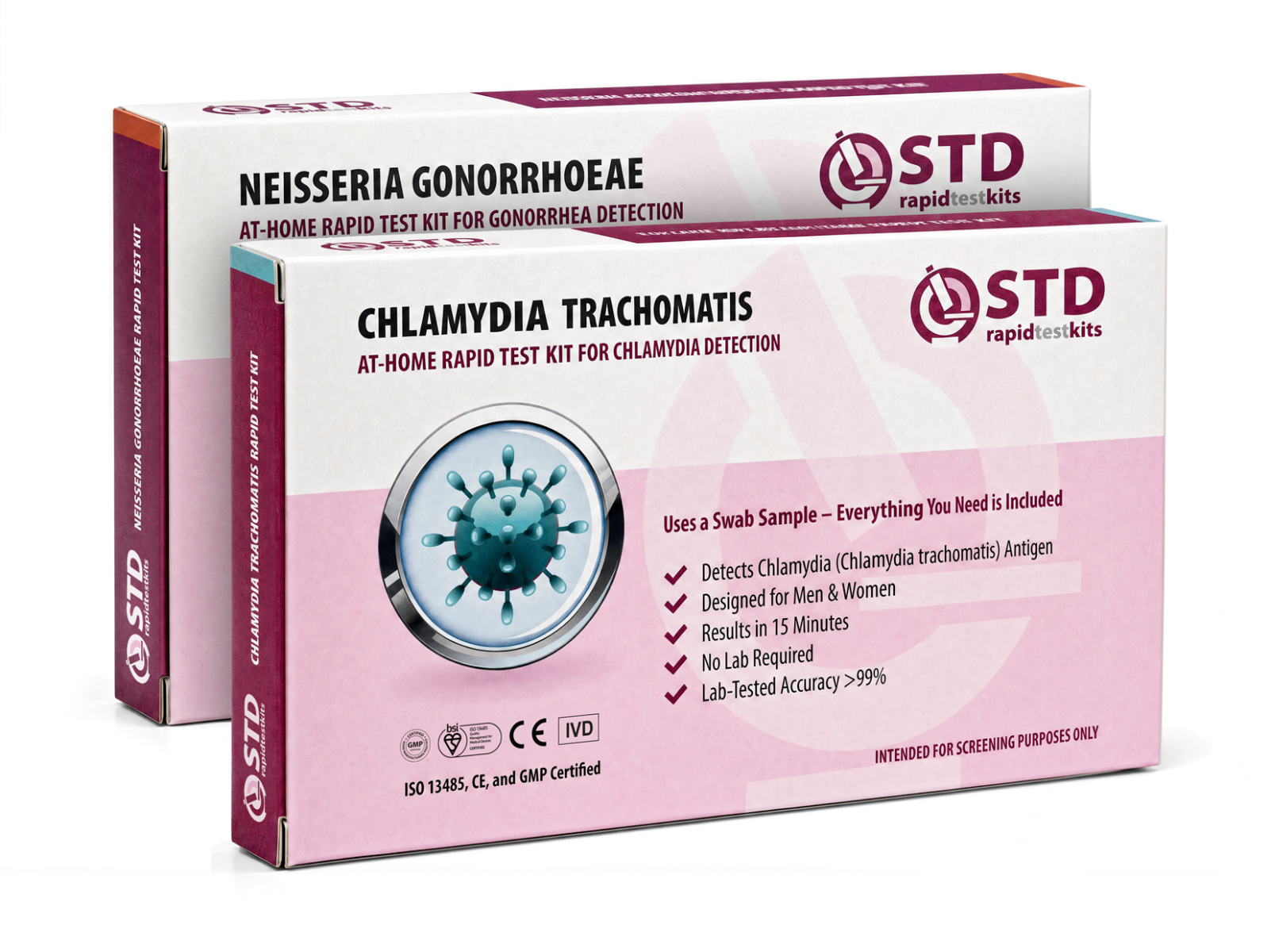
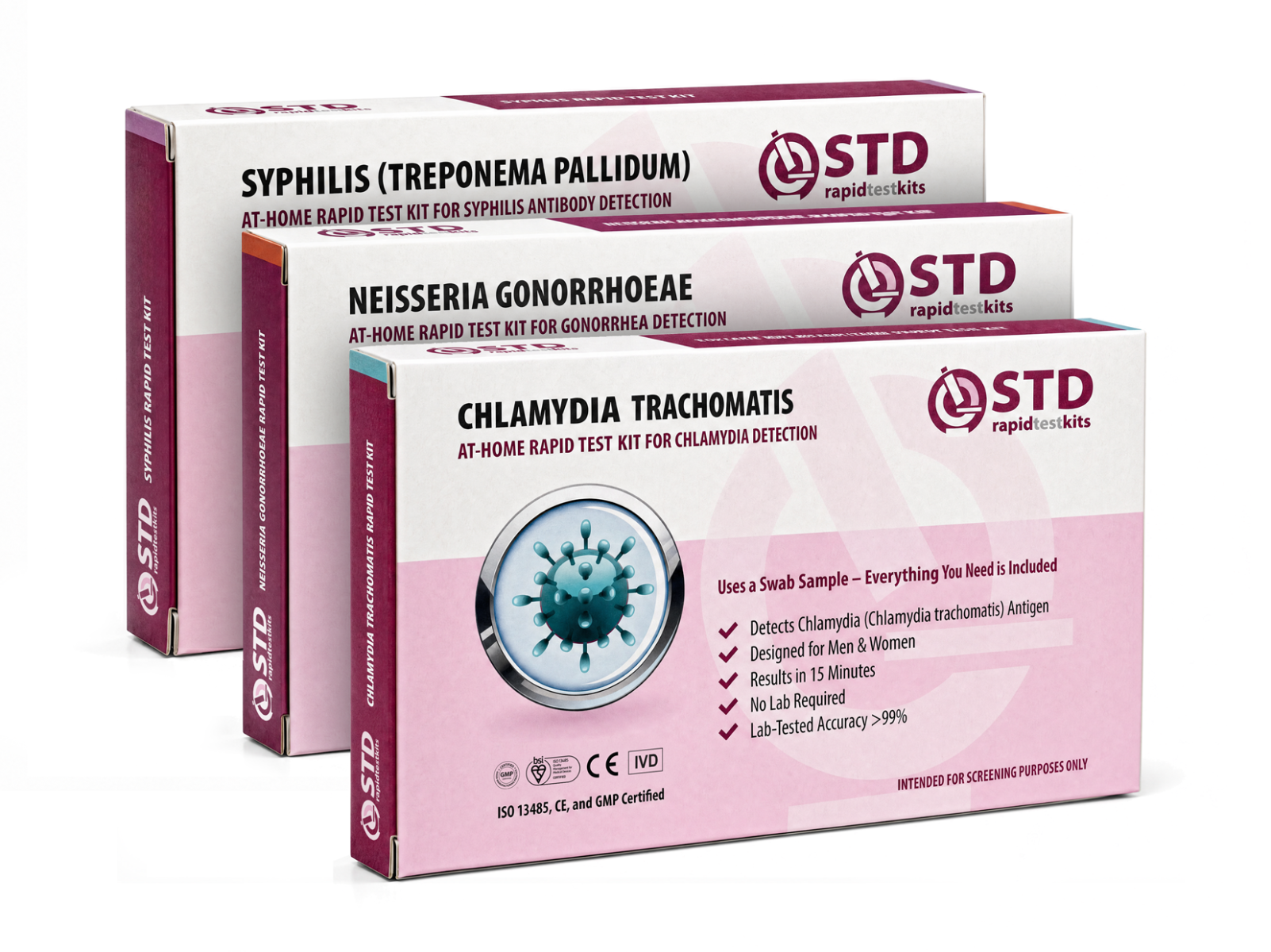
At-home rapid tests use a different chemistry. Lateral-flow immunoassay strips detect bacterial antigens directly from a self-collected urethral or penile swab. They produce results at home in about 15 minutes without a lab. The trade-off is sensitivity: lateral-flow rapid tests are typically less sensitive than laboratory NAAT in asymptomatic infections, although they perform well in symptomatic cases where bacterial load is higher. A positive home rapid test is generally informative; a negative home test in someone with persistent symptoms still warrants a confirmatory NAAT through a clinic.
Our at-home swab kits cover urethral chlamydia and gonorrhea infections in men. We do not sell pharyngeal (throat) or rectal swab kits. If your concern is a throat or rectal infection from oral or receptive anal sex, those routes need clinic-administered NAAT testing because the at-home kits are not validated for those sample types.
For testicle-specific symptoms, your provider may also order:
- A urethral swab if a urine NAAT is negative but symptoms persist
- A scrotal ultrasound to check for torsion, abscess, varicocele, or hernia
- Urine culture if a non-STI urinary tract pathogen is suspected (more common in men over 35)
- Syphilis screening if other STI risk factors are present
One note on technology: at-home rapid kits are screening tools that complement lab NAAT. They give you a fast, private answer at home, while lab NAAT gives the highest analytical sensitivity. The two work well together rather than replacing each other.
If you're under 35 years of age, sexually transmitted infections such as gonorrhea or chlamydia are the most common cause.
If a test comes back positive: telling a partner
If your testing comes back positive for chlamydia or gonorrhea, a partner needs to know, and so does anyone else you have had unprotected contact with in roughly the past 60 days (the contact-tracing window U.S. public-health departments typically use).
The conversation does not need to assign blame. Most chlamydia infections are silent in both partners. Either of you could have carried it for months without knowing. A simple framing is: "I tested positive for chlamydia. I want to make sure you can get tested too, because it is often silent and treatable." That sentence is enough.
The other point worth knowing: re-infection from an untreated partner is the most common reason chlamydia or gonorrhea returns within months of treatment. If you treat your infection and resume sex with an untreated partner, you can pick up the same bacteria again within weeks. Both people testing and being treated together is the only way to break that loop.
- Many U.S. state health departments offer expedited partner therapy (EPT), where a clinician can prescribe antibiotics for a sex partner without that partner being seen first. The CDC supports EPT for heterosexual partners diagnosed with chlamydia or gonorrhea; it speeds treatment and lowers re-infection rates.
- Anonymous notification services (such as TellYourPartner.org) let you send a message to a partner without revealing who you are. Useful when a direct conversation is not safe or practical.
- Avoid the trap of assuming monogamy proves the infection came from somewhere else. Chlamydia can carry over from a previous relationship and only become symptomatic months later. The math does not require a recent betrayal to explain a positive result.
Preventing post-sex testicular pain
Most prevention is the same advice that applies to any STI:
- Use condoms during vaginal, anal, and oral sex with new or non-monogamous partners. Consistent condom use measurably reduces transmission of both chlamydia and gonorrhea, which in turn lowers the risk of the epididymitis those infections cause.
- Get screened on a regular cadence if you are sexually active with new or multiple partners. The CDC recommends annual screening for sexually active gay, bisexual, and other men who have sex with men, with more frequent screening (every three to six months) for those at higher risk.
- Talk with partners about their last test, current symptoms, and risk factors before unprotected sex. The conversation does not have to be clinical; the substance just needs to be there.
- If you do test positive, complete the full antibiotic course and avoid sex until both you and your partner have been treated and cleared.
The other prevention is paying attention. If sex consistently causes testicular pain that has not been there before, that is information worth investigating rather than waiting it out.
For sexually active men with new or multiple partners, the CDC's screening guidance is: annual screening for sexually active gay, bisexual, and other men who have sex with men; every three to six months for higher-risk encounters; and screening at the time of any new symptom that fits the chlamydia or gonorrhea pattern. Routine screening for low-risk men in monogamous relationships is not specifically recommended.
What if every STI test is negative?
If you have tested for chlamydia, gonorrhea, and syphilis (and if relevant, HIV) and all results are clean but the pain continues, the next step is a urology workup. The structural causes mentioned earlier (varicocele, hernia, hydrocele, prostatitis, chronic pelvic pain syndrome) are diagnosed primarily by physical exam and imaging.
What the urologist will typically do:
- Physical exam of the testicles, scrotum, and groin
- Scrotal ultrasound to visualize the testicles, epididymis, and surrounding veins
- Urinalysis and urine culture to look for non-STI urinary pathogens
- In some cases a digital rectal exam to assess the prostate
Non-bacterial causes of chronic post-ejaculation pain are real and treatable. Pelvic-floor physical therapy is well supported for chronic pelvic pain syndrome, and there are medication options for muscle-mediated pain.
Sudden severe one-sided pain, especially with nausea or a visibly elevated testicle, is an emergency-department visit, not a urology referral. Persistent ache, recurrent post-sex pain, or a heaviness that does not change with sexual activity is what a urology clinic is for. The triage point is whether the pain is sudden and escalating (ER) versus persistent and pattern-based (urology).
What to do next
Is the pain sudden, severe, and one-sided, with nausea or a visibly elevated testicle?
Yes: Go to the emergency department now. This can be testicular torsion, which needs surgery within roughly six hours. Do not wait for any home test.
Has the pain lasted more than a few hours and come with discharge, burning urination, or scrotal swelling?
Yes: Test for chlamydia and gonorrhea. A swab is most reliable about 14 days after the exposure you are worried about; see a clinician sooner if symptoms intensify.
Have your STI tests come back negative but the pain continues?
Yes: Book a urology referral for a physical exam and scrotal ultrasound to check for varicocele, hernia, or pelvic-floor causes.
No: If the pain is mild and easing, it is most likely mechanical. Keep an eye on it and test or see a clinician if it returns after every encounter or new symptoms appear.
Guidance only. A clinician can advise based on your specific situation.
Frequently Asked Questions
- Can chlamydia really cause testicle pain?
- Chlamydia is one of the leading causes of bacterial epididymitis in sexually active men under 35. The infection starts in the urethra and travels through the vas deferens to the epididymis, where it produces the post-sex pain pattern. Most men with chlamydia have no early urethral symptoms, so testicle pain weeks after a new partner can be the first warning sign.
- Can I have chlamydia in my testicles without any discharge?
- Most men with chlamydia have no early symptoms at all, and many never develop the classic discharge or burning. The first warning can be a one-sided ache in the testicle that builds over a few days, with nothing showing up in your underwear. If you have had unprotected sex in the past few weeks and one testicle has been hurting, chlamydia and gonorrhea stay on the suspect list even with no discharge.
- How quickly can chlamydia cause testicle pain after exposure?
- Typically one to three weeks of unchecked infection in the urethra before the bacteria climb into the epididymis and produce pain. Pain on day one or two after sex is unlikely to be a brand-new chlamydia infection. Pain a week or more after sex fits the timing chlamydia usually follows, and pain that started weeks after a single exposure can still trace back to it.
- How do I tell if my pain is from an STI versus mechanical strain?
- The clearest tell is duration. STI-linked pain persists beyond 24 hours and often returns with each encounter. Mechanical pain from strain or blue balls fades within a couple of hours and does not recur on its own. Discharge, burning urination, or scrotal swelling alongside the pain makes infection the more likely cause.
- Can gonorrhea also cause testicle pain?
- Gonorrhea behaves much like chlamydia here. It infects the urethra first and can travel backward to the epididymis, causing the same epididymitis-related pain. Both infections are screened for together because the symptoms overlap, and gonorrhea is more likely to show visible urethral discharge.
- Is "blue balls" a real medical thing?
- Epididymal hypertension is the clinical name for it. Prolonged arousal without ejaculation increases pressure inside the testicles. The discomfort is real but rarely lasts more than an hour or two, and it never causes lasting damage.
- I tested at day 4 and got a negative. Should I retest?
- Yes, if symptoms persist. Day 4 is inside the false-negative window for chlamydia and gonorrhea. A reliable result needs at least 5 to 7 days post-exposure, with 14 days giving the most confidence. If your day-4 test was negative and the pain has not improved or is getting worse, retest at the 14-day point or see a clinician sooner if symptoms intensify.
- Is testicle pain ever a medical emergency?
- Yes. Sudden, severe, one-sided testicular pain, especially with nausea or a visibly elevated testicle, can be testicular torsion, which needs surgery within roughly six hours to save the testicle. Go to the emergency department and do not wait for any test result.
- Can untreated STI-driven epididymitis affect my fertility?
- Yes. Chronic or repeated bacterial epididymitis can scar the epididymis or vas deferens in ways that interfere with sperm transport. Mayo Clinic's epididymitis guidance flags reduced fertility as a possible long-term complication of untreated infection. The risk is dose-dependent: weeks of infection differ from months. Treatment within the first weeks of symptoms generally clears the bacteria before durable damage sets in.
- U.S. Centers for Disease Control and Prevention. STI Treatment Guidelines, Epididymitis. Lists C. trachomatis and N. gonorrhoeae among the sexually transmitted causes of epididymitis, and notes urine cultures are insensitive for these organisms.
- U.S. Centers for Disease Control and Prevention. About Chlamydia. Notes that chlamydia often causes no symptoms and that men can have pain and swelling in the testicles.
- U.S. Centers for Disease Control and Prevention. About Gonorrhea. Notes that gonorrhea often has no symptoms and lists painful or swollen testicles among possible symptoms in men.
- Mayo Clinic. Epididymitis: symptoms, causes, and complications including abscess formation, chronic pain, and reduced fertility in untreated infection.
- Mayo Clinic. Testicular torsion: symptoms, causes, and the urgent roughly six-hour surgical window required to save the testicle.
- Cleveland Clinic. Epididymitis: causes, symptoms, diagnosis, and treatment. States that in men under 35, STIs such as gonorrhea or chlamydia are the most common cause, and describes the gradual one-sided pain presentation.
- U.K. National Health Service. Chlamydia. Patient-facing summary noting most people have no symptoms and that men can develop pain and swelling in the testicles.
