
Published: October 2025 | Last updated: May 2026 | Editorial review and quality control: Martina N.
You feel a sting when you pee. Or an itch that creams won't touch. Or a pelvic ache that comes and goes for no clear reason. You check for the obvious sign people learn to watch for, discharge, and you find nothing. So you tell yourself it's probably nothing.
That's the gap most public messaging leaves wide open. Discharge is one possible sign of a sexually transmitted infection. It is far from the only one, and for several common STIs it never appears at all. The U.S. Centers for Disease Control and Prevention is direct about this: most chlamydia infections cause no noticeable symptoms, and the same is true for a large share of gonorrhea, trichomoniasis, and herpes cases. The infection can still spread. It can still cause long-term harm. The only way to know for certain is a test.
This guide walks through what those quieter symptoms feel like, which infections are most likely behind them, why some active infections never reach a visible surface, and when an at-home test gives you a useful answer.
Key Takeaways
- Chlamydia, gonorrhea, herpes, and trichomoniasis can each cause burning, itching, or pelvic ache without producing visible discharge. Asymptomatic infections are extremely common.
- Testing is the only reliable way to confirm or rule out an STI when symptoms are subtle. Waiting for the textbook signs delays both treatment and partner protection.
Why discharge gets all the attention (and why that misleads people)
Sex-ed posters and clinic pamphlets have spent decades teaching the same shorthand: STIs cause burning, itching, sores, and discharge. That last item does most of the work in people's minds. It's visible, it's hard to ignore, and it gets the test scheduled.
The problem is that the body doesn't always cooperate with the poster. Most people with chlamydia, women and men alike, have no noticeable symptoms at all, according to the CDC. Pharyngeal and rectal infections rarely produce discharge even when active. Herpes can reactivate as nerve tingling with no sores. Early HIV looks like a flu rather than anything genital.
Discharge is one signal among many. When it shows up, it's a useful clue. When it doesn't, that absence proves nothing on its own. Treating "no discharge" as a clean bill of health is exactly how silent infections continue to spread, both to new partners and through reinfection cycles inside an existing partnership where only one person ever got treated.
This article is published by stdrapidtestkits.com, which sells at-home STI testing kits. We recommend products based on fit-for-purpose for the reader's concern, not commercial benefit. Where the right tool is a clinic-administered test we don't sell (a pharyngeal swab, for instance), we say so plainly.
Stealth symptoms, infection by infection
Each common STI has its own quieter face. Knowing what that face looks like by infection helps you decide whether the discomfort you're feeling rises to the level of a test.
Chlamydia. Often invisible. When it does cause symptoms, they tend to be a faint sting at the start of urination, a dull pelvic ache, post-sex spotting in women, or a low-grade testicular ache in men. No discharge is required for the infection to be active and transmissible. Untreated chlamydia in women can quietly progress to pelvic inflammatory disease (PID), which the CDC identifies as a leading preventable cause of tubal-factor infertility, ectopic pregnancy, and chronic pelvic pain. Most cases of PID develop without any clear preceding symptoms, which is why screening before symptoms appear is the standard recommendation for sexually active women under 25.
Gonorrhea. More likely to produce discharge in men than in women, but plenty of cases produce only burning during urination, throat irritation after oral sex, or rectal fullness after receptive anal sex. Most pharyngeal and rectal gonorrhea infections are asymptomatic per the CDC. Like chlamydia, untreated gonorrhea can ascend to the upper reproductive tract and cause PID with the same fertility consequences. In men, untreated gonorrhea can cause epididymitis, a painful inflammation of the tube behind the testicle that can rarely lead to fertility problems.
Herpes (HSV-1 and HSV-2). The textbook image is a cluster of blisters. The clinical reality is that many people experience reactivation as a tingle, a small red patch, or nerve pain in the same area, with no sores ever forming. Some people only learn they carry the virus when a current partner tests positive.
Trichomoniasis. The CDC notes that about 70% of trichomoniasis infections are symptom-free. When symptoms occur, they range from itching and irritation to mild burning, often without the frothy discharge older textbooks describe.
Syphilis (primary stage). The first sign is usually a painless ulcer (chancre) at the site of contact. It can be internal (vaginal, rectal, or pharyngeal) and resolve on its own within a few weeks, leaving the infection to advance silently. There is no discharge phase.
Early HIV. The acute phase often looks like a one to two week flu: fever, sore throat, swollen lymph nodes, body aches, two to four weeks after exposure. Genital symptoms are not the main story. The transmission stakes during this acute window are unusually high. Viral load peaks in the first weeks of infection, and per CDC and NIH research, the per-act risk of transmitting HIV to a partner is many times higher in this window than during chronic infection. That makes the flu-like phase one of the most epidemiologically critical times to test, even though the genital exam looks unremarkable.
| Symptom you might notice | Infections to consider | Why discharge may be missing |
|---|---|---|
| Sting at the start of urination | Chlamydia, gonorrhea, trichomoniasis | Urethral inflammation can precede measurable discharge by days or weeks |
| Itch or irritation that creams don't fix | Herpes, HPV, chlamydia | Inflammation from viral shedding or mucosal irritation often produces no fluid |
| Dull pelvic or testicular ache | Chlamydia, gonorrhea, early HIV | Internal swelling presses on tissue and nerves without surface discharge |
| Rectal pressure, itching, or spotting | Chlamydia, gonorrhea, syphilis, herpes | Rectal infections frequently produce no visible discharge, especially early |
| Tingling or nerve-pain patches | Herpes (HSV-1 or HSV-2) | Reactivation can stay below the skin without forming visible sores |
| Flu-like symptoms 2 to 4 weeks after exposure | Acute HIV | Acute HIV is a systemic immune response, not a local genital one |
Is it an STI, a UTI, a yeast infection, or something else?
One reason people delay testing is the genuine overlap between STI symptoms and other common conditions. Burning during urination, for example, is the calling card of both chlamydia and a urinary tract infection. Itching can come from herpes, a yeast infection, bacterial vaginosis, or an allergic reaction to laundry detergent. The Mayo Clinic walks through this differential in its overview of STD symptoms, and the upshot is consistent across guidelines: testing is what separates them.
The table below summarizes where the confusion typically lives. The clue that pushes the answer toward an STI is usually contextual (recent unprotected sex, a new partner, or a partner who has tested positive) rather than the symptom itself.
| Condition | Typical clues | Where it overlaps with STIs |
|---|---|---|
| Urinary tract infection | Frequent urge to pee, urgency, sometimes blood in urine, no recent sexual context required | Burning during urination is shared with chlamydia, gonorrhea, and trichomoniasis |
| Yeast infection | Thick white discharge, intense itching, redness in cisgender women | Itch can mimic herpes or trichomoniasis, though the discharge pattern differs |
| Bacterial vaginosis | Fishy odor, thin gray discharge, mild discomfort | Symptoms overlap with trichomoniasis; lab testing distinguishes them |
| Allergic or contact reaction | Rash or itch after latex, soap, lubricant, or new fabric exposure | Looks like early herpes irritation, but resolves once the trigger is removed |
| Friction or microtears | Soreness after vigorous sex, no fever, no systemic symptoms | Can be confused with early herpes; symptoms don't recur in the same spot |
Why some infections never reach the surface
Discharge is fluid that has worked its way out of an inflamed mucosal surface. When the inflammation sits somewhere fluid can't easily flow, the cervix, the upper urethra, the rectum, or deep in the vaginal canal, the infection can be active for weeks without producing anything you'd notice externally.
Two patterns matter here:
- Cervical infections. Chlamydia and gonorrhea preferentially infect the cervix in cisgender women and people with female anatomy. Cervical chlamydia frequently produces no symptoms; when it does, the signal is often spotting after sex, a heavier-than-usual period, or a vague pelvic pressure that gets dismissed as cycle-related.
- Rectal infections. People who engage in receptive anal sex are at real risk for rectal chlamydia, gonorrhea, and syphilis. These infections usually cause nothing more than mild itching, a sense of fullness, or occasional spotting on toilet paper. Many cases get mistaken for hemorrhoids and never tested.
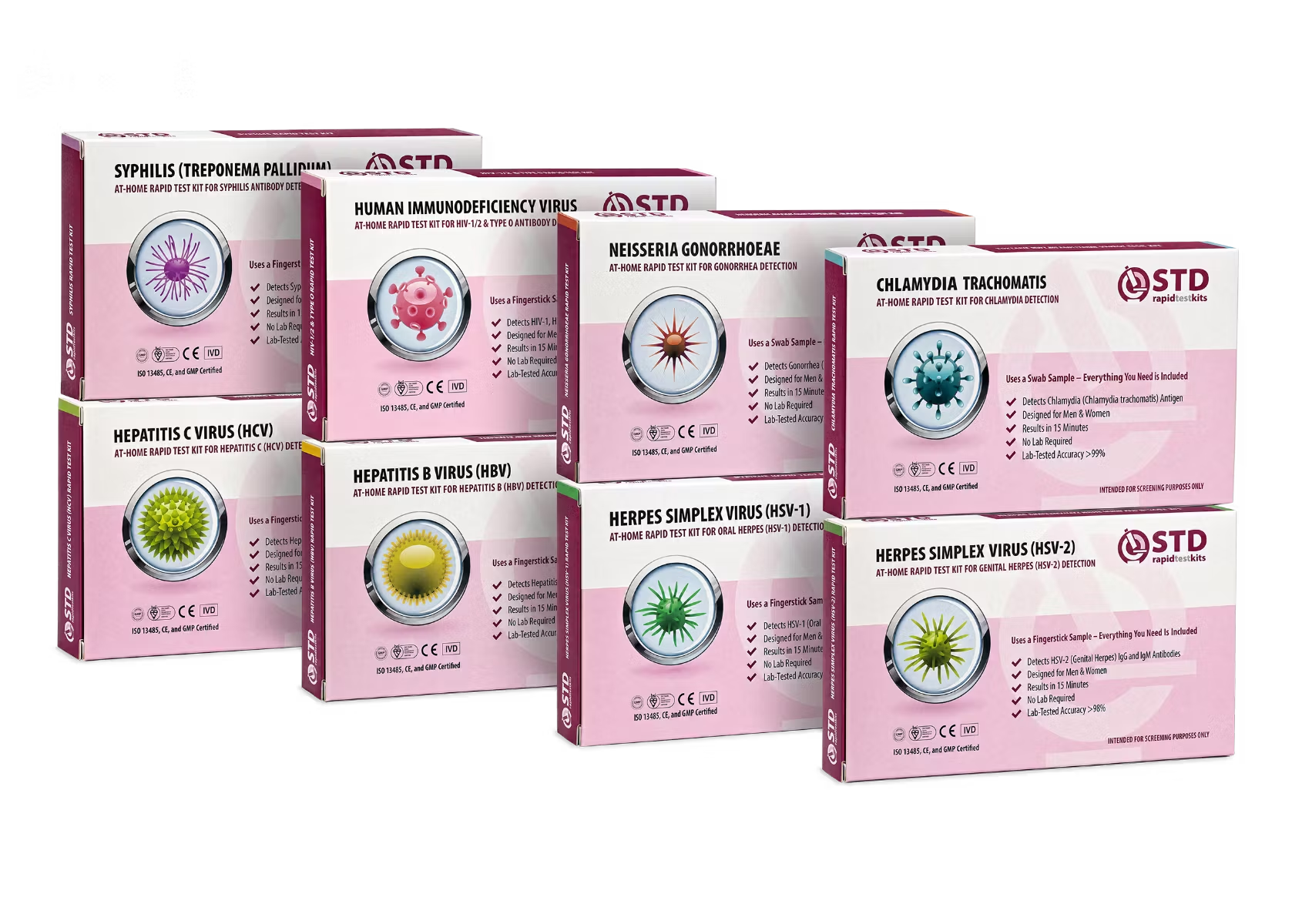
For an at-home rapid screen to be useful in these cases, the test type matters. Our kits are lateral-flow rapid tests using the same swab sample type as lab assays for the bacterial infections (chlamydia, gonorrhea, trichomoniasis), and a fingerstick blood antibody or antigen-antibody test for HIV, syphilis, hepatitis, HSV-1, and HSV-2. They are not equivalent to laboratory NAAT testing in analytical sensitivity, and a positive home result is worth confirming with a lab when possible. They are, however, a meaningful first screen when symptoms are subtle and the alternative is waiting indefinitely for clearer signs.

Incubation windows, and why timing changes the answer
If you've been counting days since exposure, the next question is whether you tested too early. Bacterial and viral infections each have a window period, the time between exposure and the point at which a test can reliably detect them. Test before that window closes and a real infection can read negative.
The numbers below are typical for the U.S. CDC's published guidance on common STIs. They aren't a guarantee for any individual case; immune response and test technology both shift the curve.
| Infection | Typical incubation period | Likelihood of producing discharge |
|---|---|---|
| Chlamydia | 1 to 3 weeks | Low to moderate; many cases produce none at all |
| Gonorrhea | 2 to 14 days | Common in male urethral cases, much rarer in cervical, rectal, or pharyngeal cases |
| Trichomoniasis | 5 to 28 days | Possible in women, less common in men; many cases show only itch or burning |
| Herpes (HSV-1 or HSV-2) | 2 to 12 days for first outbreak | No discharge; symptoms are skin-level if they appear at all |
| Syphilis (primary) | 10 to 90 days | No discharge; a painless chancre that often goes unnoticed |
| HIV (acute phase) | 2 to 4 weeks | No genital discharge; flu-like systemic symptoms if any |
Can you have an STI without any discharge?
Yes. The majority of chlamydia infections, plus a large share of gonorrhea, trichomoniasis, and herpes cases, produce no discharge at all. Symptoms, when they appear, can be as subtle as a brief sting during urination, an itch that doesn't respond to creams, a dull pelvic or testicular ache, or nerve-tingling skin patches. If you've had a recent exposure and something feels off, an at-home rapid test is the fastest way to get from anxiety to information; persistent or worsening symptoms warrant a clinic visit regardless of the home result.
What to do when a first test reads negative but symptoms continue
A negative test taken inside the window period doesn't rule the infection out. It usually means the test couldn't see it yet. The two most common reasons a real STI gets a negative result on a first home test are timing (tested before the window closed) and test technology (a screening test that has lower analytical sensitivity than a laboratory NAAT).
If symptoms persist past 48 to 72 hours, especially after a high-risk exposure, the practical move is to retest at around 14 days from exposure. That second test catches most bacterial infections that a first early test missed. For HIV and syphilis, the window can run longer, often 4 to 12 weeks for full antibody seroconversion, depending on the test technology. Retesting at 14 days from exposure for bacterial STIs is consistent with CDC guidance on window periods.
Persistent symptoms also warrant a clinic visit, regardless of what at-home tests show. A clinician can run a NAAT panel (the laboratory standard for chlamydia, gonorrhea, and trichomoniasis), do a swab of any visible lesion, and look at relevant findings directly. At-home rapid screens are a good first step, especially when the alternative is delaying any test at all, though they aren't a substitute for a clinical exam when something is genuinely wrong and not resolving.

Why a partner with no symptoms still needs a test
The hardest part of a positive result is often the conversation that follows. "I feel fine" is a common partner response, and on its own it means very little. STIs frequently show up in only one partner's symptoms even when both are infected. Trichomoniasis is famously asymptomatic in most men while causing significant inflammation in women. HPV can persist quietly for years without producing a wart.
Both partners should test regardless of who has visible symptoms. Untreated asymptomatic partners are the main reason couples ping-pong infections back and forth for months. Many U.S. clinics also offer expedited partner therapy for chlamydia and gonorrhea, where the diagnosed partner is given prescriptions or medication to pass to the partner without a separate clinic visit. It's a public-health measure with strong evidence supporting it.
If your partner is genuinely uncertain whether they want to test, an at-home kit lowers the friction substantially: no appointment, no waiting room, no insurance bill. The barrier most asymptomatic partners cite is logistical, not philosophical.
When discomfort lingers after treatment
Antibiotics or antivirals don't always switch symptoms off the moment the last dose is taken. Tissue inflammation from a treated chlamydia or gonorrhea infection can stay tender for several days while the mucosa repairs itself, particularly with cervical or prostatic involvement. Burning during urination that fades over the following week is usually the tail end of healing rather than a sign of treatment failure.
Herpes is its own category. Even after a successful course of antivirals, the virus stays latent in nerve roots and can reactivate as nerve pain or skin tingling without producing sores. Per CDC guidance on genital herpes, asymptomatic shedding is also possible, which is why suppressive therapy is offered for frequent recurrences.
If symptoms are still present more than a week after finishing prescribed treatment, a follow-up test is reasonable. Wait at least three weeks after treatment for chlamydia and gonorrhea retesting, since residual bacterial DNA can produce false positives on NAAT-based tests if they're done too soon.
Most people who have chlamydia have no symptoms. If you do have symptoms, they may not appear until several weeks after you have sex with an infected partner.
The bottom line on "no discharge"
Trust the symptom you actually have, not the symptom you've been told to look for. A subtle sting, a persistent itch, a pelvic ache that won't quite leave, or a nerve-tingling patch you've never noticed before, each of these can be the only sign of an active infection. They deserve the same response a textbook discharge would: get tested, tell your partner, follow through on any treatment.
Testing is rarely about being sure something is wrong. Most of the time it gives you a result you can act on.
- Test at around 14 days from exposure if you had unprotected sex and any subtle symptom (sting, itch, ache, tingling) hasn't resolved.
- Tell any partners from the relevant exposure window so they can test too. Asymptomatic infection is the norm, not the exception.
- See a clinician if symptoms persist past 72 hours regardless of what an at-home test shows. A NAAT panel and a physical exam catch infections a rapid screen can miss.
- Retest at the longer windows for HIV (up to 12 weeks for some antibody tests) and syphilis if the initial exposure was high-risk.
Frequently asked questions
- Can I have chlamydia and not know it?
- Yes, easily. The CDC reports that most chlamydia infections produce no symptoms at all. Many people only learn they have it when a partner tests positive, when they get a routine annual screening, or when complications like pelvic inflammatory disease or testicular pain force a clinic visit. "No discharge" doesn't rule chlamydia out.
- Is it normal to have an STI with no discharge?
- It's common, especially with chlamydia, trichomoniasis, and pharyngeal or rectal gonorrhea. Herpes also tends to produce skin-level symptoms rather than discharge. Visible signs are one possible presentation, and their absence isn't evidence of absence.
- I'm a man, and I keep hearing that men always get discharge with STIs. Is that true?
- No. Men with urethral gonorrhea often produce discharge, but men with chlamydia, rectal infections, pharyngeal infections, or early HIV typically don't. A faint sting at the start of urination or a dull testicular ache can be the only signal an at-home or clinic test catches.
- I have itching but nothing else. Could it still be herpes?
- Possibly. Herpes reactivation often presents as a tingling patch, a small red area, or nerve-pain sensations without forming visible blisters. If the itch keeps recurring in the same general spot, herpes belongs on the differential. A blood antibody test can confirm exposure history; a swab of an active lesion is needed to confirm a current outbreak.
- Could it just be a UTI or yeast infection?
- It's possible. Burning during urination is the headline symptom of UTIs, and itching is the headline symptom of yeast infections. The catch is that chlamydia and gonorrhea can mimic both. The deciding factor is usually context: recent unprotected sex or a new partner pushes the answer toward an STI test rather than a UTI culture.
- I tested negative but I still feel something. What now?
- If your first test was within the window period (under 7 days for many bacterial infections, longer for HIV and syphilis), retest at around 14 days from exposure. If symptoms persist beyond 72 hours regardless of the test result, see a clinician. A clinic NAAT panel and a physical exam catch infections a home rapid test can miss.
- Do at-home STI tests work without discharge?
- They do. At-home rapid tests detect either bacterial proteins on a self-collected swab or antibodies and antigens on a fingerstick blood sample. Whether your body is producing discharge is irrelevant to whether the test runs. The same is true for laboratory NAAT testing.
- Do I need to tell a partner with no symptoms?
- It's the right move. Asymptomatic infection is normal, and a partner who feels fine can still be infected and contagious. Many U.S. clinics offer expedited partner therapy for chlamydia and gonorrhea so a diagnosed person's partner can be treated without a separate appointment. Telling a partner is also the only way to break a reinfection cycle.
- U.S. Centers for Disease Control and Prevention. About Chlamydia, including asymptomatic infection rates and incubation timing.
- U.S. Centers for Disease Control and Prevention. About Gonorrhea, including pharyngeal and rectal asymptomatic patterns.
- U.S. Centers for Disease Control and Prevention. About Genital Herpes, including reactivation patterns and asymptomatic shedding.
- U.S. Centers for Disease Control and Prevention. About Trichomoniasis, including the share of asymptomatic infections.
- U.S. Centers for Disease Control and Prevention. STI testing and treatment guidance overview, including window-period and retest intervals.
- Mayo Clinic. Sexually transmitted diseases (STDs) symptoms and causes reference, covering atypical and asymptomatic presentations across common infections.
