
Published: October 2025 | Last updated: April 2026 | Editorial review and quality control: Martina N.
Most sexually transmitted infections do not announce themselves. Chlamydia rarely burns. Gonorrhea may not produce discharge. Herpes can pass between partners with no visible sore. The body's quietest tissues, the cervix, the urethra, the throat, and the rectum, do not reliably register inflammation as pain, so an infection can replicate for months without sending a single warning signal. Feeling fine is not the same thing as being uninfected. It is one of the main reasons silent STIs keep spreading from one partner to the next.
Can you have an STD without any symptoms?
Yes, and it is the rule, not the exception. The CDC describes chlamydia as often having no symptoms at all, and most genital herpes carriers have never recognized an outbreak. Gonorrhea, HPV, syphilis, and early HIV can all sit silently for weeks, months, or years. Routine testing, not waiting for symptoms, is the only reliable way to know your status.
Key Takeaways
- Most chlamydia, gonorrhea, herpes, and HPV cases cause no symptoms, which means feeling fine is not proof you are uninfected.
- Untreated silent infections can scar fallopian tubes, damage fertility, and pass to partners during ordinary sex even with no visible signs.
Why So Many STIs Hide Without Symptoms
Chlamydia earned the nickname "the silent infection" for a reason. Public-health summaries from the CDC describe chlamydia as an infection that often produces no symptoms at all, especially in women, and that frequently goes undetected in men too (CDC chlamydia fact sheet). Gonorrhea is similar. Herpes carriers often never recognize an outbreak. HPV usually clears or persists silently for years. WHO data tracks more than a million new STIs acquired worldwide every day, the majority going undetected at the moment of transmission (WHO STI fact sheet).
The reason for this quietness is partly anatomical. The cervix, urethra, rectum, and throat have very few pain receptors compared with skin. Inflammation in those tissues rarely registers as pain or burning unless it becomes severe. A cervical chlamydia infection can scar fallopian tubes for months while the person feels nothing. A throat infection from oral sex can colonize without producing soreness. A rectal infection can cause mild discharge or no signs at all.
The reason is also evolutionary. Pathogens that produce dramatic symptoms on first contact get treated quickly and spread less. Pathogens that produce few symptoms tend to spread further before anyone notices, which is why "silent" variants of common STIs persist in the population. Herpes simplex virus type 2 is a clear example: most carriers shed virus periodically with no visible sore, and most new genital herpes cases are passed by people who did not know they had it.
The practical implication is straightforward. Symptom checklists are not a reliable screening tool for STIs. "Do you have any unusual discharge or burning?" misses the majority of infections, especially in women, in people whose infection sits in the throat or rectum, and in early-stage exposures. The only way to detect a silent infection is to test for it directly.
The cervix and urethra have far fewer pain receptors than skin. Chlamydia can inflame cervical tissue for months without producing any sensation the carrier notices, which is why a symptom-only screen misses the majority of infections in women.
Which STIs Stay Quietest, and How Often
Not every STI hides equally well. Some announce themselves quickly with discharge or pain, others colonize the body and stay quiet for years. The pattern depends on the pathogen, the body site infected, and whether the person's immune system mounts a visible response. The table below summarizes the qualitative picture from CDC surveillance and the WHO STI fact sheet; rates vary by body site infected and by gender.
Two patterns repeat across the data. First, women carry chlamydia and gonorrhea silently more often than men, partly because cervical infections are harder to feel than urethral ones. Second, infections in the throat or rectum (from oral or anal exposure) almost never produce noticeable symptoms in any gender. A standard genital symptom check misses these entirely, which is why the CDC's screening recommendations include site-specific testing of the throat and rectum alongside urine-based testing when sexual behaviors involve those sites (CDC STI screening recommendations).
| Infection | How often it causes no symptoms | Why it stays quiet |
|---|---|---|
| Chlamydia | Majority of women, many men | Cervical and urethral infections rarely produce pain |
| Gonorrhea | Often silent, more so in throat and rectal sites | Throat and rectal sites have few pain receptors |
| Trichomoniasis | Often asymptomatic | Mild irritation often blamed on yeast, BV, or soap |
| Herpes (HSV-2) | Most carriers do not recognize an outbreak | Outbreaks can be internal, mild, or absent altogether |
| HPV | Most infections cause no symptoms | Cleared or persistent without visible warts in most cases |
| Syphilis | Often unnoticed in primary and latent stages | Painless chancre, then a years-long latent phase |
| HIV | Years of clinical silence after seroconversion | Slow CD4 decline produces no day-to-day signs |
Silent Doesn't Mean Harmless: What Untreated Infections Damage
An STI without symptoms is not an STI on hold. It is an STI doing damage you cannot feel. The mechanisms vary by pathogen, but the pattern is consistent: by the time the consequences become noticeable, much of the damage is already done.
Untreated chlamydia and gonorrhea climb from the cervix into the upper reproductive tract, causing pelvic inflammatory disease (PID). PID scars the fallopian tubes. Scarred tubes raise the risk of ectopic pregnancy and can permanently impair fertility. The CDC's PID resource notes that about one in eight women with a history of PID experience difficulties getting pregnant, and lists fallopian-tube scarring, infertility, and ectopic pregnancy as direct complications (CDC PID fact sheet). Many women only learn they had a long-standing chlamydia infection during a fertility workup, after months or years of trying to conceive.
In men, untreated chlamydia and gonorrhea can inflame the epididymis (the duct behind the testicle), causing pain, swelling, and in some cases reduced sperm function. Gonorrhea that reaches the bloodstream can also trigger joint inflammation or, rarely, sepsis.
Syphilis is staged. The early sore (chancre) often goes unnoticed because it is painless and may sit on internal tissue. Without treatment, the infection moves into a latent phase that can last years before producing tertiary complications: neurosyphilis, cardiovascular damage, or eye and ear involvement. Detection in the latent phase relies almost entirely on blood testing.
HIV produces a brief flu-like illness in some people during seroconversion, then settles into years of clinical silence while it depletes CD4 cells. By the time opportunistic infections appear, immune damage is significant. Modern antiretroviral therapy works exceptionally well when started early, which is why the CDC recommends HIV testing for anyone with possible exposure rather than waiting for symptoms (CDC HIV testing page).
HPV is the stealthiest of all. Most infections clear on their own within one to two years. A subset persist and, with high-risk strains, can drive cervical, anal, or oropharyngeal cancers a decade or more after initial infection. The Pap smear and HPV co-test catch the cervical changes early, which is why routine cervical screening matters even with no visible symptom.
Untreated chlamydia or gonorrhea can scar the fallopian tubes silently. Many people only discover a prior infection during a fertility evaluation, months or years after the fact. Treatment cannot reverse scarring that has already happened, which is why the CDC stresses early detection of these infections.
How a Silent Infection Still Reaches Your Partner
Asymptomatic STIs still pass between partners. The pathogen does not need symptoms to move from one body to another; it needs contact with the right tissue.
Herpes simplex virus type 2 is the textbook example. Most genital herpes transmission happens during periods of asymptomatic viral shedding, when the virus is active on skin or mucosa with no visible sore. People who have never had a recognized outbreak can still pass the virus during ordinary sex. Daily antiviral medication reduces but does not eliminate this shedding.
Bacterial STIs work the same way. Someone with chlamydia in the urethra, cervix, throat, or rectum can pass it during vaginal, oral, or anal sex regardless of how they feel. Gonorrhea behaves identically. Trichomoniasis sits in the vagina or urethra and transmits during intercourse without warning.
HPV transmits skin to skin in the genital region. Condoms reduce risk but do not fully prevent spread because the virus lives on tissue the condom does not cover. The vast majority of new HPV infections come from partners who did not know they were carriers.
The implication for prevention is uncomfortable but important: the visual screening many people quietly do ("they look healthy, no sores, no discharge") is not a screen at all. The healthiest-feeling person can carry chlamydia, asymptomatic herpes, latent syphilis, or undetected HIV. The only reliable status check is a recent test, by both partners, covering the relevant body sites for the kind of sex they are having.
This is also the mechanism behind community-level spread. Asymptomatic carriers are the engine of STI epidemics: each unknowingly passes the infection to a new partner, who unknowingly passes it on, and the chain continues until someone tests and breaks it.
Most sexually transmitted infections cause no symptoms, and people can transmit them without knowing they are infected.
Window Periods: Why Testing Too Soon Misses Infections
Every STI has a window period, the time between exposure and when a test can reliably detect the infection. Testing inside the window can produce a false negative even when the infection is present. The window varies by pathogen and by test method.
Bacterial infections such as chlamydia and gonorrhea become detectable within one to two weeks because the bacterial load builds quickly and sample-based tests pick up genetic material directly. Viral and treponemal infections take longer because the test depends on the body producing detectable antibodies, which can take weeks. The CDC's HIV testing page lists detection windows by test type: laboratory antigen/antibody (4th-generation) tests typically detect HIV within about 18 to 45 days after exposure, rapid antigen/antibody tests within 18 to 90 days, and antibody-only tests within 23 to 90 days (CDC HIV testing page).
If a recent exposure is the trigger for testing, two tests are often better than one: an initial test at two weeks for the bacterials, then a second test at six to twelve weeks to capture HIV and syphilis. A single negative test inside the window is reassurance, not closure. Retest at the appropriate interval to confirm.
| Infection | Earliest reliable detection | Recommended retest |
|---|---|---|
| Chlamydia | About 1 to 2 weeks after exposure | 3 months after treatment to detect reinfection |
| Gonorrhea | About 1 to 2 weeks after exposure | 3 months after treatment to detect reinfection |
| HIV (lab Ag/Ab) | About 18 to 45 days after exposure | Repeat at 3 months to confirm a negative |
| Syphilis | 3 weeks to 3 months after exposure | Repeat at 3 months for early-window negatives |
| Herpes (HSV-2 antibody) | About 6 to 12 weeks after exposure | Repeat at 12 weeks if early result is negative |
| HPV | Variable; often detected only via Pap or HPV co-test | Per cervical screening schedule |
How At-Home Rapid Tests Work, and Where Lab NAATs Still Win
At-home STI tests have changed how many people approach screening, especially the readers who would otherwise put off a clinic visit indefinitely. Privacy, speed, and not having to explain a sex life to a receptionist are real barriers, and removing them gets more people screened than any other intervention.
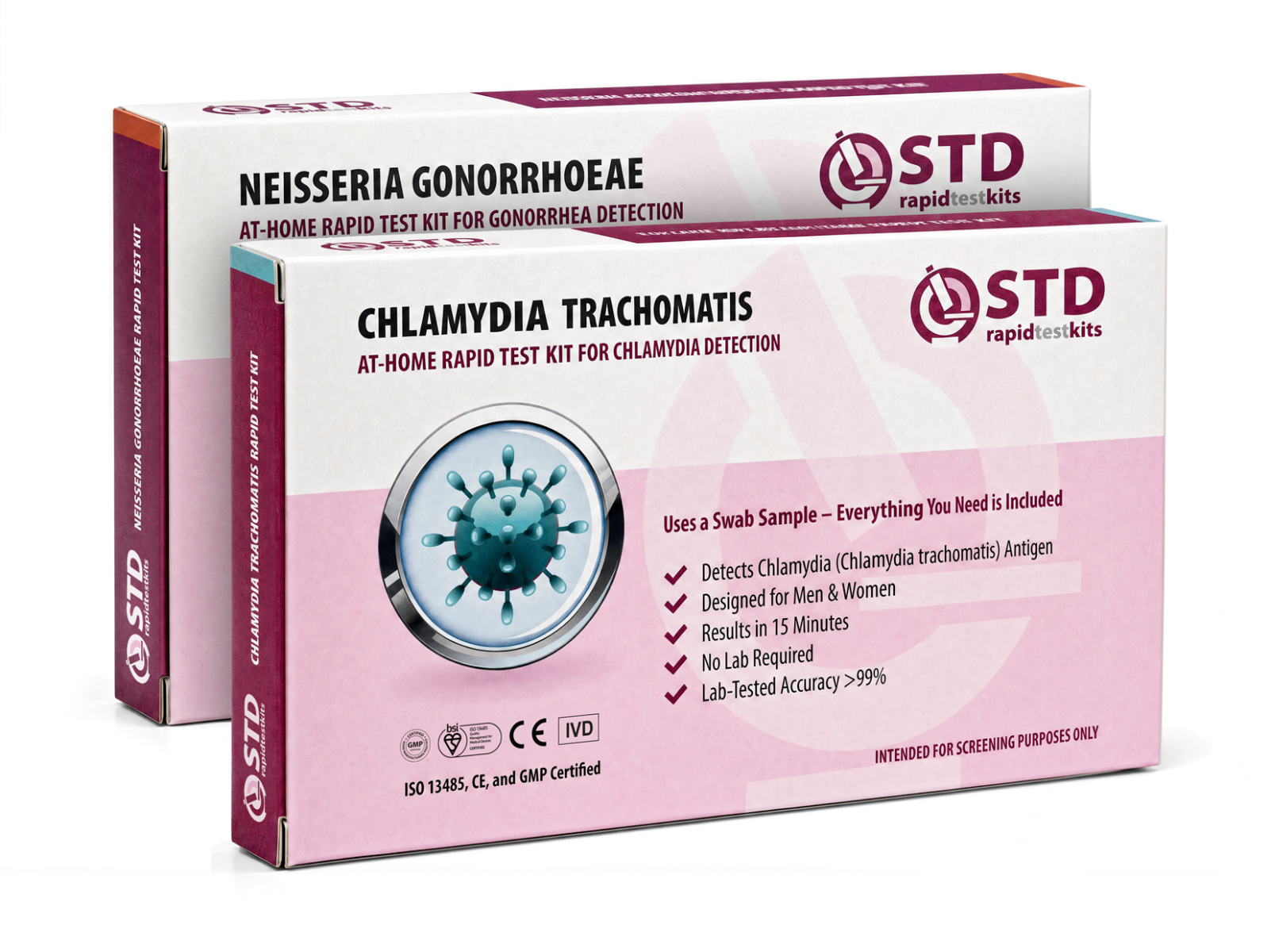
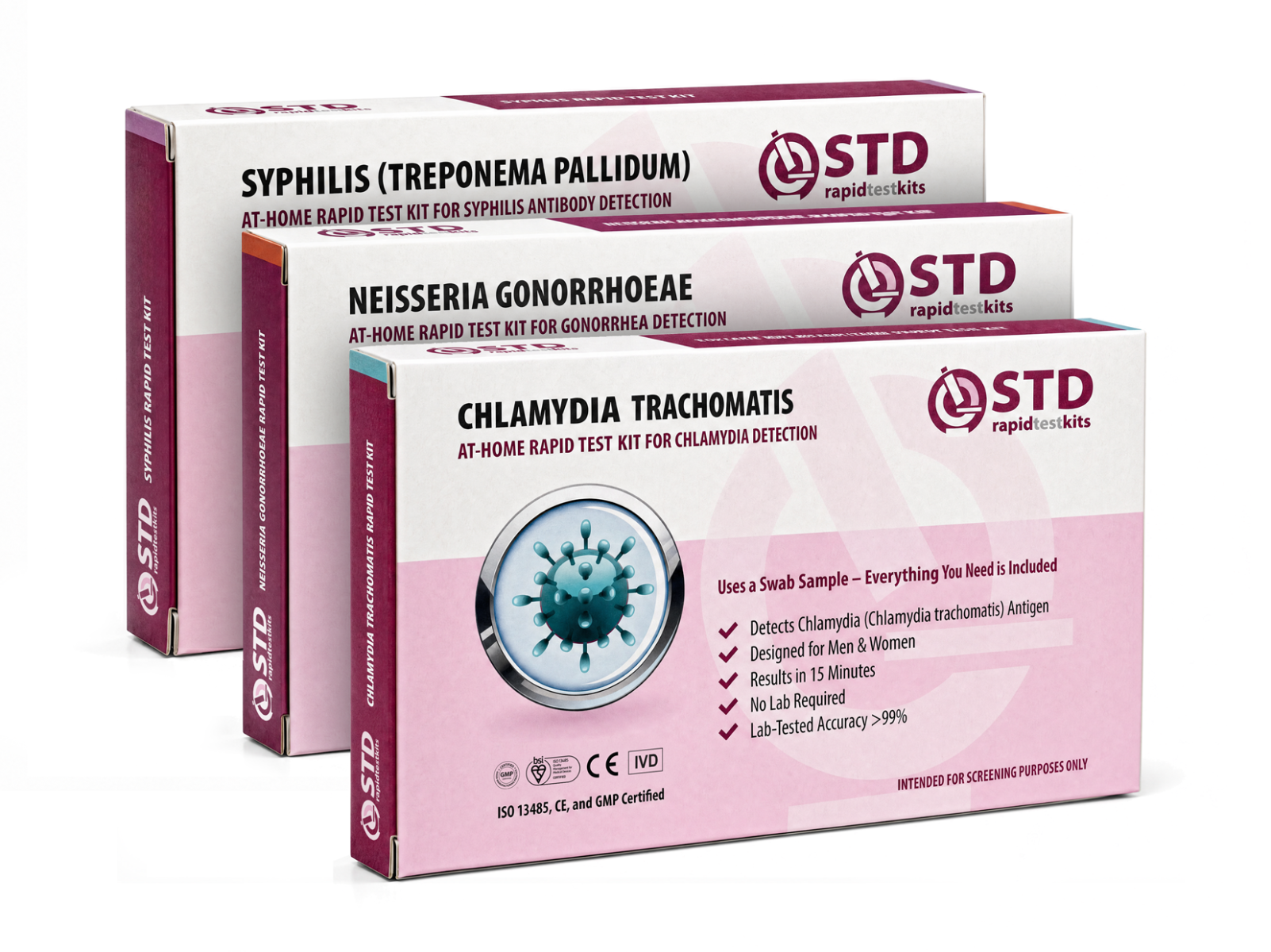
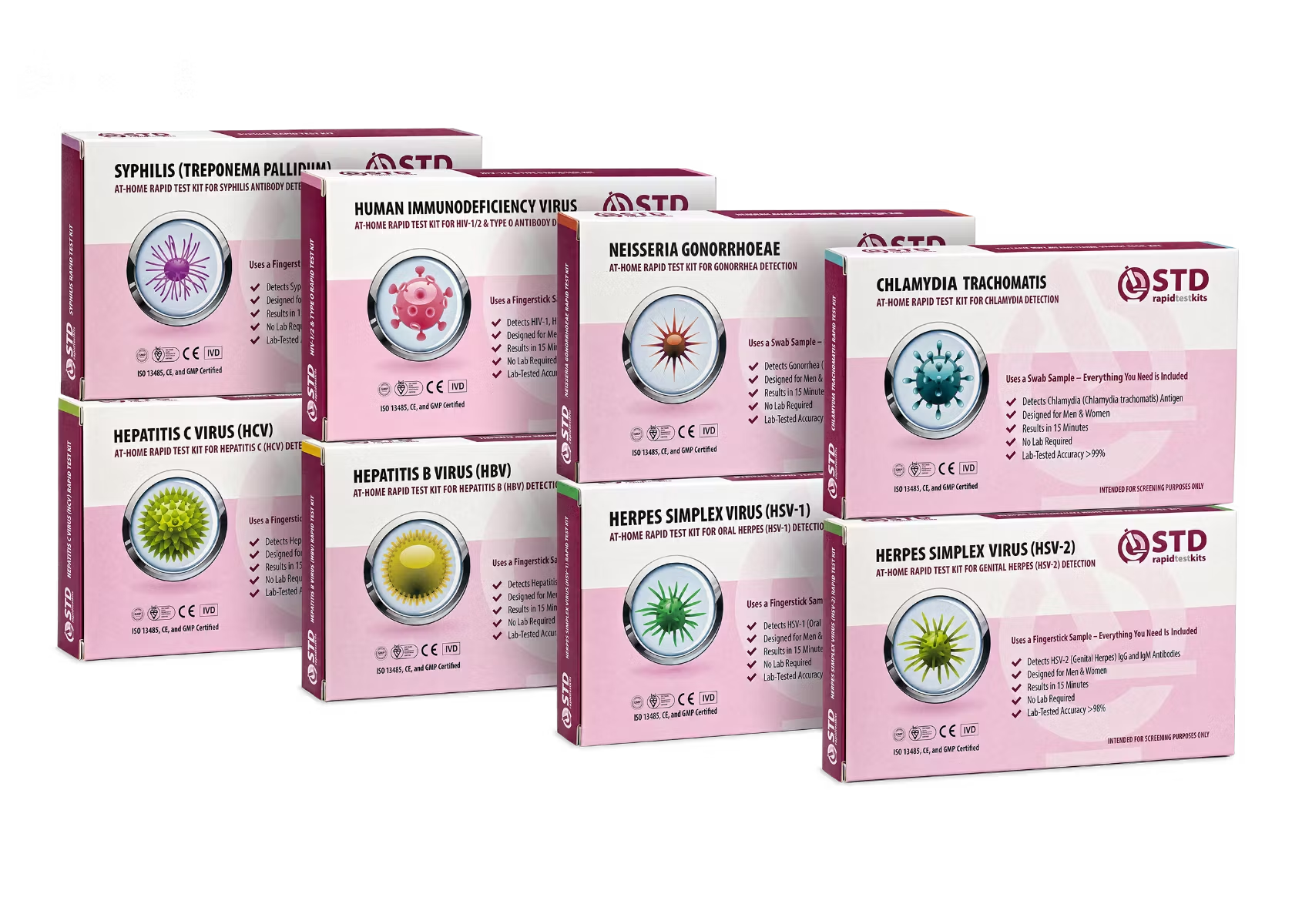
The chemistry behind a typical at-home test is lateral-flow immunoassay. The user collects a swab (vaginal, penile, oral) or fingerstick blood sample, applies it to the test cassette, and a colored line appears within minutes if the target antigen or antibody is present. The same chemistry is used in pharmacy pregnancy tests and many flu and COVID home kits. It is fast, requires no lab, and produces a result the user reads directly.
Lab-based testing for the same infections uses a different chemistry: nucleic acid amplification testing (NAAT, which includes PCR). NAAT amplifies the pathogen's genetic material directly and detects very low loads. For chlamydia and gonorrhea screening the CDC considers NAAT the laboratory gold standard. The two technologies are complementary, not equivalent. A rapid lateral-flow test screens at home with strong specificity. A lab NAAT confirms or rules out at lower detection thresholds, especially valuable in early-window or asymptomatic infections where pathogen load is low.
The practical workflow that gets the best of both: use the at-home test as the screening step, then confirm any positive at a clinic with NAAT, and follow up any concerning negative (especially one taken inside a window period) with a repeat test at the appropriate interval. A negative at-home result one week after exposure is not the same as a negative NAAT three months later.
One scope honesty point: at-home rapid kits cover genital swab samples and fingerstick blood. They do not include validated pharyngeal (throat) or rectal swab options for most infections. If oral or anal exposure is the concern, a clinic visit for site-specific testing is the right call. The home rapid kit handles the genital and bloodwork side. It does not replace clinic-based extragenital testing.
Test at two weeks for chlamydia and gonorrhea, then retest at three months to confirm HIV and syphilis negatives. A single negative inside the window period is reassurance, not closure. Confirm any positive at-home result with a lab NAAT before treatment decisions.
Who Should Test Even with Zero Symptoms
The CDC's screening guidance covers anyone who is sexually active, with extra emphasis on specific groups (CDC testing recommendations). The reasoning behind "even with zero symptoms" is the entire point of this article: most infections do not produce symptoms in the first place. Waiting for a sign before testing is waiting for damage to start.
The general rule for sexually active adults outside higher-risk categories is once a year, with an extra screen at relationship transitions: starting a new exclusive relationship, ending one, or before stopping condoms in a new partnership.
Who the CDC singles out for routine screening
- Sexually active women under 25, who should get annual chlamydia and gonorrhea screening.
- Anyone with new or multiple partners in the last six to twelve months.
- Men who have sex with men, every three to six months depending on exposure pattern.
- Anyone planning a pregnancy or starting fertility treatment, since silent infections directly affect both fertility and pregnancy outcomes.
- Anyone whose partner has tested positive, regardless of how they feel.
If You Test Positive While Feeling Completely Fine
A positive result without any prior symptoms is disorienting. The first reaction is often disbelief, followed by trying to retrace exposures and partners. Both are normal. Neither needs to determine the next step.
For bacterial STIs (chlamydia, gonorrhea, syphilis, trichomoniasis), treatment is generally straightforward: a short antibiotic course, usually a single dose for chlamydia and gonorrhea, longer for syphilis depending on stage. Cure rates are high. The CDC's STI Treatment Guidelines describe the standard regimens in detail (CDC STI Treatment Guidelines). After completion, retesting at three months is recommended for chlamydia and gonorrhea to detect reinfection, which is common.
For viral STIs (HIV, herpes, HPV), the framing shifts from cure to management. Modern antiretroviral therapy for HIV produces undetectable viral loads in most people who take the medication consistently, and undetectable equals untransmittable in sexual contexts (the U=U principle). Daily antiviral medication suppresses herpes outbreaks and reduces transmission risk. Most HPV infections clear without intervention, and routine cervical screening catches the strains that do not.
The conversation with recent partners is the part most people dread, but it matters. Anonymous partner-notification services exist in most regions and can send a message on the user's behalf if a face-to-face conversation is too much. The framing that tends to land best is short and factual: "I just got tested and came back positive for [X], which can be silent. You may want to get tested too." Most partners respond with their own testing rather than blame, especially when the message acknowledges that silent transmission is the norm.
The mental piece is real. A positive result for an asymptomatic infection often surfaces older feelings about a relationship or partner. Therapists who specialize in sexual health are useful here. So is recognizing that a positive result is information, not a verdict on the person.
- Confirm the result with a clinic if you used a rapid at-home kit, especially before starting any treatment.
- Complete the prescribed treatment in full, even if you feel fine throughout.
- Notify partners who could plausibly have been exposed (anonymous services exist if direct conversation is too much).
- Retest at the recommended interval, three months for chlamydia and gonorrhea after treatment.
- Resume normal life. A positive result is information, not a verdict.
FAQs
- Can I really have an STD and feel completely normal?
- Feeling normal is the most common scenario for the infections most people worry about. Chlamydia goes undetected in the majority of women who carry it. Gonorrhea, herpes, HPV, and early HIV follow the same pattern. The absence of symptoms is not reassurance; it is how these infections spread most widely.
- How long can a silent STD stay in the body?
- Months to years. Chlamydia commonly persists asymptomatically for months. HPV can sit dormant for a decade. Latent syphilis can extend for many years before producing tertiary complications. HIV without treatment progresses over roughly eight to ten years on average. A negative test today is reassurance about today, not forever.
- If my partner has no symptoms, can they still infect me?
- Yes. Asymptomatic transmission is the dominant route for genital herpes, HPV, chlamydia, gonorrhea, and trichomoniasis. The pathogen does not need symptoms to move; it needs contact with the right tissue. Both partners need their own recent tests rather than relying on how either of them looks or feels.
- How long should I wait after exposure before testing?
- About two weeks for chlamydia and gonorrhea, roughly 18 to 45 days for HIV with a lab antigen/antibody test, and three to twelve weeks for syphilis. Testing too early can produce a false negative. If exposure was very recent, an initial test at two weeks plus a follow-up at three months is the safest pattern.
- Are at-home rapid tests reliable when I have no symptoms?
- Yes, when used at the right time and per the instructions. Rapid lateral-flow tests detect antigens or antibodies, not symptoms, so they work the same whether or not you feel something. A positive result is worth confirming with a lab NAAT, especially for chlamydia and gonorrhea where lab testing reaches lower detection thresholds.
- What should I do if I test positive but I feel fine?
- Confirm with a clinic if you used a rapid kit, complete the prescribed treatment, notify recent partners (anonymous services are available in most regions), and retest at the recommended interval. Three months after treatment is the standard retest timing for chlamydia and gonorrhea. Most asymptomatic infections respond well to standard treatment when caught early.
- How often should I test if I am sexually active without symptoms?
- Once a year as a baseline if you are in a stable mutually-tested relationship. Every three to six months if you have new or multiple partners. After every relationship transition, including starting a new exclusive partnership, ending one, or before stopping condoms with a new partner. The CDC's full guidance is on its STI testing page.
- U.S. Centers for Disease Control and Prevention. Chlamydia detailed fact sheet, used here for the qualitative "often asymptomatic" framing.
- U.S. Centers for Disease Control and Prevention. Screening recommendations from the STI Treatment Guidelines, used here for site-specific (throat and rectal) testing alongside urine-based testing.
- U.S. Centers for Disease Control and Prevention. STI Treatment Guidelines landing page, used here for the prose claim that standard antibiotic regimens for chlamydia, gonorrhea, and syphilis are documented in the full guidelines.
- U.S. Centers for Disease Control and Prevention. Getting tested for STIs, used here for screening interval and retest guidance.
- U.S. Centers for Disease Control and Prevention. Pelvic inflammatory disease (PID) fact sheet, used for fertility-impact and fallopian-tube scarring claims (about one in eight women with a history of PID experience difficulties getting pregnant).
- U.S. Centers for Disease Control and Prevention. HIV testing page, used for detection-window figures by test type (4th-generation lab Ag/Ab approximately 18 to 45 days).
- World Health Organization. Sexually transmitted infections fact sheet, including the global incidence figure and the asymptomatic-transmission framing.
- UK National Health Service. Sexually transmitted infections, used for general STI guidance for sexually active adults.
