Published: November 2025 | Last updated: May 2026 | Editorial review and quality control: Martina N.
You took the test. The line appeared. You did the responsible thing and reached out to your partner. Then your phone went quiet. Hours stretched into a day, then two, and every notification ping turns out to be something else.
If you are sitting in that exact moment, take a slow breath. Their silence is loud, but it does not change what you need to do over the next 48 hours. You can start treatment without their cooperation, you can plan retesting independent of their reply, and you can protect yourself and any future partners whether or not they ever respond. This guide walks through the calm, evidence-based steps so the next stretch feels less like freefall and more like a checklist you can work through.
Key Takeaways
- Treatment for the most common STIs is based on your own test result, not on whether your partner replies. Most clinics will treat same-day for bacterial infections like chlamydia and gonorrhea.
- If a partner is unreachable or hostile, state-run partner-services programs can inform them anonymously, keeping your identity private while completing the public-health step.
The First 24 Hours After a Positive Result
The first reaction is almost always emotional. Your chest tightens, your brain replays the timeline, and your phone becomes a stress object that lights up with everything except the message you are waiting for. That part is human, and it does not signal that you are doing anything wrong.
Pause before you start playing detective. Inside the first 24 hours, only three things really shape what happens next: confirming the result, starting treatment, and deciding how you will handle disclosure to recent partners. None of those three steps require your partner to reply.
If the result came from an at-home rapid kit, follow the instructions once more and check that the control line appeared clearly. If you are unsure whether you read a faint line correctly or whether you stayed inside the read window, follow up at a clinic. Lab-administered nucleic acid amplification tests (NAATs) are the diagnostic standard for chlamydia and gonorrhea per CDC STI Treatment Guidelines, and confirmatory testing is widely available for HIV and syphilis. Then book treatment. You do not need your partner present, cooperative, or even reachable to start care.
Three things shape the next 24 hours after a positive result:
- Confirm the result is valid. Check that the control line was clear and the read window was correct; follow up at a clinic if there is any doubt.
- Book treatment. Same-day prescribing is standard for bacterial STIs at most clinics.
- Decide on disclosure. Plan one clear message to recent partners, or route through anonymous partner services if direct contact is not possible.
None of these steps require your partner to reply.
You Do Not Need Them in Order to Get Treated
One of the most common fears in this situation is the worry that treatment somehow depends on whether your partner cooperates. The clinical answer is reassuring: your treatment decision rests on your test result and your clinical picture, and nothing else.
For the bacterial infections people most often ask about, the antibiotic regimens are short and well-studied. The CDC STI Treatment Guidelines set out single-dose or short-course options for chlamydia, gonorrhea, and early syphilis, and clinics prescribe based on the diagnosis in front of them. Viral infections like herpes and HIV follow different management pathways, but the same principle holds. Antiviral therapy for a herpes outbreak, or starting antiretroviral therapy after an HIV diagnosis, is handled between you and your clinician. Your partner's response is not a prerequisite.
Here is how treatment independence breaks down by infection type.
| Infection | Partner involvement required for your treatment? | Standard treatment | Recommended follow-up testing |
|---|---|---|---|
| Chlamydia | No | Single-dose or short-course antibiotics | Retest at ~3 months (CDC) |
| Gonorrhea | No | Intramuscular ceftriaxone, often with oral coverage | Retest at ~3 months (CDC) |
| Syphilis (early) | No | Long-acting penicillin | Serologic follow-up at 6 and 12 months |
| Genital herpes | No | Antiviral medication for acute outbreak | As outbreaks recur |
| HIV | No | Antiretroviral therapy with clinical follow-up | Regular viral-load monitoring |
Do I need my partner's cooperation to get treated and retested?
No. Treatment is prescribed based on your own positive result, and most clinics will start care same-day for bacterial infections. Retesting around three months after treatment is also independent of whether your partner replies, and is specifically recommended for chlamydia and gonorrhea to catch reinfection.
When to Retest, Even If They Never Reply
Window periods exist because infections need time to become detectable. A test taken too soon after exposure can read negative simply because viral or bacterial load has not yet climbed into the assay's detection range. If you tested very early after a known exposure, plan a retest regardless of how your partner responds.
The table below summarizes typical detection windows from CDC and clinical-laboratory guidance. The HIV row references the fourth-generation antigen/antibody (Ag/Ab) combination test, the format used in most modern rapid and lab HIV screens. Treat the optimal column as the minimum confidence point for ruling out a recent exposure, not as an upper limit.
| Infection | Earliest detection (NAAT or equivalent) | Optimal testing window |
|---|---|---|
| Chlamydia | About 7 days | About 14 days |
| Gonorrhea | About 7 days | About 14 days |
| Syphilis | About 3 weeks | 6 weeks for serologic certainty |
| HIV (Ag/Ab combo) | About 18 days | Around 45 days for high confidence |
| Genital herpes (blood antibody) | Symptoms in 2 to 12 days | 12+ weeks for seroconversion testing |
Anonymous Partner Notification When Direct Contact Fails
If you have been blocked, ghosted, or you simply do not have working contact information, you still have options to inform someone. Most U.S. state health departments offer confidential partner-services programs, and the CDC's STI program describes how disease-intervention specialists can contact named partners without revealing the index case's identity.
Online tools also let you send an anonymous text or email letting someone know they may have been exposed and should get tested. The framing matters: the message stays neutral, the accusation is removed, and the health information remains intact. Picture someone receiving a short note that reads, "You may have been exposed to an STI. Please consider getting tested at a clinic or with an at-home kit." There is no story to argue with, only a useful next step.
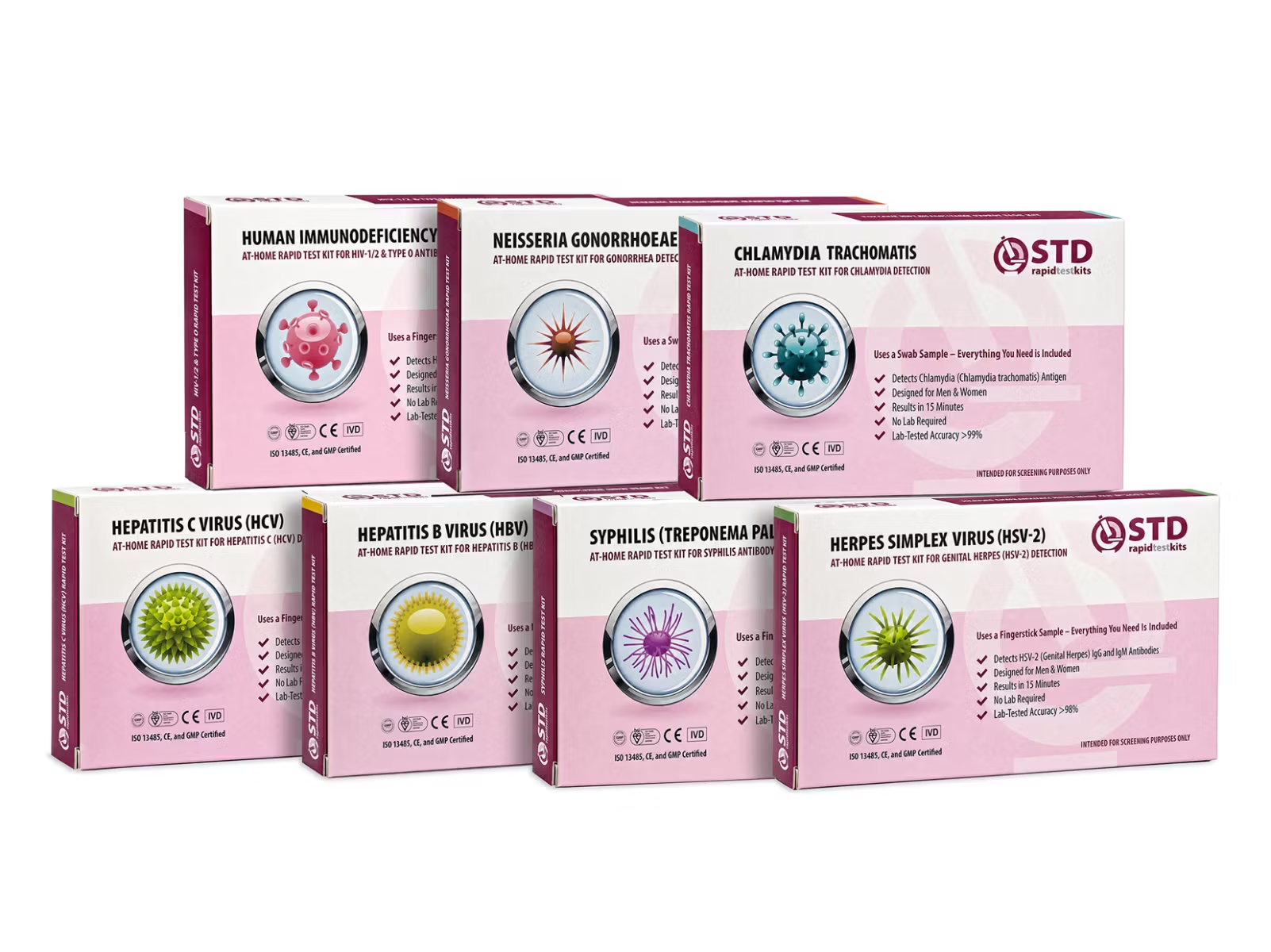
For people who would prefer to test broadly and privately before a clinic visit, an at-home multi-panel kit can screen for several common infections in one round. That is especially helpful when the original exposure context is uncertain or when there have been multiple recent partners. stdrapidtestkits.com sells rapid at-home STI test kits; product links below go to our own catalog.
Reinfection Risk When Your Partner Stays Silent
Treatment clears the infection from your body. It does not clear it from anyone else who was part of the original exposure. If you complete treatment and your partner refuses treatment or simply refuses to respond, there is a measurable risk of reinfection if you resume sexual contact with them. That risk is a fact of microbiology rather than a moral judgment.
Reinfection rates for chlamydia and gonorrhea inside three to twelve months after the index case's treatment are notably high when the partner remains untreated, which is the specific reason the CDC recommends retesting at about three months after treatment. The treatment did not fail. Exposure simply recurred from the same untreated source. The table below summarizes the practical posture to take based on what you know about the partner's status.
| Scenario | Risk level | Recommended action |
|---|---|---|
| Partner treated and clearance confirmed | Low | Resume sexual activity after both have medical clearance |
| Partner status unknown, no contact possible | Moderate | Retest at 3 months and avoid contact until clarity |
| Partner refuses treatment but stays in contact | High | Avoid sexual contact; consider involving public-health partner services |
What the Law Actually Says About Partner Notification
At some point, usually somewhere around midnight, the question turns legal. Am I required to keep contacting them? Could I be held liable if they never reply? What if they later accuse me of giving it to them?
In most U.S. states, there is no law requiring you to chase down a partner who refuses contact. Where legal responsibility for STI exposure does exist, it generally applies to knowing exposure without disclosure, not to a good-faith attempt to inform a silent person. You tested, you attempted contact, and you initiated treatment. That sequence stands on its own.
For HIV specifically, several states have written disclosure statutes and the obligations vary by jurisdiction. For bacterial infections like chlamydia and gonorrhea, the legal framework is usually a public-health reporting structure rather than criminal enforcement. Many state health departments will conduct partner notification on your behalf as part of routine disease-intervention work, and that process is confidential by design. If you are unsure about the rules where you live, your county or state health department's STI program is the most direct place to ask.
Partner services are free and confidential services offered to people with HIV or another sexually transmitted infection and their partners. They help people get tested and, if needed, treated.
The Emotional Layer of Being Ignored
The physical pathway is straightforward. Antibiotics, antivirals, and follow-up testing all exist and work. What destabilizes most people in this situation is the social layer, the experience of vulnerability being met with disappearance instead of a reply.
It can help to separate two distinct things. A positive STI result is a medical event. Ghosting is a behavioral choice the other person made. They happened to overlap in time, but they are not the same kind of fact, and they do not say the same thing about you. The diagnosis came from a bacterium or virus. The silence came from a person who was unwilling or unable to engage with the situation.
Silence in this moment can mean denial, fear, shame, or simple avoidance. None of those make your underlying condition worse or your responsibility larger. Untreated infections spread further; hurt feelings, while real, do not. The most useful redirect is toward measurable next steps: confirm treatment, mark your retest date, and decide what level of disclosure you want with people you might be intimate with in the next few months. If you can do only one thing before closing this page, write down your retest date.
How Long to Abstain From Sex After Treatment
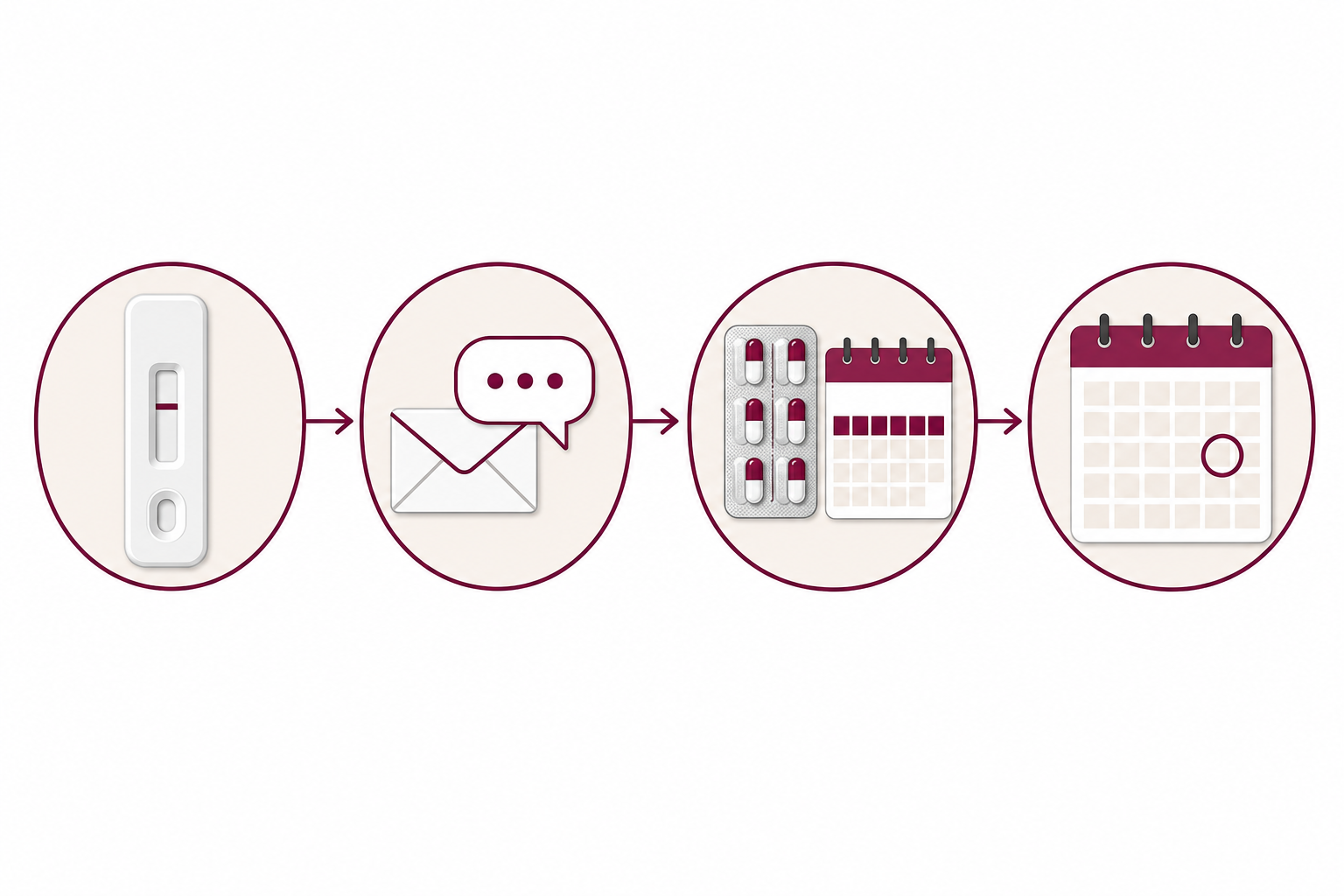
The standard clinical guidance after treatment for bacterial infections like chlamydia or gonorrhea is to abstain from sex for seven days after the full course of antibiotics is complete. The difference between starting and completing matters because bacteria need time to clear, and resuming sexual contact before that point raises reinfection risk, especially if the original partner has not been treated.
For viral infections the picture shifts. Herpes outbreaks raise transmission risk substantially, so the standard advice is to avoid sexual contact during an active outbreak and to use barrier protection between outbreaks. For HIV, sustained antiretroviral therapy can suppress viral load to undetectable levels, and at that point sexual transmission risk is effectively zero, the principle commonly summarized as Undetectable equals Untransmittable, supported by the CDC's HIV treatment guidance. Reaching that point takes consistent medication and regular monitoring with a clinician.
The temptation when a relationship goes silent is to rush back into casual contact, partly to fill the social space. The medically protective choice is to wait the full recommended interval, retest at the right window, and only then reenter sexual activity from a position of confirmed clearance.
Abstinence windows at a glance
- Bacterial STIs (chlamydia, gonorrhea, early syphilis): wait seven days after completing the full antibiotic course, not after starting it.
- Genital herpes: avoid sexual contact during active outbreaks; use barrier protection between outbreaks to lower transmission risk.
- HIV: follow your clinician's guidance on antiretroviral therapy and viral-load suppression before resuming unprotected sex; sustained undetectable viral load effectively prevents sexual transmission.
If They Finally Reply, and It Turns Hostile
Sometimes the silence breaks with accusation instead of accountability. Your phone buzzes, and the tone is, "I do not have anything," or, "You must have given it to me." That shift from avoidance to attack can knock the wind out of you, especially when you were the one who initiated the disclosure in the first place.
Take a breath before you respond. A positive result does not automatically prove the direction of transmission. Chlamydia and gonorrhea are commonly asymptomatic for weeks or months, herpes can lie dormant between outbreaks, and syphilis moves through stages quietly. Transmission timelines are rarely clean, and arguing who-gave-it-to-whom rarely produces a useful outcome.
Keep your message factual and short. You are sharing health information rather than litigating fault. If the conversation escalates further, disengaging is protective, and your responsibility was disclosure rather than emotional arbitration. At that point, their decision about whether to test is separate from your completed obligation, and redirecting your energy toward your own treatment timeline is the more useful move.
If you need words to start with, this is enough:
"I tested positive for [infection] and wanted to let you know so you can get tested too. I am not blaming you, and I don't need a debate. I just wanted you to have the information."
You do not have to defend, explain, or argue. You shared a health fact. The next step is theirs.
Testing Again When Anxiety Will Not Quiet Down
Even after treatment and the recommended abstinence window, some people carry a residual hum of worry. What if something else was missed? What if there was a second exposure that did not seem important at the time? Comprehensive screening converts that loop from "I should worry about this" to "I have data."
A multi-panel at-home kit checks several common infections in a single round, which is useful both for peace of mind and for catching anything outside the original test's scope. The same logic applies if you are simply re-entering dating after a quiet stretch and want a clear baseline. Testing on your own timeline, in private, lowers the activation energy compared with booking a clinic visit specifically to ask about a worry.
Choosing to retest is a maintenance decision rather than a sign of weakness, and it mirrors the same logic a clinician would apply when ordering a follow-up panel after any course of treatment.
Moving Forward Without Closure
Closure feels essential when you imagine it from the outside. From inside the situation, it is often the part that never arrives. You can complete treatment without hearing an apology, retest without hearing a thank-you, and rebuild trust in your own judgment without a final message from the person who went silent.
What stays with you long-term is the evidence that you handled the situation responsibly. You tested, disclosed, and sought medical care. You protected anyone you might be intimate with in the months ahead. Reciprocity from the other side would have been the easier outcome, and you are allowed to be disappointed it did not happen. Reciprocity was not, however, a precondition for doing the right thing.
Modern medical care for recovery exists and works. Rapid testing, confidential treatment, and accessible follow-up are all part of the standard pathway.
Three forward actions to anchor on
- Complete your treatment course in full, even after symptoms resolve.
- Schedule the retest at the right window for your specific infection (about 3 months for chlamydia and gonorrhea, structured serologic follow-up for syphilis and HIV).
- Use barrier protection with any new partners until your follow-up testing confirms clearance for curable infections.
FAQs
- Can I get treated for an STI without my partner's involvement?
- Yes. Same-day treatment is standard for bacterial STIs at most clinics, and prescribing is based on your result, not on anything your partner does or says. Clinics do not require partner confirmation to start antibiotics for chlamydia, gonorrhea, or syphilis, or to start antivirals for a herpes outbreak. Waiting for a partner to reply only delays your own recovery.
- What if I tested very soon after exposure and worry about a false negative?
- Plan a retest at the optimal window for the specific infection: about 2 weeks for chlamydia and gonorrhea, around 6 weeks for HIV Ag/Ab combination tests, and around 12 weeks for HSV blood-antibody testing. A negative test taken inside a window period is not yet conclusive, so the second test confirms the result.
- Can I notify a partner anonymously if they have blocked or ghosted me?
- Yes. Most U.S. state health departments offer confidential partner-services programs that contact named partners without revealing your identity. Several online tools also let you send an anonymous notification by text or email. The CDC STI program describes how the public-health route works in practice.
- How long should I wait before having sex again after treatment?
- For bacterial infections like chlamydia and gonorrhea, the standard is seven days after the full antibiotic course is complete, not seven days after starting. For herpes, avoid contact during active outbreaks and use barrier protection between them. For HIV, sustained antiretroviral therapy that achieves undetectable viral load effectively prevents sexual transmission, but reaching and maintaining that state requires medical follow-up.
- Do I have to keep trying to reach them?
- No. A reasonable attempt at notification, typically one or two clear messages, is generally considered sufficient from a public-health and ethical standpoint. After that, anonymous partner services through your state health department is a credible alternative path, and you can redirect energy back to your own treatment and retesting.
- Could I be held legally responsible if they never respond?
- In most U.S. states, no. Legal responsibility for STI exposure usually applies to knowing exposure without disclosure, not to a good-faith attempt to notify someone who chose not to reply. For HIV, some states have specific disclosure statutes. Your county or state health department's STI program is the most direct route for jurisdiction-specific guidance.
- Should I retest after I finish treatment?
- For chlamydia and gonorrhea, the CDC recommends retesting about three months after treatment, primarily to catch reinfection from a partner who may not have been treated. For other infections, the retest cadence depends on the specific diagnosis and your clinician's guidance, with HIV and syphilis typically followed by structured serologic checks.
- What if I do not even have their contact information?
- Complete your own treatment, abstain for the medically recommended window, and retest within the appropriate timeframe. For any future partner, disclose before sexual contact until your follow-up testing confirms clearance for curable infections. There is no retroactive obligation when contact information is genuinely unavailable, only forward responsibility with new partners.
How we sourced this article: Our editorial team consulted current public-health and clinical guidance from the CDC, WHO, NHS, and MedlinePlus on STI testing, treatment, and partner notification, plus the CDC's chlamydia program page for the three-month retest recommendation and the CDC's HIV treatment guidance for the Undetectable equals Untransmittable principle. The recommendations in this article reflect that evidence base, translated into plain-language steps a reader can act on at home, with each numeric or clinical claim linked to its source.
- CDC Sexually Transmitted Infections Treatment Guidelines. Used for antibiotic regimens for chlamydia, gonorrhea, and early syphilis, and for diagnostic-standard NAAT framing.
- CDC STI program homepage. Used for the confidential partner-services framing and the public-health rationale behind partner notification.
- World Health Organization Fact Sheet on Sexually Transmitted Infections. Used for global incidence framing and testing-and-treatment overview.
- NHS Sexually Transmitted Infections. Public-information page used for general testing options and post-exposure steps.
- CDC About Chlamydia. Used for the asymptomatic-infection context and the three-month retest cadence after treatment.
- CDC HIV Treatment. Used for antiretroviral therapy and the Undetectable equals Untransmittable (U=U) principle.
- MedlinePlus Sexually Transmitted Diseases. NIH consumer-health overview used for general STI background and reader-friendly definitions.
