
Published: November 2025 | Last updated: May 2026 | Editorial review and quality control: Martina N.
The text from the lab read “positive for HSV-2,” and Casey’s phone suddenly felt heavier than the result itself. Their pulse did not race from fear of the virus. It sank under a different weight: every joke, headline, and dating-app bio they had ever absorbed about what an STD says about a person. Casey, 26, was reading a medical result, while the voice in their head was already writing a different sentence: “Who is going to want me now?”
For many people, the hours and days after a positive STI result feel less like a medical event and more like a social rupture. One day you are someone who dates, flirts, and enjoys your body. The next, you feel like someone who gets pitied, avoided, or ghosted. Even when friends and partners are supportive, something inside shifts. Diagnosis can feel like rejection, sometimes before anyone has actually rejected you.
Key Takeaways
- The shame and identity rupture you feel after an STD diagnosis is a stigma response, not a verdict on your worth or your future.
- Healing happens in waves, and disclosing, dating, and rebuilding confidence are skills you grow with practice, with support, and with clear information from sources like the CDC and WHO.
When Diagnosis Feels Like a Breakup (Even If No One Dumped You)
The first sting of an STD diagnosis is rarely about the pathogen. It is about identity. A virus or bacterium is a biological event. A diagnosis, in our culture, often gets read as a moral one, so the nervous system reacts the way it does to social exclusion. The U.S. Centers for Disease Control and Prevention notes that stigma can leave people who have tested positive feeling shame, fear of disclosure, isolation, and despair, and that those feelings can keep people from getting tested and treated (CDC, Let’s Stop HIV Together).
This is not weakness or overreaction. It is what humans do when a piece of news threatens how they think they belong. Even when no one else has been told, the imagined reaction in your head can hit as hard as a real conversation. According to CDC clinical guidance, the majority of STDs are either curable with antibiotics or fully manageable with modern antiviral medication. The harder thing to treat is the social meaning we have layered on top of them.
The CDC’s Let’s Stop HIV Together campaign names shame, fear of disclosure, isolation, and despair as the documented emotional responses to a positive result. Each of those is a stigma effect rather than a symptom of the virus, and each is something a calmer information environment can soften.
What Shame After Diagnosis Really Looks Like
The shame does not come from the diagnosis itself. It comes from years of absorbed messaging: high school jokes about “dirty girls,” dating-app bios that say “disease-free only,” a health class that framed STDs as moral failings instead of medical events. When you test positive, those messages activate like a virus of their own.
You might suddenly avoid mirrors. You might overexplain to a new partner, trying to prove you are still worth loving. You may mentally audit your past: was I too reckless, was this my fault, did I ruin myself? Those thoughts are not facts. They are trauma responses, well documented in the clinical literature on internalized health stigma.
Shame does not always scream. Sometimes it creeps. It can show up as isolation, dating avoidance, or anxious attachment patterns. It can even look like hypersexuality, where someone tries to reclaim desire by proving they are still desirable. Peer-reviewed reviews of STI-related stigma consistently find that women and LGBTQ+ patients report the steepest drops in perceived self-worth after a positive result, and that drop correlates more closely with cultural exposure to shame messaging than with the medical severity of the infection.

What Makes an STD Feel Like Rejection?
Let’s break this down clinically and emotionally. Why does a lab result feel like getting dumped, even when no one has said a word? The answer is mostly about how the brain translates social risk into physical sensation. Each of the triggers in the table below is one step in that translation, from the moment you read the result to the imagined fallout that follows. Clinical psychology calls this pattern “core shame activation,” where a triggering event reawakens a deeper belief that you are bad or unworthy. Guilt focuses on something you did; shame focuses on who you are, which is why a single test result can feel like a verdict on your entire self. Recognizing the difference is the first step toward responding to the feeling without believing it.
| Trigger | Emotional Translation |
|---|---|
| Seeing a positive result | “I am now a burden or a threat to others.” |
| Imagined partner reaction | “No one will want to touch me again.” |
| Fear of disclosure | “They will think I am dirty or careless.” |
| Unfamiliar physical symptoms | “My body is broken or contaminated.” |
| Ghosting after a disclosure | “See? I was right. I am unlovable now.” |
The Stigma Machine: How Culture Makes It Worse
You did not invent these feelings. They were programmed. Sex education in much of the United States still frames STDs as failure, as something that happens to people who are irresponsible, dirty, or morally weak. In some school systems, fear-based images of herpes sores are paired with phrases like “permanent consequences.” That kind of teaching sinks deep, well before the average person ever needs to think about testing.
Dating apps reinforce it. Profiles that proudly list “DDF” or “clean only” frame sexual health as moral currency, where “clean” is positioned as the opposite of contagious. Pop culture has not helped either, since STDs are still used as punchlines, character assassinations, or a fast way to write someone off as a cautionary tale.
Some clinical encounters echo that tone, even when no one intends harm. A rushed visit, a sigh, or a clipped question can make a patient feel like a failure instead of a person who needs care. The CDC reports that millions of new STI infections occur in the United States every year, and stigma remains one of the primary barriers to timely testing (CDC, About Sexually Transmitted Infections).
That fear of being read as careless is what makes disclosure so hard. You are not just sharing a medical fact. You are inviting judgment on your worth, and you know it.
NHS sexual health guidance consistently emphasises that patients are entitled to care without judgment, that visits are confidential, and that you can switch providers if a clinic feels unwelcoming. If a clinician’s tone leaves you feeling small, that is a service failure, and it is not a verdict on you. You are entitled to switch providers or use an at-home option without losing access to care.
When Rejection Becomes Real: What Happens After Disclosure
Alejandro, 31, did not expect it to go this way. He built up the nerve to tell someone he was seeing that he had genital herpes. He followed the standard advice: calm voice, facts first, disclosure before sex, mention of antivirals. She went quiet, then unmatched, then blocked him. “It felt like getting dumped for something I did not even do wrong,” he said.
This is the part of STD stigma that cuts deepest: what some people choose to do with the information you share. Ghosting after disclosure, judgmental reactions, awkward avoidance, each of these reinforces the feeling that you are now marked, less than, or unwanted. Even when rejection does not happen, the fear of it can be paralyzing.
Here is the reframe. Someone can ghost you simply because they do not know how to respond, and that has nothing to do with your worth. It makes them emotionally unequipped in that moment. When you are already feeling vulnerable, silence can land like confirmation of your worst fear: that you are no longer desirable. The people who handle disclosure well are the only ones whose response should be allowed to define how you see yourself.
Sharing an STI status with a partner is a form of informed consent. It takes courage, and it is health information offered in good faith. A reaction of warmth, neutral questions, or even a thoughtful pause is a sign of an emotionally available partner. A reaction of disgust or ghosting is the boundary you set doing its job.
The Healing Timeline: What Recovery Looks Like (Emotionally)
Physical recovery from most STDs, especially with treatment, is straightforward. Bacterial infections like chlamydia, gonorrhea, and syphilis clear with antibiotics. Viral infections like HSV and HIV are well managed with modern medication. Emotional recovery has no prescription pad, and no guaranteed timeline. Healing from diagnosis-related shame happens in waves, and some waves hit harder than others.
The arc below is drawn from therapy-informed grief and stigma models, and it tracks what most people describe in support groups, clinical counseling, and patient interviews. You do not have to “love” your diagnosis. You do not have to be grateful for the lesson.
| Emotional Phase | Common Feelings | Typical Duration |
|---|---|---|
| Shock and denial | Numbness, disbelief, frantic Googling | Hours to a few days |
| Shame spiral | Self-blame, disgust, worthlessness | Days to weeks |
| Hypervigilance | Symptom checking, avoiding dating, body monitoring | Weeks to months |
| Tentative acceptance | Normalizing, reading stories, reclaiming identity | Varies widely |
| Empowerment | Disclosing without fear, setting boundaries | Ongoing |
When Your Inner Voice Turns Toxic
After diagnosis, the hardest voice to manage is not the world’s, it is the one inside your head. That voice can be brutal. “No one will want you now.” “You are contaminated.” “You ruined your shot at a normal sex life.” Those thoughts are not truths. They are echoes of a culture that taught you health equals purity, and infection equals failure.
Here is the reframe. An STD does not make you broken. It makes you biologically normal. The World Health Organization estimates that more than 1 million curable sexually transmitted infections are acquired worldwide every single day, the majority of them asymptomatic (WHO STIs Fact Sheet). Viral STIs such as HSV and HPV are tracked separately and add hundreds of millions of cases to the global total under disease-specific surveys.
Your worth is not conditional on someone else’s comfort with your status. When someone cannot hold space for the truth you are sharing, that says something about their capacity, and it does not diminish your value. The people who matter will not flinch.
Stigma can make people living with HIV feel ashamed, isolated, and afraid to seek the care they need. Knowing the facts helps reduce stigma and supports better health for everyone.
You Are Not Dirty. You Are Not Alone.
Let’s say it clearly. You are not dirty, irresponsible, or worth any less than you were before the result. STDs are infections. They are common, often symptomless, and either treatable or well managed with modern care. The real public-health problem in 2026 is the stigma, and it is not the STI itself.
If you have been diagnosed, you are now part of a large global cohort. The CDC reports that millions of new STI infections occur in the United States every year, affecting people across all demographics and relationship types (CDC, About STIs). Acquiring an STI is a biological event. The judgment that follows is a cultural one, and the two do not need to travel together.
If you are spiraling right now, take a slow breath. The person you were before the result is still here, and the steps below are the ones that most reliably bring them back into the room.
The WHO estimates more than 1 million new curable STIs are acquired worldwide every single day, alongside hundreds of millions of people living with chronic but manageable viral infections like HSV and HPV. Whatever you are feeling about your result, you are not feeling it alone.
Compassionate Next Steps That Actually Help
Reclaiming confidence after an STD is not a makeover, and it is not a single pep talk. It is slow, layered, nonlinear work. The repeatable steps that show up across therapy-informed models, sexual-health counseling, and patient interviews look like this:
- Name the feeling. Write down the specific story you are telling yourself (“no one will want me,” “I deserved this”). Naming a thought is the first step in challenging it.
- Get the medical facts. Read the relevant CDC, WHO, and NHS fact sheets for your specific diagnosis. Knowing transmission rates, treatment options, and the actual prognosis usually cuts the catastrophizing in half.
- Find one safe person. A close friend, a therapist, a peer support group, or a moderated online community where you can be honest without performing.
- Plan disclosure, do not improvise it. Decide ahead of time what you want to say, what level of detail you are comfortable with, and when in a new relationship you will share it.
- Re-enter dating on your own timeline: you decide when you are ready, regardless of outside pressure.
The second step matters more than most people expect. Diagnosis-related shame thrives in vagueness, and the clearer the medical facts you carry into a conversation, the smaller the catastrophic voice in your head tends to get.
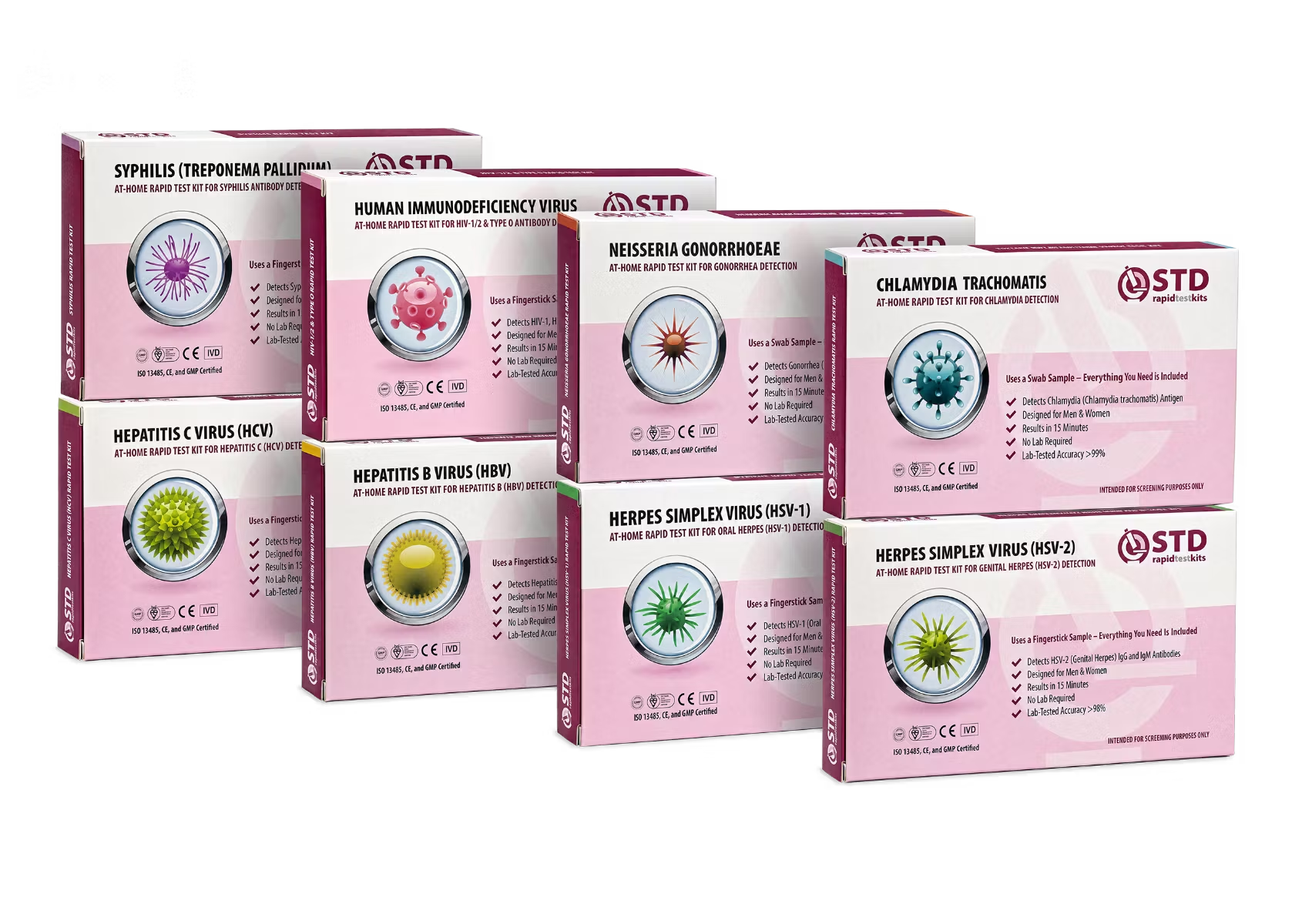
This article is published by stdrapidtestkits.com, which sells at-home STI testing kits. The products linked below are from our own catalog. We recommend them based on fit for the reader’s concern, not commercial benefit, and we will say so plainly when a clinic visit is the better option.
How to Date Again Without Apologizing for Your Body
Dating after an STD diagnosis can feel like a leap. In practice it functions more like a reclamation, a way of saying you are still here, still desirable, and still in charge of your own romantic life. You are not damaged goods. You are a person who knows your status, cares about consent, and is brave enough to be honest, and that kind of integrity tends to attract people who can match it.
Tasha, 24, did not date for six months after finding out she had genital herpes. “I just assumed no one would want me,” she said. Eventually she got tired of hiding. She added a line to her dating profile about valuing honesty and open conversations on sexual health. On her second date back, she disclosed. He nodded, said “I appreciate you telling me,” and they kept eating tacos.
What made that moment matter was not the acceptance from someone else. It was that Tasha had stopped rejecting herself. When you are ready to date again, you get to choose how much you disclose, when, and how. You do not owe anyone your full medical history on a first coffee. When intimacy is on the table, transparency becomes part of trust, and the right people will not flinch.

How to Tell Someone You Have an STD (Without Feeling Small)
Disclosing to a potential partner can feel like the emotional equivalent of standing under fluorescent lights with nothing to hide behind. It does not have to be a shame bomb. Think of disclosure as a boundary, a filter, and a self-trust exercise all at once, because each role it plays serves you whether or not the conversation goes well.
Frame the conversation as health information rather than a confession. You are sharing context. You are taking ownership of your body without apologizing for it. The wording in the box below is one calm, low-pressure version that has worked well for the people we interviewed.
If someone reacts with disgust, ghosting, or hostility, that is not your shame to carry. The boundary you set is doing its work. Rejection in this context is redirection toward someone emotionally safe enough to deserve your vulnerability. Disclosure is not a tool for convincing someone to stay. It is information that lets them meet you with care, and it lets you heal in community instead of isolation.
“Before things go further, I want to be upfront. I tested positive for [STD], I manage it with [treatment if applicable], and I care about transparency. I am happy to answer any questions you have.”
Adjust the wording to your voice. Practice it out loud once before you need it, so the first time you say it is not under pressure.
Yes, You Can Still Have Good Sex After Diagnosis
If you have ever wondered whether a diagnosis ends your sex life, the answer is no. Sex changes but it does not end. Many people describe sex after an STI diagnosis as more purposeful, more open, and more connected, because the conversations they used to avoid suddenly become normal.
There will be pauses to talk about medication, condom use, viral shedding, or timing. These are intimacy-building, not deal-breaking. They are trust exercises, and they are how adults who care about each other have sex.
When a partner knows your status and still wants you, the experience is not charity. It is clarity, consent, and care made physical. Peer-reviewed research on sexual wellbeing after STI diagnosis consistently finds that people who feel supported after disclosing report higher satisfaction than people who never disclose at all, because being seen and still wanted rebuilds self-worth in a body-based way that talk therapy alone cannot replicate.
Peer-reviewed studies on post-diagnosis sexual wellbeing consistently find that people who feel supported after disclosing an STI report higher satisfaction than people who never disclose at all. Disclosure is not a tax on your sex life. It is a filter that protects the part of your sex life worth keeping.
What Slows Down Healing (And What Does Not)
Sometimes what hurts most is not the diagnosis, it is how we interpret it. People often assume they have to fully “accept” their status before they can heal. In practice, healing often starts before acceptance kicks in. You can be messy, mad, and still moving forward at the same time. The myth table below collects the most common misconceptions about emotional recovery, and what clinical practice and patient experience suggest instead.
What slows people down most is rarely the virus. It is silence. The more we name what we are feeling in journals, in therapy, in support groups, and in plain conversation, the less power the silence has to keep us stuck.
| Myth | Why It Is Wrong |
|---|---|
| I have to forgive myself before dating again. | Forgiveness is a process. You can date while healing. You are not a project to complete. |
| Disclosure will always lead to rejection. | Many people respond with respect, curiosity, or shared experience. Some will thank you for the trust. |
| I need to fully educate my partner during disclosure. | You can offer resources, but you are not a walking PSA. “I am still learning too” is a complete sentence. |
| Having an STD means I cannot have spontaneous sex. | You can. Spontaneity now includes brief conversations as well as condoms. |
FAQs
- Why did testing positive feel like getting dumped?
- Your brain is reacting to more than the result. It is reacting to a lifetime of cultural messages that taught you STDs are a moral failing. A diagnosis can trigger the same grief response as a breakup, even when no one has left you. The pain is real, and stigma is doing more of the work here than the infection itself.
- Is it normal to feel dirty or contaminated after an STD diagnosis?
- It is extremely common. The feeling is not about the infection. It is about years of messaging that framed STDs as punishment instead of as part of being human. You are not contaminated. You are a person with a manageable health condition, and you still deserve pleasure, connection, and care.
- How soon can I start dating again after a diagnosis?
- As soon as you want to. There is no formal waiting period for self-esteem to return. You can date while still healing emotionally. Just be gentle with yourself, because rejection lands harder when you are already raw, and the first few dates back are usually the most vulnerable ones.
- What is the best way to tell someone I have an STD?
- Use a calm voice, share the facts, and skip the apology. Try something like, “Before things go further, I want to be upfront. I tested positive for [X], I manage it, and I always aim to be transparent. If you have questions, I am happy to answer them.” Then breathe. You just did a brave thing.
- What if someone ghosts me after I tell them?
- Ghosting is rarely a verdict on your worth. It usually means the other person did not know how to respond, and silence felt easier to them than vulnerability. The people who matter will not run. They will listen, ask questions, and stay.
- Will I ever stop feeling ashamed?
- Not overnight, and probably not in a straight line. Shame fades when it is exposed to air. Talk about it with people you trust, read stories from others who have walked the same path, and reclaim your body on your own terms.
- Do I have to tell every person I date?
- Not every casual swipe, no. Once intimacy is on the table, yes. That is about trust and informed consent. You get to decide when and how to share, and withholding it entirely in sexual situations is not fair to either of you.
- Can I really use an at-home test and skip the clinic?
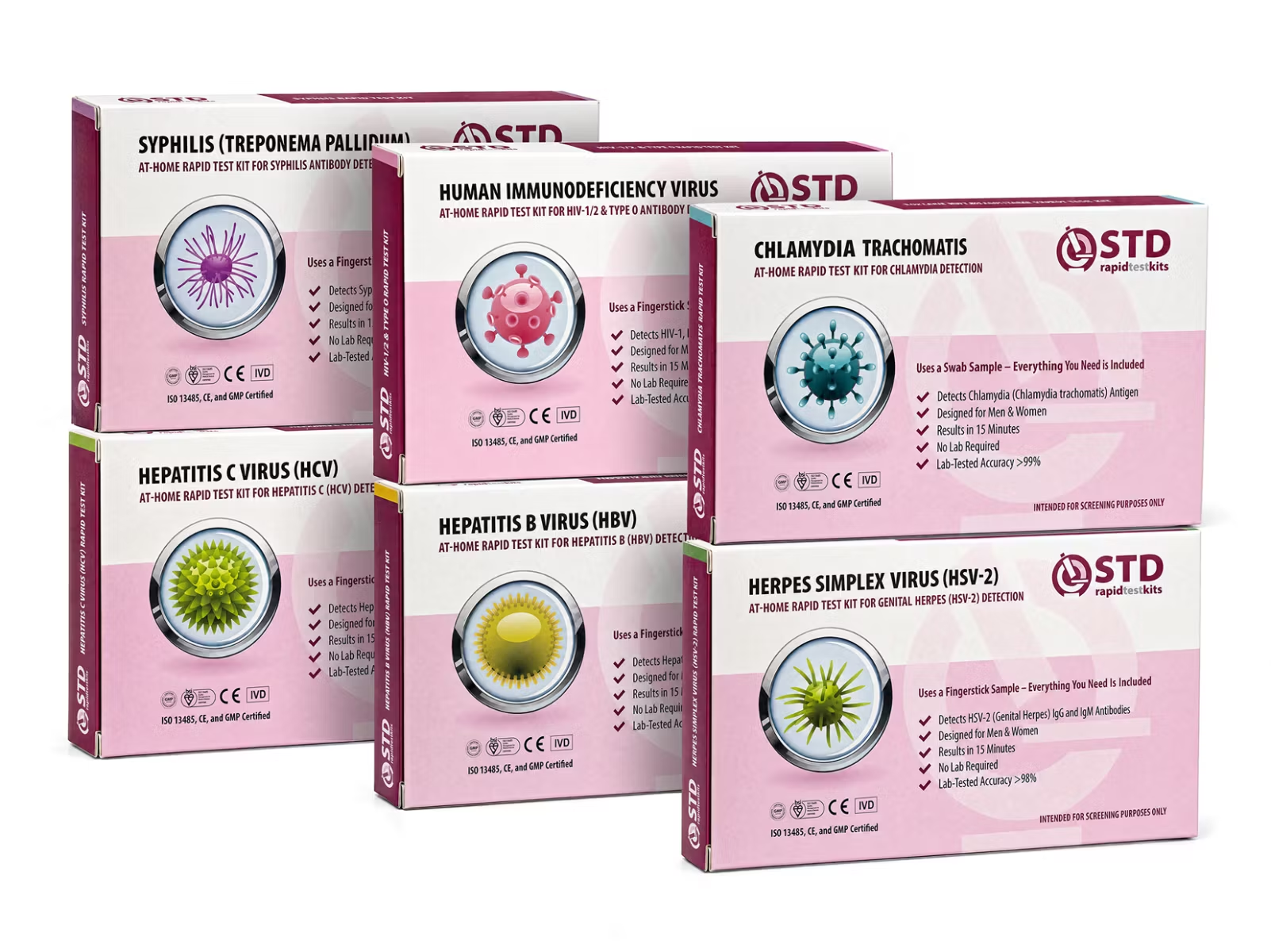
- For many common STIs, yes. At-home rapid kits use lateral-flow immunoassay chemistry, not PCR; they are well-suited for screening and give results in about 15 minutes per cassette. A positive at-home result is worth confirming with a lab NAAT, especially if you are asymptomatic, and any active visible lesion is worth a clinic visit. For routine screening between clinic appointments, a reputable rapid kit is a practical option.
You Are Still You, and You Deserve to Feel Whole Again
If you are reading this with a lump in your throat or a pit in your stomach, here is what to hold onto. The person you were before the diagnosis has not disappeared. They are doing the slow work of integrating new information about their body, and that work is closer to growth than to punishment. You are not broken, and you are not a warning sign; you are a whole person who has gone through something intimate, vulnerable, and very human.
Your story does not end here. It expands, into new kinds of intimacy, new versions of honesty, and a deeper kind of self-respect that does not flinch when life gets messy. If you want to take back a piece of control, testing can be a powerful first step or a healing next one. An at-home combo kit covers several of the most common STIs in unbranded packaging, on your timeline, with results in about 15 minutes per cassette.
A positive STI result is information about your body, not a verdict on your worth. You are still the person your friends love, still the person a future partner will be lucky to know, and still allowed to want pleasure, intimacy, and care.
How We Sourced This Article: We combined current guidance from the U.S. Centers for Disease Control and Prevention, the World Health Organization, and the U.K. National Health Service with peer-reviewed research on stigma, internalized shame, and sexual wellbeing after STI diagnosis. We then layered in real-world experiences described in patient interviews and moderated support communities. Quotes from individuals have been anonymized and lightly edited for clarity.
- U.S. Centers for Disease Control and Prevention. Let’s Stop HIV Together: HIV Stigma. National stigma-reduction campaign covering the emotional impacts of HIV-related shame, including shame, fear of disclosure, isolation, and despair.
- U.S. Centers for Disease Control and Prevention. About Sexually Transmitted Infections. Overview of common STIs, screening recommendations, U.S. annual incidence figures, and the role of stigma as a barrier to timely testing.
- World Health Organization. Sexually transmitted infections (STIs) fact sheet. Global incidence figures for curable STIs, transmission routes, and the role of stigma in barriers to testing.
- U.K. National Health Service. Sexually transmitted infections (STIs) overview. Patient-facing guidance on testing, treatment, confidentiality, and access to care without judgment.
- U.S. Centers for Disease Control and Prevention. HIV (program landing page). Reference for transmission, prevention, and the long-term manageability of HIV infection with modern antiretroviral therapy.
