
Published: December 2025 | Last updated: May 2026 | Editorial review and quality control: Martina N.
You finished treatment for syphilis. The injection or pill course is complete, your symptoms have eased, and you want this behind you. Then a follow-up test comes back reactive, and your stomach drops. Did the treatment fail? Are you still contagious? Do you have to start over?
Usually not. A reactive result after treatment is expected with one type of syphilis test and clinically meaningful with another. Knowing which is which is the difference between a confusing month of anxiety and a clear picture of what is actually happening in your body.
This guide walks through the standard retesting schedule, what the numbers on your lab report mean, and when an unexpected titer signals reinfection rather than treatment failure. It draws on current syphilis follow-up guidance from the CDC, the WHO, and the 2020 European IUSTI syphilis guideline.
Key Takeaways
- After treatment for early syphilis, the CDC recommends repeat serologic testing at 6 and 12 months to confirm cure, with the schedule extended to 24 months for late latent infection.
- Treponemal tests can stay positive for life, so providers track non-treponemal titer changes (RPR or VDRL); a fourfold drop indicates successful treatment, not a clean negative.
Why a positive syphilis test doesn't always mean active infection
Syphilis testing happens in two flavors, and they answer different questions. Once you understand the split, the rest of follow-up testing makes sense.
Treponemal tests (FTA-ABS, TPPA, EIA, CIA) detect antibodies your immune system made against Treponema pallidum, the bacterium that causes syphilis. Those antibodies are usually permanent. Once your body has seen syphilis, the treponemal test will likely read reactive for the rest of your life, even after you are completely cured. This is not a failure of treatment. It is a record that your immune system did its job.
Non-treponemal tests (RPR, VDRL) detect antibodies tied to active tissue damage. They are reported as a titer, written as a ratio: 1:8, 1:32, 1:128. The higher the dilution at which the result is still reactive, the more antibody activity is present. When syphilis is successfully treated, the titer drops. When it does not drop, or starts climbing, something is still going on.
This is why a single post-treatment test by itself can mislead you. If your follow-up is run on a treponemal assay, a reactive result is expected and does not signal that the antibiotics failed. If it is run on a non-treponemal assay, the trend over time, not the reactive label, is what your provider cares about. The Mayo Clinic's overview of syphilis diagnosis describes the two-step testing strategy in more detail.
| Test Type | What It Detects | Stays Positive After Treatment? |
|---|---|---|
| Treponemal (FTA-ABS, TPPA, EIA, CIA) | Syphilis-specific antibodies (lifetime markers) | Yes, often for life |
| Non-Treponemal (RPR, VDRL) | Activity level of current infection (reported as titer) | No, should decline after cure |
The standard retesting schedule after syphilis treatment
Major guidelines, including the CDC's 2021 STI Treatment Guidelines and the 2020 European IUSTI guideline, recommend the same broad pattern for syphilis follow-up: repeat blood testing at fixed intervals after treatment, with the timing depending on the stage at diagnosis.
For early syphilis (primary, secondary, or early latent within the past year), expect retesting at 6 and 12 months. Your non-treponemal titer (RPR or VDRL) is expected to drop fourfold by the 6-month mark, meaning from 1:32 to 1:8, or from 1:64 to 1:16. That fourfold decline is the threshold providers use to call treatment successful.
For late latent syphilis or syphilis of unknown duration, retesting extends to 24 months. The immune response in late-stage infection is slower, so providers give the titer more time to fall.
If you have HIV, follow-up is more frequent: at 3, 6, 9, 12, and 24 months. Coexisting HIV can blunt the antibody response, and retesting more often catches treatment failure earlier.
One exception sometimes confuses people. If your first diagnosis came with a very low starting titer (1:2 or 1:4), a fourfold drop may not be measurable, and the test itself can read non-reactive afterward. In that case, your provider will use the absence of a rising titer plus symptom resolution as the marker of cure.
Retesting is not optional even when you feel fine. Syphilis is famous for going quiet, especially in latent stages, and a non-treponemal titer can creep up while you are completely asymptomatic. The schedule exists for that reason.
| Time Since Treatment | Expected Action |
|---|---|
| 3 months | Optional early check-in for high-risk or symptom-persistent cases; standard for people with HIV |
| 6 months | Standard retest to evaluate treatment success (fourfold RPR/VDRL titer drop) |
| 12 months | Confirm continued decline or stability in titers |
| 24 months | For late latent or syphilis of unknown duration: extended follow-up endpoint |
How long after syphilis treatment should I get retested?
For most people, retesting happens at 6 and 12 months after treatment. People with late latent syphilis are followed out to 24 months, and those co-infected with HIV are tested at 3, 6, 9, 12, and 24 months. The number to watch is your non-treponemal titer (RPR or VDRL); a fourfold drop within the expected window signals successful treatment.
Reading your titer numbers
The number after the colon in a titer (the "32" in 1:32) is the highest dilution at which your blood sample still reacted in the lab. Bigger numbers mean stronger antibody activity, which usually correlates with more active infection or a more recent exposure.
After treatment, two patterns suggest the antibiotics worked: a fourfold drop in titer within 6 months for early syphilis, or within 12 to 24 months for later stages. A drop from 1:64 to 1:16 is fourfold. A drop from 1:128 to 1:8 is sixteenfold, even better. Either way, you are tracking the trajectory, not chasing a clean negative.
Two patterns concern providers. The first is a titer that does not decline at all, called serologic failure. The second is a titer that drops and then climbs back up. Both prompt additional evaluation, which may include a lumbar puncture to rule out neurosyphilis, an HIV test if not already done, and re-treatment.
One subtlety: titer results from different labs are not always directly comparable. RPR and VDRL use slightly different methods, and even the same assay run at two different facilities can differ by a single dilution. For follow-up, providers prefer to use the same lab whenever possible so the comparison is apples to apples.

Reinfection vs. treatment failure: how providers tell them apart
A rising titer after treatment usually has one of two explanations: the antibiotics did not clear the original infection, or you were exposed again. Distinguishing the two changes what happens next.
True treatment failure is uncommon when penicillin G is given at the correct dose for the correct stage. It looks like a titer that never dropped meaningfully. If your starting RPR was 1:64 and six months later it is still 1:64 or 1:32, the immune response did not turn the corner. Providers usually retreat with an extended course of penicillin G and may add neurosyphilis evaluation.
Reinfection looks different. The titer drops appropriately after the first treatment, sometimes all the way to non-reactive, and then climbs months later, often after a new sexual encounter. A jump back up to 1:32 or higher in someone who was 1:4 a year ago is consistent with a fresh infection, not failed treatment. Reinfection is treated the same as a first case, with a new course of penicillin G dosed by the stage of the new infection.
Sexual history matters here. Providers will ask about new or untreated partners, condom use, and the timing of any potential exposures. Honest answers shorten the diagnostic path; vague ones lead to more tests. There is no value in protecting a partner's reputation at the cost of getting the right care.
The window period also matters. A non-treponemal test can take up to 90 days to turn reactive after a fresh exposure, so a retest done too soon after a new encounter can miss an early reinfection. If exposure is recent and your last titer was low, providers may pair an early RPR with a treponemal-specific assay or repeat testing at 90 days.
Stagnant titer (never dropped meaningfully): evaluate for treatment failure. Providers may extend penicillin G and consider neurosyphilis workup.
Titer dropped, then climbed after new exposure: consistent with reinfection. Treat as a fresh case, staged on current presentation.
When titers won't budge: the "serofast" pattern
A subset of people treated for syphilis end up in a third category that does not fit neatly into "cured" or "failed." Their non-treponemal titer drops, but stops short of a fourfold decline, and then sits there. The lab terminology is serofast, sometimes written as serofast reaction or serological non-response.
The serofast pattern is more common than most people realize. The 2020 European IUSTI guideline notes that 15 to 40 percent of treated cases can show some degree of serofast response, depending on stage, age, and HIV status. That does not mean the infection is still active or that you are contagious. It means your antibody production has settled into a holding pattern at a low level.
Most clinicians do not retreat serofast patients automatically. Instead, they evaluate the situation: is there evidence of neurosyphilis on physical exam or imaging, does the patient have HIV, are there new symptoms, was the initial treatment correct for the stage? If everything else looks clean, the serofast titer is monitored over time rather than chased with more antibiotics.
What changes the picture: a serofast titer that suddenly rises fourfold. That is treated as reinfection or relapse, not a continuation of the serofast state, and triggers retreatment plus additional workup.
If you land in serofast territory, the most important thing is to have a provider familiar with syphilis serology. Generalists sometimes recommend re-treatment based on a single reactive result; specialists are more likely to read the trend correctly and avoid unnecessary penicillin.
Per the 2020 European IUSTI guideline, 15 to 40 percent of treated syphilis cases show some degree of serofast response, with the rate varying by stage at diagnosis, age, and HIV status. A stable serofast titer, in the absence of new symptoms or exposure, is not on its own a reason to retreat.
Retesting after a new exposure
The standard 6 and 12 month schedule assumes nothing new is happening sexually during the follow-up window. Real life is messier. A new partner, a missed condom, or a partner whose treatment status is unclear all reset the clock in a different way: the question stops being "did treatment work?" and becomes "did I get exposed again?"
For high-risk exposure events after treatment, the CDC's STI guidelines suggest testing tied to the window period rather than the original treatment timeline. Non-treponemal tests can become reactive as early as 1 to 2 weeks after symptoms appear, but seroconversion windows can run out to 90 days after exposure. A retest at 3 to 6 weeks catches many fresh infections; a follow-up at 3 months covers the rest.
Practically, that means two retests after a high-risk exposure: an early one to catch active acute infection, and a confirmatory one at 3 months to close the window. If symptoms appear before either retest, get evaluated right away, since a visible chancre or rash is enough to act on without waiting for serology.
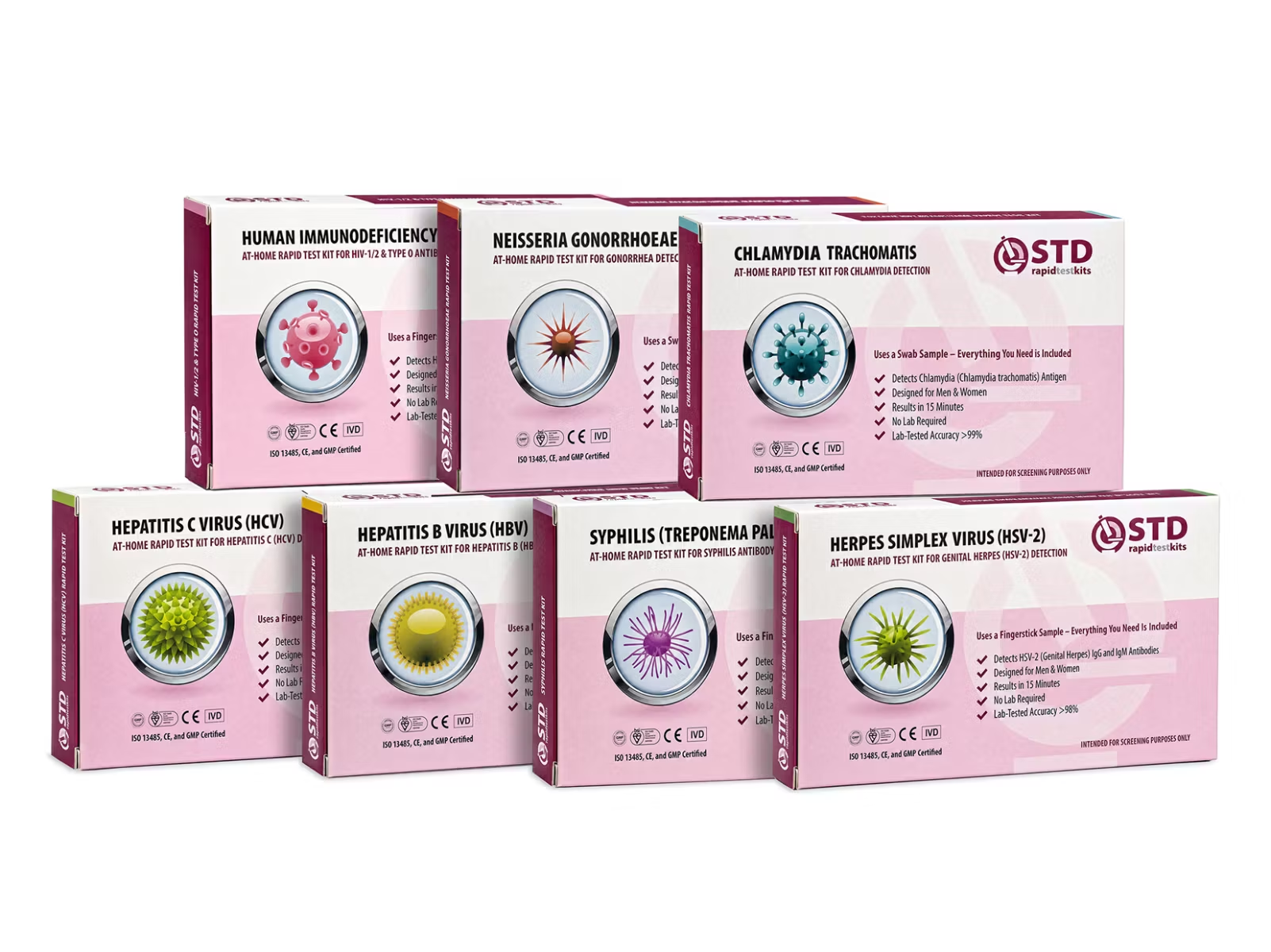
You do not need to remember every detail of the exposure to justify retesting. If the question is in your head, that is reason enough to test. Providers, at-home test kit services, and sexual health clinics are used to seeing people who cannot reconstruct the exact night, and they do not gate care on a perfect timeline. This site sells rapid at-home STI test kits; the panel below may be useful if you are screening after a new exposure alongside your syphilis follow-up.
Retest at 3 to 6 weeks to catch active acute infection, then confirm again at 3 months to close the 90-day seroconversion window. If a chancre or rash appears in the meantime, see a provider right away rather than waiting on serology.
At-home retesting and privacy
Home test kits have made follow-up testing simpler for people who do not want their results showing up in a shared insurance portal, a campus health record, or a small-town clinic that everyone uses. The trade-off is understanding what a home test actually measures, which matters more for syphilis than for some other infections.
Most at-home syphilis rapid tests use a fingerstick blood sample and detect treponemal antibodies. That is useful for an initial screen of someone who has never tested positive, but less useful for tracking treatment success after a prior diagnosis. Treponemal antibodies usually stay positive for life, so a reactive at-home result months after treatment does not tell you whether the infection is still active.
For follow-up testing where titer tracking matters, the more informative path is an RPR or VDRL run by a lab. Some at-home services collect a fingerstick sample and ship it to a CLIA-certified lab that runs the full non-treponemal assay; the result includes the titer ratio your provider needs to compare against your baseline. If you are using a home kit specifically for post-treatment follow-up, confirm before ordering that the kit reports a titer, not just a reactive or non-reactive label.
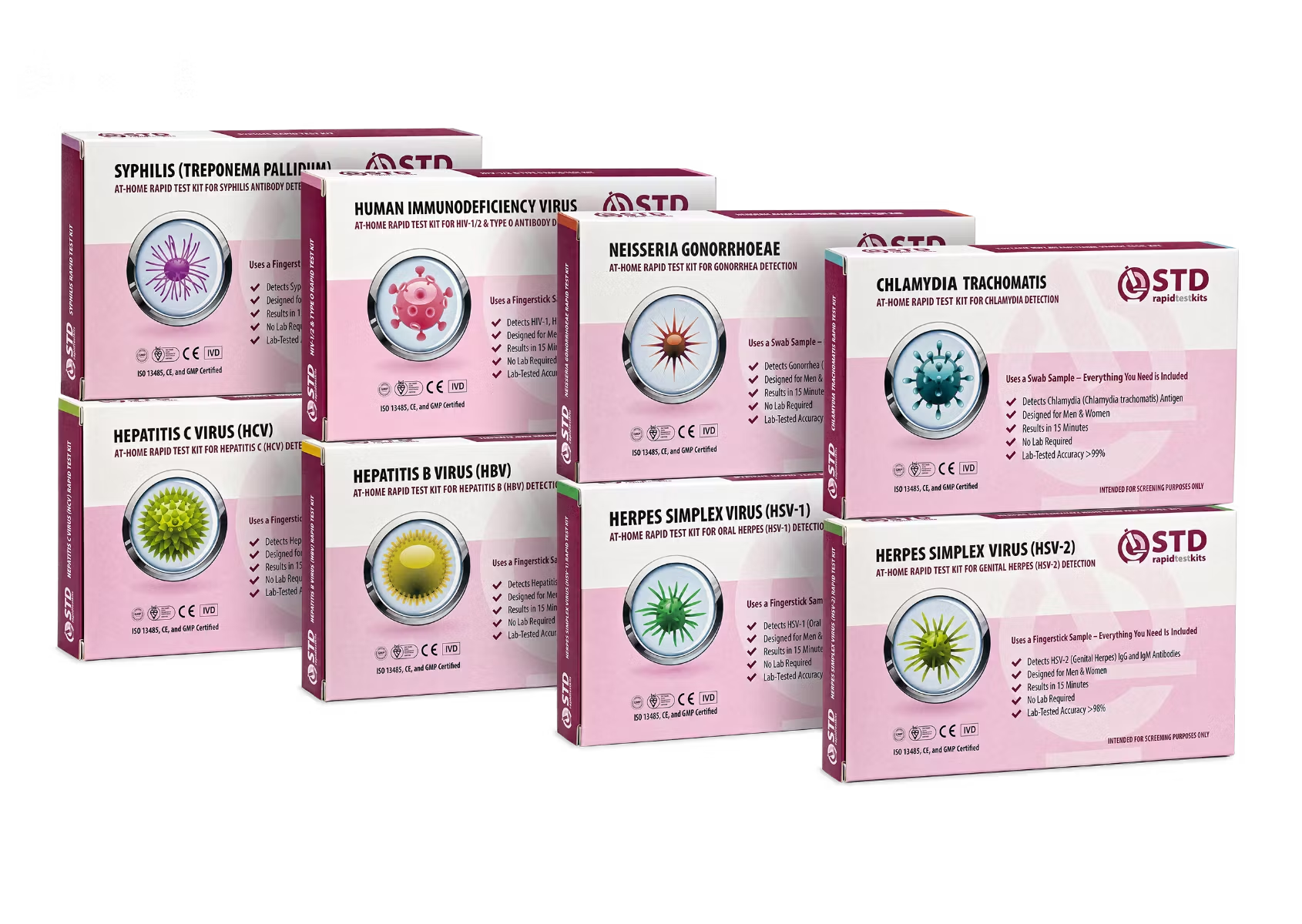
You can order a standalone syphilis rapid test kit for an initial screen, or use a combo kit covering multiple STIs in one go. The privacy advantage is real: you choose where, when, and how to open the result. The trade-off to keep in mind is that interpreting a syphilis follow-up result is not always intuitive, and a provider in the loop, even by telehealth, helps you decide what a given number actually means.

Should your partner test too?
Syphilis is one of the infections where partner testing changes outcomes for everyone involved. If you were diagnosed and treated, any partner from the previous 90 days (for primary syphilis), 6 months (for secondary), or 1 year (for early latent) is considered exposed, even if they have no symptoms. The CDC's guidance is to test those partners and offer presumptive treatment without waiting for their result.
The reason for empirical treatment is window-period math. A partner exposed within the last few weeks may still be in the window where their own non-treponemal test reads non-reactive, despite carrying an early infection. Treating before serology turns reactive prevents both progression and transmission back to you.
If a partner refuses testing or you do not feel safe disclosing directly, many health departments offer anonymous partner notification services. They send a partner a message saying they may have been exposed to a specific STI and recommend testing, without naming you. This is not a substitute for a conversation when one is safe, but it is a meaningful tool when one is not.
Ping-pong reinfection, where a treated person and an untreated partner pass the same infection back and forth across multiple courses of antibiotics, is one of the more frustrating patterns in STI medicine. It is also entirely preventable by treating partners together. If you and a partner are both in the system, ask whether you can be tested and treated on the same visit.
When you can finally stop retesting
For most people with treated early syphilis who hit two clean follow-up windows without complications, the answer is: after the 12-month retest. A documented fourfold drop in non-treponemal titer, no symptoms, no new exposures, and your provider can sign off and shift you back to routine STI screening as part of regular sexual health care.
For late latent or syphilis of unknown duration, the endpoint stretches to the 24-month mark. The slower titer response simply takes longer to confirm.
A few situations extend follow-up beyond the standard endpoints. A diagnosis of neurosyphilis adds cerebrospinal fluid reexamination every 6 months until normalized. Co-infection with HIV adds testing at 3, 6, 9, 12, and 24 months. Pregnancy adds monthly serology in the third trimester, since congenital transmission risk is highest near delivery.
After the official follow-up window closes, routine STI screening picks up where syphilis-specific follow-up leaves off. The CDC's general screening recommendations apply: annually for sexually active people with new or multiple partners, more often for people with HIV or men who have sex with men, and at the start of every pregnancy.
It is reasonable to feel uncertain even after the medical clock has run out. A previous syphilis diagnosis sticks in memory in a way few other infections do. Reframing future tests as routine sexual health checks, not punishment for a past infection, helps. So does having a primary care provider or sexual health clinic you can come back to without explaining the history from scratch every time. If you prefer to stay at home, combination home test kits let you fold syphilis screening into routine bloodwork without a clinic visit.
Clinical and serologic evaluation should be performed at 6 and 12 months after treatment; more frequent evaluation might be prudent if follow-up is uncertain or if a repeat infection is a clinical concern.
FAQs
- Can syphilis come back after treatment?
- Not on its own. Properly dosed penicillin G clears the infection. But syphilis does not confer immunity, so any new exposure can cause a fresh infection. That is what retesting at 6 and 12 months catches: not the original infection returning, but a new one.
- Why is my syphilis test still showing positive months after treatment?
- If the test is a treponemal assay (FTA-ABS, TPPA, EIA, CIA), that is expected and not a sign that treatment failed. Those antibodies usually stay positive for life. What matters is the trend on a non-treponemal test (RPR or VDRL): for early syphilis, a fourfold drop is expected by 6 months; for late-latent or syphilis of unknown duration, the window extends to 24 months. If the titer is not falling on schedule, your provider will evaluate whether retreatment or further workup is needed.
- How long should I wait before I retest?
- For early syphilis, most providers retest at 6 and 12 months. For late latent or syphilis of unknown duration, follow-up extends to 24 months. If you have had a new exposure since treatment, a retest at 3 to 6 weeks plus a confirmatory test at 3 months covers the seroconversion window.
- I haven't had new partners. Why would I need to retest?
- Because the titer trend itself is the evidence that treatment worked. If your RPR dropped fourfold and you have no symptoms, retesting confirms the cure. If it did not drop, the result points to either serologic failure (rare with correct treatment) or a serofast pattern (more common than people realize) and tells your provider what to do next.
- My partner says they tested negative. Should I still get retested?
- Yes, on the schedule your provider set. A partner's single negative result does not change your own follow-up plan. If they tested very early after an exposure, their result could be a false negative inside the 90-day window. The CDC's partner-services guidance is to treat exposed partners presumptively, not wait for serology.
- Can I retest for syphilis at home after treatment?
- You can, but match the test to the question. Rapid at-home treponemal tests detect lifetime antibodies, so they cannot distinguish treated past infection from active disease. For follow-up titer tracking, look for an at-home service that ships a fingerstick sample to a CLIA-certified lab for an RPR or VDRL with a reported titer.
- My test result says reactive. Does that mean I'm still infected?
- Not necessarily. A reactive treponemal test after past syphilis is the expected baseline for the rest of your life. A reactive non-treponemal test only matters in context: a low and stable titer after treatment is typical, a falling titer is a good sign, and a rising titer is what providers act on.
- Do symptoms always come back with reinfection?
- No. Reinfection can be entirely asymptomatic, especially in latent stages. Painless chancres can also occur in places hard to see. That is why timed retesting, rather than waiting for symptoms, is the strategy most syphilis guidelines recommend.
- U.S. Centers for Disease Control and Prevention. 2021 STI Treatment Guidelines, syphilis section, including follow-up serologic testing intervals, titer interpretation, and partner management.
- World Health Organization. Sexually Transmitted Infections fact sheet, covering global syphilis burden, screening, and follow-up.
- Mayo Clinic. Patient-facing overview of syphilis diagnosis and treatment, including the two-step treponemal/non-treponemal testing strategy.
- International Union against Sexually Transmitted Infections. 2020 European Guideline on the Management of Syphilis, including serofast definitions and follow-up testing schedules.
- American Sexual Health Association. Patient-facing syphilis education materials covering treatment, follow-up, and partner notification.
