Published: November 2025 | Last updated: May 2026 | Editorial review and quality control: Martina N.
Testing too early after a possible STI exposure is one of the most common ways people end up with false reassurance. The negative result feels like relief, but in many cases it just reflects what your body could show on that specific day. Bacterial infections like chlamydia and gonorrhea become detectable within days; viral infections like HIV and syphilis take weeks. The number on your calendar matters more than which test you choose.
This guide walks through the window period for each major STI, when home rapid tests give reliable answers, and when a follow-up test is what actually closes the loop. The goal is clarity, not panic, and not the kind of premature "I tested and it was negative" that quietly hides an early-stage infection.
Key takeaways
- Most STI tests are not reliable in the first 72 hours after exposure. Bacterial infections like chlamydia and gonorrhea become detectable around day 7-14; HIV antibody tests can take up to 90 days for full accuracy.
- If you have symptoms now, test now. Plan a follow-up at the 2-6 week mark, because symptoms can appear before any test can confirm the cause.
What the window period actually means
After exposure, your body does not generate an immediate signal. There is a quiet phase where bacteria are multiplying, viruses are replicating, and your immune system is just beginning to register that something happened. Diagnostic tests do not measure the act of exposure; they measure evidence. For bacterial infections, the evidence is genetic material from the bacterium itself, which is what nucleic acid amplification tests (NAATs) detect in a lab. For viral infections like HIV, most tests measure antibodies your immune system produces in response to the virus, and that response takes weeks to build to a detectable level.
The CDC defines the window period as the time between potential exposure and when a test can reliably detect infection. During this window, a negative result is biologically uninformative. You can be infected and still test negative because the test simply does not have anything to find yet.
The <a href="https://www.cdc.gov/hiv/testing/" target="_blank" rel="noopener">CDC's HIV testing guidance</a> states that antibody tests can take 23 to 90 days after exposure to detect HIV. A lab-based antigen/antibody test on blood drawn from a vein detects HIV at 18 to 45 days. A nucleic acid test (NAT, sometimes called HIV RNA) detects HIV the earliest, at 10 to 33 days.
When each STI becomes detectable
The earliest moment something might show up on a test is rarely the moment a test result is trustworthy. The table below maps the two for the most common infections, drawing on CDC and NHS guidance. Lab tests and at-home rapid tests cover the same infections but use different chemistry, so the windows differ slightly between them.
| STI (test type) | Earliest detection | Most reliable testing time |
|---|---|---|
| Chlamydia (NAAT or rapid swab) | 1-5 days | 2 weeks |
| Gonorrhea (NAAT or rapid swab) | 2-6 days | 2 weeks |
| Trichomoniasis (NAAT or rapid swab) | 5-7 days | 1-2 weeks |
| Syphilis (treponemal blood antibody) | 3 weeks | 6-12 weeks |
| HIV (rapid fingerstick antibody) | 23 days | 45-90 days |
| HIV (lab antigen/antibody, 4th-gen) | 18 days | 45 days |
| HIV (NAT/RNA, lab only) | 10 days | 10-33 days |
| HSV-2 (blood antibody) | 3 weeks | Up to 16 weeks or more (per CDC) |
| HSV (lesion swab, clinic only) | When sore appears | Within 48 hours of active sore |
How soon after sex can I get a reliable STI test result?
For chlamydia, gonorrhea, and trichomoniasis: around 2 weeks. For HIV using a lab 4th-generation antigen/antibody test: around 45 days; for at-home rapid antibody tests: week 6, with a follow-up at week 12 for full coverage. For syphilis: 6-12 weeks. If you have symptoms, test now and follow up at the standard intervals regardless of the window-period math.
The first 72 hours: anxiety high, accuracy low
The first few days after a potential exposure can feel like the longest of your life. Every twinge or sensation gets scrutinized. From a testing standpoint, this window is almost always too early. Most infections are not yet producing the genetic material or antibodies that a test needs to find them, so a negative result during this period carries almost no diagnostic weight.
There is one important exception. If you develop a visible sore, blister, or ulcer in the genital, anal, or oral area in the first week, a clinical swab of that lesion can detect herpes simplex virus before any blood test would. This is direct viral testing rather than antibody testing, and timing it to an active sore is what makes it useful. Outside of that scenario, the first three days are mostly a holding pattern while bacterial and viral loads build toward detectable levels.
If you had a known exposure to HIV in the last 72 hours, do not wait for a test. Post-exposure prophylaxis (PEP) is a 28-day course of HIV medication that can reduce the chance of infection if started within 72 hours of exposure. This is a clinic visit, not a home-test decision. Per CDC guidance, the earlier PEP is started, the more effective it is.
Days 7 to 14: bacterial infections start showing up
By the end of the first week, chlamydia and gonorrhea typically become detectable on NAAT-based testing. NAAT is the lab method that the CDC's STI Treatment Guidelines treat as the standard for these bacterial STIs. Trichomoniasis follows a similar curve, often detectable within 5-7 days of exposure on NAAT.
At-home rapid lateral-flow tests for these infections use the same swab sample type as lab tests. The chemistry is different (immunoassay rather than amplified DNA), so the sensitivity profile is also different. A positive result from a home rapid test is a strong signal that warrants follow-up; a negative result early in the window is best treated as a preliminary check, with the option to retest closer to day 14.
Lab NAAT is the higher-sensitivity tool because it amplifies bacterial DNA, picking up very small amounts of the pathogen. Home rapid lateral-flow tests use antibody-style strips and have lower analytical sensitivity, particularly very early in the window. The practical result: a home rapid test at day 14 is reasonable for screening, and any positive result deserves a confirmatory lab NAAT.
Weeks 2 to 6: where most results become meaningful
This is the window where testing starts to give you answers you can rely on. Bacterial STIs are reliably detectable by day 14 for most people. By week 4, fourth-generation HIV antigen/antibody lab tests pick up the vast majority of infections. Syphilis blood antibody tests become reliable around the 6-week mark, consistent with NHS general guidance that infections can take up to 7 weeks to appear on tests (see the NHS STI testing guidance).
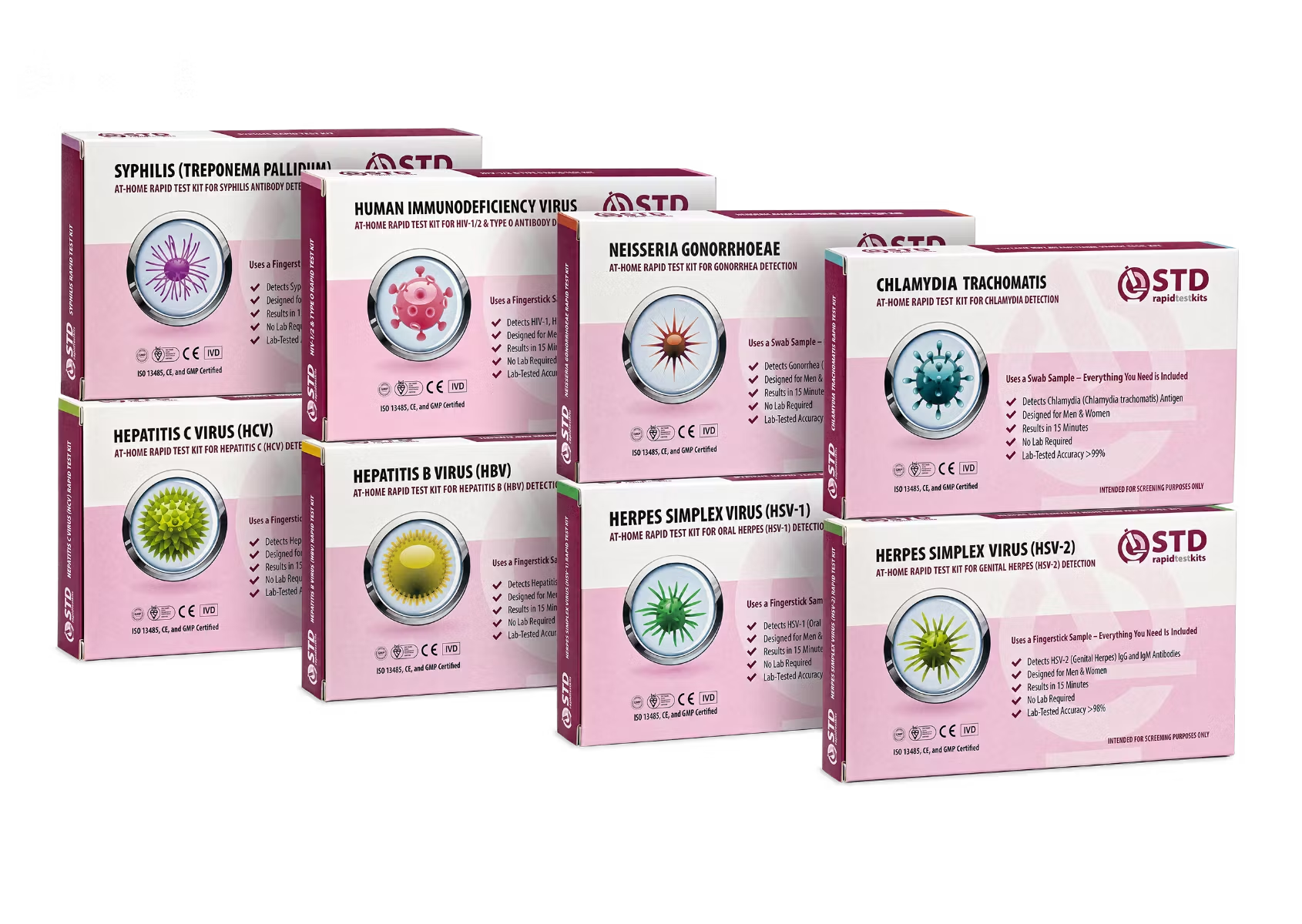
If you are choosing a single time point that balances early answers against accuracy, the 2 to 3 week mark is the practical sweet spot for most common STIs. It will not fully cover HIV and syphilis (those still need a follow-up later), but it does cover chlamydia, gonorrhea, and trichomoniasis with confidence. For people who want privacy and do not want to navigate a clinic visit twice, a rapid home panel at week 3 followed by a confirmatory home test at week 6-12 is a workable plan for most exposure scenarios.
This article is published by stdrapidtestkits.com, which sells at-home STI testing kits; the product recommendations below reflect kits that match the article's topic. The site does not sell pharyngeal swabs, rectal swabs, urine-based tests, or lab-processed NAAT panels, so a clinic visit is the right next step for oral or rectal exposure regardless of which home kit you also use.
Week 6 and beyond: when HIV and syphilis confirmation lands
For HIV and syphilis specifically, week 6 is the point where most modern tests become highly reliable. The CDC's HIV testing guidance notes that a fourth-generation antigen/antibody test detects HIV in most people by day 45 after exposure, and treponemal antibody tests for syphilis are well-established by the 6-week mark. Outliers exist; rare cases of delayed seroconversion push the window to 90 days or beyond for HIV.
For HSV-2 blood antibody testing, the window stretches further. The CDC's herpes testing page states that after exposure it can take up to 16 weeks or more for current tests to reliably detect infection. Most people seroconvert within several weeks to a few months, while the outer edge of the antibody response extends well past the 12-week mark for a meaningful subset of infections.
Antibody tests can take 23 to 90 days to detect HIV after an exposure. An antigen/antibody test performed by a laboratory on blood from a vein can usually detect HIV 18 to 45 days after an exposure.
Why a negative result might not mean what you think
A negative test is a measurement at one point in time. It says: at this moment, the test did not detect what it was looking for. It does not speak to whether you were exposed, whether an infection is developing somewhere on its curve, or whether the same test would still be negative a week from now. This gap between "negative today" and "truly uninfected" is where false reassurance lives, especially when the test was done too early.
A false negative is most often a timing issue, not a faulty test. The table below summarizes the most common reasons a negative result can be incomplete.
| Reason | What it means in practice |
|---|---|
| Window period not yet over | Infection is present but markers are below the detection threshold |
| Low viral or bacterial load | Some early infections shed pathogen at levels too low for rapid tests |
| Wrong sample site | Pharyngeal and rectal exposures need site-specific swabs; a genital sample will not catch them |
| Test sensitivity mismatch | Rapid lateral-flow tests have different sensitivity than lab NAAT; both have a place but they are not equivalent |
Different exposures, different timing decisions
Not every exposure carries the same risk profile, and the right testing plan shifts accordingly. Protected vaginal sex with a partner of unknown status has different odds than unprotected anal sex, which has different odds than oral sex, which has different odds again than skin-to-skin contact in an area where herpes or syphilis sores could be present.
In rough terms: unprotected receptive anal sex carries the highest per-act HIV risk; vaginal sex carries lower but meaningful risk; oral sex is lower still but not zero, particularly for gonorrhea and syphilis; skin-to-skin contact without penetration matters most for herpes and HPV. The CDC's STI screening guidance reflects these gradations, recommending more frequent testing for higher-risk categories, including at narrower windows.
If you have symptoms now, test now
Symptoms change the timing calculation. Burning during urination, unusual discharge, genital itching, painful sex, visible sores or blisters, sudden flu-like symptoms after a recent exposure: any of these are reasons to test promptly, even if you are inside the typical window period. Symptoms mean something is happening in your body, and even an early test result has more weight when there is a clinical correlate.
For herpes specifically, this matters because the most accurate herpes test on an active sore is a swab of the lesion (clinic-administered PCR or viral culture), not a blood antibody test. If a sore appears, going to a clinic within the first 48 hours of the lesion gives the swab its best shot at detecting the virus. Blood antibody tests can come later to confirm whether the infection is HSV-1, HSV-2, or both.
- Painful urination, unusual discharge, or genital itching that started after a recent exposure
- Visible sores, blisters, or ulcers anywhere in the genital, anal, or oral area
- Unexplained flu-like illness (fever, swollen lymph nodes, sore throat, rash) in the weeks after a possible HIV exposure (acute retroviral syndrome)
- Pelvic or testicular pain
Any of these warrants prompt testing, even before the typical window period closes, and a clinic visit if symptoms persist.
At-home testing: timing rules still apply
At-home rapid tests have changed who tests and when. Home testing removes the friction of an appointment, a waiting room, and a conversation with a receptionist who might be a neighbor. The flip side is that the timing rules are the same as in a clinic: a rapid test taken three days after exposure is not suddenly more accurate because it was taken at home. The chemistry does not know where you are.
Used correctly, at-home rapid tests are a reasonable screening tool for the major STIs the site covers, with two caveats. First, a positive result on a rapid lateral-flow test is a strong signal that warrants lab confirmation. Second, a negative result inside the window period is still a preliminary check, no different from an early clinic test on the same day.
A simple testing plan you can follow
For most people, the question is not "which test" but "when and how many times." The plan below works for typical exposure scenarios. It is not a substitute for clinical care if you have symptoms or known exposure to a specific infection, but it is a reasonable default to start from.
| Time after exposure | What to do | What it covers |
|---|---|---|
| Day 0 to 3 | Wait. Monitor for symptoms. Consider PEP for known HIV exposure. | Almost nothing testable except active herpes lesions via clinic swab |
| Day 7 to 14 | Optional first test | Most chlamydia and gonorrhea cases |
| Week 2 to 3 | Main test window | Bacterial STIs reliably; early indicator for HIV and syphilis |
| Week 6 | Follow-up test | HIV and syphilis with high confidence |
| Week 12 to 16 | Optional final check | Rare delayed-window cases for HIV; HSV-2 antibody seroconversion outer edge |
Common testing mistakes
Most of the mistakes people make around testing are not about recklessness. They come from acting on incomplete information. The list below covers the patterns that account for the majority of avoidable false reassurance.
- Testing within 72 hours of exposure and treating the negative as conclusive
- Skipping the follow-up test because the first one came back negative
- Assuming no symptoms means no infection; many STIs are silent for weeks or longer
- Using a blood antibody test on an active herpes sore instead of a clinic-administered lesion swab
- Testing only the genital site when the exposure included oral or rectal contact, which need site-specific swabs
Final word: clarity over guesswork
The hardest part of waiting is the gap between maybe and certain, more than the test itself. Once the timeline makes sense, that gap shrinks. You stop watching every sensation for evidence and start treating the calendar like a checklist. Test when it counts. Retest when it matters. Each step does what it is designed to do, which is to replace speculation with measurement.
If there is even a small question mark from a recent exposure, the simplest path is to wait for the 2-3 week mark, run a multi-infection home rapid panel, and plan a confirmatory test at week 6 if HIV or syphilis is on your list. Symptoms override the timeline. A clinic visit overrides the home kit when a specific site of exposure (throat, rectum) needs its own swab.
Testing schedule at a glance
- Week 2-3: rapid home panel for bacterial STIs (chlamydia, gonorrhea, trichomoniasis)
- Week 6: follow-up to confirm HIV and syphilis
- Week 12-16: optional final check for rare delayed-seroconversion HIV cases and HSV-2 antibody outer edge
Frequently asked questions
- How soon after sex can I test for STIs and get a reliable result?
- For chlamydia, gonorrhea, and trichomoniasis, around day 14 is when home and lab tests both become reliable. For HIV, week 6 is when a fourth-generation antigen/antibody test detects most infections; a final confirmation at week 12 covers rare late-seroconversion cases. Syphilis follows a similar 6-week window. Testing earlier than that gives you a snapshot, not a conclusion.
- If my test came back negative two days after sex, can I stop worrying?
- Not yet. Two days is well inside the window period for every STI, so the negative result reflects what was measurable that day rather than your actual status. The right move is to treat the early result as a preliminary check and plan a follow-up test at the 2-3 week mark.
- What is the earliest I can detect HIV?
- A NAT (nucleic acid test, sometimes called HIV RNA test) can detect HIV in lab settings as early as 10 to 33 days after exposure. Fourth-generation lab antigen/antibody tests detect most infections by day 18-45. Rapid fingerstick antibody tests, which is what most home kits use, become reliable around week 6, with a 90-day window for full coverage of delayed seroconversion.
- How long does HSV-2 take to show up on a blood test?
- The CDC's herpes testing page notes that it can take up to 16 weeks or more after exposure for current blood antibody tests to reliably detect HSV-2. Most people seroconvert within several weeks to a few months, but a meaningful subset stays below the detection threshold past the 12-week mark. A swab of an active sore at a clinic is the more reliable test in the early weeks.
- Do I really need to retest if my first result was negative?
- If the first test was inside the window period for any infection on your list, yes. A second test at week 6-12 is not doubling up; it covers infections that had not yet reached the detection threshold the first time. Retesting is built into standard CDC testing protocols, not a sign that something went wrong.
- I have symptoms but my test was negative. What now?
- Symptoms reflect what your body is doing; tests reflect what is measurable at a moment in time. The two do not always align inside the window period. If symptoms persist, a clinic visit for site-specific testing (a swab of an active lesion, or NAAT on the appropriate sample site) is the next step. Symptoms should not be dismissed because a single rapid test was negative.
- How accurate are at-home rapid STI tests compared to lab tests?
- At-home rapid tests use lateral-flow immunoassay chemistry. They are well-suited for screening when used at the right time, with reported sensitivity in the mid-to-high 90s for most of the infections they cover. Lab NAAT and fourth-generation antigen/antibody tests have higher analytical sensitivity, especially for very early infections. The two work well together: rapid tests for accessible screening, lab tests for confirmation of any positive result.
- Does the type of sex change which test I need?
- Yes. Penile or vaginal exposure can be screened with a genital sample and bloodwork. Oral exposure carries genuine risk for gonorrhea and syphilis, and a clinic-administered pharyngeal swab is what catches throat gonorrhea; a genital home kit will not. Rectal exposure follows the same logic: rectal NAAT in a clinic, not a genital sample. Bloodwork for HIV, syphilis, and hepatitis is the same regardless of exposure site.
How we sourced this article: This guide synthesizes current CDC and NHS guidance on STI window periods with established data on test sensitivity for each major infection. We cross-checked window-period figures against the CDC's HIV testing pages, the CDC's herpes testing page, the WHO STI fact sheet, and NHS condition-specific guidance, and we kept the testing recommendations aligned with what at-home rapid lateral-flow tests can actually detect. Where the at-home test profile diverges from lab NAAT, we say so explicitly rather than blurring the two.
- U.S. Centers for Disease Control and Prevention. HIV testing window periods, by test type (antibody, antigen/antibody, NAT).
- U.S. Centers for Disease Control and Prevention. Sexually Transmitted Infections Treatment Guidelines, screening and diagnostic recommendations.
- U.S. Centers for Disease Control and Prevention. Herpes testing page, including the up-to-16-weeks-or-more antibody seroconversion window for HSV.
- NHS. Sexually transmitted infections (STIs) overview, including general testing and window-period guidance.
- World Health Organization. Sexually transmitted infections (STIs) fact sheet, global incidence and screening guidance.
- Planned Parenthood. STD testing: when to get tested and why testing without symptoms still matters.
