Published: October 2025 | Last updated: May 2026 | Editorial review and quality control: Martina N.
Most mouth sores are not a sexually transmitted infection. The vast majority are aphthous ulcers, the everyday canker sore brought on by stress, a bitten cheek, an acidic meal, or a brief nutritional dip. They sting when food touches them, sit on the inside of a cheek or lip, and fade within a week or two (NHS, mouth ulcers overview). If your sore behaves that way, the rest of this article is reassurance.
A small minority of mouth sores tell a different story. A painless ulcer that lasts longer than two weeks, especially after recent oral sex with a new partner, deserves a closer look. That is the visible signature of a primary syphilis chancre, and although the sore itself heals on its own, the bacteria do not. The chancre disappears in three to six weeks while the infection quietly enters the bloodstream (CDC, About Syphilis).
This guide walks through the visible differences between canker sores and oral chancres, what oral syphilis actually looks like across the lips, tongue, and inner mouth, why early presentations are so often missed, and how to confirm or rule out syphilis without a stressful clinic visit.
Key Takeaways
- A canker sore stings when food touches it and clears in roughly 7 to 14 days. A primary syphilis chancre is usually painless and lingers 3 to 6 weeks before healing on its own.
- If a mouth sore is painless and you have had recent oral exposure, get a syphilis blood antibody test 3 to 6 weeks after exposure. The chancre heals whether or not you treat it; the infection does not.
What a typical canker sore looks and feels like
Canker sores, clinically called aphthous ulcers, are extremely common. They are not caused by an STI and are not contagious (NHS, mouth ulcers). Most adults experience them at least once, and a recurrent pattern (a few episodes per year) is normal.
Common triggers include stress, hormonal cycles, a bitten cheek or rough toothbrush, acidic or spicy foods, and dips in B12, folate, or iron. Some autoimmune conditions, including celiac disease and inflammatory bowel disease, increase the frequency of canker sores, which is one of the reasons NHS guidance recommends seeing a GP about ulcers that recur often or last longer than three weeks.
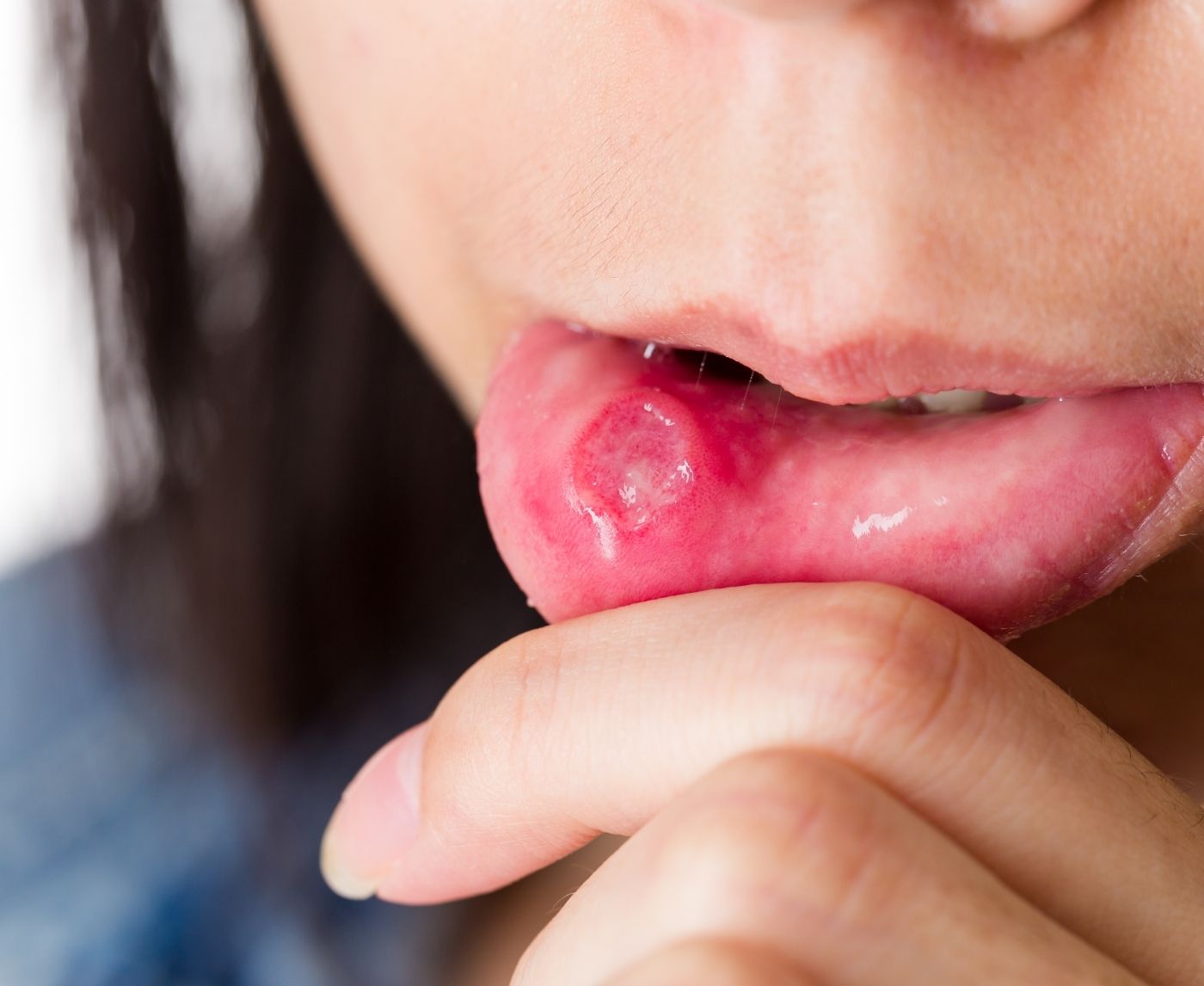
The visible signature is consistent: a small round or oval ulcer with a white or pale yellow center surrounded by a clearly erythematous (bright red) border. Canker sores favor movable, non-keratinized tissue: the inside of the cheek, the inner lower lip, under the tongue, the soft palate, and the floor of the mouth. They almost never appear on the hard palate, the gum line attached to teeth, or the outer vermillion border of the lip.
Pain is the strongest tell. A canker sore stings sharply when acid, salt, or temperature changes touch it. Most heal in 7 to 14 days without scarring (NHS). If the same ulcer is still present three weeks in, that is a clinical red flag worth investigating regardless of cause.
| Feature | Typical canker sore |
|---|---|
| Appearance | White or pale yellow center, bright red halo, shallow |
| Pain | Sharp stinging or burning, especially with acidic or spicy food |
| Location | Inside cheeks, inner lower lip, under tongue, soft palate |
| Healing time | 7 to 14 days, no scarring |
| Contagious | No (NHS, mouth ulcers) |
| When to escalate | Sore lasts longer than 3 weeks, or recurs frequently |
What an oral syphilis chancre looks like
The first stage of syphilis produces a sore at the precise spot where Treponema pallidum, the bacterium that causes syphilis, entered the body. If the entry point was the lip, tongue, gum, or back of the throat during oral sex, deep kissing, or another close oral contact, the chancre forms in or around the mouth (CDC, About Syphilis; MedlinePlus, Syphilis).
Three things make the oral chancre easy to miss. First, it is usually painless or only mildly tender. The CDC describes the primary sore as "usually firm, round, and painless." Second, it heals on its own within roughly three to six weeks regardless of treatment, so the visible warning sign disappears before many people decide to act on it. Third, it often appears on hidden surfaces (the lateral edge of the tongue, the inner lip line, the tonsillar pillars) where neither the person nor a casual mirror check will spot it.
Visible appearances vary more than people expect. A primary oral chancre can look like a single round ulcer with a slightly raised, indurated (firm to the touch) border; a flat reddish patch with a smooth surface; a clean-based erosion that resembles a healed pressure spot; or a slightly crusted lesion on the lip that mimics a chapped-lip split. There is no pus, no clustered grouping, no aphthous-style yellow center, and typically only one sore.
One supporting clue: lymph nodes near the chancre, usually under the jaw or along the side of the neck, often swell painlessly during the primary stage. That regional lymphadenopathy is one of the few external signs that the body is responding to a systemic process rather than a local irritation.
The dangerous part is what happens after the sore heals. The bacteria have already entered the bloodstream by then and continue replicating during the asymptomatic interval before secondary syphilis appears. Secondary syphilis classically shows up several weeks later as a non-itchy rash that often includes the palms and soles, mucous patches inside the mouth, swollen lymph nodes, low-grade fever, and patchy hair loss (MedlinePlus).
If your sore stings sharply when food touches it, has a white or yellow center with a red halo, sits on the inside of a cheek or under the tongue, and is healing within two weeks, you are looking at a canker sore. This is the everyday outcome and no testing is needed. The pattern that warrants a syphilis test is different: painless, persistent past two weeks, and following a recent oral exposure.
Side by side: how to tell them apart
Because oral syphilis sores can look like several harmless conditions, the differences are best evaluated as a pattern rather than a single feature. Pain, duration, number of sores, and recent exposure together carry far more diagnostic weight than appearance alone.
| Feature | Canker sore | Primary syphilis chancre |
|---|---|---|
| Pain | Sharp stinging, worse with food | Usually painless, sometimes mildly tender |
| Number | Often single, sometimes a small cluster | Typically a single sore |
| Color and surface | White or yellow center with red halo, shallow | Reddish, smooth or erosive surface; may be flat or slightly raised |
| Border | Soft, even, red | Firm and slightly indurated, sometimes rolled |
| Location | Inside cheek, inner lower lip, under tongue, soft palate | Lips, tongue edges, gums, back of throat (site of contact) |
| Duration | 7 to 14 days | 3 to 6 weeks; heals on its own |
| Lymph nodes | Usually unaffected | Painless swelling under jaw or along neck is common |
| Contagiousness | Not contagious | Highly contagious from active sore until 1 to 2 weeks after treatment |
Visual reference: what these sores can look like
Photographs help up to a point. Even experienced dermatologists do not diagnose oral syphilis by sight alone, because the visual range overlaps with traumatic ulcers, oral herpes, candidiasis, and a handful of inflammatory conditions. The figures below illustrate the typical visual range of canker sores compared with primary and early-secondary oral syphilis lesions. Use them to recognize patterns worth testing for, not to self-diagnose.
Why oral syphilis often gets misdiagnosed
Even clinicians miss oral syphilis routinely because its appearance overlaps with several harmless or unrelated conditions. The differential list a primary-care provider works through often includes:
- Aphthous ulcers (canker sores)
- Traumatic ulcers from biting, dental work, braces, or hot food
- Recurrent intraoral herpes simplex (HSV-1) lesions, although herpes typically clusters and is painful
- Oral candidiasis (thrush), which can look similar to secondary-stage mucous patches
- Lichen planus or other inflammatory mucosal conditions
- Squamous cell carcinoma in older or higher-risk patients with persistent ulcers
Visual appearance alone cannot confirm syphilis. Testing is what reliably differentiates one cause from another, which is why the standard of care for any persistent oral ulcer (especially after a possible exposure) is serologic testing rather than watchful waiting. The point of seeing the photographs above is recognizing the pattern that warrants the test, not arriving at a diagnosis from your bathroom mirror.
Quick answer: How can I tell if a mouth sore is a canker or syphilis?
Most painful, short-lived (under two weeks), white-yellow-centered ulcers on the inside of a cheek or lower lip are canker sores and need no testing. A painless sore that persists past two weeks, especially after recent oral sex with a new or untested partner, is the classic primary syphilis chancre and warrants a blood antibody test. Treponemal blood antibody tests become reliably positive 3 to 6 weeks after the exposure that started the chancre, so timing the test to that window matters more than testing immediately.
When the sore disappears, the infection does not
The single most dangerous belief about syphilis is that a healed sore equals a resolved infection. The chancre heals on its own in three to six weeks regardless of whether you receive treatment (CDC, About Syphilis). What follows is often a quiet interval of weeks to months where nothing visible happens (CDC).
Then secondary syphilis appears. The classic features are a non-itchy rash that frequently involves the palms and soles, mucous patches inside the mouth, generalized swollen lymph nodes, low-grade fever, fatigue, and patchy hair loss (MedlinePlus, Syphilis). Secondary symptoms also fade on their own after several weeks, which is why people repeatedly conclude they have "recovered" when in fact they have entered latent syphilis. Latent infection can persist for years and, if untreated, can lead to neurosyphilis (affecting the brain and nerves), cardiovascular syphilis, or destructive gummatous lesions in tertiary disease.
Treatment for early syphilis is straightforward: a single intramuscular injection of long-acting benzathine penicillin G is the first-line regimen for primary, secondary, and early latent stages. Treatment for late latent or tertiary syphilis is longer (three weekly penicillin injections at minimum), and the damage already done to organs is not always reversible. Catching the infection during or shortly after the chancre stage is by a wide margin the cheapest, simplest, and most reliable path to a full cure.
Sores are usually (but not always) firm, round, and painless... The sore usually lasts 3 to 6 weeks and heals regardless of whether you receive treatment.
How to test for syphilis after a possible oral exposure
Three test types matter for a reader weighing whether to test:
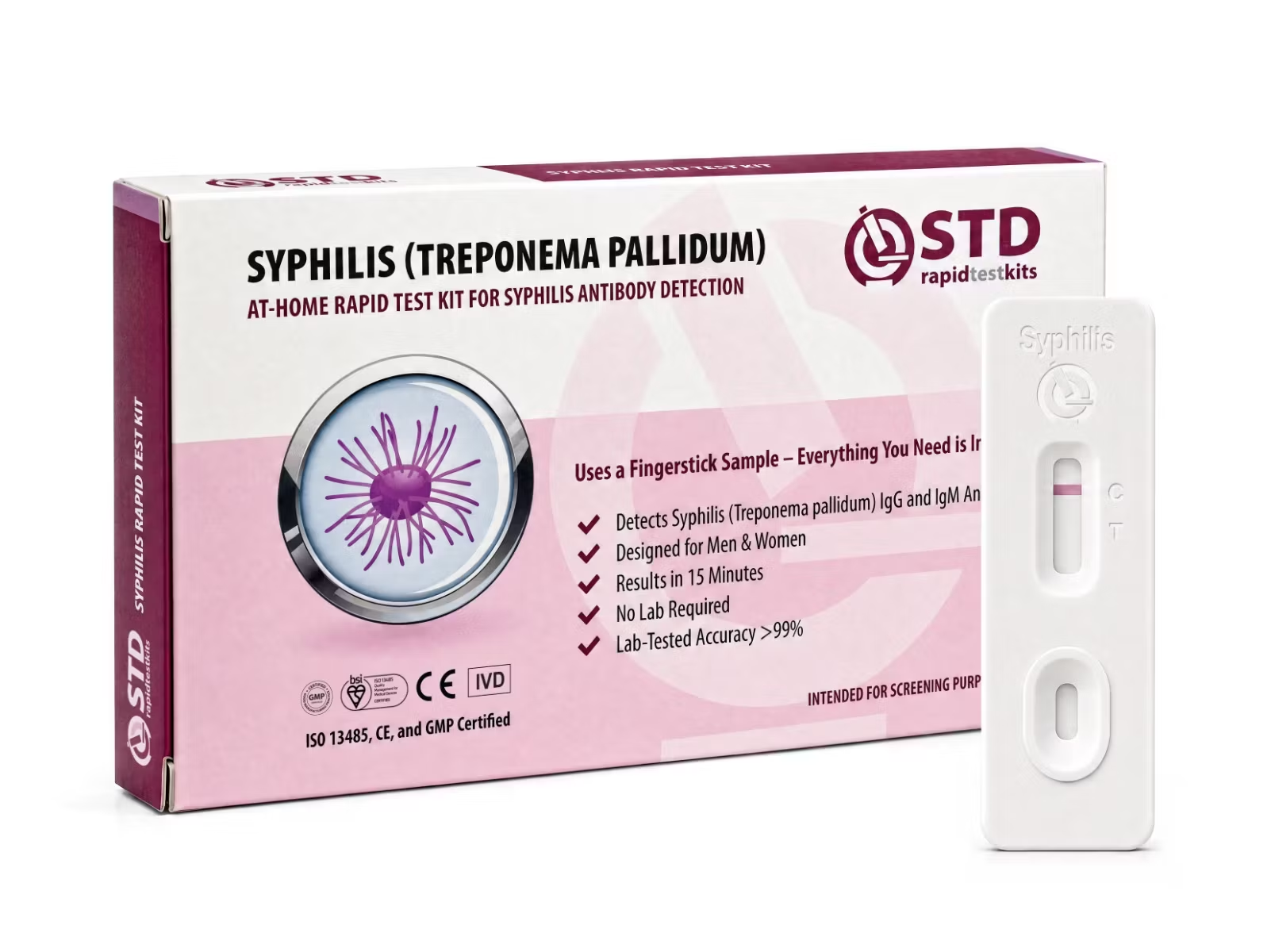
- Treponemal blood antibody tests (including the rapid lateral-flow antibody test sold for home use) detect antibodies the body produces against Treponema pallidum. They become reliably positive roughly 3 to 6 weeks after the exposure that started the chancre, which lines up with when the chancre is still present or just healed.
- Non-treponemal blood tests (RPR and VDRL) measure non-specific antibodies. These are run in clinical labs and are used both for confirmation and for tracking how well treatment is working over time.
- Direct detection (darkfield microscopy or PCR from a swab of the chancre fluid) can confirm an active sore but requires the chancre still be present and is rarely available in primary care.
For someone wondering whether a healing or recently healed mouth sore was a chancre, the practical path is a treponemal blood antibody test taken 3 to 6 weeks after the suspected exposure. A reactive result triggers a clinic visit for confirmatory non-treponemal testing (RPR titer) and the penicillin injection. A non-reactive result on a properly timed test, with no other symptoms, is reassuring.
Disclosure: this site sells rapid at-home STI test kits, including the fingerstick syphilis antibody test described in the next section. We recommend products based on fit-for-purpose for the reader's concern, not commercial benefit. Note on the technology: at-home rapid syphilis tests are lateral-flow immunoassays that detect antibodies. They are screening tools, not laboratory NAATs, and a reactive screening result should always be confirmed in a clinic. The point of testing at home is removing the friction that delays the question, not replacing the lab.
Oral-to-genital and oral-to-oral transmission
Syphilis transmits through direct contact with an active chancre or a secondary-stage mucous patch. The bacterium does not survive long outside the body, so transmission requires skin-to-skin or mucosa-to-mucosa contact with the lesion. That makes oral routes meaningful in three specific scenarios.
WHO classifies syphilis as one of the four currently curable bacterial STIs and explicitly lists oral sex among the established transmission routes for sexually transmitted infections (WHO, STIs fact sheet). Once the chancre or mucous patches have healed and treatment is complete, transmission risk falls to baseline.
| Scenario | Direction of risk | Practical prevention |
|---|---|---|
| Performing oral sex on a partner with a genital chancre | Bacteria transfer to the giver's mouth and lips | Barrier (condom or dental dam) on the partner; avoid oral contact while a chancre is visible |
| Receiving oral sex from a partner with an oral chancre or mucous patch | Bacteria transfer to the receiver's genitals | Barrier protection; both partners test if either has any persistent oral or genital sore |
| Deep kissing while either partner has an active oral lesion | Documented but lower than oral-genital contact | Avoid kissing while a sore is present; both partners test |
Talking to a current or recent partner
If a syphilis test comes back reactive, partner notification is part of the standard treatment plan. Most jurisdictions also offer anonymous partner-notification services through the local health department, which can deliver the news without identifying you. Either route works; what matters is that exposed partners get tested and, if needed, treated before the infection progresses in their bodies too.
The conversation does not need to be heavy. A workable script: "I just got tested and one of the results came back positive. I'm getting treated. I want you to be able to test too, just to be sure." That phrasing is honest, non-accusatory, and puts the practical action front and center. Most partners respond better to this framing than to a vague hint or, worse, silence.
Practically, partners should test 3 to 6 weeks after the most recent possible exposure, or sooner if they have any visible sore. A negative test taken too early is not reassuring; the timing window matters.
Recent partners (past 90 days) should test 3 to 6 weeks after the most recent possible contact. Earlier testing risks a false-negative because antibodies have not yet developed. Any partner with a visible mouth or genital sore, regardless of timing, should see a clinician now rather than wait for the antibody window. Anonymous partner-notification through a local health department is available in most U.S. states and UK regions if direct conversation feels too difficult.
When to see a clinician instead of self-testing
A home antibody test is well-suited to one specific question: yes-or-no on syphilis exposure 3 to 6 weeks after a possible oral or sexual contact. There are situations where it is the wrong first step.
- The sore has lasted longer than three weeks regardless of pain. NHS guidance specifically recommends a GP review for any mouth ulcer past three weeks, primarily because of the small but real risk of oral cancer (NHS).
- The sore is bleeding, growing, or located at the back of the throat. NHS lists these as features that warrant clinical assessment.
- You have systemic symptoms suggesting later-stage disease: a non-itchy rash on the palms or soles, mucous patches in the mouth, patchy hair loss, fever, or generalized lymph-node swelling. These need clinic-led testing and treatment, not screening.
- You are pregnant or planning pregnancy. A reactive screening result needs same-day clinical follow-up because untreated syphilis in pregnancy can cause stillbirth, neonatal death, or congenital syphilis.
- You take immunosuppressants, are living with HIV, or have any condition that complicates antibody response. Antibody tests can behave unusually in these settings, and a clinician can choose the right confirmatory pathway.
For everyone else, the practical sequence is: notice a painless sore that lasts past two weeks, count back to the exposure, test once you are at least 3 weeks past it, and bring a reactive result to a clinic for the penicillin injection.
FAQs
- Can syphilis really show up as just one sore in my mouth?
- Yes. The primary stage of syphilis classically produces a single painless sore at the site where the bacterium entered the body. A solitary lip, tongue, or gum ulcer that lasts longer than two weeks and does not hurt is the textbook presentation, and it is exactly the case that most often gets dismissed.
- How do I tell a canker sore from a syphilis chancre at home?
- The strongest distinguishing features are pain and duration. Canker sores sting (especially with food) and clear in 7 to 14 days. Syphilis chancres are usually painless or only mildly tender and last 3 to 6 weeks. Recent oral sex with a new partner moves syphilis higher on the list. None of these is conclusive on its own; a blood antibody test is the only definitive answer.
- The sore healed on its own. Am I in the clear?
- No, and the timeline matters more than the disappearance. Within weeks of the chancre healing, the bacteria have already seeded the bloodstream and can resurface as secondary syphilis: a non-itchy rash on the palms and soles, mucous patches in the mouth, swollen lymph nodes, or patchy hair loss. Catching the infection at the chancre stage offers by far the easiest treatment path (a single penicillin injection), so book a blood antibody test 3 to 6 weeks after the original exposure rather than waiting to see if more symptoms appear.
- Can I catch syphilis from kissing?
- Transmission via deep kissing is documented but less common than transmission via oral sex. The risk is real when one partner has an active oral chancre or secondary-stage mucous patches. Avoid close oral contact while any unexplained mouth sore is present and have both partners tested if there is uncertainty.
- How long after an oral exposure should I wait before testing?
- Treponemal blood antibody tests, including at-home rapid antibody kits, become reliably positive roughly 3 to 6 weeks after exposure. Testing earlier than 3 weeks risks a false-negative result. If you test in the early window and the result is non-reactive, retest at 6 weeks to be confident.
- Could a persistent mouth sore be something other than syphilis or a canker?
- Yes. Several conditions can mimic both, including recurrent oral herpes (usually painful and clustered), traumatic ulcers from dental work or biting, oral candidiasis, lichen planus, and, in older or higher-risk patients, oral squamous cell carcinoma. NHS guidance recommends a GP visit for any mouth ulcer lasting more than three weeks for this reason.
- Is syphilis curable if I catch it during the chancre stage?
- Yes, and this is the easiest stage to treat. WHO lists syphilis among the four curable bacterial STIs, and the CDC-recommended first-line regimen for primary, secondary, and early latent syphilis is a single intramuscular injection of long-acting benzathine penicillin G. Catching the infection while the chancre is still healing or recently healed prevents progression to later stages where treatment is longer and damage may be permanent.
- Can I use an at-home test for oral syphilis?
- Yes, with two caveats. The at-home rapid syphilis test is a fingerstick blood antibody test, not a swab of the mouth sore itself. It detects whether your body has produced antibodies to Treponema pallidum, which is the same thing a clinic blood test does. The two caveats: time the test to 3 to 6 weeks post-exposure, and bring a reactive result to a clinic so they can run confirmatory testing and give the penicillin injection.
How we sourced this article: We synthesized current clinical guidance from the U.S. Centers for Disease Control and Prevention, the UK National Health Service, the U.S. National Library of Medicine (MedlinePlus), and the World Health Organization. Every quantitative claim in this article (window periods, healing times, treatment regimens, transmission routes) was checked against the cited primary source on the day of writing. We do not provide clinical diagnosis. For symptoms that concern you, especially a mouth ulcer lasting more than three weeks, see a licensed clinician.
- U.S. Centers for Disease Control and Prevention. About Syphilis: stages, primary chancre features (firm, round, usually painless), 3 to 6 week duration, healing regardless of treatment, possible mouth and lip locations.
- UK National Health Service. Syphilis overview: symptoms including sores in the mouth or on the lips, painless ulcer character, 3-week-or-more onset window after infection.
- UK National Health Service. Mouth ulcers overview: 1 to 2 week typical healing, non-contagious, escalation criteria including ulcers lasting longer than 3 weeks.
- U.S. National Library of Medicine (MedlinePlus). Syphilis: oral and lip transmission sites, single small painless primary sore, secondary rash on hands and feet, symptom recurrence pattern.
- World Health Organization. Sexually transmitted infections (STIs) fact sheet: syphilis as one of four curable bacterial STIs, oral sex as an established transmission route.
