

Published: September 2025 | Last updated: April 2026 | Editorial review and quality control: Martina N.
Most people who put off STD testing are not lazy or careless. They are afraid of what a clinic visit will look like to anyone who notices, of what a partner will assume, and of what a positive result might say about who they are. That fear has a name in public-health research: testing-related stigma, or more plainly, STD testing shame, and it stops more people from screening than cost, time, or insurance ever do. This guide walks through how testing shame actually works, why silence so often makes infections worse, and what private at-home options can and cannot replace.
Why does shame stop people from getting tested for STDs?
Shame works as a silencer. People delay STI screening because they expect judgment from clinic staff, partners, parents, or faith communities, or because the test itself feels like an admission of guilt. The CDC links anticipated stigma directly to delayed screening, and surveys consistently find emotional barriers outrank cost or access. Private at-home rapid tests leave the underlying stigma in place; what they change is the most visible step, letting people get answers without the clinic encounter.
Key Takeaways
- Fear of judgment outranks cost and access as the top reason adults delay STD testing in CDC and peer-reviewed survey data.
- Most early-stage STIs cause no symptoms, so 'I feel fine' is one of the least reliable signals in sexual health.
What STD testing shame actually looks like
Shame around testing rarely looks like someone weeping in a clinic parking lot. Most of the time it looks ordinary. It looks like the person who has googled “burning when I pee” every night for a month but never clicks the appointment link. It looks like the long-married adult who slept with someone outside the marriage once and now feels they have lost the right to ask for healthcare. It looks like the teenager who is more worried about a discreet package than about a possible chlamydia diagnosis. It looks like the queer or trans reader bracing for a clinic visit where they will have to explain their anatomy to a stranger.
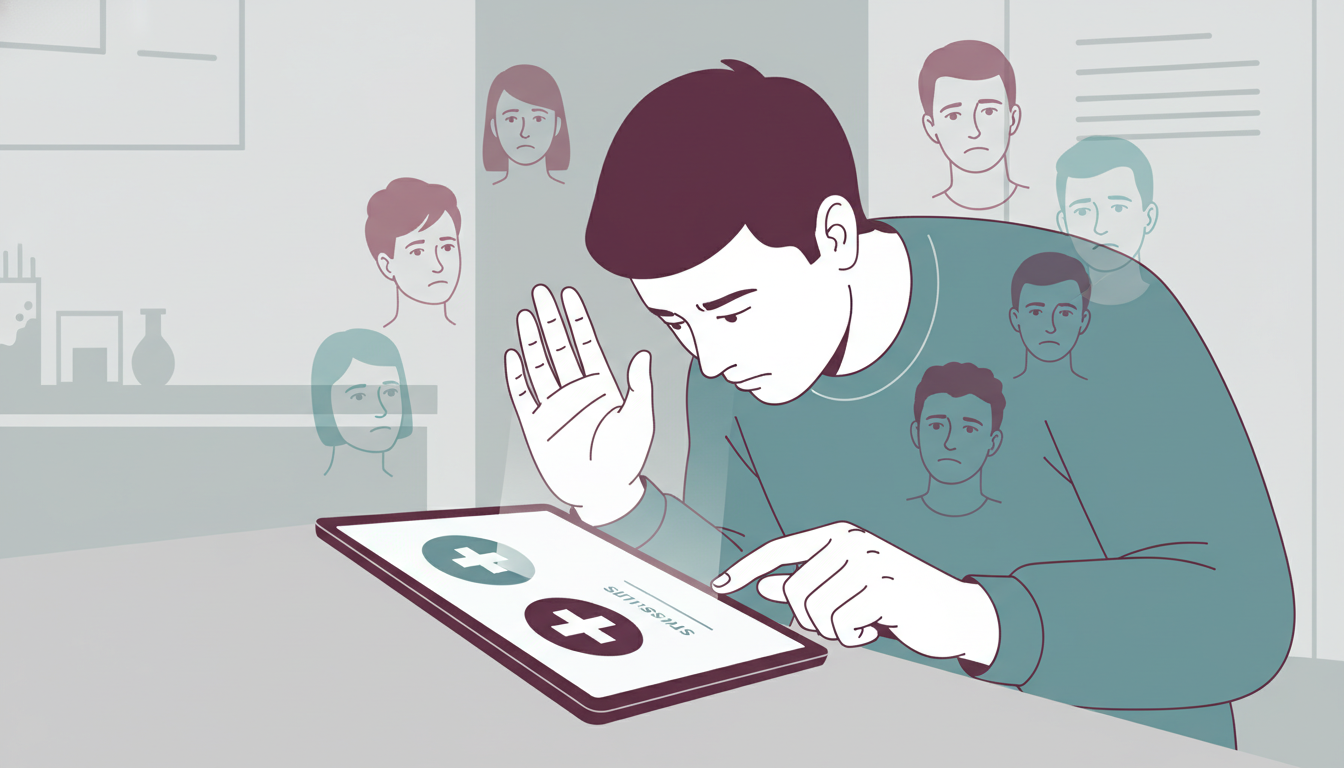
What ties these examples together is the imagined audience, not the physical act of testing. Most people are not afraid of a swab or a fingerstick. They are afraid of being seen by a partner, a parent, a friend who works at the front desk, a pharmacist who recognizes them, a religious leader, or themselves in the mirror. Public-health researchers call this anticipated stigma, and CDC surveillance and prevention materials consistently identify it near the top of reported reasons for delayed screening (CDC sexually transmitted infections hub).
Knowing intellectually that STIs are common does not erase the feeling. Plenty of sex-positive, well-informed adults still feel a jolt at the thought of saying out loud, “I think I should get tested,” and that jolt is usually social rather than medical, anchored in anticipated reactions from other people more than in the underlying biology of chlamydia or HSV-2.
What the data says about testing avoidance
Surveillance data shows a persistent gap between recommended and observed screening rates across most groups. The CDC publishes routine screening recommendations for sexually active adolescents and adults, including annual chlamydia and gonorrhea screening for sexually active women under 25, and at-least-annual HIV and syphilis screening for sexually active gay and bisexual men. Observed screening falls well below those recommendations across most age and risk groups (CDC sexually transmitted infections hub).
When researchers ask people why, emotional reasons keep landing at the top of the list. Fear of judgment, fear of the result, and the worry that asking for a test will look like an admission of something shameful all show up more often than cost, transport, or clinic hours. Surveys consistently place stigma-related reasons at the top of the list, ahead of cost and access barriers. The table below pairs each common reason with the inner script that usually goes with it.
Most people do not even recognize that what is stopping them is shame. They tell themselves they are too busy, or that it does not feel urgent. Underneath those reasons sits a quieter mix of self-blame, fear, and the very specific dread of being asked, “How many partners?” by someone holding a clipboard.
| Reason for avoiding STD testing | What it sounds like inside the head |
|---|---|
| Fear of judgment or stigma | “They will think I am dirty.” |
| Fear of a positive result | “I would rather not know.” |
| Belief that no symptoms means no infection | “If I felt sick, I would know.” |
| Worry about a partner's reaction | “They will think I cheated.” |
| Embarrassment about asking | “How do I even bring it up?” |
When faith and purity culture become a testing barrier
For readers raised in strict religious environments, testing shame can have an extra layer. If sexuality and morality were taught as the same thing, then the test itself can feel like a confession. Some people who grew up with abstinence pledges or purity messaging have described feeling that a positive result would mean they had failed not just their body but their entire community.
Abstinence-only education rarely covers oral sex, manual contact, or shared toys as transmission routes, leaving some people sincerely believing they are not at risk and dismissing early symptoms like burning, sores, or unusual discharge because they still identify as virgins. The fear of being recognized at a local clinic by a congregation member, parent, or family friend then keeps people away for months or years on top of that.
None of this is a problem with faith as such. Most major faith traditions value compassion, honesty, and care for the body. The harm comes from the specific cultural framing that infection is moral punishment. STIs are spread by skin contact, fluid exchange, and exposure. They do not care about anyone's worldview, and treating them is a medical question, not a spiritual one.
For readers in this position, reframing testing as care for a future partner rather than a confession of past behavior tends to help most. Private at-home kits also remove the clinic-recognition risk that keeps some readers away from local services entirely (WHO STI fact sheet).
People raised with abstinence-only education sometimes assume that if they have not had penetrative intercourse, they cannot have been exposed to an STI. Chlamydia, gonorrhea, herpes, HPV, and syphilis can all transmit through oral contact, manual contact, or shared toys. Identifying as a virgin does not change biology, and early symptoms like burning, sores, or unusual discharge are worth a screen regardless of how recent sexual activity has been.
When you are more afraid of judgment than infection
For a lot of people, the loudest fear is not the infection itself. It is what other people will think if they find out. The partner who sees a kit on the bathroom counter. The roommate who notices a clinic appointment on a shared calendar. The pharmacist who hands over the result and seems to glance up from the screen. Anticipated social exposure can be a more powerful silencer than the medical risk.
That fear is almost always worse than the reality. Caring for your sexual health is not embarrassing, even if it has been culturally framed that way. If a partner reacts to news that you are getting tested with suspicion or anger, that reaction is information about the partner, not about the test. Most people who have done it once will tell you the actual experience was less dramatic than the imagined version.
One reframing that helps: testing is closer to a routine health behavior than to a verdict. People who get screened on a regular cadence are most often the ones who have folded the test into the same mental category as their dentist appointment or their flu shot.
If you tell a partner you are getting tested and they treat it as an accusation, that reaction is information about the relationship, not about the test. Routine screening is closer to a dentist visit than to a confession. A partner who can hold the conversation calmly is showing you something useful about how future health conversations will go; a partner who cannot is also showing you something useful.
The “I feel fine” trap
One of the most common reasons people skip testing is that nothing hurts. The body is doing its usual thing, no obvious sores, no discharge, no fever. So the screening keeps drifting to next month. Then next year.
Most early-stage STIs are silent. Chlamydia and gonorrhea can sit in the body for months with no symptoms, while quietly causing pelvic inflammatory disease and contributing to infertility risk in people with a uterus (CDC STI hub). HPV often shows nothing for years before any cellular change is detectable. Acute HIV produces a flu-like phase that most people brush off as a bad week. Syphilis can present as a single painless sore that heals on its own and is then mistaken for a paper cut or razor burn.
By the time something does hurt, two things may already have happened. The infection may have caused damage that is harder to reverse. And it may already have been transmitted to one or more partners. Routine screening at recommended intervals is the only way to catch the silent phase before it becomes either of those things.
This matters especially for people who are using condoms inconsistently, who have multiple partners, or who have a new partner since the last screen. The Mayo Clinic's STD testing overview is a good plain-English starting point on which tests make sense in which scenarios (Mayo Clinic STD testing).
STIs that most often hide without symptoms
- Chlamydia: frequently silent for months in either sex; major contributor to pelvic inflammatory disease and to infertility risk in people with a uterus.
- Gonorrhea: often asymptomatic at the cervix and at oral and rectal sites, even when the genital site is producing discharge.
- HPV: typically silent for years before any cellular change shows up on a Pap smear or visible wart.
- Acute HIV: produces a flu-like phase most people brush off as a bad week, then settles into a clinically silent phase that can last years.
How shame lands differently across communities
Testing shame is not the same shame everywhere. The pattern shifts with culture, history, and who has been treated badly by the medical system before.
For queer and trans readers, especially those raised in conservative households, testing can carry the additional fear of being outed. The clinic visit becomes a coming-out moment by accident. For trans readers there is also the very practical worry of being misgendered, asked invasive questions, or having to educate the provider about anatomy.
For women, testing shame is often loaded with “you should have known better” framing. The same clinic encounter that a male partner might walk out of unbothered can leave a female partner feeling lectured. Surveys consistently find that women report higher anticipated stigma around STI testing than men, even when the underlying behavior and risk profile are similar.
For Black and Latinx readers, the shame layer is often compounded by a longer history of being mistreated by healthcare systems. Mistrust of providers, lack of culturally competent care, and the experience of being stereotyped during clinic visits all reduce the likelihood of returning for routine screening (CDC STI hub).
For people in conservative religious communities, as covered above, the shame can feel spiritual rather than medical. For people in small towns where clinic staff might double as neighbors, it can feel social. Different shapes of shame need different routes through, which is why having more than one way to test (a primary care visit, a dedicated sexual-health clinic, a discreet at-home kit) matters more than any single perfect channel.
National surveillance shows substantial differences in STI rates by race and ethnicity, driven largely by structural inequities in access, screening, and clinical experience rather than by individual behavior. Discreet at-home testing is one tool among many for closing the screening gap; it is not a substitute for systemic reform of how care is delivered.
Why private at-home testing changes the math
For a lot of readers, the fear is not the result. It is the process of getting to the result. The waiting-room lighting, the form on a clipboard, the moment of saying the words out loud to a stranger. At-home rapid testing changes that part of the experience.
The kits sold on this site are rapid lateral-flow tests, the same chemistry used in many pharmacy pregnancy tests and in the early-pandemic COVID antigen tests. You collect a sample at home (a self-swab for chlamydia, gonorrhea, trichomoniasis, and HPV; a fingerstick blood drop for HIV, syphilis, herpes, and hepatitis), then read the result on the cassette in roughly 15 to 20 minutes. Our trichomoniasis and HPV swabs are validated for vaginal self-collection only; readers needing a male-anatomy trich or HPV test should see a clinic.
This is screening, not laboratory diagnosis. Lab NAAT (nucleic-acid amplification) tests have higher analytical sensitivity than lateral-flow rapid tests, especially in early or asymptomatic infection, and a positive at-home result is worth confirming with a clinic test where possible. The two technologies are complementary. Where rapid lateral-flow tests win is access. They give an answer to people who would otherwise stay frozen by shame, in their own bathroom, on their own schedule, without a receptionist asking how many partners they have had this year.
The trade-off table below compares the three main testing routes most readers in the United States have access to.
| Testing route | Privacy | Time to result | Best for |
|---|---|---|---|
| At-home rapid lateral-flow test | Very high | 15 to 20 minutes | Readers stuck on the doorstep of any clinic by shame or scheduling |
| Mail-in lab NAAT kit | High | 2 to 5 days after the lab receives the sample | Readers who want lab-grade sensitivity but no in-person visit |
| In-clinic test (primary care or sexual health clinic) | Lower | Same day to about a week | Readers with active symptoms, recent high-risk exposure, or who need same-visit treatment |
Reframing testing as care, not confession
The single most useful mental shift for anyone stuck in testing shame is to stop treating screening as a verdict on past behavior. A test does not litigate what happened on a particular night two months ago. It tells you, today, whether something needs treating. The same way a flu swab tells you whether you have the flu without weighing in on whether you should have washed your hands more often.
Reframed that way, testing is closer to brushing your teeth or checking your blood pressure than to a confession. It is something you do because you have decided to know what is happening in your body, not because you have done something wrong. Telling a new partner “I get screened regularly” is not an admission. It is a standard.
That standard is also part of how the wider STI epidemic gets controlled. The more people who screen routinely, the more silent infections get caught and treated before they can spread. The same logic shows up in CDC and WHO screening guidance, which targets routine testing in sexually active adults precisely because most early infections never produce symptoms on their own.
Many people who are infected with an STD do not know it. Testing is the only way to know for sure if you have an STD.
What to actually do next
If you have been sitting on the idea of testing for weeks or months, the smallest useful step is usually the same one. Pick the route with the lowest amount of friction for your specific shame, and start there. For some readers that means an at-home rapid kit because the clinic visit feels impossible. For others it means a sexual health clinic because they want a provider to talk through the results in person.
A reasonable baseline for most sexually active adults is annual screening, with more frequent screening (every three to six months) for people with new or multiple partners, inconsistent condom use, or any specific exposure they are worried about. Symptoms that warrant testing within days rather than weeks include burning when urinating, unusual discharge, new sores or rashes in the genital area, and unexplained pelvic or testicular pain (NHS sexually transmitted infections).
This article is published by stdrapidtestkits.com, which sells at-home STI testing kits. We recommend products based on fit-for-purpose for the reader's concern, not commercial benefit. If a kit is the right route for you, the 8-in-1 panel below covers eight of the most common STIs for both men and women in a single shipment.

FAQs
- I do not have any symptoms. Should I still test?
- Yes. The CDC recommends annual screening for all sexually active adults regardless of how they feel, precisely because most early infections produce nothing noticeable. A new partner since your last screen, or any sex without consistent condom use, is enough reason to test.
- What if my partner sees the kit and thinks I do not trust them?
- That is a conversation worth having directly. Routine testing is a health behavior most clinicians frame the same way as an annual physical, focused on transparency rather than trust. If a partner responds to a test by accusing you of suspicion, that response is itself useful information about the relationship.
- How accurate are at-home rapid STI tests?
- Most rapid lateral-flow kits report sensitivity in the mid- to high-90s and specificity above 99 percent when used after the correct window period. Accuracy depends on following the instructions and waiting the right number of days after exposure. A positive at-home result is worth confirming with a lab NAAT test.
- Is the packaging actually discreet?
- Reputable at-home test providers, including this site, ship in plain outer packaging with no clinical branding, no diagnostic terms, and no clue to the contents. The shipping box looks like any other small parcel.
- Can I get an STI from someone who said they were 'clean'?
- Yes. Not necessarily because they lied. Many people genuinely believe they are STI-free because they feel fine, even though they have not been tested in months or years. The word 'clean' covers a wide range of recent testing histories, including 'never recently tested.'
- What if the test comes back positive?
- Most STIs are treatable. Bacterial infections (chlamydia, gonorrhea, syphilis) are curable with a standard course of antibiotics. Viral ones including HIV, herpes, and hepatitis B and C are manageable with current treatment, and HIV in particular now carries near-normal life expectancy when caught and treated early. A positive result opens a treatment path.
- Is my information safe with an at-home test?
- Reputable providers do not share results with insurers or employers. Results stay between you and the kit. If you upload a result to a connected portal or use a telehealth follow-up, the standard medical-privacy rules of the relevant jurisdiction apply.
- How often should I get tested if I am sexually active?
- Once a year for most sexually active adults; every three to six months if you have had new or multiple partners or inconsistent condom use since your last screen. The CDC STI prevention pages carry tailored guidance by demographic group.
- U.S. Centers for Disease Control and Prevention. Sexually transmitted infections hub, used here for the framing of anticipated stigma as a barrier to recommended screening, for the underlying screening recommendations by population, and for the gap between recommended and observed screening across age and risk groups.
- U.S. Centers for Disease Control and Prevention. STI hub, used here for the broader context on disparities in screening, mistrust of providers, and culturally competent care for Black and Latinx communities, and for the asymptomatic-infection framing in the 'I feel fine' section.
- World Health Organization. Sexually transmitted infections fact sheet, used here for global incidence and the framing of stigma as a contributor to poorer sexual and reproductive health outcomes.
- Mayo Clinic. STD testing overview, used here for plain-English description of which tests make sense for which scenarios.
- U.K. National Health Service. Sexually transmitted infections, used here for the symptom-list guidance on when testing should happen within days rather than weeks.
