

Published: October 2025 | Last updated: April 2026 | Editorial review and quality control: Martina N.
Chlamydia is the most commonly reported bacterial STI in the United States, and most people who have it never feel a thing. That silence makes the infection easy to miss in any patient, and harder still in patients whose symptoms tend to be minimized, ignored, or filed under something else. The numbers reflect that pattern. Black women in the U.S. are diagnosed with chlamydia at rates roughly five times those of white women, and the disparity reflects testing access and clinical attention more than risk behavior.
This guide walks through why chlamydia hides, what untreated infection does to the body over weeks and months, when testing actually catches the bacteria, and what to do with a positive result. If you came here for reassurance that subtle symptoms do not always mean disaster, you will find it. If you came for a clear next step, that is here too.
Why does chlamydia affect Black women differently?
Chlamydia diagnosis rates are about five times higher in Black women than in white women, but the gap reflects testing access, clinical bias, and rates of asymptomatic infection rather than risk behavior. Most women with chlamydia feel nothing at all, which makes routine testing the most reliable way to catch it early, especially when subtle symptoms keep getting filed as a urinary tract infection or hormonal change. The CDC recommends annual screening for sexually active women under 25 and for older women with new or multiple partners.
Key Takeaways
- Most women with chlamydia have no symptoms, and Black women in the United States are diagnosed at rates roughly five times those of white women, per CDC health-disparities surveillance.
- Untreated chlamydia can scar the fallopian tubes within weeks; most clinicians recommend testing about 14 days after exposure, and routine retesting catches what an early swab can miss.
Why chlamydia hides, and why that hits Black women harder
Chlamydia is caused by Chlamydia trachomatis, a bacterium that infects the cervix, urethra, rectum, or throat. Most women who carry it report nothing unusual: no burning, no discharge, no pain during sex, no spotting. The CDC's chlamydia overview notes that the majority of female infections are asymptomatic, which is why the agency recommends routine annual screening for sexually active women under 25 (CDC, About Chlamydia). Screening is not a response to suspicion. It is the only way to catch an infection that does not announce itself.
For Black women, that quiet pattern sits on top of a healthcare environment that already misses things. CDC health-disparities surveillance reports the rate of diagnosed chlamydia among African American/Black females at roughly five times the rate among white females, citing 1,411.1 versus 281.7 cases per 100,000 (CDC, Health Disparities). The gap is not driven by behavior; it tracks closely with testing access, clinic availability, and how often a provider thinks to suggest a swab. The same agency identifies social determinants such as access to care and stigma as the primary drivers, not differences in sexual behavior.
Two readers with the same exposure history can leave a clinic with very different outcomes. One walks out with a chlamydia diagnosis and antibiotics in hand. The other walks out with a vague reassurance and a follow-up booked for a few months later. The biology of chlamydia is the same in everybody. The system around the biology is not, and closing that gap is what this article is trying to help with.
Chlamydia diagnosis rates among Black women in the U.S. run roughly five times higher than among white women. The CDC attributes the gap to testing access, provider attention, and social determinants of care, not to differences in sexual behavior. The same surveillance also notes that Black or African American populations carry a disproportionate share of bacterial STI diagnoses overall.
Where the system loses people, and how to ask differently
Most readers who walk into urgent care with low-grade pelvic pressure or unusual spotting do not leave with an STI swab. They leave with a urinalysis, a yeast-infection treatment, or a script for cramping. The default workup leans toward whichever cause is most common for the patient profile in front of the clinician, and clinical default settings are not neutral. Multiple studies in public-health journals have documented that implicit bias and patient demographics influence which tests get ordered and how quickly. The result is that infections which present subtly, in patients whose pain reports are statistically discounted, get caught later than they should.
What this means in practice is straightforward. If a urinary tract infection prescription does not clear the burning, if a yeast treatment does not clear the discharge, or if cramps keep showing up outside a regular cycle, an STI panel is reasonable to ask for explicitly. The wording matters. A direct request such as "can we run a chlamydia and gonorrhea swab while we are here" tends to move the visit faster than waiting for a provider to suggest it. Asking for the swab works the same way a blood-pressure check does. It belongs in the visit regardless of who initiated the conversation.
The table below collects the symptom patterns that most often get filed as something else. None of these are unique to Black women; what differs is how often each one gets followed up with a chlamydia test rather than reassurance.
| Symptom | Common misdiagnosis | Why it gets missed |
|---|---|---|
| Light spotting between periods | Hormonal imbalance or stress | Often dismissed without an STI swab when no other red flags are present |
| Pelvic discomfort or pressure | Stress, digestive issues, or normal cycle variation | No external signs make the link to an infection harder to draw |
| Abnormal discharge | Bacterial vaginosis or yeast infection | Visual diagnosis only; no confirmatory swab taken at the visit |
| Burning during urination | Urinary tract infection | Urine culture alone may not catch chlamydia; needs an explicit STI test |
| Pain during sex | Psychological or emotional cause | Often minimized in younger women, with a measurable gap for Black patients |
From a quiet infection to PID, on a clock
The reason routine screening matters is that chlamydia does not stay polite. Once the bacteria establish a foothold in the cervix or urethra, they can travel upward over weeks. The CDC's overview of pelvic inflammatory disease describes the same pathway in clinical language. Untreated chlamydia is one of the most common precipitants of PID, and PID is one of the most common causes of preventable infertility, chronic pelvic pain, and ectopic pregnancy (CDC, About PID).
The timing matters because the window between "easy to treat" and "complications start" is shorter than most readers think. The table below sketches what that progression can look like in untreated cases. The numbers are not promises. Some people clear the bacteria spontaneously and others develop PID inside a month, and both ends of that range happen with no obvious external cue. The point is that the clock is running whether or not the body is reporting in. A swab around two weeks after exposure, even when nothing feels wrong, is the move that prevents most of the timeline below.
| Stage | Timeline | What is happening | Risk if untreated |
|---|---|---|---|
| Initial infection | Days 1 to 14 | Bacteria attach to cervix or urethra; usually no symptoms | Contagious to partners; easily missed without a swab |
| Silent ascent | Weeks 2 to 6 | Infection travels into the uterus and fallopian tubes | Mild pelvic pressure, occasional spotting; tubal inflammation begins |
| Pelvic inflammatory disease | 1 to 3 months | Active inflammation and early scarring of fallopian tubes | Severe pelvic pain, fever, abnormal bleeding; ectopic-pregnancy risk rises |
| Long-term reproductive impact | Months to years | Tubal scarring obstructs egg movement | Tubal-factor infertility, chronic pelvic pain, recurrent infection |
How the bacteria ascends through the reproductive tract
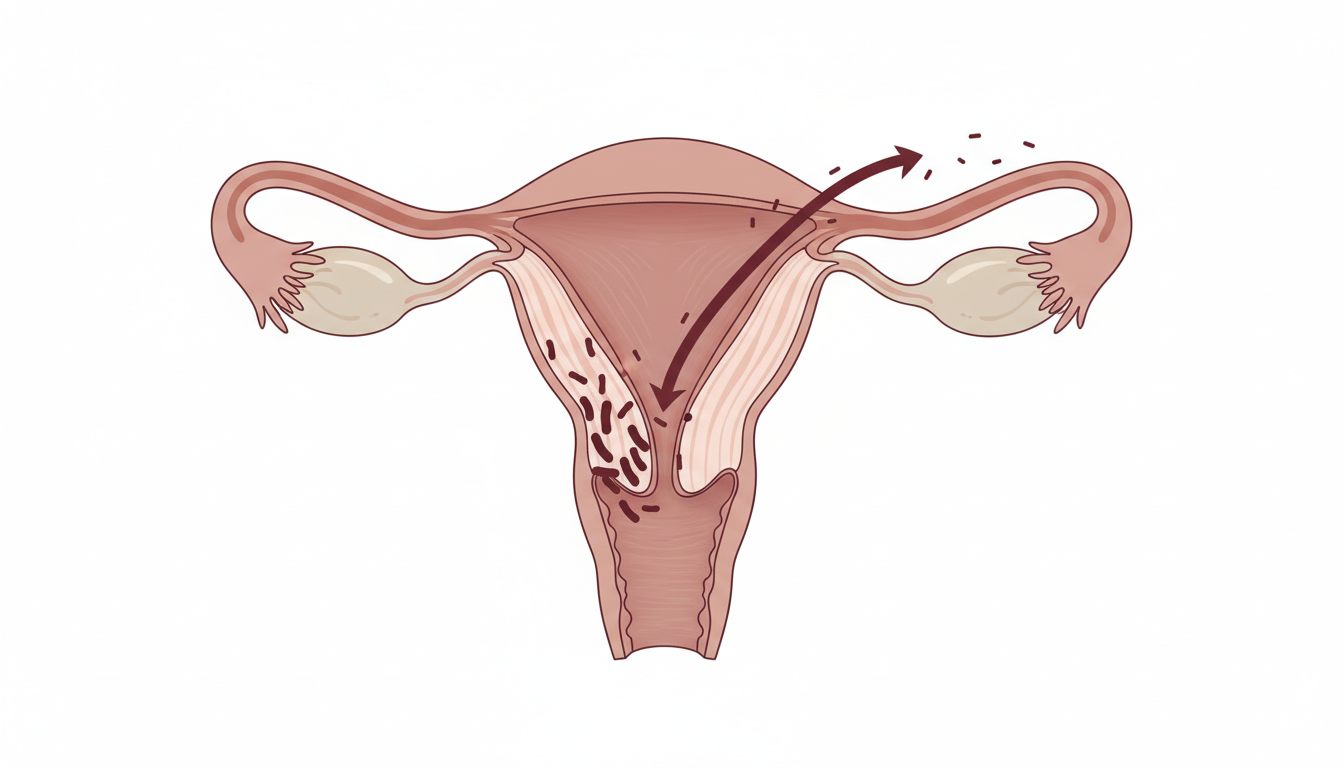
Chlamydia trachomatis attaches first to the columnar epithelial cells (the surface cells lining the inside of the cervix and urethra) of the cervix or urethra. From there, the bacteria can move through the cervical canal into the uterine cavity, then up into the fallopian tubes. The body's inflammatory response to that ascent is what damages the tissue. White blood cells flooding the area to fight the infection cause swelling, then scarring as the inflammation subsides. The scar tissue is what blocks the tubes and complicates future pregnancies.
The diagram below traces the upward path. It is the reason a cervical infection that produced no obvious symptoms can quietly become a fallopian-tube problem months later. By the time someone notices sharp lower-quadrant pain, deep pain during sex, or fevers, the inflammation has often been working for weeks. The CDC's PID overview describes the same trajectory, including how scarring of the reproductive tract can occur without the patient ever noticing the original infection (CDC, About PID). The takeaway is not alarm. The takeaway is that screening is more useful than waiting for an internal alarm bell that may never ring.
Symptoms that hide in plain sight
For the readers who do experience something, the signs tend to be subtle. Light spotting between periods. A pulling pressure in the lower pelvis. Pain during sex that gets blamed on stress or hormones. None of these announce themselves loudly, and most have non-STI explanations on a busy day. The full set of patterns most often filed as something else is in the misdiagnosis table above.
If a UTI antibiotic course does not clear the burning, swapping from a urine culture to an STI swab is a reasonable next step; chlamydia of the urethra mimics a UTI closely. Recurrent bacterial vaginosis or yeast that keeps returning after correct treatment can also signal that something else is going on underneath. Neither pattern proves chlamydia. Both are reasons to ask for the swab explicitly rather than waiting for a provider to suggest it. The NHS patient overview of chlamydia covers the same ground on how often the infection is asymptomatic and the same advice that an explicit STI test is the only way to confirm it (NHS, Chlamydia).
If antibiotics for a UTI did not fix the burning, if a yeast treatment did not clear the discharge, or if pelvic pressure keeps returning outside a regular cycle, ask for a chlamydia and gonorrhea swab. Saying "I would like a full STI panel including chlamydia" is faster than waiting for a provider to suggest it. The two infections often co-occur and are commonly co-tested.
When to test, and what the window actually means
Most clinicians recommend waiting about 14 days after exposure before testing for chlamydia. Some laboratory NAAT methods can pick up bacterial DNA earlier, around five to seven days, but a negative result that early can give a false sense of clearance. The CDC's About Chlamydia page recommends annual screening for sexually active women under 25 and retesting after a new exposure or if symptoms develop later (CDC, About Chlamydia).
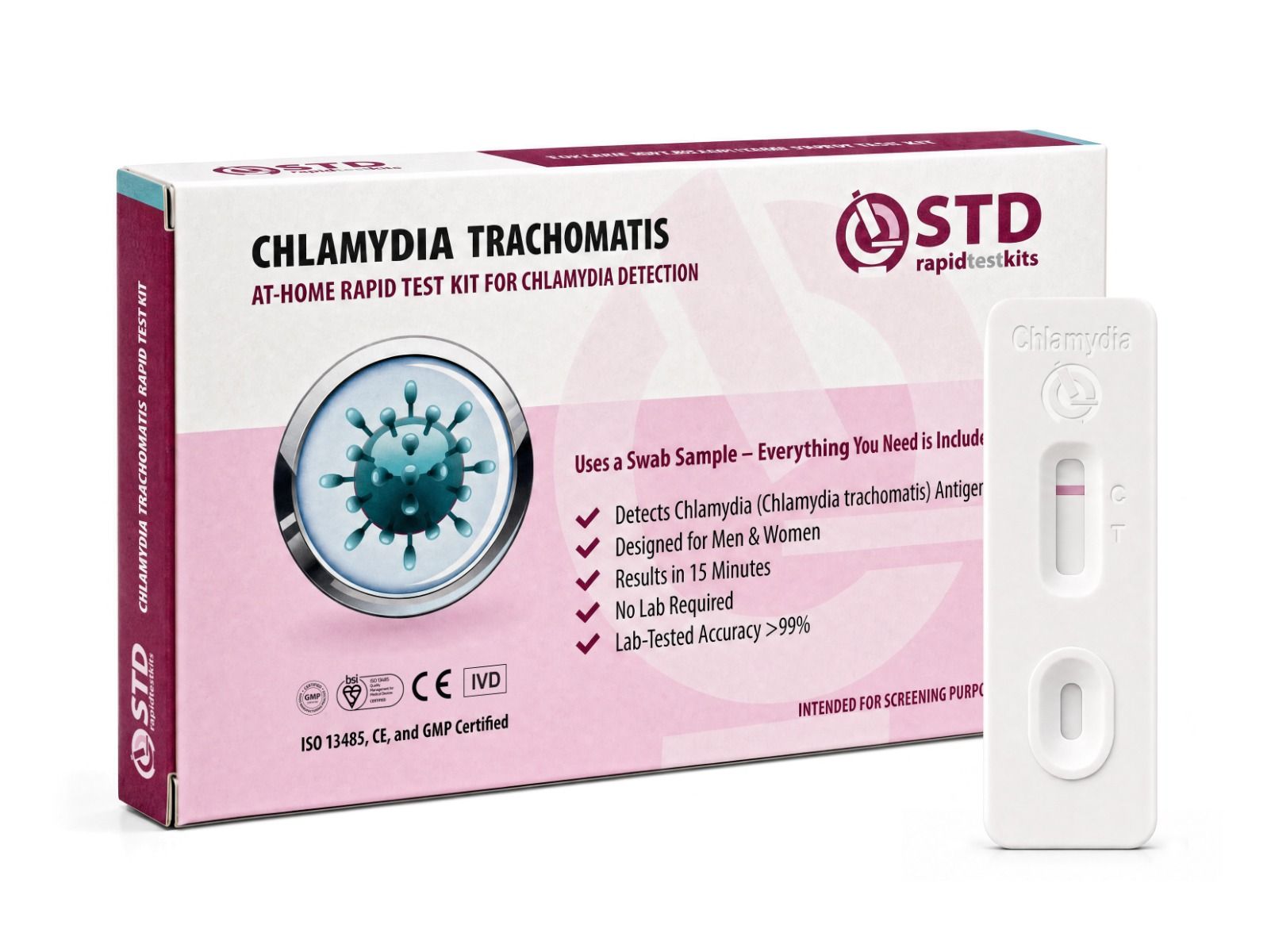
At-home rapid swab kits use lateral-flow chemistry rather than NAAT, which is the gold-standard laboratory technology. The two are complementary, not identical. Lateral-flow is faster and private; lab NAAT is more analytically sensitive. A positive at-home result is worth confirming with a lab NAAT when possible, and a negative at-home result paired with persistent symptoms is a reason to retest at the lab. Either way, the 14-day window applies, and a swab taken much earlier than that should be repeated rather than trusted as final.
For sexually active women under 25 and for older women with new or multiple partners, the CDC recommends annual screening as a baseline, with a three-month rhythm after any new exposure or after a previous chlamydia diagnosis. Treating testing like an annual physical, not an emergency, is the way the rhythm becomes routine instead of a reaction to a scare.
This article is published by stdrapidtestkits.com, which sells the at-home STI test kits referenced below. The recommendations here are based on fit-for-purpose for a reader's specific concern, not commercial benefit.
Test at 14 days for a reliable result. If you test earlier and get a negative, retest at 14 days. If symptoms appear after a negative test, retest at that point regardless of the prior result. A positive at any stage is worth confirming with a lab NAAT.
What treatment looks like, and when to retest
Chlamydia is curable with a short antibiotic course. Current CDC treatment guidance is doxycycline 100 milligrams twice daily for seven days, with azithromycin 1 gram as a single dose available in specific situations such as pregnancy. Both clear the active infection in nearly all completed courses. Skipping doses or stopping early is the most common reason treatment fails.
Two follow-up steps protect the result. First, both partners need treatment at roughly the same time, otherwise reinfection is almost guaranteed once sex resumes. Many states allow expedited partner therapy, where a clinician writes a script for a partner who has not had a clinic visit. Second, retest about three months after the antibiotic course finishes. Reinfection rates are high enough that the CDC recommends this as standard practice, especially for women under 25.
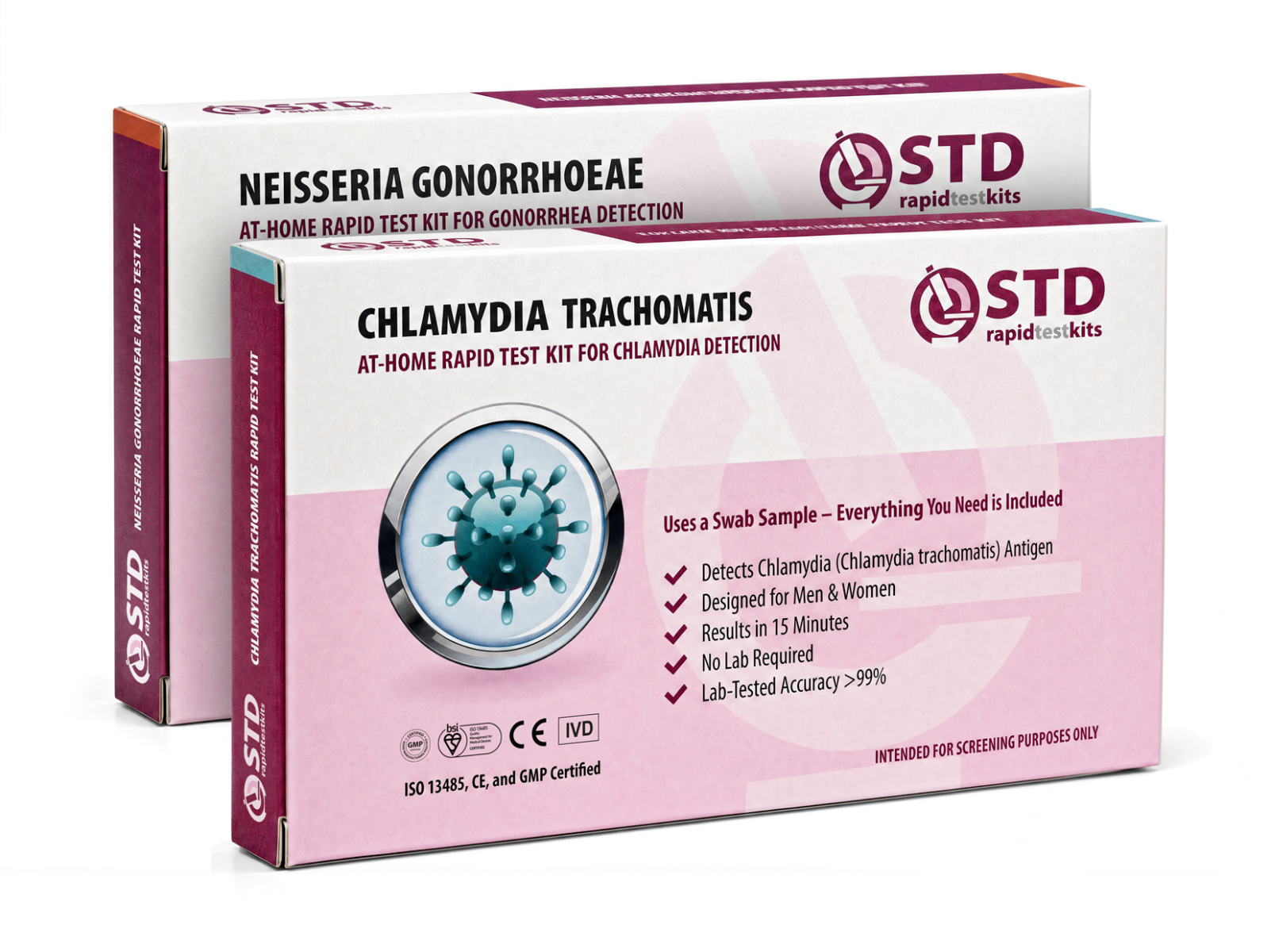
If a chlamydia diagnosis comes back, gonorrhea is worth testing for at the same time. The two infections often co-occur, and CDC screening guidance commonly co-tests both. The WHO STI fact sheet sets the same expectation in the global context, including the importance of partner treatment to prevent ping-pong reinfection (WHO, STIs). A combined swab kit answers both questions in one self-collection rather than booking two visits.
Chlamydia treatment at a glance
- Doxycycline 100 mg twice daily for 7 days is the standard CDC-recommended course; azithromycin 1 g as a single dose is reserved for specific situations such as pregnancy.
- Both partners need to complete treatment at roughly the same time so the infection does not bounce back once sex resumes.
- Retest about three months after the course finishes. Reinfection rates are high in the first year, and a follow-up swab is part of the standard plan, not a sign of mistrust.
Testing as power, on your terms
For readers who have run into clinical environments that did not listen, the choice between waiting for the system to take you seriously and taking yourself seriously first is a real one. At-home testing does not replace clinical care for treatment, but it does shift who controls the timing of an answer. A box on a kitchen counter, a private fifteen minutes, and a result that belongs to nobody but the person reading it.
That route works well for screening when nothing feels wrong, for retesting after antibiotics, and for partners who want to test together before changing barrier-method habits. It does not work as well for active complications such as severe pelvic pain or fevers, which are reasons to see a provider quickly. The two routes are tools for different jobs. The at-home kit is the one that fits a routine instead of an emergency, and a routine is what catches chlamydia in the window where treatment is straightforward rather than complicated.
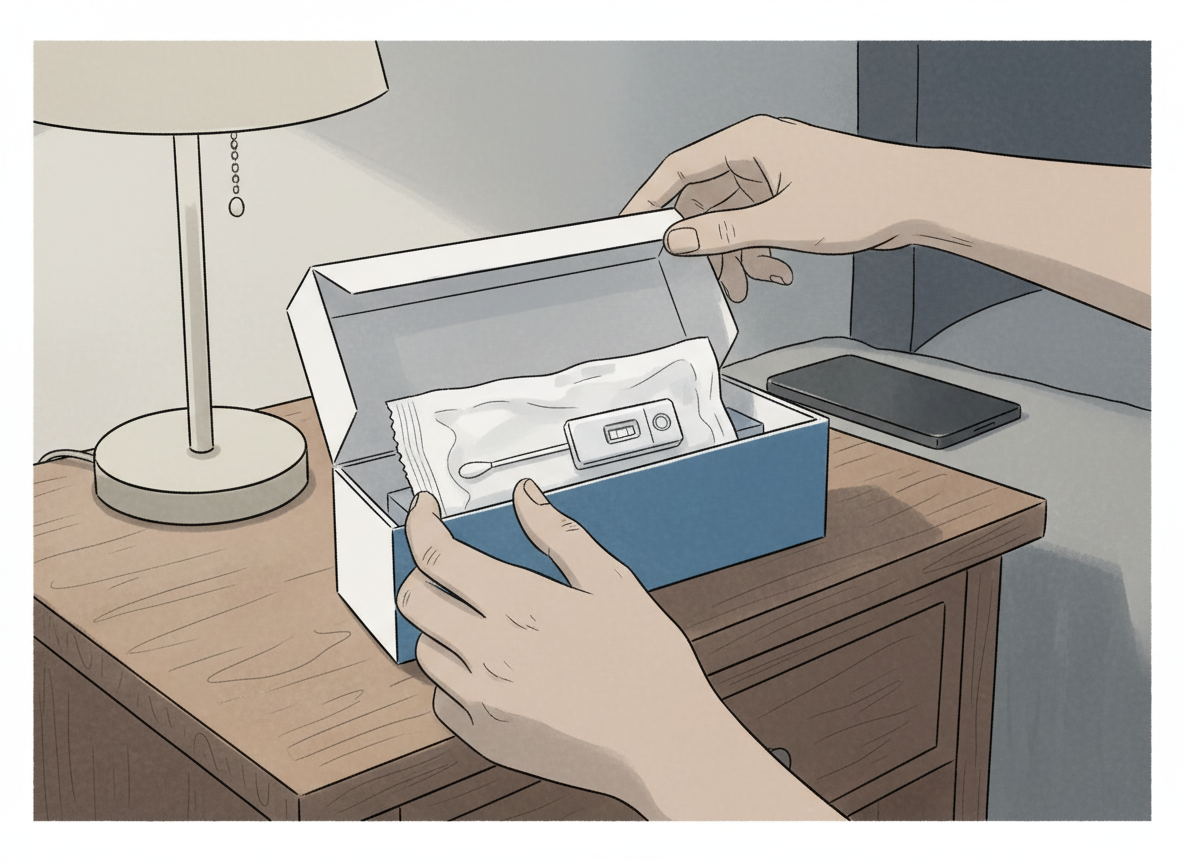
The most useful framing of at-home testing is rhythm rather than reaction. Setting a quarterly reminder to run a rapid swab during ongoing exposure, or scheduling a retest three months after antibiotic treatment, turns chlamydia from a thing that surprises people into a thing that gets caught early. The 15-minute window the cassette takes to develop is the same length as a coffee, and the privacy of the result is the part most readers describe as the difference-maker.
None of this replaces seeing a clinician for treatment, for severe symptoms, or for prenatal care. It does mean that the screening step, the one that historically has been gated by access and provider attention, no longer has to be.
Most people who have chlamydia have no symptoms. If you do have symptoms, they may not appear until several weeks after you have sex with an infected partner.
Frequently asked questions
- Can you have chlamydia with no symptoms?
- Yes. Most women with chlamydia feel nothing at all. The CDC notes that the majority of female infections are asymptomatic, which is why routine screening is recommended for sexually active women under 25 and for older women with new or multiple partners. No itching, no discharge and no pain do not mean no infection. The only reliable answer comes from a swab, not a self-check in the mirror.
- How long after sex should I wait to test?
- Wait 14 days. Tests run closer to day 5 or 7 can miss active infections because the bacterial DNA is still at low concentrations. A negative result before day 14 should be repeated at 14 days. If symptoms develop after a clean test, repeat the swab at that point. A positive result at any stage is worth following up with a laboratory NAAT for confirmation.
- Why are Black women diagnosed at higher rates?
- The diagnosis-rate gap for Black women runs roughly five times that of white women, and the gap reflects the system rather than the biology. Testing access is uneven, providers are statistically less likely to offer a full STI panel without a direct request, and asymptomatic infections quietly spread for longer when no one runs the swab. Knowing this helps when walking into a visit informed, or when picking a testing route that does not require convincing anyone.
- Could untreated chlamydia really cause infertility?
- It is one of the leading preventable causes of tubal-factor infertility in women. Bacteria from an untreated cervical infection can ascend into the uterus and fallopian tubes, triggering pelvic inflammatory disease. PID can scar the tubes, block egg movement and raise the risk of ectopic pregnancy. The damage often happens before any pain announces it, which is why early testing is the lever that matters most.
- Could it be confused with a UTI or yeast infection?
- Easily. Burning during urination, pelvic pressure and unusual discharge overlap with urinary tract infections, bacterial vaginosis and yeast infections. If a UTI antibiotic does not clear the burning, if a yeast treatment does not clear the discharge, or if symptoms keep returning, asking for an STI swab during the same visit is reasonable. A urine culture alone will not always catch chlamydia.
- Can I test at home and trust the result?
- At-home rapid swab kits are designed for private self-collection and give a 15-minute result. They use lateral-flow chemistry rather than the laboratory NAAT methods clinics rely on, so the technologies are complementary rather than identical. A positive at-home result is worth confirming with a lab NAAT when possible, and either way an antibiotic course is needed before retesting roughly three months later.
- Does treatment work, and do I need to retest?
- Chlamydia is curable with a short antibiotic course, usually doxycycline taken twice a day for seven days or a single dose of azithromycin in specific situations. The current infection clears, but treatment does not make you immune. The CDC recommends retesting about three months after treatment because reinfection rates are high and missed partner treatment is the most common reason it returns.
- Does a positive result mean a partner cheated?
- Not always. Chlamydia can stay quiet in the body for months before being detected, so a fresh diagnosis does not pin down a recent exposure. If the test is the first time anyone in the relationship has been screened, the infection could date back well before the current partnership. The conversation about how to handle that is its own thing; the medical step of getting both partners treated comes first.
For a broader check: a full multi-infection panel
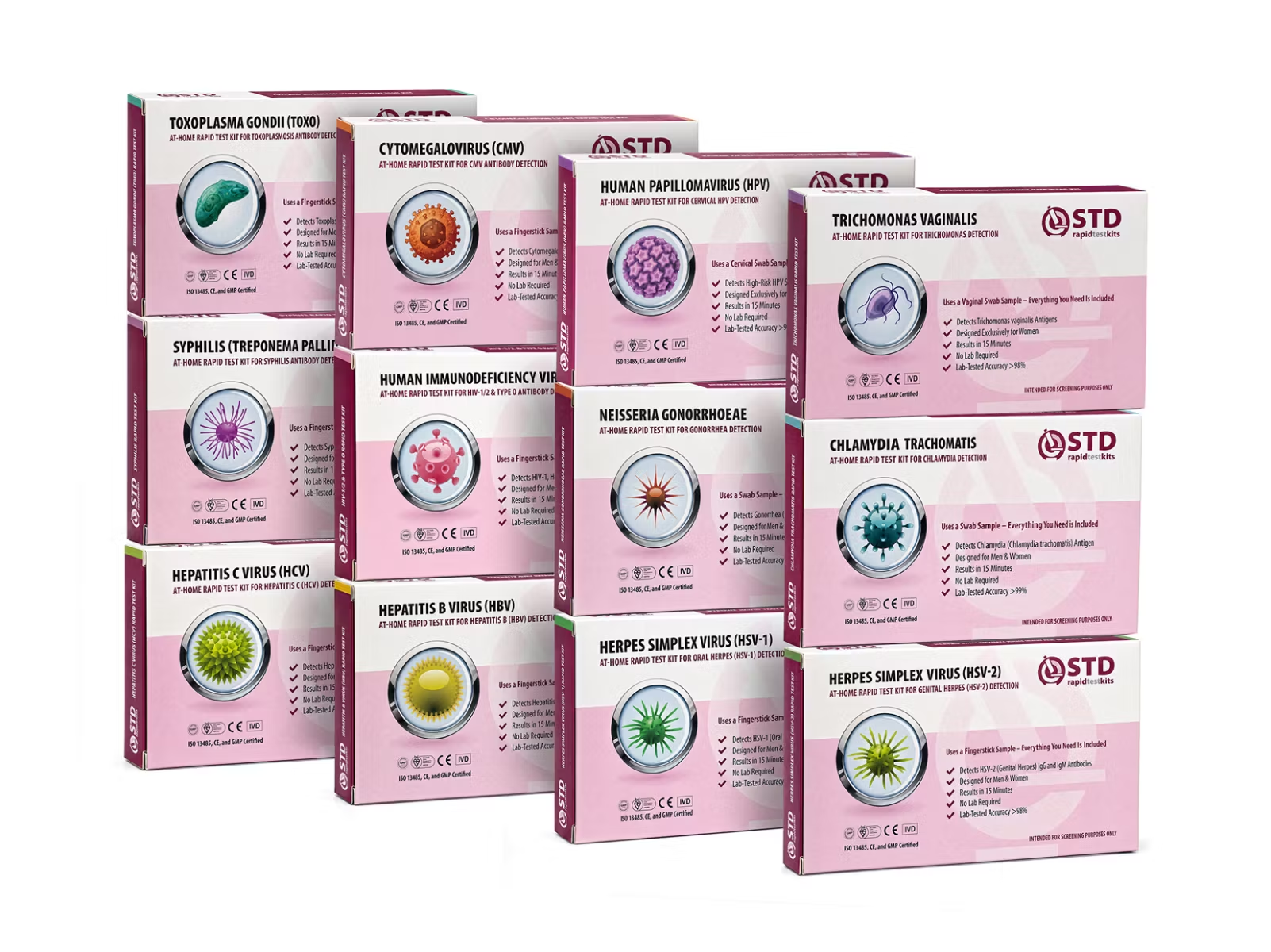
The exposure event that puts chlamydia on the table often carries risk for other infections too. A women's 10-infection panel answers the wider question in one self-collection rather than booking separate visits for each test, and the result format is consistent across the kit. Useful when the chlamydia question is the front door and a fuller picture is what actually closes the loop.
- U.S. Centers for Disease Control and Prevention. About Chlamydia. Symptoms, transmission, screening recommendations and treatment guidance.
- U.S. Centers for Disease Control and Prevention. About Pelvic Inflammatory Disease. Role of untreated chlamydia and gonorrhea in PID, infertility and ectopic pregnancy.
- U.S. Centers for Disease Control and Prevention. Health disparities in HIV, STIs and TB among Black or African American populations. Source for the five-times chlamydia diagnosis-rate gap (1,411.1 vs 281.7 cases per 100,000) and social-determinant context.
- World Health Organization. Sexually transmitted infections fact sheet. Global guidance on chlamydia and other curable bacterial STIs, including partner treatment.
- U.K. National Health Service. Patient-facing chlamydia overview covering symptoms, testing and treatment basics.
