Full STD Panel vs Single Tests: Which One Do You Actually Need?
A 'full STD panel' isn't a magic blanket test, and a single test isn't always too narrow. Which one fits depends on three things: how clear your exposure was, how much time has passed, and who is paying. Here is what each test actually covers, when to pick which, and where targeted testing can leave gaps you will wish you had closed.
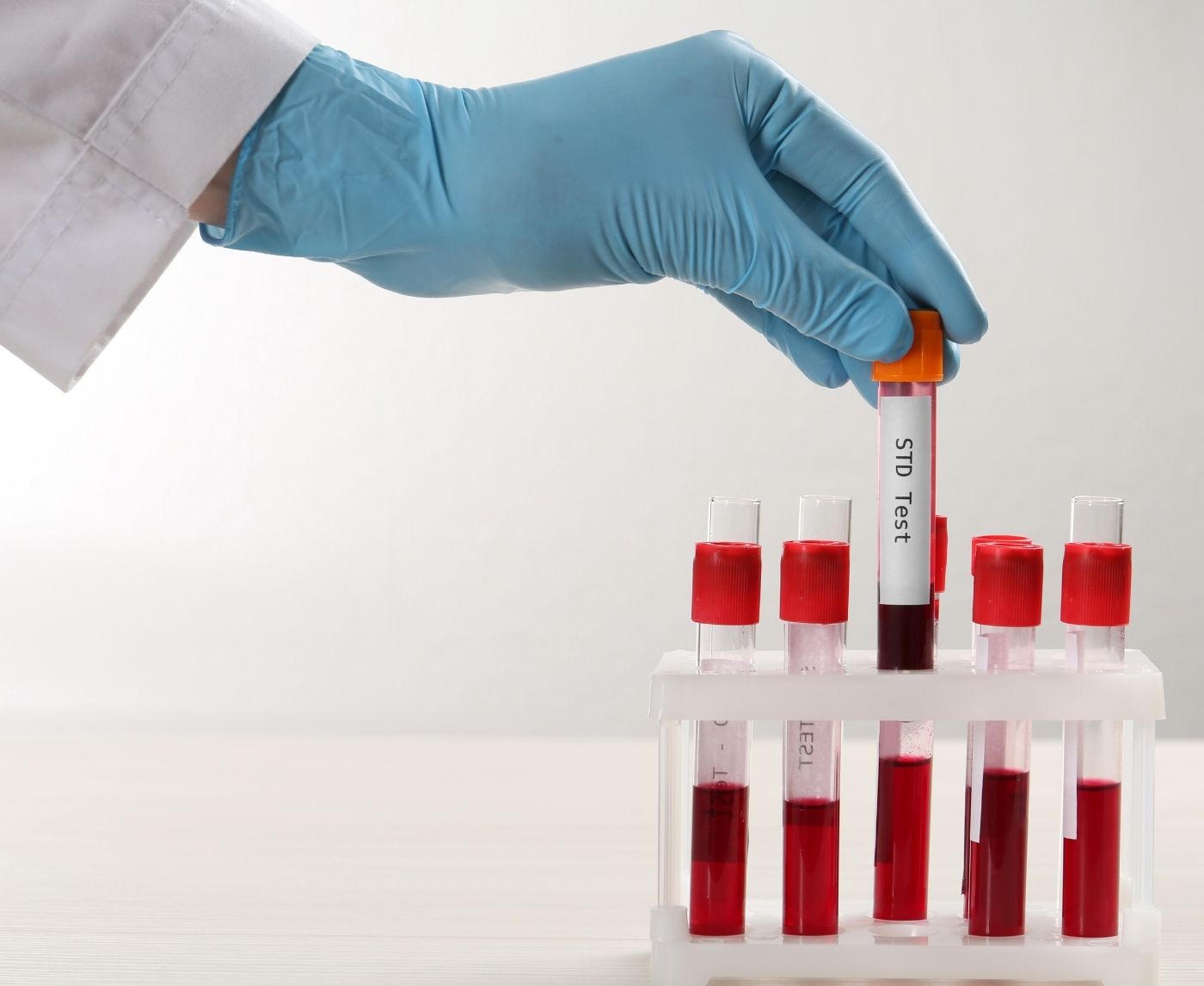



- A 'full panel' is a strategic bundle of the most common STIs (typically chlamydia, gonorrhea, syphilis, HIV, and sometimes hep B and C). It is not a guarantee of catching every infection that exists.
- Picking single vs full depends less on cost and more on how specific your exposure was and how long ago it happened. Window periods apply either way.
Published: October 2025 | Last updated: April 2026 | Editorial review and quality control: Martina N.
You are trying to figure out what to do after a risky encounter, and the internet keeps yelling 'just get tested for everything.' Fine. But your insurance might not cover a full panel without a symptom code, the clinic in your town does the bare-minimum bundle, and the at-home kit you are eyeing costs three times what a single test does. The honest answer is that 'should I test for everything?' becomes much clearer once you ask three smaller questions first: was your exposure broad or specific, how recent was it, and who needs to see the paperwork.
Do I need a full STD panel, or is one test enough?
A full STD panel is the right move when your exposure was unclear, involved multiple partners, or happened recently and you have not tested in a while. A single test makes sense when a partner has disclosed a specific infection, you are following up after treatment, or symptoms point clearly to one condition. Most rapid at-home panels cover 4 to 8 of the most common infections (chlamydia, gonorrhea, syphilis, HIV, and often hepatitis B and C), but no panel catches every possible STI. Timing matters as much as breadth, since each infection has its own detection window.
Key Takeaways
- A 'full panel' is a strategic bundle of the most common STIs (typically chlamydia, gonorrhea, syphilis, HIV, and sometimes hep B and C). It is not a guarantee of catching every infection that exists.
- Picking single vs full depends less on cost and more on how specific your exposure was and how long ago it happened. Window periods apply either way.
What a 'full STD panel' actually covers
A full STD panel is not a single magic test that finds every sexually transmitted infection. It is a bundle of separate tests, packaged together, that screens for the infections most likely to show up in routine screening of sexually active adults. The exact lineup varies by provider.
A typical bundle screens for chlamydia, gonorrhea, syphilis, and HIV, often plus hepatitis B and hepatitis C. Some expanded panels add trichomoniasis or herpes antibody testing. The U.S. CDC's screening recommendations describe what is typically tested by age, gender, and risk profile, but each clinic and at-home kit ships its own combination.
What a panel rarely covers without you specifically asking: HPV in people who do not have a cervix, herpes in someone without symptoms, mycoplasma genitalium, throat or rectal swabs (these need to be ordered separately), and any infection requiring a sample type the kit does not collect. So 'full' is a relative word. It means 'the common ones' rather than 'all of them.'
Usually included: chlamydia, gonorrhea, syphilis, HIV, and often hepatitis B and C.
Usually not included unless you ask: mycoplasma genitalium, herpes in someone without symptoms, HPV in people without a cervix, throat or rectal swabs, and any infection requiring a sample type the kit does not collect.
When a single test is the right tool
Targeted testing has a real role. It is not a budget compromise; it is the right answer for several specific situations.
If a partner texts you that they tested positive for chlamydia, the clinically logical follow-up is a chlamydia test, possibly paired with a gonorrhea test (the two often co-occur). If you finished antibiotic treatment for gonorrhea three weeks ago and your provider asked you to confirm clearance, a single follow-up test is enough; you are not starting over. If you are experiencing burning during urination two weeks after unprotected sex, with no other symptoms or risks, a chlamydia and gonorrhea swab pair often answers the question.
Targeted testing also makes sense when you recently completed a full panel that came back clean and only one new exposure has happened since. You are updating one variable, not rebuilding from scratch.
Where targeted testing falls short: any time your exposure history is broad or unclear. Casual encounters, multiple partners in a short window, condom failure, alcohol blurring details. Those situations carry diffuse risk, and asking a single test to cover diffuse risk is not realistic.
When a single test is the right call
- A partner has disclosed a specific named infection
- You are confirming clearance two to four weeks after antibiotic treatment
- You had a recent clean full panel and one new low-risk exposure since
- Symptoms strongly point to one organism, such as burning urination two weeks post-exposure suggesting chlamydia or gonorrhea
The cost picture, without the spin
Money is one of the loudest factors in this decision, especially without insurance or for anyone trying to keep testing off a shared insurance plan. The honest math depends on how many tests you would otherwise need.
One single test is cheap. Four single tests, ordered separately because you keep second-guessing yourself, are not. Once a situation calls for three or more separate tests, a bundled panel usually becomes the cheaper option, even before you factor in the time and stress of multiple retests.
| Testing option | Typical out-of-pocket price | Insurance coverage | Best for |
|---|---|---|---|
| Single STI test (e.g., chlamydia) | $40 to $100 | Often covered when symptoms or exposure are documented | Confirmed exposure to one infection, or post-treatment follow-up |
| Basic full panel (4 to 5 infections) | $120 to $250 | Often covered as preventive screening on commercial plans | Routine annual screening, or unclear single exposure |
| Expanded panel (6 to 8 infections) | $200 to $350+ | Coverage varies; usually requires medical justification | Multiple partners, longer gap since last test, broader unknown exposure |
Timing matters as much as breadth
This is the part most people miss. The accuracy of any STI test depends heavily on when it is done relative to exposure, not just on how many infections it screens for. Each infection has its own window period, the time the body needs to either replicate enough pathogen for direct detection or generate enough antibodies for indirect detection. A panel taken five days after exposure can produce false reassurance across every infection in the bundle. A targeted test done at the right window can be more reliable than a broad one done too early.
The CDC's HIV testing guidance spells this out clearly for HIV: a fourth-generation antigen-antibody test can detect most infections by 18 to 45 days post-exposure, while older antibody-only tests need longer.
| Infection | Common test type | Earliest reliable detection | Peak accuracy window |
|---|---|---|---|
| Chlamydia | NAAT (urine, swab) | About 7 days | 14 days or more |
| Gonorrhea | NAAT (urine, swab) | About 7 days | 14 days or more |
| HIV | 4th-gen antigen/antibody (blood) | 18 to 45 days | 6 weeks or more |
| Syphilis | Treponemal antibody (blood) | 3 to 6 weeks | 6 to 12 weeks |
| Hepatitis B | Surface antigen (blood) | 3 to 6 weeks | 8 to 12 weeks |
| Hepatitis C | Antibody test (blood) | 8 to 11 weeks | 12 weeks or more |
The sample-type gap most people miss
Standard at-home panels and most clinic bundles diverge on sample type in ways the packaging rarely flags. Different infections need different sample types, and a 'full panel' from one provider can miss what a 'full panel' from another covers, depending on which samples are collected.
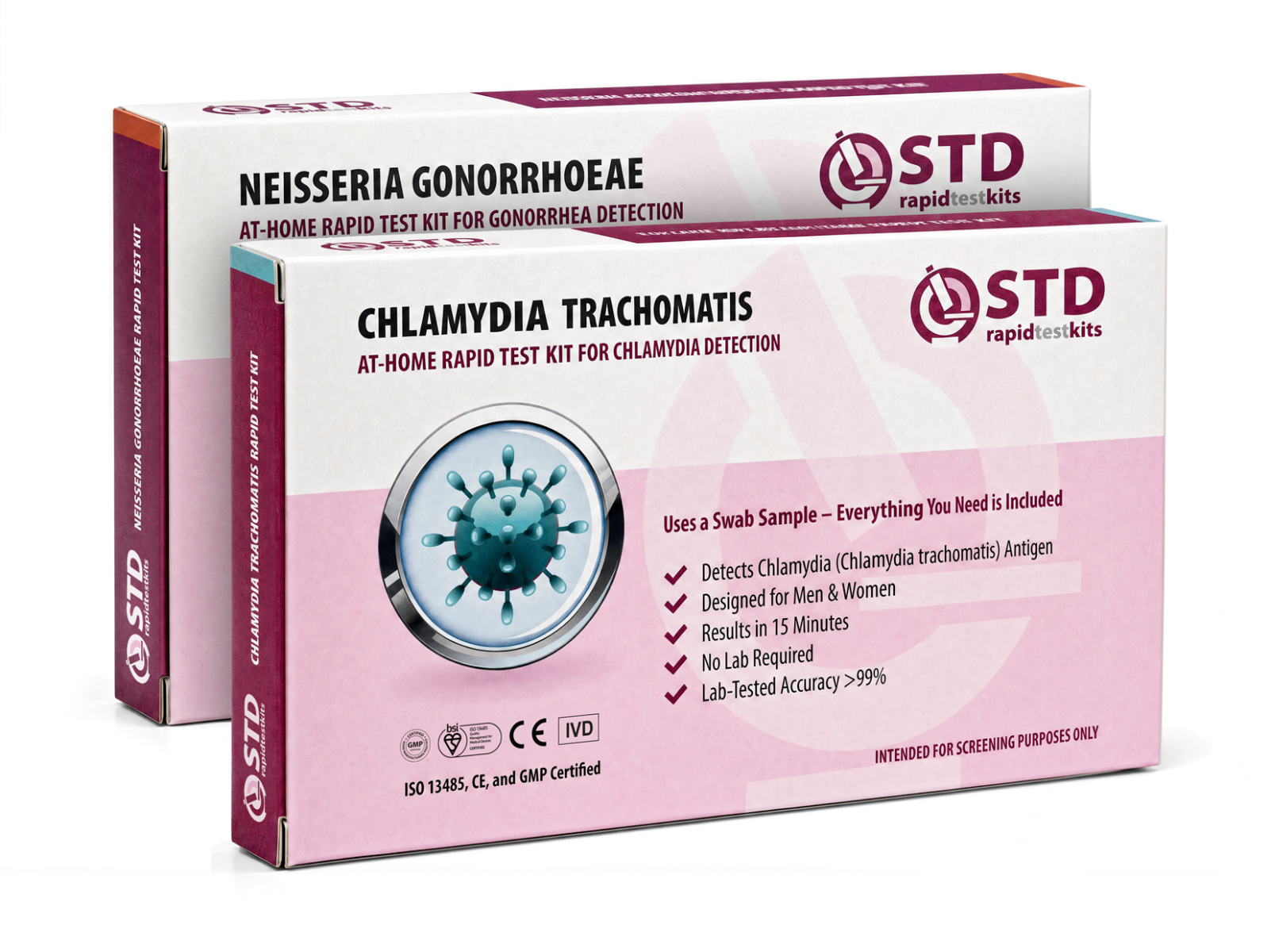
Standard at-home rapid panels (the kind sold on this site) collect a self-administered genital swab plus a fingerstick blood sample. That works for chlamydia, gonorrhea, syphilis, HIV, hepatitis, and herpes antibodies. It does not work for throat or rectal infections. If your exposure was oral sex (giving), you may need a pharyngeal swab to detect throat-based chlamydia or gonorrhea. If it was receptive anal sex, a rectal swab is the appropriate sample. Neither swab type is something we sell as an at-home kit, and neither is part of any rapid panel on the market today; both require a clinic visit or a mail-in lab kit that handles those sample types.
Our rapid at-home kits and most other rapid panels test genital and bloodstream infections. They do not detect throat-based or rectal infections, even when the same organism causes both. A negative result on an at-home panel does not rule out a throat or rectal infection. For those exposures, a clinic-administered pharyngeal or rectal swab is the right test.
Privacy, insurance, and the EOB question
Cost is rarely the only reason people pay out of pocket for STI testing. The other reason, often unspoken, is that running anything through insurance can generate paperwork. An Explanation of Benefits (EOB) is mailed or emailed to the primary policyholder, which may be a parent on a family plan, a spouse, or a partner. EOBs do not always list the specific infection tested, but they typically list the type of service (laboratory testing, sexually transmitted infection screening, or the relevant CPT code).
For someone on a parent's plan, or sharing insurance with a partner who would prefer not to see that line item, this matters. The decision-driver becomes 'do I want this in the household record,' not 'is it medically the right test.' Both single tests and full panels generate similar EOB visibility once insurance is involved; the difference is whether insurance is involved at all.
Ordering directly from an at-home retailer keeps the transaction off the insurance ledger entirely. Shipping is discreet, and billing descriptors on a credit card statement are typically generic. For readers whose primary concern is privacy rather than cost or breadth, that single change in routing matters more than the panel-vs-single decision itself.

Lab NAATs vs at-home rapid tests, and why it isn't a contest
One common misconception is that broader tests are inherently more accurate than narrow ones. Accuracy depends on test technology, not on how many infections are bundled. Laboratory testing for chlamydia and gonorrhea uses nucleic acid amplification (NAAT), which is highly sensitive and is the screening method the CDC recommends for clinical settings. At-home rapid kits use lateral-flow immunoassays, which detect antigens or antibodies directly on a test strip in about 15 minutes. The two technologies are complementary, not equivalent.
Rapid lateral-flow kits are useful for speed, privacy, and cost. A positive result on a rapid test is worth confirming at a lab, where NAAT or a direct culture can verify the result and (for some infections) inform antibiotic choice. A negative rapid result, taken at the right window period and used correctly, is reasonably reliable for screening purposes.
Many sexually transmitted infections do not cause noticeable symptoms, so getting tested is the only way to know for sure if you have an STI.
Choosing based on your actual situation
Skip the question 'is a full panel better than a single test' and ask 'what problem am I trying to solve.' The right test follows from how clear your exposure was, how recently it happened, and what you have or have not tested for in the past year.
| Situation | Risk scope | Better fit | Why |
|---|---|---|---|
| New partner, status unknown, condom used | Diffuse but lower-risk | Basic full panel | Multiple possible exposures, low individual probability per infection |
| Partner disclosed a specific infection | Narrow and known | Targeted single (or pair) test | Direct exposure to one defined organism |
| No symptoms, multiple partners in past 12 months | Diffuse | Full panel | Asymptomatic carriage is common, especially for chlamydia and HIV |
| Recent clean panel, one new low-risk exposure | Focused | Targeted single test | Updating one variable; baseline is recent |
| Burning urination 2 weeks after exposure | Symptomatic, narrow | Chlamydia + gonorrhea pair | Symptoms align with the two most likely culprits |
| Tight budget, no insurance, broad concern | Variable | Targeted first, expand if needed | Stretch limited dollars; testing something is better than testing nothing |
What to do if you tested negative but still feel anxious
A negative result during a properly-timed test should be reassuring, but anxiety is not a logical state. If your test happened inside the window period for any infection on your worry-list, the practical move is to schedule one retest at the peak accuracy window for that infection (see the timing table above) and then commit to that as the answer. Repeat testing every week is rarely productive once a properly-timed result is in.
If a single targeted test came back negative and the lingering anxiety is about whether something else is silently present, that is the case for a follow-up panel rather than another single test. The signal you are listening to (broad worry) does not match the tool you reached for (narrow test).
Step 1: Check whether your test cleared the peak accuracy window for the infection you are worried about (chlamydia or gonorrhea: 14 days; HIV: 6 weeks; hepatitis C: 12 weeks).
Step 2: If you tested inside the window, book one follow-up retest at the peak window and commit to that result instead of repeating the same test every week.
Bottom line: test strategically, not maximally
Strategic testing is the test that matches your situation. For broad or unclear exposure with a long gap since your last test, that is usually a panel. For specific recent exposure, or follow-up after treatment, that is usually a single test. For oral or anal exposure, an at-home kit is not the right tool; a clinic-administered swab is.
Privacy is its own variable, and ordering at home solves it independently of which test you pick. The least useful approach is the one driven by anxiety alone, where someone keeps testing the same way every two weeks looking for a different answer. Window periods do not bend, and breadth does not substitute for timing.
The decision you actually have is not 'should I test for everything.' It is 'what does my exposure history actually call for, and what is the right test to answer that.'
Frequently asked questions
- Does a 'full STD panel' really cover every infection?
- No. A full panel is a curated bundle of the most common STIs, usually chlamydia, gonorrhea, syphilis, HIV, and often hepatitis B and C. Less-common infections (mycoplasma genitalium, lymphogranuloma venereum) and site-specific infections (throat or rectal swabs) are not included by default. If you need one of those, ask specifically, or see a clinic that can order them.
- Can I trust at-home rapid panels for accuracy?
- When timing is right and instructions are followed carefully, yes, for screening purposes. Rapid at-home kits use lateral-flow immunoassays, which are reliable for detecting established infections but are screening tools, not laboratory NAAT. A positive result on a rapid test should be confirmed at a lab. A negative result during a properly-timed window is reasonably reassuring for the infections the kit covers.
- What if my exposure was only oral or anal sex?
- Sample type matters more than which infections the kit names. Standard at-home rapid kits collect genital swabs and fingerstick blood, so they detect genital and bloodstream infections only. Throat-based or rectal infections need site-specific swabs, which are not part of any at-home rapid panel and require a clinic visit. If your exposure was specifically oral or receptive anal, plan for clinic-collected swabs from those sites.
- How early after exposure can I get an accurate test?
- Plan for at minimum two weeks before testing for chlamydia or gonorrhea, six weeks for HIV, and twelve weeks for hepatitis C. Those are the peak-accuracy windows, not the earliest possible detection dates. Testing before then is technically possible but carries higher false-negative risk, so a properly-timed first test plus one repeat at the peak window is usually the safer plan.
- Will my insurance company tell my parents or partner I got tested?
- Possibly. An Explanation of Benefits is typically sent to the primary policyholder. EOBs do not always specify the exact infection but commonly list the service type, which can read as 'laboratory testing' or 'STI screening.' If household privacy matters more than cost, paying out of pocket (clinic or at-home) keeps testing off the insurance paper trail entirely.
- Is testing once for everything cheaper than retesting later?
- Often yes, when the exposure was unclear and you would otherwise end up running multiple single tests. By the time you have ordered three separate $80 tests, a $200 panel would have been cheaper. If the exposure was specific (one named infection from a partner disclosure), one test is enough and a panel is overkill.
- If I test positive for one infection, should I screen for others?
- Generally yes. Some STIs share transmission routes, and detecting one increases the practical likelihood of others being present. CDC screening guidance recommends co-testing for partners of someone diagnosed with chlamydia or gonorrhea. A confirmed positive result is also the right time to talk to a clinician about treatment and partner notification.
- I had a negative test but I'm still worried. What now?
- Start with the math: did the test clear the peak accuracy window for the infection you are worried about? At minimum two weeks for chlamydia or gonorrhea, six weeks for HIV. A properly-timed negative is reliable, and repeating the same test weekly will not change it. Where a panel does become the right next step is when the lingering anxiety is about an infection your single test never covered in the first place.
- U.S. Centers for Disease Control and Prevention. STI screening recommendations by age, gender, and risk profile.
- U.S. Centers for Disease Control and Prevention. HIV testing guidance, including detection windows for antigen/antibody and rapid antibody tests.
- World Health Organization. Sexually transmitted infections fact sheet covering global incidence, asymptomatic carriage, and screening guidance.
- U.K. National Health Service. Overview of sexually transmitted infections, testing options, and clinic-based screening.
- U.S. Centers for Disease Control and Prevention. STI treatment guidelines covering diagnostic methods, follow-up testing intervals, and partner services.
- Mayo Clinic. Sexually transmitted diseases category overview, including symptoms, diagnosis, and when to seek care.