

Published: November 2025 | Last updated: April 2026 | Editorial review and quality control: Martina N.
For sex workers of color, deciding when and where to test for sexually transmitted infections is rarely a clean medical question. The decision sits inside a much larger calculation about safety, privacy, custody, immigration status, employment, and how a provider might react to a single intake answer. The framing of testing as personal responsibility runs head-on into systems that punish visibility. The result is a quiet pattern that public health data often misreads as carelessness, when the opposite tends to be closer to the truth.
This piece looks at what the double bind actually feels like, where racism shows up inside ordinary clinic visits, why criminalization changes the testing math, and how privacy-first options like at-home rapid testing fit into a wider harm-reduction picture.
What is the STD double bind sex workers of color actually face?
Stigma, racial bias, and the legal context around sex work create a situation where testing is framed as a duty but accessing it can feel risky. People who test most frequently are often treated as if they test least, which delays diagnoses and quietly worsens public health outcomes. Privacy-first options, including at-home rapid kits, peer-led services, and harm-reduction clinics, reduce friction so people can act on concerns without exposing themselves to the systems that cause the bind in the first place.
Key Takeaways
- Sex workers of color often test more frequently than the general population, yet face stigma, criminalization fears, and clinical bias that delay diagnosis and treatment.
- Privacy-first options like rapid at-home test kits and peer-led services shrink the gap between concern and action, which improves both individual outcomes and broader public health.
The Double Bind, Explained Without Blame
The phrase "double bind" gets used loosely, but here it has a specific meaning. Sex workers of color are routinely labeled high risk because of their work, then penalized socially, medically, and sometimes legally for trying to reduce that risk. They are expected to test frequently, disclose honestly, and protect public health, while navigating clinics that watch them more closely, trust them less, and offer fewer safe entry points into care.
Imagine walking into a clinic knowing that one truthful answer could change how the provider treats you, that a note in your chart might follow you for years, or that disclosing your work could invite moral lectures, extra unconsented testing, or concerns about mandated reporting. For many people, the calculation becomes painfully familiar: take the health risk, or take the system risk.
Testing is framed as responsibility, while accessing it can feel like institutional exposure: being seen, categorized, and judged by structures that were not built with your safety in mind.
Take the health risk, or take the system risk. For many people, that is the routine math before every clinic visit, repeated quietly each time before they decide whether to show up.
"High Risk" Labels That Miss the Point
Public health language leans heavily on the term "high risk," but rarely pauses to ask risk of what, or caused by whom. Sex workers of color are frequently grouped into high-risk categories for STIs, yet the data consistently shows that individual behavior alone does not explain the disparities in infection rates. Structural factors carry far more of the weight (CDC, sexually transmitted infections overview).
Many sex workers test more often than the general population. They negotiate condom use as part of their daily work, share information about unsafe clients and accurate testing windows within their communities, and track their own retesting schedules with discipline that most casual readers would find intense. When higher STI rates appear in certain datasets, blame quietly slides back onto individual behavior instead of access, environment, or bias.
The label "high risk" then becomes less about health and more about how systems decide who deserves trust. People described as "high risk" are often the same people doing the most prevention work, while receiving the least support for it.
The CDC's social-determinants framework points to structural factors such as access, discrimination, and economic precarity as the dominant drivers of disparities in STI rates across racial and occupational groups (<a href="https://www.cdc.gov/sti/about/index.html" target="_blank" rel="noopener">CDC overview of sexually transmitted infections</a>).
Where Racism Shows Up in STI Care
Racism in healthcare is not always loud. More often it is subtle and procedural. It shows up in shorter appointments, fewer follow-up questions, a rushed tone that signals discomfort, or an assumption of noncompliance before any result has come back. For sex workers of color, these moments stack on top of each other and shape decisions long before anyone asks about symptoms.
Consider a scene that plays out in clinics across the country. A patient sits in an exam room while a provider asks about sexual partners but skips questions about safety concerns or pain. Symptoms get attributed to stress, hormones, or hygiene rather than tested. The visit ends with a brief instruction sheet and no real conversation. The patient leaves with the clear sense that returning is not worth the social cost.
These dynamics affect outcomes, not only feelings. When patients anticipate dismissal, they delay care. When care is delayed, infections go untreated for longer. When untreated infections circulate in a community, public health visibility drops. Stigma designed to control risk ends up amplifying it.

Criminalization Changes the Math
For sex workers of color, STI testing decisions are often shaped by laws as much as by biology. In jurisdictions where sex work is criminalized, healthcare settings can feel adjacent to surveillance. Fear of records, disclosure, or misinterpretation turns routine care into a calculated risk (WHO, sex workers and STI prevention).
Someone might silently weigh whether a positive test could be used against them in a custody dispute, whether documentation could be subpoenaed, whether repeated testing flags them in ways they cannot predict, and whether disclosing recent partners could be misread by a provider with little context. Even when those fears are not legally guaranteed, they are emotionally real and grounded in lived experience.
This legal context shifts behavior. People test less publicly, avoid clinics that feel institutional, and rely on peer knowledge and private solutions, none of which signals indifference to their own wellbeing. The system has simply made care harder to access safely.
Concerns commonly weighed before walking into a clinic include:
- How a positive result might surface in a custody dispute or family-court proceeding
- Whether documentation could be subpoenaed in connection with a sex-work-related charge
- Whether repeated testing flags someone in records or databases they cannot see or correct
- Whether a provider might misread routine partner disclosure as evidence of trafficking, drug use, or noncompliance
These fears do not need to be legally guaranteed to influence behavior. The perceived risk is what shapes the decision.
When Symptoms Get Missed Across Common Infections
One of the quieter consequences of the double bind is that real symptoms get attributed to other causes: light bleeding to hormones, discharge to a yeast infection, a faint rash on the palms to an allergy. None of these moments individually look like systemic failure, but together they explain why women of color and trans women are repeatedly underdiagnosed for the same conditions that the rest of the population catches earlier.
The table below shows where common STIs frequently get misread, and why missing them matters. None of this is unique to sex workers, but the pattern hits hardest for people who have already been signaled that their symptom reports will not be taken at face value.
| Infection | Common symptom | How it gets misread | Why it matters |
|---|---|---|---|
| Chlamydia | Light bleeding, pelvic pressure, discharge | Attributed to hormones, stress, or normal cycle changes | Untreated chlamydia can progress to pelvic inflammatory disease and affect fertility |
| Trichomoniasis | Itching, frothy discharge, odor | Dismissed as bacterial vaginosis or a yeast infection | Untreated trichomoniasis is linked to higher HIV transmission risk |
| Herpes (HSV-2) | Tingling, redness, mild sores | Misread as a shaving rash or a contact reaction | Antiviral treatment reduces outbreaks and lowers transmission risk |
| Syphilis | Painless sore, then rash on palms or trunk, fatigue | Attributed to allergies, eczema, or unrelated viral illness | Late-stage syphilis can affect the brain, eyes, and nerves; early treatment is highly effective |
| HPV | Often no symptoms; sometimes warts or cervical changes | Skipped at visits when patients are uninsured or assumed not to need screening | Persistent high-risk HPV is the cause of nearly all cervical cancer cases (per CDC HPV cancer guidance, see citation below table) |
Per <a href="https://www.cdc.gov/cancer/hpv/basic-information/hpv-cancer.html" target="_blank" rel="noopener">CDC, HPV and cancer</a>, nearly all cervical cancers are caused by persistent infection with high-risk HPV types. Screening through Pap and HPV testing catches the precancerous changes that develop slowly over years, which is why missed routine screenings carry outsize long-term consequences.
Why Avoiding Clinics Is Not the Same as Avoiding Care
One of the most persistent myths in STI prevention is that avoiding clinics equals avoiding care. For sex workers of color, the opposite is often closer to the truth. Avoiding a particular clinic can be a strategic choice that preserves safety, privacy, and autonomy while staying informed about one's body.
Someone might choose to test at home after a boundary-crossing client interaction, sitting on the edge of a bed with a phone timer running, the lab insert open on the table, and no one else in the room. The moment is deliberate. Choosing to test at home after a difficult interaction is a calculated health decision, and the setting itself makes the difference between testing now and not testing at all.
At-home testing does not replace all medical care: it cannot deliver antibiotics, and it does not substitute for confirmatory lab work after a reactive result for HIV or syphilis. What it does is fill the critical gap between concern and action, the gap where stigma usually wins.
Can: screen privately and quickly, give you a useful first answer in roughly 15 minutes, let you bring a result into a follow-up appointment instead of starting from zero.
Cannot: deliver antibiotics or antivirals, replace NAAT or treponemal lab confirmation after a reactive HIV or syphilis result, treat severe symptoms requiring an exam. Used as a screening layer alongside clinical care, it shortens the time between concern and action.
At-Home Testing as a Control Point
For people who have been burned by medical systems, the value of at-home testing is control over when the test happens, who learns the result, and how that information is absorbed without an audience. Someone might take a test alone, with a cup of tea on the counter, giving themselves space to feel whatever comes next without performance.
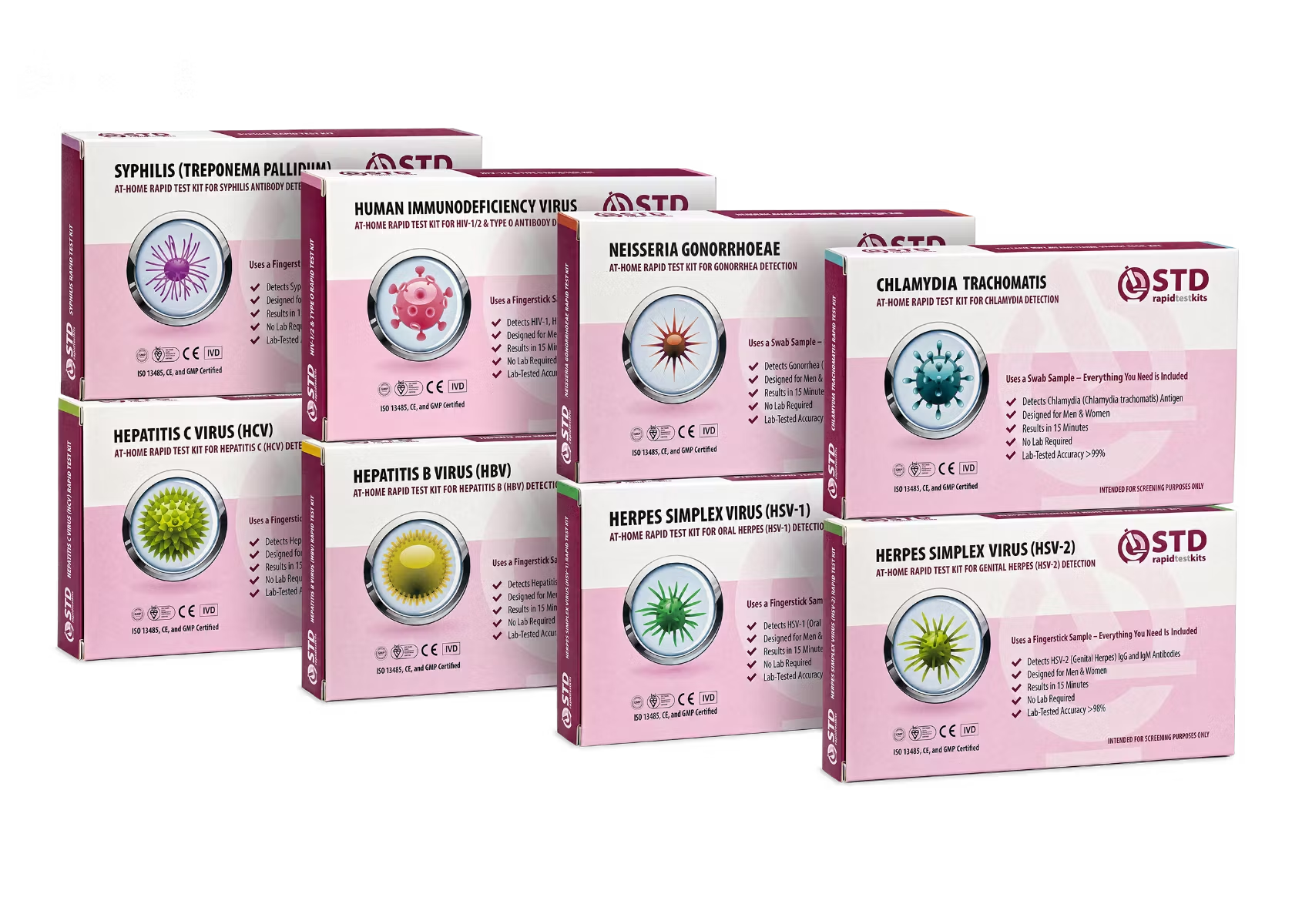
Modern home rapid kits use lateral-flow chemistry, the same format used in pregnancy tests and rapid COVID antigen tests. Swab-based kits cover infections like chlamydia, gonorrhea, trichomoniasis (vaginal self-swab), and HPV (vaginal self-swab). Fingerstick blood-based kits cover HIV, syphilis, hepatitis B, hepatitis C, and herpes antibody panels. They are screening tools, used alongside lab NAAT confirmation rather than as replacements for it.
For most bacterial infections, the right testing window is roughly two weeks after a possible exposure. For HIV, fourth-generation antigen-antibody tests reach high sensitivity by about 45 days, with antibody-only rapid tests usually reliable by 90 days. For syphilis, antibodies typically appear within 3 to 6 weeks. Knowing those windows is a quiet form of expertise that many sex workers already carry, often more accurately than their clinicians give them credit for (CDC, HIV testing windows; CDC STI treatment guidelines).
This site sells at-home rapid STI test kits; the options highlighted below link to our own product pages. We recommend kits based on whether they fit the reader's concern, not on commercial benefit.

When the Result Is Positive
A reactive result does not land in a vacuum. It lands in the middle of work schedules, financial planning, and personal relationships. For sex workers of color, the first reaction is often not panic about the infection itself. It tends to land first on logistics: time off, who needs to know, how to protect partners without exposing oneself to harm, and which conversations carry the highest cost.
Most STIs caught early are highly treatable. Bacterial infections like chlamydia, gonorrhea, syphilis, and trichomoniasis clear with appropriate antibiotics (CDC STI treatment guidelines). HIV is now a manageable chronic condition with antiretroviral therapy that, when adherence is consistent, prevents sexual transmission. Herpes is not curable, although suppressive antiviral medication reduces outbreaks and lowers transmission risk to partners. The clinical part is usually the most predictable part of the experience.
The social part is harder, which is where discreet testing pathways earn their value. They let people move from information to action on their own timeline.
| Step after a reactive home test | Why it matters | Lower-friction option |
|---|---|---|
| Confirm with a lab test | Home tests screen; some results need lab NAAT or treponemal confirmation before treatment | Telehealth provider, community health center, or harm-reduction clinic that does not require ID |
| Start treatment | Most bacterial STIs clear with a short course of antibiotics; HIV is treated with antiretroviral therapy | Sliding-scale clinics, planned-parenthood-style providers, or telehealth STI services |
| Notify partners | Prevents reinfection and reduces onward transmission | Anonymous notification tools (e.g. TellYourPartner.org) that send a text without revealing your name |
| Retest at the right interval | Reinfection is common, especially for chlamydia and gonorrhea; CDC recommends a 3-month retest after treatment | Another at-home kit if returning to a clinic feels unsafe |
| Find peer or community support | Stigma after a diagnosis can be isolating; peer support reduces avoidance behavior | Sex worker advocacy networks, harm-reduction collectives, online peer-support spaces |
Why Privacy Is Not a Luxury
Privacy is often treated as a nice-to-have feature in healthcare, secondary to accuracy or speed. For people who carry layered vulnerability, privacy is foundational. Without it, care itself becomes risky.
Testing without explaining yourself, receiving a result without worrying about who sees it, and choosing when to engage with care are not extras. Together they create the sense of agency that conventional clinic flows often remove without meaning to. Discreet testing options work as basic building blocks of access for the people who need access most.
For people who carry layered vulnerability around their work, immigration status, or gender identity, privacy operates as a precondition for care. The WHO's guidance on key populations is direct on this point: without confidential entry points, the people who most need testing often do not show up at all (<a href="https://www.who.int/teams/global-hiv-hepatitis-and-stis-programmes/populations/sex-workers" target="_blank" rel="noopener">WHO, key populations and sex workers</a>).
Barriers vs Solutions: Where the Leverage Really Is
It is tempting to believe that more health education alone will fix outcome disparities. Knowledge without access does not move the needle. The interventions that consistently work tend to reduce friction rather than lecture people into compliance.
| System-level barrier | Real-world impact | Practical lever that helps |
|---|---|---|
| Clinic-based stigma and bias | Delayed or skipped testing | Privacy-first pathways: at-home kits, telehealth, sex-worker-friendly clinics |
| Criminalization fears | Limited disclosure; under-reporting | Discreet, non-mandated-reporting options and peer-led services |
| Cost and insurance gaps | Inconsistent testing schedules | Transparent upfront pricing; sliding-scale and free testing networks |
| Provider misgendering and skipped exams (trans patients) | Missed infections; loss of trust | Trans-affirming clinics; self-collected swabs that match the patient's anatomy |
| Language and immigration fears | Avoidance of care; late diagnosis | Multilingual peer navigators; non-ID-required services |
How Harm Reduction Outperforms Shame
Harm reduction starts from a practical premise: when systems offer working tools, the people who most need care actually use them. In sexual health, that means offering testing options that align with how people actually live, including the parts of their lives that mainstream healthcare prefers to ignore.
When sex workers of color have access to judgment-free testing, treatment, and information, outcomes improve in measurable ways: infections get caught earlier, partner conversations happen sooner, treatment starts faster, and reinfection rates drop. The shift comes from changing how the room is built, while the people inside it remain the same.
WHO guidance on key populations describes sex workers as carrying a disproportionate burden of HIV and other sexually transmitted infections, and identifies stigma, criminalization, violence, and limited access to friendly health services as the main drivers of those outcomes (<a href="https://www.who.int/teams/global-hiv-hepatitis-and-stis-programmes/populations/sex-workers" target="_blank" rel="noopener">WHO, sex workers and STI prevention</a>).
Practical Steps for Safer Care
If you are reading this for yourself, the steps below are roughly the order most peer-led testing networks teach. Adapt them to your work, your geography, and your own threshold for clinic visits.
If you are reading this as a provider, ally, or organizer, the leverage is structural: quieter intake forms, trans-inclusive exam protocols, multilingual access, sliding-scale pricing, and honest signposting to peer-led services that you may not be able to provide directly. None of those changes asks anything of the patient; they all change how the room itself is built.
Three steps to a personal testing plan
- Build a small home toolkit. Stock a combination kit covering the infections most relevant to your work, plus a printed note of the testing window for each one, so you know when results are reliable after exposure.
- Pre-identify one or two trusted clinical fallbacks before you actually need them, such as a sex-worker-friendly clinic, a telehealth STI service, a harm-reduction collective, or a peer who knows the local landscape.
- Test on a schedule when you can. Planned tests keep your sense of control intact and produce more useful information than panic tests do, since you are not constantly retesting outside the right window.
Frequently Asked Questions
- Do sex workers of color really test more often than the general population?
- Often yes. Many sex workers test on schedules most people would find intense, every few weeks or after specific exposures, instead of once a year. Testing routines tend to be tied to client activity, condom incidents, and partner disclosures rather than a calendar. The frequency typically reflects awareness, not carelessness.
- If testing matters so much, why do so many people avoid clinics?
- Because clinics are not neutral spaces for everyone. For some people, walking into a clinic means bracing for invasive questions, judgmental tones, or assumptions that follow them long after the visit. Avoiding a particular clinic is not the same as avoiding care; it is often a route to the same goal through a less risky path.
- Does criminalization really shape health decisions that much?
- More than most people realize. Even when no one says it out loud, the worry is present: will this show up in my records, could it be used against me later, will someone ask questions I do not feel safe answering. Those concerns shape behavior, especially for people who have already been harmed by institutions.
- How accurate are at-home rapid STI tests?
- Used at the right time after exposure, current at-home rapid tests typically report sensitivity in the mid-to-high 90s and specificity above 99 percent for most common infections. They use lateral-flow chemistry, the same family used in rapid COVID antigen tests and pregnancy tests. They are screening tools, so a reactive result is worth confirming with a lab NAAT or treponemal test when possible. Ranges vary by infection and by kit; check the product insert for the specific test you are using.
- What is the right time to test after a possible exposure?
- For most bacterial STIs (chlamydia, gonorrhea), accuracy improves at about 14 days. For syphilis, antibodies typically appear within 3 to 6 weeks. For HIV, fourth-generation antigen-antibody tests reach high sensitivity by about 45 days; rapid antibody-only tests are usually reliable by 90 days. If you have symptoms, test now and retest later if needed.
- Can I take an at-home test if I already have symptoms?
- Yes, and a symptomatic moment is one of the more useful times to use one. A rapid result can give you immediate information to bring into a clinical visit or telehealth appointment. If the result is negative but symptoms persist, follow up with a provider, since rapid screens can miss early or low-load infections.
- What should I do first after a positive result?
- Confirm the result through a lab where possible (community health center, telehealth STI service, harm-reduction clinic, or sliding-scale provider), then start treatment. For most bacterial STIs, treatment is a short course of antibiotics. For HIV, the first step is starting antiretroviral therapy with a provider who treats people, not categories. Anonymous partner-notification tools can handle disclosure without exposing your identity.
- What actually makes STI testing feel safer?
- Control: being able to choose when to test, where to test, and who learns the result. Feeling that the process belongs to you rather than to a system that is watching. When that control is present, people use testing more often, which is the opposite of what stigma-based approaches tend to achieve.
- U.S. Centers for Disease Control and Prevention. Sexually transmitted infections (STIs) overview: transmission, common infections, screening, and treatment.
- U.S. Centers for Disease Control and Prevention. Sexually Transmitted Infections Surveillance: provisional 2024 statistics on chlamydia, gonorrhea, and syphilis, with full demographic breakdowns pending the final report.
- World Health Organization. Sex workers and STI prevention: stigma, criminalization, and access to friendly health services as core drivers of outcomes.
- World Health Organization. Sexually transmitted infections (STIs) fact sheet: global burden, prevention, and treatment overview.
- U.S. Centers for Disease Control and Prevention. STI treatment guidelines: bacterial STI antibiotic regimens and 3-month retest recommendations.
- U.S. Centers for Disease Control and Prevention. HPV and cancer: persistent infection with high-risk HPV types causes nearly all cervical cancers.
- National Health Service (UK). Sexually transmitted infections: overview of testing, treatment, and partner notification.
