How Long Should You Wait to Retest for Herpes After Exposure
A negative herpes test in the days after exposure rarely tells the full story. IgG antibodies take weeks to build, and most blood tests do not become reliable until the 12 to 16 week mark. Here is the retest timing math, when a swab test is the better tool, and what to do if you already tested too early.




- IgG antibody blood tests are most accurate 12 to 16 weeks after exposure. Earlier results, especially before 6 weeks, can produce false negatives because antibodies have not formed yet.
- If you have visible sores or blisters, a PCR swab from the lesion within 48 hours of it appearing is faster and more direct than waiting on antibody bloodwork.
Published: November 2025 | Last updated: April 2026 | Editorial review and quality control: Martina N.
How long should you wait to retest for herpes after exposure?
For an IgG antibody blood test (the kind most clinics and home kits use), the most reliable retest window is 12 to 16 weeks after the exposure event. A test before 6 weeks is often too early to detect antibodies, and even results between 6 and 12 weeks can miss slow seroconverters. If you develop sores, a polymerase chain reaction (PCR) swab taken from the lesion within 48 hours can confirm an active infection much sooner.
Key Takeaways
- IgG antibody blood tests are most accurate 12 to 16 weeks after exposure. Earlier results, especially before 6 weeks, can produce false negatives because antibodies have not formed yet.
- If you have visible sores or blisters, a PCR swab from the lesion within 48 hours of it appearing is faster and more direct than waiting on antibody bloodwork.
A negative herpes test does not always mean you are clear of the virus, and the reason comes down to timing. Most herpes blood tests look for IgG antibodies, the long-term immune response your body builds after exposure. Those antibodies take weeks to develop, so a test run too early can read negative even when the infection is real.
If you tested within a week or two of a possible exposure, that result is best treated as a baseline rather than a final answer. Your immune system has not caught up yet. The fix is straightforward: retest at the right window. This article walks through the timing math, when each test type works, and what to do if you already tested too early or your partner tested positive while you tested negative.
Window period vs. incubation period: two different clocks
People often use these two phrases interchangeably, but they describe different things, and confusing them is the most common reason herpes test results get misinterpreted.
The incubation period is how long it takes for symptoms to appear after exposure. For herpes simplex virus, symptoms typically appear within the first two weeks of exposure, though some people get a textbook outbreak with grouped blisters, tingling, and flu-like symptoms while many get nothing, or feel something so subtle they write it off as razor burn or an ingrown hair. The NHS guidance on genital herpes notes that symptoms can also take much longer to appear, sometimes years after the initial infection.
The window period is how long the test takes to detect the infection. For IgG antibody blood tests, the window is typically 6 to 12 weeks, with 16 weeks marking the outer edge for slower seroconverters. The CDC's STI Treatment Guidelines recommend repeat type-specific antibody testing 12 weeks after the presumed time of acquisition in cases of recent suspected HSV-2 exposure, reflecting the window during which false negatives are most likely.
Symptoms can therefore appear days before the antibody blood test reads positive. The virus may be actively replicating weeks before your IgG result catches up. That mismatch is what makes a 10-day post-exposure negative blood test almost meaningless on its own. The virus may be there. The antibodies are not yet.
Incubation period = how soon symptoms appear (often within two weeks, sometimes never). Window period = how soon the blood test can detect the infection (6 to 16 weeks for IgG). They run on different timers, which is why a sore can appear before the antibody test turns positive.
How herpes test timing maps to your post-exposure week
The right test depends almost entirely on where you are in the timeline since exposure, and whether you have visible symptoms. The table below maps the common scenarios to the test that actually works at that point.
| Time since exposure | Most useful test | What a negative result means | Retest plan |
|---|---|---|---|
| 0 to 5 days | PCR swab if a sore appears | Antibody tests are not reliable yet | Wait, then retest IgG at 12 to 16 weeks |
| 5 to 14 days | PCR swab on any visible lesion within 48 hours | Limited value from blood tests; possible false negative | IgG retest at 12 weeks regardless |
| 3 to 6 weeks | IgG antibody blood test (early indicator) | Encouraging but not conclusive; some seroconvert later | Confirm at 12 weeks for higher reliability |
| 6 to 12 weeks | IgG antibody blood test | More reliable; majority of true positives detected | Final confirmation at 16 weeks if exposure was high-risk |
| 12 to 16 weeks and beyond | IgG antibody blood test | Highly reliable; nearly all true positives detected by week 16 | No further retest needed unless new exposure |
The three main herpes test types, and when each works
Herpes testing is not a single product. There are three distinct test technologies in common use, and each answers a different question.
Swab tests (polymerase chain reaction, or PCR, and viral culture). These look for the actual virus harvested from a sore or lesion. PCR detects viral DNA and is the most sensitive method available; viral culture grows live virus and is older but still used. Both require an active outbreak. Per the CDC's STI Treatment Guidelines, swab-based virologic testing is the preferred diagnostic method when a lesion is present, and the sample should be collected as early as possible after the lesion appears. Once the lesion starts to crust over, sensitivity drops sharply.
IgG antibody blood test. This is the workhorse for asymptomatic screening and the test most home kits use. It looks for type-specific antibodies (HSV-1 IgG and HSV-2 IgG separately). Reliability climbs over time: limited at 6 weeks, decent at 8 to 12 weeks, and highest at 12 to 16 weeks. The CDC recommends type-specific IgG serology over IgM for serologic screening.
IgM antibody blood test. This was once marketed as the early detector, but most current guidelines, including the CDC's 2021 STI Treatment Guidelines, recommend against it. IgM cannot reliably distinguish a new infection from a reactivation, and it cross-reacts between HSV-1 and HSV-2. False positives and false negatives are both common. If a clinic offers you only IgM, ask for an IgG instead.
The illustration below sketches the rough timeline so you can see at a glance where each test fits.
What to do if you already tested too early
If you tested within the first three weeks of a known or suspected exposure and got a negative IgG result, the practical next step is to schedule a retest. The standard retest checkpoints are 6 weeks (early indicator), 12 weeks (high reliability), and 16 weeks (final confirmation for slow seroconverters).
A few practical notes that providers often skip:
- Date your retest from the exposure event itself, not from the date of your first test. The clock starts at exposure.
- If you had multiple potential exposures, count from the most recent one.
- Ask for both HSV-1 and HSV-2 IgG. Many labs default to HSV-2 only because it is more commonly genital, but per the WHO herpes simplex virus fact sheet, HSV-1 can also cause genital herpes through oral-genital contact.
- If a sore appears between now and your retest, get a PCR swab within 48 hours. That single result can short-circuit the entire waiting game.
An early negative is not wasted. It functions as a baseline. If your 12-week test comes back positive, the comparison helps confirm a recent infection rather than a long-standing one.
Your partner tested positive and you tested negative: what is happening
This is one of the most stressful scenarios in sexual health. Your partner has a confirmed positive, you tested, and your result came back negative. Three explanations cover almost every case.
You tested inside the window. If your test was within the first 6 to 12 weeks of the exposure, the result may simply be premature. Antibody production has not finished. A 12 to 16 week retest is the standard next step.
You did not contract the virus. Herpes is not 100% contagious per exposure. Per the CDC's STI Treatment Guidelines, condom use reduces (but does not eliminate) herpes transmission risk, and suppressive antiviral therapy in an infected partner can significantly reduce the risk further. Add that asymptomatic shedding is intermittent rather than constant, and many single exposures simply do not transmit.
You contracted it but remain asymptomatic. Per CDC data on genital herpes, most people with HSV-2 have never received a clinical diagnosis. The same antibody test still picks up the infection at 12 to 16 weeks even in completely asymptomatic carriers.
Avoid new sexual partners until you have a result you trust, or use barriers and have an honest conversation.
IgG at 12 weeks post-exposure, with a 16-week confirmation if the exposure was high-risk. If a sore appears at any point, swap in a PCR swab within 48 hours. The action is the same whether the early negative was premature, lucky, or asymptomatic.
Symptoms vs. no symptoms: does the retest plan change?
The strategy shifts slightly depending on what your body is doing. The table below lays out four common situations and the right next step for each.
| Your situation | Best next step | Why this fits |
|---|---|---|
| Active sores, blisters, or tingling now | PCR swab within 48 hours of the sore appearing | Direct viral DNA detection; bypasses the antibody timeline entirely |
| No symptoms, recent (under 6 weeks) exposure | Wait, then take an IgG blood test at 12 weeks | Antibody production needs time; testing now risks a false negative |
| No symptoms, tested early and got a negative | Schedule an IgG retest at 12 to 16 weeks post-exposure | Confirms or overturns the early result with a reliable window |
| Past possible symptoms but never tested during outbreak | IgG antibody test now (full 12+ weeks have passed) | Detects long-term HSV-1 or HSV-2 antibodies even without an active outbreak |
How accurate are herpes blood tests, and what is a low positive
Per the CDC's STI Treatment Guidelines, the type-specific IgG serologic tests for HSV-2 generally report sensitivities in the 80 to 98% range when used at the appropriate post-exposure window. Specificity is more variable. The most commonly used test (HerpeSelect HSV-2 EIA) has an overall specificity of 57.4%, dropping to 39.8% for borderline index values between 1.1 and 2.9, which is precisely why borderline positives require confirmatory testing. HSV-1 IgG performance is similar in shape: sensitivity climbs as the post-exposure window stretches, which is the entire reason the 12 to 16 week mark matters. The same assay is meaningfully less sensitive at 6 weeks than at 12.
The complication: a low-titer or borderline positive (in lab terms, an IgG index value just above the positive cutoff) is not the same thing as a confirmed infection. Results just above the positive cutoff carry a higher false-positive rate than results well above the threshold. Per the American Sexual Health Association, a wrong result is also possible when a person has a low risk of infection.
The two confirmation options:
- Western Blot, run by the University of Washington virology lab, is the long-standing gold-standard confirmation. It separates true HSV-2 antibodies from cross-reactivity with HSV-1.
- Repeat IgG at 8 to 12 weeks, ideally on the same platform, can also resolve a low positive. If the index climbs, it is more likely a real infection. If it falls or stays flat, the original was probably a false positive.
The CDC notes that HSV-2 antibody testing is not recommended as routine screening for the general low-risk population precisely because of this false-positive issue. It remains appropriate when there is a known exposure or a partner with confirmed HSV. If you are reading this article, you almost certainly fall into that second category, so the test is fit for your purpose.
One more thing the lab paperwork rarely explains: a positive antibody result tells you that you have been exposed to that virus type at some point. It does not tell you the body site (oral vs. genital), and it does not tell you how recently.
Can suppressive antiviral therapy hide herpes on a test
Short answer: no. Daily antivirals like valacyclovir, acyclovir, or famciclovir suppress viral replication and outbreaks in the partner who is already infected. They do not affect what happens inside your body if you were exposed.
Per the CDC herpes treatment guidelines, suppressive therapy in an infected partner reduces the amount of virus shed and lowers transmission risk to a negative partner. So if your partner is on suppressive therapy and you were exposed, your overall transmission risk was lower. But if transmission did occur, your antibody response unfolds on the normal 12 to 16 week timeline regardless. The medication does not interfere with your IgG test.
The same logic applies in reverse. Once someone is diagnosed and starts antivirals, the medications do not change their own antibody status either. They suppress outbreaks and viral shedding, not seroconversion.
Suppressive therapy in a positive partner reduces your odds of contracting herpes during exposure, but if transmission did happen, it will not change when or whether your IgG antibody test turns positive. Stay on the standard 12 to 16 week retest schedule.
Talking to a new partner while you wait out the window
If you are between an early negative and a 12-week retest, and you are sexually active, transparency is the safer choice for everyone involved. You do not have to disclose every detail of the exposure event. A short, factual sentence does the work.
A working script:
I had a possible exposure to herpes recently and tested negative, but my doctor noted that the antibody test is most reliable at the 12-week mark. I am scheduled to retest in a few weeks. I wanted to let you know so we can decide together how to handle protection until then.
Why this conversation pays off
What this script does: it makes the situation legible without dramatizing it. It hands the other person enough information to make their own informed choice. It also moves the conversation toward concrete next steps (condoms during the waiting period, postponing certain activities, knowing the retest date) rather than abstract worry.
People generally respond better to early transparency than to a surprise at week 14. A partner who responds poorly to honest, time-bounded uncertainty is showing you something practical about how they would handle harder disclosures later, which is information you can use when deciding how much to share next time.
Most people with HSV-1 or HSV-2 infection have no symptoms at all, or only very mild symptoms that go unnoticed or are mistaken for another skin condition.
Home retesting vs. clinic retesting: which fits your situation
Both routes use the same IgG antibody target, but the experience and the chemistry differ.
Clinic-based testing involves a venipuncture blood draw sent to a reference lab running ELISA or chemiluminescent immunoassay platforms. Results return in a few days. The clinical visit lets you ask questions and request specific add-ons (HSV-1 plus HSV-2, full STI panel, Western Blot if a low positive shows up). Insurance often covers it. The downside is privacy: the result lands in your medical chart, and you may pass colleagues in the waiting room.
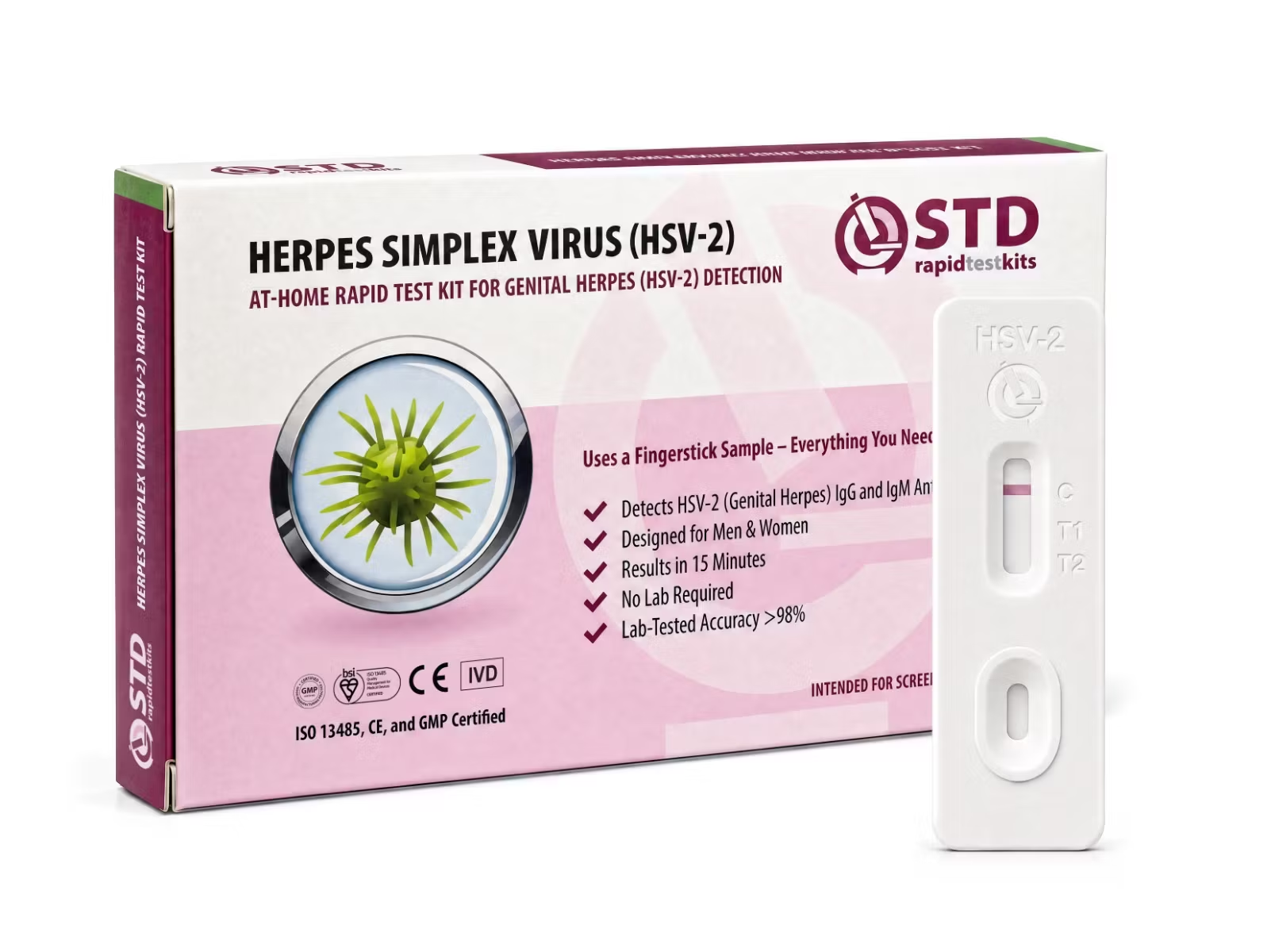
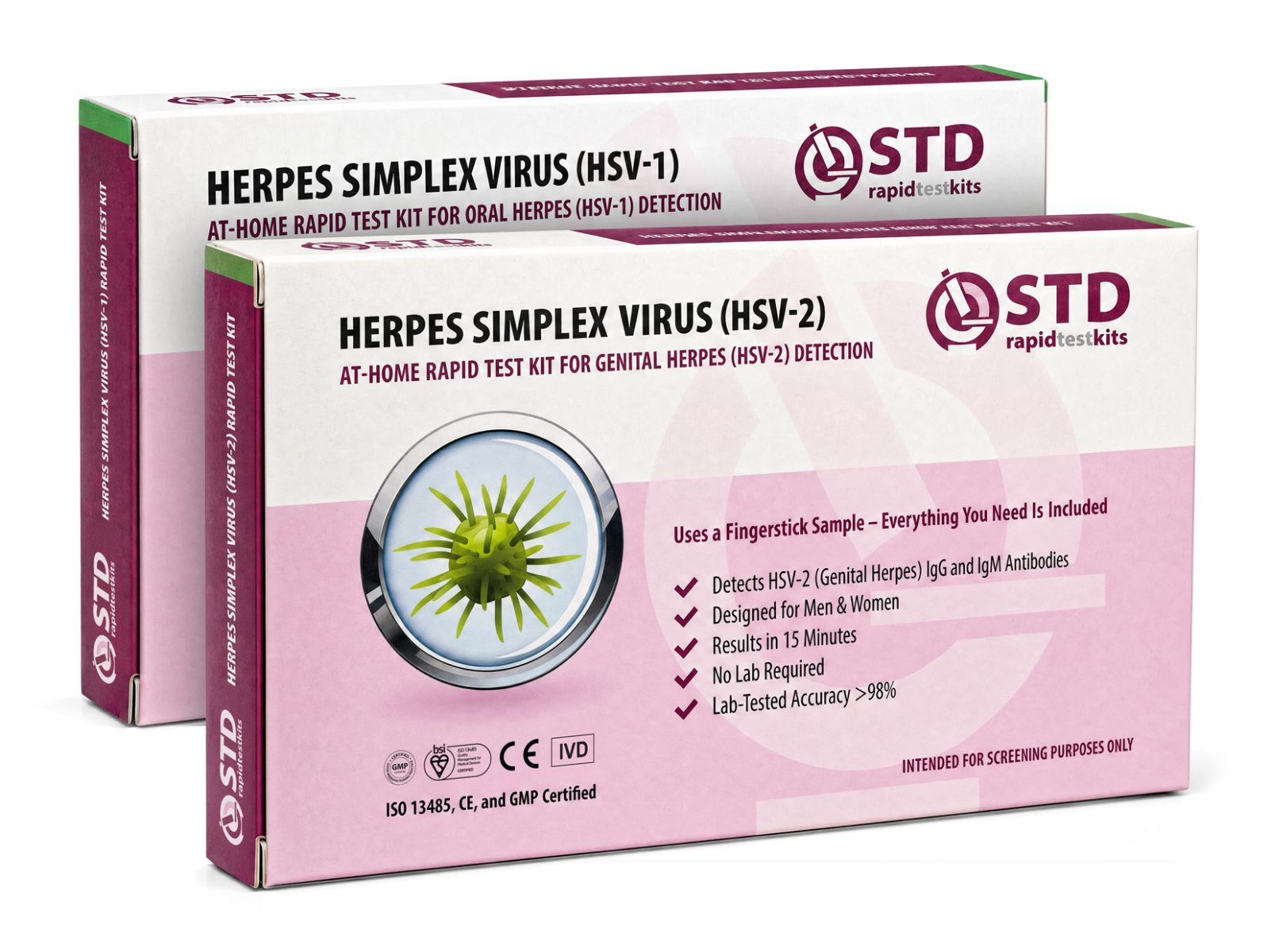
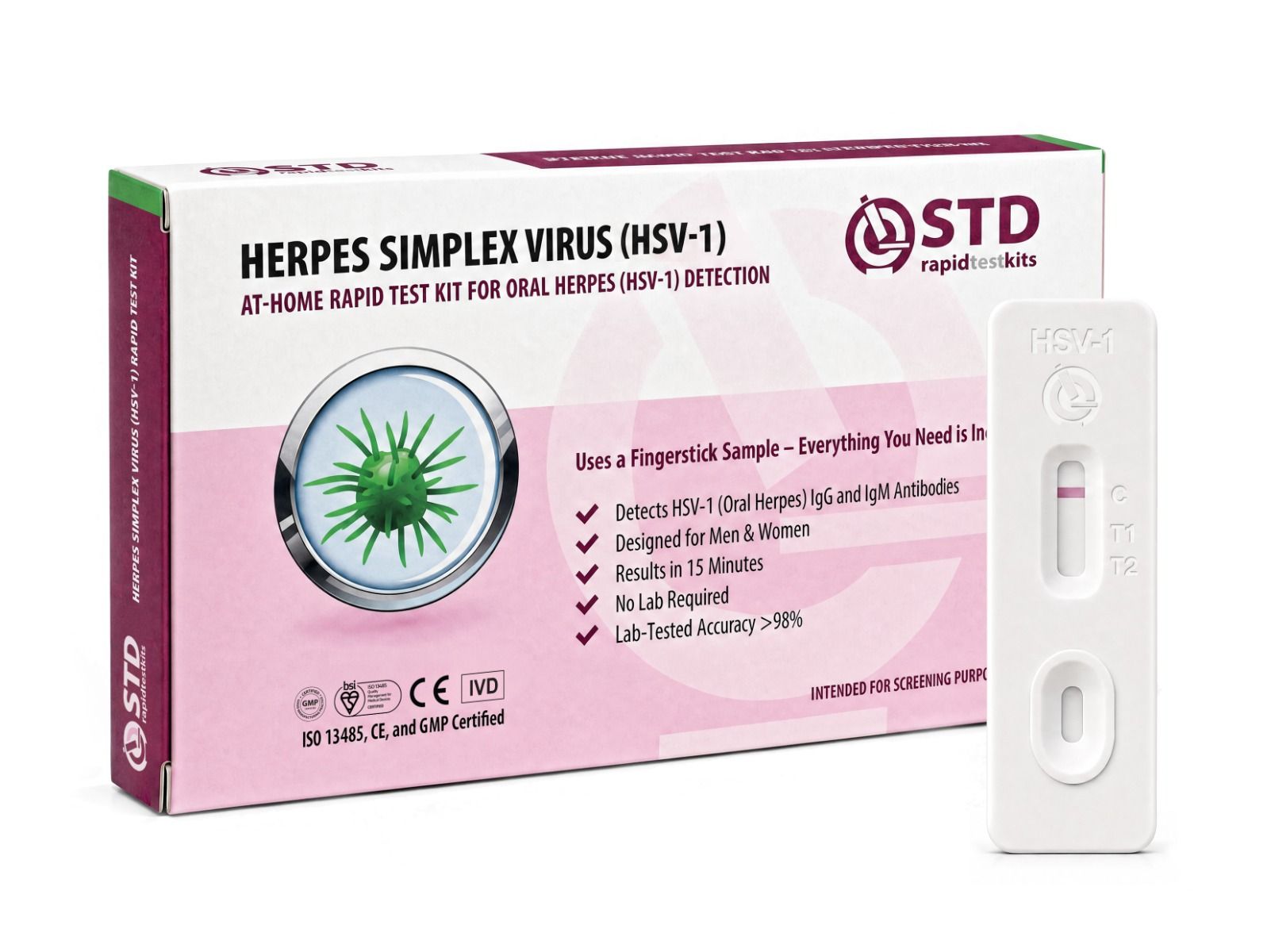
At-home rapid lateral-flow tests (a strip-based chemistry that produces a color-line result within 15 minutes, similar in format to a home pregnancy test) use a fingerstick blood sample and read out at home. They use the same IgG antibody target as a lab serology, but the chemistry is rapid lateral-flow rather than ELISA, so a positive at home is worth confirming with a lab serology when possible. The privacy advantage is the main draw, along with no clinic appointment and discreet shipping.
For retest purposes specifically, both work as long as you have hit the 12 to 16 week window. If you got an early negative at a clinic and want to retest privately, the at-home route is fast and avoids re-explaining the situation to a new provider. If you got an early negative at home and want a lab-grade follow-up, the clinic route gives you a result you can take to a doctor for treatment if it comes back positive.
This article is published by stdrapidtestkits.com, which sells at-home STI testing kits. We recommend products based on fit-for-purpose for the reader's concern (here, IgG antibody retesting at the 12 to 16 week window), not commercial benefit. The home tests we sell use rapid lateral-flow chemistry; for confirmatory work after a borderline positive, a lab-run ELISA or Western Blot through a clinic is the appropriate next step.
Frequently asked questions
- How long should I actually wait before retesting for herpes?
- Count forward from the exposure event itself, not from the day you started worrying or the day of your first test. The clock starts at exposure. Six weeks gives you only an early-indicator IgG result; 12 weeks is when most providers consider the result high-reliability; 16 weeks is the outer edge for slow seroconverters. If you had multiple possible exposures, count from the most recent one.
- Can I have herpes and still test negative on a blood test?
- Yes, especially if you tested too early. IgG blood tests detect your immune response, not the virus itself. If your immune system has not produced enough antibodies yet, the test reads negative even when the infection is real. This is why timing your test from the exposure event (not from when you started feeling worried) matters so much.
- My partner is positive but I tested negative. How is that possible?
- Three common reasons: you tested inside the window (retest at 12 weeks), you did not contract the virus (it is not 100% contagious per exposure), or you contracted it but remain asymptomatic and need to wait for antibodies to develop. The same retest plan covers all three: 12-week IgG, with a 16-week confirmation if the exposure was high-risk.
- Should I get tested for both HSV-1 and HSV-2 separately?
- Most standard panels and home kits default to HSV-2 only. You typically need to request HSV-1 explicitly. If the exposure involved oral-genital contact, HSV-1 is a meaningful possibility, per WHO guidance. Asking for both type-specific antibody tests up front saves you from an inconclusive partial answer.
- Is the IgM herpes test reliable for early detection?
- No, and current CDC guidance recommends against using it. IgM cannot reliably distinguish a new infection from an old one reactivating, and it cross-reacts between HSV-1 and HSV-2. False positives and false negatives are both common. If a clinic or kit offers you only IgM, ask for an IgG instead, even if it means waiting longer for a reliable result.
- Can suppressive antiviral medication hide herpes on a test?
- No. Antivirals like valacyclovir suppress outbreaks and viral shedding in someone who is already infected, but they do not interfere with your antibody response if you were exposed. If a positive partner is on suppressive therapy, your transmission risk is lower, but if transmission did occur, your IgG test still becomes positive on the normal 12 to 16 week timeline.
- What is a low positive on a herpes IgG test, and what should I do about it?
- A low positive (sometimes called borderline or equivocal) is an IgG index value just above the positive cutoff. Per CDC data on the most commonly used HSV-2 IgG test (HerpeSelect EIA), specificity drops sharply for borderline values, which means false positives are more likely in this zone. The standard next step is confirmatory testing, either a Western Blot through the University of Washington virology lab or a repeat IgG at 8 to 12 weeks on the same platform.
- Can I trust an at-home rapid herpes test for retesting?
- Yes, with two caveats. First, make sure you are using an IgG-based test, not an IgM. Second, time it correctly: the 12-week minimum window applies to home tests just as it does to lab tests. The chemistry is rapid lateral-flow rather than the ELISA used by clinical labs, so a positive at home is worth confirming with a lab serology when possible. For a retest after an early clinic negative, an at-home IgG at 12 to 16 weeks is a reasonable and private option.
- U.S. Centers for Disease Control and Prevention. Sexually Transmitted Infections Treatment Guidelines: Genital Herpes. 12-week retest recommendation, IgG vs. IgM guidance, suppressive therapy and condom transmission-reduction language, HerpeSelect HSV-2 EIA sensitivity (80 to 98%) and specificity (57.4% overall, 39.8% for borderline index values).
- U.S. Centers for Disease Control and Prevention. About Genital Herpes. Asymptomatic carriage statement and transmission overview.
- World Health Organization. Herpes simplex virus fact sheet. HSV-1 vs HSV-2 epidemiology, asymptomatic prevalence, and HSV-1 transmission via oral-genital contact.
- U.K. National Health Service. Genital herpes overview. Patient-facing window period and delayed-symptom guidance.
- American Sexual Health Association. Herpes testing reference. False-positive caution for low-risk individuals.