Published: November 2025 | Last updated: May 2026 | Editorial review and quality control: Martina N.
Chlamydia is famous as a genital infection. It is consistently the most reported bacterial infection tracked by CDC STD surveillance, and most public-health messaging focuses on what it does below the belt. The throat and eyes get far less attention, even though both can be infected after oral sex or hand-to-eye contact with chlamydial bacteria.
If your throat feels off after oral sex, or one eye is red and weepy and won't clear with regular drops, the question "could this be chlamydia?" is worth taking seriously. The same bacterium that causes genital chlamydia (Chlamydia trachomatis) can colonize the back of the throat (oropharyngeal chlamydia) and the eye's conjunctiva (chlamydial conjunctivitis). Both forms are real, both respond to the same antibiotics, and both are routinely missed by the standard chlamydia panel most clinics run.
For most people with a sore throat or red eye after sexual contact, the cause is still the usual suspects: a viral illness, dry air, or an allergic reaction. Chlamydia is worth considering when the timing fits a recent exposure, the symptoms are one-sided or persistent, and standard remedies are not working. Our chlamydia rapid kit is a self-collected genital swab, useful for the genital infection most people pick up first. It does not replace a clinic-administered swab of the throat or eye when symptoms point that way.
Key Takeaways
- Chlamydia can infect the throat after oral sex and the eyes through hand-to-eye contact with infected genital fluids. Both forms often cause subtle symptoms or none at all.
- Standard chlamydia panels usually only check genital sites. A throat or eye infection needs a site-specific clinic swab, which most providers will run on request.
When pink eye isn't really pink eye
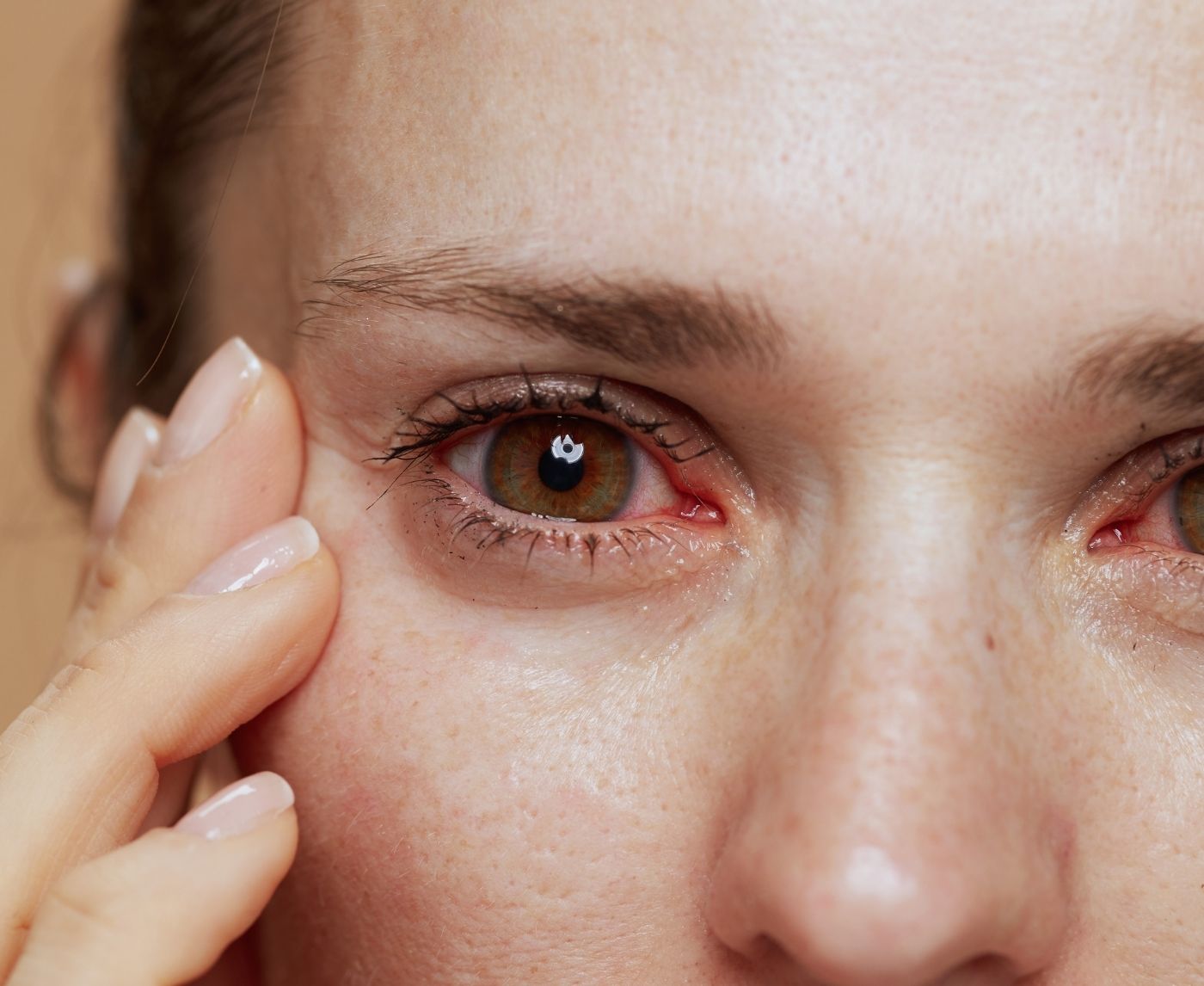
Most pink eye in adults is viral, the same family of bugs behind the common cold. Allergic conjunctivitis sits next on the list, followed by bacterial conjunctivitis. Chlamydial conjunctivitis is its own category. It comes from Chlamydia trachomatis, the same organism responsible for genital chlamydia, and reaches the eye through hand-to-eye transfer of infected genital fluids or, less commonly, splash exposure during sex.
The presentation varies. Some people get a mild pink eye that drags on for two or three weeks instead of clearing in the usual seven to ten days. Others get more obvious findings: a thick yellowish discharge along the lower lid in the morning, lid swelling, a gritty feeling like sand is stuck behind the eyelid. Often only one eye is affected at first, and the second eye picks it up days later from contact with hands or shared towels. Adult inclusion conjunctivitis caused by chlamydia is well-documented but routinely overlooked in primary care because the eye findings are indistinguishable from other bacterial causes; a clinic-collected swab tested by NAAT is the only reliable way to confirm the organism.
In the throat, oropharyngeal chlamydia is even quieter. The WHO notes that most chlamydia infections cause no symptoms, and throat infections are especially likely to be silent. When symptoms do appear, they tend to be a low-grade scratchy throat without fever, without cough, without the classic markers of viral pharyngitis. It feels minor enough to ignore, so it gets ignored, and that is exactly why pharyngeal cases get passed on.
How chlamydia reaches the throat and eyes
Chlamydia spreads when the bacteria reach a susceptible mucous membrane: the urethra, cervix, rectum, throat, or eye conjunctiva. You don't need penetrative sex for that to happen. The CDC's overview of STI risk during oral sex lists chlamydia as one of the infections that can be transmitted from genitals to mouth and from mouth to genitals. The throat is the more common non-genital site because oral sex is common and condom or dental-dam use during oral sex is uncommon.
Eye infections are rarer but well-documented. The most common route is hand-to-eye transfer: a person touches their own or a partner's genital fluids, then rubs an eye before washing their hands. Splash exposure during sex is possible but unusual. Sharing a face towel immediately after a partner with an active infection is another route in published case reports.
What matters is that ordinary, low-key contact is enough. There is no threshold of "how much" sexual activity makes an exposure count. If chlamydial bacteria reach the mucous membrane in any quantity, they can establish there and start replicating quietly.
| Transmission route | Site that gets infected | Typical scenario |
|---|---|---|
| Oral sex on a partner with genital chlamydia | Throat | Receptive oral sex without a condom or dental dam |
| Hand-to-eye contact after touching genital fluids | Eye conjunctiva | Touching the eye after sex without washing hands |
| Splash exposure of genital fluids to the face | Eye conjunctiva | Less common but documented in case reports |
| Genital-to-genital sex | Genitals (the usual route) | Vaginal or anal sex with an infected partner |
What it actually feels like
The frustrating part of non-genital chlamydia is that the symptoms are mild, nonspecific, or absent altogether. The CDC notes that most people with chlamydia have no symptoms, and pharyngeal infections in particular are usually silent. When the throat or eye does signal something is off, the signs sit just inside the territory of common, unrelated complaints.
In the throat, the typical pattern is a low-grade scratchy or sore feeling that hangs around for several days, with no fever, no productive cough, no nasal congestion. Some people describe it as the start of a cold that never quite arrives. Tonsillar redness can be mild or absent on examination.
In the eye, the most common pattern is a mucopurulent unilateral conjunctivitis that does not respond to standard lubricating drops or short courses of over-the-counter antibiotic ointment. The eye is red. There is yellowish or thick discharge along the lower lid in the morning. The lid may be slightly swollen. Vision is usually normal but feels slightly grainy. Without antibiotic treatment aimed at the underlying organism, the inflammation persists for weeks.
These presentations are easy to miss in primary-care visits when the patient does not raise the possibility of an STI cause directly. The clinician sees a mild sore throat or a stubborn pink eye, runs the usual tests, and the diagnosis stays hidden.
| Site | Possible symptoms | Often mistaken for |
|---|---|---|
| Throat | Mild scratchy or sore throat, slight redness, swollen neck glands, no fever, no cough | Post-nasal drip, dry-air irritation, the start of a cold, mild tonsillitis |
| Eye | Redness, yellowish discharge, gritty feeling, morning crustiness, often one-sided | Allergic conjunctivitis, viral pink eye, contact-lens irritation |
What our at-home test can and can't answer
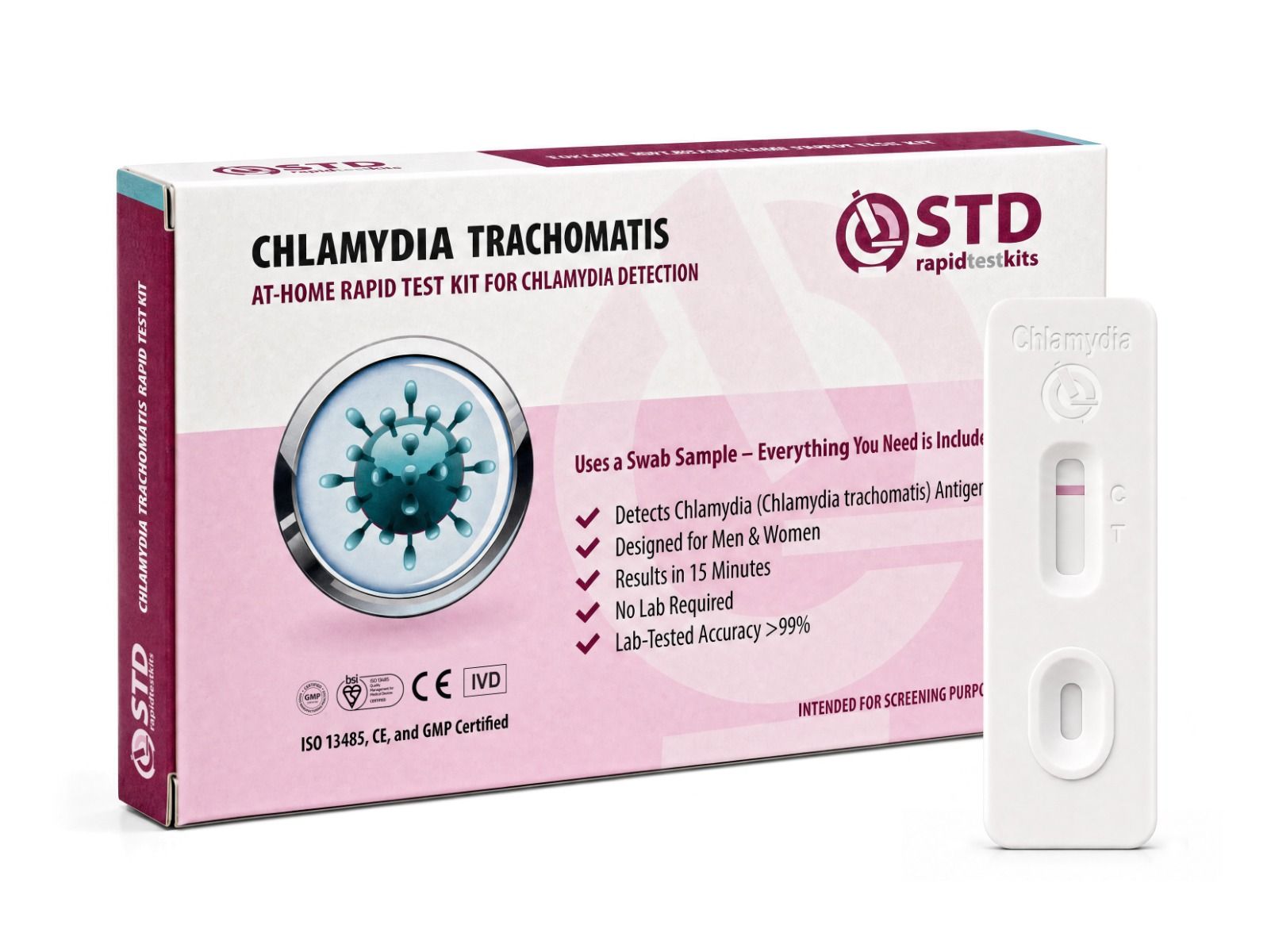
Honest scope first. The chlamydia rapid test we sell is a self-collected genital swab using lateral-flow chemistry. It is designed to detect a chlamydia infection at the genital site (vaginal or penile sample). It is not a throat swab, and it is not an eye swab. If your concern is specifically pharyngeal or ocular chlamydia, an at-home genital kit cannot give you a definitive answer for those sites.
What the at-home test is good for in this situation: anyone with a recent sexual exposure who wants a fast genital screen at home. Many people who develop throat or eye chlamydia also carry a genital infection, because the genital site is usually the original route of acquisition. A positive at-home genital result tells you that you have chlamydia somewhere and that you need treatment regardless of where else it may have settled. A negative at-home result rules out a genital infection but does not rule out a throat or eye infection that you only acquired at that site (for example, after oral sex with a partner who had only genital chlamydia).
For most readers who arrive at this article worried about a sore throat or red eye after a sexual encounter, the practical sequence is: use the at-home kit for the genital question (because the result changes what your clinician needs to know), and book a clinic appointment for a site-specific swab of the throat or eye if symptoms persist.
We do not sell a pharyngeal (throat) swab or an ocular (eye) swab. Those tests are run by clinics using nucleic acid amplification (NAAT) on a sample collected by a clinician. If your symptoms point at the throat or eye specifically, ask your provider for a site-specific swab. They will know what you mean.
Site-specific testing for non-genital chlamydia
The lab gold standard for chlamydia at any site is a nucleic acid amplification test (NAAT). NAAT detects the genetic material of Chlamydia trachomatis directly and works on urine, vaginal swabs, urethral swabs, throat swabs, rectal swabs, and conjunctival swabs. The catch is that you need the right sample. A urine NAAT will not detect a throat infection, and a genital swab NAAT will not detect an eye infection.
The CDC's STI Treatment Guidelines for chlamydial infections describe extragenital screening as a clinical option that should be guided by exposure history. In practice, this means most clinics do not run throat or rectal swabs by default. They run them when a patient mentions oral or anal exposure and asks. If you want a throat or eye swab, say so directly when you book the appointment.
Telehealth services are catching up. Some online STI providers offer a throat swab as part of a multi-site mail-in panel, where a clinician sends you the swab and you return the sample to a partner lab for NAAT. These are different from at-home rapid tests. They are lab-processed NAATs and often take a few business days for results.
| Infection site | Sample needed | Best testing route | Practical note |
|---|---|---|---|
| Genital | Self-collected swab or urine | At-home rapid test or clinic NAAT | What our at-home kit covers |
| Throat (pharyngeal) | Throat swab of tonsillar area | Clinic NAAT or telehealth mail-in NAAT | Ask your provider directly; not a default in standard panels |
| Eye (ocular conjunctiva) | Conjunctival swab | Clinic NAAT, often via ophthalmology referral | Less commonly run; mention sexual exposure to the clinician |
When to test after exposure
Timing matters because chlamydia bacteria need time to reach detectable levels at the infection site. Testing too early can return a false negative even when an infection is establishing.
For genital chlamydia, NAAT becomes reliably positive about 1 to 2 weeks after exposure. Most sexual-health guidance recommends testing around 14 days after exposure for a result you can act on, with a follow-up retest at a longer interval if you remain concerned. If you test sooner because of symptoms, that is reasonable: a positive early result is still trustworthy, but a negative early result should be repeated.
For throat chlamydia, the same general window applies. Bacterial load builds over the first 1 to 2 weeks. If you had oral sex 3 days ago and your throat hurts, a swab right now may miss it. A swab in another week is more meaningful.
For ocular chlamydia, the timing is harder to fit on a calendar because the inoculation event (the moment fingers carrying genital fluid touched the eye) is often unclear. The practical rule: if you have an unexplained, persistent unilateral red eye that does not respond to ordinary drops over 2 to 3 weeks, mention sexual exposure to your eye doctor and ask whether a chlamydia swab is appropriate.
| Site | Earliest reliable test point | Best testing route |
|---|---|---|
| Genital | About 14 days post-exposure | At-home rapid test or clinic NAAT |
| Throat | About 14 days post-exposure | Clinic NAAT or telehealth mail-in NAAT |
| Eye | Persistent unilateral redness past 2 to 3 weeks | Clinic NAAT or ophthalmology referral |
What happens if you don't treat it
Untreated chlamydia at any site continues to be transmissible. That is the most reliable downstream consequence. As long as the bacteria are present, sexual contact (or hand-to-eye contact for an ocular case) can spread the infection to a partner. This is true even when you yourself feel completely fine, which is why public-health guidance treats screening as a partner-protective measure rather than a personal-symptom measure.
For genital chlamydia, the well-documented risk in people with vaginas and uteruses is pelvic inflammatory disease (PID), which can develop when the infection ascends from the cervix into the uterus and fallopian tubes. PID can damage the fallopian tubes and increase the risk of ectopic pregnancy and tubal-factor infertility. The WHO's chlamydia fact sheet describes these reproductive-health complications as the main reason untreated chlamydia is a public-health concern.
Throat chlamydia is less likely to cause serious local complications. The clinical concern is that an untreated pharyngeal infection acts as a quiet reservoir and continues to spread. For the eye, persistent untreated chlamydial conjunctivitis can lead to chronic inflammation, scarring, and (in repeated infections over years, the global trachoma pattern) corneal damage. Trachoma is rare in high-income countries but illustrates that the eye does not tolerate ongoing chlamydial infection well.
Chlamydia often has no symptoms, but it can cause serious health problems, even without symptoms.
Treatment is straightforward
Chlamydia is treatable with antibiotics, and the regimen is the same regardless of which site is infected. The current first-line treatment, per the CDC's STI Treatment Guidelines for chlamydial infections, is doxycycline 100 mg taken orally twice a day for 7 days. Single-dose azithromycin (1 g orally) was the older default and is still used in pregnancy and in some specific situations, but doxycycline is now preferred for most adults because of better cure rates at extragenital sites, particularly the rectum.
What this looks like in practice: you fill the prescription, take it twice a day for a week, and avoid sex for 7 days from the start of treatment to reduce the risk of passing it on while the medication clears the infection. Skipping doses or stopping early increases the risk of treatment failure and resistance pressure. If nausea is a problem with doxycycline, taking it with food helps; the package label and your pharmacist will explain the specifics.
For ocular chlamydia, oral antibiotics treat the eye infection because the medication reaches the conjunctival tissue through the bloodstream. Topical antibiotic drops alone are not sufficient. Some clinicians add a topical agent for symptomatic relief, but the systemic course is what clears the underlying organism.
One round of antibiotics, taken correctly, clears the infection in the great majority of cases.
Standard CDC first-line regimen: doxycycline 100 mg taken orally twice a day for 7 days. Avoid sex for 7 days from the start of treatment. Plan a retest at about 3 months from treatment to catch reinfection from an untreated partner.
Retesting after treatment
The CDC recommends retesting roughly 3 months after treatment, even if symptoms have resolved. The reason is reinfection rather than treatment failure. The antibiotics work, but if a sexual partner was not treated at the same time, or a new partner introduces the infection, the original patient can pick it up again. Retesting at 3 months catches that pattern early.
For ocular cases specifically, follow up with an eye doctor if eye symptoms persist beyond 10 to 14 days after starting antibiotics. The bacterial infection should be clearing by then; lingering symptoms can mean residual inflammation that needs additional management, or another diagnosis worth considering.
For throat cases, retesting is appropriate if symptoms return after treatment, or if there has been a new oral sexual exposure. A returned sore throat is more likely to be a different respiratory cause, but a low-threshold retest in the right context is reasonable.
One thing not to do: do not use leftover antibiotics from a partner or a previous course to self-treat a new suspected infection. The dose, drug, and length of course matter, and the CDC's regimen is specific for chlamydia. Empirical self-treatment risks under-dosing, masking symptoms, and contributing to antibiotic resistance.
Retesting basics
- Avoid sex for 7 days after starting antibiotics, then plan a retest at about 3 months from treatment to catch reinfection from an untreated partner.
- If eye symptoms persist past 10 to 14 days on antibiotics, see an eye doctor for follow-up. If throat symptoms return after treatment, ask for a repeat throat swab.
Talking to partners without making it dramatic
Partner notification is part of effective treatment. If chlamydia is confirmed at any site, current sexual partners and recent partners (typically within the last 60 days) need to know so they can get tested and treated. Without partner treatment, the most common outcome is reinfection of the original patient.
The conversation does not need to be elaborate. A simple version: "I tested positive for chlamydia. It's easily treated with one round of antibiotics. I wanted to let you know so you can get tested too." That is the entire useful content of the message. Anything more is optional.
For partners who are difficult to contact directly, several U.S. public-health departments offer anonymous partner-notification services that send a message on the patient's behalf without identifying the source. Some online STI services offer the same. These tools exist because partner notification is one of the highest-impact things a person treated for an STI can do, and the easier it is to do, the more likely it gets done.
For people in ongoing partnerships, providers will often prescribe expedited partner therapy where local law allows. This means the patient can be given a prescription or medication packet to deliver directly to a partner without the partner needing to visit a clinic. It is not appropriate in every situation, but where it is offered, it shortens the time-to-treatment for the partner significantly.
If the original exposure raised concerns about more than one infection, a broader screen before or after the partner conversation can answer multiple questions in one session. The kit below covers eight of the most common STIs at once.

FAQs
- Can chlamydia really infect the eye?
- Yes. The same bacterium that causes genital chlamydia can colonize the conjunctiva of the eye and cause a persistent unilateral pink eye that does not clear with regular drops. The most common route is hand-to-eye transfer of infected genital fluids.
- What does throat chlamydia feel like?
- Usually nothing. Pharyngeal chlamydia is silent in most cases. When symptoms do appear, the clue is a mild scratchiness without the usual cold markers (no fever, no congestion). If it lingers past a week without progressing and recent oral sex is part of the picture, a clinic throat swab is worth requesting.
- I tested negative on a urine chlamydia test. Am I clear?
- You are clear of a genital infection at the time of testing. A urine test does not check the throat or eye. If you have symptoms in those sites, ask your clinician to run a site-specific swab. The negative urine result does not rule out a throat-only or eye-only infection.
- Will antibiotic eye drops fix chlamydial conjunctivitis?
- Topical drops alone do not clear it. Chlamydia is intracellular, and effective treatment requires oral antibiotics (most commonly a 7-day course of doxycycline) that reach the conjunctival tissue through the bloodstream. Drops can soothe symptoms; they will not cure the infection.
- Do I need to tell my partner if it's only in my throat?
- Yes. A pharyngeal infection can be transmitted through oral sex, and your partner may have a genital infection that is keeping the cycle going. Partner treatment is what prevents reinfection after you are treated.
- Can chlamydia be passed by kissing?
- Almost never. Chlamydia is not a saliva-transmitted infection in the way that, for example, mononucleosis is. Deep, prolonged oral contact in the presence of an active oral infection is theoretically possible but extremely rare in the literature.
- Should I stop wearing contact lenses if my eye might be infected?
- Yes. Switch to glasses until the eye is fully cleared. Contact lenses can trap bacteria against the conjunctiva, prolong the infection, and reintroduce the organism if the lenses are not properly disinfected. Replace soft lenses you were wearing during the infectious period.
- Do I need to retest after treatment?
- Avoid sex for 7 days from the start of antibiotics. Then retest around 3 months after treatment. The CDC recommends this 3-month retest because reinfection from an untreated partner is the most common reason for a recurrence, not treatment failure.
How we sourced this article: the editorial team summarized current public-health guidance from the U.S. Centers for Disease Control and Prevention, the World Health Organization, and the U.K. National Health Service, alongside the CDC's published STI Treatment Guidelines. Inline citations link directly to the relevant root pages so you can read the source guidance yourself. This is general health information, not personal medical advice.
- U.S. Centers for Disease Control and Prevention. About Chlamydia: prevalence, asymptomatic infection, complications.
- U.S. Centers for Disease Control and Prevention. STD Surveillance: annual case-count data for chlamydia and other reportable STIs.
- U.S. Centers for Disease Control and Prevention. Chlamydial Infections, STI Treatment Guidelines: doxycycline first-line regimen, extragenital screening, retesting recommendation.
- U.S. Centers for Disease Control and Prevention. STI Risk and Oral Sex: chlamydia transmission via oral sex.
- World Health Organization. Chlamydia fact sheet: global epidemiology, asymptomatic infection, reproductive complications.
- U.K. National Health Service. Chlamydia: general overview of symptoms, testing, and treatment.
