Published: November 2025 | Last updated: May 2026 | Editorial review and quality control: Martina N.
Ask a friend what their last STI test covered, and most will say something close to “everything.” It almost never is. The phrase “full panel” means different things at different clinics, and the panels most people get, including at urgent care, walk-in labs, and routine annual physicals, leave out three of the most common infections: genital herpes, trichomoniasis, and HPV. Patients walk out feeling reassured. The lab is done. The bill is paid. And a non-trivial number of people are still carrying an undiagnosed infection they were never screened for.
This article is published by stdrapidtestkits.com, which sells at-home STI testing kits. We recommend products based on what fits the reader's actual concern, not commercial benefit. Below is what a standard panel typically covers, what it usually skips, and how to think about closing the gap, whether through a clinic conversation or a private at-home test.
Key Takeaways
- Standard STI panels usually cover chlamydia, gonorrhea, syphilis, and HIV. Herpes, trichomoniasis, and HPV are often excluded unless you specifically request them.
- If a recent test felt thorough but didn't list those three by name, you weren't tested for them. Closing that gap takes one follow-up at the clinic or one targeted at-home test.
What “Full Panel” Usually Means in Practice
There's a powerful, persistent myth that a “full STI test” checks for every possible infection. The CDC's Getting Tested for STIs page sets out individualized recommendations: HIV testing at least once for everyone aged 13 to 64, annual chlamydia and gonorrhea screening for sexually active women under 25, and syphilis testing for most sexually active adults. Together those four infections make up what most routine clinic panels include. Hepatitis B and C may be added depending on risk factors and pregnancy status. Beyond that, screening is request-based or symptom-driven.
That leaves three of the most common sexually transmitted infections in the United States, herpes (HSV-1 and HSV-2), trichomoniasis, and human papillomavirus (HPV), routinely excluded from the panel patients believe they got.
Why? It's a mix of guideline carve-outs, insurance coding, accuracy concerns with certain blood tests, and historical assumptions about which infections are worth screening for in asymptomatic adults. The result is a system where a “clean” lab report can technically be true and still incomplete.
| Infection | In a typical basic panel? | Usually requires a separate request? | Available as an at-home test? |
|---|---|---|---|
| Chlamydia | Yes | No | Yes |
| Gonorrhea | Yes | No | Yes |
| Syphilis | Often | Sometimes | Yes |
| HIV | Yes | No | Yes |
| Herpes (HSV-1 / HSV-2) | No | Yes | Yes (blood antibody) |
| Trichomoniasis | Rarely | Yes | Yes (vaginal swab, women only) |
| HPV | No (unless cervical screening is due) | Yes | Yes for women; no recommended at-home test for men |
| Hepatitis B & C | Sometimes | Sometimes | Yes |
Why Herpes, Trich, and HPV Get Skipped
Each of the three commonly missed infections has its own reason for falling outside routine screening. Knowing the reason matters because it changes how to handle the gap.
Herpes is excluded from the CDC's routine screening recommendations for asymptomatic adults. The CDC's screening guidance states plainly that HSV-2 serologic screening among the general population is not recommended. The clinical reasoning, well established in the broader literature on type-specific HSV IgG assays, is that antibody testing in low-prevalence populations carries a meaningful false-positive rate, so a positive result in someone with no symptoms can introduce more anxiety than clarity. The trade-off: people with mild or absent symptoms can carry HSV-2 for years without ever being tested.
Trichomoniasis is the most common non-viral STI in the United States. The CDC's trichomoniasis fact sheet estimated more than 2 million infections in the United States in 2018. Despite that, it's not part of standard urgent-care or annual-physical panels. Symptoms (discharge, odor, irritation, mild burning) are easy to mistake for a yeast infection or bacterial vaginosis, so it gets misdiagnosed before it gets correctly tested.
HPV screening is built into cervical cancer prevention, not into general STI screening. For women, an HPV test is part of cervical screening starting at age 25 or 30 depending on the protocol. For men, HPV tests are not recommended to screen, per the CDC's genital HPV information page. They can still carry and transmit HPV. Vaccination, partner communication, and watching for visible warts are the main tools.
Herpes, trichomoniasis, and HPV each require a specific request at the clinic or a targeted at-home test. None appear on a default routine panel, regardless of how thorough the visit feels.
Herpes: The Test That Was Never Offered
Herpes is probably the most common STI people have never been tested for. The CDC's genital herpes overview recorded 572,000 new genital herpes infections in the United States in 2018 among people aged 14 to 49, and notes that most cases go undiagnosed because symptoms are mild, atypical, or absent. HSV-1 (which causes most cold sores) can also cause genital infection through oral-genital contact.
The clinical reasoning behind not testing routinely is real. A positive antibody result tells you someone was exposed to HSV at some point, not where the infection lives or whether it's currently active. False positives at low-index values are well-documented in the clinical literature on type-specific HSV IgG assays. For someone with no symptoms and a low pre-test probability, a positive result can introduce more anxiety than clarity. The CDC therefore does not recommend type-specific HSV blood testing as a routine screen.
For people with recurring genital symptoms, multiple partners, or a partner who has just disclosed HSV, the calculus changes. Knowing your serostatus can shape disclosure, prevention, and partner counseling. A blood antibody test is the right tool there, with the caveat that low-positive results often warrant confirmation. Sensitivity rises with time since exposure, so if exposure was recent, the test should be repeated at 12 to 16 weeks to allow antibodies to develop.
Trichomoniasis: The STI That Slips Through the Cracks
Trichomoniasis is caused by a parasite, Trichomonas vaginalis, not bacteria or a virus. The CDC's trichomoniasis page describes it as one of the most common curable STIs in the United States, and notes that around 70% of infected people have no symptoms at all. When symptoms do appear, they're often mistaken for a yeast infection or BV: discharge, odor, irritation, mild burning during urination.
Untreated trichomoniasis matters for two reasons. It is associated with an increased risk of acquiring or transmitting HIV, per the CDC's treatment guidelines. And treatment itself is straightforward: a single course of metronidazole or tinidazole, with retreatment of partners to prevent ping-pong reinfection.
The CDC currently recommends routine trich screening for women with HIV and for women in high-prevalence settings. For everyone else, it's a request-based test. If you've had a stubborn “yeast infection” that didn't clear, recurrent BV, or unprotected sex with a new partner and any of the symptoms above, asking specifically for a trichomoniasis test, or doing a self-collected swab at home, is worth the few minutes it takes.
Note on scope: our at-home rapid trichomoniasis test is a self-collected vaginal swab and is validated for women only. Men with symptoms suggestive of trich should see a clinician for a urethral or urine-based laboratory test, since there is no equivalent at-home option for male anatomy.
Around 70% of people with trichomoniasis have no symptoms (CDC). When symptoms do appear, they overlap heavily with yeast infection and bacterial vaginosis, so the infection often gets misdiagnosed before anyone tests for it directly.
HPV: A Hidden Gap, Especially for Men
HPV is the most common STI in the country. The CDC estimates that nearly every sexually active person who isn't vaccinated will acquire some HPV strain in their lifetime. Most infections clear on their own within one to two years. Persistent infection with high-risk strains is what causes cervical, anal, and oropharyngeal cancers and genital warts.
The screening structure reflects this. Women receive HPV testing as part of cervical cancer prevention, typically alongside or after a Pap smear, on a schedule set by age and prior results. For men, HPV tests are not recommended to screen, per the CDC's genital HPV information page. Their best protection is vaccination (per ACIP, routine through age 26, with shared clinical decision-making through age 45), regular self-exams for visible warts, and honest partner communication.
A practical implication: a man telling a new partner he tested negative for HPV is, strictly speaking, telling them about a test the CDC does not recommend for him. The honest version is, “I've never had an HPV test because there isn't a recommended screening test for men, but I'm vaccinated and I haven't had any visible warts.”
Why You Can't Assume a Partner's Test Was Complete
“He said he was clean” is one of the most common reassurances in dating, and one of the most often misunderstood. Most people genuinely believe their last test covered everything. They walked into a clinic, asked for the works, and walked out with a clean bill of health. Unless herpes, trichomoniasis, and (for those with a cervix) HPV were specifically requested, those infections were almost certainly not on the panel.
There's no need to interrogate a new partner about this. One or two clarifying follow-up questions cover the gap, the same way you'd ask about any other health detail before a shared decision. Useful framings:
- “Do you remember if your last test included herpes? I read that most don't unless you ask.”
- “Was that a routine screen or were you tested because of a symptom?”
- “How long ago was the test, and have you had a new partner since?”
If a partner gets defensive at any of these, treat the defensiveness as a signal. If they engage honestly, that openness is a better basis for shared decision-making than a vague reassurance.
“Negative” Doesn't Always Mean “Clear”
A negative test is reassuring. It's not a guarantee that no infection is present. The reasons fall into a few buckets:
- The panel didn't include it. The most common reason for a “negative” result on something the test never looked for. If herpes wasn't on the panel, the negative HIV/chlamydia/gonorrhea/syphilis result tells you nothing about HSV.
- You tested too early. Most STIs have a window period between exposure and reliable detection. HIV antigen-antibody tests are reliable from about 18 to 45 days post-exposure depending on the assay. HSV antibodies can take 12 weeks or more to develop. Syphilis can take 3 to 6 weeks for treponemal antibodies to appear.
- Sample handling or technique. Less common, but real, especially with self-collected samples that aren't stored or shipped correctly.
If you tested within a few days of a possible exposure and the result was negative, treat it as a preliminary check rather than a final answer. The CDC's screening guidance recommends repeat testing at the appropriate window for each infection.
Window periods at a glance
- HIV: reliable from about 18 to 45 days post-exposure with a 4th-generation antigen-antibody test
- Syphilis: 3 to 6 weeks for treponemal antibodies to appear
- HSV (herpes): up to 12 weeks or more for type-specific antibodies to develop
Retest Timing for Commonly Missed Infections
The table below outlines reasonable retest timing for the three infections most often missing from a standard panel.
| Infection | Initial test window | When to retest | Why retest matters |
|---|---|---|---|
| Herpes (HSV-1 / HSV-2) | From about 2 weeks; sensitivity climbs over the first 12 weeks | 12 to 16 weeks post-exposure | Antibody response takes time; early negatives are common |
| Trichomoniasis | From about 5 to 28 days | 4 to 6 weeks post-exposure or 3 weeks after treatment | Symptoms can resolve while the infection persists; reinfection from untreated partners is common |
| HPV (women) | Detected during cervical screening, not on demand | On the schedule your clinician sets after a positive high-risk result | Most strains clear on their own; persistent high-risk strains are what require monitoring |

How At-Home Testing Can Fill the Gap
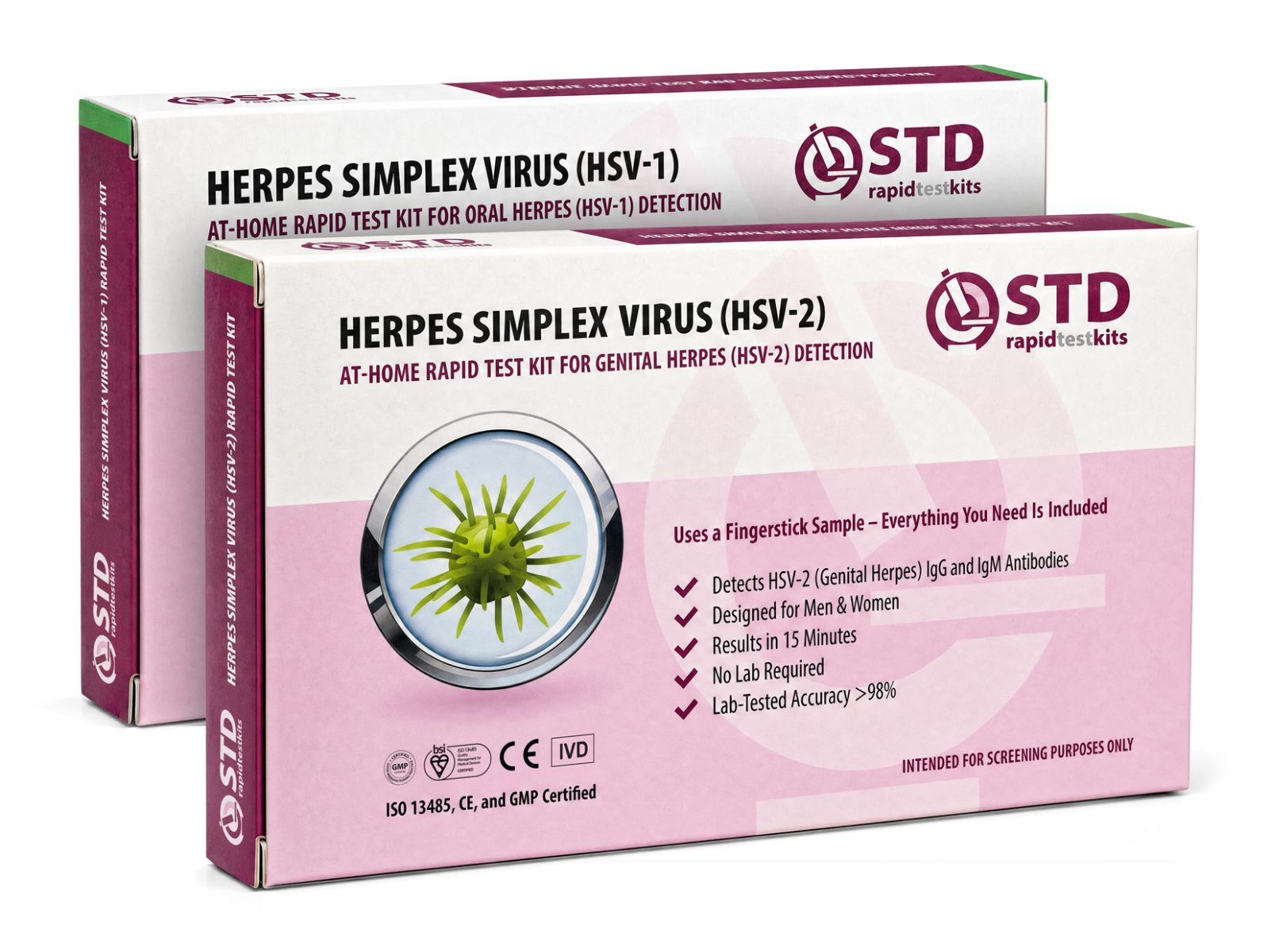
At-home rapid tests use lateral-flow immunoassay chemistry, the same general technology as a home pregnancy test or a rapid COVID test. They are not laboratory NAAT or PCR tests; the lab tests have higher analytical sensitivity, particularly in early or asymptomatic infection. The two are complementary. A positive home result is worth confirming with a lab test. A negative home result, taken at the right window, gives a reasonable screening signal.
What at-home testing does well is close specific gaps. If your clinic's standard panel didn't include herpes, an at-home herpes blood antibody test can answer that one question privately, after the appropriate window. If you've had recurring symptoms misread as yeast or BV and you're a woman, an at-home trichomoniasis swab can rule it in or out before you go back to the clinic. If you want a broad post-exposure screen and your last clinic visit was thin, a combination kit covers more ground in one go.
At-home testing doesn't replace clinical care. It just removes the need to negotiate with a provider, justify your concern, or wait for an annual physical to find out what wasn't checked last time.
Many people with STIs do not have symptoms. Without testing, you and your healthcare provider have no way to know if you have an STI, and you may unknowingly pass it on to a partner.
What to Do Next
If you've read this far and you're second-guessing a recent “clean” result, follow that instinct. Pull up the lab report if you can, and look for each infection listed by name. If herpes, trichomoniasis, or HPV aren't on the list, you weren't screened for them regardless of how the visit was framed.
From there, match the test to your specific concern. A targeted at-home kit handles a single gap (a herpes antibody check after the 12-week window, a trich swab for women with recurring yeast-like symptoms). A combination kit makes more sense if you want a broad recheck across multiple infections at once, especially after a new partner or a long stretch without testing.
Check what was actually tested first, then decide what's worth adding.
FAQs
- Why isn't herpes automatically included in STI tests?
- The CDC does not recommend routine type-specific HSV blood testing for asymptomatic adults. The reasoning: antibody tests can produce false positives in low-prevalence populations, and a positive result tells you about past exposure, not current activity or location. For most people without symptoms, the result raises more questions than it answers. For people with symptoms, a partner with HSV, or a personal preference to know, the test is worth requesting.
- If I tested negative, could I still have something?
- Yes, in two common ways. First, if the infection wasn't on the panel (herpes, trich, and HPV usually aren't), a negative result tells you nothing about it. Second, if you tested inside the window period, the infection may not have been detectable yet. A “negative” result is only as good as what the test looked for and how long after exposure you took it.
- I asked for a full panel. Doesn't that mean everything?
- “Full panel” isn't a standardized term. Different clinics and labs include different infections. Almost no panel includes HPV, trichomoniasis, or herpes by default. The most reliable way to know what was tested is to read the lab report and look for each infection by name.
- What if my partner says they're clean but didn't get tested for these?
- Most people genuinely believe their last test covered everything. The non-confrontational way to ask: “Do you remember if herpes or trich were on your last panel? I read that most don't include them unless you ask.” If they engage with the question honestly, you have a useful sense of how they handle health conversations with a partner.
- Can I test for HPV if I have a penis?
- There is no recommended HPV screening test for men, per CDC guidance. The main protections are HPV vaccination (routine through age 26 per ACIP, shared clinical decision-making through age 45), regular self-checks for visible genital warts, and honest partner communication. If a wart-like lesion appears, see a clinician for evaluation.
- Is at-home herpes testing reliable?
- At-home rapid herpes tests use lateral-flow blood antibody chemistry, similar in principle to the antibody test a clinic would order. They're useful from about 12 to 16 weeks after possible exposure. As with any antibody test, low-positive results should be confirmed with a clinic-based test, and a negative result soon after exposure should be repeated once the window has passed.
- What does trichomoniasis feel like?
- About 70% of people with trich have no symptoms at all per the CDC. When symptoms do appear, they often look like a stubborn yeast infection or BV: discharge, odor, mild burning, irritation. The overlap is exactly why trich gets misdiagnosed. The reliable way to tell is a direct test, not a guess based on symptoms.
- Should I retest if a previous result was negative but I'm still uncertain?
- If you tested inside the window period for the infection you're worried about, yes. HSV antibodies can take 12 weeks or more to appear. HIV antigen-antibody tests are reliable from about 18 to 45 days depending on the assay. If the gap is just emotional rather than driven by a specific exposure or symptom, a single retest at the appropriate window is usually enough to settle it.
- U.S. Centers for Disease Control and Prevention. Getting Tested for STIs, with population-specific recommendations for HIV, chlamydia, gonorrhea, and syphilis screening.
- U.S. Centers for Disease Control and Prevention. STI screening recommendations, including the statement that HSV-2 serologic screening among the general population is not recommended.
- U.S. Centers for Disease Control and Prevention. About Trichomoniasis, including prevalence, symptom profile, and asymptomatic carriage rates.
- U.S. Centers for Disease Control and Prevention. Trichomoniasis treatment guidelines and HIV co-acquisition risk.
- U.S. Centers for Disease Control and Prevention. About Genital HPV Infection, including the statement that HPV tests are not recommended to screen men.
- U.S. Centers for Disease Control and Prevention. About Genital Herpes, including 2018 incidence data and asymptomatic carriage.
