
Published: November 2025 | Last updated: May 2026 | Editorial review and quality control: Martina N.
Getting tested for an STD should be a step toward better health. In dozens of U.S. states, it can also be the start of a criminal record. More than thirty states still have laws making it a crime, or grounds for a civil lawsuit, to know you have an STD and not tell a sexual partner. These laws can apply even when no transmission occurred, even when a condom was used, even when treatment had reduced the actual risk to near zero.
This article explains how that legal framework got built, what the science actually says about transmission and disclosure, what at-risk groups need to know, and what your testing options look like when your knowledge can be turned against you. The short version: the gap between the legal definition of an STD-related crime and the public-health definition of actual transmission risk is wider than it has ever been, and the people paying the price are often the ones doing the responsible thing.
Key Takeaways
- More than 30 U.S. states still have HIV-specific criminal laws, and many extend similar reasoning to herpes, syphilis, and HPV through civil suits, even when no transmission occurs.
- Most STD criminalization statutes were written in the 1980s and 1990s and ignore modern science: undetectable viral loads, asymptomatic shedding, and the fact that most transmissions happen between people who never knew they were positive.
When Laws Are Written in Fear, Not Facts
The modern history of STD criminalization started during the HIV/AIDS crisis of the 1980s. Faced with a virus people did not understand and a culture saturated with homophobia and sex panic, lawmakers reached for the bluntest instrument available: criminal statutes that made it illegal not to disclose a positive status, regardless of whether anyone got infected. By the early 1990s, more than half of U.S. states had enacted some form of HIV-specific criminal law.
Forty years later, those legal templates are still in place. According to the Center for HIV Law and Policy, more than 30 U.S. states still have laws criminalizing potential HIV exposure, and several states apply similar reasoning to other infections, including herpes, syphilis, and HPV. The Center maintains a state-by-state HIV Laws database, and the Williams Institute at UCLA tracks the resulting prosecutions.
Most of these statutes do not require proof of intent. They do not require proof of transmission. They do not even require proof of meaningful risk. The legal trigger is simple: did the defendant know their status, and did they tell their partner before sex. That standard sounds intuitive until you compare it against what actual STI transmission looks like in clinical practice. Then it falls apart. Herpes sheds asymptomatically. People on effective HIV treatment with undetectable viral loads cannot transmit. Most STIs spread through people who have never been tested and have no idea they are positive. The criminal law reasons about transmission as if it were a deliberate act. The science says it usually is not.
More than 30 U.S. states still have HIV-specific criminal laws on the books, most enacted before 1995 and before the science of viral load, antiretroviral therapy, and asymptomatic transmission was well understood. Reform has been slow: only a small number of states have meaningfully amended or repealed their statutes in the last decade, according to the Center for HIV Law and Policy's state tracker.
What the Laws Say (And Don’t Say)
Here is the part that catches most people off guard: you do not have to infect anyone to be prosecuted. In many states, simply knowing your status and not disclosing before sex, even if you used a condom, even if you had no active symptoms, can result in criminal charges, civil lawsuits, or both. The rules vary widely state to state, and even within a state, prosecutors use very different thresholds. The table below shows a sample of how this plays out across major jurisdictions.
| State | Criminal Penalties for STD Non-Disclosure | Notes |
|---|---|---|
| California | Misdemeanor for HIV (reduced from felony in 2017) | Civil suits remain possible for herpes and HPV |
| Florida | Felony for HIV, syphilis, and gonorrhea | No actual transmission required |
| New York | No HIV-specific criminal statute | Civil suits possible for herpes or HPV |
| Georgia | Felony for HIV exposure | Reform bills under active discussion in 2024–2026 |
| Illinois | Fully repealed HIV criminal exposure law in 2021 | Handled through public-health framework instead |
| Texas | No HIV-specific statute | Civil litigation still occurs; herpes lawsuits documented |
The Cost of “Protect Yourself” Culture
Public health campaigns spend a lot of energy telling people to get tested and know their status. What those campaigns rarely admit is that knowing your status can make you legally vulnerable. In most U.S. jurisdictions, knowledge of one’s infection shifts the entire responsibility for transmission onto the person with the diagnosis, even when protection was used, even when no transmission occurred.
That legal asymmetry quietly discourages the exact behavior public health depends on. It punishes the people who tested. It leaves the people who never tested with a clean defense: I did not know. Peer-reviewed research, including studies published in AIDS and Behavior and PLOS ONE, has consistently found that HIV criminalization laws do not reduce transmission rates, and several studies have linked harsher statutes to lower testing rates in the affected populations.
In blunt terms: if you test positive for herpes, you can be sued. If you test positive for HIV, you can be prosecuted, even if you never had symptoms, even if you did not know at the time of sex, even if you used a condom. The law treats your test result, not your actual behavior, as the source of the harm. That is a meaningful break from how criminal law is supposed to work everywhere else, where what you do matters more than what you know.

When Public Health Gets Rewritten by Courtrooms
The medical and public-health community has been clear on this: criminalizing health conditions does not reduce risk, and in many cases it increases it. The U.S. Centers for Disease Control and Prevention, the World Health Organization, UNAIDS, and Planned Parenthood have all publicly opposed laws that punish people for their STI status. They argue that these laws undermine trust in public health systems, discourage testing, and reinforce stigma.
Most of these statutes also ignore core public health facts:
- Herpes is extremely common. CDC estimates place genital HSV-2 prevalence at roughly 1 in 6 U.S. adults aged 14 to 49, and oral HSV-1 at about half of all adults, with most carriers never developing recognizable symptoms.
- Modern HIV treatment can reduce viral load to undetectable levels. The CDC, WHO, and the Prevention Access Campaign affirm that ‘Undetectable = Untransmittable’ (U=U): a person on effective treatment with an undetectable viral load cannot sexually transmit HIV.
- HPV is nearly universal. More than 80% of sexually active adults will acquire at least one HPV strain in their lifetime. Condoms reduce but do not eliminate transmission, because HPV spreads through skin-to-skin contact outside the area condoms cover.
Testing as a Legal Risk: What to Know
Here is the paradox. The more proactive you are about testing, the more legally vulnerable you become. If you never test, you may avoid liability under a “did not know” defense. If you do test, even when you are asymptomatic, even when you are on treatment with an undetectable viral load, you are now expected to disclose under threat of arrest or civil suit. The law rewards ignorance and punishes information.
That dynamic chills exactly the behavior public health needs. Surveys by the Williams Institute at UCLA and others have found significant numbers of LGBTQ+ adults report delaying or avoiding STI testing because of perceived legal or social consequences. The chilling effect is largest among communities already most affected by HIV: Black and Latino gay and bisexual men, transgender women, and people living in states with the harshest statutes.
That fear is not paranoid. Each year, dozens of people in the U.S. are prosecuted for HIV-related exposure offenses, and the majority of cases involve no actual transmission. The Williams Institute and the Sero Project track these cases; the pattern is consistent. Many defendants are poor, are people of color, or live in rural areas with limited health-care access. If you have ever hesitated to test out of fear that “this could come back to bite me,” you are already living with the weight of these laws, even if you have never been charged with anything.
Consider Marcus, a 28-year-old who tested positive for HIV in 2021 after a hookup left him uncertain. His viral load was already low. He started antiretroviral treatment immediately, notified his recent partners, and used condoms consistently after that. Six months later, an ex he had not seen in months filed a criminal complaint, alleging Marcus had not disclosed before they had sex. No transmission had occurred. Marcus was arrested under his state’s HIV exposure law. The charges were eventually dropped, but by then his name had appeared in local news and he had lost his job. He had done every textbook-correct thing: tested early, treated quickly, disclosed proactively, used protection. The law punished him anyway, because the allegation alone was enough to trigger arrest and the public disclosure of his private health status. (Composite case based on documented prosecutions tracked by the Sero Project; identifying details changed.)
This article is published by stdrapidtestkits.com, which sells at-home STI testing kits. The product callouts in this article match the testing window and infection profile most relevant to the topic, and the full sample-type details are on each product page.
What the Science Says (And Why the Law Ignores It)
STD transmission is rarely simple, and almost never criminal. Research published in The Lancet HIV and elsewhere consistently finds that most people who transmit STIs do so unknowingly. The majority of cases involve asymptomatic carriers or low-risk transmission pathways. That is not negligence. That is biology.
Take herpes as a concrete example. HSV-2 sheds asymptomatically: the virus can be present in genital secretions even when there are no visible sores. Most people who carry it have never had a textbook outbreak and do not know they have it. Telling a partner “you should have known” ignores the medical reality that the carrier often did not know either.
Legal systems do not handle that kind of ambiguity well. Courts want intent, causality, and a clearly responsible defendant. Those three things often do not exist in sexual health, where the actual transmission event is biological, asymptomatic, and unobservable. So the law forces clarity where the science cannot supply it, and the result is people prosecuted for being informed and honest rather than for putting anyone at meaningful risk.
There is no evidence that the broad application of criminal law to HIV transmission achieves either criminal justice or public health goals.
STD Risk Is Complex: Context Matters
The idea that any non-disclosure equals harm ignores the entire spectrum of actual transmission risk. Context matters. Symptoms matter. Viral load matters. Protection matters. Two people in legally identical situations, both positive for an STI, both not having disclosed, can have wildly different actual transmission risks depending on which infection, what treatment, what protection, and what point in the infection cycle they are in. The law treats them the same. The biology does not. The table below shows how those two risk axes diverge across common scenarios.
| Scenario | Actual Transmission Risk | Legal Risk (in many states) |
|---|---|---|
| Condom used, no symptoms, no verbal disclosure | Low to negligible (varies by infection) | High (if status was known) |
| Unknown status, never tested, no disclosure | Moderate (especially for asymptomatic STIs) | None (treated as lack of knowledge) |
| Symptomatic, aware, verbal disclosure given | Moderate to high (depends on encounter) | Low (mutual consent on the record) |
| On effective HIV treatment, undetectable viral load | Effectively zero (U=U, scientifically confirmed) | Still high in most states (laws do not recognize U=U) |
Consent Is a Conversation, Not a Contract
Much of the legal framework around STI disclosure treats sex like a binding agreement, where failure to disclose a diagnosis voids consent. That logic is flawed in ways that show up the moment you apply it consistently. No law requires someone to disclose their last negative test result. No one is prosecuted for not revealing the number of past partners they have had, or whether they were tested recently, or whether their current partner has been tested. Risk exists in every sexual encounter, disclosed or not.
The moment a positive result enters the picture, though, especially for something stigmatized like HIV or herpes, the standard flips. The person with the diagnosis is treated as a presumptive criminal until they can prove they disclosed in a way the court will accept. That double standard turns health information into a liability.
It also does not work in practice. As CDC researchers and others have repeatedly noted, people disclose more, not less, when they do not fear retaliation, legal or social. Punitive systems push disclosure underground. They do not make it more common.
Consider Selena, a 22-year-old diagnosed with HSV-2 six months before meeting her current partner. She had every intention of telling him. The night came, she panicked, they used a condom, she had no outbreak. They did not talk about it again. Months later she still has not had the conversation. The fear is not of transmission, which is what condoms and antiviral suppressive therapy can manage. The fear is of how her partner will react if she discloses, and what could happen legally if she ever ends up in court. Selena’s case is not unusual. Disclosure is hard. It requires vulnerability, trust, and time. Legal fear makes that conversation harder, not easier. Punitive systems do not protect people; they keep people scared. (Composite case, identifying details changed.)
Is Legal Reform Coming?
There is movement, but it is slow. A handful of states have started rewriting or repealing their HIV-specific statutes, replacing criminal liability with public-health frameworks. California reduced its HIV non-disclosure law from a felony to a misdemeanor in 2017. In 2021, Illinois became the first state to fully repeal its HIV criminal exposure statute, replacing it with public-health-based provisions. New Jersey followed with a similar reform. Several other states, including Michigan, Ohio, and Georgia, have active reform bills in their legislatures, and prosecutors in Texas and Florida have narrowed how aggressively they apply existing statutes.
Advocacy groups like the Sero Project, the Center for HIV Law and Policy, and the Positive Justice Project have driven much of this work. They publish state-by-state legal trackers, support defendants in active cases, and lobby for repeal. The evidence they cite is consistent across multiple peer-reviewed studies: decriminalization is associated with better testing uptake, more open disclosure, and improved health outcomes, with no measurable increase in transmission.
Pushback still comes from groups operating on 1980s assumptions about who carries HIV and why, but the legal and medical consensus has been moving steadily in the same direction for more than a decade. The CDC has publicly stated that most state HIV laws were enacted before scientific evidence about transmission was robust, and that those laws do not appear to influence transmission rates. The American Medical Association, the American Academy of HIV Medicine, and the National Association of County and City Health Officials have all called for reform. Change will happen. It will just take longer than the science deserves, and in the meantime, knowing your rights and your testing options is the practical line of defense.

Take Back Control: Test Without the Fear
Your sexual health is yours. Not the court’s, not your ex’s, not the state’s. It is personal, private, and entirely your own to manage, whether or not you have ever had an STI, whether or not you have disclosed in the past, whether or not you feel ready to test again right now.
At-home testing gives you answers without involving a clinic visit, an insurance claim, or an electronic medical record that can be subpoenaed in a future dispute. You control the test, the timing, and what you do with the result. You decide who to tell. You decide when. None of that replaces a clinic when you need follow-up confirmation testing, treatment, or partner-services support, but it does put the first step back into your hands.
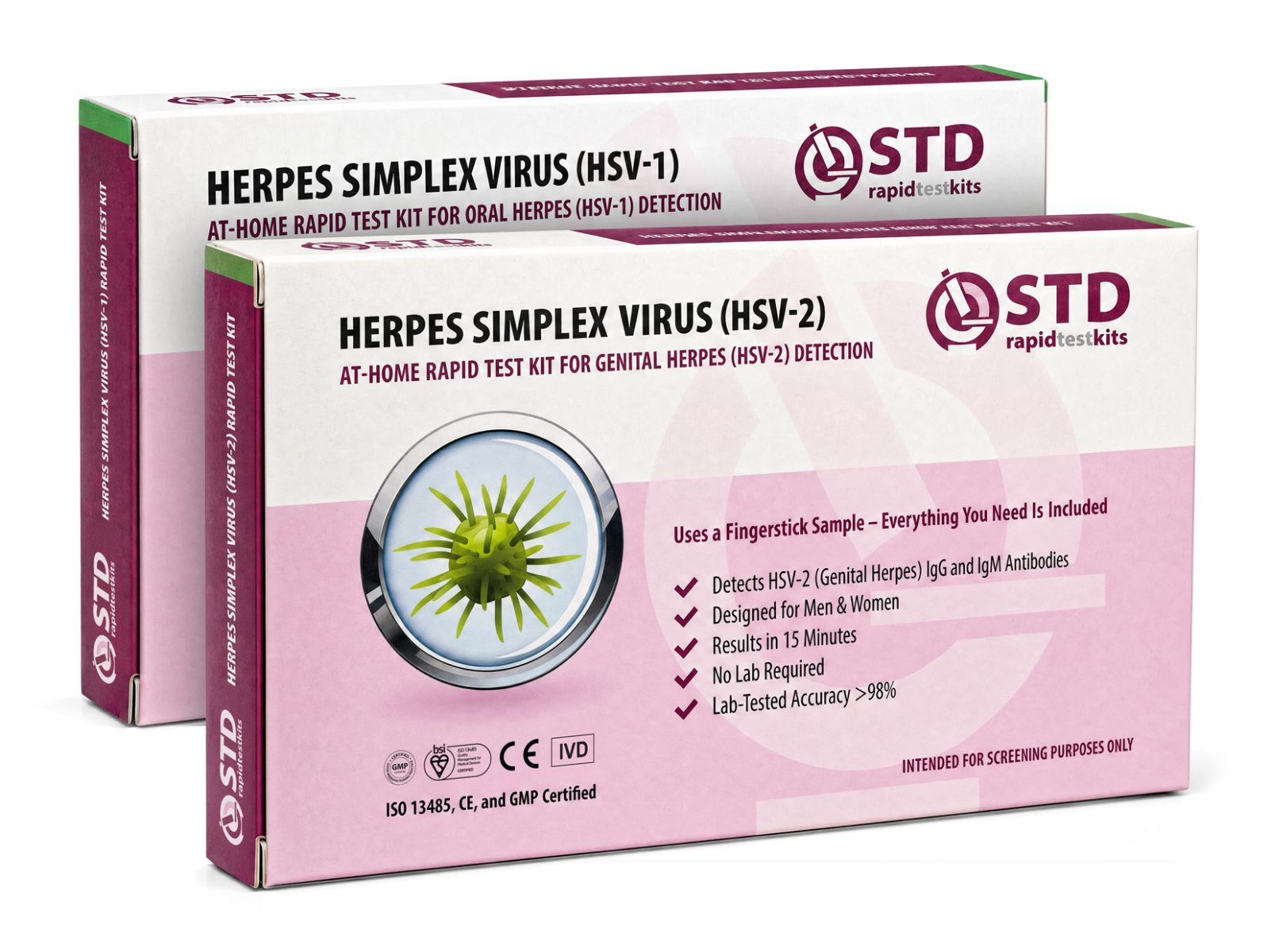
If you are weighing a single-infection test or a broader screening kit, the right answer depends on which exposure you are worried about and how long ago it happened. The herpes panel covers HSV-1 and HSV-2 via fingerstick blood (most useful 12 or more weeks after exposure). The combination kit below screens for the most common bloodborne and swab-detectable STIs in one shipment. Either way, the testing decision is private, the result is private, and what you choose to share is yours to decide.

FAQs
- Can I be arrested just for testing positive for an STD?
- In some states, yes. If you know you have HIV and do not tell a partner before sex, you can face criminal charges in more than 30 U.S. states, even if you used a condom and even if no transmission occurred. For herpes, HPV, and other STIs, the more common risk is a civil lawsuit rather than criminal charges. The exact rules vary widely by state.
- What if I did not know I was positive?
- You generally are not legally liable for non-disclosure of an STD you did not know you had. The legal asymmetry runs the other way: ignorance is a defense, but proactive knowledge often is not. You cannot disclose what you do not know, yet once you do know, most state statutes impose disclosure obligations they never place on people who stayed untested.
- Should I avoid testing to stay legally protected?
- No. Not knowing your status carries far higher health risks than the legal risk in nearly all cases. Untreated HIV is a serious medical condition with modern treatments that can give you a normal life expectancy. Untreated syphilis can cause long-term neurological damage. The right strategy is to test, get on treatment if needed, and learn your state’s disclosure rules so you know how to handle them. Discreet at-home testing is one way to keep the process private.
- Can someone sue me for transmitting herpes?
- Yes. Civil herpes lawsuits have become more common over the past decade. Even without criminal charges, plaintiffs can sue for emotional distress, medical expenses, and damages. Some lawsuits have succeeded even when the plaintiff struggled to prove the defendant knew they had herpes at the time of contact.
- Do condoms and HIV treatment count as legal defenses?
- Medically, they should. A person on antiretroviral therapy with an undetectable viral load cannot sexually transmit HIV. The CDC, WHO, and UNAIDS all confirm ‘Undetectable = Untransmittable.’ Yet many state HIV statutes do not formally recognize U=U, and condom use alone is not always a complete legal defense. The law has not kept up with the medicine.
- What counts as legal disclosure?
- That varies enormously by state and by court. Some courts require verifiable proof of disclosure, such as a text message or a signed acknowledgement. A verbal disclosure with no witnesses can be hard to prove if your partner later denies it. People in strict-statute states sometimes document disclosures in writing for that reason.
- Does this only apply to HIV?
- HIV is the most criminalized condition, but several states extend non-disclosure liability to herpes, syphilis, hepatitis B, and gonorrhea, either through specific statutes or through civil claims for reckless endangerment or emotional distress. HPV claims occasionally show up in civil court too.
- What is the safest way to test if I am worried about legal risk?
- Discreet at-home testing avoids creating a clinic record tied to your name and insurance. It is not a legal shield (a positive result still creates an obligation under most state statutes if you later have sex without disclosing), but it does keep your health information out of databases that can be subpoenaed. Combine private testing with a working knowledge of your state’s STD laws, and if you ever face a legal situation, talk to a lawyer who specializes in HIV/STI law. The Sero Project maintains a referral list.
How we sourced this article: We combined current guidance from leading public-health organizations (CDC, WHO, UNAIDS) with state-by-state legal tracking from the Center for HIV Law and Policy and the Williams Institute, and peer-reviewed research on the public-health effects of HIV criminalization. The composite cases used to illustrate testing-related arrest and disclosure freeze are drawn from documented prosecutions tracked by the Sero Project, with identifying details changed. This article describes the law as a general matter and is not legal advice; talk to a lawyer licensed in your state about your specific situation.
- U.S. Centers for Disease Control and Prevention. HIV policies, legal landscape, and current testing guidance.
- Center for HIV Law and Policy. State HIV laws database and policy advocacy resources.
- Williams Institute at UCLA School of Law. Research on HIV criminalization, prosecution patterns, and demographic impact.
- The Sero Project. National advocacy for HIV criminalization reform, defendant support, and case tracking.
- UNAIDS. Joint United Nations Programme on HIV/AIDS, including the policy brief on criminalization of HIV transmission.
- World Health Organization. HIV and AIDS fact sheet, including current treatment and U=U guidance.
