
Published: December 2025 | Last updated: May 2026 | Editorial review and quality control: Martina N.
Penile discharge means any fluid that leaves the urethra and isn't urine or semen. Some discharge is harmless. Some is the body's first signal of a treatable infection. The trick is knowing which is which fast enough to act, without panicking over a normal lubricating fluid your body produces every day.
This guide walks through what penile discharge looks like across the most common causes, when it points toward a sexually transmitted infection like chlamydia or gonorrhea, and how to decide between an at-home rapid test and a clinic visit. The short version: clear discharge during arousal is usually nothing. Yellow, green, cloudy, or thick discharge with burning urination almost always needs testing within a few days.
Is my discharge normal or a sign of something to test for?
Clear, thin discharge that appears only with sexual arousal (pre-ejaculate) is normal. So is a small amount of white smegma under the foreskin in uncircumcised men, which is dead skin cells, not infection. Discharge becomes a warning sign when it's yellow, green, cloudy white, or thick; when it smells unusual; or when it comes with burning during urination, itching, or pain. Those signs point most often to chlamydia or gonorrhea, both common and both fully treatable with a short course of antibiotics. Test within a few days if any warning sign appears.
Key Takeaways
- Clear arousal-related discharge is normal. Yellow, green, or cloudy discharge with burning urination almost always means a treatable bacterial STI, usually chlamydia or gonorrhea.
- Test within a few days of noticing colored or painful discharge. Both chlamydia and gonorrhea respond to a short antibiotic course; untreated, they can cause epididymitis, prostatitis, and fertility problems.
What counts as normal penile discharge?
Most healthy men produce small amounts of fluid from the urethra at some point in any given week. The features of normal discharge are predictable: it's tied to arousal or to hygiene rather than appearing at random; it's clear or whitish; it has no strong smell; and it doesn't come with burning, pain, or itching.
Pre-ejaculate (pre-cum)
Clear, slightly slippery fluid released during sexual arousal. Pre-ejaculate neutralizes acidity in the urethra and lubricates passage of sperm. Volume varies widely between men. This is normal and does not indicate any infection.
Smegma
A whitish or yellowish waxy material that can build up under the foreskin in uncircumcised men. Smegma is shed skin cells, oil, and moisture, not infection. Daily gentle cleaning with warm water resolves it. When smegma accumulates alongside redness, swelling, soreness, or itching of the head of the penis, that combination can indicate early balanitis, which benefits from medical evaluation.
Trace morning fluid
A small drop of clear fluid at the urethral opening on waking, with no smell or burning, is generally not concerning, especially in younger men. If it persists for weeks, changes color, or comes with discomfort, treat it as a symptom rather than a quirk.
| Feature | Normal | Worth testing |
|---|---|---|
| Color | Clear, whitish, or slightly cloudy | Yellow, green, or thick cloudy white |
| When it appears | Only with sexual arousal | Any time of day, including before urinating |
| Smell | None or very mild | Strong, unusual, or fishy |
| Burning when urinating | Absent | Usually present |
| Other genital symptoms | None | Itching, sores, swelling, or testicular pain |
| Recent unprotected sex | Doesn't change interpretation | Raises pretest probability of STI |
When discharge points to an STI
Discharge that's any color other than clear, that smells, or that comes with burning urination almost always means a bacterial infection of the urethra. Chlamydia and gonorrhea cause the majority of cases. Trichomoniasis and non-gonococcal urethritis (NGU) account for most of the rest. The CDC's STI Treatment Guidelines on urethritis describe the typical urethral discharge presentation as mucoid, mucopurulent, or purulent.
Pattern by infection
The four most common causes of true urethral discharge in men have overlapping features but distinct typical patterns. The table below summarizes; the prose afterward fills in the detail.
Gonorrhea: thick, often yellow or yellow-green discharge, frequently within 2 to 7 days of exposure. Burning during urination is usually present. The CDC's gonorrhea page lists "a white, yellow, or green discharge from the penis" as a typical symptom.
Chlamydia: lighter, cloudy white or clear discharge. The CDC's chlamydia page notes that symptoms, when they appear, may not show up until several weeks after exposure, and that chlamydia often has no symptoms at all. That asymptomatic pattern is the main reason public-health agencies recommend annual screening for sexually active men under 25.
Trichomoniasis: thinner, sometimes frothy discharge with mild irritation. Often missed in men because symptoms can be subtle.
Non-gonococcal urethritis (NGU): the umbrella term for urethritis not caused by gonorrhea. Common pathogens are Mycoplasma genitalium and Ureaplasma. Discharge tends to be clear-to-cloudy with persistent burning. The NHS NGU page covers this in plain language.
Symptom overlap between these is high. The only reliable way to tell them apart is testing.
| Infection | Discharge appearance | Typical onset after exposure | Other signs |
|---|---|---|---|
| Gonorrhea | Thick, yellow or yellow-green | 2 to 7 days | Burning urination usually present |
| Chlamydia | Cloudy white or clear; lighter | Several weeks if any; often silent | Mild burning or testicular ache when symptomatic |
| Trichomoniasis | Thin, sometimes frothy | Variable; often subtle in men | Mild urethral irritation |
| Non-gonococcal urethritis (NGU) | Clear to cloudy | 1 to 5 weeks | Persistent burning; pathogens include Mycoplasma genitalium |
An at-home rapid test is fine for triaging classic urethral symptoms. The signs below are different and need urgent in-person evaluation:
- Severe testicular pain or swelling on one side
- Fever above 38°C / 100.4°F with discharge
- Visible blood in urine or in the discharge
- Inability to fully empty the bladder
- Severe lower abdominal or pelvic pain
These can mean epididymitis, an ascending bacterial infection, or another complication that requires antibiotics started immediately, sometimes intravenously.
Causes of discharge that aren't sexually transmitted
Not every case of urethral discharge is an STI. A meaningful minority of men presenting with discharge have a non-sexually-transmitted cause, especially men who haven't had a new sexual partner in months. The most common alternatives:
Prostatitis
Inflammation of the prostate, either acute (bacterial, sudden onset) or chronic (often lower-grade, lasting weeks). The NHS prostatitis page lists pelvic or perineal pain, painful urination, and painful ejaculation as the typical signs. Some men with bacterial prostatitis also notice a milky or thin urethral discharge, especially in the chronic form.
Urinary tract infection
Less common in younger men than in women, but possible at any age. UTIs in men more often produce burning and frequent urination than visible discharge, but discharge can occur, especially with concurrent prostatitis.
Balanitis
Inflammation of the head of the penis or foreskin, often from yeast, bacterial overgrowth, or chemical irritation (scented soaps, detergents, latex). Usually presents with itching, redness, and swelling rather than discharge from the urethra itself, though under-foreskin discharge is common.
Mechanical irritation
Vigorous sex without enough lubrication, friction from clothing, or new soaps and laundry detergents can irritate the urethral lining and produce a small amount of clear discharge. It resolves on its own once the irritant stops.
Non-STI causes at a glance
- Prostatitis: pelvic or perineal pain plus painful ejaculation are the typical lead symptoms; discharge, when present, is usually milky or thin.
- UTI in men: burning and frequent urination dominate; visible discharge is uncommon unless prostatitis is also present.
- Balanitis: itching, redness, and swelling under the foreskin; under-foreskin material rather than urethral discharge.
- Mechanical irritation (friction, harsh soaps, new detergents): small amount of clear fluid that resolves once the irritant is removed.
How to test, and how soon
If discharge has any of the warning features above (color, smell, burning, recent unprotected sex), test within a few days. Don't wait for symptoms to ease on their own. The bacteria don't go away without treatment, and untreated chlamydia or gonorrhea can ascend to cause epididymitis, prostatitis, and over time fertility problems.
Window periods
Both chlamydia and gonorrhea become detectable within roughly 1 to 2 weeks after exposure. If your discharge has appeared, you're already past the window for the relevant tests; results will be reliable. The exception is very recent unprotected exposure with no symptoms yet; in that case, wait at least a week before testing for the most reliable result.
At-home rapid swab tests
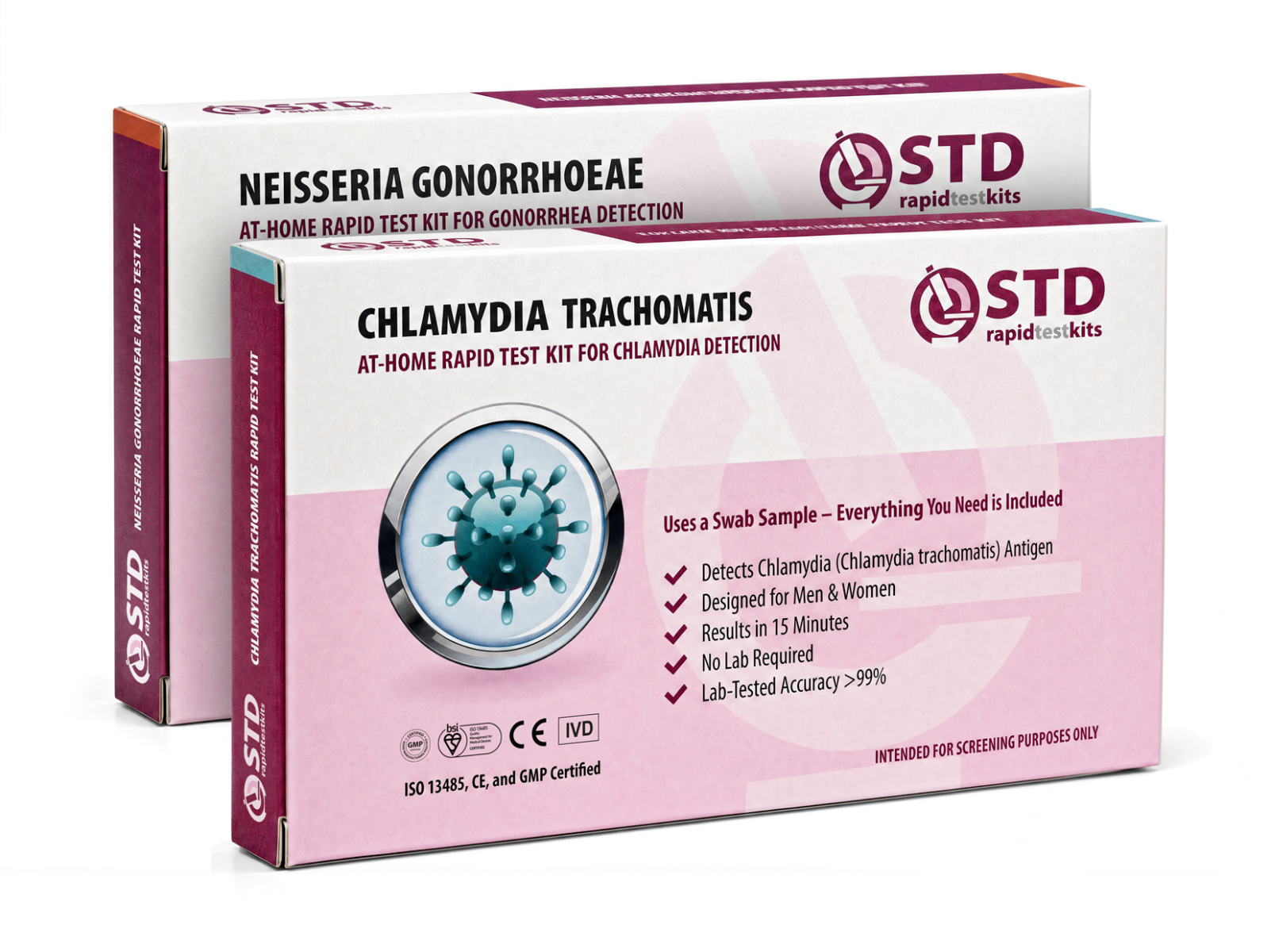
Lateral-flow rapid tests for chlamydia and gonorrhea use a self-collected sample (a urethral swab or a first-void urine collection, depending on the kit). The result appears in about 15 minutes at home. These are screening tools with strong specificity, useful for fast triage and for the privacy benefit. A positive at-home result is worth confirming with a lab NAAT before starting antibiotics, and a negative result with persistent symptoms is worth re-testing in 1 to 2 weeks.
Lab-based NAAT (clinic or sexual-health service)
Nucleic-acid amplification testing remains the laboratory gold standard for both chlamydia and gonorrhea. The CDC STI Treatment Guidelines favor NAAT for confirmation. Most U.S. sexual-health clinics, urgent-care clinics, and large primary-care practices offer it. Results typically take 1 to 3 days.
If both tests are negative but discharge continues
Ask about testing for trichomoniasis, Mycoplasma genitalium, and a urine culture for atypical bacteria. Persistent discharge after a clean chlamydia and gonorrhea result is the typical NGU pattern.
Treatment and what to expect
Both chlamydia and gonorrhea are fully curable with short courses of antibiotics, prescribed by a clinician after a positive test. The current CDC-recommended regimens, summarized in the CDC STI Treatment Guidelines, are:
- Chlamydia: doxycycline 100 mg by mouth twice daily for 7 days, the first-line option for non-pregnant adults. A single 1-gram dose of azithromycin is an alternative when doxycycline isn't appropriate.
- Gonorrhea: a single intramuscular injection of ceftriaxone, dosed by body weight. Because gonorrhea has developed resistance to multiple oral antibiotics, the injection is now standard.
- Trichomoniasis: oral metronidazole or tinidazole, usually as a single dose or short course.
Timeline of recovery
Discharge and burning typically improve within 3 to 7 days of starting treatment. Pause sex for at least 7 days after a single-dose regimen, or until you finish a multi-day course AND feel better. If symptoms haven't fully cleared at 2 weeks, see your clinician for re-evaluation; reinfection or a missed second pathogen is the usual reason.
Re-testing
The CDC recommends a follow-up test about 3 months after treatment for chlamydia or gonorrhea. Reinfection from an untreated partner is common and is the leading reason that discharge returns. Notify all sexual partners from the past 60 days so they can test and treat in parallel.
Many STIs have no symptoms or may only cause mild symptoms, so people can have an infection but not know it.
What to do this week if you have discharge
Translate the information above into a short action list. None of this requires a doctor's visit at the first step, but every step gets you closer to a clear answer.
Pause sex until you have a result
Even with a condom. Both chlamydia and gonorrhea can transmit through unprotected oral sex and through breaks in barrier use, and you don't yet know which infection is in play.
Note what you see
Color, consistency, smell, when it appears (only after urinating? all day? on waking?), and any associated symptoms (burning, testicular pain, fever). A two-line note on your phone is enough. This helps your clinician or your test interpretation later.
Order an at-home rapid test or schedule a clinic visit
For privacy and speed, an at-home rapid swab covers the two highest-probability infections in about 15 minutes. For depth and definitive answers, a sexual-health clinic NAAT is the gold standard. Both are reasonable; the at-home option works well for triage, the clinic option for confirmation and prescription access.
Don't try to treat yourself
Antibiotics are prescription-only in most countries for good reason. Self-treating with a friend's leftover doxycycline or with online-purchased pills almost always picks the wrong drug, the wrong dose, or both, and the missed bacteria become harder to treat next time.
Quick decision summary
- Yellow or green discharge with burning urination: test for chlamydia and gonorrhea this week. Both are curable with a short antibiotic course.
- Severe testicular pain, fever, or blood in urine: see a clinician same-day, not an at-home test alone.
- Tested negative but discharge continues: ask about prostatitis, NGU, or trichomoniasis. A meaningful share of persistent discharge has a non-chlamydia, non-gonorrhea cause.
- Re-test about 3 months after treatment. Reinfection from an untreated partner is the most common reason discharge comes back.
Frequently asked questions
- How soon after exposure does penile discharge appear?
- Timing depends on the pathogen. Gonorrhea tends to be faster, often producing thick discharge within a week. Chlamydia is slower and can take several weeks if symptoms appear at all. The implication: if you had unprotected sex and you're uncertain, testing is more reliable than waiting for symptoms, because both infections can stay completely silent.
- Can I have an STI without any discharge?
- Yes. Per the CDC, chlamydia and gonorrhea both often cause no symptoms in men, and a meaningful share of cases are picked up only on routine screening. This is the main reason public-health agencies recommend annual screening for sexually active men under 25, and for men of any age with new partners.
- Is morning discharge always a sign of infection?
- Usually not. Clear, odorless fluid that appears on waking and clears up by mid-morning is a normal variant in younger men. The version that warrants testing: fluid that is colored, persists all day, recurs for more than 2 weeks, or comes with any burning. If more than one of those is true, treat it as a symptom and test.
- How accurate are at-home rapid swab tests for chlamydia and gonorrhea?
- Lateral-flow rapid tests have strong specificity (few false positives) and good sensitivity when used correctly per the kit instructions. They are screening tools and complement, rather than replace, a laboratory NAAT. A positive at-home result is worth confirming at a clinic before starting antibiotics; a negative with persistent symptoms is worth re-testing in 1 to 2 weeks.
- Will old or borrowed antibiotics clear up the infection?
- Almost certainly not, and self-treating creates real harm. Old prescriptions are usually the wrong drug or wrong dose for current resistant strains. Gonorrhea in particular now requires injectable ceftriaxone in most cases. Self-treating breeds antibiotic resistance and can mask symptoms while the underlying infection continues.
- Can stress, diet, or alcohol cause penile discharge?
- Not directly. Stress can flare chronic prostatitis, which can produce discharge as a downstream symptom. Spicy food, caffeine, and alcohol can irritate the urinary tract, but irritation usually causes burning rather than true urethral discharge. If discharge is what you're seeing, treat it as a sign to test.
- Should I tell my partner before I test?
- If you have classic symptoms (colored discharge plus burning urination), telling your partner now lets them test in parallel and pause sexual contact, which prevents back-and-forth reinfection. After a confirmed positive, the standard recommendation is to notify all sexual partners from the past 60 days so they can be tested and treated.
- What if discharge keeps coming back after antibiotics?
- Three common reasons: reinfection from an untreated partner; a different infection (such as trichomoniasis or Mycoplasma genitalium) that the original test didn't cover; or a non-infectious cause like chronic prostatitis. See a clinician for a broader workup including a urine culture and an NGU panel.

- U.S. Centers for Disease Control and Prevention. STI Treatment Guidelines: Urethritis and cervicitis. Supports the description of urethral discharge appearance (mucoid, mucopurulent, or purulent) used in the body.
- U.S. Centers for Disease Control and Prevention. About chlamydia. Supports the asymptomatic-pattern framing and the multi-week onset timing used in the body.
- U.S. Centers for Disease Control and Prevention. About gonorrhea. Source for the white, yellow, or green discharge presentation in men.
- U.S. Centers for Disease Control and Prevention. STI Treatment Guidelines (index). Source for the doxycycline and ceftriaxone regimens described above.
- U.K. National Health Service. Non-gonococcal urethritis (NGU): symptoms, causes, and when to test for non-chlamydia, non-gonorrhea urethral infection.
- U.K. National Health Service. Prostatitis: pelvic pain, painful urination, and painful ejaculation as the typical signs of prostatitis discussed in the non-STI causes section.
- U.S. Centers for Disease Control and Prevention. About sexually transmitted infections. Source for the pull-quote on asymptomatic STIs.
