
Published: November 2025 | Last updated: May 2026 | Editorial review and quality control: Martina N.
Pelvic pain sits in an uncomfortable gray zone between reproductive health and sexual health. It is low enough in the abdomen to feel intimate. It is vague enough that you cannot immediately name it. And because infections like chlamydia and gonorrhea can quietly travel upward into the uterus and fallopian tubes, many people fear the worst before they have anything close to a clear answer.
That fear is not irrational. The CDC's pelvic inflammatory disease fact sheet notes that early PID is often mild or even asymptomatic, and that roughly 1 in 8 women with a history of PID later experience difficulties getting pregnant. Knowing what the pain is, and what it is not, is the difference between a productive next step and another night of guessing in the dark.
The good news is that pelvic pain tends to follow recognizable patterns. Infection-related pain typically builds across days. Ovarian cyst pain often arrives as a one-sided spike that softens over a week. Cyclical pain that tracks with periods usually points elsewhere again. Pattern recognition cannot replace testing or imaging, though it is a useful first filter for deciding what to do next.
Key Takeaways
- Pelvic pain that builds gradually across days, worsens with sex or movement, and follows recent unprotected exposure is the pattern most consistent with chlamydia, gonorrhea, or early pelvic inflammatory disease.
- Sudden one-sided pain, especially around mid-cycle, more often points to an ovarian cyst, ovulation, or another non-infectious cause; STD testing can rule out infection while ultrasound identifies a cyst.
STD vs Ovarian Cyst: What the Pain Usually Feels Like
Pain from a sexually transmitted infection tends to build gradually. It often starts as a mild ache or a sense of pelvic heaviness that worsens over several days, especially during sex or with sudden movement. Cyst pain behaves differently. A simple functional cyst can sit silently for weeks and then become sharply painful only if it stretches the ovary capsule, leaks, or ruptures.
Discharge is not required for an STD diagnosis. The CDC notes that many people with chlamydia have no noticeable vaginal symptoms at all, which is part of why screening matters more than waiting for visible signs. Relying on discharge to decide whether to test will miss a meaningful share of infections, especially those that have already moved upward into the upper reproductive tract.
The summary below covers the broad strokes.
| Pain feature | STD / Pelvic inflammatory disease | Ovarian cyst |
|---|---|---|
| Onset | Gradual over days to weeks | Often sudden if rupture or stretch occurs |
| Location | Central lower abdomen; both sides possible | Often localized to one side (left or right) |
| Associated symptoms | Fever, pain during sex, abnormal bleeding, sometimes discharge | Bloating, pressure, possible sharp episode |
| Pattern | Dull ache that worsens with movement or intercourse | Sharp spike, then lingering soreness |
| Risk trigger | Recent unprotected sex or untreated infection | Ovulation or hormonal shift; no sex required |
When Pelvic Pain Is Actually an STD
Chlamydia and gonorrhea do not always stay where they start. Left untreated, they can ascend from the cervix into the uterus and fallopian tubes, triggering pelvic inflammatory disease. At that point pain becomes more noticeable, sometimes paired with low-grade fever, pain during intercourse, or irregular bleeding between periods.
The CDC's chlamydia fact sheet emphasizes that most people with chlamydia have no symptoms at all, and that routine screening is the only reliable way to catch it before complications develop. The same is true of gonorrhea. Infection can be active for weeks, quietly producing tubal inflammation, without ever generating a moment dramatic enough to drive someone into a clinic on its own.
If unprotected sex happened in the past two to three weeks and new pelvic pain has appeared, testing belongs higher on the priority list than it usually feels like it does. Early antibiotics are highly effective, and the complications that follow delayed care (chronic pelvic pain, ectopic pregnancy, infertility) are largely preventable when treatment starts on time. Timing of the test matters too: bacterial STIs are most reliably detectable from about day 14 after exposure, which is covered in the window-period table further down.
Mild pelvic ache, mild nausea, a sense that something is just off: the early signs of PID are easy to dismiss. The CDC describes many cases as subclinical, meaning real inflammation is happening without the dramatic symptoms most people expect. A low-grade ache after a recent exposure deserves a test, not a waiting game.
When It Is More Likely an Ovarian Cyst
Ovarian cysts are extremely common. Mayo Clinic notes that most people with ovaries develop functional cysts during their reproductive years, and most resolve without any treatment over one or two menstrual cycles.
The pain pattern is often one-sided. It can feel like a pinpoint soreness low on the left or right, sometimes radiating into the back or hip. It may worsen with sudden movement, coughing, or sex. Many describe it as pressure or fullness rather than the steady ache that infection tends to produce.
A cyst that ruptures is more dramatic. A sudden sharp spike, occasionally with dizziness or nausea, may be followed by a few days of soreness as the body reabsorbs the released fluid. Most ruptures resolve on their own. The exceptions, which include heavy internal bleeding and ovarian torsion (the ovary twisting on its blood supply), are surgical emergencies and require imaging the same day.
Other Causes That Get Overlooked
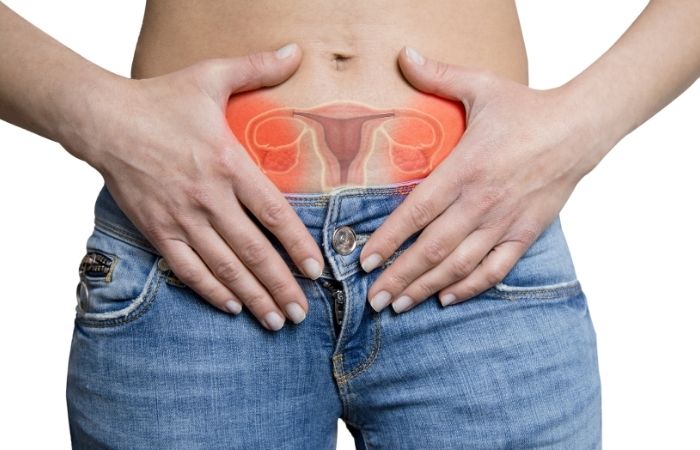
The pelvis is crowded real estate. Muscles, ligaments, intestines, bladder, uterus, and ovaries share the same square inches, which means any one of them can refer pain to a region that feels reproductive.
Ovulation itself can cause a brief sharp mid-cycle pain known as mittelschmerz, usually on whichever side is ovulating that month. Endometriosis, where uterine-lining tissue grows outside the uterus, often produces deep aching pain that worsens around menstruation and improves once a period ends. Urinary tract infections create lower-abdominal pressure that overlaps with classic STD discomfort, usually paired with burning during urination. Even chronic constipation or irritable bowel syndrome can radiate pressure into the pelvic floor in a way that feels gynecologic.
Where in the cycle does the pain appear? Was there recent sexual contact? Is the pain constant, cyclical, or sudden?
- Mittelschmerz: brief, sharp mid-cycle pain on the ovulating side, usually resolving within hours to a day.
- Endometriosis: deep aching pain that worsens before and during menstruation, improves once the period ends.
- Urinary tract infection: lower-abdominal pressure paired with burning, frequency, or urgency on urination.
- IBS or chronic constipation: cramping that follows bowel patterns, eases after a bowel movement, and is not tied to sexual activity.
- Pelvic floor muscle tension: deep internal ache, often worse after long sitting or heavy lifting.
Red Flags: When Pelvic Pain Is an Emergency
Some pain belongs in an emergency department, not a comparison table. Sudden severe pain that doubles a person over, fainting, fever above 101°F, vomiting, or heavy unexplained vaginal bleeding all warrant same-day evaluation. These signs can point to ovarian torsion, a ruptured ectopic pregnancy, severe PID with abscess, or appendicitis presenting as pelvic pain, and each is time-sensitive.
| Symptom | Seek immediate care? | Why it matters |
|---|---|---|
| Sudden severe one-sided pain | Yes | Possible ovarian torsion or significant rupture |
| Fever above 101°F with pelvic pain | Yes | Possible advanced PID or tubo-ovarian abscess |
| Fainting, dizziness, or rapid heartbeat | Yes | Could signal internal bleeding |
| Sharp pain with a positive or possible pregnancy | Yes | Rule out ectopic pregnancy |
| Mild ache without fever | Monitor and test | Often early infection or simple cyst |
The Timeline Tells the Truth
Timing changes the differential. Pelvic pain that begins twelve hours after sex is almost never an STD. Bacterial infections need days to multiply enough to produce symptoms. Pain that arrives within minutes of intercourse is more likely mechanical irritation, deep-penetration soreness, a muscle strain, or a pre-existing cyst reacting to pressure.
Infection pain does not always start with a clear signal, though. It can creep in a week or more later as a dull heaviness, an internal soreness, or a vague sense that something is off. No single dramatic moment, just a quiet shift that gets worse instead of better over a few days.
Cysts often track with the hormonal rhythm. Mid-cycle discomfort that appears near ovulation and fades within a few days is usually benign. A sudden stabbing pain that resolves into soreness across the next day is the pattern of a cyst rupture.
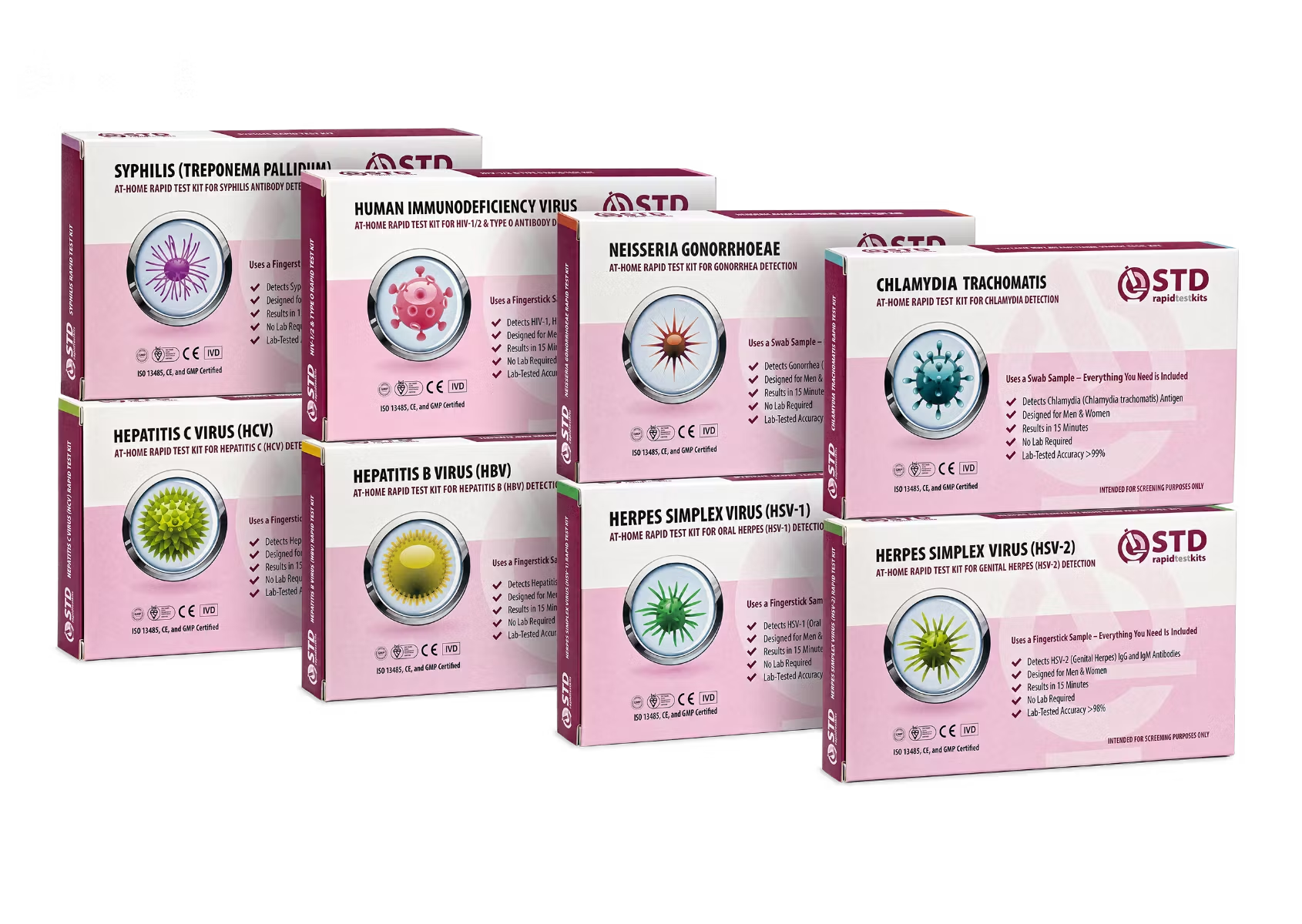
stdrapidtestkits.com sells at-home rapid lateral-flow tests for several of the infections discussed in this article. Product banners appear where a screen is plausibly useful for the reader; testing is not a substitute for clinical evaluation when red flags are present.
When to Test for an STD After Pelvic Pain
If pelvic pain follows a possible exposure, the timing of the test matters as much as the decision to test. Most bacterial STIs become reliably detectable in the second week after exposure. Testing too early can produce a falsely reassuring negative.
The window-period guide below summarizes typical detection ranges. These are general benchmarks, not personal predictions; individual cases vary, and a clinician can advise on retesting if early results were ambiguous.
| Infection | Typical window period | When testing is most reliable | Pelvic pain possible? |
|---|---|---|---|
| Chlamydia | 7–14 days | 14+ days after exposure | Yes, especially if untreated |
| Gonorrhea | 5–14 days | 14+ days after exposure | Yes |
| Trichomoniasis | 5–28 days | 2–4 weeks after exposure | Sometimes |
| Syphilis | 3–6 weeks | 6+ weeks after exposure | Rare in early stages |
How Pelvic Inflammatory Disease Develops
PID does not start dramatically. It begins as an untreated cervical infection, most often chlamydia or gonorrhea. Over days to weeks, bacteria travel upward into the uterus and fallopian tubes, triggering inflammation. That inflammation is what creates the deep aching pelvic pain that is so hard to describe and so easy to dismiss.
The NHS overview of PID lists abnormal vaginal discharge, irregular bleeding, painful intercourse, and lower abdominal pain as the most common signs, with fever appearing in more advanced cases. The same overview notes that early antibiotics are highly effective, while delays raise the risk of scarring, chronic pelvic pain, ectopic pregnancy, and infertility.
The CDC describes the symptom profile in similar terms:
You may not realize you have PID because your symptoms may be mild, or you may not experience any symptoms.
Pelvic Pain Without Discharge: Does That Rule Out an STD?
No. This is one of the most stubborn misconceptions online. Discharge changes can accompany chlamydia and gonorrhea, but they are not required for either infection, and they are particularly unreliable once the infection has moved beyond the cervix.
The absence of discharge should not lower the suspicion for infection if pelvic pain follows a recent sexual exposure. A real infection can present as nothing more than a low ache for days before it announces itself any other way.
The same logic applies to lab markers. A urine NAAT (the standard laboratory test for chlamydia and gonorrhea) can be positive even when the cervix and vagina look completely normal on exam. Visible signs are useful when they appear; their absence is not reassurance.
Around half of chlamydia and gonorrhea cases in women cause no obvious discharge or visible vaginal change at all. If pelvic pain followed an unprotected exposure in the last two to three weeks, the absence of discharge does not lower the probability of infection. Test inside the right window rather than waiting for a more dramatic sign.
At-Home Testing vs Clinic Evaluation
There is a practical split between what at-home tests and clinic evaluations are good at. At-home rapid kits screen for the most common bacterial STIs quickly and privately, with results in roughly 15 minutes. They are well-suited to the scenario where exposure happened in the last two to three weeks, pain is mild, and there are no red flags.
Clinic visits offer something at-home tests cannot: a pelvic exam and same-day imaging. If the pain is severe, persistent, paired with fever, sharply one-sided, or accompanied by abnormal bleeding, ultrasound is the only tool that can rule out a ruptured cyst, torsion, or advanced PID. Lateral-flow rapid tests are screening tools. They cannot replace imaging when imaging is the relevant question.
The right choice depends on the question being asked. "Is there an infection I can screen for in private?" points one way. "Is there something structural happening that needs to be seen on ultrasound?" points the other.

What If STD Tests Are Negative but Pain Persists?
A negative STD test, taken inside the right window, is useful information. It tells you infection is far less likely as the explanation, which narrows the field rather than closing the case. The pain is still real; what changes is where to look for the cause.
Persistent pain after negative testing usually moves the workup toward imaging and cycle history. One-sided pain that comes and goes can point to a cyst that has not yet been seen on ultrasound. Pain that gets dramatically worse before menstruation and improves once a period ends fits the endometriosis pattern described by the Office on Women's Health. Pelvic-floor muscle tension can produce a deep internal ache that mimics gynecologic pain almost exactly. Even chronic constipation will radiate pressure into the lower pelvis in a way that feels reproductive.
Next steps when STD tests are negative
- Pelvic ultrasound to look for cysts, hemorrhagic cysts, fibroids, or structural causes the exam cannot catch.
- Cycle-history review with a clinician to map pain against ovulation and menstruation, which often reveals an endometriosis pattern.
- Pelvic floor assessment by a clinician or pelvic-floor physical therapist when deep internal ache lingers without a structural finding.
- Gastrointestinal review for IBS, chronic constipation, or other bowel causes that radiate pressure into the pelvis.
- Repeat STD testing only if the first test was taken before the window closed, or if a new exposure has occurred.
Retesting and Partner Considerations
If chlamydia or gonorrhea testing comes back positive, the CDC recommends retesting approximately three months after treatment to make sure reinfection has not happened. The reason is not treatment failure, which is rare for the standard antibiotics. The reason is partner dynamics: a treated person can be reinfected by a partner who was never retested or never treated.
Partner notification can feel heavy. Framed correctly, it is care, not confession. The faster a partner tests, the faster everyone is clear and the cycle of reinfection stops. Most clinics and at-home services support anonymous partner-notification options if a direct conversation is not safe or comfortable.
If pain resolves after treatment, that is a strong signal that infection was the driver. If pain continues despite negative repeat testing and completed antibiotics, the workup needs to broaden, sometimes to include ultrasound, hormonal evaluation, or referral to a pelvic-pain specialist.
You Deserve Clarity, Not Guesswork
Pelvic pain feels intimate because it is. It lives in a part of the body tied to sex, fertility, and identity, and that is why it triggers fear so quickly. Fear is understandable, but a test result or an imaging report will answer the question faster than any amount of searching online.
If the pain is sudden and severe, especially with fever, fainting, or heavy bleeding, urgent care is the right call, not Google. If sex happened in the last two to three weeks and pain is mild but new, testing inside the right window is the productive next move. If pain tracks with the cycle and stays one-sided, an ultrasound usually settles the cyst question.
FAQs
- I have pelvic pain but no discharge. Could it still be an STD?
- Yes. Discharge is common with some infections, but it is not required for chlamydia, gonorrhea, or early pelvic inflammatory disease. A meaningful share of cases produce no visible vaginal symptoms at all. If the pain followed a sexual exposure, testing is the right move regardless of how the discharge looks.
- The pain started the same day I had sex. Could it still be an STD?
- Almost certainly not. Bacterial STIs need days to incubate before they cause symptoms. Pain within minutes or hours of intercourse usually points to friction, deep-penetration soreness, muscle tension, or a pre-existing cyst reacting to pressure. Infection-related pain typically appears about a week later, sometimes longer.
- What does PID actually feel like in real life?
- Less dramatic than people expect. It is most often a deep, stubborn ache rather than a sharp spike. Sex can feel tender in a way it did not before. Spotting or low-grade fever can show up. Some describe it as pressure behind the pubic bone. It builds across days and lingers, rather than stabbing and disappearing.
- If the pain is only on my left side, does that mean it is a cyst?
- One-sided pain leans toward a cyst because the ovaries sit on either side of the uterus, but it is not a guarantee. Infection can irritate one fallopian tube more than the other, and conditions like endometriosis can also produce localized pain. The safest framing: one-sided pain raises the cyst probability, and STD testing rules out infection when there is any exposure risk.
- Can anxiety actually make pelvic pain feel worse?
- Yes. When the nervous system is on high alert, normal sensations get amplified. Ovulation twinges feel louder, gas pressure feels suspicious, and any new ache pulls attention immediately. That amplification is a real perception loop, which means the ache is a real signal being turned up by stress rather than an invented one. Concrete information (a test result, an imaging result) usually quiets it faster than reassurance does.
- How do I know if this is an emergency?
- Severe sudden pain, especially with fever above 101°F, fainting, vomiting, or heavy unexplained bleeding, belongs in an emergency department. Ovarian torsion, ruptured cyst with bleeding, and ectopic pregnancy all need same-day evaluation. A mild ache that lets daily life continue normally is usually a test-and-monitor situation, not a 911 call.
- My STD test was negative but the pain is still there. Now what?
- That is real progress. A negative result inside the correct testing window makes infection much less likely. The next step is usually ultrasound to check for cysts or structural causes, plus a conversation about cycle timing if the pain looks cyclical. Diagnosis is often a process of elimination rather than a single dramatic reveal.
- Could a ruptured ovarian cyst feel like something tore inside?
- The lightning-bolt description is common and accurate. Many ruptures resolve on their own across a few days as the body reabsorbs the released fluid. The exceptions, which include heavy internal bleeding and ovarian torsion, are serious. If the pain is unbearable, paired with dizziness, weakness, or rapid heartbeat, urgent imaging is the right call.
How we sourced this article. This guide draws on current public-health guidance from the U.S. Centers for Disease Control and Prevention, the U.K. National Health Service, the World Health Organization, the Office on Women's Health, and Mayo Clinic, with attention to clinical specifics around pelvic inflammatory disease, ovarian cysts, STI window periods, and the differential diagnosis of lower abdominal pain. Editorial framing avoids first-person clinical anecdotes, prioritizes plain-English translation of the underlying guidance, and is reviewed for clinical accuracy before publication.
- U.S. Centers for Disease Control and Prevention: Pelvic Inflammatory Disease (PID) fact sheet, covering symptoms, complications, and the link to untreated chlamydia and gonorrhea.
- U.S. Centers for Disease Control and Prevention: Chlamydia fact sheet, including the high rate of asymptomatic infection and the case for screening rather than waiting for symptoms.
- Mayo Clinic: Ovarian cysts symptoms and causes page, including cyst types, rupture, and complications such as ovarian torsion.
- U.K. National Health Service: Pelvic inflammatory disease overview, covering common signs, antibiotic treatment, and the importance of early care.
- Office on Women's Health, U.S. Department of Health and Human Services: Endometriosis topic page, including the typical cyclical pain pattern.
- World Health Organization: Sexually transmitted infections (STIs) fact sheet, providing global context on prevalence and screening recommendations.
