
Published: November 2025 | Last updated: May 2026 | Editorial review and quality control: Martina N.
The assumption is reasonable: no discharge, no sores, no rash, so it cannot be an STI. Genital and pelvic pain often get blamed on a urinary-tract infection, dehydration, tight clothing, or stress. The reasoning feels logical. It is also wrong often enough to matter clinically.
Several common sexually transmitted infections can cause real pain without producing visible discharge. Chlamydia, gonorrhea, herpes, and trichomoniasis all have presentations where the only warning signs are internal: burning during urination, deep pelvic ache, testicular soreness, nerve tingling, pain during sex. The discharge people expect may show up later, may show up only sometimes, or may never show up at all in a particular case.
This guide walks through which STIs commonly present with pain alone, how to tell that pain apart from a urinary-tract infection or a non-infectious cause, what testing looks like at each window period, and when the discomfort is reason enough to act even if nothing else seems wrong.
Key Takeaways
- Several common STIs (chlamydia, gonorrhea, herpes, trichomoniasis) can cause genital, pelvic, or urethral pain without producing visible discharge.
- If pain has lasted more than a few days, returned after a UTI antibiotic course, or appeared after a new sexual encounter, testing is reasonable regardless of what you do or do not see.
When Pain Is the Only Warning Sign
Silent and minimally-symptomatic infections are the rule rather than the exception in sexually transmitted disease. The CDC's chlamydia page notes that chlamydia often has no symptoms, and the same pattern of frequent silence shows up in cervical gonorrhea. When symptoms do appear, they often start subtly: a faint burn during urination, an aching pressure in the lower pelvis, soreness during or after sex.
Pain alone, without discharge, lesions, or sores, is the under-recognized face of these infections. People expect drama. They get a slow, low-grade discomfort that is easy to attribute to dehydration, a hard workout, a tight pair of jeans, or general anxiety. The infection meanwhile continues, and so does the transmission risk.
Why does this matter clinically? Untreated chlamydia and gonorrhea can ascend the reproductive tract and cause pelvic inflammatory disease, epididymitis, and ultimately infertility. Untreated herpes infections continue to shed virus during periods when the carrier feels nothing, or feels only a vague nerve tingle. Untreated trichomoniasis roughly doubles the likelihood of acquiring HIV during a subsequent exposure, because the inflammation it causes in the genital lining makes the mucosa easier for the virus to penetrate. Treating trichomoniasis before any HIV-risk exposure is one of the more direct risk reductions available, and none of these progressions require visible discharge to occur.
- Chlamydia and gonorrhea can ascend to the upper reproductive tract and cause pelvic inflammatory disease (women) or epididymitis (men), with infertility as a long-term consequence.
- Herpes sheds virus during asymptomatic periods, so an unsuspecting carrier can transmit even when nothing is visible.
- Trichomoniasis roughly doubles HIV-acquisition risk on a subsequent exposure, because of inflammation it causes in the genital mucosa.
The STIs Most Likely to Cause Pain Without Discharge
Each common STI has a textbook presentation and a real-world presentation that often diverge. Here is how the major pain-without-discharge culprits actually behave, and why they are easy to miss when discharge does not announce them.
Chlamydia is the most-reported bacterial STI in the United States, and its hallmark feature is silence. When chlamydia does produce symptoms in women, the pain often shows up as deep pelvic ache, dyspareunia (pain during sex), or post-coital spotting that looks unrelated to a cycle. Men with chlamydia may notice mild urethral burning during urination, a testicular ache, or epididymal tenderness. Discharge, when it does appear, is often clear, thin, and easy to miss.
Gonorrhea is louder than chlamydia on average, but the loudness varies dramatically by anatomy. Men with urethral gonorrhea typically develop thick yellow-green discharge within days, but a meaningful subset experience only urethral burning and never see discharge at all. Women with cervical gonorrhea are frequently asymptomatic; when something is felt, it is more often described as deep pelvic soreness or pain on intercourse than visible discharge.
Herpes (HSV-1 and HSV-2) is the single most frequent cause of genital pain without discharge. The hallmark vesicles can be tiny, located internally where the carrier never sees them, or absent entirely during the prodrome phase that precedes an outbreak. Many people with herpes describe burning, tingling, or sharp nerve-like pain in the genitals, inner thighs, or lower back as their only symptom for days or longer. The CDC's genital-herpes page confirms that herpes can cause symptoms even when no visible sore is present.
Trichomoniasis traditionally presents with a frothy yellow-green vaginal discharge, but a substantial share of infected women have minimal or no discharge, only itching, vulvar irritation, and pain during intercourse or urination. In men, trichomoniasis is most often asymptomatic but can cause urethral irritation that feels like a UTI without growing any bacteria on culture per the CDC trichomoniasis page.
| STI | Type of Pain | Discharge Common? | Other Clues |
|---|---|---|---|
| Chlamydia | Pelvic pain, testicular ache, painful sex | Not always | Spotting between periods, mild burning when urinating |
| Herpes (HSV-1 / HSV-2) | Tingling, burning, nerve-like shooting pain | Usually no discharge unless lesions are present | Pain may appear before any visible blister (prodrome) |
| Gonorrhea | Urethral burning, pelvic pressure | Often in men, not always in women | Can mimic a UTI or be entirely silent |
| Trichomoniasis | Vaginal or penile irritation, painful sex | Common in women, often absent in men | Itching, change in vaginal pH |
Pain That Mimics a Urinary-Tract Infection
The single most common scenario for missed STIs in primary care is straightforward: a patient with burning urination, urgency, and pelvic pressure assumes a UTI, takes a course of nitrofurantoin or trimethoprim-sulfamethoxazole, and the symptoms either fail to resolve or come right back two weeks later. By then the actual infection (often chlamydia or gonorrhea) has been festering, with continued transmission risk.
The clinical overlap between UTIs and STIs is real. Both cause dysuria, urgency, and frequency. Urinary-tract infections are vastly more common in women and respond to standard antibiotics within 24 to 48 hours. STIs typically do not respond to UTI antibiotic regimens at all, because the antibiotics chosen for UTIs (which target E. coli and other gram-negatives) are not the right drugs for chlamydia or gonorrhea.
Three signals should redirect suspicion toward an STI:
- Symptoms appeared after a new sexual encounter, especially within one to three weeks.
- A presumed UTI treatment course did not relieve symptoms.
- Symptoms recurred shortly after the antibiotic course finished.
Add to that any nerve-character pain (tingling, electric shocks down the inner thigh, burning across the lower back), which is more characteristic of herpes than of bacterial cystitis. Recurrent dysuria after multiple antibiotic courses with negative urine cultures is another flag, because bacterial cystitis would have grown bacteria. Empty cultures plus persistent symptoms is a pattern that warrants STI testing rather than another antibiotic round.
| Condition | Primary Pain Location | Response to Antibiotics | Likely Cause |
|---|---|---|---|
| UTI | Bladder, urethra | Rapid (24 to 48 hours) | Bacteria, most often E. coli |
| STI (chlamydia, gonorrhea, herpes) | Genitals, pelvis, testicles, sensory nerves | Minimal or none unless treated with the right drug | Sexual transmission |
| Non-infectious cause | Vulvodynia, prostatitis, pelvic-floor muscle pain | Unpredictable | Complex; not necessarily linked to sexual activity |
Can an STI cause pain without any discharge?
Yes. Chlamydia, gonorrhea, herpes, and trichomoniasis all commonly present with genital, pelvic, or urethral pain alone, especially early in infection or in carriers without an active outbreak. If pain has lasted more than a few days, persisted after a UTI antibiotic course, or appeared after a new sexual exposure, testing makes sense even with no visible discharge.
Can You Be Contagious Without Discharge?
Yes. The myth that visible discharge equals infectious is one of the most damaging misunderstandings in STI prevention. Three mechanisms explain why a carrier without discharge can still transmit.
Asymptomatic shedding for herpes. HSV-1 and HSV-2 release infectious virus from the genital, oral, or perianal skin during periods when the carrier has no visible lesions and feels nothing. The CDC's genital-herpes guidance describes asymptomatic shedding on a meaningful share of days even between outbreaks, and notes that this is one of the main reasons the virus continues to spread within established relationships where neither partner has ever seen a sore.
Cervical and urethral colonization for chlamydia and gonorrhea. The bacteria live on the mucosal surfaces of the cervix or urethra and can transfer to a partner's mucosa during contact, even when no fluid is visibly emerging. The pathogen is present whether or not the carrier has produced enough inflammatory exudate to be visibly leaking.
Vaginal-fluid colonization for trichomoniasis. Trichomonas vaginalis lives in normal vaginal secretions and is transferred during contact regardless of whether the carrier reports symptoms. Symptom-based decisions about whether to use a barrier or whether to disclose to a partner are unreliable for the same reason symptom-based decisions about whether to test are unreliable, since invisible signs and an active infection routinely coexist.
Per the <a href="https://www.cdc.gov/trichomoniasis/about/index.html" target="_blank" rel="noopener">CDC's trichomoniasis page</a>, only about 30% of people with trichomoniasis develop any symptoms. The other roughly 70% have no symptoms at all yet remain capable of transmitting the parasite during contact. This is a strong reason to include trichomoniasis in any panel ordered after a new sexual encounter, even when nothing feels obviously wrong.
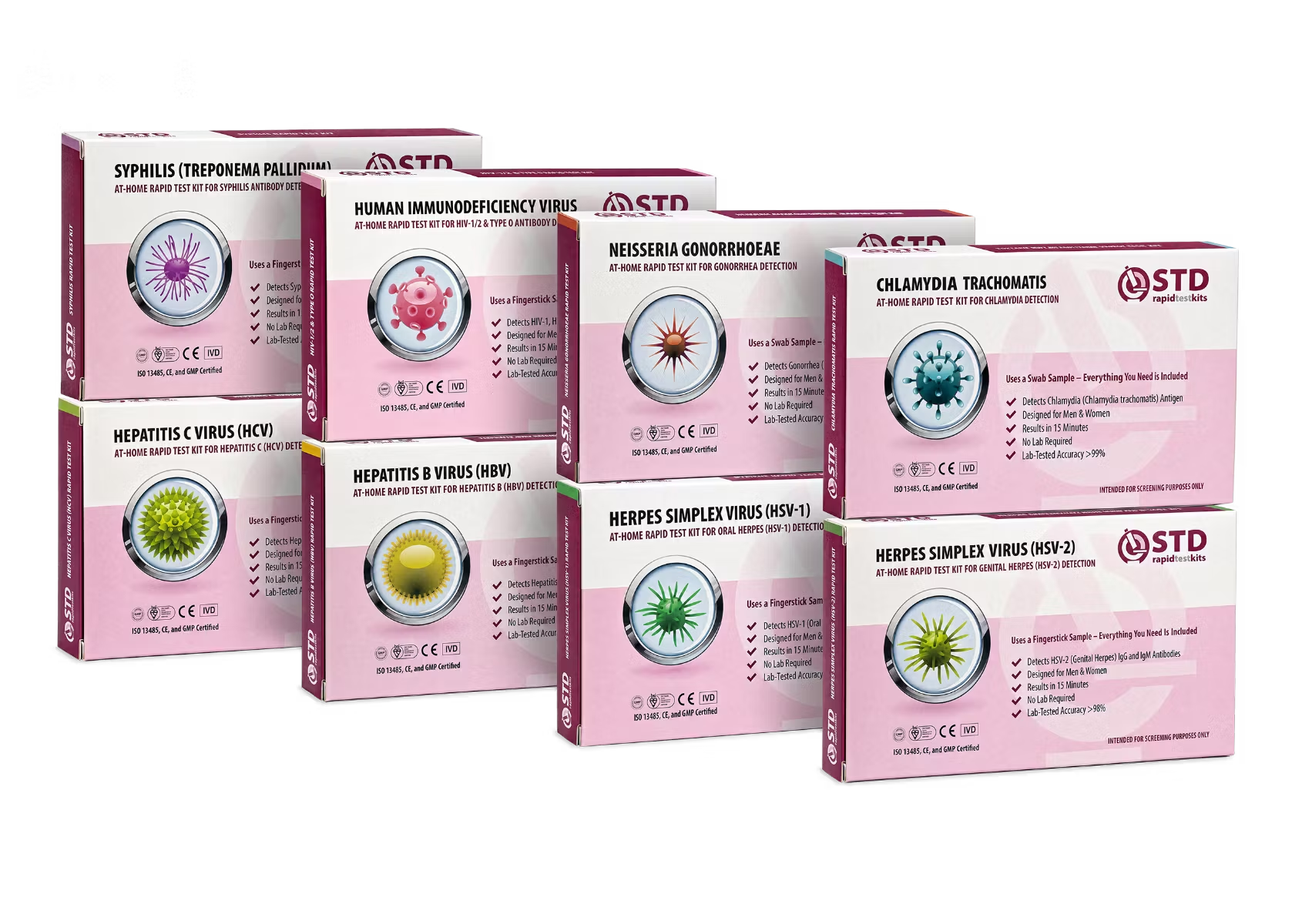
This article is published by stdrapidtestkits.com, which sells at-home STI testing kits. The clinical information above is drawn from CDC and other public-health guidance and is independent of any product recommendation. The kits below are linked because they fit the symptom pattern this article describes, not because the article was written to promote them.
Herpes Prodrome: The Pain Before Anything Visible
Herpes is the STI most likely to cause pain without any discharge, sore, or visible sign. The reason is the prodrome, a period before an outbreak when the virus reactivates inside a sensory nerve and travels back to the skin. During this phase, the nerve itself is irritated. The sensation is often described as electric, buzzing, prickling, or burning across the genitals, buttocks, inner thighs, or lower back. Some carriers feel the prodrome and never develop a visible lesion at all. Others develop a lesion days later that they trace back to the sensation.
Two implications follow for someone with unexplained genital nerve pain. The first concerns diagnosis: many primary-care providers and urgent-care clinics do not consider herpes when the patient has no visible lesion to swab, because the standard diagnostic workflow for herpes is PCR or viral culture of an active lesion. Without a lesion to sample, the conversation often skips to muscle tension or stress.
The second concerns the alternative test. Blood-based herpes tests (IgG type-specific antibody) can confirm whether someone has been infected with HSV-1 or HSV-2 at some point, regardless of whether a current outbreak is visible. This is the test that is informative when the only symptom is recurrent nerve pain. Most type-specific IgG assays reach reliable sensitivity between 12 and 16 weeks after exposure, though some individuals seroconvert earlier.
If recurrent burning, tingling, or shooting pain in the genital area has been dismissed as nothing during multiple visits, asking a provider for a type-specific HSV antibody panel, or running one at home, is reasonable. A negative antibody test 12 weeks or more after the suspected exposure rules out infection from that exposure with reasonable confidence; a positive result moves the conversation toward suppressive therapy and disclosure rather than another round of muscle-relaxant prescriptions.
- Tingling or pins-and-needles around the genitals, buttocks, or inner thighs.
- Sharp electric or shooting pain that follows a nerve path down a leg or across the lower back.
- A localized burning or itching that does not match any visible skin change.
- A vague pulsating ache or pressure in the same spot a previous lesion has appeared.
- Mild flu-like fatigue or low-grade fever combined with any of the above.
Pain During or After Sex: What Is Actually Inflamed
For people with vaginas, deep pain during or after sex (dyspareunia) is one of the most reliable signs that an upper-tract infection may be present. Pelvic inflammatory disease (PID), most often caused by ascending chlamydia or gonorrhea, produces inflammation in the uterus, fallopian tubes, and surrounding tissue. The pain shows up during deep penetration, after sex, or as crampy lower-abdominal soreness independent of intercourse. Per the CDC's PID page, the condition can develop without ever producing emergency-level symptoms, and untreated PID is a leading preventable cause of infertility, ectopic pregnancy, and chronic pelvic pain.
For people with penises, post-coital testicular ache or a dull pain in the scrotum can signal epididymitis, inflammation of the duct that carries sperm from the testicle. Epididymitis in men under age 35 is most often caused by chlamydia or gonorrhea infecting the urethra and ascending into the epididymis. The pain is typically one-sided, builds over hours or days, and may be accompanied by a low-grade fever or scrotal swelling. The condition responds well to the right antibiotic course; the harm comes from delayed treatment.
Either pattern, deep pelvic pain in women or unilateral testicular ache in men, warrants an STI workup that goes beyond a urine dipstick. CDC PID guidance specifically calls for testing for chlamydia and gonorrhea (and ideally trichomoniasis) in any sexually active person presenting with these symptoms, regardless of discharge.
- For PID (women): deep pelvic pain on penetration, lower-abdominal cramping unrelated to a cycle, fever, abnormal bleeding, or pain combined with chills.
- For epididymitis (men): one-sided testicular ache that builds over hours, scrotal swelling, low-grade fever, or testicular pain that does not improve with rest.
- Either pattern: if the pain follows a recent sexual exposure, request testing for chlamydia, gonorrhea, and trichomoniasis at minimum, regardless of whether discharge is present.
What If You Already Tested Negative?
Tests have windows. A negative result from a test taken too soon after exposure is unreliable, because the infection has not yet produced enough antigen, antibody, or detectable nucleic acid to register. Each STI's window is specific to the test technology used, and the at-home rapid tests share most of the same windows as their lab-based counterparts.
If the original test was taken before the recommended window, it does not rule the infection out. A chlamydia swab four days after a single exposure, for instance, is too early; the minimum reliable window for chlamydia testing is around 7 to 14 days. A herpes blood test taken two weeks after exposure is similarly premature, because IgG antibodies can take 12 to 16 weeks to develop reliably. The remedy in either case is to repeat the test at the recommended interval. Any subsequent change in symptom character, such as a bladder-burn feel shifting to nerve-type tingling, is also grounds to retest even after a prior negative, because the new sensation may signal an infection that has progressed since the first sample was collected.
If symptoms persist past 7 to 10 days, especially after an antibiotic course that should have resolved a UTI, retesting at a longer post-exposure interval is the right next step.
| STI | Minimum Test Window | Best Time to Test |
|---|---|---|
| Chlamydia | About 7 days | 14 days after exposure |
| Gonorrhea | 6 to 7 days | 14 days after exposure |
| Herpes (IgG blood test) | 3 to 6 weeks | 12 to 16 weeks for maximum sensitivity |
| Trichomoniasis | 5 to 7 days | 10 to 14 days after exposure |
Many STIs have no symptoms or may only cause mild symptoms, so people can have an infection but not know it.
The Quiet Cost of Unexplained Symptoms
There is a separate harm from this category of pain that does not show up in any clinical guideline: the mental cost of not knowing. Pain that nobody else can see, that has no obvious explanation, and that does not respond to the first treatment people reach for is exhausting. Every twinge becomes a question. Every search result raises a different possibility. The internal narrative tends to oscillate between catastrophizing and dismissing, neither of which produces an answer.
What helps, practically, is converting an open question into a definite test result. A negative result on the right test, taken at the right window, is genuinely reassuring. A positive result, while harder, opens a clear treatment path: most bacterial STIs are cured with a single antibiotic course, and viral STIs are managed with antivirals that significantly reduce symptoms and transmission risk.

How At-Home Testing Actually Works
For someone whose only symptom is pain, a quiet, ambiguous, second-guessable symptom, at-home testing removes friction. There is no clinic visit, no questions about partners or activities, and no waiting for an appointment to resolve a question that has been sitting in the background for weeks.
The swab-based tests (chlamydia, gonorrhea, trichomoniasis, HPV) involve a self-collected vaginal or penile swab, applied to a buffer-loaded cassette, and read like a pregnancy test in 15 to 20 minutes. The blood-based tests (HIV, syphilis, hepatitis B, hepatitis C, HSV-1, HSV-2) use a fingerstick lancet to collect a small drop of blood, applied similarly to a cassette, and read in the same time window.
Combination kits cover multiple infections in a single shipment. The 6-in-1 and 8-in-1 kits screen for the most common bacterial and viral STIs in one go, which is the right call when the symptom is non-specific (pain that could be any of three or four causes) and when waiting for sequential single tests would delay clarity.
One important caveat about the technology: at-home rapid tests are lateral-flow immunoassays, not lab-grade nucleic acid amplification tests (NAAT). Lab NAAT remains the most sensitive option for chlamydia and gonorrhea, and a positive at-home result should be confirmed by a clinician's NAAT or culture before treatment. The at-home kit is best understood as a fast, private screening tool that drives the next clinical decision, not a final answer.
Lateral-flow rapid tests use the same swab or blood sample type as a lab, but a different chemistry. They are fast (results in 15 to 20 minutes), private, and useful for screening at home. Lab NAAT amplifies tiny fragments of bacterial or viral DNA and detects infections at lower concentrations, which makes it the most sensitive option for chlamydia and gonorrhea in particular. The two are complementary: a positive at-home rapid result is a strong reason to seek a confirmatory NAAT, which then guides the antibiotic prescription.
When Testing Makes Sense: A Practical Threshold
The clearest indicators for testing when pain is the only symptom:
- Pain has lasted more than three to five days without an obvious explanation (workout strain, recent dehydration, recent gynecological exam).
- Pain appeared in the days or weeks following a new sexual encounter.
- A presumed UTI did not resolve with appropriate antibiotic treatment.
- The pain has nerve characteristics: tingling, electric shocks, or burning across an area larger than the bladder.
- The pain is positional or activity-linked: worse during or after sex, worse with cycling, worse with prolonged sitting.
- A previous STI test was taken before the recommended window after exposure.
Routine testing after a new partner is also reasonable regardless of symptoms. CDC guidance recommends annual STI screening for sexually active women under age 25 and for men who have sex with men, plus per-exposure testing for higher-risk encounters.
The cost-benefit calculation is one-sided. Untreated chlamydia or gonorrhea ascending to the upper tract has long-term reproductive consequences. Untreated herpes continues to shed and transmit. Untreated trichomoniasis multiplies HIV-acquisition risk on subsequent exposures. The downside of an unnecessary test is small and brief; the downside of a missed infection compounds over months.
FAQs
- Can I have an STI even if I do not see any discharge?
- Yes. Chlamydia, gonorrhea, herpes, and trichomoniasis all commonly present without visible discharge, especially early in infection. The pain or burning may be the only sign for days or longer, and the absence of discharge does not rule the infection out.
- It burns when I urinate but nothing else looks wrong. Is it a UTI or an STI?
- It can be either. UTIs respond to standard antibiotics within 24 to 48 hours; STIs typically do not. If the burning followed a new sexual encounter, did not resolve with a UTI antibiotic course, or returned shortly after the course ended, an STI is more likely and an STI-specific test is the next step.
- I feel tingling or shooting pain in the genital area but I do not see any sores. Could it still be herpes?
- Yes. The herpes prodrome causes nerve-character pain (tingling, burning, electric shocks) before any visible lesion appears, and some carriers experience prodrome without ever developing a visible sore. An IgG type-specific HSV antibody blood test taken 12 to 16 weeks after suspected exposure can confirm or rule out infection in this scenario.
- How do I tell a UTI from an STI when the symptoms feel similar?
- Three clues point toward an STI rather than a UTI: symptoms appeared after a new sexual encounter, a UTI antibiotic course did not relieve symptoms, or symptoms returned shortly after the course ended. Nerve-character pain (tingling or shocks rather than just bladder burning) also points away from a simple UTI.
- I tested negative last week but I still feel something. What should I do?
- Check whether the test was taken inside the recommended window for that infection. Most chlamydia and gonorrhea tests need at least 7 to 14 days after exposure to be reliable; herpes IgG antibody tests need 12 to 16 weeks. If the original test was taken too early, retest at the recommended window. If the original test was at the right window but symptoms have changed in character, retest as well.
- Do I need to have visible discharge for an at-home STI test to work?
- No. At-home swab tests use the swab itself as the sample (the swab carries cells from the cervical or urethral surface, with or without obvious discharge). Blood-based tests use a fingerstick drop. The accuracy of either format does not depend on whether you have visible discharge at the moment of sample collection.
- Could my partner have given me an STI without knowing they had one?
- Yes, and this is the most common transmission scenario. Most people with chlamydia, gonorrhea, herpes, or trichomoniasis are unaware they are infected because their own symptoms were silent or mild. Partner notification and routine testing in established relationships exist precisely because symptom-based awareness is unreliable.
- When does pain by itself justify testing rather than waiting it out?
- Pain that has lasted more than three to five days, pain that followed a new sexual encounter, pain that did not respond to UTI antibiotic treatment, nerve-character pain in the genital area, and pain that is worse during or after sex are all reasonable thresholds for testing. Clinically the math is simple: a false-alarm test costs a few minutes and a lancet, while an undetected chlamydia or gonorrhea infection can progress to pelvic inflammatory disease or epididymitis over the same period.
- U.S. Centers for Disease Control and Prevention. About sexually transmitted infections, including frequency of asymptomatic infection.
- U.S. Centers for Disease Control and Prevention. About chlamydia, including the high rate of asymptomatic infection.
- U.S. Centers for Disease Control and Prevention. About gonorrhea, including the variable presentation of urethral and cervical infection.
- U.S. Centers for Disease Control and Prevention. About genital herpes, including asymptomatic shedding and prodrome.
- U.S. Centers for Disease Control and Prevention. About trichomoniasis, including its frequent asymptomatic presentation.
- U.S. Centers for Disease Control and Prevention. About pelvic inflammatory disease, including its causes and long-term consequences.
