Can Women Get Herpes From Other Women? Risks for WSW Explained
What lesbians and queer women aren't told about herpes risk.




- Herpes (HSV-1 and HSV-2) spreads between women through oral sex, shared sex toys, fingers, and skin-to-skin contact, with no penetration or male partner required.
- Standard STI panels do not include herpes; women who have sex with women have to specifically request type-specific HSV-1 and HSV-2 IgG blood testing.
Published: August 2025 | Last updated: May 2026 | Editorial review and quality control: Martina N.
The story most people grow up hearing about sexually transmitted infections leaves women who have sex with women almost entirely out of the picture. Sex ed focused on pregnancy and male partners. Doctors stopped asking once they heard the word lesbian. Clinic posters showed straight couples. The takeaway, absorbed by millions of queer women over decades, was simple and wrong: two women together are low risk. Herpes does not read the room. It transmits through skin, mucosa, and saliva, regardless of who is involved or what acts they share. This guide walks through how herpes actually spreads between women, why so many cases go unnoticed, and what informed care, testing, and partner conversations look like.
Key Takeaways
- Herpes (HSV-1 and HSV-2) spreads between women through oral sex, shared sex toys, fingers, and skin-to-skin contact, with no penetration or male partner required.
- Standard STI panels do not include herpes; women who have sex with women have to specifically request type-specific HSV-1 and HSV-2 IgG blood testing.
"But We're Both Women, Isn't That Safe?"
This assumption is everywhere: in friend groups, in some clinics, and in the outdated sex education most adults received. The belief that lesbian or queer women cannot acquire or transmit sexually transmitted infections is one of the most stubborn myths in sexual health, and it has real consequences.
The reasoning behind the myth treats penises and ejaculation as the only vectors that matter. Herpes does not care about that framing. HSV-1 and HSV-2 spread through direct contact between skin, mucous membranes, and saliva. Lips, vulvas, mouths, hands, and the soft tissue inside the body all qualify. If a sexual encounter involves any of those surfaces meeting any of those surfaces, transmission is biologically possible.
NHANES data shows measurable HSV-2 seroprevalence (the proportion of people who test positive for HSV antibodies in their blood) among women who report sex exclusively with women, lower than rates seen in heterosexual women but not zero, confirming that same-sex transmission does occur (Xu et al., 2010). The CDC's STI treatment guidelines for women who have sex with women (WSW) make the same point: orientation alone does not lower risk, and clinicians should not assume it does (CDC, 2021 STI Treatment Guidelines).
Women who have sex with women are at risk for STIs from current and prior partners, both male and female. WSW should not be presumed to be at low or no risk for STIs based on sexual orientation.
Where Herpes Hides: Oral, Genital, and Everywhere In Between
HSV-1 classically lives in the orofacial nerve roots and presents as cold sores on or near the lips. HSV-2 classically prefers the sacral nerves and causes genital outbreaks. The classical pattern is not the only pattern. Either virus can infect either location, and HSV-1 in particular is increasingly a cause of new genital herpes cases, especially among younger adults whose first sexual encounters often involve oral sex (CDC STI Treatment Guidelines: Genital Herpes).
Practically, that means several things between women:
- A partner with a cold sore (oral HSV-1) can transmit it to the genitals during cunnilingus.
- A partner with genital HSV-1 or HSV-2 can transmit it to a giving partner's mouth during oral sex.
- Hands can carry virus from one mucosal surface to another during the same session.
Sharing toys, fingers, and oral contact without barriers is part of how many women have sex. That intimacy is also exposure. Crucially, herpes does not require a visible sore to spread; asymptomatic viral shedding from apparently healthy skin and mucosa accounts for a substantial share of transmissions (CDC herpes).

Sex Without Penetration Still Spreads Herpes
One of the most damaging assumptions in queer sex education is that anything short of penetrative intercourse is risk-free. Herpes spread does not depend on penetration. It depends on contact between virus-containing fluid or skin and a susceptible mucous membrane or break in the skin. Several common encounters between women carry meaningful risk:
- Oral sex (cunnilingus): Especially when one partner has active or asymptomatic HSV-1 in or around the mouth, or HSV-2 genitally.
- Shared sex toys: Particularly when toys move between partners without a fresh condom or proper cleaning. HSV can survive briefly on porous and non-porous surfaces.
- Hand-to-genital contact: If a hand contacts an area of viral shedding and then a mucous membrane, transmission is possible. Active sores raise the risk further.
- Kissing during an oral outbreak: Saliva and lesion fluid carry HSV. Even brief lip contact during a flare is a clear transmission route.
Queer sex is not biologically immune. It is simply under-discussed. When the risks are not named, barrier use feels optional, and information gaps quietly become transmission events.
Dental dams (single-use latex squares) or a condom cut open and laid flat both work for cunnilingus and oral-anal contact. For shared toys, replace the condom on the toy before it changes partners. For hand-to-genital contact during a known outbreak, a fresh nitrile or latex glove reduces transferred virus and is easy to swap mid-session.
How Herpes Shows Up in Women, and Why It Gets Missed
Herpes does not always look like the textbook picture of clustered fluid-filled blisters on a clean background. In women, especially during a first outbreak that is mild rather than severe, the presentation can look like:
- Itching, tingling, or burning on the vulva, perineum, or buttocks.
- Small cuts, fissures, or red spots easily mistaken for shaving irritation or chafing.
- Localized redness, swelling, or painful urination caused by the urine touching tender skin.
- Mild systemic symptoms in a first outbreak: body aches, low fever, and swollen groin lymph nodes.
Many women never get a clear flag-the-textbook outbreak. A first episode can be severe, or it can pass for an allergic reaction, a yeast infection, or a reaction to a new soap, detergent, or pair of tight jeans. Recurrences are usually milder than the first episode, sometimes so subtle that the person never notices.
Because most clinics will not test for HSV unless asked, and because routine swab tests are only useful when an active lesion is present, a quiet first outbreak often goes undiagnosed. The person remains contagious during periodic asymptomatic shedding and may unknowingly transmit to partners for years before any clinical confirmation.
A herpes first outbreak in women is often diagnosed as one of these conditions before HSV is even considered:
- Razor burn or ingrown hairs on the labia or bikini line.
- Recurrent yeast infection that does not respond to antifungals.
- Urinary tract infection because urination stings (the sting is from urine on a lesion, not from the bladder).
- Contact allergy to soap, lubricant, or laundry detergent.
- "Friction" or a small cut from new sexual activity.
A symptom that does not resolve in five to seven days with the usual self-care for the suspected cause is worth a clinical visit and a request for HSV swab testing while the lesion is still present.
Why Testing Isn't Routine, Especially for Queer Women
The mainstream STI panel offered by most providers checks for chlamydia, gonorrhea, syphilis, HIV, and sometimes hepatitis. Herpes is not included by default, and the CDC explicitly does not recommend population-level routine HSV serology screening for asymptomatic adults. The agency does support testing for people with symptoms, partners of people with herpes, and those who specifically request it after a discussion of pros and cons (CDC STI Treatment Guidelines: Genital Herpes).
For women who have sex with women, that policy interacts with a long pattern of clinician assumptions. Providers often presume low risk, skip the conversation, and never order a herpes test even when the patient asks for a full check. Surveys of WSW consistently report being told they do not need certain screenings, having their sexual histories minimized, or being asked irrelevant questions about contraception instead of relevant ones about sexual practices.
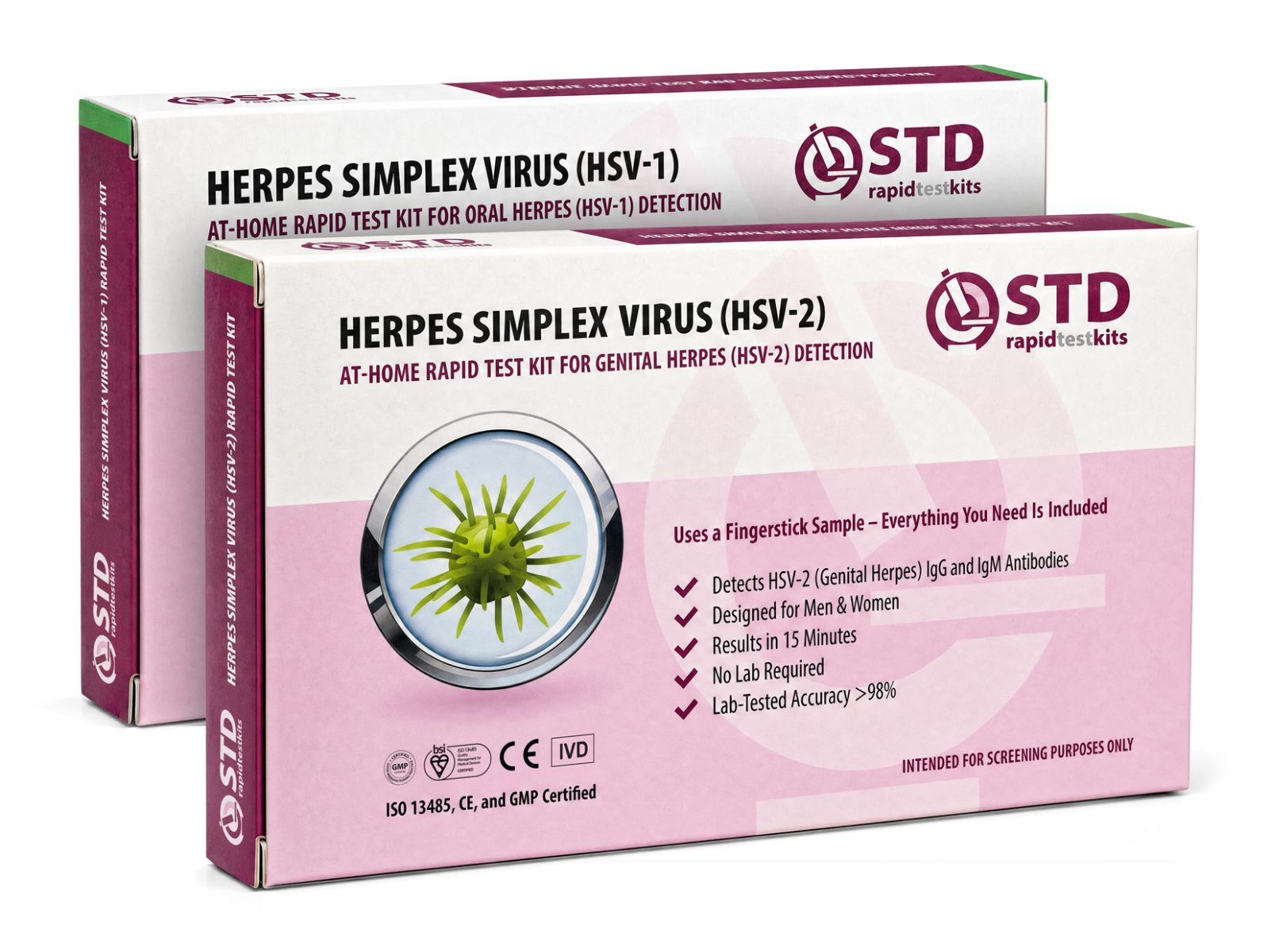
The practical workaround is specific language. Asking a provider for type-specific HSV-1 and HSV-2 IgG serology (a blood test that detects antibodies your immune system has built against HSV) gives them a precise order to write. For people who would rather skip the conversation entirely, a private at-home test sidesteps the gatekeeping. We offer rapid at-home fingerstick blood tests for both HSV-1 and HSV-2 if you would prefer to skip the clinical conversation entirely.
Talking to a Partner: Honesty Doesn't Kill Desire
Disclosure conversations are not easy. They are also not the end of intimacy, and they are not as catastrophic as anticipatory anxiety makes them feel. A workable opening can be calm and short:
- "I want to share something about my sexual health before we go further."
- "I've tested positive for HSV-1. I don't have symptoms right now. Here's what that means and how we can think about safety together."
- "I want to give you space to ask questions and decide what feels right."
A few practical points that often help in queer-to-queer disclosure conversations:
- Lead with the basic fact, not with apology. Apologizing frames herpes as moral failure rather than common viral infection.
- Bring information. Most people who react badly are reacting from misinformation. Knowing the difference between HSV-1 and HSV-2, what suppressive therapy can and cannot do, and how transmission risk changes with barrier use shifts the conversation from fear to logistics.
- Treat the partner's processing time as separate from the disclosure itself. A pause is not rejection.
A partner who responds to disclosure with curiosity rather than judgment is showing exactly the kind of behavior that makes any relationship safer: the capacity to absorb information without weaponizing it.

Managing Outbreaks Without Panic or Shame
The first outbreak is typically the most uncomfortable. Subsequent episodes are usually milder, shorter, and sometimes absent for years at a stretch. A few principles help most people:
- Start antivirals at the first prodromal symptom: tingling, burning, or itching at the usual site. Episodic treatment with valacyclovir, famciclovir, or acyclovir is most effective when started in that early window.
- Keep the area clean, dry, and unirritated. Loose breathable underwear, cool compresses, and over-the-counter pain relief manage the surface discomfort.
- Avoid sexual contact involving the affected area until lesions have fully crusted and healed. Barriers do not fully prevent transmission during an active outbreak; abstaining from contact with the affected site is the safest choice during a flare.
The emotional weight of a diagnosis is real and tends to ease over weeks to months as the practical reality (manageable virus, mostly mild recurrences, full life intact) replaces the early shock. Support groups and a therapist familiar with chronic-but-mild infections can help in the early adjustment period.
Triggers vary by person but the most consistently reported ones across the clinical literature are:
- High or sustained stress.
- Acute illness or fever.
- Sleep deprivation.
- Sun exposure (specifically for oral HSV-1 cold sores on the lip).
- Hormonal shifts around menstruation.
- Friction at the usual outbreak site (tight clothing, prolonged sex without lubrication).
Logging triggers over your first three to four outbreaks usually surfaces your personal pattern, which then makes prevention much more targeted.
Protecting Future Partners Without Losing Pleasure
Safer sex with a herpes-positive partner is a layered approach, not a single tool:
- Barriers during oral sex: Dental dams or cut condoms reduce skin-to-skin and saliva-to-mucosa contact. Coverage is partial because herpes can be shed from skin adjacent to the barrier.
- Toy hygiene: Cover shared toys with a fresh condom for each partner, or do not share toys during one session. Wash silicone, glass, and metal toys with hot water and soap between uses.
- Daily suppressive antivirals: Daily valacyclovir significantly reduces the rate of HSV-2 transmission for serodiscordant couples (one partner tests positive for HSV, the other does not), alongside reductions in viral shedding (CDC STI Treatment Guidelines: Genital Herpes). It is most useful for committed serodiscordant couples.
- Prodrome awareness: Avoid contact with the affected area at the first sign of an outbreak, even before visible lesions appear.
Protection is not the same as fear. Couples build sustainable sex lives around herpes all the time.
Stigma in Queer Spaces, and Why It Stays Hidden
Queer communities have spent decades pushing back against external narratives that frame same-sex sex as dirty or dangerous. One side effect of that work is a quiet reluctance inside the community to talk openly about STIs, especially common ones like herpes, because doing so feels like handing ammunition to those external narratives.
That silence has a cost. Women who get a herpes diagnosis often describe feeling more isolated than the diagnosis warrants, partly because the queer-positive content they consume rarely mentions herpes at all. The emotional weight piles up: stigma about being queer, stigma about having an STI, stigma about not having known better. None of those weights are deserved.
The corrective is unglamorous: more honest community conversations, more matter-of-fact mentions of HSV in queer health resources, and more visibility of people who are living full sexual lives with herpes.
The first two weeks after a diagnosis are usually the hardest. A few things help:
- Tell one trusted person before telling a partner. Practising the words out loud once removes most of the catch in your voice.
- Read one accurate source (CDC, NHS, Planned Parenthood) and then close the browser. Spiral-scrolling forums in the first week is rarely useful.
- If you are partnered, frame the conversation as joint problem-solving rather than confession.
- The American Sexual Health Association runs anonymous online support groups specifically for HSV-positive adults.
When Medical Providers Don't Take You Seriously
The clinical literature is clear that WSW receive less comprehensive sexual health screening than their straight peers, partly because clinicians ask fewer relevant questions and partly because patients learn to expect dismissive responses (CDC WSW guidelines). Common patterns include being told a particular test is unnecessary, being asked irrelevant questions about pregnancy prevention, or having symptoms attributed to non-STI causes without the workup that would distinguish them.
A few practical strategies help close the gap:
- Be specific about the test you want: "type-specific HSV-1 and HSV-2 IgG serology" beats "the herpes test."
- Describe sexual practices, not orientation: "I have oral sex with a partner who has cold sores" gives a clinician a concrete risk to address, while "I'm a lesbian" too often triggers a low-risk assumption.
- Ask for documentation in the chart when a clinician declines a test you requested. The act of writing it down often changes the answer.
- If a provider repeatedly minimizes your concerns, switching to a clinic with experience in LGBTQ+ sexual health is a reasonable choice.
Self-advocacy is not a substitute for better training of clinicians; it is the short-term workaround that lets individual care happen while the system catches up.
Dating After a Herpes Diagnosis: What Changes and What Doesn't
Dating after a herpes diagnosis includes one new conversation. The rest of the dating experience (chemistry, compatibility, building a relationship) continues largely unchanged. The shape of an honest disclosure conversation is described above; the lived reality is that most prospective partners receive the information and continue dating, particularly when the disclosure is calm and informed.
What does shift is the implicit screening: a herpes-positive person learns quickly which partners can hold complex sexual-health information without judgment and which cannot. The first category becomes the dating pool. The second category was never going to be a good fit anyway.
A diagnosis does not subtract from sexual desirability, and it does not require performing extra cheerfulness about it. It does require some new logistics: barrier use, suppressive medication if chosen, and pauses during outbreaks. Those logistics fit inside an ordinary sex life rather than dominating it.
Frequently Asked Questions
- Can women give each other herpes?
- Yes. Herpes spreads through contact between skin, mucous membranes, and saliva. Cunnilingus, shared sex toys, hand-to-genital contact, and kissing during an oral outbreak are all routes that work between female partners. NHANES data and the CDC's STI treatment guidelines both confirm that women who have sex with women acquire HSV at meaningful rates.
- Do herpes symptoms look different in women?
- They often look milder or atypical, which is one reason they get missed. Many women have a first episode that feels like razor burn, a yeast infection, or a reaction to friction or new soap. Genital lesions can sit on the labia, perineum, vaginal opening, or inside the vagina where they are not visible. A mild first outbreak followed by years of asymptomatic shedding is common.
- Do regular STI tests include herpes?
- No. The standard panel offered by most clinics tests for chlamydia, gonorrhea, syphilis, and HIV. The CDC does not recommend routine population-level HSV serology for asymptomatic adults but does support testing on request. To get checked, ask specifically for type-specific HSV-1 and HSV-2 IgG blood testing. Private at-home testing skips the need to negotiate that conversation with a provider.
- Can I get herpes from a partner with no symptoms?
- Yes. Asymptomatic viral shedding is well documented and accounts for a substantial share of new transmissions. The infected partner may have no current sores, no historical sores they noticed, and no awareness of being contagious. Daily suppressive antiviral therapy reduces shedding but does not eliminate it.
- Does daily suppressive antiviral therapy actually work?
- Yes, partially. The CDC's STI Treatment Guidelines confirm that daily valacyclovir significantly reduces the rate of HSV-2 transmission in serodiscordant couples and lowers viral shedding from the positive partner. Suppressive therapy is most useful in committed serodiscordant relationships and is typically combined with consistent barrier use and avoidance of contact during outbreaks. It does not eliminate transmission risk entirely.
- Can I keep dating and having sex after a herpes diagnosis?
- Yes. A diagnosis adds one conversation to dating; it does not remove dating from the table. Most people who receive a calm, well-informed disclosure choose to continue the relationship. Sustainable sex with a herpes-positive partner uses barriers, optional suppressive medication, and pauses during outbreaks. Partners who react with stigma rather than questions are usually selecting themselves out of a long-term match.
- Can herpes spread through shared sex toys?
- Yes. HSV can survive briefly on silicone, glass, and other toy surfaces. Sharing toys between partners during the same session, without cleaning or a fresh condom, creates a transmission route. Two simple practices remove most of the risk: cover toys with a condom that is replaced between partners, and clean toys with hot water and soap between sessions.
- Can HSV-1 cause genital herpes?
- Yes, and the proportion is rising in many populations. HSV-1 is traditionally associated with oral cold sores, but it transmits to the genitals during oral sex. A growing share of new genital herpes cases, especially in younger adults, are caused by HSV-1 rather than HSV-2. The clinical picture and treatment are similar, although HSV-1 genital recurrences tend to be less frequent than HSV-2 genital recurrences.
- U.S. Centers for Disease Control and Prevention. STI Treatment Guidelines, Special Populations: Women Who Have Sex With Women, 2021. Used for the statement that WSW should not be presumed low-risk and for screening guidance.
- U.S. Centers for Disease Control and Prevention. STI Treatment Guidelines: Genital Herpes. Used for HSV-1 genital trend, transmission mechanics, screening policy, and suppressive antiviral therapy effects in serodiscordant couples.
- U.S. Centers for Disease Control and Prevention. About Herpes (root topic page). Used for asymptomatic shedding and general transmission information.
- Xu F, Sternberg MR, Markowitz LE. Women who have sex with women in the United States: prevalence, sexual behavior, and HSV-2 seroprevalence (NHANES data). Used for HSV-2 seroprevalence among WSW and comparative seroprevalence between lesbian-identified and heterosexual-identified women.
- World Health Organization. Herpes simplex virus fact sheet. Used for global epidemiology context and oral-to-genital HSV-1 transmission patterns.
- National Health Service (UK). Genital herpes. Used for symptom presentation, antiviral treatment, and outbreak management.