Published: October 2025 | Last updated: May 2026 | Editorial review and quality control: Martina N.
Can you have oral herpes without knowing it?
Yes. Most people with HSV-1 never have a recognizable outbreak; signs may be a small lip fissure or nothing visible. The virus sheds from saliva and skin on roughly 9 to 18 percent of symptom-free days, so transmission can happen with no warning. A blood antibody test is most reliable 12 to 16 weeks after exposure.
Most adults carry HSV-1, the virus behind oral herpes, and most of them have no idea. The World Health Organization estimates that roughly 3.8 billion people under fifty are infected globally, about two-thirds of that age group, the majority without any memorable outbreak ever showing up on their lip (WHO Herpes Simplex Virus fact sheet). That gap between how common HSV-1 is and how rarely it announces itself explains the confusion, the guilt, and the partner conversations that follow when one person finally tests positive.
This guide focuses on what oral herpes actually looks like, how it spreads when nobody feels sick, what to do if a partner's diagnosis points back to recent contact with you, and what testing can and cannot tell you when no sore is present. The information below comes from current CDC, WHO, NHS, Mayo Clinic, and Johns Hopkins guidance, framed for someone who wants the practical version rather than the textbook one.
Key Takeaways
- Roughly two-thirds of adults under 50 carry HSV-1 globally per WHO data (around 3.8 billion people), and the majority do not know they are infected.
- HSV-1 can spread from saliva and skin on days when no sore is visible, so feeling fine offers no guarantee that a partner cannot be exposed.
What Oral Herpes Actually Looks Like (and Why Most People Miss It)
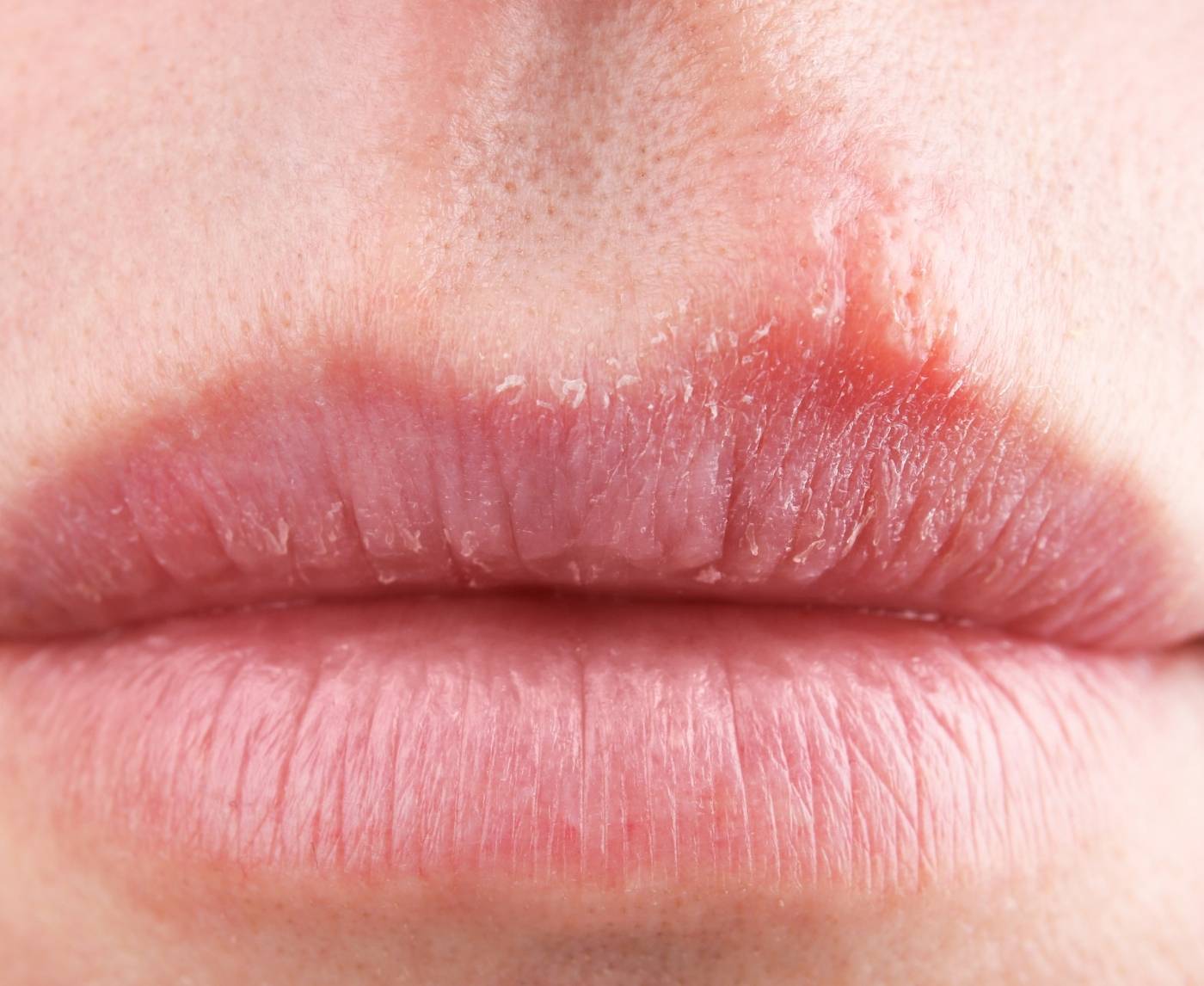
The textbook image of oral herpes is a cluster of small fluid-filled blisters on the lip border, painful for several days, then crusted over before healing in roughly one to two weeks. That presentation is real, but it represents the most obvious end of a wide spectrum. According to Mayo Clinic reference materials, many infections look almost nothing like the classic photograph.
Common alternatives include a single small vesicle that drains within a day, a flake of dry skin at the corner of the mouth, a faint redness inside the lip border, or no visible change at all even during a period of active viral shedding. Some people experience a tingling, itching, or burning sensation called the prodrome in the hours before any visible sign appears. Others feel nothing.
Severity also varies by exposure history. The first outbreak after a new infection tends to be the most dramatic and the most painful, occasionally accompanied by fever, swollen lymph nodes, and multiple lesions. Subsequent reactivations are usually shorter, milder, and less symptomatic, sometimes to the point of being entirely invisible. The figures below illustrate the range of presentations a single virus can produce on the same anatomical area.
Cold Sores Are Herpes: Naming the Virus Honestly
Doctors sometimes soften the language. Parents call them fever blisters. Pharmacies sell over-the-counter creams without ever using the word herpes. The result is that millions of people grow up with HSV-1 outbreaks on their lips and never connect the dots: a cold sore is a herpes sore. The virus that causes it is herpes simplex virus type 1, the same family of pathogens that causes genital herpes.
This naming gap matters because language shapes risk perception. If you think a cold sore is just an annoying skin blip, you do not think about disclosure, you do not think about timing intimate contact around outbreaks, and you do not think about whether oral sex during a flare-up could transmit the virus to a partner's genitals. All of those questions become obvious the moment the virus has its real name.
Three plain facts that get blurred when cold sores are downgraded to lifestyle nuisances. HSV-1 is a lifelong viral infection; once it establishes itself in the trigeminal ganglion (the cluster of nerve cells behind the cheekbone), it stays for life. It transmits through skin-to-skin contact, not just sex; kissing, sharing a straw, or trading lip balm during a shedding window is enough. And there is no cure, but antivirals like acyclovir and valacyclovir reduce both symptom severity and the amount of virus shed during and between outbreaks.
HSV-1 is also a much milder infection than HIV. There is no meaningful risk of acquiring HIV from oral herpes or from a partner who carries HSV-1; the two viruses use entirely different transmission routes, and the oral lesions of HSV-1 do not contain HIV unless the carrier is also independently HIV-positive. If HIV exposure is a separate concern, for instance after unprotected sex with a partner of unknown HIV status, a fourth-generation antigen-antibody test is the appropriate next step, reliable from approximately 18 to 45 days post-exposure per CDC guidance.
HSV-1 traditionally caused oral herpes (cold sores) and HSV-2 caused genital herpes, but the line has blurred. HSV-1 now causes a substantial share of new genital herpes cases in younger adults, transmitted by oral sex from someone with oral HSV-1 to a partner's genitals. The CDC notes this trend and recommends that conversations about herpes consider both anatomical routes, not just genital-to-genital contact.
How HSV-1 Actually Spreads
HSV-1 transmission requires direct contact with virus particles. The virus does not survive long on dry surfaces, but during shedding episodes it is present in saliva, in the fluid inside or beneath active sores, and on the surrounding skin. Common transmission routes include:
- Kissing, including brief lip-to-lip contact, not only deep kissing.
- Sharing items that touch the mouth, such as utensils, drinking glasses, straws, lip balm, lipstick, mouth guards, or cigarettes during shedding episodes.
- Oral sex, which can transmit HSV-1 from the mouth of one partner to the genital area of another, where it then establishes a genital HSV-1 infection.
- Skin-to-skin contact with the lip area when sores or shedding are active. Kissing a baby or young child during an outbreak is a recognized route by which many people first acquire HSV-1 in childhood.
- Self-inoculation in rare cases, where someone with an active oral sore touches the lesion and then transfers virus to their own eye (herpes keratitis) or to a fresh skin abrasion elsewhere on the body.
The most surprising part of the transmission story, for most readers, is that visible sores are not required.
HSV-1 does not spread through casual non-intimate contact: shaking hands, sharing a workspace, touching doorknobs, or breathing the same air. It also does not transmit through blood transfusion or routine pregnancy in a way that matters for everyday adult exposure. A primary outbreak during late pregnancy is a separate clinical situation handled by obstetricians, but ordinary recurrent cold sores in a long-standing carrier do not pose the same risk.
Asymptomatic Shedding: How HSV-1 Spreads When You Feel Fine
The phrase asymptomatic shedding refers to days when HSV is active enough to be transmitted but not active enough to cause a visible sore. The virus migrates back up the trigeminal nerve from its dormant site, replicates near the surface of the skin or mouth, and can be passed through saliva or direct contact during this window without any external clue.
Published viral shedding studies find detectable HSV in oral or genital secretions on roughly 9 to 18 percent of symptom-free days, with substantial variation between individuals. The WHO herpes fact sheet notes that transmission can occur from skin or mucosal surfaces that appear normal, which is the practical consequence of this shedding pattern. That works out to about three to five days per month, distributed unpredictably. There is no reliable way to forecast a shedding day in advance, which is why kissing, sharing a drink, or oral sex during one of those windows can result in transmission to a previously uninfected partner who never sees a warning sign.
Shedding episodes are usually short, lasting a few hours to a couple of days, and most carriers cannot reliably tell when they are or are not shedding. Triggers that increase the likelihood of both visible outbreaks and asymptomatic shedding include physical stress (illness, fever, dental work), emotional stress, immune suppression, hormonal changes around menstruation, sun exposure on the lips, and trauma to the affected area. Identifying personal triggers helps with managing outbreaks but does not make a carrier reliably non-contagious during trigger-free periods. Daily suppressive valacyclovir or acyclovir lowers both the frequency of shedding episodes and the amount of virus shed during each one, but does not bring shedding to zero.
Most people with herpes have no symptoms or only very mild symptoms, so they may not know they are infected.
Why So Many People Don't Know They Carry It
HSV-1 stays under-recognized at the individual level for several connected reasons, even though it is one of the most common viral infections on earth.
Routine STI panels almost never include herpes testing. Standard sexual-health screening covers chlamydia, gonorrhea, syphilis, HIV, and sometimes hepatitis, but not HSV. The CDC does not recommend universal herpes blood testing for asymptomatic adults, because the available antibody tests have well-documented false-positive issues in low-prevalence populations and because a positive result rarely changes clinical management. The downstream effect is that millions of HSV-1 carriers go through life without any test result that names the virus.
Many infections are also acquired in childhood, before anyone frames them as sexually transmissible. A substantial share of HSV-1 cases are picked up before age 10 from non-sexual contact such as a peck from an aunt or sharing a juice cup at preschool, and the first outbreak, if there is one, gets dismissed as a fever blister or canker sore. The connection to a herpes virus is never explicitly drawn for the patient or the parent.
And everyday language reinforces the gap. Phrases like "it's just a cold sore," "everyone gets them," and "it's a fever blister, not herpes" actively prevent people from understanding that they carry an infectious virus. The CDC, WHO, and major dermatology references all use HSV-1 and oral herpes interchangeably with cold sore, but everyday clinical communication often does not. The combination means a person can have decades of cold sores, never be told it is herpes, never be tested, and have no framework for thinking about transmission until a partner's diagnosis forces the question.
Two reasons. Antibody serology testing for HSV in low-prevalence groups produces a meaningful number of false positives, and a false-positive herpes diagnosis carries real psychological and relational cost. And a confirmed positive in an asymptomatic adult rarely changes clinical management, since there is no cure and the carrier is already managing whatever symptoms they have. The CDC therefore recommends targeted testing (a partner's diagnosis, recurrent unexplained lesions, pregnancy planning) rather than universal screening (<a href="https://www.cdc.gov/herpes/testing/index.html" target="_blank" rel="noopener noreferrer">CDC herpes testing guidance</a>). Reasonable clinical policy, but it leaves a lot of carriers unaware of their status.
Cold Sore or Just Chapped Lips? Telling Subtle HSV from Common Look-Alikes
One of the most common diagnostic confusions is between herpes simplex and angular cheilitis, the inflammation that appears at one or both corners of the mouth from saliva pooling, friction, or yeast overgrowth. Angular cheilitis tends to be bilateral, persistent, and often crusted with cracks that heal slowly. Herpetic lesions usually appear on one side, follow a recognizable life cycle of vesicle to crust to healing within roughly a week, and recur in the same anatomical spot. The NHS guide to cold sores confirms this classic vesicle-to-crust life cycle, with healing in about ten days. Clinically, the most reliable ways to distinguish an HSV lesion from look-alikes are its location on or near the vermillion border of the lip, its tendency to recur at the same anatomical spot, and the preceding prodrome of tingling or itching.
Other look-alikes include impetigo, a bacterial infection that produces honey-colored crusts and tends to spread quickly across nearby skin; aphthous ulcers, which are canker sores located inside the mouth on softer mucosa rather than on the lip border; and simple wind, sun, or cold-weather chapping, which lacks the recurrence pattern and the prodrome of HSV.
None of this means a person can self-diagnose with certainty. A clinician can confirm an active lesion by swabbing it for PCR, the most accurate diagnostic when a sore is visible. PCR is performed in a clinical or laboratory setting; at-home rapid herpes tests use blood antibody chemistry instead and are intended for screening past exposure rather than identifying an active lesion.
If you are trying to tell a cold sore from chapped lips, angular cheilitis, or another irritation, three patterns favor HSV-1: the lesion sits on or right at the vermillion border of the lip rather than inside the mouth or down on the chin; it recurs in the same anatomical spot over months or years; and it is preceded by a few hours of tingling, itching, or pin-prick sensation (the prodrome). A clinician can confirm any active lesion by swabbing it for PCR.
Can You Get Oral Herpes from Kissing?
Yes, and it is one of the most common transmission routes. HSV-1 is typically acquired in childhood through non-sexual contact such as a parent's kiss or a shared cup, well before sexual activity begins. CDC household-transmission data attributes the majority of HSV-1 infections to ordinary daily-life contact rather than sexual activity.
That distribution is shifting in younger adults. Improvements in childhood hygiene have meant that fewer people acquire HSV-1 as children, leaving more young adults seronegative when they begin sexual activity. The result is a rising share of HSV-1 infections acquired in adolescence and early adulthood through kissing, oral sex, or both. CDC and Mayo Clinic surveillance shows HSV-1 increasingly causing genital infections in this age group as a downstream consequence of oral sex with an HSV-1-positive partner.
Practically, this means a casual peck, a shared drinking glass, or oral sex with someone who carries asymptomatic HSV-1 can transmit the virus. The risk per single encounter is not high, but the cumulative exposure over many ordinary contacts is what makes population-level prevalence so common. Avoiding kissing during a visible cold sore reduces but does not eliminate transmission risk because of the asymptomatic shedding window described above.
How HSV-1 actually transmits
- Childhood non-sexual contact (parental kisses, shared cups, household items) accounts for the majority of HSV-1 infections per CDC household-transmission data.
- Adult-acquired HSV-1 through kissing, shared drinks, lip balm, and oral sex is rising in younger adults who reach sexual debut without childhood exposure.
- Oral sex with an HSV-1-positive partner is now a meaningful cause of new genital herpes diagnoses in younger adults, including during asymptomatic shedding windows.
Testing for Oral Herpes When You Have No Symptoms
Two test methods exist, and they answer different questions. PCR or viral culture, performed in a clinic during a visible outbreak, identifies whether a specific lesion is herpes and which type. This is the appropriate test when there is something to swab. Rapid lateral-flow blood antibody tests, including the at-home kind, identify whether the body has produced antibodies against HSV-1 or HSV-2 from a past exposure. This is the appropriate screen when no sore is present (CDC herpes testing guidance).
Antibody seroconversion takes time. The CDC testing page states that it can take up to 16 weeks or more after exposure for current tests to detect infection. In clinical practice, most people who will seroconvert do so by around 12 weeks, which makes that a practical threshold for a first test, with a confirmatory retest at 16 weeks if the result is negative and concern persists. Testing too soon after a suspected exposure can return a false negative simply because the body has not yet produced enough antibody.
Specific situations where it is reasonable to test for HSV-1 even without symptoms: you have a history of recurrent lip lesions and want to know whether HSV-1 is the cause, particularly before disclosing to a new partner; a partner has been diagnosed with HSV-1 (orally or genitally) and you want to know your own status; you are entering a sexual relationship with someone HSV-negative and you both want a baseline; or you are pregnant or planning pregnancy, since first-time HSV infection during pregnancy is a different clinical scenario and your obstetrician will want to know your serostatus.
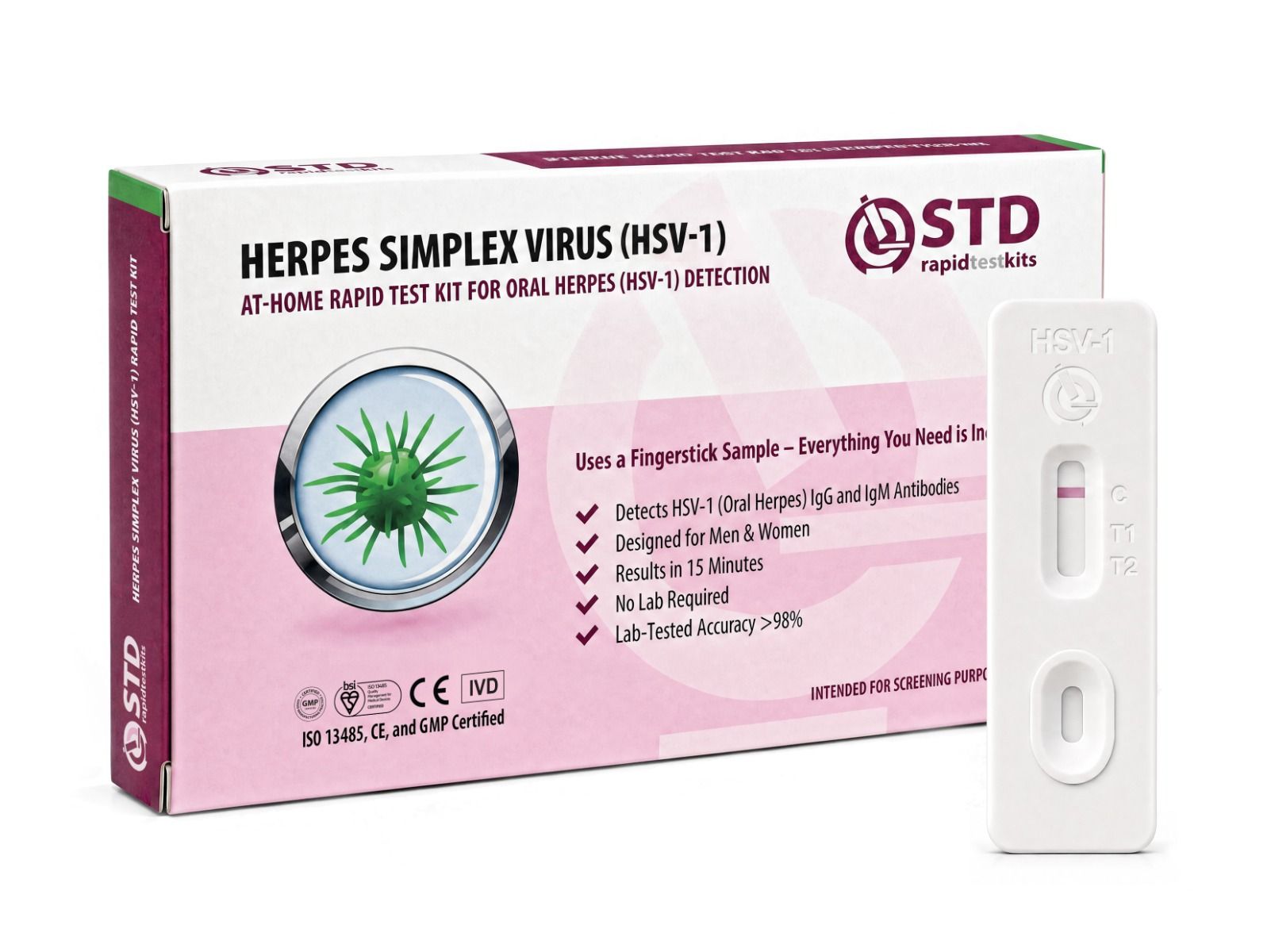
It is also worth being precise about what at-home rapid kits are: they are lateral-flow immunoassays, not laboratory NAAT or PCR. The two technologies are complementary rather than equivalent. A positive at-home result is meaningful and worth confirming with a laboratory test if the result will inform major decisions. A negative result more than 12 weeks after exposure is reassuring.
An at-home rapid HSV test detects antibodies in blood, which is the right tool for screening past exposure when no sore is present. It is not designed to diagnose an active lesion of any anatomic site, oral or otherwise; that requires a clinic-administered PCR swab of the lesion itself. If you currently have a visible sore on your lip and want a definitive answer about that specific spot, a primary-care provider, urgent care, or sexual-health clinic can swab it directly. Disclosure: stdrapidtestkits.com sells the at-home rapid tests linked below; products are from our own catalog and are recommended on fit-for-purpose grounds rather than commercial benefit.
What to Do First If a Partner Tests Positive After Contact With You
The disclosure goes one of two ways. Either a partner gets a recognizable first cold sore after intimate contact and asks if you knew you had it, or the partner gets tested and the test points back to recent contact. In either case, the first hour is when most people make their worst decision: they panic and either over-explain or go silent.
A practical sequence works better. Take a breath and check what you actually know: do you have a personal history of cold sores, even infrequent or mild ones? Have you ever been told by a clinician that what you had was HSV-1? Have you ever had a herpes blood test? Knowing your own status (or lack of it) changes the conversation. Then get tested if you don't already know; an HSV antibody blood test will tell you whether you carry the virus, and at-home rapid antibody tests cover this need privately and quickly.
Respond to your partner with what you know, plainly. Whether the answer is "I get cold sores occasionally and didn't realize I could transmit between outbreaks" or "I had no idea I carried this," the correct posture is honesty plus information, not over-apology and not defensiveness. Encourage them to see a clinician for confirmation; a first cold sore in an adult is sometimes more severe than later outbreaks, and a clinician can prescribe oral antivirals like acyclovir or valacyclovir, which shorten the outbreak when started early. Do not promise certainty about source: HSV-1 has a wide incubation range (typically 2 to 12 days for a first outbreak after exposure, but the virus can also reactivate from a much older infection). Without lab typing and timing, no one can prove which contact transmitted it.
First three steps after a partner's diagnosis
- Check your own history before reacting. Cold sores you have dismissed, even infrequent or mild ones, are HSV-1. A herpes blood test you have never taken means your status is unknown rather than negative.
- Test yourself with an HSV antibody blood test if you do not already know your status. At-home rapid antibody tests cover this privately and quickly, and a clinic visit can confirm the result.
- Respond plainly with what you know. Honesty plus information lands better than over-apology or defensiveness, and honesty about uncertainty over the source of infection preserves trust better than confident attribution.
Telling a Partner: Practical, Calm Scripts
The disclosure conversation gets framed as much harder than it usually is. A short, plain version works better than a dramatic confession. A useful template:
"I want to mention something before we go further. I have been told I carry oral HSV-1, the virus behind cold sores. About two-thirds of adults have it, often without knowing. I avoid kissing during outbreaks, and I am happy to answer any questions you have."
That structure puts the relevant facts in plain language without apology or alarm: what you carry, how common it is, what precautions you take, and an open door for the partner's questions. The reaction will vary by partner. Some people will have known for years they are also positive and will not consider it a meaningful change. Others will want time to think it through. Both responses are reasonable. Do not bundle disclosure with a request for forgiveness in the same conversation; that makes both harder. Information first; the relationship conversation can come later.
- The name of the virus (HSV-1) and the fact that cold sores are herpes.
- That asymptomatic shedding, not visible sores, accounts for most transmission.
- That roughly two-thirds of adults under 50 worldwide carry HSV-1 per WHO global estimates, so a positive result does not isolate either of you from your peers.
- That antivirals shorten a first outbreak and can be prescribed quickly by a primary-care clinician or urgent-care visit.
- That the source of infection often cannot be proven without lab typing and timing data, so apologize for not disclosing earlier without claiming certainty about who transmitted what.
Asymptomatic vs Symptomatic Carriers: Where Does the Real Risk Live?
An intuitive guess is that people with frequent visible outbreaks pose the greatest transmission risk. The data complicates that picture. People who experience symptoms tend to know their status, avoid sex during obvious flare-ups, and may take suppressive antiviral medication. People who carry HSV asymptomatically often do not know they are positive and therefore take no precautions at all. The result is that asymptomatic carriers can contribute meaningfully to population-level transmission despite shedding less frequently per individual day. Knowing your status is the practical starting point for any precaution, which is why testing matters even when you feel fine.
| Carrier profile | Shedding frequency | Aware of status | Day-to-day caution |
|---|---|---|---|
| Symptomatic with frequent outbreaks | Higher around outbreaks, lower between | Usually yes | Often takes precautions during prodrome and flare-ups |
| Symptomatic with rare outbreaks | Moderate, episodic | Sometimes | Variable, depends on individual awareness |
| Asymptomatic carrier (positive on antibody test, no outbreak history) | Lower per day, unpredictable timing | Often no | Typically none |
| Recently infected, before seroconversion | Variable, can be high | Usually no | None |
When Oral Herpes Is Most Contagious
Contagiousness varies across the outbreak cycle. Knowing the rough timing helps reduce, though never fully eliminate, transmission risk during the highest-risk windows. The stage-by-stage breakdown below draws on viral-load patterns described in CDC and Mayo Clinic reference materials.
| Stage | Contagiousness | What is happening |
|---|---|---|
| Active vesicle or open sore | Very high | Highest viral load on the skin surface |
| Prodrome (tingling, itching, before vesicle appears) | High | Virus replicating, no visible sign yet |
| Crusted, healing | Moderate, declining | Viral load decreasing, skin not yet intact |
| Healed, recent outbreak | Lower | Sporadic shedding still possible for days to weeks |
| No outbreak history or long quiescence | Lowest, but not zero | Asymptomatic shedding still occurs on roughly 9 to 18 percent of days |
Reducing Day-to-Day Transmission Risk
Several practical steps lower the chance of passing HSV-1 to a partner without forcing constant vigilance. Most are low-effort once the underlying behavior pattern is in place. Avoid kissing and oral contact during prodrome and visible outbreak. Do not share lip balm, water bottles, utensils, mouth guards, or smoking items. Use a dental dam or condom during oral sex with new or unknown-status partners. Wash hands after touching the lip area, especially during outbreaks.
Three steps that meaningfully reduce HSV-1 transmission
- Recognize the prodrome. Many reactivations are preceded by a few hours of tingling, dryness, or a faint pin-prick sensation on the lip. Skipping kissing and oral sex during prodrome and active outbreak windows reduces transmission substantially, and the prodrome window is often long enough to act on once you know what to look for.
- Consider daily suppressive antiviral therapy. Valacyclovir or acyclovir, taken daily, reduce both outbreak frequency and viral shedding. CDC guidance supports daily suppressive therapy as a transmission-reduction strategy in mixed-status couples; a primary-care provider or sexual-health clinic can prescribe and pick the appropriate dose.
- Use brief, honest disclosure with new partners before kissing or oral sex. Most adults already carry HSV-1 antibodies, so the additional risk to a seropositive partner is negligible. The pragmatic version is matter-of-fact: HSV-1 is common, here is what you do during outbreaks, and your partner can ask whatever they want.
When HSV-1 Becomes a More Serious Concern
For most adults, oral HSV-1 is a periodic skin nuisance and nothing more. A small set of clinical situations warrant more attention, and two of them (neonatal exposure and herpes keratitis) are urgent enough that they bear flagging up front before the rest of the list.
Beyond those two urgent scenarios, three further situations change clinical management. A first outbreak in pregnancy matters because a primary HSV infection acquired in late pregnancy carries a higher risk of neonatal transmission than reactivation of a long-standing infection; any new herpes diagnosis should be mentioned at the next prenatal visit so the obstetric team can plan accordingly. Immunocompromise changes the picture too: people on immunosuppressive medication or living with HIV may have more frequent, longer, and more severe HSV-1 outbreaks, and daily suppressive antivirals are commonly prescribed in those settings. And the rare but serious complication of HSV-1 encephalitis deserves explicit mention because the warning signs are easy to dismiss: sudden severe headache, fever, confusion, or seizure in an adult with cold-sore history is an emergency department visit, full stop.
Newborn exposure. Adults with an active oral cold sore should not kiss newborns. Neonatal HSV is rare but serious; ask any visitor with a visible cold sore to wait until it has fully healed.
Eye involvement (herpes keratitis). Eye pain, redness, or vision change in someone with a history of cold sores is a same-day ophthalmology call. Untreated corneal HSV can scar the cornea and damage vision.
Coping with the Guilt and Shame
Realizing you may have passed a lifelong virus to someone you care about is a heavy moment, and the cultural baggage around the word herpes makes it heavier than the biology warrants.
One useful anchor is statistical. HSV-1 is one of the most common human infections on earth. The WHO estimates roughly 3.8 billion people under age 50 carry it, the majority asymptomatically. Carrying HSV-1 puts a person in the same category as roughly two-thirds of their adult peers. It does not mark anyone as careless, dirty, or morally compromised; it marks them as a person whose immune system once met a very common virus.
A complementary reset is informational. The cultural weight around the word herpes is largely a 1970s and 1980s artifact, when antiviral medication was new, public-health messaging was alarmist, and the virus became a stand-in for cultural anxieties about sexuality. Modern public-health communication, including from the CDC and major medical centers, frames herpes as a manageable common viral infection. Reading a few well-sourced summaries (rather than internet message boards) often resets the emotional baseline. If guilt or anxiety persists past the initial conversation with a partner, it is worth talking to a therapist with experience in sexual health, or joining one of the moderated online communities for HSV-positive people.
WHO global estimates put HSV-1 prevalence at roughly 3.8 billion people under 50 (about two-thirds of that age group). A diagnosis lands a person in the same category as the majority of their adult peers, and the modern CDC framing treats HSV-1 as a manageable common viral infection rather than a character verdict.
Next steps based on your situation
Are you unsure of your HSV-1 status, or has a partner recently been diagnosed?
Yes: Take an HSV blood antibody test. The result is most reliable 12 to 16 weeks after a possible exposure. A positive result is worth following up with a clinician; a negative result outside the window is reassuring.
Do you currently have a visible sore on or near your lip, particularly a first one in adulthood?
Yes: See a primary-care provider, urgent care, or sexual-health clinic, ideally within 72 hours of symptom onset. A clinic-administered PCR swab confirms HSV; oral antivirals shorten a first outbreak when started early.
Are you in a mixed-status relationship, immunocompromised, pregnant, or seeing any eye pain or newborn-exposure concern?
Yes: Talk to a clinician. Daily suppressive valacyclovir or acyclovir reduces shedding and transmission risk in mixed-status couples; eye pain in someone with cold-sore history is a same-day ophthalmology call; an active cold sore around a newborn waits until it has fully healed.
No: Stay with the day-to-day precautions covered earlier: avoid kissing and oral contact during prodrome and visible outbreak, do not share lip-area items, and use brief honest disclosure with new partners before kissing or oral sex.
Guidance only. A clinician can review the trade-offs for your specific situation.
Frequently Asked Questions
- Can I really have oral herpes and never know it?
- Yes. Roughly two-thirds of adults carry HSV-1 per WHO global estimates, and most of them have never had a recognizable outbreak. A type-specific blood antibody test is the only reliable way to check status when no sore is present, and the standard wait is at least 12 weeks after a possible exposure for the most accurate result.
- Is a cold sore the same as herpes?
- Yes. Cold sores are caused by herpes simplex virus type 1 (HSV-1). Fever blister, cold sore, and oral herpes all refer to the same infection. The CDC, WHO, and major dermatology references use these terms interchangeably.
- Can you spread oral herpes without a visible cold sore?
- Yes. Asymptomatic viral shedding releases HSV-1 into saliva and onto the skin around the lips on roughly 9 to 18 percent of symptom-free days, with no symptoms during those episodes. Most new HSV-1 infections come from these asymptomatic windows, not from visible outbreaks. There is no reliable way for a carrier to predict shedding days in advance.
- How long after a possible exposure should I wait to test?
- CDC testing guidance states that it can take up to 16 weeks or more after exposure for current tests to detect HSV infection. In practice, most people who will seroconvert have done so by around 12 weeks, which makes that a reasonable threshold for a first test with a retest at 16 weeks if the result is negative and concern persists. Testing earlier than 12 weeks can return a false negative even when infection has occurred.
- How long is HSV-1 contagious, and which test is right for which situation?
- An outbreak is contagious from prodrome (tingling or itching, typically 12 to 48 hours before a visible sore) through full crusting and re-epithelialization of the lesion, usually 7 to 10 days for a recurrent outbreak; first outbreaks last longer. Asymptomatic shedding occurs outside this window too. Two test types match the two scenarios: a clinic-administered PCR swab of an active lesion is the right tool when there is something visible to test, and a blood antibody assay (at-home rapid kits or a lab draw) is the right tool when no sore is present, because it detects past exposure rather than local infection of a specific spot.
- Can HSV-1 cause genital herpes through oral sex?
- Yes. HSV-1 is increasingly responsible for genital herpes infections in younger adults, often through oral sex with a partner who has oral HSV-1, including during asymptomatic shedding windows. Genital HSV-1 typically causes fewer recurrences than genital HSV-2 but is still a meaningful cause of new genital herpes diagnoses.
- Should I take daily antiviral medication if I never have outbreaks?
- It depends on goals. Daily suppressive antivirals like valacyclovir reduce viral shedding and lower transmission risk, even in people without obvious outbreaks. CDC guidance supports daily suppressive therapy for transmission reduction in mixed-status couples. People who never have outbreaks usually do not need daily medication for symptom management but might choose it for transmission-reduction reasons in a serious partnership. A primary-care provider or sexual-health clinic can review the trade-offs for your situation.
- What is the difference between HSV-1 and HSV-2?
- Both are herpes simplex viruses that cause similar outbreaks. HSV-1 historically caused most oral infections and a smaller share of genital infections; HSV-2 historically caused most genital infections. The clinical and behavioral lines have blurred, with HSV-1 increasingly causing genital infections in younger adults through oral sex. A type-specific blood test distinguishes which type a person carries, which can matter for prognosis (genital HSV-2 tends to recur more frequently than genital HSV-1) and for partner counseling.
- World Health Organization. Herpes simplex virus fact sheet, including the global prevalence figure of roughly 3.8 billion HSV-1 carriers under age 50, transmission routes, and the role of asymptomatic shedding from surfaces that appear normal.
- U.S. Centers for Disease Control and Prevention. About genital herpes, including HSV-1 and HSV-2 epidemiology, asymptomatic shedding patterns, and household transmission routes.
- U.S. Centers for Disease Control and Prevention. Herpes testing guidance, including indications for type-specific antibody testing and the statement that current tests can take up to 16 weeks or more after exposure to detect infection.
- Mayo Clinic. Cold sore: symptoms and causes, including the typical lifecycle of an HSV-1 oral lesion and common look-alikes.
- NHS. Cold sores: causes, symptoms, treatment, and self-care guidance from the UK national health service, including the classic vesicle-to-crust life cycle and recurrence pattern.
- MedlinePlus (U.S. National Library of Medicine). Herpes simplex overview, including HSV-1 and HSV-2 transmission and presentation.
