
Published: November 2025 | Last updated: May 2026 | Editorial review and quality control: Martina N.
Living far from a clinic should not mean living with hidden risk. Chlamydia is the most commonly reported bacterial sexually transmitted infection in the United States, and rural counties carry a disproportionate share of undiagnosed cases. Prevention does not require a city ZIP code or a same-day appointment. With at-home rapid testing, consistent condom use, frank partner conversations, and a clear retest schedule, anyone with reliable mail delivery can stay ahead of chlamydia.
This guide walks through the practical steps: how to test from home, when the testing window actually opens, what to do if a result comes back positive, how to talk to partners without setting off a small-town gossip chain, and how to keep the cycle from repeating. None of it requires a clinic.
Key takeaways
- Most chlamydia infections cause no symptoms, so routine testing is the only reliable way to catch them before complications develop.
- Rural prevention runs on three habits: condoms used correctly, screening every 3 to 6 months when sexually active, and notifying past partners after a positive result so the chain breaks.
Why Rural Areas Are Seeing Higher Chlamydia Rates
It is tempting to assume smaller towns mean lower STI risk. The data say otherwise. According to CDC STI surveillance data, chlamydia is the most commonly reported notifiable infection in the United States, with well over a million reported cases each year and rural rates rising among young adults. Rural counties often report lower per-capita case counts than urban areas, but that gap is misleading: rural screening rates are also lower, which means more infections go undiagnosed and untreated for longer rather than not happening at all.
Several access gaps stack on top of each other. Fewer family-planning clinics per square mile. Longer travel times to the nearest specialist. Higher uninsurance rates in some rural states. And a thinner public-health workforce, which slows partner notification and reduces the chance that an asymptomatic case gets caught during a routine visit. A 2021 narrative review of rural STI care identified distance to care and provider shortages as key structural barriers contributing to delayed diagnosis and reinfection in rural communities.
The picture gets harder when you layer on stigma. In places where gossip travels faster than lab results, the fear of being recognized in a waiting room keeps people from testing at all. That delay quietly extends transmission chains. Public-health researchers describe this pattern as a structural access gap, not a behavioral failure. Rural sexual networks are no riskier per encounter, but each undiagnosed case stays infectious longer, which raises the cumulative chance of community spread.
Most chlamydia infections are asymptomatic. The World Health Organization estimates roughly 129 million new chlamydia infections globally each year, with the majority going undiagnosed. A person with no symptoms can transmit chlamydia for months without knowing, which is why the home-testing toolkit covered below matters most where clinic access is thin.
Most people who have chlamydia have no symptoms. You can have chlamydia and not know it, and you can pass it to your sex partners without knowing.
Can You Get Tested Without a Clinic Nearby?
Yes. At-home test kits make routine chlamydia screening practical for anyone with mail service. Two formats dominate the home market, and they answer slightly different questions.
Rapid at-home kits use lateral-flow immunoassay strips and deliver results in about 15 minutes from a self-collected swab. They are best for screening on demand: after a possible exposure, before a new partner, or as part of a quarterly check-in. Sensitivity is good but not perfect; a positive result is meaningful, and a negative result during a confirmed exposure window is worth following up with a lab confirmation if symptoms appear.
To use one, you typically collect a vaginal or urethral swab, dip it in the buffer vial that comes in the kit, and apply a few drops to the cassette. A control line confirms the test ran correctly; a second line indicates a positive result. Instructions in reputable kits include diagrams, expiration dates, and a help-line number.
Mail-in kits let you collect a sample at home and ship it to a laboratory that runs nucleic acid amplification testing (NAAT) and returns results through a secure portal in a few days. NAAT is the laboratory gold standard for chlamydia detection and is more sensitive than rapid lateral-flow chemistry, so mail-in is worth using when a rapid result is positive, when symptoms persist despite a negative rapid test, or when you want maximum confidence in a screening result.
Before ordering, check that the kit is FDA-cleared or CE-marked for over-the-counter use and that the company has a clear privacy policy. Reputable services pair results with telehealth consults so a positive can move straight to treatment without an in-person visit. CDC STI testing guidance explicitly recognizes self-collected samples and home-based testing as valid screening pathways.
| Format | Result Time | Technology | Best Use Case | Confirmation Advised? |
|---|---|---|---|---|
| Rapid at-home kit | About 15 minutes | Lateral-flow immunoassay from self-collected swab | On-demand screening after exposure, before a new partner, or as part of a quarterly rhythm | Yes for any positive result, when feasible |
| Mail-in lab kit | 2 to 3 days via secure portal | Nucleic acid amplification testing (NAAT) in a certified lab | Higher-confidence screening, confirming a positive rapid result, or persistent symptoms | Usually no, NAAT is the lab gold standard |
How Chlamydia Spreads in Tight-Knit Communities
One pattern public-health researchers see in rural sexual networks is called partner overlap. People in smaller communities are more likely to share recent partners with their friends and acquaintances, which means a single undiagnosed case can move through a cluster of people quickly. You can have only had one partner in six months and still be exposed to an infection that traveled through a chain of three or four other people you did not sleep with.
Reinfection is the second silent driver. A person finishes antibiotics, feels better, and resumes sex with a partner who never got tested. The bacteria move back. According to CDC STI treatment guidelines, reinfection within the first year of treatment is common enough that retesting at three months is recommended for nearly everyone, not just people with ongoing symptoms.
Expedited Partner Therapy (EPT) is a tool many states allow precisely because of these dynamics. A clinician treats the index patient and provides a second prescription that can be passed to the partner without requiring the partner to come in for their own appointment. EPT is legal or permissible in most U.S. states for heterosexual chlamydia exposure; rural pharmacies will typically fill it when paired with a telehealth visit. Ask the telehealth provider whether EPT is an option in your state if a partner is reluctant or unable to schedule their own visit.
| Risk Factor | Why It Matters in Rural Areas |
|---|---|
| Delayed or no testing | Fewer clinics and longer travel times mean infections stay undiagnosed for weeks or months. |
| Partner overlap in small communities | Tightly connected sexual networks let a single undiagnosed case reach more people, faster. |
| Stigma and recognition fear | Reluctance to be seen at a local clinic delays testing; home kits remove the visibility barrier. |
| Reinfection from untreated partners | When the index patient is treated but partners are not, the infection cycles back within weeks. |
| Limited specialist access | Complications like PID may require referral that is geographically out of reach without telehealth. |
Condoms, Conversations, and Control
Consistent condom use remains one of the most effective ways to lower chlamydia risk. The CDC condom guidance notes that correctly using a latex or polyurethane external condom every time prevents transmission of chlamydia and gonorrhea by reducing genital contact with infectious fluids. Internal condoms work too. Dental dams reduce oral transmission risk during oral sex. The catch is that consistency matters more than any single product choice.
In rural settings the practical barrier is usually access, not knowledge. Some readers describe avoiding the gas-station condom rack because a neighbor might see them, or buying in bulk during out-of-town trips. Mail-order delivery, plain packaging, and discreet pickup at chain pharmacies all flatten that barrier. Most online retailers ship condoms in unmarked boxes. Keeping a small supply in a vehicle, travel bag, or bedside drawer is sensible regardless of relationship status.
Conversations about testing are the second lever. A simple framing works better than a serious sit-down. "I get tested every few months, want to test together?" treats screening as routine self-care rather than an accusation. Couples who establish a shared testing rhythm catch infections earlier and reinfect each other less often. A partner who refuses to discuss testing under any circumstance is telling you something useful about how they manage shared risk.
- Heat and friction degrade latex, so a glove box parked in summer sun is the worst place for the supply you actually plan to use. Bedside drawer or travel pouch is better.
- Check the wrapper expiration date and replace household stock annually.
- Use water- or silicone-based lubricant with latex condoms. Oil-based lubricants (lotion, baby oil, petroleum jelly) weaken latex and cause breakage.
- External and internal condoms both work for chlamydia prevention. Dental dams reduce oral-route risk.
When Should You Test After a Possible Exposure?
Timing changes the answer. Chlamydia has a biological window period: the time between exposure and the point when a test can reliably detect the infection. For chlamydia the window is generally 7 to 14 days after exposure. Testing before day 7 can miss an early infection (a false negative); testing at 14 days or later catches nearly all detectable cases at home or lab.
The practical script is: if a known or suspected exposure happened, wait until at least day 7 to test. Symptoms that develop earlier (unusual discharge, burning during urination, lower abdominal pain in women, testicular tenderness in men) are reason to test sooner and to consider a clinical evaluation by telehealth. A negative rapid test at day 5 should be repeated around day 14 to be confident, especially if you are still asymptomatic.
Screening without a specific exposure event is different. The U.S. Preventive Services Task Force recommends chlamydia screening for all sexually active women aged 24 and younger, and for older women with risk factors such as new or multiple partners. CDC guidance recommends at least annual testing for that population and for men who have sex with men, with more frequent testing for those with multiple partners. Many rural readers test every three to six months when sexually active, which keeps the catch-window tight without becoming burdensome.
If you are pregnant or planning to become pregnant, screening guidance is more aggressive: CDC recommends testing at the first prenatal visit and retesting in the third trimester for those at increased risk. Untreated chlamydia in pregnancy can be passed to the newborn during delivery and cause conjunctivitis or pneumonia, both preventable with treatment during pregnancy.
| Time Since Exposure | Recommended Action |
|---|---|
| 0 to 6 days | Wait; the infection may not yet be detectable. Treat symptoms only if they appear and consider a telehealth consult. |
| 7 to 13 days | Test now with an at-home rapid kit or schedule a mail-in NAAT. A positive at this stage is reliable. |
| 14 days or more | Optimal window. Retest in 2 to 4 weeks only if symptoms develop or the first test was equivocal. |
| After treatment | Retest at approximately 3 months to confirm the chain was broken and you have not been reinfected. |
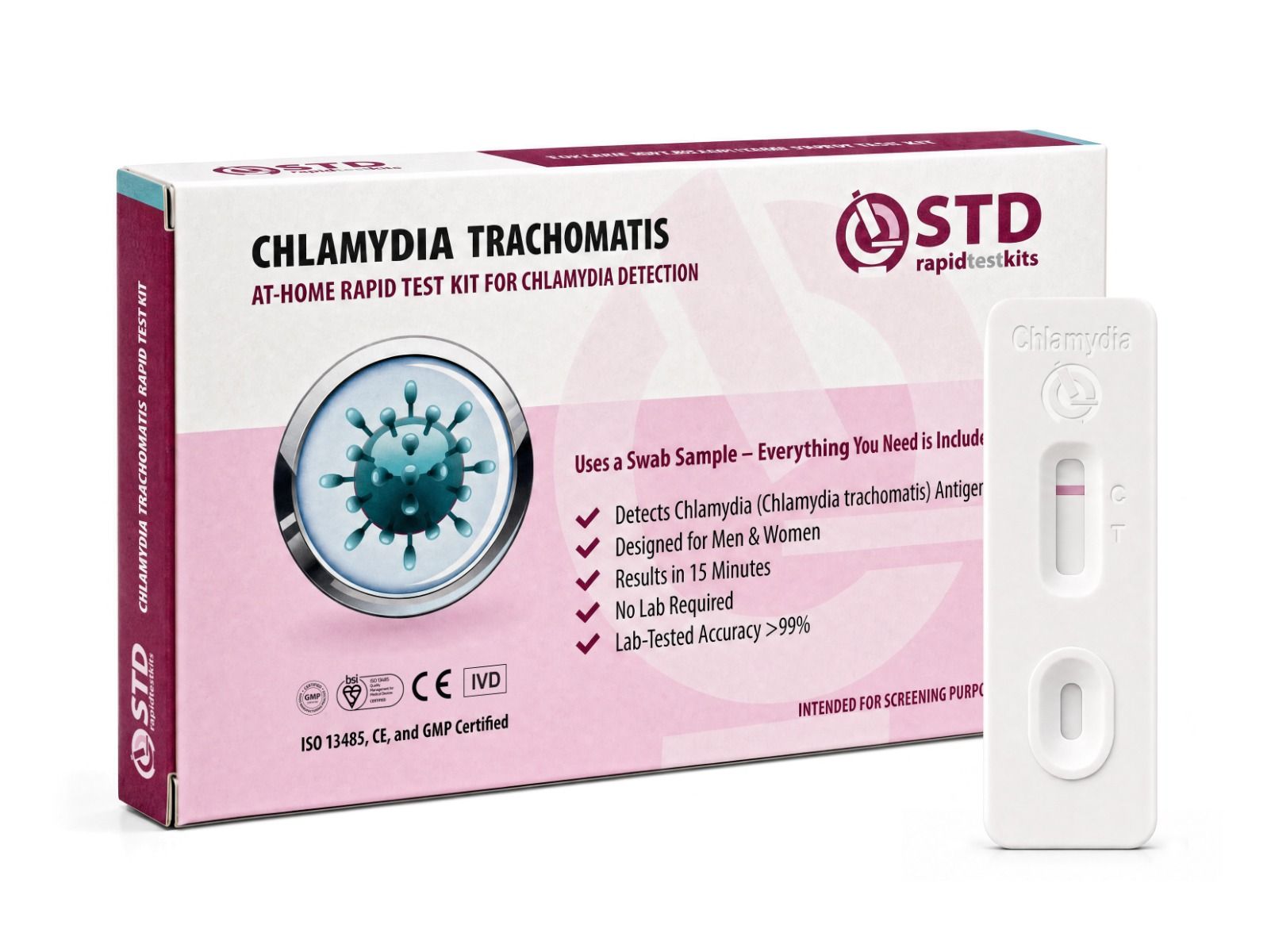
This site sells at-home rapid STI test kits, including the chlamydia kit linked below. We recommend kits based on fit for the reader's concern, not commercial benefit. Laboratory NAAT testing through a clinic or mail-in lab service remains the most sensitive option, and a positive at-home result is worth confirming with a lab NAAT when feasible.
What If the Test Is Positive?
First, breathe. A positive chlamydia result is common and the infection is curable with antibiotics. The current CDC first-line treatment is doxycycline 100 mg taken twice daily for seven days. Azithromycin 1 g as a single dose remains an alternative when adherence to a week-long course is a concern, such as during pregnancy when doxycycline is contraindicated, or for people on the road for work without reliable access to a daily pillbox.
The path from positive result to filled prescription does not need to involve a local clinic. Many at-home testing companies pair a positive result with a telehealth consult, after which the provider can call in a prescription to a chain pharmacy with drive-through pickup. People in remote areas often coordinate the pharmacy with whichever town they will be passing through that week. State laws on telehealth prescribing vary, but the major chains operate in nearly every state and can fill standard chlamydia treatment without obstacles.
Two follow-through tasks matter after treatment starts. First, notify recent sex partners, typically those from the past 60 days, so they can be tested and treated. The CDC STI Treatment Guidelines use the past 60 days as the partner look-back window for chlamydia exposure, and tools like TellYourPartner.org allow anonymous notification by SMS or email. Some states permit Expedited Partner Therapy so a clinician can prescribe for a partner without requiring them to be seen.
Second, do not resume sex until at least 7 days after completing treatment AND until each partner has also completed treatment. Most reinfections happen because one half of a couple finished antibiotics while the other half had not started. This is the part most people skip and most reinfection chains hinge on.
If symptoms persist beyond a week of treatment, the infection was not actually cleared, or there is a coexisting infection. Schedule a follow-up telehealth visit and a confirmatory lab NAAT. Persistent symptoms are not common with doxycycline but are not zero, and they are always worth investigating rather than waiting out.

Do I Need to Retest After Treatment?
Yes. The CDC recommends a follow-up test approximately three months after treatment for chlamydia, regardless of whether you believe your partners were also treated. Reinfection rates inside the first year are meaningful, and rural data show especially high reinfection rates when partner notification is incomplete or when a person resumes sex with a new partner whose status is unknown.
A three-month retest is not the same as a test of cure. Modern NAATs can detect residual bacterial nucleic acid for weeks after the bacteria are no longer viable. This is why CDC does not recommend retesting in the first three weeks after treatment except in specific circumstances such as pregnancy, persistent symptoms, or suspected reinfection. The three-month timing balances false positives against catching genuine reinfection early enough to prevent complications.
If symptoms return at any point, test sooner. If a new partner enters the picture, test sooner. Untreated or repeatedly recurring chlamydia in women can lead to pelvic inflammatory disease (PID), a serious complication that increases the risk of ectopic pregnancy and tubal-factor infertility. In men, untreated chlamydia can cause epididymitis, with testicular pain and swelling. Both complications are preventable with timely treatment and retesting.
Keeping one or two spare home kits in a closet shelf turns retesting from a logistics problem into a 15-minute task on a quiet evening. Most kits have shelf lives of one to two years from manufacture; check the date when stockpiling.
Retest at 3 months after treatment. NAATs can detect residual bacterial DNA for weeks after the infection has cleared, so do NOT retest inside the first 3 weeks of finishing treatment unless symptoms persist or reinfection is genuinely suspected. The 3-month interval avoids false positives while catching real reinfection before complications develop.
How to Protect Yourself When Healthcare Is Far Away
The most resilient rural prevention setups share four habits. They are inexpensive, do not require regular clinic visits, and adapt to whatever schedule a working life imposes. None of them assume the nearest health department is around the corner.
- Keep at least one chlamydia rapid kit at home so you can screen on demand without waiting on shipping during a stressful week.
- Store condoms somewhere accessible and climate-controlled: a bedside drawer or a travel pouch beats a hot glove box.
- Use anonymous partner-notification tools like TellYourPartner.org to alert past partners by text or email without a confrontation.
- Schedule a recurring testing rhythm: every 3 to 6 months when sexually active, sooner with new partners or new symptoms.
Privacy, Stigma, and Getting Help Without the Gossip
Small towns can be tight on community and tight on judgment. In places where the clinic receptionist might be a cousin or a former teacher, asking for an STI panel can feel like making a public statement. Privacy is not vanity. It is a practical condition that determines whether people actually test.
Most at-home kits ship in plain packaging with no visible branding, and results are delivered through encrypted email or a private portal. Some services let you use a generic return address, a P.O. box, or a trusted friend's mailbox if your own does not feel private. Prescriptions from telehealth visits can be filled at chain pharmacies several towns over, especially those with drive-through pickup that minimizes face-to-face interaction.
College students living rurally during breaks have additional options: most campus health centers offer confidential STI services, and federal Title X clinics provide sliding-scale care without parental notification for minors in most states. Planned Parenthood centers, where they exist, also operate confidentially.
If a positive result feels overwhelming, calling a state STI hotline (most states maintain one) gives you an anonymous adult to talk through next steps with. The conversation costs nothing and does not enter your medical record.
What No One Tells You About Living Rural With STD Risk
The myth that STIs are a city problem is durable and wrong. Bacteria do not check ZIP codes. Rural communities are often more vulnerable, not less, because clinics are fewer, stigma is heavier, and sex frequently happens in private with people passing through during hunting trips, fair weekends, summer breaks, or seasonal workforce rotations. Once a person returns to ordinary life without testing, transmission chains lengthen quietly.
Shifting that picture is partly cultural. Treating chlamydia testing as routine maintenance, the way most people accept dental cleanings, drains the moral weight from it. Saying "I tested last month, everything was clear" makes the topic discussable in a way that silence never can. Saying nothing keeps it dangerous, because nobody else knows the topic is on the table.
Whether you live in a farmhouse, a trailer, a college dorm, a workforce camp, or off-grid with limited Wi-Fi, the same toolkit works. Privacy is preserved by mail. Treatment is dispensed by phone. Reinfection is prevented by notifying partners and retesting on schedule.
Treating chlamydia testing as routine maintenance, the way most people accept dental cleanings or annual physicals, drains the moral weight from it. Saying out loud that you tested last month and everything was clear makes the topic discussable for the next person in your social circle who needs to test but does not yet know how.
You Deserve Answers, Not Assumptions
The decision to test is rarely about confidence in a current partner. It is about respecting your own body enough to know its status. Whether discomfort prompted the question, a new relationship started, or it has just been a while, the next step is the same. Order a kit, test in the window, and follow through on the results. The privacy and convenience of home testing exist precisely so that geography does not become a barrier to good sexual health.
Frequently asked questions
- Do I really need to worry about chlamydia in a small town?
- Yes. Rural counties consistently show lower screening rates and longer delays to treatment than urban counties, which means infections circulate longer per case. Sexual contact does not depend on town size; testing access does. Lower reported case counts often reflect under-testing, not lower true prevalence.
- What if I have no symptoms at all?
- Screen anyway if you are sexually active and 24 or younger, or older with new or multiple partners. USPSTF recommends screening this population; CDC adds at least annual frequency. Most chlamydia infections are completely asymptomatic, so absence of symptoms is the rule rather than reassurance. Untreated asymptomatic infection still causes PID and infertility risk over time.
- How do I get tested if I live two hours from a doctor?
- Order a rapid at-home kit (15-minute result, self-collected swab) or a mail-in NAAT kit (2 to 3 days via secure portal). Both ship in plain packaging with no clinic visit required. Use rapid kits for a quick first screen and routine quarterly checks; mail-in NAAT is worth using to confirm a positive rapid result or when you want the most sensitive option.
- How accurate is an at-home rapid chlamydia test?
- At-home rapid chlamydia tests use lateral-flow immunoassay chemistry. They perform well as a first-line at-home screen, particularly when used during the correct window period (7 to 14 days after exposure). Laboratory NAAT panels remain the most sensitive option, and a positive rapid result is worth confirming with a lab NAAT when feasible.
- I tested positive. What happens now?
- Chlamydia is curable. First-line CDC treatment is doxycycline 100 mg twice daily for seven days; azithromycin 1 g as a single dose remains an alternative when adherence is a concern or during pregnancy. Many at-home test companies pair positive results with telehealth consults, allowing you to fill a prescription at a local pharmacy without an in-person visit.
- Do I need to tell my partners?
- Yes. CDC STI Treatment Guidelines use the past 60 days as the partner look-back window so they can be tested and treated. Anonymous notification tools such as TellYourPartner.org allow this by SMS or email if direct contact feels too uncomfortable. In many states, Expedited Partner Therapy lets a clinician prescribe for a partner without requiring them to come in.
- When can I resume sex after treatment?
- Wait until 7 days after a single-dose azithromycin treatment or until you finish a 7-day doxycycline course, AND until each partner has also completed treatment. Resuming earlier is the most common cause of reinfection cycles where the same infection ping-pongs between partners.
- Should I retest after I clear the infection?
- Yes at the 3-month mark. CDC recommends retesting then because reinfection is common when partner treatment is uncertain, and because residual bacterial DNA from the original infection can cause false positives if you test sooner. Retest earlier than 3 months only if symptoms return or a new partner enters the picture.
- U.S. Centers for Disease Control and Prevention. STI surveillance data hub on reported chlamydia case counts and rural-urban distribution.
- U.S. Centers for Disease Control and Prevention. About Chlamydia patient fact sheet, including asymptomatic transmission information.
- U.S. Centers for Disease Control and Prevention. STI Treatment Guidelines for chlamydial infections, including first-line doxycycline regimen, 3-month retest recommendation, and 60-day partner look-back window.
- U.S. Centers for Disease Control and Prevention. Next steps after testing positive for gonorrhea or chlamydia, general partner notification guidance.
- U.S. Centers for Disease Control and Prevention. Condom Use Overview, supporting the consistent-use recommendation for chlamydia prevention.
- U.S. Preventive Services Task Force. Recommendation: Chlamydia and gonorrhea screening for women aged 24 and younger and higher-risk adults.
- World Health Organization. Chlamydia fact sheet with global incidence estimates.
- PMC narrative review on STI epidemiology and care in rural U.S. areas, identifying access-gap structural barriers to diagnosis and treatment.
