
Published: December 2025 | Last updated: May 2026 | Editorial review and quality control: Martina N.
How long should testicle pain last before I worry?
Sudden, severe pain in one testicle, especially with nausea or a testicle sitting higher than usual, is a medical emergency: go to an ER. Pain that builds gradually over a day or two, often with burning urination, usually means epididymitis from an STI like chlamydia or gonorrhea and needs an STI test plus a clinician within 24 to 72 hours.
Pain that will not quit in one testicle is the body asking for attention. It might be a strain that fades by morning, an infection that crept up days after sex that felt completely routine, or a twisted spermatic cord that leaves roughly six hours to save the testicle, and in the first hour all three can feel alike.
This guide sorts the patterns by how the pain behaves. It covers what counts as a true emergency, when a sexually transmitted infection is the likely cause, what an at-home rapid test can and cannot tell you, and where the line sits between watchful waiting and a clinic visit.
Key Takeaways
- Sudden, one-sided testicle pain is a six-hour emergency. Testicular torsion cuts off blood flow, and the chance of saving the testicle falls sharply after the first six hours.
- Pain that builds over a day or two, especially after recent sex, is most often epididymitis. Chlamydia and gonorrhea are the leading bacterial causes in sexually active men under 35.
First, Decide If This Is an Emergency
Two patterns drive the first decision. If pain came on suddenly, within minutes, and is bad enough to make sitting or walking miserable, especially with nausea, vomiting, or one testicle riding higher than the other, treat it as testicular torsion until a doctor proves otherwise. Torsion happens when the spermatic cord twists and shuts off blood flow. The first six hours after symptoms start are the window when the salvage rate is highest, close to 100% if the cord is untwisted in time (NIH StatPearls, testicular torsion). Torsion often wakes someone from sleep with no obvious trigger.
If pain has built gradually over hours or days, the suspect list shifts toward infection. Epididymitis is inflammation of the epididymis, the coiled tube behind each testicle that stores sperm. The NHS notes that in men under 35 the usual cause is a sexually transmitted infection, while in men over 35 it is more often a urinary infection (NHS, epididymitis). Pain usually starts on one side, the scrotum can feel warm or swollen, and urination may burn.
The hard middle ground is pain that began gradually but keeps intensifying, or torsion that briefly untwists and recurs, which doctors call intermittent torsion. When the picture is unclear, an in-person Doppler ultrasound is what separates the two. You cannot diagnose torsion at home, and the NHS advice is blunt: sudden, severe testicle pain is an emergency rather than a wait-and-see (NHS, testicle pain).
Sudden, severe testicle pain with nausea is an emergency-room trip, not an urgent-care or wait-and-see call. Even if it turns out to be nothing, the cost of being wrong about torsion is losing the testicle. No emergency department will fault you for showing up.
A Quick Anatomy Refresher
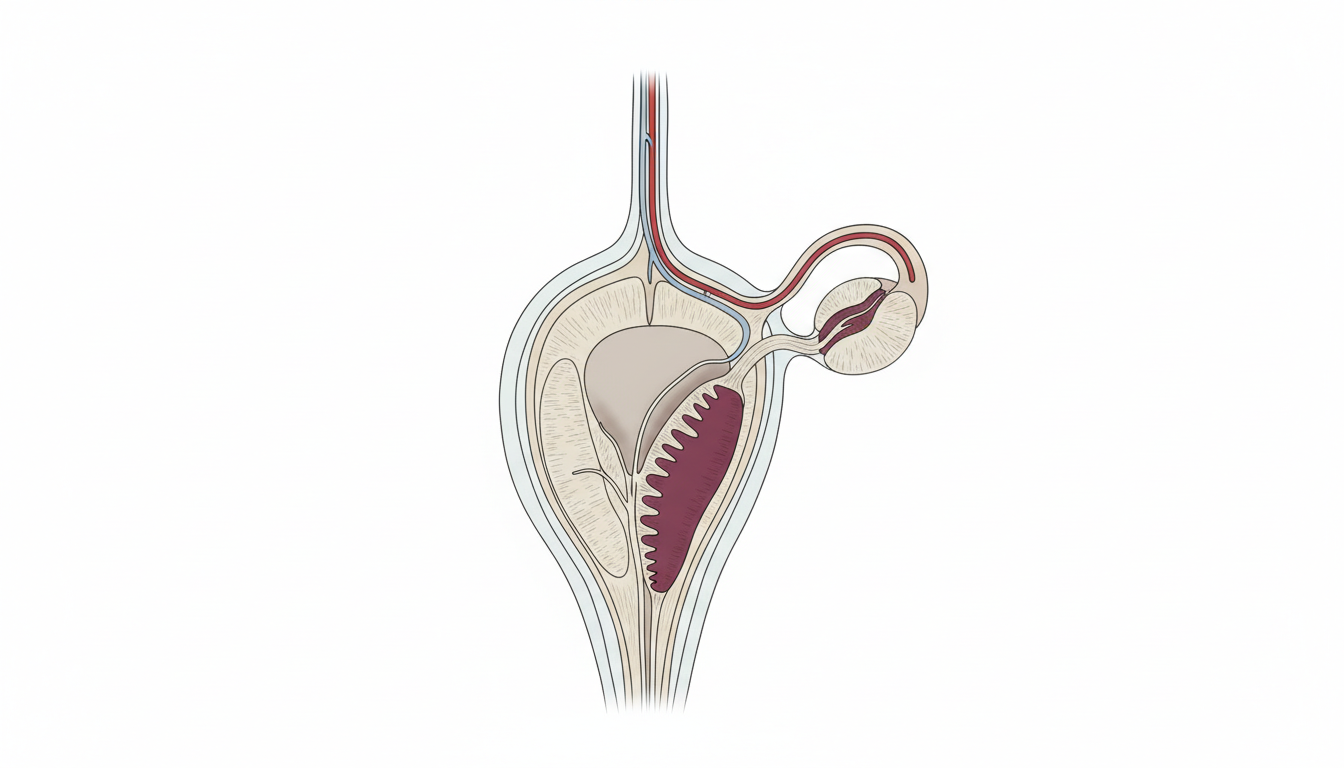
A little anatomy makes the rest of this guide easier to read. Each testicle sits inside the scrotum with a coiled tube called the epididymis running along its back surface. That tube connects to the vas deferens, which carries sperm upward, and the whole supply line passes through the spermatic cord, which also holds the blood vessels that keep the testicle alive.
Two of those parts explain most serious testicle pain. The epididymis is where bacteria settle when an infection causes epididymitis. The spermatic cord is what kinks off blood flow when it twists in torsion.
Why STIs Show Up as Testicle Pain
One of the most overlooked causes of testicular pain is an untreated sexually transmitted infection. Many men rule it out because the classic signs are missing: no discharge, no burning, no visible sore. Just an ache on one side.
Here is the path the infection takes. Bacteria from a chlamydia or gonorrhea infection in the urethra can travel up the vas deferens and settle in the epididymis. The inflammation there produces pain ranging from a dull ache to a sharp jab, almost always on one side, sometimes with scrotal swelling, a low-grade fever, or tender lymph nodes in the groin. The reason this catches people off guard is timing: the World Health Organization notes that most curable STIs are asymptomatic, so an infection can sit quietly for a week or two before testicle pain becomes its first noticeable sign (WHO, sexually transmitted infections). You can have sex on a Saturday, feel fine for ten days, then notice an ache with no obvious trigger.
Chlamydia and gonorrhea are not the only possibilities. A share of cases come from non-gonococcal urethritis, urethral inflammation often linked to Mycoplasma genitalium or Ureaplasma. The CDC lists all three among the sexually transmitted causes of epididymitis, which is why testing usually starts with a chlamydia and gonorrhea panel before a clinician decides whether to look further (CDC, epididymitis treatment guidelines). Older men can also develop epididymitis from bacteria that travel up from a bladder infection, with no STI involved at all.
Epididymitis is sometimes caused by a sexually transmitted infection (STI), such as chlamydia or gonorrhoea. This is more likely in younger men under 35 years old.
What STI-Related Epididymitis Feels Like
When symptoms do appear, they tend to cluster. Gonorrhea often brings a white, yellow, or green discharge from the penis and a burning sensation when peeing, with painful or swollen testicles in a smaller share of cases (CDC, about gonorrhea). Chlamydia tends to be quieter, with a thinner clear or cloudy discharge if any at all. Pain during or after ejaculation is less common but telling.
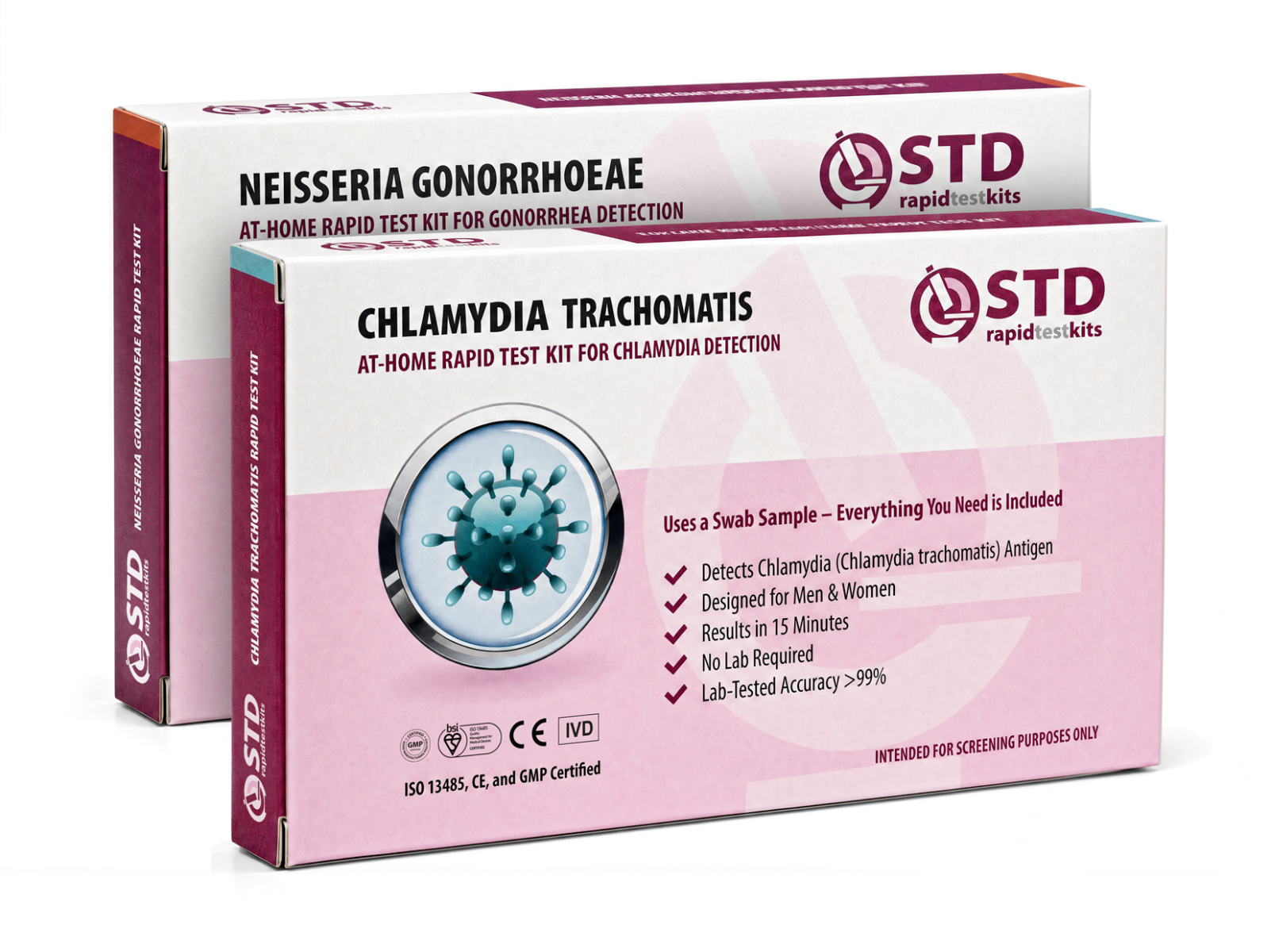
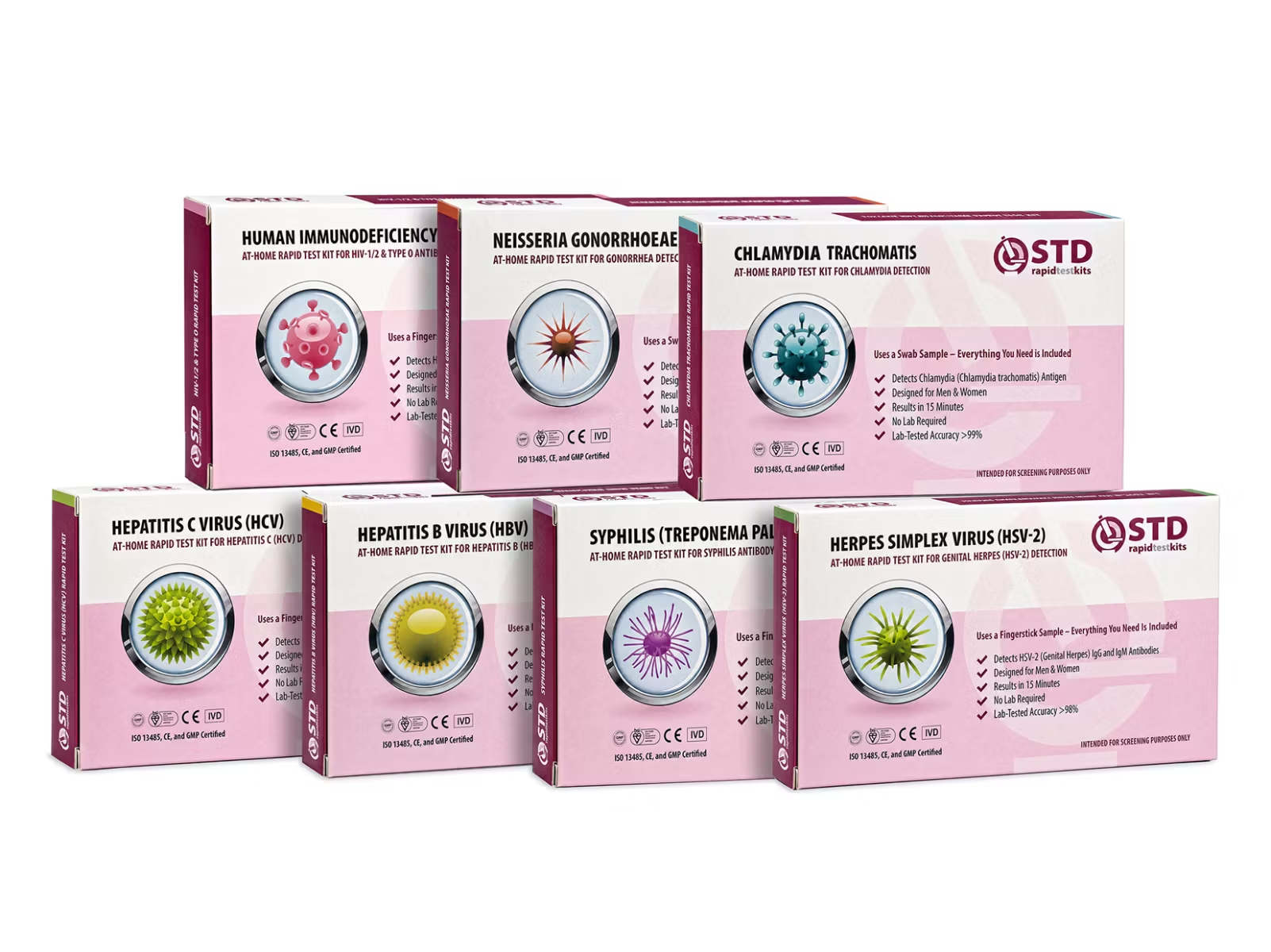
The checklist below covers the signs that point toward STI-related epididymitis. Having one or two of them after recent sex is a reason to test, not to panic. If you would rather start at home, an at-home chlamydia and gonorrhea test covers the two pathogens behind most cases, though a positive result still needs a clinician for treatment. This site sells the at-home kits linked here, and we recommend one only when it fits the concern. For sample types we do not offer at home, such as a urine NAAT or a scrotal ultrasound, we say so plainly and point you to a clinic.
Signs That Point to STI-Related Epididymitis
Having one or two of these after recent sex is a reason to test, not to panic. Only a test can confirm an infection. Sudden, severe pain with nausea is a separate emergency: go to an ER.
- A dull ache or heaviness on one side of the scrotum Common
- Burning or stinging when you urinate Common
- A white, yellow, green, or clear discharge from the penis Common
- Swelling, warmth, or redness on one side of the scrotum Common
- A frequent urge to urinate with little coming out Less common
- Pain during or after ejaculation Less common
- A low-grade fever or tender, swollen lymph nodes in the groin Less common
Epididymitis vs Torsion: How to Tell Them Apart
The two conditions can look alike in the first hour, then diverge in ways worth knowing. Onset speed is the single most useful clue: torsion announces itself in minutes, while epididymitis builds across hours or days. A second tell is the cremasteric reflex, which a clinician checks by lightly stroking the inner thigh to see if the testicle pulls upward. In torsion that reflex is usually absent on the affected side; in epididymitis it is usually preserved. A Doppler ultrasound settles it either way.
Epididymitis vs Testicular Torsion
| Feature | Epididymitis | Testicular torsion |
|---|---|---|
| Onset | Gradual, over hours to days | Sudden, within minutes |
| Usual cause | Bacterial infection, often an STI | Spermatic cord twists, cutting off blood flow |
| Pain on touch | Tender along the back of the testicle | Whole testicle painful, often firm |
| Position | Normal scrotal position | Affected testicle may sit higher |
| Cremasteric reflex | Usually preserved | Usually absent on the affected side |
| Other signs | Burning urination, possible discharge, low fever | Nausea, vomiting, abdominal pain |
| Most affected ages | Under 35 (STI); over 35 (urinary) | Most common in teens, possible at any age |
| Treatment | Antibiotics, usually outpatient | Emergency surgery to untwist the cord |
Onset speed is the fastest way to tell them apart; an ultrasound confirms it.
The Torsion Clock
The phrase golden window comes up constantly in urology and emergency medicine. It refers to the first six hours after torsion symptoms begin, when surgical untwisting, called orchiopexy, gives the best chance of saving the testicle. After that, the odds fall steeply, and StatPearls notes salvage becomes rare once more than 24 hours have passed (NIH StatPearls, testicular torsion).
Reported salvage rates vary by study and population, so the figures below are commonly cited approximations rather than guarantees. The pattern is what matters: every hour after the cord twists lowers the odds.
| Time after onset | Approximate salvage rate | What it means |
|---|---|---|
| 0 to 6 hours | About 90 to 100% | Best window for full recovery if untwisted surgically |
| 6 to 12 hours | About 50 to 75% | Odds start to drop; urgent surgery still warranted |
| 12 to 24 hours | About 20 to 50% | Damage often advanced; decision based on viability |
| Over 24 hours | Rare; testicle often non-viable | Removal (orchiectomy) may be needed |
What Else Could It Be?
Plenty of testicle pain has nothing to do with infection or torsion. The Cleveland Clinic groups several non-infectious causes that get mistaken for an STI at first glance (Cleveland Clinic, testicular pain).
Blunt trauma is the most familiar: a sports impact, a bike crash, or a fall brings immediate sharp pain, bruising, and swelling that usually settles with rest, ice, and scrotal support over a few days. A clinic visit is still worth it if swelling is severe or a blood collection, called a hematocele, forms, since that occasionally needs drainage. A varicocele is a tangle of enlarged scrotal veins that aches more after standing or exercise and feels like a bag of worms above the testicle. A hydrocele is a soft, mostly painless fluid swelling. Inguinal hernias push a loop of bowel toward the scrotum and hurt with lifting or coughing. Kidney stones can refer cramping pain from the flank down into the groin and testicle, usually with nausea and blood in the urine. Prostatitis, more common past age 30, can send a deep pelvic ache into the testicle alongside urinary urgency and sometimes fever. None of these show up on a swab or a blood test; they show up on an ultrasound or a clinic exam.
Testicular cancer is rare and usually shows up as a painless lump or a firm change in size, not as pain, though some men describe a vague heaviness. Any new lump, hardness, or asymmetry deserves a clinical exam whether or not it hurts.
| Cause | Pain pattern | Other signs | What to do |
|---|---|---|---|
| Chlamydia or gonorrhea epididymitis | Gradual one-sided ache, builds over days | Possible burning urination, discharge, mild fever | STI test plus a clinician within 24 to 72 hours |
| Testicular torsion | Sudden, severe, constant | Nausea, vomiting, high-riding testicle, belly pain | ER immediately; surgical emergency |
| Trauma or strain | Aches after exertion, usually fades in hours | Recent injury or hard workout, no fever | Rest and ice; clinic if no better in 24 to 48 hours |
| Varicocele | Dull ache, worse with standing or exertion | Enlarged veins that feel like a bag of worms | Urology referral, often non-urgent |
| Hydrocele | Heavy, mostly painless swelling | Soft, fluid-filled enlargement of the scrotum | Urology referral, often non-urgent |
| Inguinal hernia | Pain with lifting or straining | Bulge near the groin or scrotum | Clinician evaluation; may need surgical repair |
| Kidney stones (referred) | Cramping that radiates from flank to groin | Back pain, nausea, blood in the urine | Urgent care and imaging |
| Prostatitis (older men) | Deep pelvic ache that refers to the testicle | Urinary frequency, painful urination, fever | Clinician evaluation and urine test |
Pain That Shows Up After Sex
Some pain does not arrive during sex. It shows up the next morning, or two days later, as an ache after ejaculation or a soreness that flares in certain seated positions or after a long drive. Mild soreness from frequent activity usually fades within a day.
What is different is pain that lingers past two days, or pain paired with burning urination, scrotal swelling, or any unusual discharge. That combination fits the epididymitis pattern. The exposure that started it can be a week or two back, sometimes longer, and oral sex counts: chlamydia and gonorrhea can colonize the throat and pass on during later oral or genital contact, even when penetration was protected. If pain after sex has not eased within 48 hours, an STI screen is the smartest first step, even if you tested recently, because reinfection is common when only one partner gets treated.
Treat a post-sex testicle ache as an epididymitis flag rather than a pulled muscle when any of these show up:
- Pain still present beyond 48 hours, or getting worse instead of better.
- Burning or stinging during urination.
- Swelling or warmth on one side of the scrotum.
- Any unusual discharge, even a small amount of clear fluid.
- A low-grade fever or tender lymph nodes in the groin.
Any one of these is reason enough to test for chlamydia and gonorrhea and to book a clinician within 24 to 72 hours.
Pain That Comes and Goes
Intermittent testicle pain has its own logic. It might flare after hours on a hard chair, then ease when you lie down. It might follow sex, or show up with no pattern at all.
Common explanations include nerve irritation, low-grade chronic inflammation, an unresolved varicocele, or chronic epididymitis that lingers after the original infection clears. One uncommon but important pattern is intermittent torsion, where the cord twists and untwists with episodes that resolve before damage sets in. Recurring sharp episodes, especially in younger men, deserve a urology evaluation rather than another round of waiting. An STI test early on clears the most common bacterial causes from the list, which also helps with the anxiety that uncertainty tends to feed.
Intermittent testicle pain is usually benign, but a few patterns call for a urology evaluation rather than more waiting:
- Recurring sharp episodes that come on suddenly and resolve within minutes to hours, especially in men under 25 (possible intermittent torsion).
- Pain that keeps following the same trigger (a specific position, lifting, sitting) for weeks.
- A negative STI test alongside symptoms that persist or worsen past two weeks.
- A palpable lump, a change in firmness, or a vein cluster that feels like a bag of worms.
Home Test, Clinic, or ER?
Your next step follows from how the pain started and how severe it is.
Go to an ER now if pain is sudden and severe, especially with nausea, vomiting, or a testicle that sits higher or looks different. That is the torsion path, and it does not wait.
Start with a home rapid test plus a clinician follow-up if pain built gradually over a day or two, you have had recent sex, and there is no other obvious cause. A self-collected swab can detect chlamydia and gonorrhea reasonably well during a symptomatic infection. It helps to understand the test technology here: at-home rapid kits are lateral-flow immunoassays, while clinical labs use NAAT, which has higher analytical sensitivity, especially for infections without symptoms. The two are complementary rather than interchangeable. A positive home result is informative and worth acting on; a negative result with continuing symptoms still warrants a clinic NAAT. If you tested within a few days of exposure and it was negative, retest at 7 to 14 days, since bacterial loads need time to build. For a wider net, our range of at-home STI test kits bundles several infections into one session.
Book a clinic visit if there is significant swelling, fever, severe burning, a palpable lump, or pain lasting more than two to three days. A physical exam, urine test, and ultrasound can sort out what home testing alone cannot.
| Option | Best for | Speed | Privacy |
|---|---|---|---|
| Rapid home test | Symptoms plus a recent exposure; fast triage | Result in about 15 minutes | Maximum |
| Clinic NAAT (lab) | Asymptomatic screening; confirming a positive home test | 1 to 3 business days | Moderate |
| ER or urgent care | Severe pain, swelling, or possible torsion | Same day, often within hours | Lower |
Recovery and Fertility
Recovery looks different for the two main culprits. Epididymitis from a bacterial STI usually responds within 48 to 72 hours of the right antibiotic, with pain easing first and swelling settling over one to two weeks. The CDC's standard regimen for STI-related epididymitis is a single ceftriaxone injection plus a ten-day course of doxycycline (CDC, epididymitis treatment guidelines). Most cases clear without complication when treated promptly. Left untreated, the inflammation can turn chronic and scar the tubes that carry sperm, which is one of the routes by which untreated STIs reduce fertility. That fertility risk is the main reason to test rather than ride it out, and it is far more often avoided when the infection is caught early.
Torsion recovery depends on whether the testicle was saved. Untwisted within the golden window, full function usually returns, and surgeons commonly secure the other side at the same time because the predisposing anatomy often affects both. If the testicle could not be saved, the remaining one usually keeps hormone and fertility function normal, though the emotional adjustment is real and worth taking seriously. If fertility is a future priority, ask about a semen analysis after a torsion event or repeated epididymitis; it gives a clearer picture than guessing.
Recovery contrast at a glance
- Epididymitis: pain usually eases within 48 to 72 hours of the right antibiotic, with full resolution over one to two weeks. Untreated, it can scar the sperm-transport tubes.
- Torsion with the testicle saved: function usually returns, and surgeons often secure the other side at the same time as a precaution.
- Torsion with the testicle lost: the remaining testicle usually keeps hormone and fertility function normal; a semen analysis is the clearest way to confirm.
Talking to Partners
If the cause is an STI, partner notification matters, because reinfection is one of the main reasons epididymitis comes back. The CDC recommends that sex partners from the 60 days before symptoms began be evaluated, tested, and treated, even when they have no symptoms (CDC, chlamydial infections treatment guidelines).
The conversation does not have to be elaborate. Plain language works better than a rehearsed speech: "I tested positive for chlamydia, you should get tested too, and treated if it is positive." If direct contact feels impossible, anonymous notification services such as TellYourPartner.org will send a text-based heads-up without revealing your identity, and many local health departments offer the same.
For a positive STI result, the message has three parts, in any order:
- The result. I tested positive for chlamydia (or gonorrhea).
- Why they should test. You may be carrying it without symptoms, and untreated infections can cause complications.
- Why they should treat anyway. The CDC suggests partners from the last 60 days be treated even if a test is negative, because early infection can fall inside the testing window.
If a direct conversation feels impossible, anonymous partner-notification services through local health departments, or platforms like TellYourPartner.org, will pass the message along for you.
When to Retest
Retesting timing depends on where you are in the exposure and treatment timeline, and three different situations tend to get mixed up. There is the early-window retest, the post-treatment re-screen, and the routine check after a new partner. The table below keeps them separate. One rule cuts across all three: while you are being treated, pause sex until both you and your partner have finished treatment and any waiting period your clinician sets, usually about seven days after a single-dose regimen.
| Scenario | Timing | Recommended action |
|---|---|---|
| Early test was negative but symptoms continue | 7 to 14 days from exposure | Retest at home or with a clinic NAAT; bacterial loads need time to build |
| After finishing antibiotics | About 3 months later | Re-screen for chlamydia and gonorrhea to catch reinfection (not a test of cure) |
| After a new partner | Routine, no symptoms needed | Standard STI screen with each new partner |
What to Do Next
Three signals decide the next move, and they map cleanly onto how the pain started. The quick check below runs through them in order, from the one emergency that cannot wait to the slower patterns that still deserve a test or a clinic visit.
Testicle Pain: What Should I Do Right Now?
Did the pain come on suddenly and severely, with nausea, vomiting, or one testicle sitting higher than usual?
Yes: Go to an emergency room now. This is the testicular torsion pattern, and the window to save the testicle is roughly six hours. Do not wait it out or test at home.
Has the pain built gradually over a day or two, with recent sexual activity and no other obvious cause?
Yes: Start with an at-home rapid swab for chlamydia and gonorrhea, and book a clinician within 24 to 72 hours regardless of the result.
Has the pain lasted more than two to three days, or is there a lump, fever, significant swelling, or a negative home test with ongoing symptoms?
Yes: See a clinician in person for a physical exam, ultrasound, and lab NAAT, which can find causes a home test cannot.
No: If a mild ache is clearly muscular and easing on its own, watch it for 24 to 48 hours, and still test for STIs if you have had recent partners.
Guidance only. A clinician can advise based on your specific situation.
FAQs
- Can an STI cause testicle pain when I have no other symptoms?
- Yes, and it is more common than people expect. Chlamydia and gonorrhea can inflame the epididymis without the discharge or burning many people associate with STIs, and the World Health Organization notes most curable STIs are asymptomatic. Oral sex counts too: both infections can colonize the throat and pass on during later contact. If pain has built over a day or two and you have had recent sex of any kind, a test is the most useful first step.
- I have not had sex in months. Could this still be an STI?
- It can. Chlamydia in particular can stay quiet for weeks, so the infection that started it may be older than the pain you are feeling now. A recent dry spell does not rule it out, and a test is the cleanest way to know.
- How do I tell torsion from epididymitis?
- Speed of onset is the biggest clue. Torsion arrives in minutes and is severe, often with nausea and a testicle that sits higher than the other. Epididymitis builds over hours or days and tends to come with burning urination or a low fever. A Doppler ultrasound is the definitive test. If onset was sudden and severe, go to the ER instead of trying to sort it at home.
- Should I test at home or go to a clinic when one testicle hurts?
- Decide by speed and severity. Sudden, severe pain with nausea is an ER call. Gradual pain after a recent exposure is a reasonable place to start with a home rapid swab for chlamydia and gonorrhea, while planning a clinician follow-up either way. A clinic visit is the right call if pain has lasted more than two to three days, there is a lump, or there is significant swelling.
- How long is too long to wait?
- For sudden severe pain, zero hours: go now. Pain that has lingered past 48 hours, especially with fever, urinary burning, or swelling, is the standard threshold for getting checked. A mild ache that is clearly muscular and improving on its own can be watched for 24 to 48 hours.
- Does testicle pain mean my fertility is at risk?
- Most chlamydia and gonorrhea infections caught and treated early do not affect fertility. The risk comes from leaving an infection untreated, which can scar the epididymis and the tubes that carry sperm. That is the main reason to test rather than wait it out. If you have had a torsion event or repeated epididymitis, ask a clinician about a semen analysis.
- Could testicle pain be cancer?
- It is uncommon. Testicular cancer usually shows up as a painless lump or a firm change in shape rather than as pain, though some men describe a vague heaviness. Any new lump, asymmetry, or change in firmness deserves a clinical exam whether or not it hurts.
- My home test was negative but the pain is still there. Now what?
- Retest in 7 to 14 days if it has been less than a week since a possible exposure, since the first test may have been too early. If repeat testing stays negative and the pain persists, see a clinician for an ultrasound to check for torsion, varicocele, hydrocele, hernia, prostatitis, or referred pain. A negative STI panel does not mean nothing is wrong; it means the most common bacterial causes are ruled out.
- U.S. Centers for Disease Control and Prevention. STI Treatment Guidelines: Epididymitis. Used for the sexually transmitted causes (chlamydia, gonorrhea, Mycoplasma genitalium) and the recommended antibiotic regimen of ceftriaxone plus doxycycline.
- U.S. Centers for Disease Control and Prevention. STI Treatment Guidelines: Chlamydial Infections. Used for partner management, including evaluating and treating sex partners from the 60 days before symptom onset.
- U.S. Centers for Disease Control and Prevention. About Gonorrhea. Used for male symptoms, including white/yellow/green penile discharge, burning urination, and painful or swollen testicles, plus the note that infection is often asymptomatic.
- U.S. National Library of Medicine, NCBI Bookshelf. StatPearls: Testicular Torsion. Used for the six-hour salvage window and the time-dependent salvage-rate approximations.
- U.K. National Health Service (NHS). Epididymitis. Used for the under-35 STI cause versus over-35 urinary cause stratification.
- U.K. National Health Service (NHS). Testicle pain. Used for the emergency thresholds and when to seek in-person care.
- Cleveland Clinic. Testicular pain. Used for the non-infectious causes that mimic an STI: varicocele, hydrocele, kidney stones, and inguinal hernia.
- World Health Organization. Sexually transmitted infections (STIs) fact sheet. Used for the global STI burden and that the majority of curable STIs are asymptomatic.
