Published: November 2025 | Last updated: May 2026 | Editorial review and quality control: Martina N.
At-home sexual health testing has changed faster in the last two years than in the previous decade. The U.S. Food and Drug Administration cleared the first fully at-home self-test for chlamydia and gonorrhea in late 2023, the first at-home self-collection HPV test in 2024, and a wave of newer rapid kits arrived through 2025. Public health officials have started saying out loud what advocates have argued for years: when testing is private, fast, and reachable from a phone, more people get tested. That matters because the U.S. saw STI cases plateau and start to edge downward for the first time in a decade in 2023, and broader self-test access is one of the working theories for why.
This guide is for the person who has been meaning to test, hesitating about a clinic visit, or trying to figure out which of the dozen options online is actually worth your money. It explains what the new self-test landscape offers in 2026, how at-home rapid tests differ from a clinic NAAT or a mail-in lab kit, when each one is the right tool, and what to do with a positive result. The short version: at-home self-tests are useful screening for several common infections. They sit alongside clinic and lab testing rather than replacing either. Knowing which to reach for, and when, takes a few minutes to learn and saves a lot of time later.
Key Takeaways
- FDA-cleared at-home self-tests now cover chlamydia, gonorrhea, HPV, HIV, syphilis, hepatitis B and C, and herpes, with most rapid kits returning a result in 15 to 30 minutes from a fingerstick blood drop or a self-collected swab.
- Timing the test against the infection's window period is what makes home results trustworthy: bacterial STIs need 7 to 14 days post-exposure, antibody-based blood tests need 3 to 12 weeks.
What's New About At-Home STD Self-Tests in 2025 to 2026
The biggest shift is regulatory. Until 2023, the FDA had cleared one at-home HIV oral-fluid test, a handful of mail-in collection kits where the lab still does the analysis, and basically nothing for chlamydia or gonorrhea you could read at your kitchen table. In late 2023 the agency cleared the first fully at-home test for those two infections that uses self-collected swabs and gives a result without a lab. In 2024, the first at-home self-collection HPV test arrived for cervical cancer screening, letting people with a cervix swab themselves at home and mail the sample to a partner laboratory.
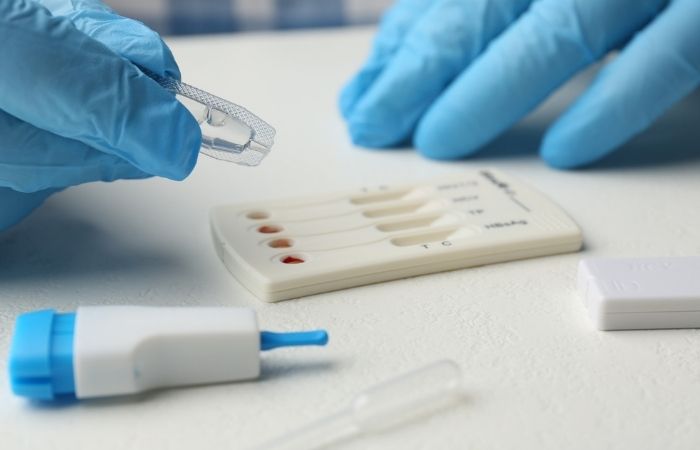
2025 added more rapid lateral-flow kits for HIV, syphilis, hepatitis B, hepatitis C, and the herpes simplex viruses. Several of these kits use a fingerstick blood drop and read like a pregnancy test, with control and result lines on a small cassette. Others bundle multiple tests into one combination kit, so a single self-collection session screens for the most common infections at once.
Why this is happening now: STI rates climbed steadily through the 2010s and into the early 2020s, peaked, and have started leveling off. The U.S. CDC's STI program reported the first nationwide drop in syphilis cases among most groups in 2023 in over two decades. Public health authorities and several recent reviews credit a mix of expanded screening access (including at-home tests), faster treatment pathways, and renewed condom-use messaging, and at-home self-testing is one part of that mix that any reader can act on tonight.
This article is published by stdrapidtestkits.com, which sells at-home rapid lateral-flow STI test kits. Our recommendations cover screening fits where our products are useful and explicitly flag the situations where a clinic NAAT, a mail-in lab kit, or an in-person evaluation is the better tool. We do not sell urine-sample tests, throat swabs, or rectal swabs.
What Counts as an At-Home STD Test
The phrase "at-home STD test" covers three different categories, and reading them as the same thing leads to a lot of confusion. The first is a fully at-home rapid test: you self-collect a sample (a swab, or a fingerstick blood drop), apply it to a cassette or strip, and read the result yourself in 15 to 30 minutes. The second is a mail-in self-collection kit: you collect at home, ship the sample to a partner laboratory, and the lab runs a high-sensitivity NAAT (nucleic-acid amplification test) and reports a result through a secure portal in a few days. The third is a hybrid: an at-home rapid screen, plus a confirmatory mail-in sample if the rapid test reads positive.
The technologies are different. Rapid lateral-flow tests detect a specific protein (an antigen) or your body's antibodies against the infection, which is fast but less sensitive than NAAT, especially in early or asymptomatic infections. Lab-processed NAAT tests amplify the genetic material of the infection itself, which is what the CDC's STI treatment guidelines call the "gold standard" for chlamydia and gonorrhea. Both have a place. A rapid test gives you a fast first read; a lab NAAT confirms borderline or asymptomatic cases.
Sample types you'll see at home include self-collected vaginal or penile swabs (for chlamydia, gonorrhea, HPV, and trichomoniasis), fingerstick blood drops (for HIV, syphilis, hepatitis B and C, and HSV antibodies), and oral-fluid swabs (for HIV only). Urine collection is mostly used in clinics rather than at-home rapid kits because it complicates the lateral-flow chemistry. Most products marketed as "at-home urine tests" online turn out to be mail-in lab kits rather than fully at-home rapid results, so check the listing carefully before you buy.
Window Periods: When Each Test Becomes Reliable
Every STI test has a window period: the time between exposure and when the test can reliably detect the infection. Test too early and a negative result does not actually rule infection out, because the body has not yet made enough antibodies, antigen, or detectable bacterial load. Window periods are the single biggest reason an at-home test fails to do its job. Most of the failure cases are people testing one or two days after exposure and trusting the negative.
The numbers below summarize current CDC testing guidance and standard package-insert windows for at-home rapid kits. Use the "earliest reliable" column as the floor; results are most trustworthy at the "peak" timing.
| Infection | Common at-home sample | Earliest reliable test | Peak detection window |
|---|---|---|---|
| Chlamydia | Self-collected swab | Day 7 to 14 post-exposure | 14 days and beyond |
| Gonorrhea | Self-collected swab | Day 7 to 14 post-exposure | 14 days and beyond |
| Trichomoniasis (women-only home test) | Vaginal self-swab | Day 5 to 28 post-exposure | 2 to 4 weeks |
| HIV (4th-gen Ag/Ab) | Fingerstick blood | About day 18 and later | 45 to 90 days |
| Syphilis (treponemal antibody) | Fingerstick blood | 3 to 6 weeks | 6 to 12 weeks |
| Hepatitis B (HBsAg) | Fingerstick blood | 3 to 6 weeks | 8 to 12 weeks |
| Hepatitis C (anti-HCV) | Fingerstick blood | 8 to 11 weeks | 11 to 16 weeks |
| HSV-1 / HSV-2 (antibody) | Fingerstick blood | 3 to 6 weeks | 12 weeks for most people; up to 16 weeks on some assays |
| HPV (women-only home test) | Vaginal self-swab | Routine screening only | Screening, not exposure-based |
At-Home Rapid vs Mail-In Lab vs Clinic Visit
Three options exist, and the right one depends on what you actually need. An at-home rapid test gives you a 15-to-30 minute answer in your bathroom and is the most private option available. A mail-in lab kit pairs at-home self-collection with lab-grade NAAT analysis, which is more sensitive but takes a few days. A clinic visit is the slowest and least private of the three, but it gets you treatment in the same appointment if you have symptoms, plus speculum, pelvic, or rectal and throat swabs that you cannot do at home.
The accuracy difference between rapid and lab is real but smaller than people often assume. For chlamydia and gonorrhea, lateral-flow rapid tests typically report sensitivity in the high 80s to mid-90s percent depending on whether the person has symptoms, with specificity consistently above 95 percent. Lab NAAT pushes both numbers above 99 percent. For HIV, syphilis, and hepatitis, fingerstick rapid tests post-window perform similarly to lab tests at over 99 percent sensitivity and specificity. The practical takeaway: a positive rapid test is usually right, and a negative rapid test late in the window is usually right too. A negative rapid test inside the window is the tricky case.
| Method | Privacy | Speed | Sensitivity | Best when |
|---|---|---|---|---|
| At-home rapid lateral-flow | Highest (no labs, no portals) | 15 to 30 minutes | High past window, moderate inside window | You want fast private screening or routine peace of mind |
| At-home self-collection mail-in NAAT | High (sealed mail, online portal) | 2 to 5 days post-mailing | Lab-grade | You want the most sensitive at-home option and can wait |
| Clinic visit (NAAT plus exam) | Low to moderate | Same-day to several days | Lab-grade plus exam findings | You have symptoms, possible PID risk, throat or rectal exposure, or want same-visit treatment |
When to Test After a Possible Exposure
If your possible exposure was less than 5 days ago and you have no symptoms, the most useful thing to do is wait. A test taken 24 hours after a condom slip will almost always be negative even if infection occurred, because the bacteria or virus have not yet replicated to detectable levels. Waiting until day 7 to 14 for bacterial STIs lets the test actually do its job. If you have symptoms (burning, discharge, sores, fever, pelvic pain), do not wait: see a clinic, because symptoms warrant evaluation regardless of test timing, and clinics can treat empirically while waiting on results.
For asymptomatic potential exposures, the practical schedule is: at 14 days post-exposure, test for chlamydia, gonorrhea, and trichomoniasis. At about 6 weeks, test for HIV (a 4th-gen rapid antigen/antibody catches most acute infections by then), syphilis, and hepatitis B. At 12 weeks, retest for HIV and add herpes if relevant. Multiple test points reflect the different seroconversion clocks for each infection. One test at one time point cannot cover all of them.
If you are a regular partner of someone who tested positive, retest yourself at the same intervals after their exposure date, even if you have already tested negative once. A meaningful share of people who initially test negative after a possible chlamydia or gonorrhea exposure will turn positive on a follow-up test 2 to 3 weeks later, especially if a second exposure happened in between.
Privacy, Shipping, and Discretion
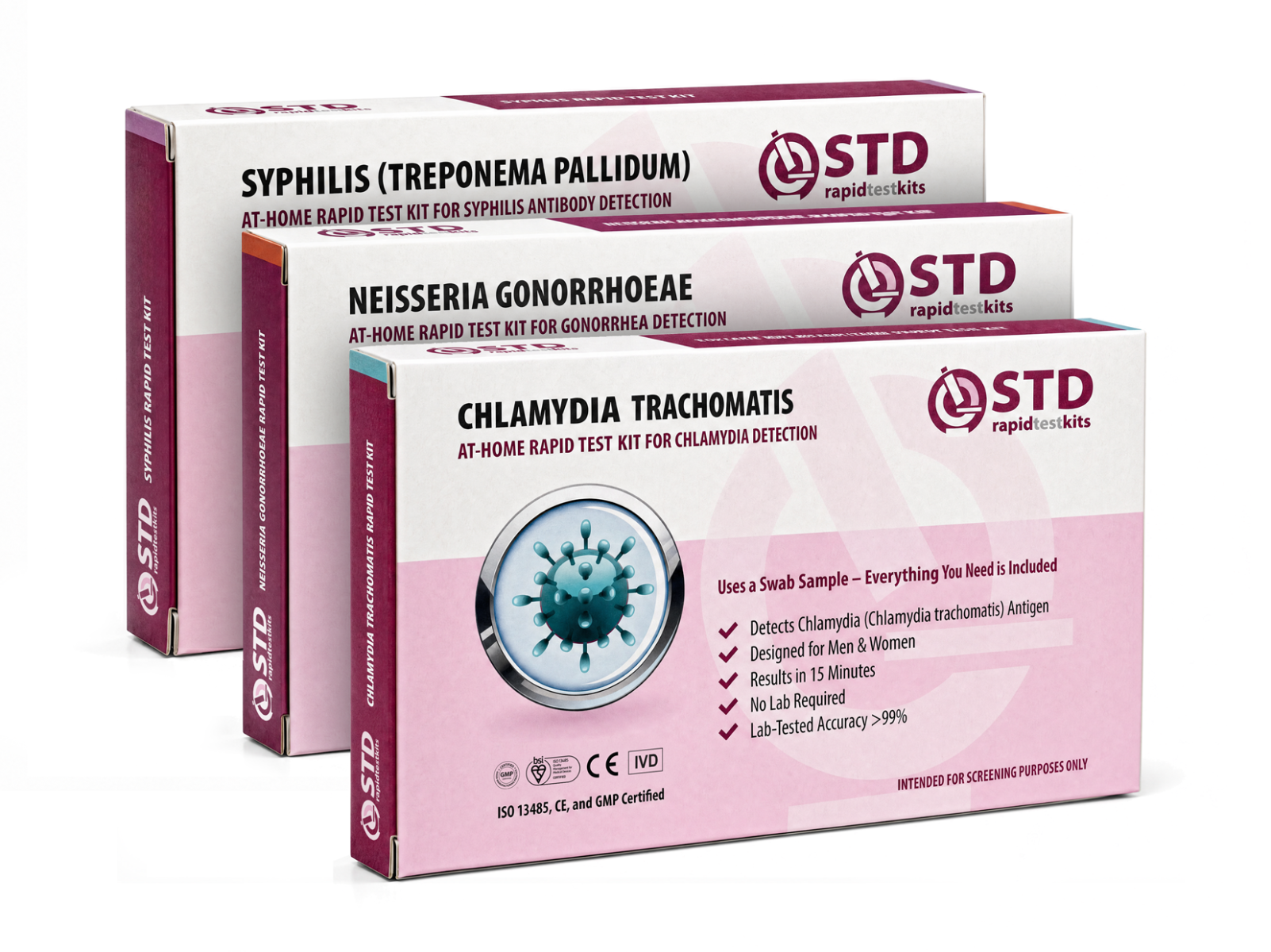
The privacy concern is real. People avoid clinics for many reasons, and showing up on a small-town pharmacy's checkout receipt or an insurance claim is one of them. At-home self-tests handle this in a few specific ways. Packaging from reputable sellers arrives in plain envelopes or boxes with no exterior labels indicating the contents. Inside, components are individually sealed. Online accounts use generic billing descriptors so credit-card statements do not read "STD test."
Shipping in the U.S. typically takes 2 to 5 business days; some sellers offer overnight to specific zip codes. If your living situation makes a doorstep delivery awkward, P.O. boxes, work addresses, and locker services like Amazon Hub all work. Several sellers, including ours, will hold a kit in stock against your account so you can request shipment the same day a possible exposure happens.
For mail-in lab kits specifically, U.S. labs that report to public-health departments are required to flag positive results for certain reportable infections (syphilis, gonorrhea in some states, HIV in many states). At-home rapid tests do not report anywhere; the result lives on your cassette and in your head until you tell someone. Confidentiality matters around work, family, and partner-notification timing, so the no-reporting feature of at-home rapid tests is worth weighing if your situation is delicate.
Buying a kit before you need it is the single best thing you can do for stress management. The day after a condom slip is not the day you want to be researching test options. Order what makes sense for the infections you would actually want to screen for, store it at room temperature, and you can act in 20 minutes when timing matters.
If Your Result Is Positive
A positive at-home result is informative but not the end of the workflow. The next steps depend on the infection, the test technology, and where you are in the window period. The general structure is: confirm, treat, notify, retest.
Confirm with a more sensitive test. For most rapid lateral-flow tests, the manufacturer recommends confirmatory testing through a clinic NAAT or a serology blood draw. Confirmation is the standard pathway for any positive screening test. Home pregnancy tests, blood-glucose monitors, and lab-based screens follow the same logic. Confirmation matters most for syphilis (rapid antibody tests can read positive from a treated past infection), HSV (antibody cross-reactivity between HSV-1 and HSV-2 happens), and HIV (every initial reactive result needs a confirmatory algorithm per CDC HIV testing guidance).
Treat as soon as you have a confirmed positive. Chlamydia, gonorrhea, syphilis, and trichomoniasis are curable with antibiotics. Most can be prescribed via telehealth in U.S. states where it is legal, often the same day you upload your test result. The 2021 CDC STI Treatment Guidelines shifted gonorrhea first-line therapy to injectable ceftriaxone due to growing antibiotic resistance, and ceftriaxone remains the standard while novel oral candidates are in late-stage trials. HIV treatment is lifelong but highly effective; modern antiretroviral therapy reduces viral load to undetectable in most people within months and to undetectable-equals-untransmittable status. HSV is managed with antivirals rather than cured. HPV is usually cleared by the body on its own, with follow-up colposcopy or HPV-specific Pap testing to manage cervical-cancer risk for high-risk strains.
Notify your recent partners. The CDC's partner services and several state health departments offer anonymous notification tools that send a partner an alert without revealing who you are. Same-day partner treatment (called expedited partner therapy) is legal in most U.S. states for chlamydia and gonorrhea.
Retest after completing treatment. Wait at least 21 days after finishing antibiotics to retest, because dead bacterial fragments can show up as a false positive on NAAT. For HIV after starting antiretrovirals, follow your provider's monitoring schedule rather than home retesting.

When a Self-Test Is Not the Right Tool
A few situations call for a clinic visit instead of, or before, a home test. The biggest categories:
Active symptoms. Pelvic pain, testicular pain, sores, fever, painful urination, abnormal discharge, or any combination of these warrants in-person care. Symptoms can mean a complication (pelvic inflammatory disease, epididymitis, disseminated infection) that needs immediate antibiotic treatment, sometimes injectable, plus a physical exam to rule out something a swab cannot detect.
Throat or rectal exposure. If your exposure was oral or anal, a genital swab will not detect a pharyngeal or rectal infection at the actual site. Pharyngeal and rectal chlamydia and gonorrhea are common in some populations and require swab samples taken from the throat or rectum, which we do not sell at-home kits for. A clinic or sexual-health center is the right place for these.
Trichomoniasis or HPV in male readers. The at-home self-test kits available for trichomoniasis and HPV are validated for vaginal self-swab only; no equivalent home test for male anatomy exists. Male readers concerned about either should see a clinic.
Pregnancy. Most at-home tests are usable during pregnancy for screening, but every positive result during pregnancy needs OB or midwife confirmation. Untreated chlamydia, gonorrhea, syphilis, or HIV in pregnancy each carry vertical transmission risks that warrant prompt clinical care, not a wait-and-retest pattern.
Recent treatment for the same infection. Re-testing too soon after antibiotics for chlamydia or gonorrhea (less than 21 days) can return a false positive on NAAT due to non-viable bacterial DNA fragments. Confirm with your provider rather than guessing from a home test.
Where Things Stand in 2026
The combination of expanded at-home testing, telehealth treatment pathways, and modernized public-health messaging is doing what advocates have argued for years it would do: bringing more infections to attention earlier, getting more people on treatment faster, and starting to bend the infection-rate curve downward. The decline in U.S. syphilis cases reported by the CDC for 2023 was the first in decades. Chlamydia and gonorrhea numbers leveled off after years of climbing. The point is catching infections early, so they can be treated and not transmitted onward.
If you have been on the fence about testing, the practical takeaway is this: pick the infections you are most worried about, look up their window periods, and either order a kit you can keep in stock or schedule a clinic visit if your situation calls for it. The privacy and speed of at-home options do not replace clinical care when symptoms are present, but they are a real, useful screening tool the rest of the time. Once you know your status, treatment, partner notification, and follow-up testing all become straightforward steps to schedule.
FAQs about at-home STD self-tests
- How accurate are at-home STD self-tests?
- Timing matters more than the chemistry. Past the window period, rapid lateral-flow kits for chlamydia and gonorrhea reach roughly 90 to 95 percent sensitivity, and blood-based rapid kits for HIV, syphilis, and hepatitis run above 99 percent. A negative result inside the window needs a follow-up; that is the real accuracy limit at home, not the test itself.
- How long should I wait after a possible exposure to test?
- For chlamydia, gonorrhea, and trichomoniasis, wait at least 7 to 14 days. For HIV with a 4th-generation rapid test, wait about 18 to 45 days for the earliest reliable result and 90 days for full confidence. For syphilis, wait 3 to 6 weeks and ideally retest at 12 weeks. For hepatitis C, wait 8 to 11 weeks. If you have symptoms, do not wait; see a clinic regardless of timing.
- Will my at-home test results be reported to anyone?
- At-home rapid tests do not report anywhere. The cassette result is yours alone unless you choose to share it. Mail-in self-collection kits processed by U.S. labs follow normal lab reporting requirements, which means certain reportable infections (HIV, syphilis, sometimes gonorrhea) may be reported to the relevant state health department by the processing lab. Check the kit's privacy policy if this matters for your situation.
- Can I get treatment without going to a clinic?
- In many cases, yes. U.S. telehealth services often prescribe oral antibiotics for chlamydia, gonorrhea, and trichomoniasis after reviewing a positive home test result. Same-day prescriptions to a local pharmacy are common in states where telehealth-prescribed antibiotics are legal. Injectable treatment (some gonorrhea cases, syphilis) and management of complications still require an in-person visit.
- Is there an at-home self-test for HPV yet?
- Yes. The FDA cleared the first at-home self-collection HPV test in 2024. People with a cervix can use a self-collected vaginal swab and mail it to a partner laboratory for high-risk HPV strain detection. The test is validated for vaginal self-collection only; no equivalent at-home HPV test exists for male anatomy. It functions as periodic screening for cervical cancer risk, similar to a Pap test, and does not have a typical exposure-based window period.
- Are at-home tests safe to use during pregnancy?
- Most at-home self-tests are safe to use during pregnancy as a screening step, especially for chlamydia, gonorrhea, HIV, and syphilis. Any positive result needs OB or midwife confirmation. Untreated bacterial STIs in pregnancy carry vertical transmission risks, so a positive home test is a reason to schedule prenatal follow-up the same week rather than waiting.
- How do I bring up testing with a new partner?
- Direct works better than oblique. A line like "I get tested every few months and I keep home kits at home; want to test together before things go further?" frames it as standard practice rather than an accusation. Normalizing testing as part of dating health is the cultural shift the new self-test access is making easier.
- Can I reuse a kit if I made a mistake?
- Lateral-flow cassettes, swabs, and buffer reagents are validated as single-use. Re-using a swab risks cross-contamination, and lateral-flow strips lose sensitivity once exposed to buffer. If you mess up the collection or read a result outside the manufacturer's time window, throw the kit out and use a fresh one.
How we sourced this article: We combined current guidance from leading U.S. and global public-health authorities with FDA package-insert windows for representative at-home rapid tests, then translated the result into plain language for readers who are deciding what to do this week. The CDC's STI program, treatment guidelines, and self-testing guidance pages were the primary references for window periods, accuracy figures, and self-test approval timelines. The HSV-1 and HSV-2 antibody window cited in the table reflects the standard CDC 12-week seroconversion timing, with the 16-week upper bound noted as an outlier observed on specific assays such as the HerpeSelect IgG ELISA. The WHO STI fact sheet and MedlinePlus were used for plain-English background. We did not cite news articles or advocacy sites for clinical figures.
- U.S. Centers for Disease Control and Prevention. STI Treatment Guidelines, used for window periods, treatment regimens, and gold-standard test methodology, including the 2021 update of gonorrhea first-line therapy.
- U.S. Centers for Disease Control and Prevention. Getting Tested for STIs, used for testing recommendations and at-home test guidance.
- U.S. Centers for Disease Control and Prevention. Sexually Transmitted Infections, CDC root program page; for current surveillance reports see the STI Statistics section linked from this page. Used for U.S. infection-rate trends including the 2023 syphilis decline.
- U.S. Centers for Disease Control and Prevention. HIV Testing, used for HIV window period and confirmatory testing algorithm.
- World Health Organization. Sexually transmitted infections health topic, used for global context on testing access and prevention.
- U.S. National Library of Medicine, MedlinePlus. Sexually Transmitted Infection (STI) Tests, used for plain-English background on test methodology.
