Published: November 2025 | Last updated: May 2026 | Editorial review and quality control: Martina N.
Noticing a sore in your mouth a few days after oral sex sets off a particular kind of worry. You catch it brushing your teeth, or eating something acidic, and suddenly you are scanning your tongue and inner cheeks for anything that looks new. Most mouth sores are not sexually transmitted. They are canker sores, minor trauma from brushing or food, or viral irritation unrelated to sex. But some are, and three infections account for almost all the ones that are: oral herpes, syphilis, and oral HPV.
This guide walks through what each of those looks like, how they differ from canker sores, when symptoms typically show up after exposure, and which tests are useful at which point.
Key Takeaways
- Painful clustered blisters that turn into shallow ulcers point toward oral herpes; a single painless round ulcer with firm edges points toward syphilis; cauliflower-like painless bumps point toward oral HPV.
- An active lesion is best diagnosed by a clinic swab or PCR test; at-home blood antibody tests are useful for systemic confirmation weeks after the sore is gone, not for identifying the sore itself.
How Mouth Sores Differ by Cause
When clinicians look at an oral lesion, they sort it into one of three visual categories before anything else. Is it an ulcer (an open break in the lining of the mouth), a chancre (a particular kind of ulcer with very clean edges and no pain), or a growth (a bump or rough patch that does not break open)? Each category points toward a different short list of causes, and each behaves differently over time.
That visual sort is also the most reliable thing you can do at home. You will not be able to tell which specific infection it is from a mirror, but you can usually tell which category you are in, and that decides what kind of test makes sense next.
| Type | What it looks like | Pain level | Common STI cause |
|---|---|---|---|
| Ulcer cluster | Multiple small shallow open sores with red border and white or yellow center, often preceded by blisters | Usually painful | Herpes simplex (HSV-1 or HSV-2) |
| Single chancre | Round, clean ulcer with firm edges, base looks smooth not inflamed | Usually painless | Syphilis (primary stage) |
| Growth or wart | Raised flesh-colored, white, or pink bump; sometimes cauliflower-textured; does not break open | Painless | Oral HPV |
| Persistent discolored patch | Flat or slightly raised red, purple, or brown patch that does not heal | Painless | Rare; can be Kaposi sarcoma in immunocompromised people |
The Painful Pattern: Oral Herpes
Oral herpes is by far the most common STI cause of mouth lesions, and the one most people are unknowingly carrying. The World Health Organization estimates that around 3.8 billion people under age 50, about two-thirds of people in that age group, have HSV-1 infection, the type most commonly responsible for oral lesions. A first outbreak after oral sex with someone shedding the virus can be the visible event that finally makes a long-standing infection symptomatic, or a brand-new infection picked up at the encounter.
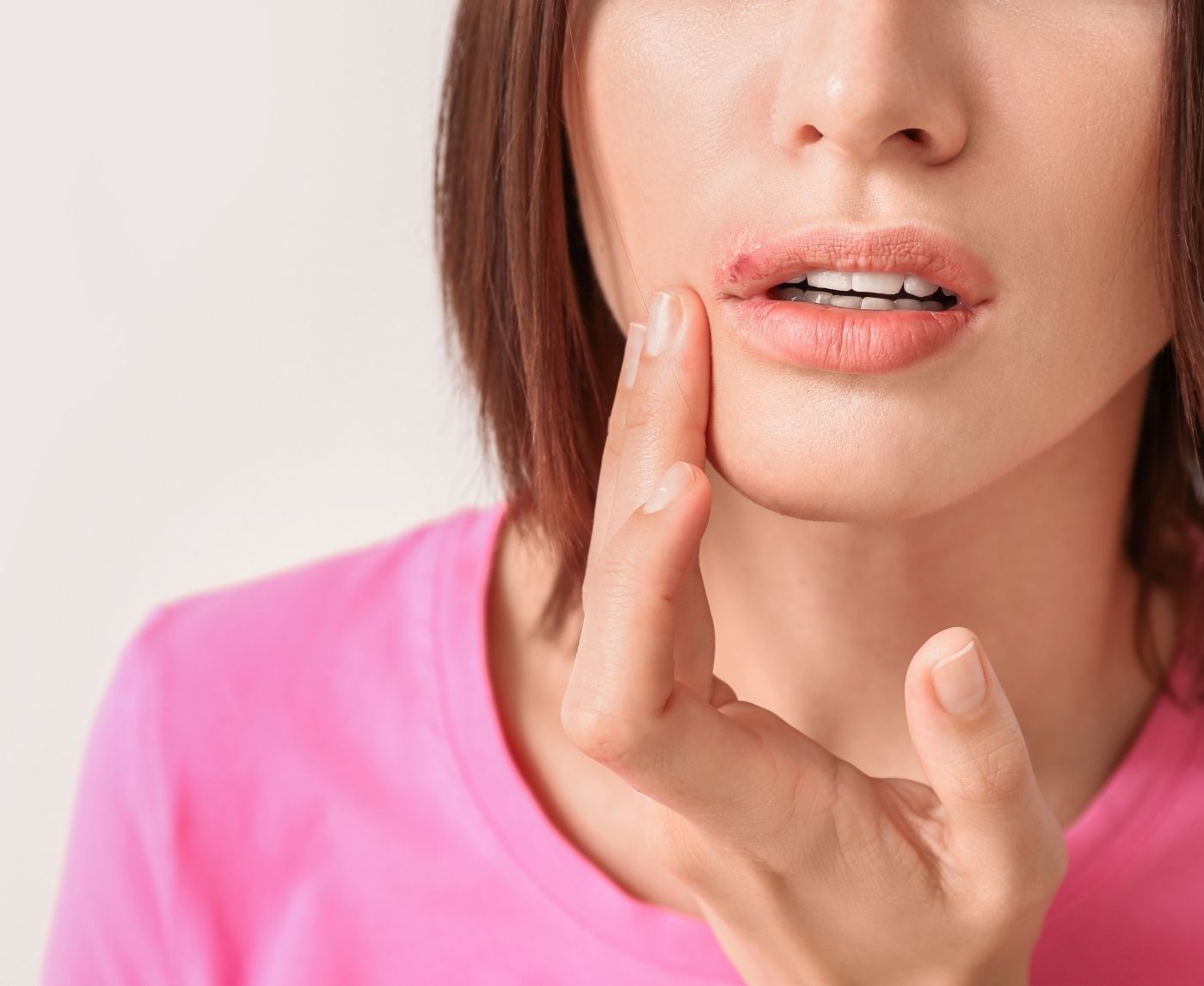
For a new infection, the MedlinePlus oral herpes encyclopedia article states that symptoms most often appear within 1 to 3 weeks after coming into contact with the virus. According to NHS guidance on cold sores, the first noticeable sign is usually not the sore itself but a tingling, itching, or burning sensation in the spot on the lip or just inside the mouth where the lesion will appear. Over the next 48 hours, one or more painful blisters develop.
What follows is a small cluster of fluid-filled vesicles. They are tiny at first, sometimes only 1 to 3 millimeters across, and grouped tightly together rather than spread out. Within a day or two the vesicles break open into shallow ulcers, which then crust over and heal across roughly one to two weeks. Acidic foods, citrus, salt, and tomato sauces hurt these lesions out of proportion to their size.
A single lonely ulcer in the middle of the cheek is less consistent with herpes; multiple small ulcers tightly grouped on the lip border, hard palate, or gums fits the pattern well.
Sores are usually (but not always) firm, round, and painless. Because the sore is painless, you may not notice it.
The Painless One: Syphilis Chancres
The CDC quote above describes exactly why oral syphilis sores are so easy to miss. The body's normal warning signal is pain, and a primary syphilis sore typically does not trigger it. People discover these lesions accidentally, often during routine tooth brushing or because they happen to glance in a mirror at the right angle.
The timing for a primary syphilis sore is longer than herpes. The NHS syphilis page states it can take 3 weeks or more for the first symptoms of syphilis to appear after infection, and notes that later (secondary-stage) symptoms may develop up to 3 months later. MedlinePlus syphilis reports an incubation period of 14 to 21 days for the primary stage and adds that symptoms of secondary syphilis start 4 to 8 weeks after the primary stage, which corroborates the multi-week-to-multi-month interval. The CDC syphilis fact sheet describes the appearance of the primary sore (firm, round, usually painless) but does not state the from-exposure timing in days. So if you had oral sex on a Friday and a sore showed up on Monday, syphilis is unlikely; if a single round painless ulcer shows up a month later, syphilis moves up the list.
The sore itself is distinctive once you know what to look for. As the CDC describes, it is usually firm, round, and painless, though not always. It is single more often than multiple, with regular borders that feel slightly raised. The base is clean, often grayish-yellow, and the surrounding tissue is not particularly inflamed. There is no red angry halo, no swelling, no clustering with other lesions.
The most dangerous feature is what happens next. Even without treatment, the sore heals on its own across roughly three to six weeks. The infection does not. The bacterium spreads through the body silently, moving toward the secondary stage, which can show up as a rash on the palms and soles weeks to months later.
A painless mouth ulcer that lasts more than two weeks deserves clinical attention regardless of how well you otherwise feel. The classic syphilis sore is painless, single, round, and heals on its own while the underlying infection continues to spread. A clinic swab of the lesion (or a blood test once seroconversion has occurred) is the only way to rule syphilis in or out.
When It Is a Growth, Not a Sore: Oral HPV
HPV behaves differently from herpes and syphilis. It does not produce open sores. Instead it produces growths: small bumps, rough patches, or cauliflower-textured warts that sit on the surface of the tongue, soft palate, inner cheek, or back of the throat. These do not bleed when you eat, do not weep fluid, and very often do not change for weeks or months at a time.
The most common reaction is to ignore them. They do not hurt, they do not interfere with eating, and they do not look like anything you have read about. People describe them as 'just texture,' 'a little bumpy spot that has always been there,' or 'something stuck in my throat that I cannot dislodge.'
Most HPV infections clear on their own within about two years, according to CDC HPV guidance. The warts themselves come from low-risk HPV types and are not the core concern. What warrants attention is the smaller subset of cases involving high-risk HPV types, which can drive oropharyngeal cancers over years. Persistent visible growths warrant a clinician examination and biopsy if anything looks atypical.
Diagnosing oral HPV is mostly visual and tissue-based. There is no good standalone blood antibody test for active oral HPV; if a growth is suspicious, the clinic biopsies it.
No home blood test detects oral HPV. If a persistent painless growth in the mouth concerns you, a clinician examines it visually and biopsies anything atypical. Visible warts and rough patches that have not changed for weeks are still worth raising at a routine dental or primary-care visit.
Less Common Causes Worth Knowing About
Dark, purple, or persistently discolored patches in the mouth occasionally point to Kaposi sarcoma, a vascular tumor strongly associated with HIV infection and immunosuppression. These are not ulcers. They are flat or slightly raised patches that are red, purple, or brown, and they do not heal on the usual timeline of a benign mouth sore. They are uncommon in people with intact immune systems but are a recognized indicator of advanced HIV when they appear.
This is one reason why a comprehensive STI screen, including HIV, is sometimes worth considering when an unusual mouth lesion does not fit the herpes-syphilis-HPV pattern. The lesion itself needs a clinician to evaluate; the broader infection status can be checked alongside.
A dark or purplish oral patch that does not resolve in two to three weeks warrants raising at a care visit rather than waiting for a routine check-up. Kaposi sarcoma is uncommon, but oral findings in an immunocompromised setting can progress faster than in a typical patient and benefit from earlier evaluation.
Not Every Mouth Sore Is an STI
Most mouth sores are benign. Aphthous ulcers, the common canker sore, are the single biggest cause of small painful mouth lesions and have nothing to do with sex. They are linked to stress, minor mouth trauma (a sharp food edge, a too-vigorous brushing), certain food sensitivities, vitamin B12 or iron deficiency, and hormonal cycles in some people.
Per NHS guidance on mouth ulcers, typical canker sores heal on their own within 7 to 14 days without treatment. They tend to be single, hurt out of proportion to their size, sit on movable mucosa (inner lip, inner cheek, under the tongue), and have a yellow-white center with a bright red halo.
The reason this distinction matters: a canker sore looks superficially similar to an early herpes ulcer at certain stages. Timing and pattern are how you separate them. A solitary sore that showed up after a stressful week of finals and has no cluster around it is far more likely a canker sore. A cluster of small lesions on the lip border that appeared a week after an unprotected oral encounter, preceded by tingling, fits herpes much better.
| Situation | What it suggests |
|---|---|
| Appeared within 1 to 3 weeks of oral sex, preceded by tingling, multiple small clustered ulcers | Pattern fits oral herpes |
| Appeared three weeks or more after oral sex, single round painless ulcer with firm borders | Pattern fits primary syphilis |
| Painless raised bump or rough patch with no ulceration, present for weeks | Pattern fits oral HPV growth |
| Single painful ulcer with yellow-white center and red halo, heals in 7 to 14 days, no exposure timing link | Pattern fits a benign canker sore |
| Persistent dark or purplish patch that does not heal | Uncommon, warrants clinician evaluation, possible Kaposi sarcoma in immunocompromised people |
Window Periods: When Each Test Becomes Reliable
Every infection has a window period, which is the gap between exposure and when a test can actually detect it. Test too early and a negative result is not reliable. Test at the right moment and you get a clear answer. The right window depends on what kind of test is being used.
For an active lesion, the swab or PCR of the sore itself works as soon as the lesion is present. There is no waiting period because the test detects viral or bacterial DNA in the lesion directly. For blood antibody tests, the body needs time to mount a detectable immune response, and that varies by infection.
| Infection | Symptoms typically appear | Blood antibody test reliable from |
|---|---|---|
| Oral herpes (HSV-1, HSV-2) | 1 to 3 weeks after exposure (MedlinePlus oral herpes encyclopedia) | Up to 16 weeks or more after exposure per CDC herpes testing guidance |
| Syphilis (primary sore) | Primary sore: 3 weeks or more after infection (NHS syphilis page); MedlinePlus reports 14 to 21 days primary incubation. Secondary-stage symptoms: up to 3 months later (NHS syphilis page); MedlinePlus adds 4 to 8 weeks from primary to secondary | 3 to 6 weeks after exposure for treponemal tests |
| Oral HPV | Weeks to months, often asymptomatic | No standard blood test; diagnosis is visual or biopsy |
| HIV (relevant if other STIs are involved) | Acute symptoms 2 to 4 weeks if any | Per CDC HIV testing guidance: rapid antigen/antibody (fingerstick) detects 18 to 90 days post-exposure; antibody-only rapid tests detect 23 to 90 days post-exposure; lab-based 4th-generation tests typically detect earliest, around 18 to 45 days |
How Doctors Test for Oral STIs
Testing approach depends on what you have at the moment of testing. If a lesion is currently visible, the gold standard is to sample the lesion itself. A clinician swabs the sore and the lab runs a PCR test that detects viral or bacterial DNA. This is fast (results often within days), highly accurate for active lesions, and works for both herpes and syphilis. It is also the only way to identify oral HPV growths, where the path is visual inspection plus tissue biopsy if anything looks atypical.
If the lesion has already healed by the time you decide to test, the picture shifts. The PCR window has closed because there is nothing left to swab. Instead, blood antibody tests check whether your immune system has produced antibodies against the infection. Syphilis treponemal blood tests are reliable from about 3 to 6 weeks after exposure. HSV blood antibody tests, per CDC herpes testing guidance, can take up to 16 weeks or more for current tests to detect infection.
A lesion currently visible means a swab or PCR is the right tool; a lesion already healed means a blood antibody test after the appropriate window. Mixing these up is a common reason people get falsely reassured by an early negative result.
So which test do I actually need?
If the sore is currently visible, the best test is a clinic swab or PCR of the lesion itself; at-home kits do not offer this. If the sore has already healed and you want to confirm whether you carry the infection systemically, a fingerstick blood antibody test (HSV or syphilis) becomes useful, but only after the relevant window period has passed: about 3 to 6 weeks for syphilis, and the CDC notes HSV antibody tests can take up to 16 weeks or more after exposure to detect infection.
What At-Home Kits Cover (and What They Do Not)
At-home rapid testing is useful for some of these questions and unhelpful for others. Being explicit about which is which avoids the common mistake of using the wrong tool and trusting the result.
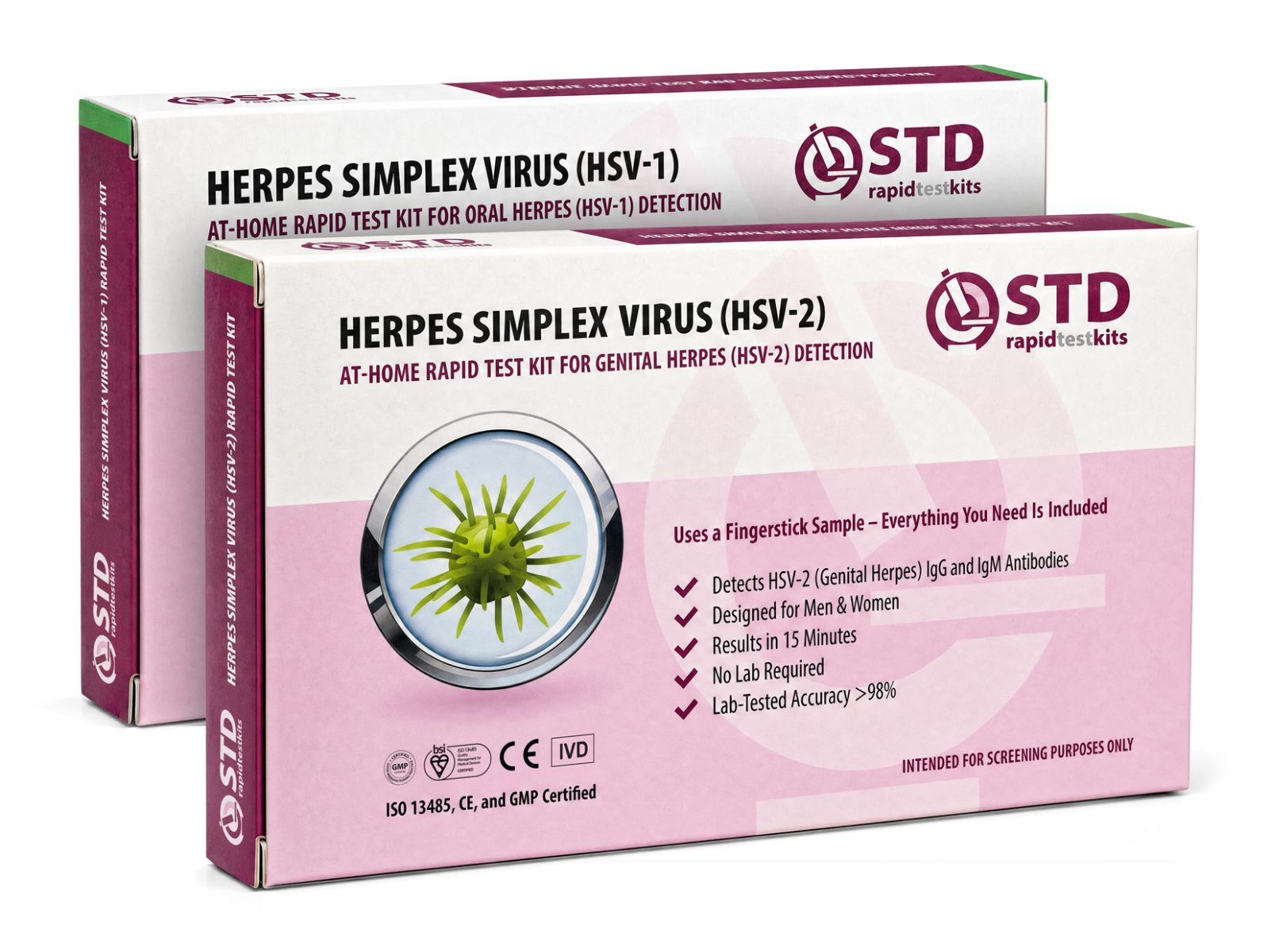
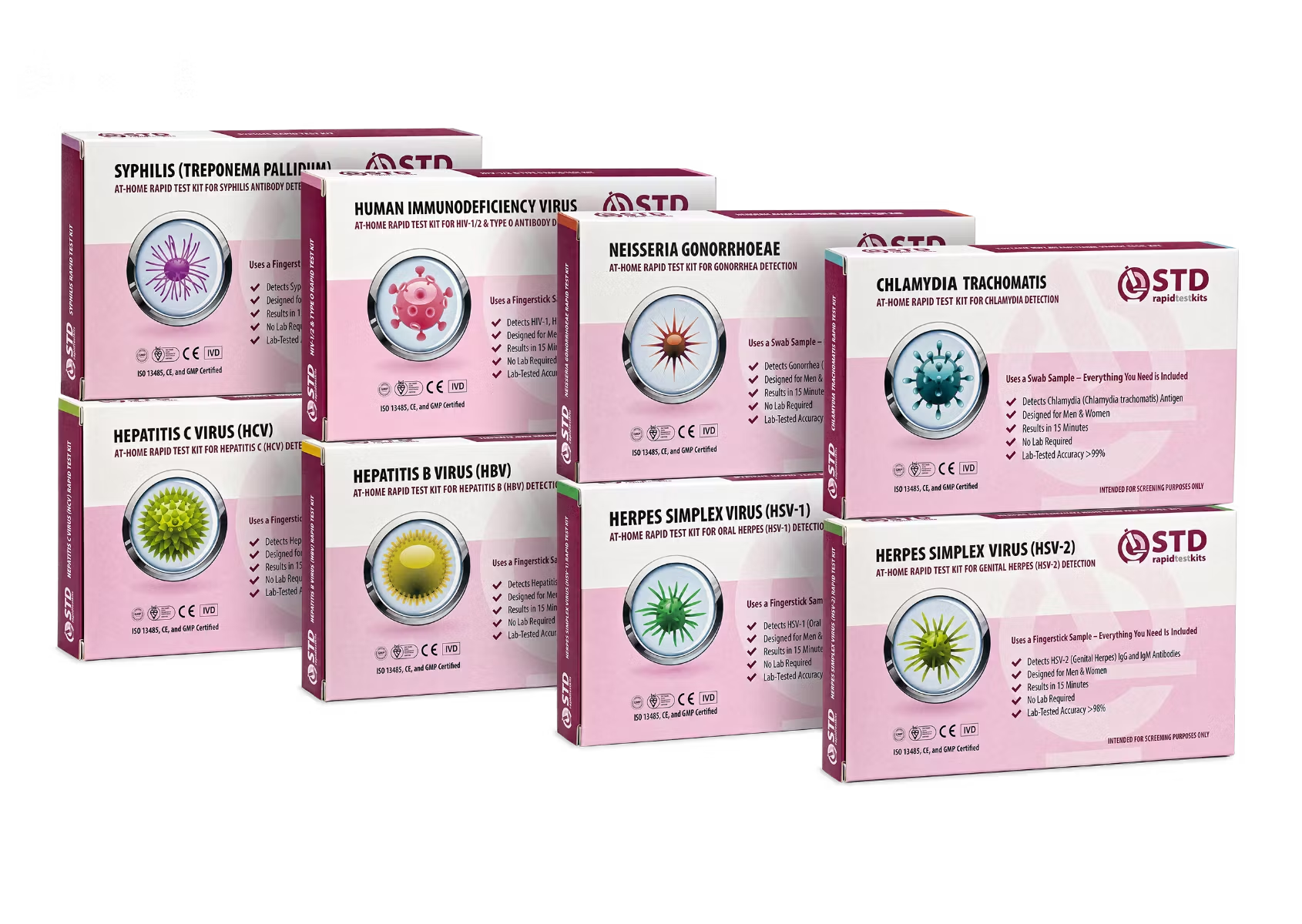
Home blood tests cover the antibody side reliably: HSV-1, HSV-2, syphilis, HIV, and hepatitis B and C, with a fingerstick result in about 15 minutes. These are lateral-flow immunoassays, not laboratory NAATs, so a positive result is generally worth confirming with a lab test, and the window periods above still apply before a negative result is meaningful.
The one gap is identifying an active oral sore directly. No home kit swabs a mouth lesion; we do not sell a pharyngeal or oral lesion swab kit, and any kit that claims to test a mouth sore at home is overstating what the technology can do. For an active sore you want identified, a sexual health clinic, urgent care, or your primary care provider is the right next step. The visit itself is short and the swab is painless.
In practice: if your mouth lesion is already gone by the time you are reading this, a home blood test after the right window is reasonable. If a lesion is currently in your mouth, see a clinician for a swab and consider the home blood test as a complementary follow-up later.
When to See a Clinician (Not Just Test at Home)
A few signals push the visit-a-clinician option to the top of the list rather than starting with a home test. Any mouth lesion that has been present for more than two weeks deserves an in-person look, regardless of pain. A single painless round ulcer with firm borders fits the syphilis pattern and is much better evaluated with a direct swab than a delayed blood test. Persistent painless growths, especially on the tongue or back of the throat, need visual inspection and possibly a biopsy. Any dark or purplish patch that does not heal warrants medical attention.
If you are immunocompromised, on certain medications that suppress immune response, or have any concern about HIV status, the threshold for seeing a clinician is lower. Mouth lesions in those settings can be more aggressive and less predictable.
Clinical triggers: see a clinician
- Any mouth lesion present for more than two weeks, regardless of pain
- Single painless round ulcer with firm raised borders
- Persistent painless growth on the tongue, soft palate, or back of the throat
- Dark or purplish patch that does not heal
- Any oral lesion if you are immunocompromised or on immunosuppressive medication
Managing the Anxiety
The hardest part of finding a sore in your mouth after a sexual encounter is rarely the sore itself. It is the loop of checking, re-checking, comparing photos online, and oscillating between 'this is nothing' and 'this is the worst-case scenario.' That loop is exhausting and tends to make the lesion feel worse than it is.
The practical exit from the loop is information, not reassurance. Either the lesion fits a clear benign pattern and will heal on the canker-sore timeline of one to two weeks, or it does not, in which case the right next step is a test that actually answers the question. Spending another week in uncertainty serves no one. Either picking up the phone for a clinic appointment or ordering an appropriate at-home test moves you out of the spiral.
If the lesion fits the canker-sore pattern (single, painful, heals in 7 to 14 days, no exposure timing link), waiting is reasonable. If it fits any STI pattern or has not healed after two weeks, a clinic appointment or a home blood test after the relevant window resolves the uncertainty faster than continued observation.
Frequently Asked Questions
- Can you actually get an STD in your mouth from oral sex?
- Yes. Oral sex transmits HSV-1 and HSV-2 (causing oral herpes lesions), Treponema pallidum (causing syphilis sores), and HPV (causing oral warts and, in a smaller subset of cases, contributing to oropharyngeal cancer risk over years). Gonorrhea and chlamydia can also infect the throat, though they more often cause sore throat or no symptoms rather than visible mouth sores.
- I have a sore but it does not hurt at all. Should that worry me more or less?
- More, not less, especially if it is round, single, and has firm raised borders. A painless oral ulcer with that appearance fits the primary syphilis pattern, and the absence of pain is the main reason these get missed. If it persists for more than two weeks, see a clinician for a direct swab.
- How do I tell a canker sore from an STI sore?
- Canker sores are usually single, painful out of proportion to their size, have a yellow-white center with a bright red halo, sit on movable mucosa, and heal within 7 to 14 days. STI sores follow different patterns: herpes makes painful clusters, syphilis makes a single painless round ulcer, and HPV makes painless raised growths that do not heal away.
- What does an oral herpes outbreak feel like before you can see it?
- Most people describe a tingling, burning, or itching sensation in one specific spot on the lip or just inside the mouth, sometimes hours to a couple of days before any visible vesicle appears. The visible lesions then follow as a tightly grouped cluster of small fluid-filled blisters that rupture into shallow ulcers.
- How fast do mouth symptoms show up after oral sex?
- Oral herpes lesions most often appear 1 to 3 weeks after exposure per MedlinePlus oral herpes guidance. Primary syphilis sores can take 3 weeks or more to appear per the NHS syphilis page, which also notes that secondary-stage symptoms may develop up to 3 months later; MedlinePlus syphilis reports a 14 to 21 day primary incubation and 4 to 8 weeks from primary to secondary stage. Oral HPV growths usually appear weeks to months later, often without a clear link to a single encounter.
- If the sore healed on its own, am I in the clear?
- It depends on the pattern. If the sore was round, firm-edged, and painless, a syphilis blood test 3 to 6 weeks after exposure is worth ordering even though the lesion is gone; a healed lesion does not mean the infection resolved. Herpes also recedes between outbreaks while the virus persists in the nerve ganglia; a future cluster at the same site would confirm it.
- Can an at-home test diagnose the sore in my mouth right now?
- No. At-home kits do not include a swab of an active oral lesion. They test antibodies in blood (or vaginal or penile swabs for genital infections). To identify an active mouth sore directly, you need a clinic swab or PCR of the lesion itself. The at-home blood antibody test becomes useful weeks later, after the relevant window.
- I am still anxious about overthinking this. How do I decide whether to test at all?
- Use the pattern. If your lesion fits the benign canker sore pattern (single, painful, no exposure timing link, healing within two weeks), waiting is reasonable. If it fits any of the STI patterns (clustered painful ulcers, single painless round ulcer, painless persistent growth, or anything still present after two weeks), getting a definitive test is faster and less stressful than another week in the loop.
How we sourced this article: Our article was constructed based on current advice from the most prominent public health and medical organizations (CDC, WHO, NHS, and MedlinePlus guidance on herpes, syphilis, HPV, HIV, and mouth ulcers), and then molded into simple language based on the situations that people actually experience. Window-period and incubation figures are taken from the CDC, NHS, and MedlinePlus condition pages cited in the source list below; each timing figure was re-verified against the source page via direct fetch during this revision. The product positioning reflects what our at-home rapid lateral-flow kits can and cannot do; we are explicit when a clinic visit is the better next step.
- MedlinePlus (U.S. National Library of Medicine). Oral herpes encyclopedia article. Verified phrase: 'They most often appear within 1 to 3 weeks after you come into contact with the virus.'
- U.S. Centers for Disease Control and Prevention. Herpes testing page. Verified phrase: 'After exposure, it can take up to 16 weeks or more for current tests to detect infection.'
- U.S. Centers for Disease Control and Prevention. Syphilis fact sheet. Verified phrase: 'Sores are usually (but not always) firm, round, and painless. Because the sore is painless, you may not notice it.' Source for the primary-sore appearance description; the page does not state from-exposure timing in days.
- MedlinePlus (U.S. National Library of Medicine). Syphilis encyclopedia article. Verified phrases: 'The incubation period for primary syphilis is 14 to 21 days' and 'The symptoms of secondary syphilis start 4 to 8 weeks after the primary syphilis.'
- U.S. Centers for Disease Control and Prevention. HPV fact sheet covering clearance over about two years and high-risk-type oropharyngeal cancer risk.
- U.S. Centers for Disease Control and Prevention. HIV testing page. Verified phrases: 'A rapid antigen/antibody test done with blood from a finger stick can usually detect HIV 18 to 90 days after exposure' and 'Antibody tests can usually detect HIV 23 to 90 days after exposure.'
- World Health Organization. Herpes simplex virus fact sheet with global HSV-1 prevalence figures: about 3.8 billion people under age 50 carry HSV-1 (roughly two-thirds of that age group).
- World Health Organization. Sexually transmitted infections (STIs) fact sheet with overview of testing approaches and population-level epidemiology.
- NHS. Cold sores page describing the tingling, itching, or burning prodrome and progression to blister formation in oral HSV outbreaks.
- NHS. Syphilis page. Verified phrases: 'It can take 3 weeks or more for the first symptoms of syphilis to appear after you're infected' and 'You may get the later symptoms up to 3 months later.'
- NHS. Mouth ulcers (canker sores) page covering the typical 7 to 14 day healing pattern and benign-cause differentials.
