Can You Get Herpes on Your Thigh?
Why HSV sometimes appears on the inner thigh instead of the genitals.




- Herpes can appear on the inner thigh, buttocks, or groin fold because HSV travels along sensory nerves rather than staying confined to genital skin.
- Most thigh bumps are not herpes. Ingrown hairs, folliculitis, and jock itch are far more common; testing is the only reliable way to confirm which one you have.
Published: October 2025 | Last updated: May 2026 | Editorial review and quality control: Martina N.
Finding a strange bump on your inner thigh and wondering if it could be herpes is a question that brings thousands of people to search engines every day. The short answer is yes: herpes can appear on the thigh, the buttocks, the groin fold, or anywhere the virus reached during transmission. The longer answer involves how the virus travels through nerves, why outbreaks recur in unexpected places, what other conditions look similar, and how to confirm what is actually happening. The goal here is clarity, not panic. Most rashes on the thigh are not herpes, and the ones that are turn out to be more manageable than the first Google search suggests.
Key Takeaways
- Herpes can appear on the inner thigh, buttocks, or groin fold because HSV travels along sensory nerves rather than staying confined to genital skin.
- Most thigh bumps are not herpes. Ingrown hairs, folliculitis, and jock itch are far more common; testing is the only reliable way to confirm which one you have.
Why Herpes Isn't Confined to the Genitals
Herpes simplex virus, both type 1 and type 2, has a particular habit that catches people off guard: it travels along nerves, not just skin. After the initial infection, the virus retreats into a cluster of nerve cells near the spine called a ganglion, where it sits quietly between outbreaks. When something reactivates it (stress, illness, friction, hormonal shifts), the virus travels back down whichever nerve it took shelter in and resurfaces wherever that nerve happens to lead.
For HSV-2, which causes most genital outbreaks, that hiding place is usually the sacral ganglia near the lower spine. The sensory nerves connected to those ganglia do not just supply the genitals. They also supply parts of the inner thigh, the buttocks, the groin fold, and the perianal skin. This is why someone whose initial infection occurred during oral, vaginal, or anal contact can develop recurring blisters on areas that never seemed connected to the genitals at all.
The same logic applies to HSV-1, which more commonly affects the mouth and lips but increasingly causes genital infections too. HSV-1 hides in the trigeminal ganglion near the brain stem, so its facial outbreaks tend to recur near the original site. When HSV-1 establishes itself in the sacral region (typically through oral-genital contact), it can also produce outbreaks on thighs and buttocks, though those tend to be milder and less frequent than HSV-2 in the same area.
According to the World Health Organization's herpes simplex virus fact sheet, an estimated 13 percent of the global population aged 15 to 49 has HSV-2, and roughly 64 percent of people under 50 has HSV-1. Most people carrying either virus do not know they have it. That matters here because non-genital outbreaks are often the first sign someone has carried the virus all along, sometimes for years, without symptoms severe enough to prompt testing.
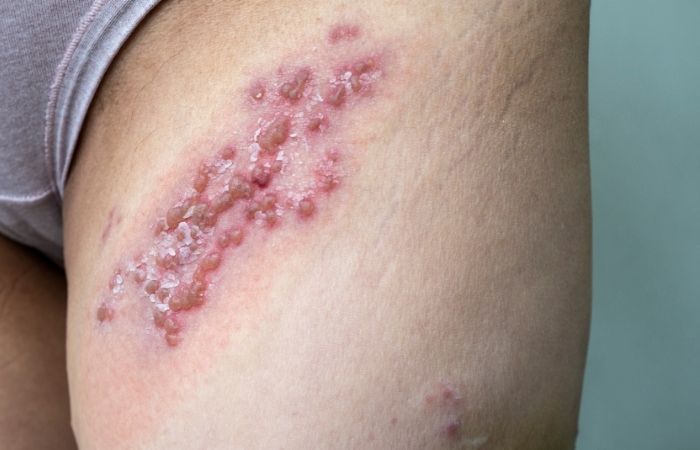
What Herpes on the Thigh Looks and Feels Like
The visible part of an outbreak follows a fairly consistent sequence, but the timing varies. Some people feel symptoms for two days before anything shows. Others wake up with full blisters and never noticed a warning sign. On the thigh specifically, the early stage often gets dismissed as a friction rash or razor irritation, which is one of the main reasons people miss the diagnosis at first.
The classic sequence runs through three phases. A prodrome (the tingling, burning, or itching that precedes visible signs) can last a few hours to a couple of days. The outbreak itself involves small fluid-filled blisters, sometimes in a tight cluster, sometimes appearing alone. These blisters break open, weep clear or slightly cloudy fluid, then crust over and scab as they heal. The whole cycle usually resolves in 7 to 14 days for a recurrence, and longer for a first outbreak, which can take 2 to 4 weeks to settle fully.
On the thigh, the picture can look a little different from textbook genital herpes images. Blisters might appear singly rather than in clusters. The surrounding skin might look red and slightly swollen but without the systemic symptoms (fever, swollen lymph nodes, body aches) that often accompany a first genital outbreak. This is partly because the skin on the thigh has different nerve density and different friction patterns than mucosal tissue. The table below summarizes what to expect at each stage. Timing is approximate and varies between people, especially during a first outbreak versus a recurrence.
| Stage | What You Might See | What It Might Feel Like |
|---|---|---|
| Prodrome (a few hours to 2 days) | No visible signs yet | Tingling, burning, or sharp ache along a specific patch of skin |
| Outbreak (3 to 5 days) | Red patch, then small fluid-filled blisters; may cluster or appear alone | Sensitive skin, sharp or stinging pain, discomfort with clothing friction |
| Crusting (5 to 10 days) | Blisters break open and form yellowish scabs | Dryness, mild itching as scabs begin to lift |
| Healing (7 to 14 days for recurrences; up to 4 weeks for first outbreak) | Scabs fall off; skin may show a temporary pink mark | Tenderness fading; full skin recovery within days of scab loss |
Herpes or Something Else? Sorting the Lookalikes
The thigh and groin area is one of the most diagnostically crowded patches of skin on the body. It deals with friction from clothing, sweat, hair follicles, and a humid microclimate, all of which produce conditions that can superficially resemble herpes. Most thigh bumps are not herpes. The trick is knowing what details actually point one way or the other.
Three patterns separate herpes from the most common lookalikes. First, herpes typically announces itself before it appears: that prodrome of tingling, burning, or itching in a specific patch of skin is rare in folliculitis, jock itch, or ingrown hairs. Second, herpes blisters are filled with clear or slightly cloudy fluid, not pus. A pustule that responds to pressure with thick yellow drainage is almost always bacterial folliculitis or an ingrown hair, not herpes. Third, herpes follows a consistent cycle (blister, break, scab, heal) over 1 to 2 weeks. Friction rashes, fungal infections, and contact dermatitis tend to either resolve quickly with hygiene changes or persist as flat scaly patches without going through a blister stage.
The table below lays out the most common differential diagnoses for a thigh bump, drawing on dermatology references summarized by the Mayo Clinic and the NHS in their genital herpes overviews. None of these comparisons is a substitute for testing when the diagnosis genuinely matters, but they can help you decide how urgent that step is.
| Condition | What It Looks Like | Distinguishing Feature |
|---|---|---|
| Herpes (HSV-1 or HSV-2) | Small clear-fluid blisters in a cluster or singly; scab over within a week | Often preceded by tingling or burning; tends to recur in the same patch |
| Ingrown hair | Single red bump, sometimes with a visible hair trapped under the skin | Resolves with pressure or warm compress; not preceded by sensory symptoms |
| Folliculitis (bacterial) | Multiple small red bumps or pustules clustered around hair follicles | Pus on pressure; often follows shaving or sweating in tight clothing |
| Jock itch (tinea cruris) | Red, scaly, itchy rash often with a half-moon border in the groin fold | Fungal; spreads outward over weeks rather than blistering; responds to antifungal cream |
| Contact dermatitis | Red, itchy, flat or slightly raised patch wherever an irritant touched | Linked to a new soap, lubricant, fabric, or laundry detergent; resolves when exposure stops |
How Herpes Reaches Non-Genital Skin
The transmission route explains why thigh outbreaks happen at all. Herpes spreads through direct skin-to-skin contact with an area where the virus is active. That includes obvious moments of contact (oral sex, vaginal sex, anal sex) and less obvious ones (grinding fully clothed if there is enough friction to create microabrasions, or any close skin contact with an area of active viral shedding). The virus does not need penetration to spread, and it does not need a visible sore to be transmissible, though active outbreaks carry the highest risk.
What this means for thigh outbreaks: if your partner's genitals or thighs touched your inner thigh during sex, that skin contact was sufficient. The virus enters through any small break in the skin, then sets up in the nearest sensory nerve. If your inner thigh was the entry point, your inner thigh becomes the recurrence zone. Outbreaks years later will tend to come back to that same patch of skin or somewhere along the same nerve.
According to the CDC's genital herpes overview, you can get genital herpes from a sex partner who does not have a visible sore or is unaware of their infection. This is called asymptomatic viral shedding, and it accounts for most of why herpes is so prevalent: people transmit it without knowing they are infectious. The shedding pattern is concentrated in genital and perigenital skin, which is why areas next to the genitals, including the thighs, can be exposed even when the source partner has no visible lesion.
A few transmission paths get blamed for non-genital outbreaks but actually have little supporting evidence. Toilet seats, swimming pools, hot tubs, and shared towels rarely if ever transmit HSV. The virus needs warm, moist skin contact and does not survive long on dry surfaces. If your thigh outbreak followed a specific exposure event, that event almost certainly involved skin contact with another person, not a gym bench.
HSV does not need penetration or a visible sore to transmit. Warm skin-to-skin contact with an actively shedding area is sufficient, which is why the thigh and groin fold can be exposed during contact that never reached the genitals directly.
When to Test, and What Each Test Actually Tells You
Testing for HSV is unusual in one important way: the right test depends on what you are trying to answer, and on whether you have an active outbreak right now. The two main methods give different information and have different windows of usefulness.
A polymerase chain reaction (PCR) swab is taken directly from a fresh blister or sore. The provider collects fluid from a lesion that has not yet scabbed over, and a lab tests for HSV DNA. This is the gold standard for diagnosing an active outbreak and for determining which type (HSV-1 or HSV-2) is causing it. The catch: it only works during the outbreak. Once the blister has crusted and healed, the virus is no longer detectable on the skin surface. PCR swabs are typically run by clinic-based providers; they are not currently available as an at-home rapid test.
A blood antibody test (specifically an IgG, or immunoglobulin G, test for HSV-2 or HSV-1) looks for the antibodies your immune system produces in response to the virus. This test is useful when you do not have a current outbreak, when you want to know if you have ever been infected, or when you want to confirm which type you carry. The window matters. Most people develop detectable IgG antibodies within about 12 weeks of infection, though some commonly used assays can detect earlier, typically from around 6 weeks onward, and a result at 16 weeks is generally considered conclusive for slower seroconverters. Testing too early can produce a negative result even in someone who is genuinely infected. The CDC notes that routine antibody screening is not recommended for everyone, but it is useful for people with a specific exposure concern, recurring suspicious symptoms, or a partner with known HSV.
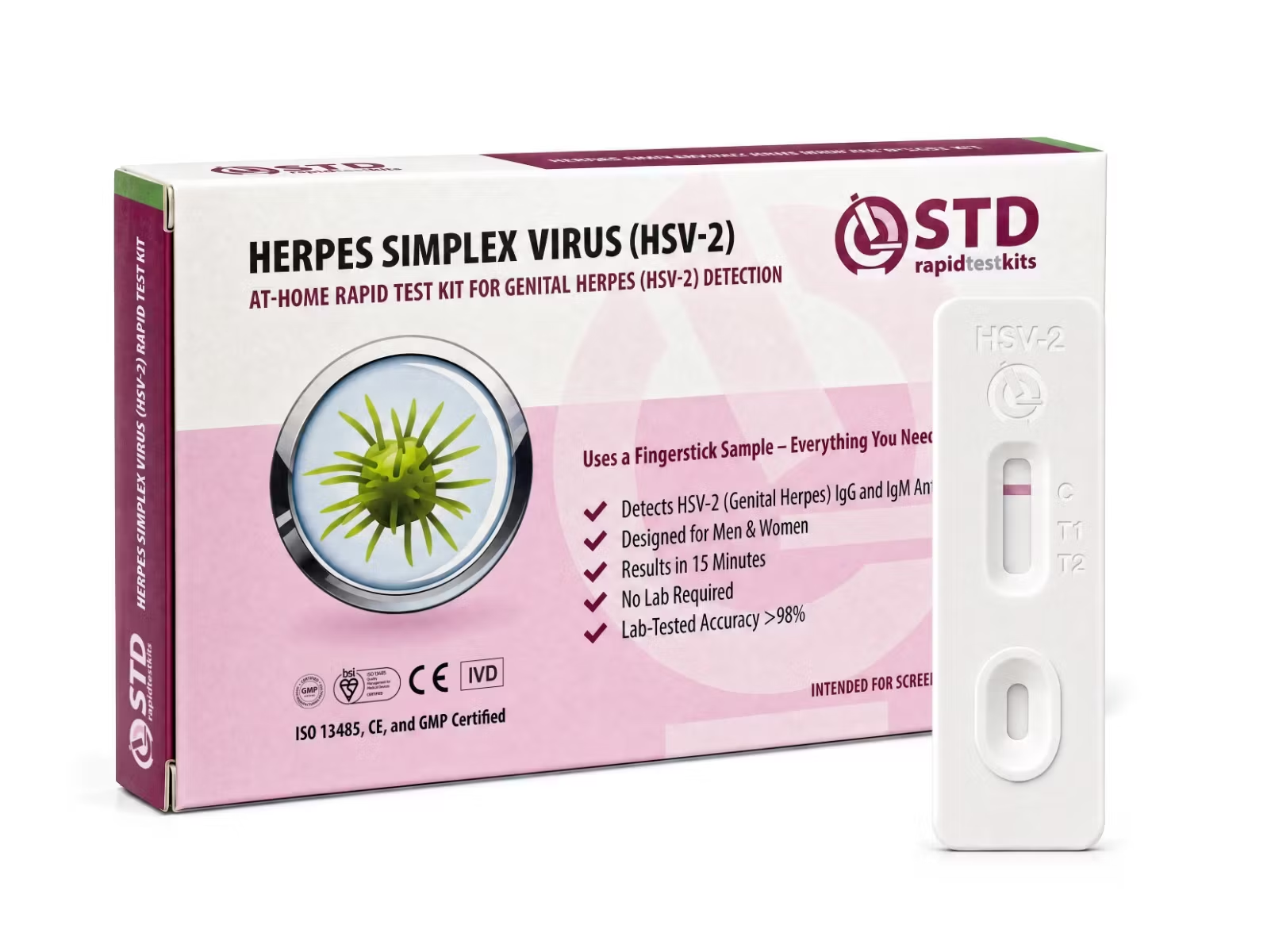
For someone watching a fresh blister on their thigh and trying to figure out what is happening, the clinically straightforward path is: see a clinician within a few days while the lesion is still active, get a PCR swab, and follow up with a blood antibody test later if needed. For someone weeks or months out from a possible exposure event, an at-home blood antibody test can confirm whether seroconversion has occurred.
Triggers, Recurrences, and Myths That Will Not Die
Once HSV is established in your nerve ganglia, certain conditions can wake it back up. These triggers do not cause herpes (you have to already carry the virus for them to matter), but they reliably tip dormant infections into visible outbreaks. The most consistent ones are physical and immune-related: stress, illness, sleep deprivation, sunburn, hormonal shifts including menstruation, and skin trauma to the affected area. Friction from tight clothing, shaving over the recurrence zone, or prolonged sweating against fabric can all set off an outbreak in someone whose virus tends to recur on the thigh or groin.
Two common myths deserve direct correction. The first is that herpes spreads through toilet seats, towels, hotel sheets, or shared gym equipment. The virus does not survive long enough on dry surfaces to remain infectious; transmission requires direct skin contact, usually warm and moist contact, with a person who is shedding virus. The second is that condoms fully prevent transmission. Condoms substantially reduce risk but do not eliminate it, because herpes can shed from skin areas the condom does not cover (the thighs and groin among them).
A more practical takeaway: if you have already been diagnosed with HSV and you keep getting outbreaks in the same spot on your thigh, look at what is happening in your life around those outbreaks. Sleep, stress, and recent skin trauma are the three most controllable triggers. Many people find that consistent sleep and reducing friction in the recurrence zone meaningfully cuts the frequency of recurrences. Daily suppressive antiviral medication (acyclovir, valacyclovir, famciclovir) is also an option worth discussing with a clinician if outbreaks happen frequently, since it both reduces outbreak frequency and lowers the risk of transmitting the virus to a partner during the periods when no symptoms are visible.

Why Outbreaks Keep Returning to the Same Spot
The reason recurrences cluster in the same place is structural. The virus lives in a specific nerve cell cluster, and when it reactivates, it travels down that specific nerve's path to reach the skin. The same nerve goes to the same patch of skin every time. People often describe a clear pattern within a year of their first outbreak: a particular spot on the inner thigh or buttock that gets the prodrome, then the blisters, then heals, then repeats.
This stability can be useful diagnostically. If you have a fresh outbreak in exactly the same patch where you had one six months ago, herpes is a strong possibility, especially if a prodrome preceded it both times. A new bump in a never-before-affected area is more likely to be a different problem (ingrown hair, folliculitis, or contact dermatitis) than a new herpes site.
That said, some people experience outbreaks at different spots within the same dermatome (the region a single nerve supplies). A thigh outbreak in March and a buttock outbreak in September can both be the same virus surfacing along slightly different branches of the same sacral nerve. The pattern is consistent enough to be informative, but not so rigid that one inch of variation rules HSV out. If you keep getting outbreaks in any combination of thigh, groin, buttock, or perianal skin, testing remains the way to confirm what is happening. The clinical detail behind this nerve-based recurrence pattern is described in the NCBI StatPearls reference on HSV-2 infection.
Most controllable recurrence triggers
- Sleep deprivation, which lowers immune surveillance and lets dormant virus reactivate.
- Acute or chronic stress, which produces the same immune-dampening effect on a slower timeline.
- Recent skin trauma in the recurrence zone (shaving, friction from tight clothing, sunburn) that irritates the nerve endings the virus travels along.
Talking to a Partner When the Sore Isn't 'Genital'
One of the more confusing parts of a thigh or buttock outbreak is the disclosure conversation. The sore is not on your genitals, but it is still herpes, and it is still potentially transmissible to a partner whose skin will come into contact with that area. The honest framing is that this is genital herpes by virus type and transmission route, even if the lesion is geographically off the usual map.
For disclosure timing, the practical answer is: before sexual contact, ideally when both of you have time to ask questions and decide together. The conversation does not need to be heavy. People appreciate being told. Many partners already carry HSV without knowing, and many are more measured about it than the cultural script suggests. The CDC's genital herpes guidance notes that disclosure paired with consistent condom use and suppressive antiviral medication can meaningfully reduce transmission risk to a partner compared with no precautions.
If you are early in a relationship and not sure how the partner will respond, it can help to lead with the practical facts (how common HSV is, what the actual transmission risk is, what reduces that risk) rather than with apology. Having a confirmed diagnosis puts you in a better position than the majority of HSV carriers, most of whom have never been tested.
1. Lead with facts. HSV-2 is carried by roughly 13 percent of adults aged 15 to 49 worldwide; most carriers do not know.
2. State your own risk-reduction plan. Daily suppressive antivirals, consistent condom use, and avoiding contact during outbreaks together reduce transmission risk substantially.
3. Leave room for questions. The conversation works better as an exchange than as a confession; partners often want to understand what their actual risk looks like before responding.
When to See a Clinician
Most uncomplicated thigh outbreaks resolve on their own within 1 to 2 weeks. A clinic visit is worth scheduling promptly in a few specific situations. A first outbreak is one: getting a PCR swab while the lesion is fresh gives you a confirmed diagnosis and the option to start antivirals quickly, which can shorten the outbreak and reduce its severity. If the rash is spreading rapidly, if the pain is severe enough to interfere with walking or sleeping, if you develop a fever or feel systemically unwell, or if the lesions are not healing after two weeks, those are all reasons to see a clinician rather than wait.
Pregnant people with a possible first herpes outbreak should be seen promptly regardless of severity, because timing of treatment matters for managing delivery and reducing risk to the newborn. People with weakened immune systems (those on immunosuppressive medication, undergoing chemotherapy, or living with HIV) should also seek care quickly, since outbreaks can be more severe and slower to heal in those populations.
For a recurrent outbreak in a known HSV-positive person, in-person care is often unnecessary unless something has changed about the pattern. Suppressive antiviral medication is a reasonable conversation to have at any check-in if outbreaks are frequent (more than four to six per year) or if transmission risk to a partner is a concern. The NHS guidance on genital herpes outlines when antiviral treatment makes the most sense.
You also can get genital herpes from a sex partner who does not have a visible sore or is unaware of their infection.
FAQs
- Can herpes really show up on my thigh, or is that something else?
- Herpes can absolutely appear on the inner thigh, the buttocks, the groin fold, or the perianal area. The virus travels along sensory nerves from the sacral ganglia, which supply all those regions in addition to the genitals. That said, most thigh bumps are not herpes; ingrown hairs, folliculitis, and jock itch are far more common. The way to know which one you have is testing.
- How can I tell the difference between a herpes blister and an ingrown hair?
- Three details usually separate them. Herpes blisters are filled with clear or slightly cloudy fluid; ingrown hairs are firm bumps that may have a visible hair trapped under the skin. Herpes is typically preceded by 1 to 2 days of tingling or burning in the affected patch; ingrown hairs appear without warning. Herpes follows a consistent cycle over 1 to 2 weeks; ingrown hairs usually resolve faster or rupture when squeezed.
- Is herpes on the thigh still considered 'genital herpes'?
- Yes. When the cause is HSV-2, or HSV-1 that established itself in the sacral ganglia, it is still classified as genital herpes by virus type and clinical management, even when the visible lesion is on adjacent skin. The treatment approach, antiviral options, and transmission considerations are the same.
- Can someone have herpes for years without knowing?
- Yes, and this is common. According to the World Health Organization, most people with HSV-2 globally are unaware they carry the virus. Symptoms can be mild enough to be mistaken for razor burn, folliculitis, or a minor friction rash. Asymptomatic viral shedding can also occur, which is part of why herpes is so widely transmitted.
- Can I spread herpes from my thigh to other parts of my body?
- Auto-inoculation is possible but uncommon, and it is mostly a risk during a first outbreak before the immune system has built antibodies. If you have an active outbreak, wash your hands after any contact with the lesion, avoid shaving over it, and do not touch your eyes or contact lenses without washing first. After your immune system mounts a full response, the virus generally stays in its established nerve pathway.
- What test should I use if I have a fresh blister on my thigh right now?
- A PCR swab from the lesion itself is the most accurate option during an active outbreak. The fluid from an unscabbed blister is tested directly for HSV DNA. PCR swabs are typically done in a clinic and are not currently available as an at-home rapid test. If you cannot reach a clinic before the lesion crusts, a blood antibody test taken several weeks after suspected exposure can confirm whether you have seroconverted.
- Will I get outbreaks in the same spot every time?
- Most people develop a consistent recurrence zone within a year of their first outbreak, because the virus travels back down the same nerve every time it reactivates. The pattern can vary slightly within the same dermatome (the area one nerve supplies). A thigh outbreak one time and a buttock outbreak another can both be the same virus surfacing along different branches of the same nerve.
- Where can I get an at-home herpes test?
- If you want to screen without visiting a clinic, an at-home HSV-2 fingerstick blood antibody test is the relevant option, but timing matters. Most assays detect antibodies reliably from around 6 to 12 weeks after a suspected exposure, with 16 weeks as the outer bound for slower seroconverters. For a fresh blister right now, a clinic PCR swab is more accurate; the home test answers the longer-term question of whether the virus is in your system at all.

Our article was constructed based on current advice from the most prominent public health and medical organizations, and then molded into simple language based on the situations that people actually experience. We reference the U.S. Centers for Disease Control and Prevention, the World Health Organization, the United Kingdom's National Health Service, the Mayo Clinic, and the NCBI Bookshelf StatPearls reference for HSV-2 clinical guidance. Where the guidance differs slightly across these bodies, we deferred to the more recent and more conservative interpretation.
- U.S. Centers for Disease Control and Prevention. About Genital Herpes: transmission routes, asymptomatic shedding, and screening guidance.
- World Health Organization. Herpes simplex virus fact sheet, with global prevalence figures for HSV-1 and HSV-2.
- National Health Service (UK). Genital herpes symptoms, treatment, and antiviral guidance.
- Mayo Clinic. Genital herpes diseases and conditions overview, used as a general reference for differential diagnosis context.
- NCBI Bookshelf StatPearls. Herpes simplex virus type 2: clinical manifestations and recurrence patterns.