

Published: December 2025 | Last updated: April 2026 | Editorial review and quality control: Martina N.
Can you get gonorrhea from kissing or sharing a drink?
Kissing carries a small but real risk, and the strongest evidence is for deep tongue kissing with someone who has an untreated throat infection. A cross-sectional study cited in a 2023 systematic review (<a href="https://pmc.ncbi.nlm.nih.gov/articles/PMC10259206/" target="_blank" rel="noopener">Chow et al., 2019, in Tran et al., 2023</a>) found 1.46-fold higher odds of oropharyngeal gonorrhea in men with four or more recent kissing-only partners. Sharing a drink, a utensil, or a casual closed-mouth kiss is not a meaningful route. If your throat hurts after a new exposure, the right test is a throat nucleic acid amplification test (NAAT) at a clinic, since at-home kits do not validate pharyngeal samples.
Key Takeaways
- Tongue kissing has been linked to throat gonorrhea in cross-sectional and network studies, but the absolute per-kiss risk is still small compared with unprotected oral sex.
- Most throat infections cause no symptoms, and standard urine STI panels miss them, so a throat swab NAAT is the only reliable way to know.
Most people grow up hearing that gonorrhea spreads through unprotected vaginal, anal, or oral sex. That is still where the bulk of transmission happens. The newer wrinkle, from a cluster of Australian network studies and a 2023 systematic review, is that deep tongue kissing can move the bacteria from one throat to another, even when no oral sex took place (Cornelisse et al., 2019). The risk is not zero, and it is not the punchline of a stigma joke either. It sits in the small but documented category, and it changes how throat-only infections should be screened.
This article walks through what is and is not a real transmission route, what oral gonorrhea feels like (when it feels like anything), how testing works for throats specifically, and what to do if you have already been exposed.
What oral or throat gonorrhea is
Oral gonorrhea, more precisely called oropharyngeal gonorrhea, is an infection of the throat and tonsils caused by the bacterium Neisseria gonorrhoeae. The same organism that infects the cervix, urethra, or rectum can colonize the back of the mouth and persist there for weeks. The CDC notes gonorrhea infections "often have no symptoms" and that throat infections can be harder to treat than infections at other sites (CDC, Gonorrhea; CDC, STI Risk and Oral Sex).
A few things make the throat unique. It is exposed to far more microbes than the genitals, so gonorrhea faces more competition and tends to stay quieter, with milder or no symptoms. It is a known reservoir for antimicrobial resistance because oral bacteria swap genetic material with gonorrhea, including resistance genes; the WHO specifically flags drug-resistant gonorrhea, including reduced susceptibility to extended-spectrum cephalosporins, as one of the most urgent issues in STI control (WHO, STIs Fact Sheet). And it is often missed: a standard urine NAAT does nothing to detect a throat infection, so people leave clinics with negative results that only describe their genital tract. The infection sits there as a "silent reservoir" and can be passed on through subsequent oral sex.
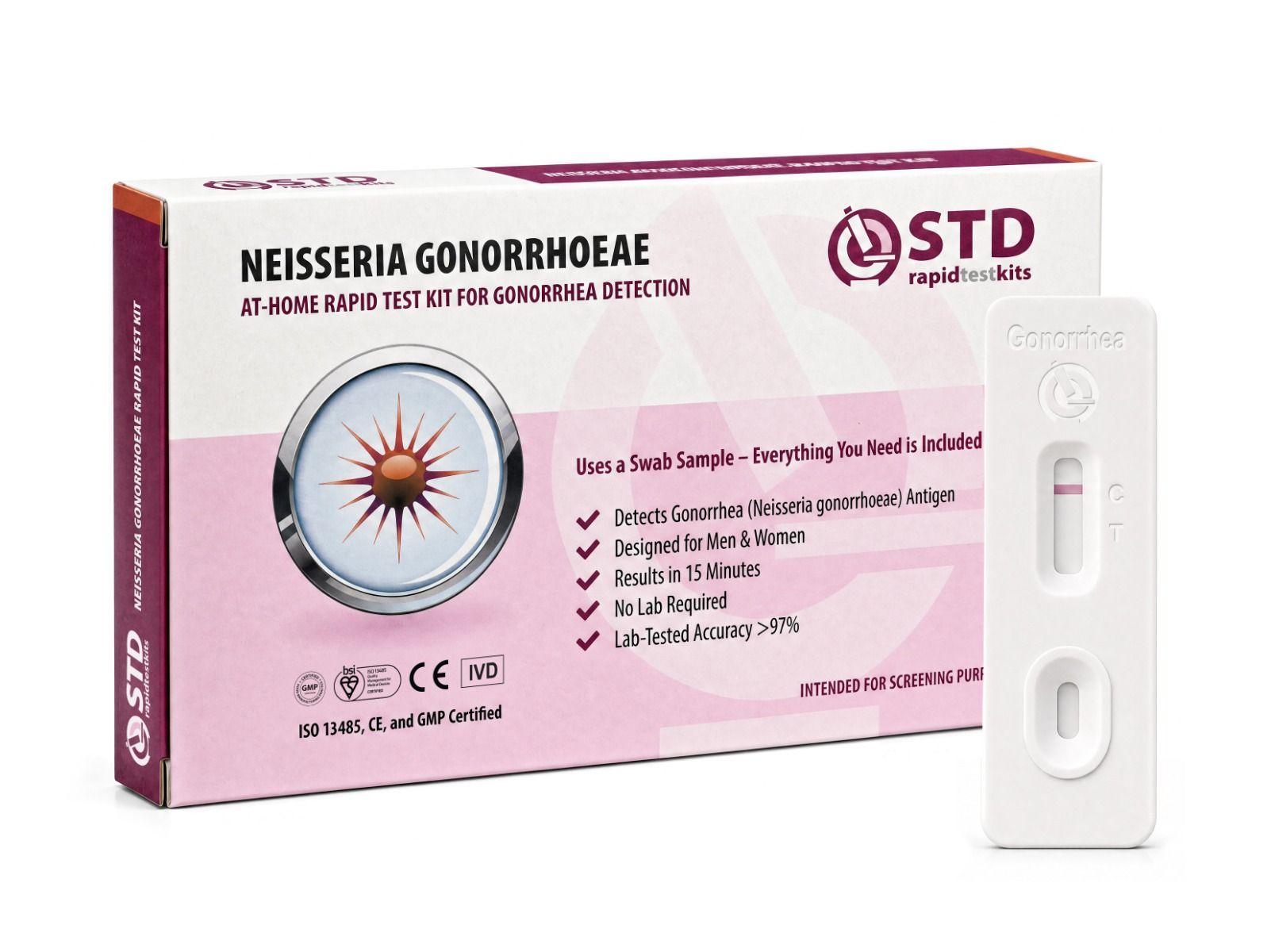
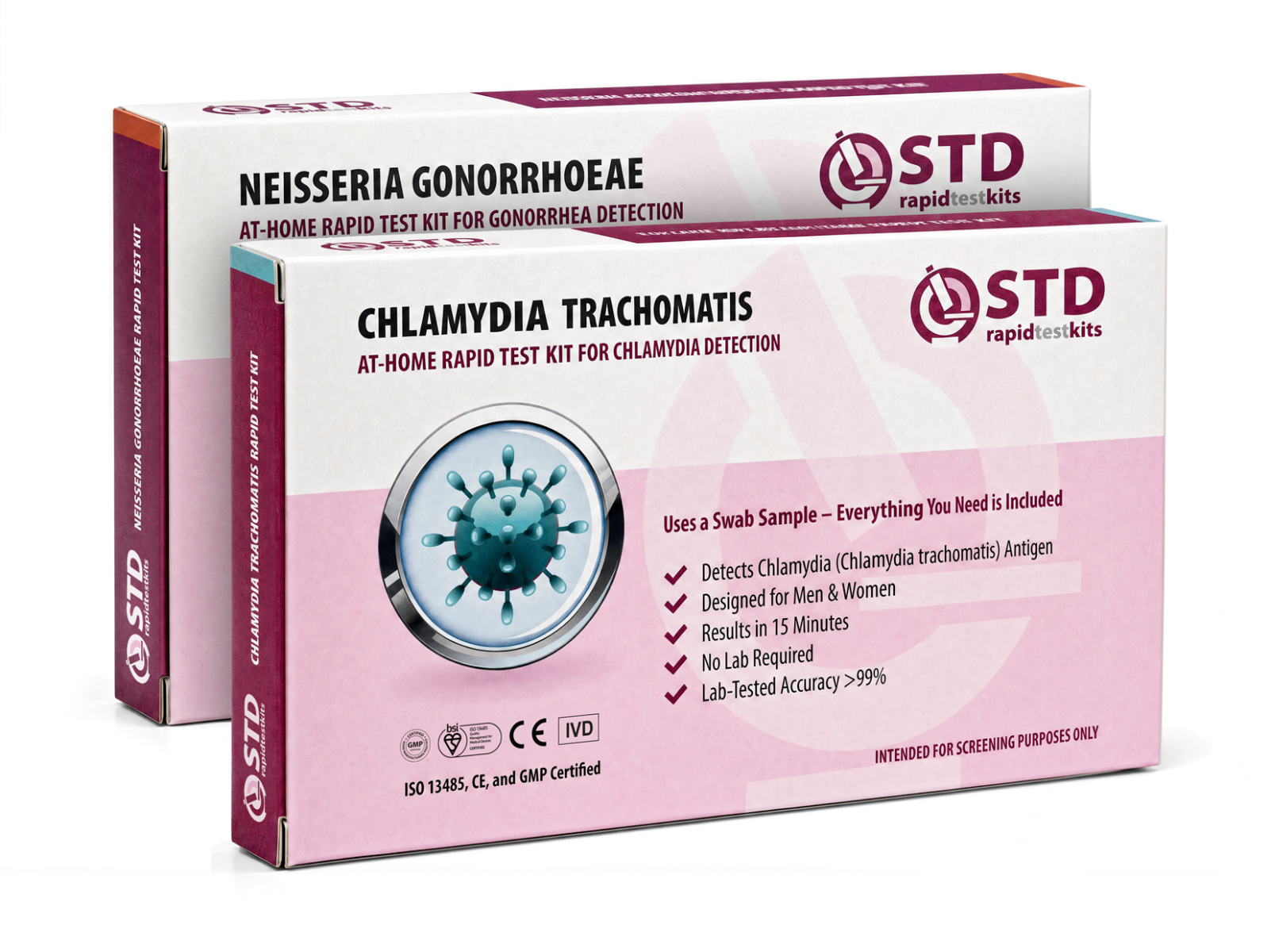
This article is published by stdrapidtestkits.com, which sells at-home rapid lateral-flow STI kits. Our kits screen genital swab samples and blood. We do not sell pharyngeal (throat) swab kits. Recommendations below reflect what fits the actual exposure, not commercial preference.
What the kissing research shows
For decades the standard line was that gonorrhea did not spread through kissing. Three things have changed that picture and they are worth understanding rather than just repeating headlines.
The first is the 2019 Australian network study published in Emerging Infectious Diseases. Researchers documented a cluster of seven people in a sexual network in which six had oropharyngeal gonorrhea but no urogenital infection. Genomic analysis showed the same strain across the network, and tongue kissing was the most parsimonious explanation for transmission since not all pairs had had oral sex (Cornelisse et al., 2019).
The second is a series of cross-sectional studies, also from the Melbourne Sexual Health Centre, that asked people how many partners they had kissed with no other contact and looked at throat infection rates. Men reporting four or more kissing-only partners in the previous three months had about 1.46-fold higher odds of oropharyngeal gonorrhea (Chow et al., 2019, cited in Tran et al., 2023 systematic review), and men kissing more than 75 percent of casual partners had a similar adjusted odds ratio of around 1.55, though this finding did not reach conventional statistical significance (95% CI 0.96 to 2.49).
The third is the 2023 systematic review itself, which performed a narrative synthesis (no meta-analysis) and concluded tongue kissing is plausibly a risk factor for oropharyngeal gonorrhea but not chlamydia, and that the effect is statistically real in some constituent studies but modest. The review cautions most studies are in men who have sex with men in high-prevalence networks, so absolute numbers do not transfer cleanly to a person who kissed someone new at a wedding.
What that adds up to: kissing can spread gonorrhea, the strongest signal is for deep tongue kissing, the per-kiss risk is small, and the risk concentrates in people with multiple recent partners and untreated throat infections in their network.
| Contact type | Realistic risk | What to do |
|---|---|---|
| Unprotected oral sex (giving) | High for the giver's throat | Throat NAAT at a clinic if symptomatic or partner positive |
| Deep tongue kissing | Small but documented | Throat NAAT if symptoms develop or partner tests positive |
| Closed-mouth kissing | Negligible | No testing needed |
| Sharing a drink, straw, or utensil | Negligible | No testing needed |
| Sharing a joint, vape, or lipstick | Negligible | No testing needed |
Symptoms of throat gonorrhea (when there are any)
Most people with throat gonorrhea feel nothing. The CDC's general gonorrhea guidance flags the same point: infections often produce no symptoms (CDC). When symptoms do show up, they are usually mild and easy to confuse with a viral sore throat, allergies, or strep.
Things people sometimes report:
- A sore throat that lingers past the usual three to five days of a cold
- Mild redness or swelling of the tonsils, sometimes with patchy white exudate
- Difficulty or discomfort swallowing
- Tender lymph nodes under the jaw or along the neck
- A scratchy or dry feeling that does not respond to lozenges
- Occasional low-grade fever or fatigue
None of those are specific to gonorrhea. Strep, mono, viral pharyngitis, post-nasal drip, and acid reflux can all look the same. The pattern that should raise an STI question is a sore throat that follows a new oral exposure, does not behave like a virus, and does not improve in a week. A strep rapid test will not catch gonorrhea; the throat needs a NAAT validated for pharyngeal samples.
What about sharing drinks, utensils, or a joint?
This is the part most people worry about, since we share drinks far more often than we deep-kiss strangers. The short version: there is no good evidence that gonorrhea spreads through casual fomite contact like cups, straws, water bottles, joints, or shared utensils. Neisseria gonorrhoeae is fragile outside the body and dies quickly on dry surfaces and in the cool conditions of a beverage. The bacterium needs warm, moist mucous membranes to survive.
That is why the CDC and NHS do not list shared drinks among gonorrhea transmission routes. The infection moves through direct mucous-membrane contact in the genitals, rectum, throat, or eye, and through bodily fluids in those moments (CDC, Gonorrhea; NHS, Gonorrhoea). Documented transmission via shared drinks is essentially absent from the medical literature, even in scenarios involving backwash and active oral lesions. If sharing a soda was your only exposure, you do not need to test.
The bacterium needs warm, moist mucous membranes and roughly body temperature to stay viable. On a cup, straw, joint, or utensil, it dies within minutes from drying out and from temperatures below body heat. That is why fomite (object-borne) transmission of gonorrhea is essentially absent from the medical literature, and why the CDC and NHS do not list shared objects among the routes worth screening for.
Other infections that do spread through kissing
Gonorrhea is not the only one to keep in mind, and a few of these are far more common from kissing than gonorrhea is.
- Herpes simplex virus type 1 (HSV-1). The classic cold sore virus is highly transmissible through kissing, and it can spread even when no visible lesion is present. Most adults carry it. Once you have HSV-1 orally, it stays for life and reactivates as cold sores. An HSV-1 antibody test can confirm exposure if you are unsure.
- Cytomegalovirus (CMV). A herpes-family virus, very commonly spread by saliva. Usually harmless in healthy adults, but matters during pregnancy because of risks to the fetus.
- Epstein-Barr virus (mononucleosis). Hence the nickname "the kissing disease." Often asymptomatic, sometimes a weeks-long fatigue and sore throat illness in teens and young adults.
- Syphilis. Can spread through kissing if there is direct contact with an infectious primary chancre or moist mucous patch in or around the mouth. Rare but documented.
- HPV. Oral HPV does occur, and certain strains are linked to oropharyngeal cancers. Routes of acquisition are debated, with oral sex being the best-established route. Kissing alone is a much weaker signal.
If a sore throat or oral lesion appeared after kissing someone new, gonorrhea is one explanation, but HSV-1 and viral pharyngitis are statistically far more likely.
How to test for throat gonorrhea
The recommended diagnostic test for pharyngeal gonorrhea is a nucleic acid amplification test (NAAT) on a throat swab, performed and processed in a clinical laboratory (CDC, Gonorrhea Treatment Guidelines). Most lateral-flow rapid kits, including ours, are validated on genital swab samples or blood, not on pharyngeal swabs.
If you genuinely need to know whether you have gonorrhea in your throat, the right move is an in-person visit to a sexual health clinic, urgent care, or primary care provider, where you can specifically ask: "I had oral exposure and I would like a throat NAAT for gonorrhea and chlamydia." That sentence is enough. You do not need to justify the exposure or apologize for asking. Throat NAAT panels are routine in sexual health clinics and many large primary care practices.
Where our at-home rapid kits do fit: most people who have had oral exposure have also had other contact, or have a partner whose genital infection status is unknown. A rapid swab-based test for genital gonorrhea (and often chlamydia) catches the most likely co-infection, gives a result in about 15 minutes, and does it discreetly at home. The strongest application is when you want to rule out the more common genital site quickly while you arrange a clinic throat NAAT, or as ongoing screening between clinic visits if you are sexually active with multiple partners.
On sensitivity: the at-home rapid kits we sell are lateral-flow immunoassays, which are highly specific but somewhat less sensitive than the lab NAATs used in clinics. A negative at-home result is reassuring, but a positive result, or a strong clinical suspicion despite a negative, should always be confirmed by a clinic NAAT. The two technologies are complementary, not equivalent.
A complete request that gets you the right test: I had oral exposure and I would like a throat NAAT for gonorrhea and chlamydia. Most sexual health clinics, urgent care centers, and primary care providers run this routinely. If you have also had genital or anal exposure, ask for swabs at those sites too, since each anatomical site is tested separately and a negative urine result does not say anything about the throat.
If you test positive: treatment, retesting, and what not to do
The treatment for uncomplicated gonorrhea, including pharyngeal infection, is straightforward. The CDC's current recommendation is a single 500 mg intramuscular dose of ceftriaxone for people weighing under 150 kg (about 330 lb), and 1 g for those at or above that weight (CDC MMWR, December 2020). This was an increase from the older 250 mg dose, made specifically because pharyngeal infections are harder to clear and require higher antibiotic levels in the throat.
For pharyngeal gonorrhea, the CDC also recommends a test of cure 7 to 14 days after treatment, using culture or NAAT, to confirm clearance. This is different from genital gonorrhea, where routine test of cure is not needed for uncomplicated cases. The throat is treated more cautiously because it is the site most associated with treatment failure and emerging resistance.
You should avoid any sex, including oral sex, for at least 7 days after treatment, and until partners from the previous 60 days have been tested and treated if needed. The CDC also recommends rescreening at three months for any gonorrhea diagnosis, because reinfection is common in sexual networks where the exposure pattern has not changed.
What you should avoid: treating yourself with leftover antibiotics, a friend's prescription, or anything bought online that is not prescribed for you. Wrong drug or wrong dose at the throat is exactly the conditions under which drug-resistant gonorrhea has emerged, and resistance to first-line cephalosporins has now been reported in multiple countries (WHO).
Any person with pharyngeal gonorrhea should return 7 to 14 days after initial treatment for a test of cure by using either culture or NAAT.
Telling a partner, and why blame is the wrong frame
A throat-only positive is one of the trickiest disclosures in sexual health because it does not map cleanly onto the cultural script of "what we did." Someone monogamous on intercourse but who has kissed others, or who had oral sex outside the relationship months ago, can still test positive in the throat. So can a partner who tested negative on a urine NAAT recently, because that test only saw the urethra.
The framing that lands best, in clinical communication research and lived experience, is health and shared problem-solving rather than blame. Ask your partner to get tested at the urethral or vaginal site, and at the throat too if any oral exposure has happened in the past few months. In a relationship with regular oral sex, both throats matter, not just the one with symptoms.
I tested positive for gonorrhea in my throat. It can spread through oral sex and there is some evidence it can spread through deep kissing too. The treatment is straightforward and I want us both to get checked.
Health and shared problem-solving, not blame. That framing reduces defensiveness in the partner and gets both of you to the clinic faster.
Putting the risk in perspective
Two facts pull in different directions and both are true. Globally, the WHO estimated 82 million new gonorrhea infections in adults aged 15 to 49 in 2020 alone, and pharyngeal infections are a meaningful share of that total in some sexual networks. The public health concern is real.
At the same time, the absolute risk of contracting gonorrhea from one closed-mouth kiss or from sharing a water bottle is so low that it does not justify avoidance behaviors or testing. Risk concentrates with deep tongue kissing, multiple recent partners, and exposure to networks with high background prevalence. If your situation does not include those, your gonorrhea-from-kissing worry probably matters less than the chance that your sore throat is a cold. If it does include those, the right move is a clinic throat NAAT plus an at-home rapid genital screen to cover the adjacent risk.
- If your only exposure was sharing a drink or a closed-mouth kiss, no testing is needed.
- If you had deep tongue kissing with a new partner and have a lingering sore throat, request a throat NAAT at a sexual health clinic, urgent care, or primary care provider.
- If you also had oral or genital sexual contact, add an at-home rapid swab kit to cover the genital site quickly while you arrange the throat NAAT.
- If your throat NAAT is positive, expect a single 500 mg ceftriaxone IM dose, no sex for 7 days, a test of cure at 7 to 14 days, and rescreening at 3 months.
FAQs
- Can I really get gonorrhea from kissing?
- Deep tongue kissing is the only type of kissing with documented gonorrhea transmission, and even then the per-kiss risk is much smaller than for unprotected oral sex. The risk concentrates in people with multiple recent partners and in sexual networks where untreated throat infections are common. A casual peck or closed-mouth kiss is not a meaningful exposure.
- Could I have gotten gonorrhea from sharing a drink or a joint?
- Neisseria gonorrhoeae cannot survive long outside warm, moist mucous membranes. On a cup, straw, joint, or utensil, the bacterium dies from drying out and cooling within minutes, which is why public health agencies do not list shared drinks among transmission routes. If sharing a drink was your only contact, no testing is needed.
- How would I know if I had throat gonorrhea?
- Most people would not, because the majority of pharyngeal infections cause no symptoms. When symptoms appear, they are usually a lingering sore throat, mild tonsil swelling, or tender lymph nodes under the jaw. None are specific to gonorrhea, which is why a throat swab NAAT is the only reliable way to know.
- Will an at-home STD test catch throat gonorrhea?
- No. Lateral-flow rapid home tests, including ours, are validated on genital swab samples or blood, not on pharyngeal swabs. For a throat result, ask a sexual health clinic, urgent care, or primary care provider for a throat NAAT. Our at-home kits cover the adjacent genital risk that often co-occurs with oral exposure.
- How long after exposure should I get tested?
- For NAAT-based testing, the practical window is about 7 to 14 days after exposure. Testing earlier can miss low bacterial loads and produce a false negative. If symptoms appear sooner, do not wait. Get tested when symptoms start and retest at the 14-day mark if the early test is negative but concern persists.
- How is throat gonorrhea treated?
- A single intramuscular dose of ceftriaxone, 500 mg for people under 150 kg or 1 g for those at or above that weight, is the current CDC recommendation. For pharyngeal infections specifically, a test of cure 7 to 14 days after treatment is also recommended, because the throat is harder to clear than the genitals and is the main site associated with emerging antibiotic resistance.
- Can throat gonorrhea clear on its own?
- Sometimes, but counting on that is a bad bet. Untreated throat gonorrhea can persist for weeks or months, can be passed on through oral sex during that time, and contributes to antibiotic-resistance pressure. If you test positive, complete treatment and the recommended test of cure.
- When can I have sex again after treatment?
- Wait at least 7 days after the ceftriaxone injection before any sexual activity, including oral sex, and until any partners from the previous 60 days have also been tested and treated if needed. The CDC also recommends rescreening at 3 months because reinfection is common in unchanged sexual networks.
- U.S. Centers for Disease Control and Prevention. Gonorrhea topic page covering symptoms, transmission routes, prevention, and the note that infections often produce no symptoms.
- U.S. Centers for Disease Control and Prevention. STI Risk and Oral Sex. Confirms throat infections from oral sex are possible and harder to treat than infections at other sites.
- U.S. Centers for Disease Control and Prevention. Sexually Transmitted Infections Treatment Guidelines, gonococcal infections in adults. Source of the 500 mg ceftriaxone IM recommendation and the 7 to 14 day pharyngeal test of cure.
- U.S. Centers for Disease Control and Prevention MMWR, December 2020. Update to gonococcal treatment recommendations explaining the rationale for the 500 mg ceftriaxone dose, including pharyngeal pharmacokinetics.
- Cornelisse VJ, Bradshaw CS, Chow EPF, Williamson DA, Fairley CK. Oropharyngeal Gonorrhea in Absence of Urogenital Gonorrhea in Sexual Network of Male and Female Participants, Australia, 2018. Emerging Infectious Diseases, July 2019. The network study supporting tongue kissing as a transmission route.
- Tran J et al. A Systematic Review of Kissing as a Risk Factor for Oropharyngeal Gonorrhea or Chlamydia. PMC10259206, 2023. Narrative synthesis citing Chow et al. 2019 (the source of the 1.46 odds ratio for kissing-only partners) and concluding kissing is plausibly a risk for gonorrhea but not chlamydia.
- World Health Organization. Sexually Transmitted Infections (STIs) Fact Sheet. Source of the 82 million new gonorrhea infections in 2020 (ages 15 to 49) and the global antimicrobial resistance discussion.
- U.K. National Health Service. Gonorrhoea overview. Source for transmission routes and the single-dose antibiotic treatment summary.
