
Published: August 2025 | Last updated: May 2026 | Editorial review and quality control: Martina N.
Fear about HIV in a shared home almost never starts in a clinic. It usually starts at a kitchen table, in a hallway, or somewhere around 2am with a phone in one hand. Someone you live with has HIV, or you just learned a friend or partner does, and your brain starts scanning every shared object in your house like it might be carrying something: the plates, the bathroom, the couch you both fell asleep on last weekend.
This is what living with outdated public-health messaging looks like in real life. The actual science of how HIV moves between people is narrow, specific, and well-mapped. Almost everything your fear is reaching for is not a transmission route at all.
Key Takeaways
- HIV transmits only through blood, semen, vaginal and rectal fluids, or breast milk entering the body through sex, shared injection equipment, mother-to-child contact, or rare healthcare exposure. Casual household contact (sharing food, hugging, kissing, using the same bathroom) does not transmit HIV.
- When a person living with HIV is on consistent treatment with an undetectable viral load, sexual transmission to partners has been shown to be effectively zero across large multi-year studies. This is the science behind U=U (Undetectable equals Untransmittable).
Where the Fear Comes From, and Why It Lingers
Across the 1980s and early 1990s, public-health messaging about HIV encouraged distance, separation, and a kind of vigilance that had less to do with biology and more to do with panic. By the time the science caught up, the cultural memory had already hardened. So when someone today learns that a roommate, friend, or partner is living with HIV, the brain reaches for those older instincts before it reaches for what the current evidence shows.
The questions tend to look the same across decades. Can HIV spread through food? Through a kissed cup? Through the bathroom? What if there is blood somewhere nobody noticed? These questions feel reasonable from inside the anxiety, but they map onto pathways the virus does not use.
Working from outdated information is not a moral failure. It is a reasonable response to messaging that did not get updated as quickly as the science did.
How HIV Moves Between People
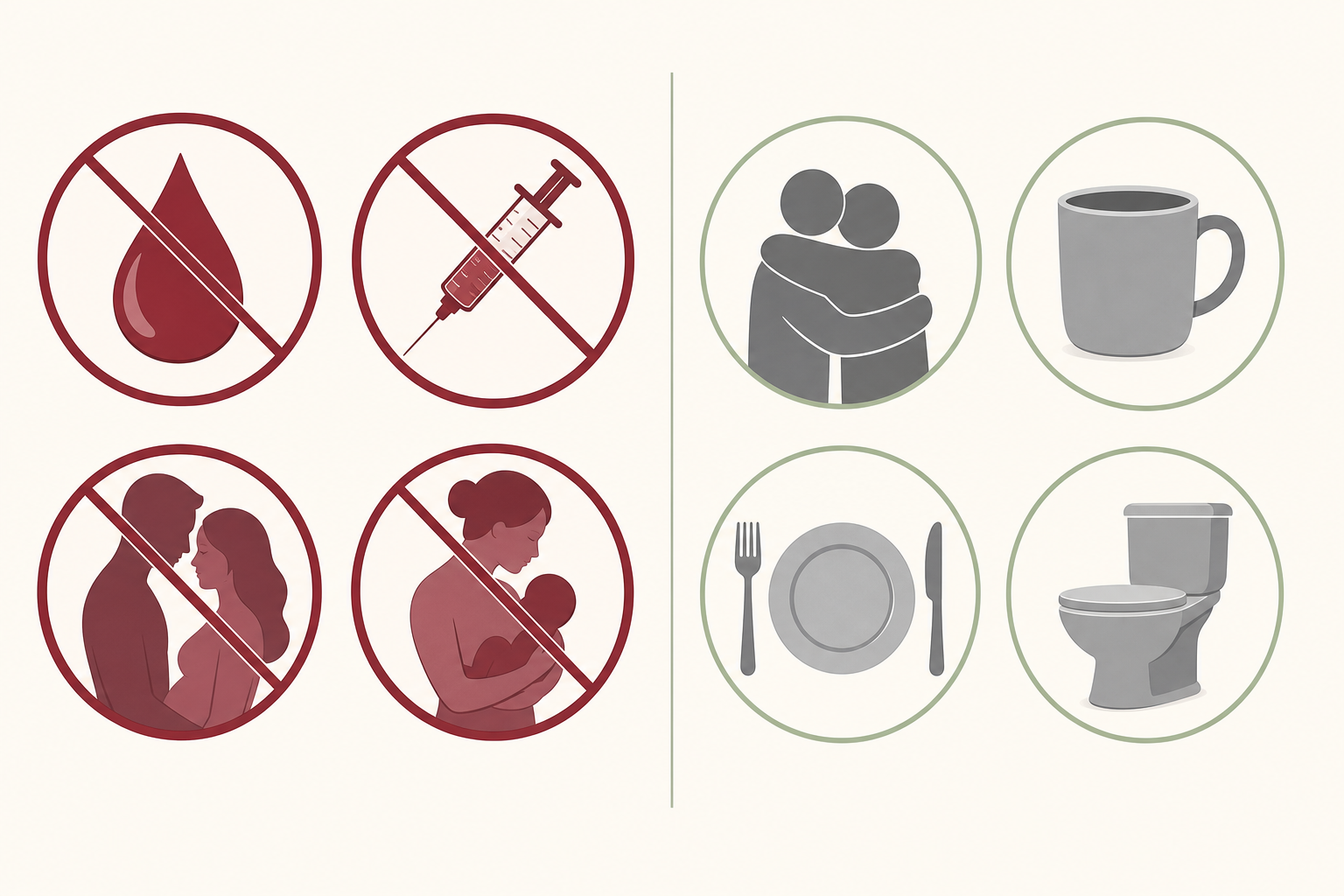
HIV transmits through only four bodily fluids in transmissible amounts: blood, semen (including pre-seminal fluid), vaginal and rectal fluids, and breast milk. According to the CDC, transmission requires one of those fluids from a person living with HIV to enter the bloodstream of an HIV-negative person, either through a mucous membrane (the lining of the rectum, vagina, penis, or in extremely rare circumstances the mouth), through a needle or syringe, or through an open wound or sore.
That short list rules out almost everything that happens in a shared home. Saliva, sweat, tears, urine, and feces do not transmit HIV in any meaningful way. Trace amounts of HIV are sometimes detectable in some of those fluids when a person has a very high viral load, but never at concentrations capable of infecting another person through casual contact. Intact skin and the inhibitors present in saliva handle those exposures without effort.
Four routes account for almost every transmission, stated in everyday language: unprotected sex without treatment, shared injection equipment, pregnancy or breastfeeding without antiretroviral coverage, and the rare needlestick or healthcare exposure.
| Activity | Risk Level | Why |
|---|---|---|
| Hugging, touching, cuddling | No risk | No fluid exchange occurs |
| Sharing food, drinks, utensils | No risk | HIV is not transmitted through saliva or food |
| Using the same toilet, shower, or sink | No risk | No transmission pathway on these surfaces |
| Closed-mouth or deep kissing | No risk | Saliva does not transmit HIV |
| Air, coughing, sneezing | No risk | HIV is not airborne |
| Sweat, tears, urine | No risk | HIV is not present in transmissible amounts in these fluids |
| Unprotected sex without treatment | Possible risk | Direct exchange of genital fluids or blood through mucous membranes |
| Sharing needles or injection equipment | High risk | Direct blood-to-blood exposure |
Is it safe to live with someone who has HIV?
Yes. HIV transmits only through specific bodily fluids (blood, semen, vaginal and rectal fluids, breast milk) entering the body through sex, shared injection equipment, mother-to-child contact, or rare healthcare exposure. Everyday household activities (sharing meals, hugging, using the same bathroom, even kissing) do not transmit HIV. When the person you live with is on consistent treatment with an undetectable viral load, sexual transmission to partners has also been shown to be effectively zero across multi-year studies of thousands of serodiscordant couples.
The Saliva Question, in Plain English
Among the questions people search at 2am, some version of can HIV spread through saliva is among the most common. The reason is intuitive. Saliva is everywhere. It lands on cups, forks, toothbrushes, and people we share life with. If HIV lived in saliva at infectious levels, shared life would be unworkable.
It does not. Saliva contains inhibitors and proteins that actively break HIV down before it could establish infection. Trace amounts of HIV are sometimes detectable in saliva from a person with very high viral load, but the concentrations are far too low and the environment too hostile to the virus for transmission to occur. CDC guidance states the conclusion plainly: HIV is not transmitted through saliva.
In practical terms, shared drinks, shared utensils, casual or deeper kissing, and ordinary household contact involving saliva do not transmit HIV. The only kissing-related risk public-health bodies have ever flagged sits in a narrow category of extreme scenarios involving fresh bleeding in both partners' mouths at the same time, and even those are described as theoretical rather than documented.
Blood: The One Scenario Worth Treating Carefully
This is where the conversation shifts from no risk at all to a level of awareness most households already practice. HIV can transmit through blood, but the conditions are specific. Infected blood needs to enter another person's bloodstream, typically through an open cut, a mucous membrane, or a shared needle. Dried blood on a surface, or a small drop that touched intact skin, is not a transmission route in any real-world sense, because the virus is fragile once exposed to air and intact skin is an effective barrier.
What this means in a shared home is closer to standard hygiene than special protocol. Wear gloves or use a barrier when cleaning a fresh blood spill. Do not share razors, toothbrushes, or nail clippers, because those items can carry small amounts of blood that could touch a small cut on someone else's skin. Cover any open cuts or wounds with a bandage until they heal. Dispose of injection equipment safely (insulin pens, lancets, anything that breaks the skin) in a sharps container rather than a regular trash bag.
None of these steps are HIV-specific. A public-health nurse would suggest the same precautions in any household, regardless of who has what diagnosis.
| Situation | What to Do | Why It Matters |
|---|---|---|
| Cleaning a fresh blood spill | Wear disposable gloves or use a paper-towel barrier; clean the surface with diluted bleach | Prevents direct skin or mucous-membrane exposure |
| Razors, toothbrushes, nail clippers | Keep these personal and do not share | These items can carry small amounts of blood that could touch broken skin |
| Open cuts or wounds on either person | Cover with a bandage until healed | Removes the only realistic indirect-exposure pathway in a home |
| Injection equipment (insulin pens, lancets) | Never share; dispose of in a sharps container | Direct blood-to-blood is the highest-risk transmission route for HIV |
Undetectable Equals Untransmittable, and Why That Reframes Everything
Over the past two decades, the most important shift in HIV science has been the data behind a phrase that still has not fully reached every household: U=U, short for Undetectable equals Untransmittable. When a person living with HIV takes antiretroviral therapy consistently, the virus in their blood can drop to a level that standard tests cannot detect. At that level, sexual transmission of HIV to a partner has been shown across multiple large studies to be effectively zero.
Evidence from three large multi-year studies makes this unambiguous. The PARTNER, PARTNER-2, and Opposites Attract studies followed thousands of serodiscordant couples (one partner with HIV, one without) over years of unprotected sex. Across tens of thousands of condomless sex acts in couples where the partner with HIV had an undetectable viral load, the studies recorded zero linked transmissions. The CDC's official guidance reflects this position: an undetectable viral load means effectively no risk of sexual transmission.
The implication for a shared household is straightforward. If sexual transmission, the highest-risk route in a close relationship, is removed by consistent treatment, then everyday household contact, which was already not a transmission route at all, becomes even further from anything resembling concern.
People with HIV who take HIV medication as prescribed and get and keep an undetectable viral load have effectively no risk of transmitting HIV to their HIV-negative sexual partners.
What a Normal Day Actually Looks Like
Day-to-day life with someone who has HIV looks like day-to-day life. The kitchen is shared, the dishwasher disagreements continue, plates and bathrooms get used by everyone without a second thought, and the couch still gets napped on by whoever sits down first. None of those moments involve the specific fluids and routes HIV needs, so none of them carry transmission risk.
What tends to change is the internal experience, not the activities themselves. People often describe a quiet recalibration that happens over a few weeks of ordinary life: the first time they realize they have not thought about it in a day, the first time a small worry passes without circling back. The shift moves from active vigilance to a state closer to how anyone lives with anyone else.
What changes more visibly is the practical layer around blood and personal items: a separate razor and toothbrush, gloves accessible for any fresh spill, and a sharps container if injection medication is part of the routine. Together these adjustments take up less than half a shelf in the bathroom.
Practical household adjustments at a glance
- Keep razors, toothbrushes, and nail clippers personal; do not share.
- Keep disposable gloves accessible for cleaning any fresh blood spill.
- If injection medication is part of the routine, use a sharps container for used needles and lancets.
When Living Together Also Means Intimacy
For some people, living together includes a sexual relationship. The questions that come up here are usually about long-term transmission risk between partners, and again, modern data has largely rewritten the answer. When the partner living with HIV is on consistent treatment with an undetectable viral load, data from PARTNER, PARTNER-2, and Opposites Attract show effectively no risk of sexual transmission, with or without condoms, across thousands of follow-up years.
Couples who want additional layers of reassurance have well-evidenced options. PrEP (pre-exposure prophylaxis) for the HIV-negative partner reduces sexual transmission risk by about 99% when taken as prescribed. Condoms remain effective at preventing other STIs and add another barrier. The combination of consistent treatment for the partner living with HIV plus PrEP for the HIV-negative partner is sometimes called the double-layer strategy.
CDC, WHO, and NHS framing all now treat HIV as a manageable chronic condition compatible with long-term relationships, intimacy, and parenthood. Older framings did not have access to this evidence, and many people are still working their relationship around outdated assumptions rather than current data.
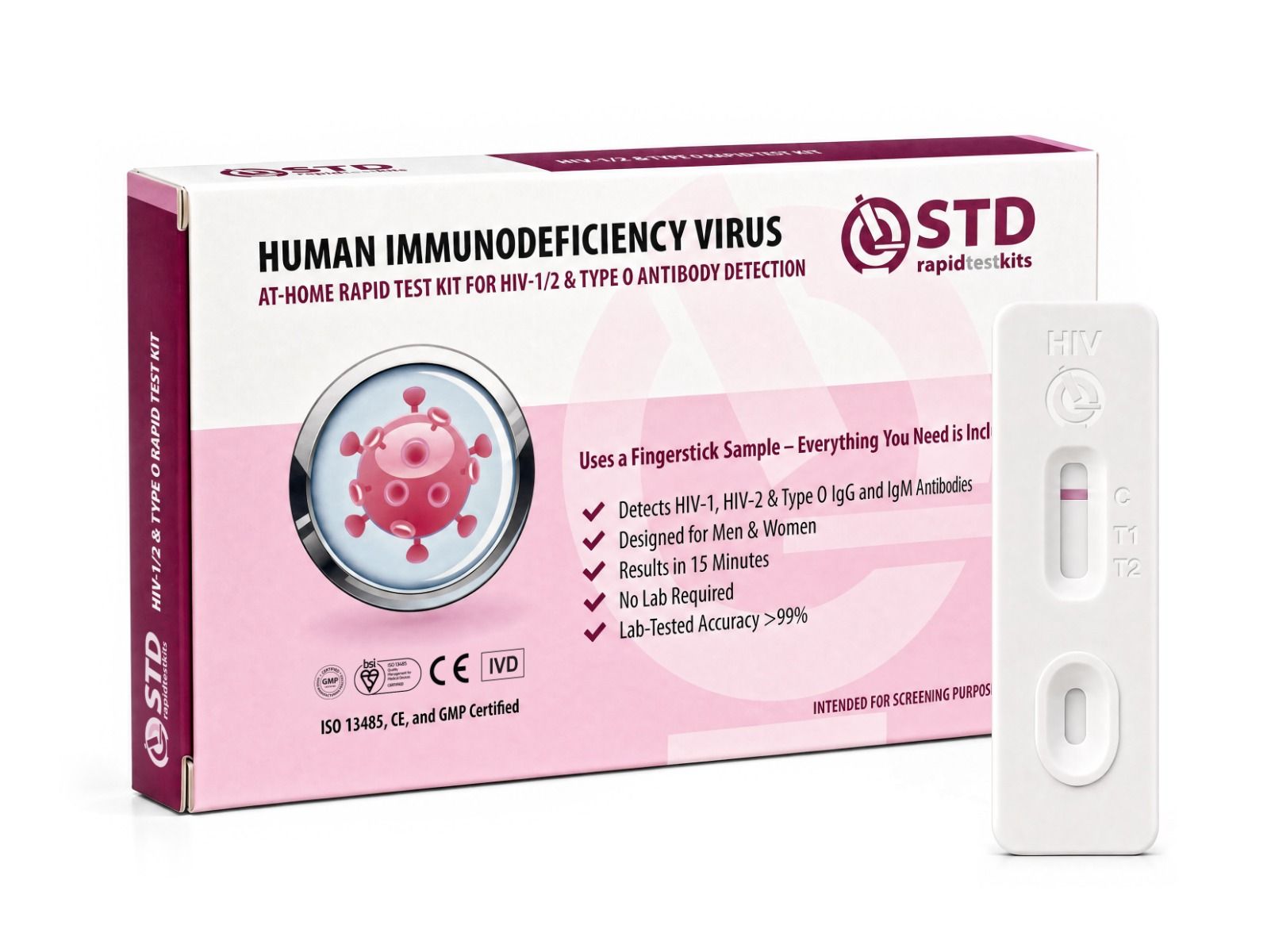
This site sells rapid at-home HIV tests; the product below links to our own page.
Testing as Peace of Mind, Not Panic
After all of this, some readers still carry a residual what-if. The reasonable next step depends on what kind of what-if it is. If the concern is about everyday household contact (sharing space, meals, bathrooms, casual touch), there is nothing to test for, because those are not transmission routes. Testing in that case is reassurance rather than medicine, and that is fine if the reassurance ends the loop.
If the concern is about a specific event that involved real exposure (unprotected sex with someone whose HIV status or treatment status was unknown, shared injection equipment, an accidental needlestick), testing has a real answer to give. The HIV antibody window for rapid home tests is roughly 23 to 90 days, with peak reliability at 90 days. Fourth-generation lab tests at a clinic (antigen plus antibody) can detect HIV by about 45 days post-exposure, which is why clinics recommend them when an exposure is recent. If the exposure was within 72 hours, post-exposure prophylaxis (PEP) at a clinic or emergency department is a separate, time-sensitive option worth knowing about.
Testing because there was real exposure is medicine. Testing to close a loop that fear opened is reassurance. Either reason is legitimate.
At-home rapid HIV tests are lateral-flow antibody tests. They are accurate when used inside the right testing window, but they are not the same technology as a clinic fourth-generation antigen-antibody test or a lab nucleic acid (NAAT) test. If your exposure was recent (under 6 weeks) or if a home result is positive, confirm with a clinic test. Rapid home tests work best as a screening and reassurance tool, not as a final diagnostic by themselves.
A Reality Check You Can Return To
If a household-contact spiral starts again later, the short version is easy to keep close. HIV does not transmit through shared meals, shared bathrooms, shared utensils, hugging, casual or deep kissing, sweat, tears, urine, air, surfaces, dishes, or laundry. It transmits through a small set of specific fluids entering the body through a small set of specific routes. Treatment with an undetectable viral load removes the highest-risk route entirely.
What changes when you know this is not your behavior. The dishes were always safe, the bathroom was always safe, the couch was always safe. What changes is how much of your attention the question takes up.
FAQs
- Can HIV spread through sharing food, drinks, or utensils?
- No. HIV is not transmitted through saliva, and it cannot survive in food or on utensils in any way that would infect another person. Sharing a meal, passing a fork, or drinking from the same cup carries no transmission risk.
- Can I get HIV from using the same toilet, shower, or sink?
- No. Toilets, showers, sinks, and other shared bathroom surfaces do not create a transmission pathway. HIV cannot survive on these surfaces or move through water in a way that would cause infection.
- What if there is a tiny amount of blood somewhere I cannot see?
- Transmission requires infected blood to enter your bloodstream directly, typically through an open wound, mucous membrane, or injection. Dried blood or microscopic traces on an intact surface are not a realistic transmission risk. Standard hygiene (covering open cuts, cleaning visible spills with gloves) is enough.
- Can I get HIV from kissing someone who has HIV?
- No. Saliva does not transmit HIV in any normal kissing scenario. The CDC notes that no documented cases of HIV transmission through closed-mouth kissing exist. Deep open-mouth kissing has only been associated with risk in extreme theoretical scenarios involving fresh bleeding in both partners' mouths at once, not in everyday intimacy.
- What does undetectable actually mean for someone I live with?
- It means the person's HIV treatment has reduced the virus to levels standard tests cannot measure. At undetectable status, the person does not transmit HIV through sex (the U=U principle). Since household transmission was never a route to begin with, undetectable status reinforces that everyday shared life is safe.
- Do we need to keep separate plates, towels, or laundry?
- No. There is no reason to separate household items based on HIV status. Plates, cups, utensils, towels, and laundry can all be shared and washed normally. The virus does not survive on these items in any way that would transmit infection.
- Can HIV travel through the air, like the flu or COVID?
- No. HIV is not airborne. It cannot be transmitted through coughing, sneezing, or sharing the same air. The virus also does not survive long once exposed to air outside the body, which is why surface transmission is not a realistic concern.
- Should I get tested just to settle my nerves?
- If your concern is everyday household contact, testing is not medically necessary because there is no real exposure to detect. If you have had a genuine exposure event (unprotected sex with someone whose status was unknown, shared injection equipment, an accidental needlestick), testing has a real answer to give. The most reliable rapid antibody result is at 90 days post-exposure; clinic fourth-generation tests can detect HIV earlier, by about 45 days.
How We Sourced This Article: This explainer summarizes current public-health guidance on HIV transmission and household safety from the CDC, WHO, NHS, HIV.gov, and NIH MedlinePlus. The U=U section reflects the consensus position confirmed by the PARTNER, PARTNER-2, and Opposites Attract studies of serodiscordant couples followed over multi-year periods. We focused on the questions readers actually search at home: shared meals, bathrooms, blood, kissing, and testing windows. This article is a summary of current guidance, not clinical advice; for symptoms or specific exposure events, see a licensed provider.
- U.S. Centers for Disease Control and Prevention. HIV basics, transmission, and prevention overview.
- U.S. Centers for Disease Control and Prevention. HIV Treatment as Prevention (Undetectable = Untransmittable) guidance.
- World Health Organization. HIV and AIDS fact sheet, including transmission routes and treatment as prevention.
- U.K. National Health Service. HIV and AIDS overview: how HIV is and is not transmitted.
- HIV.gov. How is HIV transmitted? Federal U.S. public-health information portal.
- U.S. National Library of Medicine, MedlinePlus. HIV/AIDS overview, transmission, and prevention information.
