Published: October 2025 | Last updated: May 2026 | Editorial review and quality control: Martina N.
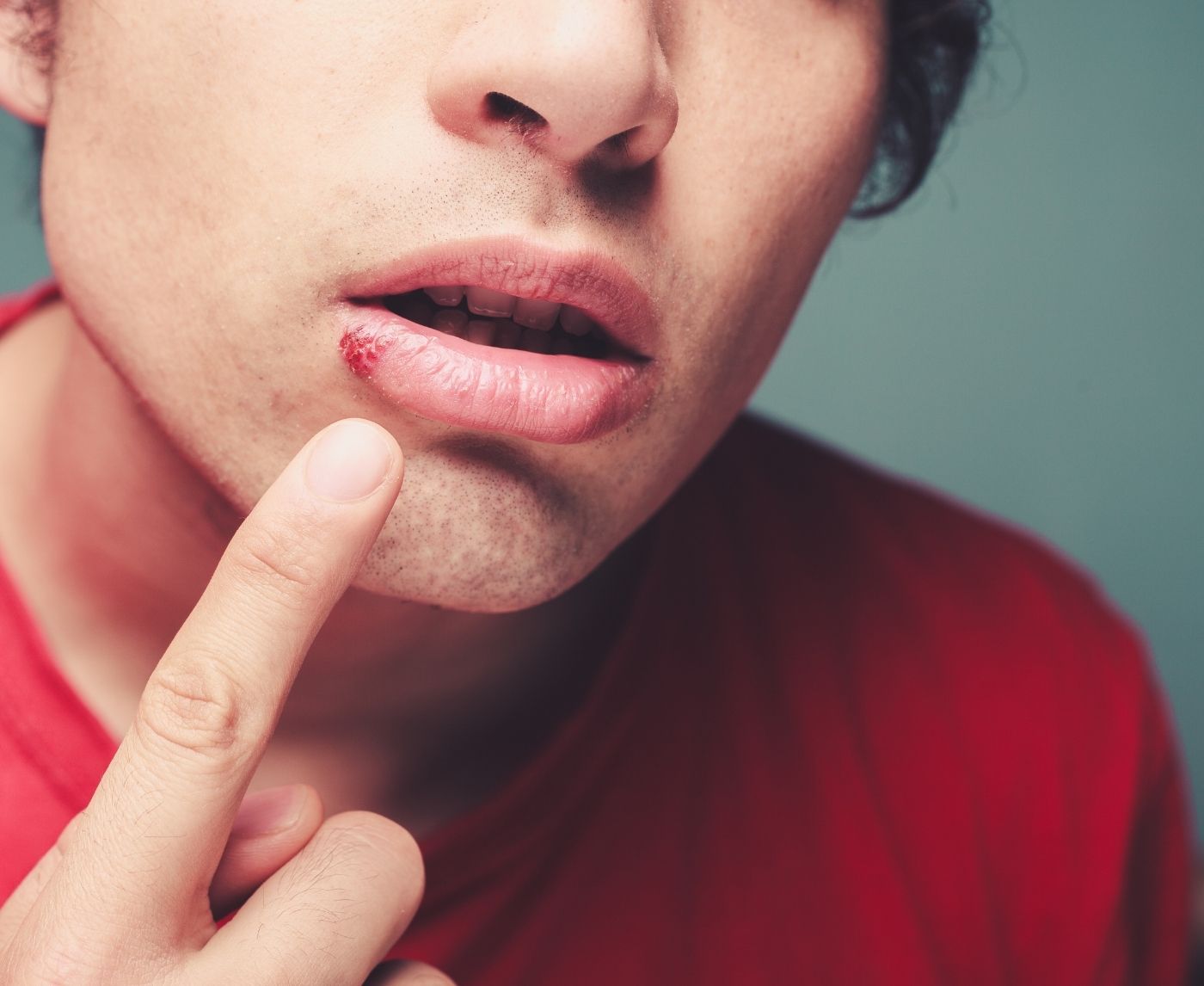
Most cold sores follow a predictable arc: a tingle on the lip, a cluster of small blisters within a day or two, a scab by the end of the week, and healed skin by about day ten. When that pattern breaks, when a sore stays solo, stays painless, or refuses to crust over, the cold-sore script is no longer the right one to read from.
That mismatch is the question this article exists to answer. A lip sore that lingers past two weeks, that never blistered, or that appeared after a new kiss or oral-sex partner can be a few different things. One of them is a primary syphilis chancre. The point of this guide is to walk through how those two infections show up on or around the mouth, when the timeline turns into a red flag, what testing options actually catch each one, and how to act on the answer without spiraling.
When a Cold Sore Isn't Acting Like a Cold Sore
Herpes simplex virus type 1 (HSV-1) causes most oral cold sores and follows a fairly tight clinical course. A prodrome of tingling or itching for a day. A cluster of small fluid-filled blisters on the lip border, sometimes the nostril or chin. The blisters break, weep, and form a yellow crust by about day five. By day seven to ten the scab falls off and the skin underneath is pink but intact. The NHS cold sores reference describes the standard course as roughly ten days from prodrome to healed skin, with no treatment required for most outbreaks.
When the arc is broken, the lesion behaves nothing like the script. A common version: a single round sore appears, never goes through a blister phase, doesn't hurt, and is still sitting there at the three-week mark. That is not how HSV-1 typically presents. It is, however, exactly how a primary syphilis chancre presents. The CDC's syphilis fact sheet describes the primary chancre as a single, firm, round, painless ulcer that appears at the site where Treponema pallidum entered the body, including the lip, tongue, gums, or back of the throat after oral contact.
The mismatch matters because both conditions can show up in the same spot, look superficially similar early on, and lead to very different next steps. Cold sores are uncomfortable but self-limited and clinically routine. Untreated syphilis quietly moves into a secondary, latent, and eventually tertiary phase that can damage the heart, brain, and nerves. The lip is just the first marker, and it disappears on its own in three to six weeks whether you do anything or not. The infection does not.
Key Takeaways
- A standard HSV-1 cold sore heals in 7 to 10 days and almost always passes through a blister phase. A sore that stays past two weeks, never blisters, or doesn't hurt is a red flag worth testing.
- Antibody-based syphilis blood tests typically turn positive 3 to 6 weeks after exposure, with some cases taking longer. If your first test is negative but the sore persists, retest at the 4 to 6 week mark before assuming you're clear.
Herpes vs Syphilis: How They Show Up Around the Mouth
HSV-1 and Treponema pallidum can both produce lesions on the lips, tongue, gums, or inside the cheek, particularly after oral sex or open-mouth kissing. The two infections share the geography but not the physiology. Their visible patterns, pain profiles, and timelines are different enough that, in a textbook case, a clinician can usually narrow the differential within a single visit. Real life is messier. Some people get cold sores that never form a true blister; some people get syphilis chancres on the inside of the lip that they never see.
The table below compares the most common features clinicians look for. Treat it as a checklist, not a diagnosis. Visual pattern matching is a useful start, not a substitute for a test. Both infections can be confirmed with the right swab or blood test, and getting that confirmation is the only way to know which path you're on.
| Feature | Herpes Cold Sore (HSV-1) | Syphilis Chancre |
|---|---|---|
| Number of sores | Multiple small blisters, usually clustered | Usually a single sore, occasionally two |
| Pain level | Tingling, burning, painful early on | Typically painless, firm to the touch |
| Appearance | Small fluid-filled vesicles over a red base | Round, clean-based ulcer with a firm, raised border |
| Crusting and healing | Crusts over within a week, heals in 7 to 10 days | Does not crust; heals slowly over 3 to 6 weeks |
| Common locations | Outer lip, edge of mouth, nose, chin | Lip, inner mouth, tongue, tonsil, gums |
| Recurrence | Often recurs in the same spot under stress or sun | Single primary lesion; resolves and is followed by secondary stage |
What These Sores Look Like Up Close
Side-by-side photographs help anchor the clinical descriptions above. The gallery below shows two HSV-1 cold sores at different points in their healing arc and two primary syphilis chancres on different oral surfaces. The visual differences are real and useful, but they are not diagnostic on their own. A confident answer needs a swab or a blood test. Use these as a sense-check on whether your sore is following the cold-sore script or breaking it.
Two Weeks and Still There: What Duration Tells You
Duration is one of the most useful clinical clues you have access to without a lab. A standard herpes cold sore resolves in about seven to ten days, sometimes pushing to fourteen if it was a severe outbreak or got reinfected. By the second week the crust should be gone, new skin should have formed, and the area should be fading back to its normal color.
When a sore is still present at three or four weeks, especially without ever having blistered or crusted, the math no longer fits HSV-1. The CDC's syphilis fact sheet states that a primary chancre typically lasts three to six weeks before resolving on its own, and it does not pass through the blister-crust-scab sequence at any point. The sore just sits there until it doesn't.
That long, quiet persistence is part of why primary syphilis is so frequently missed. The lesion isn't painful, isn't dramatic, and eventually clears on its own. Many people interpret the resolution as confirmation it was nothing serious. The bacteria, meanwhile, continue to circulate. By the time secondary syphilis symptoms appear weeks to months later, in the form of a rash on the palms or soles, swollen glands, or flu-like illness, the original lip sore is long forgotten.
If any of the following apply to your sore, make an appointment or order an at-home test now rather than waiting another week:
- Still present at day fourteen with no sign of crusting or healing
- Single round sore that never blistered, regardless of duration
- Painless or noticeably less painful than your usual cold sores
- Appeared after a new oral-sex partner or open-mouth kiss with someone you don't know well
- Accompanied by swollen lymph nodes in the neck or under the jaw
Any one of these is reason enough to test. Several together strongly suggest the sore is not a routine HSV-1 outbreak.
Why Casual Contact Still Counts as Exposure
One of the most persistent myths about oral sexually transmitted infections is that kissing, brief oral sex, or non-penetrative contact isn't "real" exposure. That belief keeps a lot of people from testing after encounters they categorize as minor. Syphilis does not respect that category. The CDC's overview of STI risk and oral sex confirms that oral-genital contact can transmit syphilis when one partner has an active chancre or other infectious lesion. The same biology applies to open-mouth kissing with someone who has an active oral chancre: published case reports and clinical references document transmission through direct contact with an infectious lesion, because the bacteria pass through mucous membranes regardless of the specific kind of contact.
Treponema pallidum is a corkscrew-shaped bacterium that enters through mucous membranes and microscopic breaks in the skin. The mouth has plenty of both. A small crack at the corner of the lip from chapped weather, a recent dental cleaning, a bitten cheek, or simply healthy oral mucosa is enough of an entry point. The exposure does not need to be repeated, prolonged, or sexual in the conventional sense. A single contact with an infectious lesion can be enough.
HSV-1 transmits even more easily and more commonly, including from people who have no visible sore. Asymptomatic viral shedding is well documented in the medical literature, and the virus is widespread enough that most adults under fifty carry it. The takeaway is not that every kiss is dangerous. It's that what felt like "low-risk" contact is still real exposure, and a sore that follows it deserves to be tested rather than rationalized away.
According to the <a href="https://www.who.int/news-room/fact-sheets/detail/herpes-simplex-virus" target="_blank" rel="noopener">World Health Organization's herpes simplex virus fact sheet</a>, about 3.8 billion people under age 50 globally carry HSV-1, which works out to roughly 64 percent of that age group (based on WHO's 2016 global herpes burden estimate). Most carriers have never had a visible cold sore and don't know they have it. The point isn't that HSV-1 is dangerous; for most people it isn't. The point is that casual oral contact with someone whose HSV or syphilis status you don't know is statistically normal, and a lingering sore deserves a clinical answer rather than a guess.
How Syphilis Moves Through Its Stages
Most people think of sexually transmitted infections as binary states: you have it, or you don't. Syphilis is different. After the bacteria establish themselves, the infection moves through four distinct stages over time. The early stages are the most infectious. The late stages are the most damaging. Because the primary chancre resolves on its own, many people assume the infection has resolved with it. It has not. Untreated syphilis remains active in the body, frequently silently, until antibiotics clear it.
The Cleveland Clinic syphilis reference and the CDC both describe the same four-stage progression. The table below summarizes the timeline and what tends to happen at each stage. The transitions are gradual, and individual cases vary, but the broad shape is consistent enough that clinicians plan testing and treatment around it.
| Stage | Typical Timing | What Happens |
|---|---|---|
| Primary | 10 to 90 days after exposure (average 21 days) | Single painless chancre at the site of entry. Heals on its own in 3 to 6 weeks. |
| Secondary | Weeks to months after the chancre | Rash, often on the palms and soles. Mucous patches, swollen lymph nodes, fever, sore throat, hair loss. |
| Latent | Months to years | No visible symptoms. Blood tests remain positive. Still treatable, still potentially transmissible early in this stage. |
| Tertiary | Years to decades after infection | Cardiovascular damage, neurological complications, gummatous lesions. Can be fatal if untreated. |
Testing Options: What to Expect and What to Ask For
When you decide to test, the options break into two paths: in-person clinical evaluation and at-home rapid testing. Both can confirm or rule out syphilis. Herpes is a slightly different story because the most accurate way to confirm an active HSV-1 lesion is a swab sent for PCR at a lab, which is not something an at-home kit currently offers. Blood antibody tests, including ours, confirm whether the body has produced antibodies to HSV-1 or HSV-2, which answers the question of past or current systemic infection but does not diagnose an individual active sore.
At a clinic, a provider will usually examine the sore visually, ask about recent sexual activity including oral contact, and order both a swab of the lesion and a blood panel. Importantly, syphilis is not always included in a standard "STD panel." Ask explicitly: "Can we include a syphilis blood test with this screening?" The typical first-line blood tests are RPR (rapid plasma reagin) or VDRL (venereal disease research laboratory) tests, both of which detect non-specific antibodies. If reactive, a confirmatory treponemal antibody test, either TPPA (Treponema pallidum particle agglutination) or FTA-ABS (fluorescent treponemal antibody absorption), is run before the diagnosis is finalized. The full guidance lives in the CDC's STI treatment guidelines for syphilis.
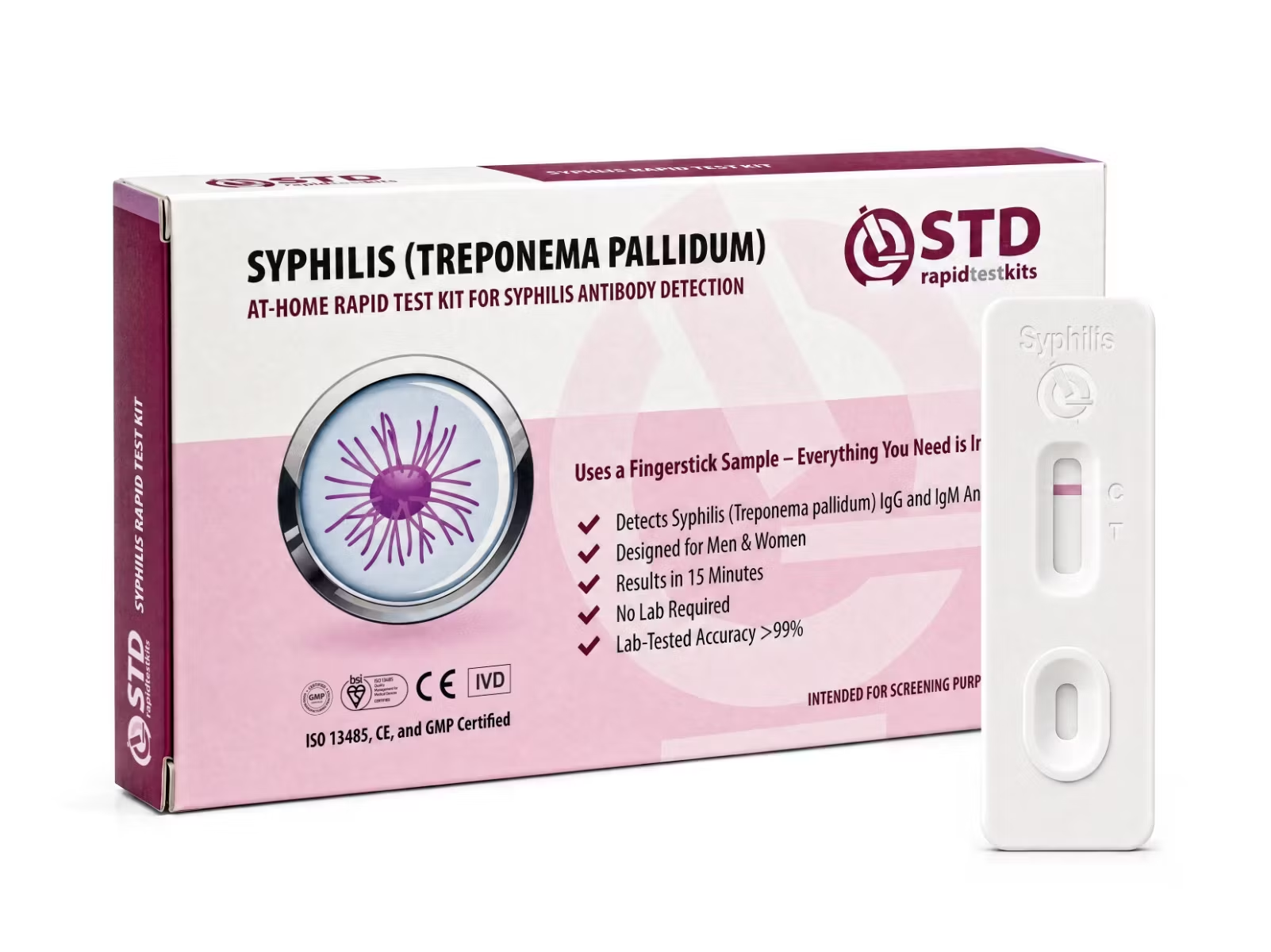
At-home rapid tests work by detecting antibodies in a small fingerstick blood sample. They use the same lateral-flow technology as a pregnancy test, just calibrated for a different target. The advantage is privacy and speed. The trade-off is that lateral-flow rapid antibody screening is not the laboratory "gold standard" of NAAT or treponemal assays; a reactive at-home result should be confirmed at a clinic, and a negative result during the window period should be retested in a few weeks. Either way, the at-home option lowers the activation cost of getting an answer.
The sore is usually firm, round, and painless. Because the sore is painless, it can easily go unnoticed.
The Retest Window: Why One Test Isn't Always Enough
A negative test does not always mean you're in the clear. Like most antibody-based STI tests, syphilis blood tests have a window period, the interval between infection and when the body has produced enough antibodies for the assay to detect them. That window is typically three to six weeks after exposure, though some people seroconvert later than that. Testing inside the window can return a falsely reassuring negative.
The practical implication is simple. If you had a possible oral exposure within the last few weeks and you have a suspicious sore now, test once at the time you notice the sore for a baseline. If that test is negative but the sore is still present, or if you've developed other secondary-stage symptoms like a rash or swollen glands, retest at the four to six week mark from the original exposure date. A persistent sore plus a delayed second test is the protocol that catches the cases an early single test misses.
This is also why a clinical visit with a swab of the lesion itself is useful when possible. PCR or direct microscopy on the sore can identify Treponema pallidum or HSV directly, regardless of how recent the exposure was, and does not depend on the body having mounted an antibody response yet. If you have access to a clinic that can swab, do that in addition to any blood test rather than instead of it.
If you have a suspicious sore right now and a possible exposure in the last few weeks:
- Test today for a baseline result. Note the date.
- If clinic access is available, ask for a lesion swab in addition to any blood test. The swab does not depend on the antibody window.
- If the first blood test is negative but the sore persists or new symptoms appear, retest 4 to 6 weeks after the suspected exposure date.
- Treat the second test as the decisive one if your first test fell inside the window period.
What Treatment Looks Like
Early-stage syphilis is one of the more straightforward infections to treat. The standard regimen, per CDC treatment guidelines, is a single intramuscular injection of long-acting benzathine penicillin G for primary, secondary, or early latent syphilis. One shot, one visit. People with documented penicillin allergy are typically managed with doxycycline over two to four weeks, with close follow-up. Pregnant patients with penicillin allergy are usually desensitized and treated with penicillin anyway, because the alternatives are less protective for the fetus.
The catch is that the visible sore is not what's being treated. The chancre will resolve on its own in three to six weeks whether you take antibiotics or not. What antibiotics treat is the systemic infection that the sore signals. A healed sore in an untreated person is not a cleared infection; it's the end of the primary stage and the beginning of the latent or secondary stage. The bacteria are still circulating. Only antibiotics clear them.
After treatment, follow-up blood tests at 6, 12, and 24 months track the decline of non-treponemal antibody titers (RPR or VDRL) and confirm the treatment worked. Sexual contact, including oral, should pause until the provider confirms the infection is cleared and any partners have been notified and treated. Partner notification matters: syphilis is highly transmissible during the primary and secondary stages, and one untreated partner can lead to reinfection or to a chain of new cases that public-health departments then have to trace.
For herpes, there is no cure. Antiviral medications like acyclovir, valacyclovir, or famciclovir can shorten outbreaks, reduce their frequency, and lower the risk of transmission. They are most effective when started at the first sign of prodrome. For someone with frequent recurrent oral HSV-1, daily suppressive therapy is sometimes prescribed. The condition is manageable, and most people learn their personal triggers and patterns over time.
| Question | Syphilis | HSV-1 Cold Sores |
|---|---|---|
| First-line treatment | Single intramuscular benzathine penicillin G injection | Antiviral pills (acyclovir, valacyclovir, famciclovir) at outbreak onset |
| Regimen length | One dose for primary/secondary/early latent disease | 5 to 10 days per outbreak; optional daily suppressive therapy for frequent flares |
| Curable? | Yes, with timely antibiotics; some late-stage damage may not reverse | No cure; managed long-term |
| Follow-up required | Blood tests at 6, 12, and 24 months to confirm clearance | None routine; track personal flare patterns |
| Partner notification | Important: untreated partners can reinfect and propagate the infection | Recommended when active sore present, less urgent overall |
If It Was Just a Cold Sore, Testing Still Helped
One of the most common reasons people put off testing is the worry they're overreacting. They imagine getting tested, getting back a negative result, and feeling silly for having gone through the trouble. That framing has it backwards. A negative result on a justified test is exactly the kind of answer the testing system is designed to produce. It rules out the dangerous possibility, confirms the benign one, and lets you move forward with clarity.
Confirming a sore is a routine HSV-1 cold sore also opens practical options. Prescription antivirals can shorten future outbreaks. A photograph and date log of the current episode gives you a baseline to compare against if a future sore behaves differently. And knowing your HSV-1 status, which the WHO estimates covers about 64 percent of adults under 50 globally (based on 2016 data), is part of having a complete picture of your sexual health.
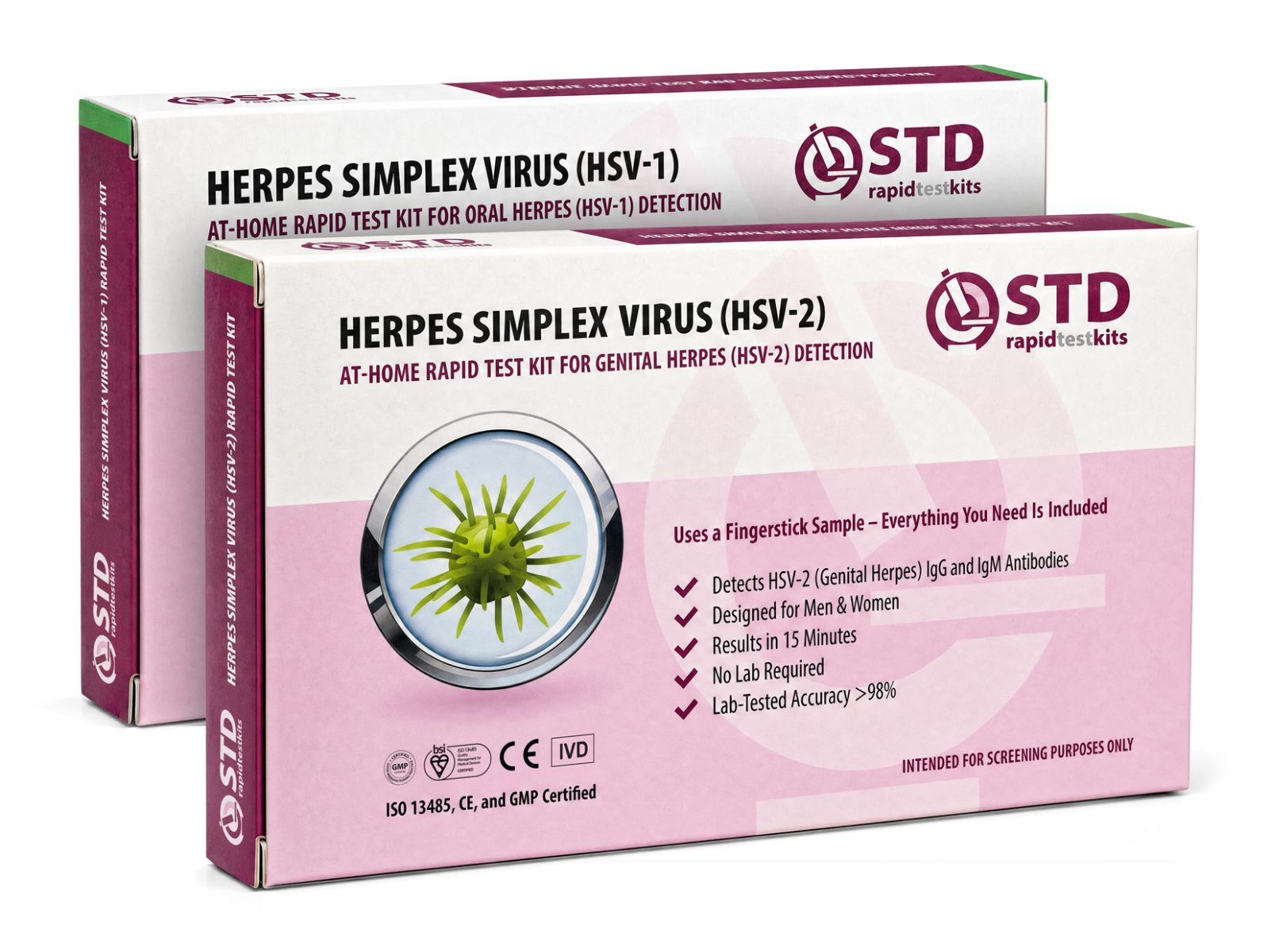
For oral HSV-1 specifically, our combined blood antibody panel detects HSV-1 and HSV-2 antibodies from a fingerstick sample. The test answers the question of whether your body has been exposed and produced antibodies. It does not diagnose the specific active lesion on your lip; for that, a clinic swab sent for PCR is the right tool. The home test fits best as a follow-up confirming whether the cold sore is part of a long-standing HSV-1 infection or, less commonly, a recent HSV-2 seroconversion from genital contact.
A clean syphilis and HSV result after a justified test gives you four useful things in one visit: a documented baseline if a future sore behaves differently, ruled-out worry about systemic infection, the option to start antivirals at the first prodrome of any recurrence, and clear context for any future partner conversation. Nothing about the visit was wasted.
Where to Go From Here
If you've made it this far, your gut is probably telling you something about the sore on your lip isn't quite right. That instinct is worth listening to. A short, structured plan is more useful than another round of late-night searching.
Today, take a clear photograph of the sore with good lighting and note the date it first appeared. Write down any recent oral or open-mouth contact in the previous 90 days, with dates. Book a same-day or next-day appointment if your clinic has one; if not, order an at-home rapid syphilis test and plan to follow up with a clinic swab when you can. When you talk to a provider, say the words "I'd like a syphilis blood test included with the screening," because it is genuinely not in every default panel. Avoid kissing, oral sex, or sharing utensils and drinks until you have a clearer picture. And if testing identifies an infection, contact recent partners; most clinics and public-health departments can help with notification anonymously if that's easier.
Most importantly, don't let the worry calcify into avoidance. One test visit or one at-home kit order produces a clearer answer than another week of watching and waiting.
Today's checklist
- Photograph the sore in good light and note the date it appeared.
- List any oral or open-mouth contact in the past 90 days with dates.
- Book a clinic visit or order an at-home rapid syphilis test today.
- Ask explicitly for a syphilis blood test, since it is not always in default STD panels.
- Pause kissing, oral sex, and shared utensils until you have a result.
- If your first test is negative but the sore persists, retest at 4 to 6 weeks from the exposure date.
Frequently Asked Questions
- Can a cold sore actually be syphilis?
- Yes, although it's uncommon. Syphilis can appear as a single painless sore on the lip, tongue, gums, or inside the mouth after oral contact with an infected partner. Because primary syphilis chancres don't blister and don't hurt, they are frequently mistaken for an atypical cold sore, a bite, or a canker sore. The clearest signals it might be syphilis rather than HSV-1 are: only one sore, no blister phase, no pain, and persistence past two weeks.
- How do I tell a herpes cold sore from a syphilis chancre at home?
- Herpes cold sores tingle before they appear, form clusters of small fluid-filled blisters, hurt, crust over within a week, and heal in about ten days. Syphilis chancres are usually solitary, painless, firm-edged, never blister, never crust, and persist three to six weeks before fading on their own. Visual checks are a useful starting point, not a diagnosis. The only way to be certain is a blood test for syphilis and ideally a swab of the lesion sent for laboratory testing.
- Can I get syphilis from kissing alone?
- Open-mouth kissing can transmit syphilis if one partner has an active oral chancre or other infectious lesion. The bacteria enter through mucous membranes and small breaks in the skin, both of which the mouth has in abundance. Brief contact is enough if an active lesion is present. The same chain of biology applies whether the contact was kissing, oral sex, or any other direct mucosal contact with the lesion.
- How soon after possible exposure should I test for syphilis?
- Antibody-based blood tests typically turn positive 3 to 6 weeks after infection, with some cases taking longer. If you test sooner than that, a negative result may simply reflect the window period rather than absence of infection. The practical approach is to test once when you first notice symptoms for a baseline, then retest at the 4 to 6 week mark from the suspected exposure if the sore persists or other symptoms appear.
- Can syphilis go away without treatment?
- The visible sore heals on its own in three to six weeks regardless of treatment. The underlying infection does not. Without antibiotics, the bacteria continue to circulate and the infection progresses through secondary, latent, and eventually tertiary stages, which can cause permanent damage to the heart, brain, and nerves over years to decades. Early-stage syphilis is curable with a single penicillin injection. Late-stage damage is not always reversible.
- Can an at-home test diagnose an active lip sore?
- At-home rapid tests are blood antibody tests. A reactive syphilis result strongly suggests current or recent infection and should be confirmed at a clinic. A reactive HSV result confirms past exposure to the herpes virus but does not identify an individual active sore. For the question of "what is this specific lesion on my lip," the most direct answer comes from a clinic swab of the sore sent for PCR. The at-home test is best used as a fast first screen or a follow-up after a clinic visit, not as a single-step diagnosis of a visible sore.
- My test was negative but the sore is still there. What now?
- Two possibilities are most likely. Either you tested inside the window period and the antibodies hadn't risen high enough to be detected yet, or the sore is caused by something other than syphilis (a canker sore, an allergic contact reaction, a fungal infection, an atypical HSV outbreak, or rarely an oral malignancy). The next step is a clinic visit so a provider can examine the lesion directly, swab it, and order any additional tests that make sense given the timeline. Plan to retest blood antibodies at the 4 to 6 week point as well.
- Should I tell a recent partner I'm getting tested?
- If a recent partner is plausibly the source of the exposure, telling them is the responsible move and also the practical one. They may need to be tested and treated, and untreated partners can reinfect you after your own treatment. The conversation does not need to be dramatic; a short note saying you noticed a sore that hasn't healed normally and are getting it checked is enough. If a positive diagnosis comes back, public-health departments in most regions can help with anonymous partner notification.
How we sourced this article: Our editorial team summarizes current public-health and peer-reviewed clinical guidance into plain-English explanations for at-home health decisions. For this piece, we drew on CDC fact sheets, the CDC's STI treatment guidelines, the Cleveland Clinic syphilis disease reference, the NHS cold sores reference, and the WHO's herpes simplex virus fact sheet. The sources below are the ones we leaned on most heavily; we also cross-checked specific window-period and stage-timing figures against current treatment guidelines to make sure the numbers match what clinicians are using right now. This article is not a substitute for clinical diagnosis. If you have a sore that is concerning you, see a licensed provider.
- U.S. Centers for Disease Control and Prevention. Syphilis fact sheet describing the primary chancre, stages, transmission, and the 3 to 6 week chancre duration.
- U.S. Centers for Disease Control and Prevention. STI risk and oral sex overview, covering syphilis, gonorrhea, chlamydia, and HSV transmission routes through oral-genital contact.
- U.S. Centers for Disease Control and Prevention. STI treatment guidelines for syphilis, including serologic testing, treatment regimens, and follow-up.
- Cleveland Clinic. Syphilis disease reference covering causes, four-stage progression, diagnosis, treatment, and prevention.
- NHS. Cold sores reference describing the typical HSV-1 outbreak arc and roughly ten-day healing timeline.
- World Health Organization. Herpes simplex virus fact sheet with global prevalence data (3.8 billion people under 50, about 64 percent, carry HSV-1, per 2016 estimates).
