
Published: November 2025 | Last updated: May 2026 | Editorial review and quality control: Martina N.
Burning when you pee, no discharge, and a urine culture that comes back clean. This pattern is one of the most common ways a chlamydia infection gets missed. Most clinicians screen first for a urinary tract infection because UTIs are common and the symptoms overlap exactly. When the culture is negative, the conversation often ends there, and the next visit a few weeks later starts the same loop again.
Chlamydia is the most reported bacterial sexually transmitted infection in the United States, and it can produce all the classic UTI symptoms (burning, urgency, lower pelvic pressure) without the visible discharge that most people expect from an STI. The CDC notes that chlamydia often has no symptoms, but can still cause serious health problems, and when symptoms do appear they can look almost identical to an irritated bladder. If your urine culture did come back positive and the symptoms resolved on antibiotics, a UTI was the most likely cause. The rest of this piece is for the reader whose culture was clean and whose symptoms have returned. It walks through why the two conditions feel the same, why standard tests miss chlamydia, and what to do if a UTI workup keeps coming up empty.
Key Takeaways
- Chlamydia and a UTI feel almost identical, but they need different tests and different antibiotics. A standard urine culture won't catch chlamydia.
- If burning when you pee keeps coming back after a clean UTI test or a short antibiotic course, asking specifically for a chlamydia test is the right next step.
When a UTI Test Comes Back Clean but the Burning Stays
The cycle that lands a lot of people in this exact position looks like this. You feel burning when you pee, maybe a dull ache below the belly button, an urgent pull to go even when there's barely anything in your bladder. Your mind jumps straight to a UTI because those are the textbook signs. You see a clinician (or a telehealth doctor, or a walk-in clinic), they prescribe a short antibiotic course, and you move on. A few days later the symptoms ease. A week or two after that, they come back.
That second round is the one worth paying attention to. If the urine culture came back negative the first time, or if the symptoms returned shortly after a treatment course, the original diagnosis might have been wrong. Chlamydia hides in this gray zone reliably. The CDC's surveillance data continues to identify it as the most-reported bacterial STI in the country, and a large share of cases produce no obvious genital symptoms at all (CDC, About Chlamydia). When symptoms do appear, they can be subtle, intermittent, or look exactly like an inflamed bladder.
A negative urine culture combined with returning symptoms is a strong reason to ask specifically for a chlamydia NAAT, not just another round of UTI antibiotics. The standard urine culture does not look for chlamydia at all.
Why Chlamydia Feels Identical to a UTI
Chlamydia and a UTI irritate the same structure, the urethra, which is why they feel identical to the person experiencing them. Chlamydia, especially early in an infection, settles in the urethra, the same tract a UTI inflames. Both trigger the same nerve endings and produce the same trio of sensations: burning during urination (clinically called dysuria), a sudden need to go, and a pressure that doesn't ease after the bladder empties.
For people with vaginas, the urethra, bladder, and cervix sit close enough that infections can spread or mimic each other quickly. A chlamydia infection can travel quietly up the reproductive tract toward the cervix and fallopian tubes, sometimes without causing visible discharge or sharp pain. When that happens it can develop into pelvic inflammatory disease, the leading preventable cause of fertility damage among women in the U.S. For people with penises, the same urethral inflammation can move toward the epididymis (the coiled tube at the back of each testicle), producing the testicular ache that often signals the infection has progressed. The clearest side-by-side comparison is in the table below.
| Symptom or sign | Chlamydia | Urinary tract infection |
|---|---|---|
| Burning during urination | Common when symptomatic | Common |
| Sudden urgency to urinate | Sometimes | Very common |
| Genital or urethral discharge | Possible, often missed | Usually absent |
| Pelvic or testicular pain | Possible | Uncommon |
| Fever, chills, or back pain | Rare unless infection has spread | Possible if the infection reaches the kidneys |
| Detected by a standard urine culture | No (needs a NAAT) | Yes (E. coli most often) |
Why a Standard Urine Culture Misses Chlamydia
A standard urine culture grows bacteria from a urine sample on a culture plate and identifies what shows up. The point of that test is to confirm a UTI, which is usually caused by Escherichia coli or one of a handful of other gut-origin bacteria that grow well on routine culture media. Chlamydia trachomatis, the bacterium that causes chlamydia, doesn't grow on those plates. It lives inside human cells and needs a different kind of test entirely.
That different test is a NAAT, or nucleic acid amplification test, which looks for chlamydia DNA in the sample rather than waiting for the bacteria to grow. NAATs are run in a lab, and the World Health Organization calls them the gold standard for diagnosing chlamydia. The catch: a clinician has to specifically order one. A bare-bones UTI workup will not include it. So if your last visit was a quick urine dip and a Bactrim prescription, chlamydia would have walked right through that screening.

When UTI Antibiotics Stall the Wrong Infection
This is where things go sideways for the most people. Common UTI antibiotics like nitrofurantoin and trimethoprim-sulfamethoxazole are good at clearing the bacteria they target, but they don't reliably cover chlamydia. Chlamydia is treated with doxycycline (typically a one-week course) or, in specific situations, azithromycin in a single dose. Different drugs, different rules.
Two patterns can follow when chlamydia is treated with the wrong antibiotic. The first is partial relief: anti-inflammatory effects, fluid shifts from drinking more water, and natural symptom variation can ease the burning for a few days even though the infection is still present. The second is silent progression. The bacteria continues to multiply along the urethra and, in women, can ascend toward the upper reproductive tract; in men, toward the epididymis. Either pattern can later show up as testicular pain, lower-belly pain, abnormal bleeding between periods, or chronic pelvic discomfort, all of which are clues that the original “UTI” was something else.
Clinicians commonly see this exact pattern in walk-in clinics: a patient comes in with the second or third “UTI” of the year, the urine culture is clean, and a chlamydia NAAT finally turns up positive. The fix at that point is usually straightforward (a short course of doxycycline), but the diagnostic delay can run weeks or months depending on how many UTI workups happened first.
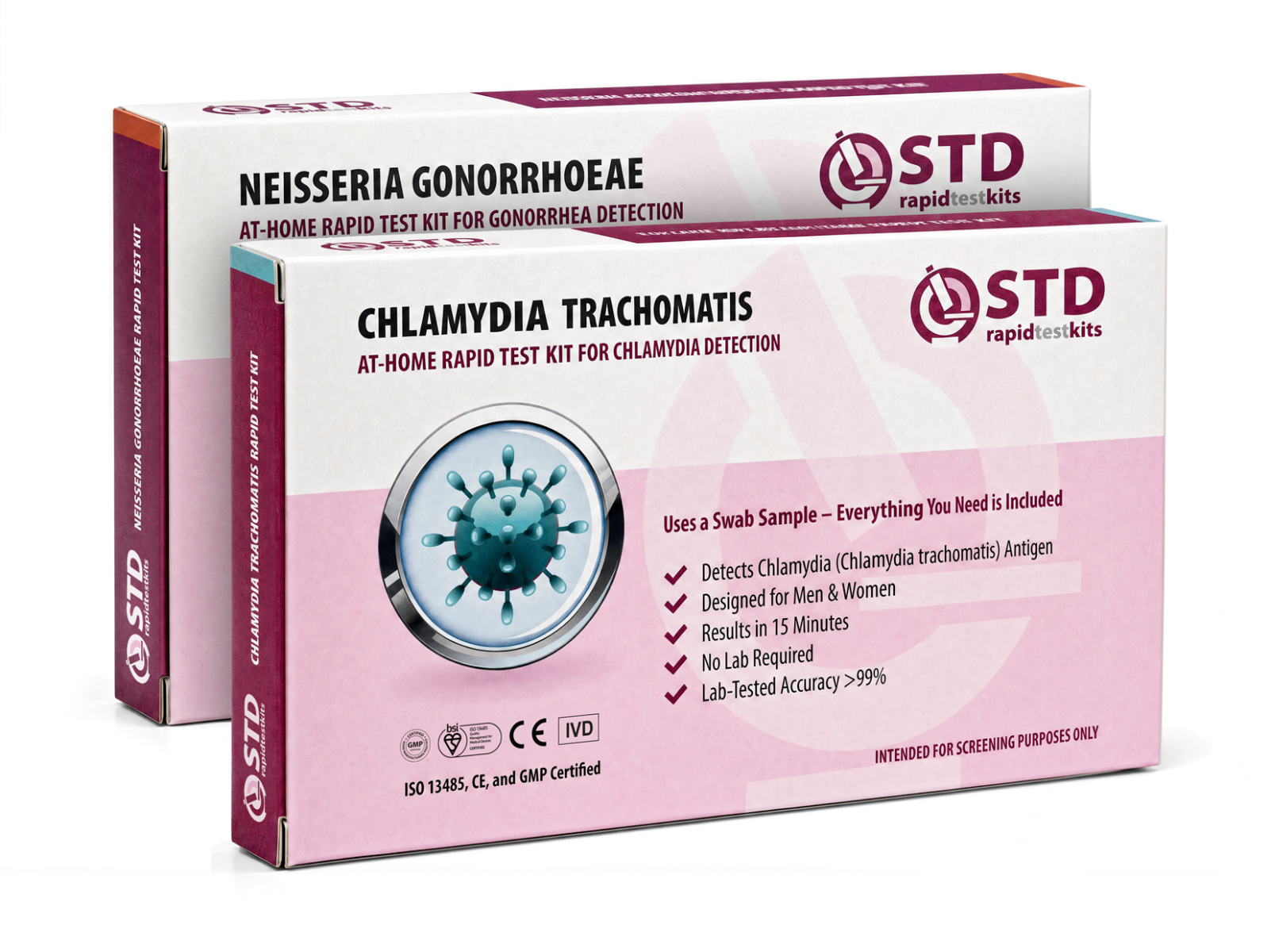
How to Actually Test for Chlamydia
If you've had UTI-style symptoms and a UTI test came back clean, the next reasonable step is a chlamydia test. There are three common ways to do that, and they trade off speed, privacy, and analytical sensitivity in different ways.
The lab gold standard is a NAAT performed on a urine sample or a self-collected genital swab. NAATs are highly sensitive, which is why the WHO designates them the gold standard for chlamydia diagnosis. Results come back in 1 to 5 days depending on lab turnaround. The trade-off is access: you need a clinician visit or a mail-in lab to order one.
The at-home alternative is a rapid lateral-flow swab test that you self-collect at home. These are not the same chemistry as a lab NAAT; they're a different (faster, less analytically sensitive) screening technology. A rapid test gives you a 15-minute screening result in private. A positive home result is worth confirming with a clinician. A negative home result is most useful when the timing is right, which is covered below.
| Test type | Sample | Where to do it | Best for |
|---|---|---|---|
| Lab NAAT (clinic or mail-in) | Urine or self-collected swab | Clinic, sexual-health center, or mail-in lab | Confirming a diagnosis when laboratory-grade accuracy matters |
| At-home rapid lateral-flow swab | Self-collected vaginal or penile swab | Home | Fast private screening; confirm any positive with a clinician |
| Standard urine culture | Urine | Clinic or doctor's office | Confirming a UTI; will not detect chlamydia |
When to Test and When to Retest
The timing of a chlamydia test matters because the bacteria takes time to reach detectable levels in the body. Test too early after an exposure and the result can come back negative even when the infection is present. Most clinical guidance recommends testing no earlier than two weeks after exposure for reliable results, since the bacteria need that long to reach detectable levels (CDC, About Chlamydia). A test done in the first few days after exposure has a meaningful chance of coming back falsely negative purely because of timing.
If you tested earlier than the two-week mark and your symptoms have continued, plan a second test about two weeks after the original exposure. After completing a treatment course for a confirmed positive, the CDC recommends confirming clearance about 3 months later, since reinfection from an untreated partner is the main driver of repeat cases. A partner who tests positive after you have already tested negative counts as a fresh exposure; start the timing window over from that date and retest about two weeks later.
| Situation | When to retest | Why |
|---|---|---|
| You tested very soon after exposure | Retest about two weeks after the exposure | Early tests can miss the infection because bacterial load is still low |
| You completed treatment for chlamydia | Retest about 3 months later | CDC recommends a follow-up test because reinfection is common |
| A recent partner later tested positive | Test now, then again about two weeks later | Treat it as a fresh exposure with a new timing window |
| Symptoms returned after a negative test | Retest in 2 to 3 weeks | Could be reinfection or an earlier false negative |
Why Absent Discharge Isn't Reassurance
The mental image most people carry around for an STI involves discharge: thick, colored, smelly, hard to miss. So when there isn't any, the assumption is that the body is fine. That assumption sends a lot of chlamydia infections undiagnosed.
The reality is much quieter. Chlamydia produces noticeable discharge in only a fraction of cases, and even then it's often clear, watery, and easy to miss. In people with vaginas it can blend into the normal hormonal variations of cervical mucus across a cycle. In people with penises it can be a small morning drop that dries before the day starts. Plenty of confirmed chlamydia infections produce no discharge at all, only intermittent burning or vague pelvic pressure (or nothing at all).
Discharge is a possible sign of chlamydia, not a required one. Burning, urgency, pelvic ache, post-sex bleeding, or a partner's positive test are each reason enough to test, regardless of whether there's anything visible at the underwear level.
Chlamydia often has no symptoms, but it can cause serious health problems, even without symptoms.
Telling Partners and Stopping Reinfection
If a chlamydia test comes back positive, the next move is making sure recent sexual partners know to get tested and treated. Blame isn't useful here. The point is closing a treatment loop so the infection doesn't bounce back between partners after treatment ends.
Chlamydia reinfection is common, and the most consistent driver is an untreated partner passing the infection back after the first person has finished treatment (CDC chlamydia overview). There are easier ways to manage the conversation than face-to-face confession. Anonymous partner notification services let you send a message through a state-run system without your name attached. Many U.S. states allow expedited partner therapy (EPT), which lets a clinician hand a treatment dose or prescription to you for your partner without requiring their separate visit.
The practical pattern: confirm your own treatment is complete, ask the clinician about EPT or a partner notification service for your state, and agree on a window where neither of you is having unprotected sex with anyone else. Then both retest at 3 months. The combination of treatment, partner treatment, and a follow-up test is what actually breaks the cycle.

What to Do This Week
If burning when you pee has come and gone, or a UTI test came back clean and the symptoms returned, the right next step is a chlamydia test. The fastest version is a self-collected swab at home with a 15-minute lateral-flow result. The most analytically sensitive version is a lab NAAT through a clinician or a mail-in lab. Both work; the trade-off is speed versus laboratory-grade sensitivity.
If you tested very soon after the exposure you're worried about, plan a retest about two weeks after that exposure. If a partner has tested positive, treat that as a fresh exposure and start the clock over. If a test comes back positive, take the full prescribed antibiotic course, ask about partner therapy options, and confirm clearance with a follow-up test about 3 months later.
Frequently Asked Questions
- Can chlamydia really cause UTI symptoms without any discharge?
- Yes, and this is one of the most common ways the infection gets missed. Burning when you pee, a sudden need to go, and pelvic pressure can all happen without any visible discharge. The CDC notes that chlamydia often produces no symptoms at all. When the burning is the only sign, a clean UTI test isn't enough to rule chlamydia out.
- Why did my UTI culture come back negative when the burning is real?
- Because a standard urine culture looks for the bacteria that cause UTIs (mostly E. coli), and chlamydia trachomatis isn't one of them. Chlamydia lives inside cells and doesn't grow on routine culture media. Detecting it requires a specific test, usually a NAAT (nucleic acid amplification test), which a clinician has to order separately. Without that order, the chlamydia infection gets walked past.
- Can chlamydia be passed through oral sex?
- Yes. Chlamydia can infect the throat and be transmitted from oral contact, even without penetration. Pharyngeal chlamydia is often asymptomatic and underdiagnosed because most clinicians don't swab the throat unless asked. If oral exposure is the relevant context, ask specifically about pharyngeal testing; that test is administered by a clinician, not at home.
- I took UTI antibiotics and felt better for a few days. Could it still be chlamydia?
- It's possible. Common UTI drugs (nitrofurantoin, trimethoprim-sulfamethoxazole, fosfomycin) don't reliably cover chlamydia. Symptoms can ease temporarily from anti-inflammatory effects or extra hydration, then return. If symptoms came back within a few weeks of finishing a UTI antibiotic course, a chlamydia test is the right next step before assuming a reinfection of the same UTI.
- Do men get chlamydia without discharge too?
- Often. The textbook image of a chlamydia infection in men involves a visible drip from the urethra, but plenty of confirmed cases produce only mild burning during urination, vague urethral irritation, or testicular pain that develops weeks later. The absence of discharge does not rule the infection out.
- How soon after sex can a chlamydia test give me a reliable answer?
- Most clinical guidance points to a window of about two weeks after exposure for a reliable result, since the bacteria need that long to reach detectable levels. A test done in the first few days after exposure can come back falsely negative purely because of timing. If a result is negative inside the right window and your symptoms haven't gone away, retest 2 to 3 weeks later.
- Can a person have a UTI and chlamydia at the same time?
- Yes. Co-infection happens. The bladder can have a true bacterial UTI while the urethra or cervix is also inflamed from chlamydia. Treating one infection without testing for the other can leave the second one to progress quietly. A clean urine culture in someone with recent sexual exposure is a reason to add an STI panel rather than stop testing.
- Are at-home chlamydia tests reliable enough to act on?
- At-home rapid tests use lateral-flow chemistry, which is faster but generally less analytically sensitive than a lab NAAT. They are useful as private screening, especially when used during the right post-exposure window. A positive home result is worth confirming with a clinician and a lab NAAT before starting treatment. A negative result is most reliable when the timing is right (about two weeks after exposure for chlamydia).
How we sourced this article: We combined current guidance from the CDC, WHO, NHS, and Cleveland Clinic with peer-reviewed clinical data to make this guide practical and accurate. Sample-type and timing details reflect current CDC and WHO chlamydia diagnostic guidance.
- U.S. Centers for Disease Control and Prevention. About Chlamydia: symptoms, complications, and screening recommendations.
- World Health Organization. Chlamydia fact sheet covering global prevalence, complications, asymptomatic course, and NAAT as the diagnostic gold standard.
- Cleveland Clinic. Chlamydia: causes, symptoms, treatment, and prevention, used here for the overlap with urinary symptoms.
- NHS. Urinary tract infections (UTIs): symptoms and causes, used here to compare against chlamydia presentation.
- NHS. Pelvic inflammatory disease (PID): risk factors and the link to untreated chlamydia.
- Cleveland Clinic. Dysuria (painful urination): causes and clinical workup.
