
Published: November 2025 | Last updated: May 2026 | Editorial review and quality control: Martina N.
Do I still need to test if we're exclusive?
If neither of you has tested since exclusivity began, yes. Common STIs like chlamydia, herpes, and HIV can sit silently for months or years and pass into a new relationship from a prior partner. A shared baseline panel timed past the relevant window periods is the only honest way to confirm your current status.
Monogamy can feel like a finish line. You agreed to be exclusive, you stopped using condoms, and you assumed the testing conversation was for people in other situations. That assumption is where many "we never thought it could happen to us" stories begin.
The biology of sexually transmitted infections does not check your relationship status. Many STIs sit quietly for months or years before causing a symptom. CDC prevalence estimates suggest roughly 1 in 5 people in the United States has an STI at any given time, with a large share of those infections occurring in adults under 25. Most of them have no idea.
If you and your partner have not been tested together since becoming exclusive, this guide is for you. It covers what monogamy protects against and what it does not, how window periods work, how to choose between at-home rapid kits and clinic visits, and how to bring up testing at the moments that matter most: before signing a lease, before stopping condoms, before any milestone that benefits from a shared baseline.
Key Takeaways
- Monogamy protects you from new exposures, not from infections either partner carried in from before the relationship.
- Most STIs cause no symptoms, so testing together early is the only way to know your shared baseline before going condom-free or sharing a home.
Why timing matters more than trust
You can be faithful and still be at risk. One of the harder truths about sexual health is that current behavior is only part of the picture. Past exposures matter too. Many STIs do not show symptoms for weeks, months, or ever. Someone might carry chlamydia or herpes without knowing it, and by the time the relationship becomes "exclusive," transmission may have already occurred.
Consider a common pattern. Jay was in a situationship for four months before he and Alex made it official. Neither had tested recently. Condoms were inconsistent. When Alex developed painful urination and assumed it was a UTI, a clinic visit revealed gonorrhea. Jay had not cheated. He simply had no idea he was carrying something from a previous partner.
An STI diagnosis during a committed relationship often reflects an untested exposure from before the relationship started rather than a breach of trust during it. The timing of older infections is one of the most overlooked variables in these conversations.
The myth of monogamy as immunity
Part of the confusion comes from how risk gets framed. Monogamy is sold as a safety blanket: as long as no one strays, there is no danger. That framing assumes two things that are often untrue. It assumes both partners entered the relationship free of STIs, and it assumes neither partner has had untested exposures or testing gaps. Most people do not get screened between partners unless something specific prompts them to.
Even well-intentioned partners can bring an infection into a relationship unknowingly. CDC surveillance reporting shows that millions of new infections occur each year, and a large share of them are silent. So if you had unprotected sex at any point before going exclusive, and you did not test afterward, that earlier contact could still be relevant today.
Here is a snapshot of how timing overlaps with risk.
| Scenario | STI risk still present? | Why testing matters |
|---|---|---|
| Started relationship without testing after a previous partner | Yes | Asymptomatic infections like chlamydia or HPV may still be present from before |
| Had sex within the test window period (e.g., under 2 weeks post-exposure) | Yes | Early tests may miss infections that are still incubating |
| Assumed partner was tested but never confirmed results | Yes | A false sense of security can delay diagnosis and spread the infection |
| Planning to stop using condoms after a long period of use | Possibly | Going condom-free increases transmission risk if a quiet infection is present |
| Moving in together without a recent shared baseline | Possibly | Cohabiting tends to change barrier-use patterns; a shared baseline is the simplest way to make that change with verified information |
What if you've never had symptoms?
This is where things get tricky. No symptoms does not mean no infection. Silent transmission is the most common way STIs pass between partners. The CDC notes that most people with chlamydia have no symptoms at all, and the same is true for the majority of HPV infections, which often clear on their own but can also persist and cause changes that only show up on a Pap test years later. Genital herpes works the same way: the CDC's fact sheet on genital herpes notes that most people with the infection do not know they have it because signs are absent or very mild.
Say you and your partner have been together for eight months. No cheating, no symptoms. But one of you had unprotected sex a year ago, before meeting the other. If neither of you tested after that last partner, and one of you is unknowingly carrying an infection, transmission becomes a matter of time, even if everything now feels safe and stable.
Most people who have chlamydia have no symptoms. If you do have symptoms, they may not appear until several weeks after you have sex with an infected partner.
When one partner doesn't want to test
It happens more often than you would think. One person brings up STI testing, and the other gets defensive. "Don't you trust me?" "Are you saying I cheated?" "Why are you making this a thing?" Behind these questions is a culture that treats testing like an accusation, when in practice it is closer to a routine part of taking care of each other.
The framing matters more than the script. Three lines couples have actually used:
- "I want us to start strong, can we test together before we change anything?"
- "I have not tested in a while and would feel better having a current panel before we sign the lease."
- "This is something I would do at any major milestone, so let's do it together."
Tying the test to a shared milestone (signing a lease, talking about pregnancy, dropping condoms) reframes it as a practical step both of you are taking together, the same way couples often verify finances, emergency contacts, or insurance details before merging households.
Micah and Zoe had been dating for six months when Zoe suggested they get tested together. Micah laughed it off. "I haven't slept with anyone since we met." But Zoe had a short fling shortly before they met. She had used protection most of the time but had never followed up with a test. The longer they went without testing, the more awkward it felt to bring it up. When Micah shut the conversation down, Zoe dropped it. They stopped using condoms two weeks later.
Three months after that, Micah developed a sore on his lip that turned out to be oral herpes. Zoe later tested positive for genital HSV-1. Neither had cheated. They had simply not finished the conversation, and by the time symptoms showed up, trust was already on edge.
The at-home test kits linked throughout this article are sold on this site. We recommend products based on fit for the reader's concern, not commercial benefit.
Timing really is everything: window periods explained
One of the most confusing parts of STI testing is knowing when to do it. You can test "too early" and get a false negative. Your body needs time to build a detectable signal (antibodies, antigens, or measurable nucleic acid) after infection, and a test run inside that gap can read negative even when infection is present. That gap is called the window period, and it varies by infection and by test type. The figures below summarize typical lab-based window periods drawn from the CDC's STI treatment and screening guidelines and individual test labels. Treat them as planning numbers rather than absolutes.
A quick glossary for the abbreviations in the table: NAAT (nucleic acid amplification test) is the laboratory gold standard for chlamydia, gonorrhea, and trichomoniasis. It is a different technology from the at-home lateral-flow rapid tests sold on this site, which screen the same sample types with somewhat lower analytical sensitivity. IgG refers to the antibody class measured in blood-based herpes and hepatitis tests.
This is also why a single panel taken at the start of a relationship does not stay accurate forever. If either of you had a possible exposure before exclusivity began, that exposure may not have been past the relevant window when the original test was run.
| STI | Common test type | Typical window period | When testing is most reliable |
|---|---|---|---|
| Chlamydia | NAAT (urine or swab) | 1–2 weeks | After 2 weeks post-exposure |
| Gonorrhea | NAAT (urine or swab) | 1–2 weeks | After 2 weeks post-exposure |
| Syphilis | Blood antibody test | 3–6 weeks | 6–12 weeks post-exposure |
| HIV | 4th-gen Ag/Ab combo or NAAT | 2–6 weeks | 6–12 weeks post-exposure |
| Herpes (HSV-2 IgG) | Blood antibody test | 6–16 weeks | 12 weeks or later |
| Trichomoniasis | NAAT or rapid antigen | 5–28 days | 2–4 weeks post-exposure |
| Hepatitis B | Blood antibody/antigen test | 3–6 weeks | 6 weeks or later |
| Hepatitis C | Blood antibody test | 8–11 weeks | 12 weeks or later |
What happens if you test positive?
Take the fear out of the picture for a moment. Most STIs are treatable. Chlamydia, gonorrhea, syphilis, and trichomoniasis are bacterial or parasitic and can be cured with a short course of antibiotics or antiparasitics. Herpes and HPV are managed with antiviral medication, monitoring, or vaccination depending on the situation. HIV is treated as a chronic condition with daily medication, and the CDC has confirmed that people on effective HIV treatment with an undetectable viral load do not sexually transmit HIV. The Mayo Clinic's overview of STIs describes the same treatment categories and confirms that earlier diagnosis leads to better outcomes; delay is what causes downstream harm.
If a surprise positive shows up in a relationship you assumed was sealed off from risk, the first instinct is often to ask who broke the seal. Sometimes that is the right question. Often it is not. A positive result can reflect an older infection one partner brought in without knowing, or a test taken just after the window period of a low-risk exposure. Syphilis in particular has long latent stages where the body shows no outward signs but the antibody test still reads positive. HSV-2 antibodies can take between 6 and 16 weeks to develop after a new exposure, with most seroconversion occurring by 12 weeks. Once present, they stay positive for life regardless of when the original exposure happened. A clinician can help interpret the timing before anyone reaches a conclusion about what the result means for the relationship.
Practically: confirm a positive rapid result with a clinic or telehealth visit, follow the recommended treatment, and re-test on the schedule your clinician suggests. Do not make relationship decisions in the first 24 hours after a positive.
When a positive result lands, both partners should be evaluated, and for curable infections like chlamydia and gonorrhea, treated at the same time. Treating only one person risks reinfection from the other. A clinician can also advise on whether earlier partners need to be notified.
How often should couples retest?
Even in committed relationships, testing benefits from a regular cadence. Life is messy, past infections can surface late, and exposures sometimes happen without anyone realizing. Retesting is preventive care, similar to a dental check.
The CDC's screening recommendations suggest sexually active women under 25 (and older women with risk factors) get tested for chlamydia and gonorrhea at least once a year, and that all adults aged 13 to 64 get tested for HIV at least once. Sexually active gay and bisexual men benefit from testing every three to six months. Pregnant people have their own screening schedule. The CDC defines higher-risk groups as sexually active men who have sex with men, people with multiple concurrent partners, and people living with HIV. Add an extra test any time something changes: a new partner appears, symptoms develop, or there is a known exposure.
Globally, the picture is similar. The World Health Organization's fact sheet on sexually transmitted infections reports more than one million curable STIs acquired worldwide every day, with the majority of people infected showing no symptoms. The cadence recommendation, periodic screening even without symptoms, holds across health systems.
Symptoms that should prompt testing outside the regular cadence include unusual discharge, burning during urination, sores or lesions in the genital area, persistent pelvic pain, and unexplained flu-like illness in the weeks after a possible exposure. Acute HIV, for example, often presents as a flu-like syndrome two to four weeks after exposure, then quiets down for years before clinical illness develops.
Here is a quick map for common retesting intervals.
| Situation | Recommended retest timing | Why it matters |
|---|---|---|
| After treatment for chlamydia or gonorrhea | 3 months | To confirm clearance and catch reinfection from an untreated partner |
| After condom-free sex with a new partner | 2–3 weeks, then again at 3 months | Early test catches faster-incubating infections; follow-up catches the rest |
| Routine check with no known risks | Annually | Catches asymptomatic infections before they cause harm or spread |
| New symptoms (burning, sores, unusual discharge) | As soon as possible, then retest if symptoms persist | Guides treatment and prevents onward transmission |
Before condoms come off or you sign the lease
The transition from condoms to no condoms is one of the most common moments where things go sideways. It feels intimate and emotionally significant, and it also meaningfully changes the math on STI transmission. Skin-to-skin infections like herpes and HPV do not require fluid exchange, and if an asymptomatic infection is present in either partner, removing the barrier raises the chance of transmission considerably.
The same logic applies to other shared milestones. Moving in together, planning a pregnancy, getting engaged, or any structural shift in the relationship is a natural prompt to confirm what is current rather than what was assumed. Cohabiting in particular tends to change barrier-use patterns over time. Couples who used condoms early on frequently stop once the relationship feels established. Stopping condoms inside an exclusive relationship works when the baseline is verified; the calculation changes when the baseline is assumed.
There is a practical angle, too. Many couples eventually face a moment that benefits from baseline data: a pregnancy attempt, a fertility evaluation, a symptom that requires explaining a partner's testing history to a clinician. Having a documented baseline from before move-in gives that conversation a starting point.
Going condom-free can be the right choice for many couples. The conditions that make it safer are two recent negative tests timed for their respective window periods, a shared conversation about prior partners and testing history, and an agreed plan for retesting if anything changes. Things that should trigger another round of testing include new symptoms, a one-time slip, uncertainty about prior partners, or simply the calendar rolling over a year.

At-home test or clinic: how to choose
Three things usually decide which testing route fits a couple: how much privacy you want, how fast you want results, and whether either of you has active symptoms that need clinician follow-up. The NHS overview of sexually transmitted infections describes the same general split between self-testing and clinic-based testing that US providers use.
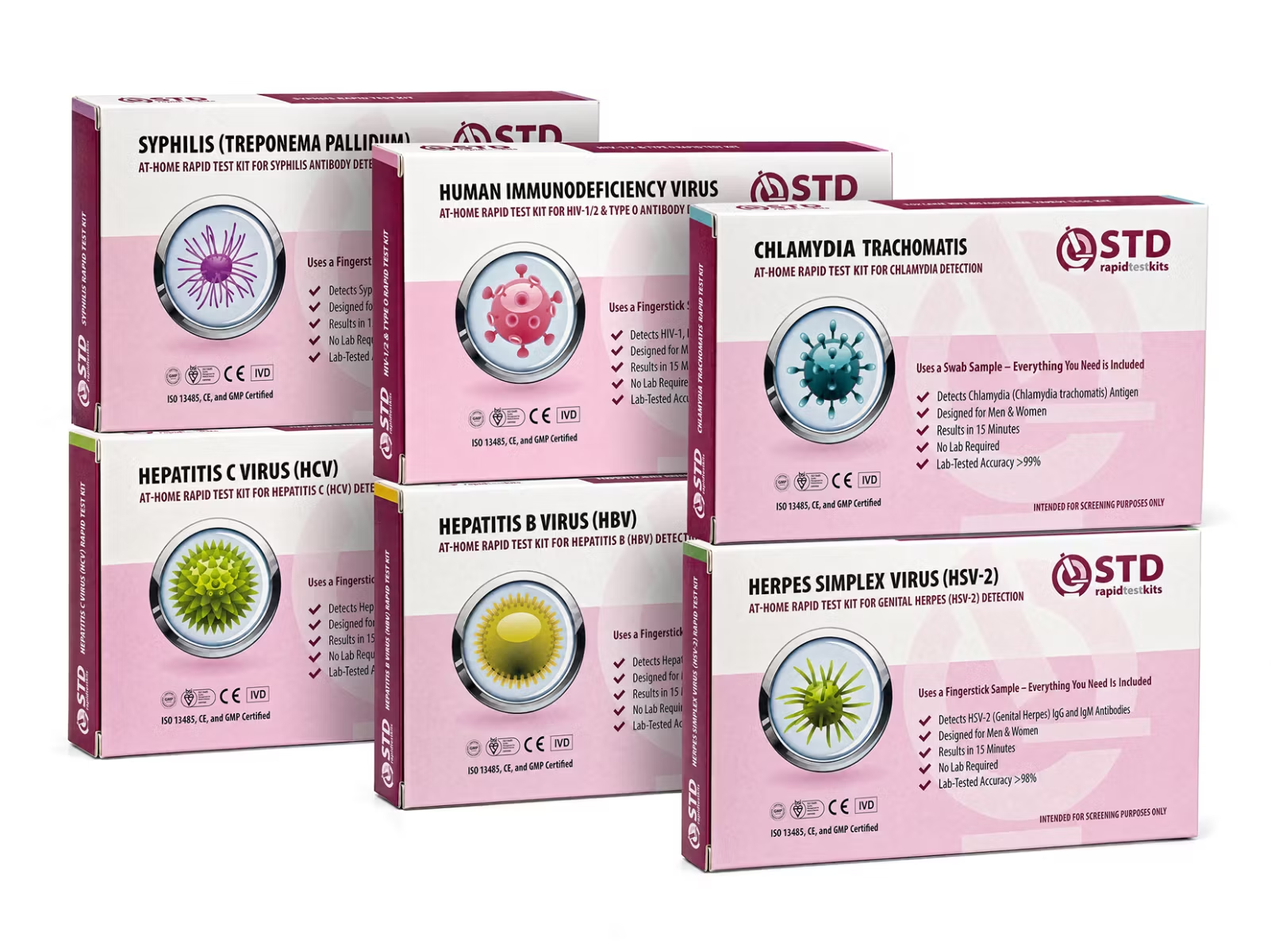
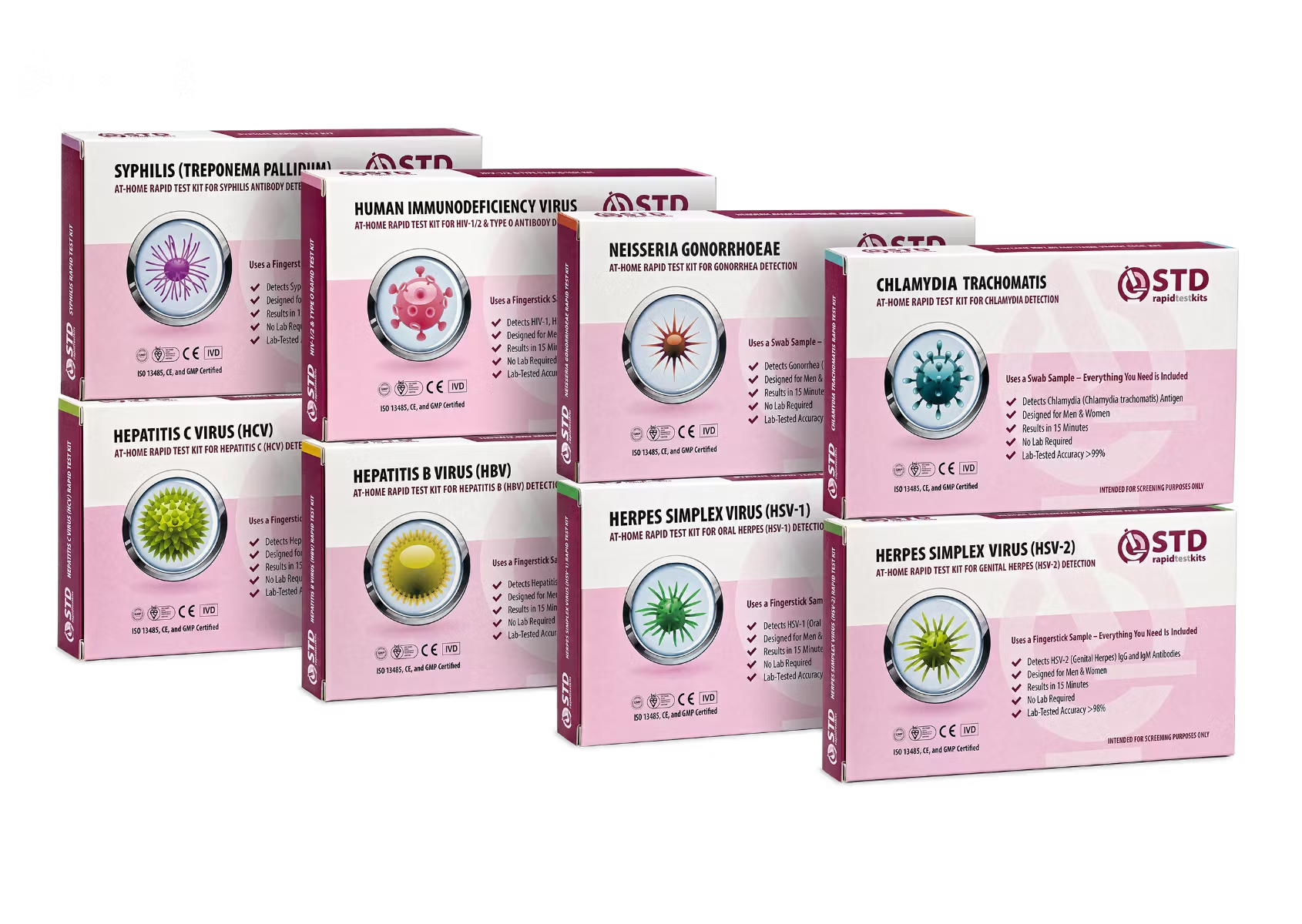
At-home rapid lateral-flow tests are the simplest fit when you want to test together privately. They use a small fingerstick of blood (for HIV, syphilis, hepatitis, herpes) or a self-collected swab (for chlamydia, gonorrhea, trichomoniasis), and they read in roughly 15 to 20 minutes. There is no clinic visit, no insurance trail, and no waiting room. The trade-off is that they screen rather than diagnose. A positive result on a rapid test should be confirmed at a clinic or with a lab-processed panel before any treatment decision.
In-clinic testing is the right call when either partner has active symptoms (discharge, sores, pelvic pain), when you want a single visit that covers screening, treatment, and follow-up, or when insurance coverage makes it the cheapest option for you. The trade-off is appointment friction and a paper trail through your insurance.
Mail-in lab panels return results in a few business days from a self-collected sample shipped to a lab. They use the same NAAT or antibody assays clinics run, so they are broader and more analytically sensitive than rapid kits. They cost more, and the wait is longer.
Many couples mix methods: rapid kits for the immediate read at home, a clinic visit for any positive that needs confirmation and treatment.
| Testing route | Privacy | Speed | Best for |
|---|---|---|---|
| At-home rapid (lateral-flow) | High | 15–20 minutes | A shared baseline check, discreet at-home use |
| Mail-in lab panel | High | 2–5 business days | Broader panels with lab-level analytical sensitivity |
| In-clinic testing | Moderate | Same day to 1 week | Active symptoms, treatment, in-person care |
What to expect from an at-home rapid test
If neither of you has used a rapid kit before, here is the practical version. Most kits include either a small lancet for a fingerstick or a self-collected swab, plus a cassette, a buffer solution, and step-by-step instructions. Combination kits include both formats. Results read in roughly 15 to 20 minutes as colored lines, dots, or a visible window indicator, depending on the specific test.
The fingerstick looks intimidating in the package. In practice it stings briefly and then it is done. The swab feels like a slightly deeper version of a nasal swab and is short enough that most people are surprised by how quick it is. Read the result strictly inside the time window the instructions give. A line that appears an hour later, after the result window has closed, is not a real positive.
Faint lines are the most common source of confusion. As a working rule, any line that appears in the result window during the readable interval, even a faint one, should be treated as a preliminary positive and confirmed at a clinic. The opposite situation, where the control line never appears, means the test ran incorrectly and you need a fresh kit.
Privacy is built into the format. Packaging is plain, instructions are simple, and results stay between you and your partner. Nothing is reported to insurance, employers, or anyone else. If you want a third-party record, for example to share with a clinician, photograph the result strip with a timestamp visible and bring it to the visit.
Any visible line in the result window during the readable interval, even a faint one, is a preliminary positive. Confirm at a clinic before starting treatment. If the control line never appears, the test ran incorrectly and you need a fresh kit.
When testing rebuilds trust
Sometimes testing comes after a breach, real or perceived. A partner discloses a one-night stand. A suspicious rash appears. A result comes back that does not seem to fit the story. These moments can break something in a relationship, but they can also become turning points. Getting tested together, talking openly, and facing the unknown side by side often rebuilds more trust than any promise.
Rachel and Malik had been exclusive for over a year when Malik tested positive for HSV-2. Rachel had never had symptoms. Her first reaction was heartbreak. Instead of trading accusations, they both got fully tested. Rachel tested positive too, most likely from a partner she had years before meeting Malik. Malik had probably been infected earlier than he realized. Neither had cheated. The diagnosis turned into useful information about both their histories rather than a verdict on the relationship.
"It forced us to communicate better," Rachel said later. "We had a harder conversation than we planned for. It ended up bringing us closer."
Couples who test together after a scare frequently learn something about their own histories they did not know. A positive can reflect an older infection from a previous partner that quietly carried into the present. The information closes a real question; it does not automatically change who you are to each other.
Before you toss the condoms, read this again
Monogamy reduces exposure to new infections, but it cannot undo what either partner brought in before the relationship started, and love alone does not substitute for knowing your status. None of that means you are doing anything wrong by asking. The most honest thing two committed people can do is sit down with the actual numbers, the actual window periods, and the actual current status of their bodies, and decide together what to do next.
The conversation is a little awkward. Finding out later, without warning, is worse. Test now, together, with the actual numbers in front of you.
Your next steps as a couple
Has either of you tested since exclusivity began, with timing past the relevant window periods?
Yes: Good. Set a calendar reminder for an annual retest, plus an as-needed test for any new symptom or known exposure.
No: Order a shared baseline panel now. Use the window-period table above to plan when each partner tests.
Are you planning to stop using condoms, move in together, or hit another shared milestone soon?
Yes: Test together first, before changing anything. Confirm both panels are negative past the relevant window periods before removing barriers.
No: Agree on a retest trigger in advance: new symptoms, a known exposure, a new shared milestone, or a yearly check-in.
A short decision flow for couples who have read this far. Use it this week, not someday.
FAQs
- Can I really get an STI even if we're exclusive?
- Yes, and it happens more often than people think. Exclusivity does not erase what came before. If one of you had an undiagnosed infection before the relationship started, and most people do not test between partners, it can quietly carry into the present. Nobody has to cheat for that to happen.
- We both tested once. Isn't that enough?
- Depends on timing. If either of you tested within the window period for a slow-seroconverting infection (HIV antibodies can take several weeks, HSV-2 IgG up to 16 weeks), that first result may have been premature. A single test is a starting point; the full-window retest is what closes the question. If either of you also had any partner afterward, even briefly, that resets the clock for the relevant infections.
- Will asking to test make my partner think I don't trust them?
- Only if you frame it that way. Try "This is about peace of mind for both of us before we change anything." Framed well, testing is a small, practical step of care, the same as checking the smoke detectors before plugging in the toaster oven. The couples with the healthiest sex lives are the ones who can have the slightly awkward conversation without it becoming a fight.
- How long should we wait after becoming exclusive before testing?
- If you are planning to stop using condoms or move in together, the best time to test is now, before things change. For the most conservative coverage including herpes IgG and hepatitis C, allow at least 12 weeks from your last potential exposure; for chlamydia and gonorrhea alone, 2 weeks is enough. Testing first gives you both a baseline grounded in real information instead of assumptions.
- Are at-home STD tests actually accurate?
- Rapid lateral-flow at-home tests function as screening tools rather than diagnostic tests. They have high sensitivity and specificity when used after the appropriate window period for each infection. A positive result should be confirmed at a clinic or with a lab-processed panel. For a shared baseline check at home, especially when both partners want privacy and a quick read, the rapid format works well; a clinic NAAT remains the diagnostic standard.
- What if our exposure histories are very different?
- Both partners test based on the most recent possible exposure. If one of you had a possible exposure two months ago and the other two years ago, the two-month timer governs the schedule. If the window is borderline (a recent exposure, especially for HIV or HSV), retest after the full antibody window has closed.
- What if I test positive but I haven't slept with anyone else?
- Pause before drawing conclusions. Many STIs can sit dormant for months or years without symptoms. You or your partner may have brought an infection in from a past relationship without knowing. A positive result is a piece of clinical information; it is not automatically a verdict on the relationship. Talk it through with a clinician before deciding what the result means.
- Can we stop using condoms after we both test negative?
- Stopping condoms inside an exclusive relationship is a reasonable choice if both partners are negative on a current panel timed past the relevant window periods, both are confident in exclusivity going forward, and pregnancy prevention is handled separately. The decision tightens when either factor is uncertain. Talk it through; do not let it default by attrition.
This article synthesizes current screening and window-period guidance from the U.S. Centers for Disease Control and Prevention, the World Health Organization, the UK National Health Service, and Mayo Clinic's patient-education library, then explains it in plain English alongside illustrative scenarios. All clinical figures are linked inline so you can verify them at source. We do not diagnose or treat individual cases; for any positive result, symptom, or specific concern, see a licensed clinician.
- U.S. Centers for Disease Control and Prevention. STI Statistics overview, including national Prevalence, Incidence, and Cost Estimate reports (used for the prevalence framing).
- U.S. Centers for Disease Control and Prevention. Chlamydia basic information (asymptomatic chlamydia prevalence and symptom-timing guidance).
- U.S. Centers for Disease Control and Prevention. Genital herpes fact sheet (asymptomatic carriage and recognition data, HSV-2 IgG seroconversion timing).
- U.S. Centers for Disease Control and Prevention. STI Treatment Guidelines (screening recommendations for chlamydia, gonorrhea, HIV, and other STIs, plus higher-risk group definitions and HIV testing window-period guidance).
- U.S. Centers for Disease Control and Prevention. HIV homepage, including treatment, prevention, and the role of antiretroviral therapy in preventing sexual transmission (undetectable equals untransmittable).
- World Health Organization. Sexually transmitted infections (STIs) fact sheet (global incidence, asymptomatic carriage, and treatment overview).
- NHS. Sexually transmitted infections (STIs) overview (when to get tested and what testing options are available in the UK; informs the at-home versus clinic comparison framing).
- Mayo Clinic. Sexually transmitted diseases (STDs) overview (symptom, complication, and treatment summary across the major STIs).
