
Published: December 2025 | Last updated: May 2026 | Editorial review and quality control: Martina N.
I tested positive for chlamydia, how do I tell my partner?
Keep it short, factual, and blame-free: "I tested positive for chlamydia. It is common and treatable, and I wanted you to know so you can get tested too." Tell partners within a few days, by text or in person. If contact is not safe, TellYourPartner.org notifies them anonymously. Both of you treat, then wait seven days before sex.
The positive result is sitting on your phone, and someone you slept with does not know yet. Whether it was last weekend or last quarter, this is the part nobody teaches you how to handle. There is a calm way to do it, and it starts with one honest message that takes pressure off both of you.
Chlamydia is the most commonly reported bacterial sexually transmitted infection in the United States, with the CDC counting 1,515,985 reported cases in 2024, a figure widely understood to undercount the real total because most cases never produce symptoms (CDC STI surveillance, 2024). So if a routine test is how you found out, you probably are not the first link in the chain, and the people you slept with may not be either. You are not confessing a betrayal. You are sharing testable information.
This article is published by stdrapidtestkits.com, which sells at-home STI testing kits. We recommend products based on fit-for-purpose for the reader's concern, not commercial benefit.
Key Takeaways
- Most people with chlamydia do not notice symptoms, so partners deserve a heads-up even when nobody feels sick. Untreated infection can lead to pelvic inflammatory disease and fertility complications.
- A short factual message works as well as a long one. "I tested positive, you should get tested too" is enough to give your partner what they need to act.
Why This Talk Matters More Than the Awkwardness
Untreated chlamydia is not a problem you can wait out. In people with a uterus it can ascend silently and cause pelvic inflammatory disease (PID), which raises the risk of chronic pelvic pain, ectopic pregnancy, and infertility (CDC chlamydia overview). In people with testes it can lead to epididymitis, a painful infection of the tubes attached to the testicles that can in rare cases affect fertility. Neither complication gives clear early warning, which is exactly why the call or text matters. It gives someone the chance to treat early, before tissue damage starts.
Awkwardness is real, but it is not a clinical outcome. Untreated PID is. The cultural script around sexually transmitted infections treats them as character flaws instead of biological events that pass between consenting people who used the protection they used and trusted the partners they trusted. Reframing helps. You are sharing health information that affects two people, and you are offering them the same chance you had: to test, treat, and move on. Most partners hear it that way once you frame it that way, especially if your tone matches the message.
The CDC notes that untreated chlamydia can cause permanent damage to a woman's reproductive system, making it difficult or impossible to get pregnant later, and can also increase the risk of ectopic pregnancy. In people with testes, untreated infection can lead to epididymitis, which in rare cases affects fertility. These complications are documented across major clinical references, including the <a href="https://www.mayoclinic.org/diseases-conditions/chlamydia/symptoms-causes/syc-20355349" target="_blank" rel="noopener noreferrer">Mayo Clinic's chlamydia overview</a>. None of this happens overnight, but none of it announces itself either. That is why an early heads-up to a partner is the most useful thing you can offer them.
Most Chlamydia Cases Do Not Make You Feel Sick
According to NHS guidance, most people with chlamydia, both men and women, have no symptoms at all (NHS chlamydia overview). When symptoms do appear they tend to be mild: a slight burning when peeing, unusual discharge, light spotting between periods, or pelvic discomfort. They are easy to dismiss as a urinary tract infection, a yeast infection, period weirdness, or chafing from sex.
That is the part to share with your partner first. Telling them "I felt nothing, the partner before me probably felt nothing, that is how this spreads" lifts a layer of stigma off the message before any blame has a chance to start. Most people only find out by testing, which is exactly why partner notification matters more than waiting for someone to feel symptoms that may never arrive.
An asymptomatic infection is still an active infection. The bacteria are still replicating, still able to transmit, still capable of causing PID, epididymitis, and reactive arthritis if left untreated. "No symptoms" is not "no big deal"; it just means the test is the only signal you are going to get.
Are You Even Sure It Came From You?
Probably not, and that is freeing. When symptoms appear at all, they may not show up until up to three weeks after exposure (WHO chlamydia fact sheet), and in many cases the bacteria can persist asymptomatically for months before a routine screen catches it. So the math of "who gave it to whom" is genuinely unsolvable from the inside of a relationship, and trying to solve it usually delays the only step that matters: telling people who could still be infected.
If a current partner asks the cheating question directly, the honest answer is that you do not know how long you have been carrying it, and that is actually the most common case. The conversation is more productive when it stays pointed at testing rather than detective work. Couples in long-term monogamous relationships test positive routinely without infidelity, simply because one person carried the infection in from earlier dating. A useful line when this lands: "I honestly do not know where it came from. What matters now is that we both treat it and move forward."
No clinical test can trace a chlamydia infection back to a specific partner. A positive result tells you the bacteria are present today, not who passed them to you or when. This is why the CDC's <a href="https://www.cdc.gov/chlamydia/about/index.html" target="_blank" rel="noopener noreferrer">chlamydia overview</a> frames partner notification as a public-health task rather than a forensic one: tell anyone who could be currently infected, treat in parallel, retest at three months.
Timing: When to Tell, and When to Wait a Few Hours
Sooner is better, but immediate is not always wise. The first hours after a positive result are usually the rawest, and the call you place from your bathroom floor tends to land harder than one you place the next afternoon, after you have read the result twice and looked up what comes next. Use these windows as anchors:
| Situation | When to disclose | Why |
|---|---|---|
| Current partner you are still sleeping with | Within 24 to 48 hours | Lets you both pause sex during treatment and avoid reinfection while antibiotics work. |
| Casual partner from the last 1 to 4 weeks | Within 3 to 7 days | Most exposures should still fall inside their detection window when they test. |
| Partner from up to 60 days ago | Within 7 days of your result | Matches the CDC's general 60-day partner-notification window for chlamydia. |
| Any partner where direct contact is unsafe | Use an anonymous service the same day | Health departments and TellYourPartner.org notify them without revealing your identity. |
Before You Reach Out, Steady Yourself
The biggest predictor of how the conversation goes is your own tone. If you panic, your partner will mirror it. If you sound like you are already braced for a fight, they will give you one. A short pause before you message helps you say the thing once, calmly, instead of three times in escalating spirals. Use this checklist as a steadier:
| Check-in step | Why it matters |
|---|---|
| Have you processed your own result? | Talking while you are still in shock can confuse your partner and pull them into your panic. |
| Do you understand the diagnosis? | Read the test report once. Knowing it is treatable with a short course of antibiotics changes the energy of the message. |
| Is direct contact safe? | If there is any history of abuse or coercion, use an anonymous notification service or your local health department instead. |
| Do you have a next step to offer? | A clinic link, a home test kit, or an expedited partner therapy prescription gives the conversation somewhere concrete to go. |
Scripts for Every Kind of Relationship
You do not need to improvise. Having a sentence or two ready in your head, or in your notes app, helps the words come out the way you mean them when adrenaline arrives. The pattern that works is: state the result, name the action, leave the door open. Adapt the tone to the relationship and keep it short enough to be read in under a minute.
What to skip: "I'm so sorry, I'm disgusting," "I must have given it to you," "please don't hate me." Those phrases shift the conversation from health to shame, and they invite the other person to react to your shame instead of the actual information. The CDC publishes its own short conversation tips for talking with a partner about STIs if you want a public-health framing to anchor your wording.
| Relationship | Sample script you can adapt |
|---|---|
| Recent hookup (by text) | "Hey, hope you're doing well. Quick heads up that I just tested positive for chlamydia. It's common and treatable, but you should get tested too. Most people do not get symptoms with it, so a test is the only way to know. Not blaming anyone, just thought you would want to know." |
| Casual but ongoing partner | "I need to share something a little uncomfortable. My recent test came back positive for chlamydia. I am getting treated. I wanted you to know so you can look after yourself, and so we can sort out a plan together." |
| Long-term partner | "This is hard to bring up, but my screening came back positive for chlamydia. Either of us could have been carrying it for a while without knowing; that is how the infection usually moves. Can we talk through testing and treatment together?" |
| An ex you do not really speak to | "Hi. Out of the blue, sorry. I just tested positive for chlamydia. We were sexually active a while back so I wanted to let you know in case you want to get checked. No reply needed, just sharing." |
When Direct Contact Is Not Safe or Possible
Some situations make direct disclosure unsafe or impractical. These include a controlling or volatile ex, a casual partner whose contact you no longer have, or someone whose first reaction is more likely to be retaliation than testing. In those cases, anonymous notification exists for a reason, and it is not a second-best option. A clinician or local health department can contact your partner without ever using your name, a service available in all U.S. states and territories through CDC-supported STI programs.
Your state may also allow Expedited Partner Therapy, where your provider gives you a second course of antibiotics, or a prescription, to pass to your partner without them needing their own clinic visit first (CDC EPT clinical guidance). Ask your clinician about EPT at the visit when you pick up your own treatment. It can shorten the gap between disclosure and treatment for the partner from weeks to hours.
TellYourPartner.org sends a free, anonymous text or email saying someone they were recently with tested positive for chlamydia and they should get tested. Local health departments often have Disease Intervention Specialists, public-health staff trained to contact partners confidentially on your behalf, which is especially useful when you have several partners to notify. Some at-home test kits include built-in partner-notification tools when you receive a positive result; worth asking when you order the kit. All three are recommended public-health options, not workarounds.
Reactions You Might Get, and How to Respond
People react in real time, and what comes out first is usually fear, not their settled response. None of these reactions change whether you did the right thing by telling them. Your own reaction afterward is worth naming too: many people feel worse for a day or two after disclosing, not better, as the vulnerability lingers. That is normal, and it passes. The most common patterns and a calm reply for each:
| Their reaction | What to say back |
|---|---|
| Anger or accusation | "I get why you are upset. I am not pointing fingers. Most cases of this are silent for weeks or months, so the timeline is not clear for either of us." |
| Denial or disbelief | "You do not have to take my word for it. A test is quick, and finding out early matters more than where it came from." |
| Silence or ghosting | Send the message once, then let it go. You have handed them the information; the next move is theirs. |
| Shame or self-blame | "You are not unclean. This is one of the most common bacterial STIs in the country. The point is just to treat it." |
| Escalation that stops being productive | "I hear you. I want to talk through this, but not while either of us is escalating. Let's pick this up tomorrow." |
Texting Is Fine, Honesty Is the Standard
For a casual or recent partner, a thoughtful text usually beats a phone call. It gives them privacy to react, time to read it twice, and a record they can show a clinician. For a long-term partner, the medium matters less than the clarity. What matters in either case is that the message states the diagnosis plainly and avoids hinting.
Vague openers like "can we talk later" or "I have something weird to tell you" stretch out the anxious window before they hear the actual thing. Lead with the result. Everything else can come after the first message lands. If the relationship is one where a phone call would normally happen for serious news, a phone call is appropriate here too. Nothing about the diagnosis itself requires a particular medium.
After Treatment, Pause Sex and Plan a Retest
The CDC's recommended treatment for uncomplicated genital chlamydia is doxycycline 100 mg twice daily for 7 days, with azithromycin 1 g as a single-dose alternative when doxycycline is not appropriate (CDC chlamydia treatment guidelines). Avoid sexual contact for 7 days after a single-dose regimen, or until you have finished a 7-day course, and until any partners have also completed treatment.
For non-pregnant adults, a routine test of cure is not advised right after treatment. Doxycycline and azithromycin are both highly effective, and lingering bacterial DNA can produce a false-positive on a lab NAAT (nucleic acid amplification test) done too early. What the CDC does recommend is a follow-up screen at 3 months to catch reinfection, which is common when partners are not treated in parallel. For pregnant patients, providers may add a test of cure at 3 to 4 weeks because untreated chlamydia in pregnancy carries higher stakes.
| Scenario | Recommended timing |
|---|---|
| Single-dose treatment finished | Wait 7 days before any sexual contact. |
| Doxycycline 7-day course | Finish the full course; resume sex no earlier than day 7 of treatment. |
| Symptoms persist after treatment | Contact your provider; you may need a different regimen and a test of cure. |
| Routine reinfection check | Retest at 3 months, even with no symptoms. |
| Pregnancy | Test of cure at 3 to 4 weeks per provider guidance. |
Preventing the Reinfection Loop
Reinfection is one of the most common ways people end up testing positive twice. It is rarely treatment failure; it is almost always one partner being treated while the other is not, then sex resuming too soon. The CDC's expedited partner therapy guidance exists for exactly this reason, and so does the recommendation to retest at 3 months even after a clean cure.
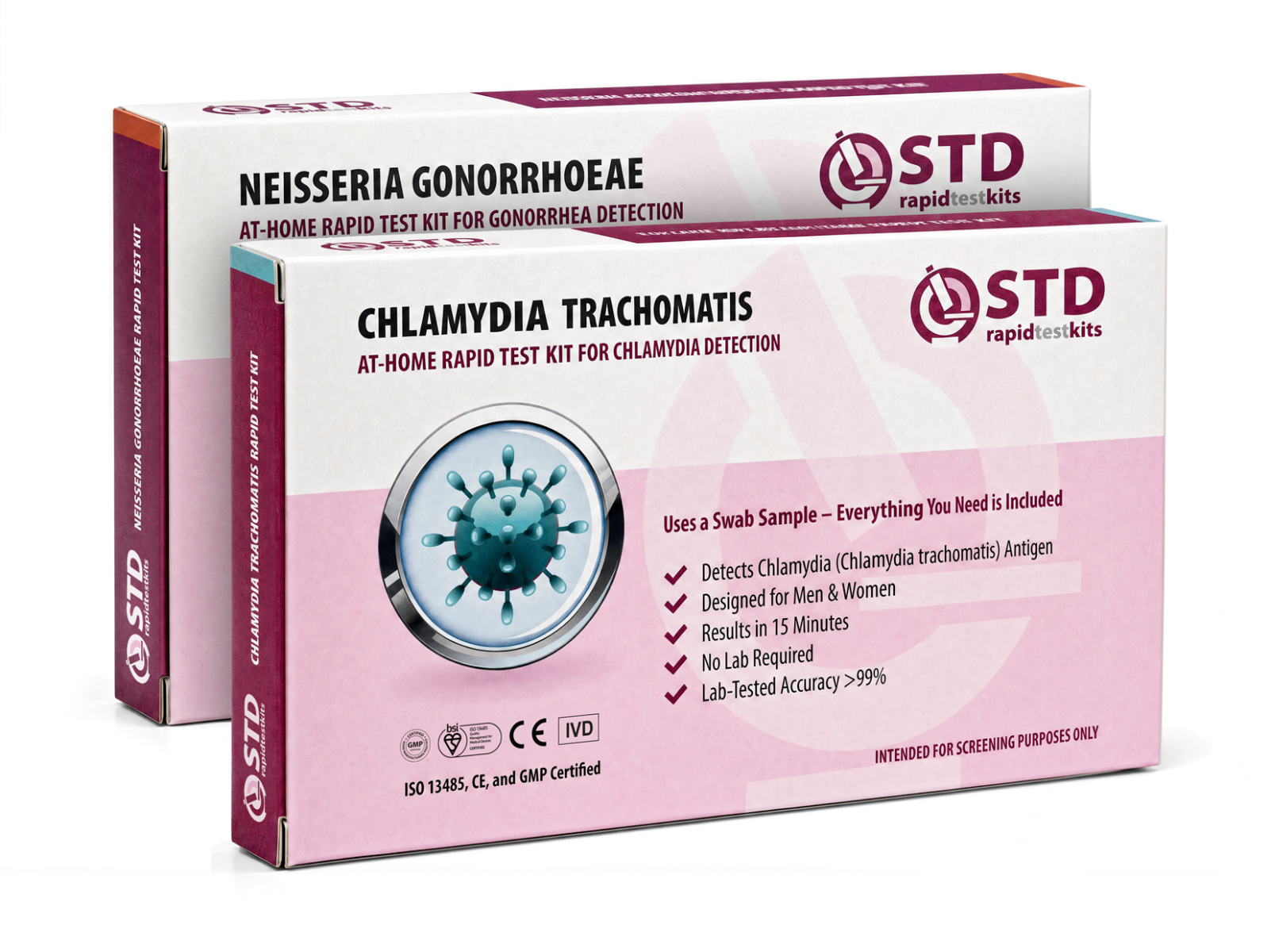
Mutual treatment, the seven-day pause, and a three-month retest together close the loop. Skipping any of the three is what restarts it. Condoms during the period before retesting add an extra layer if you are resuming sex with the same partner; they reduce chlamydia transmission risk substantially, though they do not eliminate it entirely. Because chlamydia and gonorrhea so often travel together, many clinicians screen for both at the same time when checking partners, and a two-in-one home test handles that without two separate kits.
The reinfection-prevention triad
- Mutual treatment: both partners take the full antibiotic course at roughly the same time.
- Seven-day pause: no sexual contact until both of you have finished treatment.
- Three-month retest: a routine recheck even when nobody has symptoms, because reinfection is common.
Should You Apologize?
If your partner is hurt, an apology can ease the moment, but it is most useful when it stays focused on the impact of the news rather than on guilt for the infection itself. You did not do something morally wrong by carrying a common bacterial STI you did not know you had. You can be sorry the test result lands in their week without apologizing for being a person who has sex.
Over-apologizing can read as guilt-fishing, or as agreeing with a moral framing that does not actually fit the situation. Keep it short, keep it about the timing rather than about you as a person, and let them respond.
If you want a sentence to keep ready: "I am sorry this is what I am bringing into your week. I wanted you to know as soon as I did." It acknowledges the impact without conceding a moral verdict that the situation does not call for.
Will This End the Relationship?
Probably not. Most relationships absorb a chlamydia diagnosis and continue, particularly when both partners can sit with the timing math (the silent window, the routine-test angle) instead of jumping to conclusions about fidelity. The disclosure itself is often remembered as a moment of trust rather than a moment of damage.
If a partner does choose to leave, the decision usually reflects their own comfort with sexual health, not your worth. Some people walk away from a chlamydia conversation; far more people walk away from being lied to about one. You picked the version that respects them.
The harder question is what to do in a relationship where you suspect your partner gave it to you and may not be willing to talk about it honestly. That is a relationship question more than a chlamydia question, and the test result has just made the underlying issue visible. Take the conversation slowly, get both of you treated first, and decide what comes next on a separate timeline.
Most relationships absorb a chlamydia disclosure and keep going. The conversation is more often remembered as a moment of honesty than as a wound. Staying quiet poses the real risk to a relationship; speaking up rarely does.
If Your Partner Tests Positive Too
If their result also comes back positive, the practical job is the same: complete treatment, pause sex for 7 days, retest in 3 months. The emotional job is harder. Resist the urge to apologize repeatedly or absorb their distress on top of your own. Both of you are now in the same boat, and the most useful thing you can do is be calm company through the antibiotic week.
If they test negative shortly after exposure, the test may simply be too early. Retesting in two to four weeks catches the infections that had not yet built up enough bacterial DNA to detect. Treat them as exposed in the meantime, which usually means abstaining from sex until the second test or completing expedited partner therapy if a clinician has offered it.
Chlamydia often has no symptoms, but it can cause serious health problems, even without symptoms. Symptoms may not appear until several weeks after having sex with a partner who has chlamydia.
Building Forward From Here
This conversation is not the end of your dating life or your sense of yourself as a careful person. Most adults who are sexually active will manage at least one STI conversation in their lifetime; the people who handle it well are usually the people who build it into the way they date going forward. Test before new partners, share results without ceremony, and you turn what felt like a crisis into a normal piece of sexual hygiene. If you prefer to test on your own schedule, an at-home STI test kit makes that routine check easy.
Your Next Steps After a Positive Result
Have you had sex with anyone in the past 60 days?
Yes: Notify each of those partners by text, in person, or anonymously through TellYourPartner.org so they can get tested.
Have both you and your partner started treatment?
Yes: Finish the full antibiotic course and wait seven days after the last dose before any sexual contact.
Has it been three months since you finished treatment?
Yes: Retest now, even without symptoms, to catch any reinfection.
No: Mark your calendar to retest at the three-month point regardless of how you feel.
Guidance only; your clinician can tailor this to your situation.
FAQs
- Do I really have to tell a casual hookup?
- Yes. Chlamydia transmits through vaginal, anal, and oral sex, and most cases are symptomless. A short message gives them the chance to treat early and breaks a chain of transmission you would otherwise be a link in. They do not need to like you for the message to be the right thing to send.
- How far back should I notify partners?
- The standard CDC guidance for chlamydia is to notify any sexual partner from the 60 days before your symptoms started or your positive test, whichever was earlier. If your most recent partner was more than 60 days ago, notify that person too.
- Is it okay to disclose by text?
- Yes. Text works well for casual partners, anyone you no longer see in person, and anyone whose reaction you have reason to be cautious about. Keep the message short and factual: "I tested positive for chlamydia, you should get tested." The same information lands the same way as it would in person, and a written message gives them time to process before they reply.
- Will my partner be able to tell I am the source?
- There is no clinical way to prove who passed the infection. Chlamydia can sit asymptomatically for months, so the order of transmission inside a relationship usually cannot be reconstructed. Most clinicians frame it as something both partners need to test and treat for, not assign.
- Can I tell them anonymously?
- Yes. Public health partner services in most U.S. states will contact your partner without naming you, and online tools like TellYourPartner.org let you send an anonymous text or email. The recipient sees the alert; they do not see your name. Anonymous notification is a recommended public-health option, not a workaround.
- Will my partner know I notified them through TellYourPartner.org?
- Only if you choose to tell them. The service sends a generic message that they may have been exposed and should get tested; it does not include your name. Whether to confirm it came from you is a decision you can make later, on your own terms.
- What if my partner refuses to get tested?
- You cannot force someone to get tested. You can decline to have sex with them again until they do. Retest yourself at the 3-month mark and any time you have new sexual contact. If they refuse out of denial or shame, a few days of space sometimes helps; sometimes it does not, and that information matters too.
- When can we have sex again after treatment?
- Seven days minimum, and only after both of you have finished your courses. Restarting before either partner is fully treated is the single most common cause of bouncing the infection back and forth, which is why most clinicians treat the 7-day pause as non-negotiable rather than a guideline.
- Do I need a follow-up test of cure?
- For most people, no. Doxycycline and azithromycin clear the infection reliably enough that testing right after treatment is not recommended. Schedule the 3-month recheck instead; it catches a new exposure rather than confirming the first course worked. Pregnant patients are the exception and should ask their provider about a confirmatory test at 3 to 4 weeks.
- What if I tested positive but my partner tests negative?
- An early-window negative may not yet show the infection, especially if the exposure was within the last week or two. The CDC suggests retesting in two to four weeks to be sure. They should still be treated as exposed and may be offered expedited partner therapy in the meantime.
- U.S. Centers for Disease Control and Prevention. About Chlamydia, including transmission, asymptomatic prevalence, and complications such as PID, ectopic pregnancy, infertility, and epididymitis.
- U.S. Centers for Disease Control and Prevention. Sexually Transmitted Infections Surveillance, 2024 annual report, source for the 1,515,985 reported chlamydia cases in 2024.
- U.S. Centers for Disease Control and Prevention. Chlamydial infections treatment guidelines, source for the doxycycline regimen, no-test-of-cure for nonpregnant adults, and 3-month retest recommendation.
- U.S. Centers for Disease Control and Prevention. Expedited partner therapy clinical guidance for chlamydia and gonorrhea, including state-by-state legal status.
- U.S. Centers for Disease Control and Prevention. Talking with a partner about STIs, conversation tips and disclosure framing.
- National Health Service (UK). Chlamydia overview, including symptom prevalence and treatment basics.
- World Health Organization. Chlamydia fact sheet, covering global burden, symptoms, incubation timing, and complications of untreated infection.
- Mayo Clinic. Chlamydia trachomatis, symptoms and causes, including the reproductive-tract complications of untreated infection in women and men.
