
Published: September 2025 | Last updated: May 2026 | Editorial review and quality control: Martina N.
Most people who Google this question have already tried to talk themselves down. Maybe you used protection, maybe you didn't, and the encounter was brief enough that you can't remember every detail. Now you're awake at 2 a.m., wondering whether the panic in your chest is signal or static.
Here is the steady answer: a single sexual encounter, paid or otherwise, can transmit a sexually transmitted infection. The actual risk depends on what kind of contact happened, what protection was used, and which infections were potentially in play. Testing is the only way to convert worry into information. For most single encounters where a condom was used correctly the entire time, that test will come back negative for fluid-borne infections like HIV, chlamydia, and gonorrhea, but only the result itself confirms it. This guide walks through which test, when, and what the public-health numbers actually say.
Key Takeaways
- Most STIs cannot be reliably detected within the first 5 to 7 days after exposure. The safer plan is a baseline test at 2 weeks plus a confirmatory HIV and syphilis test at 6 to 12 weeks.
- Condoms reduce risk for fluid-borne infections like HIV, chlamydia, and gonorrhea. They offer only partial protection against skin-to-skin infections like herpes, syphilis, and HPV, even when used correctly the entire time.
Why this guide exists, and who it's for
Sexual-health questions get harder when the encounter sits outside whatever a clinic intake form expects. Maybe the encounter was overseas. Maybe a partner was paid. Maybe a condom slipped, or you can't remember if one was used at all. Plenty of clinicians handle these conversations without judgment, but the friction of explaining still keeps people from making the call.
This article is for the reader who has already typed the question into Google more than once. The goal is not to scare you into testing. The goal is to give you a clear sequence: which infections are plausible after this kind of encounter, when each one becomes detectable, and what to do with the result either way. Testing is not a confession. It is a piece of information you have a right to.
Yes, you should test. The right timing depends on what kind of contact happened, not on how many times. A two-step plan, baseline at 2 weeks plus confirmatory HIV and syphilis testing at 6 to 12 weeks, covers the most common encounters.
What STIs sex worker encounters can transmit
The risk profile of any encounter depends less on who the partner was and more on what kind of contact occurred. Many full-time sex workers test more often than the general population. That said, no encounter with a new partner is risk-free, and certain infections are more likely after specific exposure routes. The most relevant infections after this kind of encounter are chlamydia, gonorrhea, syphilis, herpes, HIV, hepatitis B, and HPV.
Some of these spread through fluids (semen, vaginal secretions, blood). Others spread through skin-to-skin contact in areas a condom does not cover. Oral sex is not a safe zone for any of them. The table below is a working summary of the highest-likelihood infections by exposure type, drawn from the CDC's STI guidance.
| Infection | Main transmission route | Often asymptomatic? | Condom-preventable? |
|---|---|---|---|
| Chlamydia | Genital, anal, or oral mucosal contact | Yes, in most cases | Largely yes for genital sex |
| Gonorrhea | Genital, anal, or oral mucosal contact | Often, especially throat infections | Largely yes for genital sex |
| Syphilis | Skin-to-skin contact with an active sore | Early sore can go unnoticed | Partially; sore may sit outside condom |
| Herpes (HSV-1, HSV-2) | Skin-to-skin contact with active or shedding skin | Frequently dormant | Partially |
| HIV | Blood, semen, vaginal fluids, rectal fluids | Often no early symptoms | Yes when used correctly |
| Hepatitis B | Blood, semen, vaginal fluids | Often silent | Largely yes |
| HPV | Skin-to-skin genital contact | Often clears silently | Partially |
How long after exposure should you wait to test?
Every STI has what laboratories call a window period: the time between exposure and when the infection becomes detectable on a test. Test before the window closes and you can get a false negative even though the infection is real. Test after, and a negative result is meaningful.
The best plan after a single high-risk exposure is usually two tests. The first one at the 2-week mark catches chlamydia and gonorrhea. The follow-up at 6 to 12 weeks confirms HIV and syphilis, which take longer to seroconvert. The CDC's HIV testing guidance and the USPSTF chlamydia and gonorrhea screening recommendation are the sources for these windows. The table summarizes them.
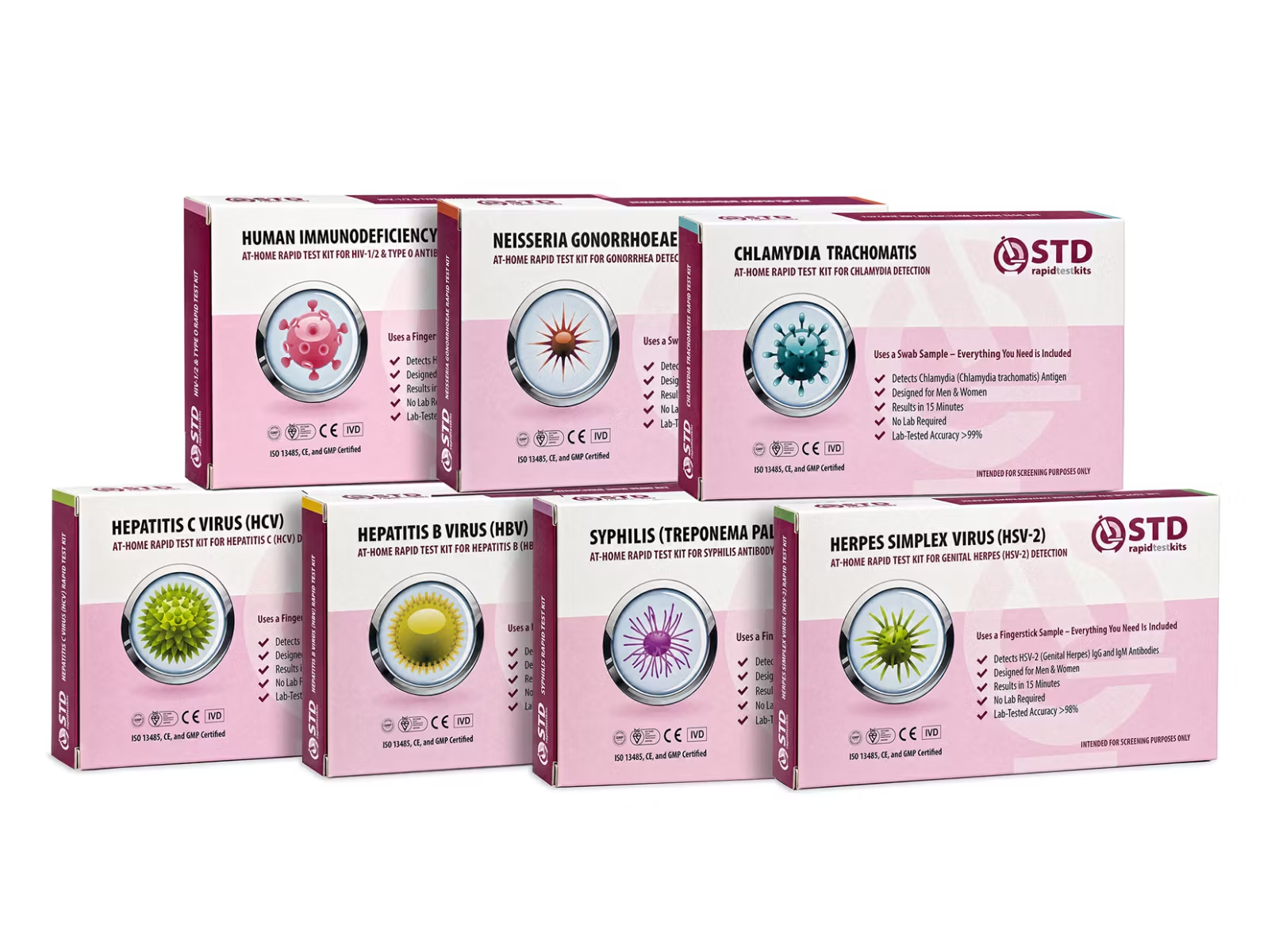
stdrapidtestkits.com sells the at-home rapid kits linked in this article. Recommendations are made on fit-for-purpose for the reader's concern.
| Infection | Earliest detection | Best testing time | Retest needed? |
|---|---|---|---|
| Chlamydia | 1 to 2 weeks | 2 weeks after exposure | Yes if tested earlier |
| Gonorrhea | 1 to 2 weeks | 2 weeks after exposure | Yes if tested earlier |
| Syphilis | 3 to 6 weeks for antibody response | 6 to 12 weeks for confidence | Yes |
| HIV (4th-gen antigen and antibody) | 18 to 45 days | 45 days post-exposure | Yes at 90 days |
| HIV (antibody-only rapid) | 23 to 90 days | 12 weeks for confidence | Yes |
| Herpes (blood antibody) | 2 to 12 weeks | 12+ weeks | Often needed |
| Hepatitis B | 3 to 6 weeks | 6 to 9 weeks | Yes |
Condoms reduce risk, but they do not eliminate it
If a condom was used correctly the entire time, the risk of HIV, chlamydia, and gonorrhea drops sharply. Those infections move through semen and vaginal fluids, which a condom physically blocks. The CDC's prevention guidance lists condoms as one of the most effective single tools against fluid-borne STIs.
The same protection does not extend cleanly to skin-to-skin infections. Herpes, syphilis, and HPV transmit through contact with infected tissue. A condom covers the shaft of the penis. It does not cover the scrotum, the inner thighs, the base of the pelvis, or the lips. A syphilitic chancre or a herpes outbreak on any of those skin surfaces can transmit even when intercourse is fully condom-protected.
That is not a reason to skip condoms. They still cut overall risk substantially. It is a reason to test even when condoms were used, especially for syphilis and herpes, and especially if any visible sore or lesion appeared on either partner.
Largely prevented by correct condom use: HIV, chlamydia, gonorrhea, hepatitis B, trichomoniasis.
Only partially blocked, because skin outside the condom can still transmit: herpes (HSV-1 and HSV-2), syphilis, HPV, molluscum.
What if it was only oral?
Oral sex carries lower transmission risk than unprotected vaginal or anal sex for most STIs, but it is not zero. The route matters less than what infections were potentially being shed at the time. If your partner had pharyngeal gonorrhea, often symptomless, and you performed oral sex, transmission to your throat or to the other partner's genitals is plausible. If they had a herpes lesion, even a small one, transmission is plausible. HIV transmission through oral sex is rare but documented, especially when bleeding gums or open mouth sores are involved.
At-home rapid STI kits screen genital and bloodborne infections. They are not validated for throat swab samples. If your specific concern is pharyngeal gonorrhea or chlamydia after performing oral sex, that test must be done at a clinic or sexual-health service that can swab the throat directly. The blood and genital tests in our home kits cover the related concerns (HIV, syphilis, hepatitis B, genital chlamydia, and genital gonorrhea), but a throat-only infection needs a throat swab.
Most early STIs have no symptoms
The biggest mental trap after an unexpected encounter is the assumption that feeling fine means being fine. According to the CDC's chlamydia fact sheet, most people with the infection have no noticeable symptoms at all. Gonorrhea is similar in many cases. Herpes can stay dormant for years. Early HIV often produces nothing more than a vague flu-like episode that the person blames on a passing virus.
Asymptomatic infection is the reason public-health screening guidelines recommend regular testing for sexually active adults rather than testing only when something hurts.
Most people who have chlamydia have no symptoms. If you do have symptoms, they may not appear until several weeks after you have sex with an infected partner. Even when chlamydia causes no symptoms, it can damage your reproductive system.
At-home rapid tests, mail-in lab kits, or a clinic visit?
Once you have decided to test, there are three realistic paths. Each one trades off speed, privacy, accuracy, and cost a little differently.
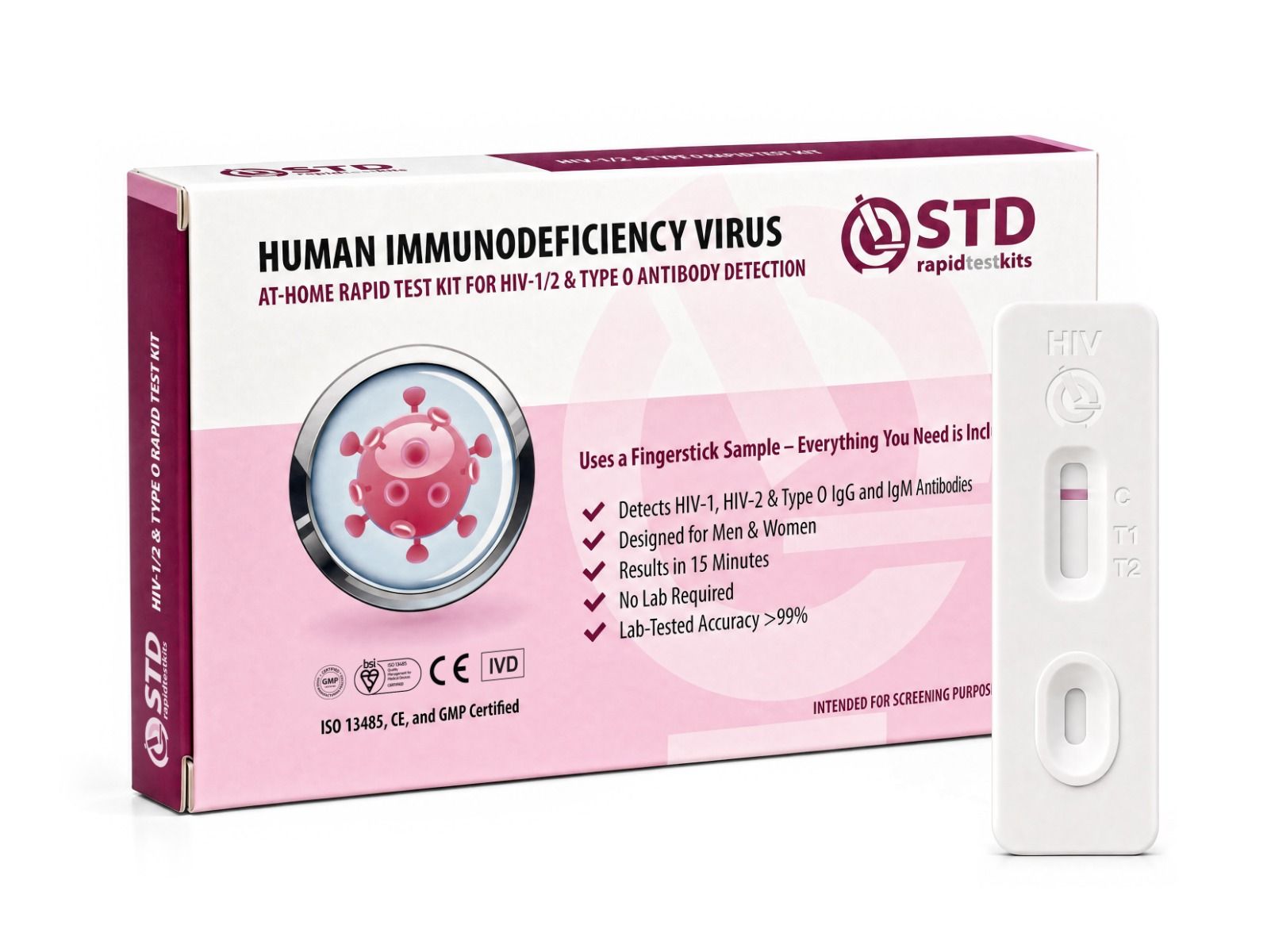
At-home rapid lateral-flow tests give a visual result in 15 to 20 minutes from a fingerstick blood drop or a self-collected swab. They are private, fast, and use the same general antigen-and-antibody chemistry as many clinic point-of-care tests. Their sensitivity is high once the window period has passed, though laboratory NAAT remains the technical gold standard for chlamydia and gonorrhea.
Mail-in kits collect a sample at home and ship it to a CLIA-certified lab. Results take 1 to 3 days after the sample arrives. The lab method (typically NAAT for chlamydia and gonorrhea, fourth-generation antigen-and-antibody for HIV) is more analytically sensitive than rapid lateral-flow chemistry, especially close to the edge of the window period.
An in-person clinic visit gives you direct sample collection, on-site treatment if a test is positive, and a chance to discuss post-exposure prophylaxis (PEP) for HIV if the encounter was within the past 72 hours. This is also the right path if a pharyngeal or rectal swab is needed.
| Test type | Speed | Privacy | Best for |
|---|---|---|---|
| At-home rapid lateral-flow | 15 to 20 minutes | Very high | Speed and privacy past the window |
| Mail-in lab kit | 1 to 3 days after mailing | High (barcode rather than name) | Highest analytical sensitivity at home |
| Clinic visit | Same day to 7 days | Lower (insurance and records possible) | Treatment, PEP, throat or rectal swab |
If your result comes back positive
The first reaction is usually some mix of fear and shame. The clinical reality is much steadier than the panic suggests. Most STIs are treatable, many are completely curable with a single round of antibiotics, and the viral ones (HIV, herpes, HPV) are well managed by current medications.
For chlamydia, gonorrhea, and trichomoniasis, treatment is usually a single dose of antibiotics or a short oral course. Syphilis is treated with a penicillin G injection, with regimen length depending on stage. For HIV, modern antiretroviral therapy reduces virus to undetectable levels, at which point sexual transmission risk is effectively zero (the U=U principle). Herpes is managed with antiviral medication that can suppress outbreaks and reduce the risk of passing it to a partner.
| Infection | Treatment | Curable? | Next step after positive |
|---|---|---|---|
| Chlamydia | Doxycycline 7 days, or single-dose azithromycin | Yes | Notify partners; retest in 3 months |
| Gonorrhea | Ceftriaxone injection, often plus oral antibiotic | Yes | Notify partners; retest in 3 months |
| Syphilis | Penicillin G injection | Yes in early stages | Follow-up titer to confirm clearance |
| Herpes | Antiviral medication (acyclovir, valacyclovir) | No, but suppressible | Daily suppression optional |
| HIV | Antiretroviral therapy (ART) | No, but undetectable equals untransmittable | Connect with HIV care provider |
Do you have to tell anyone?
This is the most-Googled follow-up question after a positive result. The honest answer: ethically yes in most cases, especially anyone you have been intimate with since the exposure. Practically, it does not have to be a confession. A short message (“I tested positive for X recently. You may want to test or talk to a clinician”) is enough to give a partner the information they need without explaining the encounter that led to it.
Many state and local health departments offer anonymous partner-notification services that send a contact a heads-up without naming you. Online tools do the same digitally. For HIV specifically, partner notification is sometimes legally required depending on jurisdiction; a clinician can walk you through the local rules. The CDC's STI program pages point to what is available where you live.
State or local health department services: in many jurisdictions, a public-health worker contacts the partner on your behalf and never names you.
Digital notification tools: apps and web services send an anonymous text or email with the suggested test plus a clinic-finder link.
HIV-specific legal requirements: some U.S. states require partner notification through the health department when HIV is diagnosed; a clinician can confirm the local rule before you decide what to do yourself.
Your path forward
Whether the encounter happened last night or last month, the sequence is the same. Pick the right test for the kind of contact you had. Wait for the window to close before trusting a negative result. Retest at the 12-week mark for HIV and syphilis if the first test was earlier. Treat what is treatable, and act on what is not.
The encounter is in the past. The only useful next step is gathering the information that lets you stop guessing about it.
Your next-step checklist
- Pick the test that matches the contact: fingerstick blood for HIV, syphilis, hepatitis; self-swab for genital chlamydia, gonorrhea; clinic throat swab if your concern is pharyngeal infection.
- Wait for the window to close before trusting a negative: 2 weeks for chlamydia and gonorrhea, 6 to 12 weeks for HIV and syphilis.
- If the encounter was less than 72 hours ago and was high-risk for HIV, see a clinician for PEP rather than waiting on a home test.
- Retest at 12 weeks for HIV and syphilis if your first test was earlier than that. Treat curable infections immediately, manage viral ones long-term.
FAQs
- I only did it once. Do I really need to test?
- Yes. Single-encounter STI transmission is well documented in CDC surveillance data. Frequency does not change biology: one exposure with the right combination of pathogen and route is enough. Testing is the only way to know either way.
- I used a condom the whole time. Am I covered?
- Mostly for fluid-borne infections like HIV, chlamydia, and gonorrhea. Less so for skin-to-skin infections like herpes, syphilis, and HPV, because a condom does not cover all the skin in contact during sex. Test for the skin-to-skin group even after consistent condom use, especially if any sore or lesion was visible.
- There were no symptoms. Could I still have something?
- Almost certainly possible. The CDC notes that most cases of chlamydia and many cases of gonorrhea are asymptomatic. Herpes can sit dormant for years. Early HIV often shows up as a vague flu-like episode at most. Symptoms are not a reliable filter, which is why screening is exposure-based rather than symptom-based.
- What if it was only oral? Do home kits cover throat infections?
- Oral gonorrhea and chlamydia are the main risks from performing oral sex on someone, and home kits cannot screen for throat infections because that requires a clinic-collected throat swab. Our kits do cover the bloodborne and genital-route concerns from the same encounter (HIV, syphilis, hepatitis, genital chlamydia and gonorrhea), so they remain useful even when oral sex was the only contact, just not for the throat itself.
- How soon should I test, and do I really need to retest?
- The simplest plan is a baseline test at 2 weeks for chlamydia and gonorrhea, then a confirmatory test at 12 weeks for HIV and syphilis. If you test for HIV earlier than that with a fourth-generation antigen-and-antibody method, retesting at 12 weeks is what gives you a confidently negative result on antibody-only platforms.
- Can I do this without anyone finding out?
- Yes. At-home test kits ship in plain unbranded packaging, do not bill insurance, and do not generate a clinical record. Mail-in lab kits use a barcode rather than your name on the sample. If your only goal is to avoid the visibility of a clinic visit, those two routes give you that.
- What about PEP for HIV after a recent exposure?
- Post-exposure prophylaxis is a 28-day course of antiretroviral medication that can prevent HIV from establishing. It must start within 72 hours of exposure, and sooner is better. PEP is available from emergency departments, urgent-care clinics, and many sexual-health services. If your high-risk encounter was within that 72-hour window, see a clinician quickly rather than waiting on a home test result.
How we sourced this article: we synthesized current guidance from the CDC, WHO, NHS, NIH, and the U.S. Preventive Services Task Force. Where specific window periods, transmission routes, or screening recommendations are quoted, the linked agency page is the source. This article does not provide individual medical advice; for symptoms or a positive result, contact a licensed clinician.
- U.S. Centers for Disease Control and Prevention. Sexually Transmitted Infections: clinical guidance, screening, and treatment recommendations.
- World Health Organization. Sexually Transmitted Infections (STIs) fact sheet: prevalence, transmission, and prevention.
- U.S. Centers for Disease Control and Prevention. Chlamydia: symptoms, screening windows, and asymptomatic transmission.
- U.S. Centers for Disease Control and Prevention. HIV: testing windows by assay generation and prevention guidance.
- NIH HIVinfo. Post-Exposure Prophylaxis (PEP): the 72-hour window and ART regimen.
- U.S. Preventive Services Task Force. Chlamydia and Gonorrhea: Screening recommendation statement.
- NHS. Sexually Transmitted Infections: patient-facing guidance on symptoms, testing, and treatment.
