
Published: September 2025 | Last updated: April 2026 | Editorial review and quality control: Martina N.
After a course of antibiotics, your body is recovering from more than the infection the prescription targeted. Broad-spectrum antibiotics like amoxicillin, ciprofloxacin, and azithromycin reduce the bacteria causing your symptoms and many of the helpful bacteria living in your gut, vagina, and rectum. If sex happened in the same window, it is reasonable to ask whether your usual defenses are at full strength, and whether probiotics can help fill the gap.
This guide separates what probiotics do well from what they cannot do. The short version: probiotics support recovery of healthy vaginal flora and reduce the chance of bacterial vaginosis (BV), the condition that itself raises sexually transmitted infection (STI) risk. They do not prevent or treat any STI directly. If you had a real exposure during your antibiotic course, the right next step is testing. Probiotics will not answer that question for you.
Do probiotics prevent STIs after a round of antibiotics?
Probiotics help your vaginal and gut microbiome recover after antibiotics, which lowers your odds of bacterial vaginosis and the downstream STI risk that BV creates. They do not prevent or treat any sexually transmitted infection directly, including chlamydia, gonorrhea, herpes, HPV, or HIV. If sex happened during or shortly after your antibiotic course and the exposure could have been risky, testing is the only way to know your status. Probiotics support healing; tests confirm what is in your body.
Key takeaways
- Probiotics help restore healthy vaginal flora after antibiotics, which reduces the chance of bacterial vaginosis and the higher STI risk that BV brings.
- Probiotics do not detect, prevent, or cure STIs. After a possible exposure, an at-home rapid test or clinic visit is the right next step.
Why You Are Right to Wonder
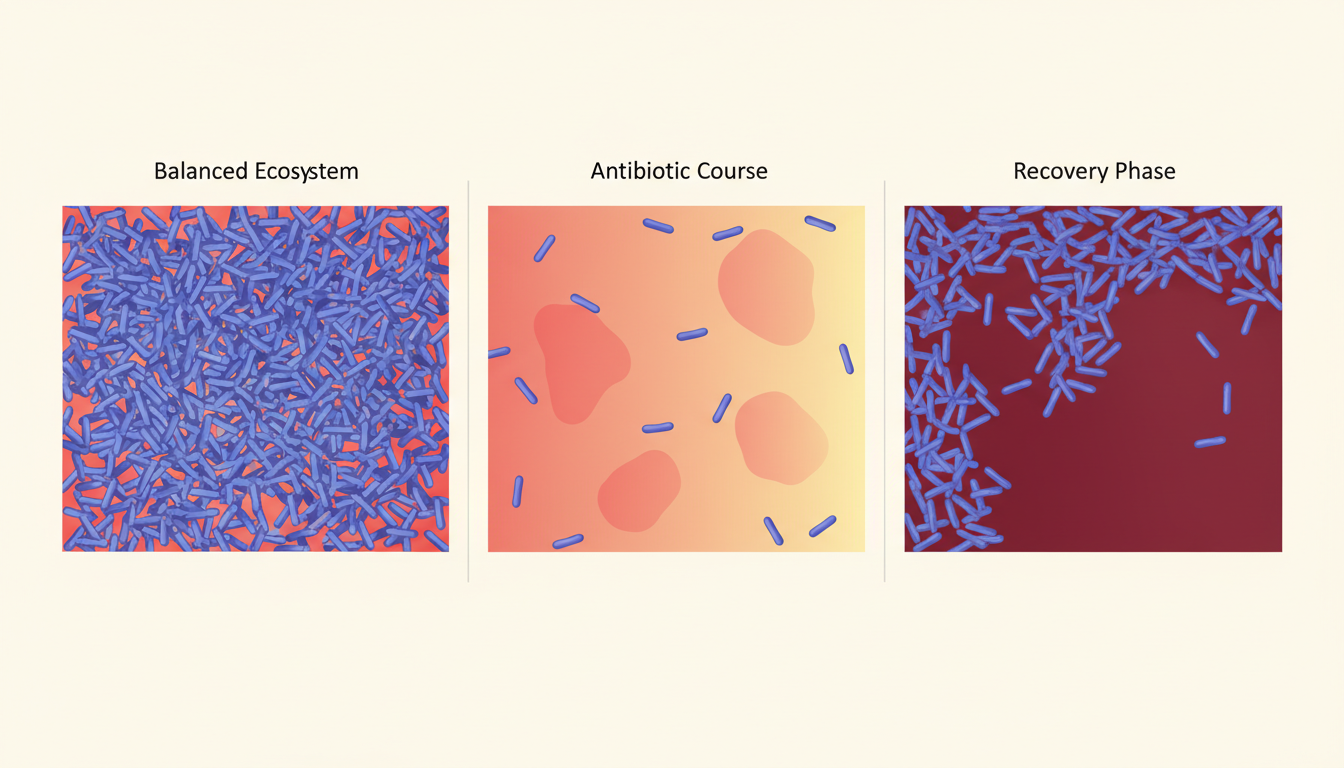
Most people do not finish a course of antibiotics thinking about sexually transmitted infections. The instinct to ask comes from a real biological pattern: antibiotics weaken the part of your body that quietly does some of the heavy lifting against everyday pathogens. The vaginal microbiome, in particular, is a tightly balanced ecosystem. When healthy strains of Lactobacillus dominate, they keep the vaginal pH between roughly 3.8 and 4.5 and produce lactic acid, hydrogen peroxide, and other compounds that crowd out organisms like Gardnerella vaginalis, the lead suspect in bacterial vaginosis.
Broad-spectrum antibiotics do not check your sex life on the way out. They reduce the bacteria causing your sinus infection, your UTI, your strep throat, and many of the protective species too. The vaginal pH can rise, the mucosal barrier can thin, and the door to opportunistic infections opens slightly wider.
The period after a course of antibiotics can carry a quietly elevated BV risk, and BV itself raises the chance of acquiring an STI if exposure happens. That is why testing, barrier protection, and flora recovery sit in the same conversation, even when the original prescription had nothing to do with sex.
How Antibiotics Reshape Your Microbiome
The vaginal microbiome is small, dense, and surprisingly fragile. A healthy state in most reproductive-age women is dominated by one or two Lactobacillus species, most often L. crispatus, L. iners, L. gasseri, or L. jensenii. These rod-shaped bacteria attach to the vaginal epithelium, lower the pH through lactic acid production, and create an environment where many pathogens cannot replicate efficiently.
Antibiotics that work systemically reach this ecosystem too. A 5- to 7-day course of azithromycin, doxycycline, or amoxicillin can drop Lactobacillus counts measurably and let other anaerobes expand. The downstream effects show up across several body sites:
- Vagina: raised pH, thinner mucosal barrier, higher chance of bacterial vaginosis and yeast overgrowth. Symptoms can include changes in discharge, mild itching, or a fishy odor.
- Gut: reduced diversity of beneficial anaerobes, antibiotic-associated diarrhea in roughly 5 to 35 percent of people depending on the drug, longer recovery for some species (sometimes months).
- Rectum: a similar disruption of mucosal flora and local immune balance, relevant for anyone receiving anal sex.
- Mouth and skin: occasional yeast overgrowth, oral thrush in vulnerable people, and shifts in commensal communities that usually self-correct.
Most of these effects are short-term. They self-correct over a few weeks if the system is not disrupted again by another antibiotic course, douching, or a recurrent infection.
What Probiotics Can and Cannot Do
Probiotics are live microorganisms (most often specific strains of Lactobacillus and Bifidobacterium) that, taken in adequate amounts, can replenish or support a microbial community after disruption. The keyword is specific strains: probiotic effects are strain-dependent. L. crispatus is not the same as L. acidophilus, even though both appear on yogurt labels.
What probiotics can plausibly do after a course of antibiotics:
- Help repopulate vaginal Lactobacillus communities and pull pH back into the protective range.
- Reduce recurrence of bacterial vaginosis when paired with the standard antibiotic treatment for BV. The 2020 LACTIN-V trial in the New England Journal of Medicine (Cohen CR et al.) found that an intravaginal L. crispatus product applied after metronidazole cut 12-week BV recurrence to 30 percent compared with 45 percent in the placebo group.
- Modestly reduce antibiotic-associated diarrhea and shorten gut recovery time.
- Lower the chance of post-antibiotic yeast overgrowth in some people.
What probiotics cannot do:
- Block transmission of any sexually transmitted infection. If a partner sheds HSV, no capsule, suppository, or yogurt prevents that virus from contacting your skin or mucosa.
- Treat or clear an existing STI. Chlamydia, gonorrhea, syphilis, trichomoniasis, and other bacterial infections require targeted antibiotics. Viral STIs require antivirals or, where available, vaccines.
- Replace barrier protection like condoms or dental dams.
- Show up on or interfere with an STI test result.
What probiotics will not do is intercept a partner's chlamydia or seal a microscopic break that herpes uses to enter. Those are different problems and need different tools.
In the United States, probiotics are regulated as dietary supplements rather than as drugs. Per <a href="https://ods.od.nih.gov/factsheets/Probiotics-HealthProfessional/">the NIH Office of Dietary Supplements</a>, current labeling rules only require manufacturers to list the total weight of microorganisms, not the count of viable cells. Strain identity, viable bacteria count at expiration, and clinical effect can vary widely between products. Look for a label that names the exact strain in full (for example, Lactobacillus crispatus CTV-05) and a colony-forming unit (CFU) count guaranteed through expiration, not just at manufacture.
Bacterial Vaginosis Is Where the Real STI Risk Lives
If there is one mechanism that explains why antibiotics, the vaginal microbiome, and STI risk all sit in the same conversation, it is bacterial vaginosis. BV is the most common cause of vaginal symptoms in women of reproductive age. BV itself is not classified as a sexually transmitted infection, although the shift it creates in vaginal pH and mucosal barrier strength raises the chance of acquiring one if exposure occurs.
CDC guidance on BV states directly that having BV increases your chances of getting other STDs. Cohort studies report higher acquisition rates for HIV, chlamydia, and gonorrhea, and several studies report higher rates for herpes simplex virus among women with persistent BV, although the precise multiplier varies by infection and study population. The mechanism combines higher vaginal pH, a thinner mucosal barrier, increased local inflammation, and lower concentrations of antimicrobial peptides.
BV is also linked to higher rates of preterm birth, post-procedural pelvic infection, and endometritis. Treatment usually involves a course of prescribed antibiotics, plus addressing modifiable risk factors like douching, scented intimate products, and smoking, per NHS guidance.
Having BV can increase your chances of getting other STDs.
Probiotic Strains With the Best Evidence
Strain matters more than category. Most over-the-counter probiotics labeled for women's health pull from a small set of strains with at least some clinical evidence in vaginal or urogenital outcomes. The table below summarizes what published trials and reviews actually support.
Two practical points when buying. First, look for products that name the full strain (genus, species, and the alphanumeric strain code, for example L. crispatus CTV-05). Generic labels like 'probiotic blend' or 'feminine flora support' often hide low-evidence species mixed with marketing herbs. Second, check the CFU count guaranteed at expiration, not at manufacture, because viable counts drop on the shelf. A daily oral dose of 1 to 10 billion CFU of a well-studied strain has more support than a 50-billion-CFU mega-dose of unspecified species.
| Strain | Best-supported use | Sample evidence |
|---|---|---|
| Lactobacillus crispatus CTV-05 | Reducing recurrence of BV after metronidazole treatment | LACTIN-V trial, NEJM 2020 |
| Lactobacillus rhamnosus GR-1 | Recolonizing vaginal flora, reducing yeast recurrence | Smaller trials in oral and intravaginal forms |
| Lactobacillus reuteri RC-14 | Often paired with GR-1 for vaginal flora support | Combined oral formulations |
| Lactobacillus iners | Common natural resident; less protective in some studies | Not typically used as a probiotic |
| Bifidobacterium longum and B. lactis | Gut recovery after antibiotics, reducing antibiotic-associated diarrhea | Pediatric and adult AAD trials |
| Saccharomyces boulardii | Antibiotic-associated diarrhea and C. difficile prevention | Cochrane reviews of AAD |
How to Time Probiotics Around an Antibiotic Course
Timing matters because antibiotics will kill probiotic bacteria too if both arrive at the same site at the same time. The general rule is to space oral probiotics at least two to four hours apart from each antibiotic dose. That window lets the antibiotic concentration drop before the probiotic strains pass through.
For people on a multi-day course of broad-spectrum antibiotics, three windows are worth thinking about:
- Before the course: if you have a history of recurrent BV or yeast infections, beginning a probiotic two to three days before starting antibiotics gives the helpful flora a head start.
- During the course: a daily oral probiotic taken two to four hours after each antibiotic dose modestly reduces antibiotic-associated diarrhea and may protect some vaginal flora.
- After the course: continue the probiotic for at least 7 to 14 days after the last antibiotic dose. Some clinicians extend this to four weeks for women with a history of BV. Intravaginal L. crispatus products are the form with the strongest evidence for vaginal recolonization, although they are prescription-only in many countries.
One thing to avoid throughout: douching. Vaginal douching wipes out beneficial flora alongside everything else and is associated with higher BV and STI rates in observational studies. Plain warm water and gentle external washing are enough.
Before antibiotics: start a probiotic 2 to 3 days early if you are prone to BV or yeast infections.
During antibiotics: take probiotic doses 2 to 4 hours after each antibiotic dose, daily.
After antibiotics: continue probiotics for 7 to 14 days; extend to 4 weeks for recurrent BV.
Probiotics Are Not a Substitute for Testing
This is the section to read carefully if you came here trying to decide whether you need a test. No probiotic, no matter how well-formulated or expensive, will:
- Detect an STI.
- Treat an STI.
- Make symptoms of an STI less concerning.
- Reset a possible exposure window.
If you had unprotected sex around your antibiotic course, the right tool is a test, sized to the type of exposure and the time elapsed. Most rapid tests for chlamydia and gonorrhea use a self-collected swab and look for antigen markers. Rapid blood-based tests for HIV, syphilis, hepatitis B and C, and HSV antibodies need different window periods to be reliable: HIV antibody/antigen rapid tests detect most infections by 18 to 45 days post-exposure, syphilis blood tests by about 3 to 6 weeks, and HSV antibody tests by roughly 12 weeks for the most reliable result.
Symptoms that warrant earlier testing or a clinic visit, regardless of where you are in the antibiotic timeline:
- Unusual discharge (color change, odor, much heavier than your baseline).
- Burning during urination, pelvic or testicular pain.
- New genital sores, blisters, or ulcers.
- Bleeding between periods, especially after sex.
- Sore throat or rectal pain after oral or anal exposure (clinic-administered swabs are needed for those sites; our home kits do not cover throat or rectal collection).
stdrapidtestkits.com sells at-home rapid test kits; the products below are available directly from this site.
Common Myths About Probiotics, Antibiotics, and STIs
Probiotic marketing leans hard on the gap between 'supports immunity' and the more honest 'supports a few specific microbiome outcomes.' That gap is where most misunderstandings sit. The table below sorts the common ones.
| Myth | Fact |
|---|---|
| I am on antibiotics, so I cannot get an STI right now. | Most antibiotics target specific bacterial families and do not cover the pathogens behind most STIs. A few classes do treat certain STIs at the right dose, but everyday antibiotics for a UTI, sinus infection, or strep throat will not protect against new exposure. |
| Probiotics can cure an STI. | No probiotic strain has been shown to clear chlamydia, gonorrhea, syphilis, trichomoniasis, herpes, HPV, or HIV. STIs require organism-specific treatment with antibiotics, antivirals, or, in some cases, vaccines. |
| If I feel fine, I do not need to test. | Most early chlamydia and gonorrhea cases are asymptomatic. Many HPV and HSV infections are silent for months or years. Testing is the only confirmation. |
| A daily probiotic replaces condoms or dental dams. | Barrier methods reduce skin-to-skin and fluid contact during sex. No supplement reproduces that effect. |
| More CFU is always better. | Strain identity matters more than CFU count. A 10-billion-CFU dose of a well-studied strain outperforms 100 billion CFU of unspecified species. |
| Yogurt is the same as a vaginal probiotic. | Most yogurts contain Streptococcus thermophilus and L. bulgaricus, which are not vaginal-colonizing strains. They support gut function but do not recolonize the vagina. |
A Layered Plan for Sexual Health
Sexual health does not collapse into a single product or pill. The most resilient setup is a small set of habits that compound over time, with each piece doing one job well.
- Barrier protection during exposure. Condoms, dental dams, and internal condoms reduce skin-to-skin and fluid transmission for most STIs. They do not eliminate herpes or HPV transmission entirely, since both can spread from skin not covered by the barrier, but they substantially lower the rate.
- Open partner conversations. Knowing when each partner last tested, what they tested for, and whether anything has changed since is more useful than guessing.
- Routine testing on a real schedule. Per CDC STI guidance, sexually active women under 25 should test for chlamydia and gonorrhea at least annually, and any sexually active person with new or multiple partners should layer in periodic HIV, syphilis, and hepatitis screening. Add testing after specific exposures or symptoms.
- Microbiome care after antibiotics. A targeted probiotic course, no douching, gentle external washing, breathable underwear, and adequate hydration support flora recovery on a 2- to 4-week timeline.
- Vaccines where available. The HPV vaccine is recommended routinely through age 26, with shared clinical decision-making through age 45. The hepatitis B vaccine is recommended for unvaccinated adults at risk. Both meaningfully change long-term outcomes.
Probiotics fit into the fourth layer of that plan, and their role is supportive rather than primary.

FAQs
- Can I get an STI even if I am taking antibiotics?
- Yes, and the window after an antibiotic course is a particularly relevant time. Most antibiotics are prescribed for a specific bacterial target (a sinus infection, a UTI, strep throat) and do not cover the organisms behind chlamydia, gonorrhea, herpes, or HIV. The antibiotic-related disruption of vaginal flora can also temporarily raise BV risk, which itself raises STI-acquisition risk. A few drugs (azithromycin, doxycycline) do treat certain STIs at specific doses, but only when the drug and dose are matched to the infection your partner exposed you to.
- Should I take a probiotic during my antibiotic course or only after?
- Both is reasonable. Take an oral probiotic 2 to 4 hours after each antibiotic dose during the course, then continue daily for 7 to 14 days after the last antibiotic dose. People with a history of recurrent BV often extend that to 4 weeks. Intravaginal probiotic products, where available, can recolonize the vagina faster than oral routes.
- Which probiotic strains are best for vaginal flora recovery?
- The best-studied strains are Lactobacillus crispatus (especially the CTV-05 strain studied in the LACTIN-V trial), Lactobacillus rhamnosus GR-1, and Lactobacillus reuteri RC-14, often paired in oral combination products. Look for products that list the full strain name and a CFU count guaranteed through expiration.
- If I had unprotected sex while on antibiotics, when should I test?
- The right test depends on the time since exposure. A swab test for chlamydia and gonorrhea is reliable from about day 14 post-exposure. HIV antibody/antigen rapid tests catch most infections by 18 to 45 days. Syphilis blood tests are reliable by about 3 to 6 weeks. HSV antibody tests need around 12 weeks for the most reliable read. If you have any symptoms, see a clinician without waiting for a window period to close.
- Will probiotics affect my STI test results?
- No. Probiotic supplements do not cause false positives or false negatives on antibody, antigen, or NAAT tests for STIs. They also do not clear an existing infection, so a negative test after probiotic use reflects actual absence of detectable infection, not masking.
- Is it safe to take probiotics after being treated for chlamydia or gonorrhea?
- Yes, and many clinicians suggest it. The antibiotics used to treat bacterial STIs (doxycycline, azithromycin, ceftriaxone) reduce vaginal Lactobacillus along with the target organism. A probiotic course over the following 2 to 4 weeks supports faster flora recovery and may reduce the chance of post-treatment BV or yeast infections.
- Do men benefit from probiotics around an antibiotic course?
- Probably modestly. Most evidence concentrates on vaginal flora and antibiotic-associated diarrhea. Gut microbiome recovery and reduced antibiotic-associated diarrhea apply to anyone. Rectal microbiome research is younger but suggests similar disruption patterns, which matter for men who have sex with men. Probiotics do not change male STI exposure risk in any direct way.
- I feel off after antibiotics, with mild itching and unusual discharge. Is this BV, a yeast infection, or an STI?
- It could be any of the three, and home guessing is unreliable. BV typically presents with a thin grey or white discharge and a fishy odor. Yeast infections usually bring a thicker white discharge with itching and no odor. Chlamydia, gonorrhea, and trichomoniasis can all mimic these patterns or produce no symptoms at all. A swab-based STI test plus a clinical exam is the only way to sort them. Treatment differs for each, so guessing wrong risks delaying the right care.
- U.S. Centers for Disease Control and Prevention. About bacterial vaginosis. Source for the BV-and-STI risk relationship cited throughout this article (HIV, chlamydia, gonorrhea).
- U.S. Centers for Disease Control and Prevention. Sexually transmitted infections (STI) basics, including testing recommendations referenced in the layered-plan section.
- Cohen CR et al. Randomized Trial of Lactin-V to Prevent Recurrence of Bacterial Vaginosis. New England Journal of Medicine, 2020. Source for the 12-week BV recurrence figures (30 percent Lactin-V vs 45 percent placebo).
- U.K. National Health Service. Bacterial vaginosis. Source for clinical features, modifiable risk factors, and standard antibiotic treatment framing.
- World Health Organization. Sexually transmitted infections (STIs) fact sheet. Source for global STI epidemiology framing.
- U.S. National Institutes of Health, Office of Dietary Supplements. Probiotics fact sheet for health professionals. Source for strain-specificity, supplement-regulation framing, and CFU labeling caveats.
