
Published: September 2025 | Last updated: May 2026 | Editorial review and quality control: Martina N.
Most women who get chlamydia never feel a thing. No itch, no smell, no dramatic change. That is the unsettling part of this infection: it is built to stay quiet, and by the time it stops being quiet, it has often already done damage that is harder to reverse. The encouraging part is that you do not need symptoms to know. A test takes minutes, and you can do it at home without anyone seeing you walk into a clinic.
This guide is for the woman wondering whether her one-week-late period or that slightly different discharge is something. It is also for the woman who feels totally fine but had unprotected sex once last month and has not stopped quietly worrying about it. Both are good reasons to keep reading.
Key Takeaways
- Most women with chlamydia have no obvious symptoms, which is why screening, not symptom-watching, is the only reliable way to know.
- The most accurate testing window starts about 14 days after exposure. If you test earlier and get a negative, retest at day 14 to confirm.
The Infection That Hides on Purpose
Chlamydia is a common bacterial sexually transmitted infection in the United States (CDC chlamydia overview). Most women infected with it have no symptoms at all. The minority who do get clues so subtle that most people brush them off: a slight change in discharge, a one-off spotting episode after sex, a low pelvic ache that gets blamed on the cycle.
A common pattern from primary-care clinics looks like this. A woman in her late 20s notices her discharge has shifted, just a touch thicker, a touch more persistent. Nothing dramatic. She figures she switched lubes or stress is doing what stress does. A month later a routine pap visit screens her, and she tests positive. By then she has had a new partner, who also has no symptoms, and the chain has already extended one link further than she knew.
This is how chlamydia spreads quietly between people who feel fine, and a well-timed test is how the chain gets broken.
Can you have chlamydia and feel completely normal?
Yes, and that is the most common case. Most women with chlamydia have no symptoms; among those who do, the signs are usually subtle (a small change in discharge, light spotting between periods, or mild pelvic discomfort). Testing is the only way to confirm, and the most accurate result comes from a sample taken at least 14 days after the suspected exposure.
The Subtle Signs That Get Dismissed
If chlamydia does cause symptoms in women, they are usually so quiet that people attribute them to something else. A change in discharge gets blamed on the new lube or a different brand of pad. Mid-cycle spotting gets shrugged off as a hormone hiccup. A dull pelvic ache feels like cramps without the period. None of these signs are diagnostic on their own, but a cluster of them, especially after a recent unprotected encounter, is worth taking seriously.
Consistency matters more than intensity. A discharge that lasts five days when yours typically resolves in two, or two episodes of after-sex spotting in the same cycle when you usually have none, is the kind of pattern shift that is worth investigating. The clinical literature finds that over 80% of women with chlamydia are either asymptomatic or have only mild symptoms such as discharge, bleeding, abdominal pain, or burning with urination (NIH/StatPearls, Chlamydia).
| Possible Symptom | How It Tends to Feel | When to Take It Seriously |
|---|---|---|
| Unusual discharge | Clear or slightly milky, a touch thicker or more persistent than your baseline | Lasts more than three days, smells off, or comes with bleeding |
| Spotting between periods | Light pink or brown, not tied to your cycle | Even one episode warrants a screen if you had recent unprotected sex |
| Pain during sex | Mild cramping or deep pressure, not sharp pain | New, recurring, or tied to specific positions |
| Pelvic discomfort | Dull lower-abdomen ache, like period cramps without your period | Worsens with sex, movement, or stress over several days |
| No symptoms at all | Everything feels normal | Most common pattern; test anyway after a possible exposure |
Often Mistaken for a UTI or a Yeast Infection
One reason chlamydia gets missed is that its handful of symptoms overlap with conditions women see far more often. Burning with urination looks like a UTI. A change in discharge looks like a yeast infection. A dull pelvic ache looks like a hormonal cycle thing. The urgent-care clinician working from a 10-minute slot may default to a UTI prescription before running an STI panel.
If you have been treated for a presumed UTI or yeast infection and your symptoms have not cleared in a few days, ask explicitly for a chlamydia and gonorrhea swab. The CDC's STI treatment guidelines recommend annual screening for all sexually active women under 25, and screening for older women at increased risk such as those with new or multiple partners (CDC chlamydial infections treatment guidelines). If your provider does not screen by default, ask for it. A quiet infection will not signal them on its own.
Why Testing Matters When You Feel Completely Fine
Untreated chlamydia does not stay where it started. Over months, the bacteria can ascend from the cervix into the uterus and fallopian tubes, where it triggers pelvic inflammatory disease (PID). PID gradually scars the fallopian tubes, and tubes that are partially or fully blocked by scar tissue are one of the leading causes of tubal-factor infertility and ectopic pregnancy. The progression happens silently in many women, which is why both the WHO and the CDC flag chlamydia as a major preventable cause of infertility globally (WHO chlamydia fact sheet).
None of this requires recklessness or multiple partners to set in motion. One unprotected encounter, one slipped condom, one new relationship that started before either of you got tested, is enough, and none of that requires panic to address, only a test at the right window. Your body cannot reliably tell you about chlamydia, because chlamydia is built not to be felt, which is precisely the gap a well-timed test is meant to close.
Disclosure: stdrapidtestkits.com publishes this article and sells the at-home STI testing kits referenced throughout. We recommend kits based on fit for the reader's situation, not commercial benefit.
When Chlamydia Actually Shows Up on a Test
Timing is the part most people get wrong. If you had unprotected sex on Friday and you panic-test on Monday, the test may come back negative because the bacteria has not multiplied to detectable levels yet, not because you are clear. The most accurate window for chlamydia testing starts about 14 days after exposure. Earlier than that, a negative is reassuring but not definitive.
The general guidance below applies to both rapid lateral-flow home tests and lab NAAT, though lab NAAT has higher analytical sensitivity and may pick up infection a few days earlier. If you test before day 14 and get a negative, retest at or after day 14. If symptoms develop in the meantime, test sooner and again at the 14-day mark.
| Days Since Exposure | Should You Test? | Test Reliability | Retest Needed? |
|---|---|---|---|
| 0–5 days | Too early unless symptoms are severe | Low | Yes, retest at day 14 |
| 6–13 days | Possible early detection | Moderate | Yes, confirm at day 14+ |
| 14+ days | Best window for accuracy | High | Only if new exposure or new symptoms |
The Three-Month Retest Most People Skip
If you test positive and get treated, the antibiotic almost always clears the current infection. The catch is reinfection. The CDC recommends retesting about three months after treatment for anyone diagnosed with chlamydia, because reinfection from an untreated partner or a new partner is common (CDC retesting guidance).
This is a separate question from whether the medicine worked. The medicine worked. The retest covers what happens after the cure, not whether the cure was effective. Skipping it is fine if you accept the risk; understanding the risk is that a partner who was not notified, or a new partner who never tested, can hand it right back to you, and the second time around can be just as silent as the first.
Retest about three months after a chlamydia diagnosis, even if you completed antibiotics. Retest sooner if you have a new exposure or new symptoms within that window. The retest catches reinfection from an untreated partner; it is not about whether the medicine worked.
Telling a Partner Without Spiraling
Telling someone you tested positive for an STI is rarely as bad as the imagining of it. The wording does not have to be elaborate; a short, direct message works, and the whole job of the message is to give the other person what they need to test and treat.
If a direct conversation feels impossible, the U.S. CDC and many state STD programs run anonymous partner-notification services, and several telehealth platforms include disclosure tools that send the message on your behalf.
“Hey, I just tested positive for chlamydia. It is treatable with antibiotics, and you should get tested too. I wanted to tell you directly.”
Send by text, DM, phone, or whatever feels least costly to you. Brevity is the point.
Chlamydia and Your Fertility
The fertility piece is the part of this conversation people avoid until it stops being avoidable. Untreated chlamydia is one of the leading preventable causes of pelvic inflammatory disease, tubal scarring, and tubal-factor infertility worldwide. The damage is gradual: the bacteria climbs from the cervix into the uterus and fallopian tubes, triggers low-grade inflammation, and over months or years that inflammation lays down scar tissue. By the time someone notices, often during a fertility workup years later, the tubes may already be partially blocked.
This is not a reason to panic about a recent exposure. The progression takes time, and treatment in the early window prevents almost all of the long-term damage. It is a reason to test. If you want children later, or have not decided, the cost of a 15-minute home test is trivial next to the cost of finding out at 32 that two of three pieces had to fall into place years ago.

How At-Home Tests Actually Work
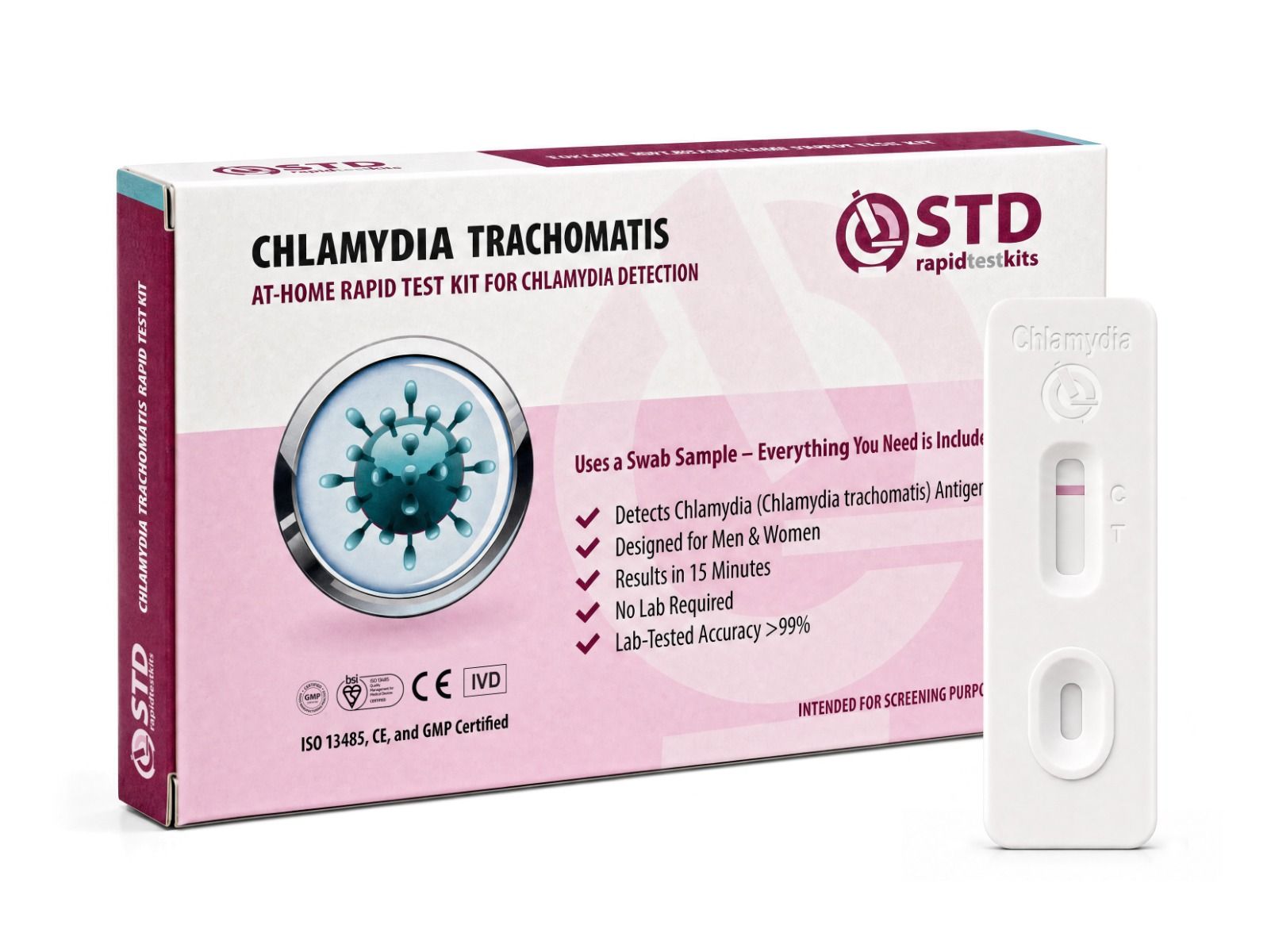
There are two different things people mean when they say “at-home test,” and the distinction matters more than most articles admit. One is a rapid lateral-flow test: you collect a vaginal swab at home, run it through a small cassette, and read the result yourself in about 15 minutes. The other is a mail-in lab kit: you collect a sample at home, ship it to a CLIA-certified lab, and wait a few business days for a NAAT result.
Both work. They do different jobs. Rapid lateral-flow tests are screening tools (fast, private, low-friction, useful for the moment you cannot stop wondering and need an answer this evening). Mail-in NAAT has higher analytical sensitivity, especially in the earlier days after exposure, and is the same method most clinics run on a sample they collect from you in the office. A clean negative on a rapid test taken at the right window is reassuring; a positive on a rapid test is worth confirming with a lab NAAT, since confirmation usually opens the door to a clinician’s prescription for treatment per the CDC STI treatment guidelines.
| Testing Option | Privacy | Test Method | Turnaround | Best For |
|---|---|---|---|---|
| Clinic or urgent care | Low to moderate (chart record on file) | Lab NAAT, often with exam | Same-day to 7 days | Symptomatic patients, in-person support |
| Mail-in lab kit | High (discreet packaging, often pseudonymous) | Lab NAAT (CLIA-certified) | 2–5 business days after mailing | Privacy-focused screening, early-window detection |
| At-home rapid test | Very high (fully self-administered) | Lateral-flow immunoassay | About 15 minutes | Day-14+ screening, immediate answers; confirm positives |

Get the Answer Without the Spiral
If you have read this far, something probably nudged you to. Maybe a slight discharge change, maybe a partner you stopped trusting, maybe a quiet 2 a.m. “could it be?” that did not pass. Trust that nudge. Chlamydia does not always announce itself, and the cost of a 15-minute home test is small enough that inertia is the only real reason to skip it.
Test at the right window. If the result is positive, treat and tell the partner you need to tell. Retest at three months.
Your next steps
- Test at day 14 or later after a suspected exposure for the most reliable result.
- If positive, complete the antibiotic course your provider prescribes and notify any partners from the past 60 days.
- Retest about three months after treatment to rule out reinfection from a missed or unnotified partner.
FAQs
- Can I have chlamydia and feel totally fine?
- Yes, and that is the rule rather than the exception. Most women with chlamydia have no symptoms. The infection is not “silent because it is mild”; it is silent because of how it colonizes cervical and urethral tissue. Symptom-watching is not a screening strategy. If you had an unprotected exposure, test at or after day 14 even if you feel fine.
- How soon after exposure can I test?
- The most reliable window starts about 14 days after exposure. You can test earlier if you need a quick answer, but a negative before day 14 is not definitive. Lab NAAT has somewhat higher sensitivity in the early window than rapid lateral-flow tests, so if you absolutely need an answer at day 7, a mail-in NAAT is the more sensitive option, with a follow-up rapid or NAAT at day 14 to confirm.
- What does chlamydia discharge usually look like?
- When chlamydia does cause discharge, it tends to be subtle: clear or slightly milky, slightly thicker or more persistent than your usual baseline. It is rarely foul-smelling, frothy, or chunky. Dramatically off discharge (thick white cottage-cheese texture, fishy smell, yellow-green frothy) usually points to yeast, bacterial vaginosis, or a different infection. The takeaway is that “looks normal” does not rule chlamydia out.
- Can I get chlamydia from oral sex?
- Yes, though pharyngeal chlamydia is less common than the genital form. If your partner has an untreated genital infection, oral sex with them can transmit it to your throat. Pharyngeal chlamydia usually causes no symptoms and is detected with a throat swab, which is a clinic-administered test. Our at-home rapid kit tests genital chlamydia, not pharyngeal; for an exposure you think was throat-only, a clinic visit is the right call.
- Does treating chlamydia mean I am immune now?
- No. Antibiotics clear the current infection but do not produce lasting immunity. Reinfection from an untreated partner or a new partner is common, which is why the CDC recommends retesting around three months after treatment.
- What if my UTI test is negative but I still feel off?
- Burning with urination plus a negative urine culture is one of the more common ways chlamydia gets missed. Ask your provider explicitly for a chlamydia and gonorrhea swab, or run a home test in parallel. Two rounds of unhelpful UTI antibiotics is a strong signal that the diagnosis is not UTI.
- Are at-home rapid tests as accurate as the lab?
- From day 14 post-exposure, a home rapid lateral-flow test catches the large majority of infections in about 15 minutes, fit for purpose as a screening tool. Lab NAAT has higher analytical sensitivity in the first two weeks and is the standard for confirming a positive. Use the home rapid test for routine day-14+ screening, and use a mail-in or clinic NAAT when you need early-window detection or are following up a positive result.
How We Sourced This Article: We combined current guidance from the U.S. Centers for Disease Control and Prevention, the World Health Organization, the U.S. Preventive Services Task Force, and the NIH StatPearls clinical reference. The article was reviewed for medical accuracy by Aikaterini Maragkou, MD.
- U.S. Centers for Disease Control and Prevention. About Chlamydia, basic fact sheet covering symptoms, transmission, and the asymptomatic pattern in women.
- U.S. Centers for Disease Control and Prevention. Sexually Transmitted Infections Treatment Guidelines, Chlamydial Infections section, including annual screening for women under 25 and treatment regimens.
- U.S. Centers for Disease Control and Prevention. Retesting After Treatment to Detect Repeat Infections, three-month retest recommendation.
- World Health Organization. Chlamydia fact sheet covering global burden, asymptomatic patterns, and complications including infertility.
- Mohseni M, Sung S, Takov V. Chlamydia. NIH/StatPearls clinical reference, citing that over 80% of women with chlamydia are asymptomatic or have only mild symptoms.
- U.S. Preventive Services Task Force. Chlamydia and Gonorrhea Screening recommendation, screening for sexually active women under 25 and older women at increased risk.
