
Published: November 2025 | Last updated: May 2026 | Editorial review and quality control: Martina N.
Friends with benefits (FWB) is supposed to be the easy option. No labels, no drama, no awkward Sunday-morning emotional check-ins. The trouble is that the same casual frame that makes it feel safe is exactly what raises the odds of an STD passing between partners without anyone realizing it. The risk does not come from how many people you sleep with. It comes from the silence around testing, the assumption that familiar means safe, and the way casual setups discourage exactly the questions that protect everyone involved.
This guide walks through the dynamics that quietly raise STD risk in FWB arrangements, why condoms are powerful but not foolproof, how often you should test if you have one or more casual partners, and how to bring up testing without making it weird. The goal is not to scare you out of casual sex. It is to make sure your version of casual still includes the basics that keep your body and peace of mind intact.
Key Takeaways
- Around 70% of chlamydia infections in women and roughly half in men cause no symptoms, per the CDC, so "we both feel fine" is not the same as "we are both negative."
- Routine testing every 3 to 6 months, combined with a quick status conversation before sex, removes most of the unknowns in any FWB arrangement, no matter how casual.
What Makes FWB a Hidden STD Risk Zone?
It is not the volume of partners that drives risk in casual setups. It is the silence. People in FWB arrangements rarely talk about sexual health, past partners, or testing cadence, because doing so feels like importing the emotional weight of a committed relationship into something deliberately light. The cultural shorthand is, “because we are not serious, it does not have to be serious.” That logic is where infections find room to move.
Picture a common scenario: two people who already know each other socially start hooking up every few weeks. One of them assumes the other has “always been careful.” Neither has tested in months. There is no overlap of recent results, no shared baseline. The day a sore, a burning sensation, or a routine pap-smear surprise shows up, the only honest answer to “where did this come from” is “any time in the last year, from any partner.”
FWB arrangements often lack the small rituals that protect committed couples: agreed-upon check-ins, a shared sense of what counts as “new partner,” a routine of testing together at the start. Because everything is supposed to be low-effort, questions like “when did you last get tested?” can feel like a vibe-killer. They are not. Silence is what increases exposure, not the question.
Most FWB partners have never compared testing dates, recent partners, or what being careful actually means to each other. That unexamined gap is where common STIs find room to move, and closing it takes one short conversation, not a relationship escalation.
"But We Used Protection" Is Not Always Enough
Condoms remain one of the most effective tools for reducing transmission of fluid-borne STIs such as HIV, chlamydia, and gonorrhea (CDC condom effectiveness). But several infections spread through skin-to-skin contact in areas that condoms do not cover. Herpes (HSV-1 and HSV-2), HPV, and syphilis can all transmit from a sore or shedding patch on the thighs, scrotum, vulva, perineum, or mouth, even when intercourse itself is covered (CDC about STIs).
Add inconsistent use to that picture, which is common in casual sex specifically. Surveys of young adults consistently find that condom use during FWB encounters is lower than during planned encounters with new dating partners. The combination of a barrier that does not cover every transmission route and a use pattern that drops off in the moment is how partners who consider themselves “protected” still end up with positive results.
| Infection | Condoms Reduce Risk? | Other Transmission Routes |
|---|---|---|
| Chlamydia | Yes, substantially when used correctly | Genital fluids; oral and anal exposure possible |
| Gonorrhea | Yes, substantially | Throat and rectal exposure during oral or anal sex |
| HPV | Partially | Skin-to-skin contact in genital area not covered by the condom |
| Herpes (HSV-1, HSV-2) | Partially | Skin-to-skin contact, kissing, oral-to-genital transmission |
| Syphilis | Partially | Direct contact with chancre on lips, mouth, genitals, or anus |
| HIV | Yes, substantially | Blood, semen, vaginal fluid, rectal fluid, breast milk |
How STDs Stay Silent (And Why That Matters in FWB)
The most common STIs are usually quiet. The CDC estimates that most chlamydia cases produce no obvious symptoms, with the highest asymptomatic share in women. Gonorrhea is similar: roughly half of women and a smaller share of men show no clear signs at infection (CDC STI Treatment Guidelines). Most HPV infections never produce visible warts. HSV-2 is carried by many adults who have never had a recognized outbreak; the CDC notes that “most people with genital herpes have no symptoms or have very mild symptoms” and can still pass the virus to partners without realizing it (CDC genital herpes overview). Trichomoniasis is similarly silent: about 70% of infections produce no signs or symptoms (CDC trichomoniasis overview).
That is the part of the picture casual setups are built to ignore. If you and your FWB both feel fine, the default assumption is that nothing is wrong. In practice, “feeling fine” correlates poorly with infection status for the infections most common among sexually active adults under 40. Itching gets blamed on shaving. A bump becomes “probably a pimple.” Light spotting gets called a cycle change. Each of these can be exactly what it looks like. Some of them are not.
Oral-to-genital transmission is one of the patterns that surprises people the most. HSV-1, the same virus responsible for most cold sores, has become a leading cause of new genital herpes in adults, often passed during oral sex from a partner who has no visible sore at the moment. That is a transmission route casual sex makes very plausible and protection talks rarely cover.
| Infection | Typical Asymptomatic Share | Easily Misread As |
|---|---|---|
| Chlamydia | ~70% in women, ~50% in men | Mild burning or light discharge mistaken for a UTI |
| Gonorrhea | ~50% in women, lower in men | Spotting, sore throat, mild rectal discomfort |
| HPV | Most cases | No symptoms; warts sometimes mistaken for skin tags |
| Herpes (HSV-1 / HSV-2) | Most carriers initially undiagnosed | Razor burn, ingrown hairs, small pimples |
| Trichomoniasis | ~70% of infections | Unusual discharge or odor blamed on diet, soaps, or cycle |
Testing Timelines That Actually Make Sense for FWB
The CDC recommends annual chlamydia and gonorrhea screening for all sexually active women under 25, and for older women with risk factors such as new or multiple partners. Sexually active gay and bisexual men are advised to test for syphilis, chlamydia, and gonorrhea at least once a year, and every 3 to 6 months if they have multiple or anonymous partners (CDC STI testing recommendations). HIV, syphilis, and hepatitis screening are recommended at intervals that depend on individual risk.
Translated into FWB language: if you have one casual partner who you are confident is monogamous with you, a baseline test followed by repeat testing every 6 to 12 months is reasonable. If you or your partner are seeing other people, shrink that window to every 3 to 6 months. After unprotected sex with a new partner, or after any symptoms appear, test sooner and plan a follow-up test once the relevant incubation window has passed.
Incubation windows are why a single test right after a hookup is not enough. Chlamydia and gonorrhea typically become detectable within about 1 to 2 weeks. HIV antigen-antibody tests usually become positive within 2 to 6 weeks. Syphilis can take 3 to 6 weeks. Herpes antibody tests can take 4 to 12 weeks to seroconvert (produce a detectable antibody response in the blood). The practical move is to test now for peace of mind, then again at the relevant follow-up point.
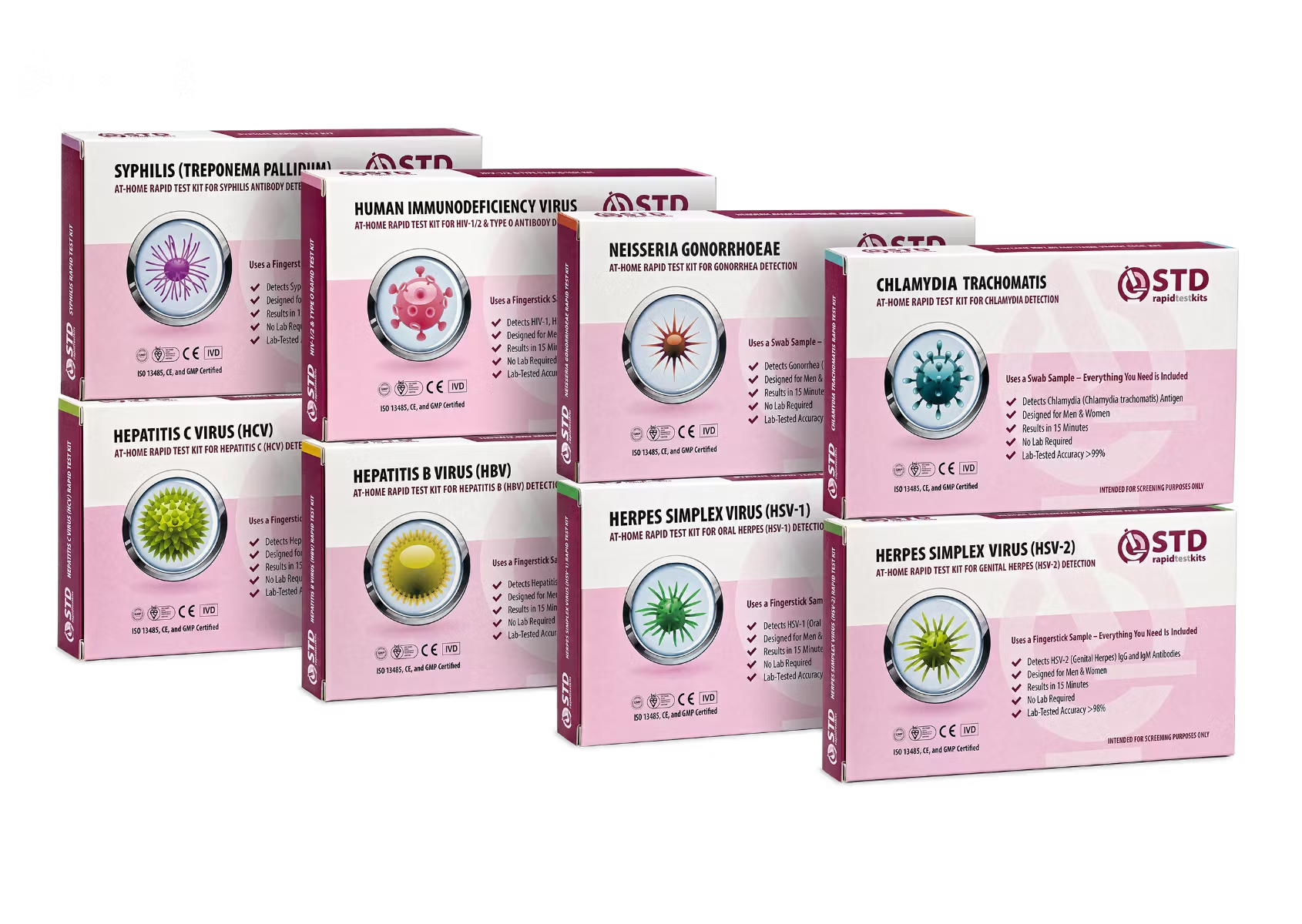
At-home rapid tests cover most of the high-frequency questions in the FWB context: chlamydia, gonorrhea, HIV, syphilis, herpes. They are lateral-flow tests, not lab NAATs, which means they are excellent screening tools and any positive result is worth confirming with a clinician. The advantage in casual setups is speed and privacy. You can test together on a weekday evening, get a result before you next see each other, and skip the waiting-room awkwardness entirely.
This article is published by stdrapidtestkits.com, which sells at-home STI testing kits. We recommend products based on fit for the reader's concern, not commercial benefit. The CTAs below are optional; many readers will leave this page knowing they do not need to test, and that is a perfectly good outcome.

How to Bring Up Testing Without Killing the Vibe
The conversation people dread is shorter and simpler than they expect. Leave out the apology and the “I know this is awkward” disclaimer entirely, and treat it as standard adult logistics, the same way you might confirm a meeting or check whether someone has eaten. The tone is what shifts it from interrogation to baseline care.
A clean version: “Quick heads-up before we go further, I test every few months and I last tested in [month]. When did you last test?” That is one sentence. It tells your partner what your normal is, gives them an easy in to share theirs, and skips the loaded framing that implies suspicion.
If the response is dodgy or defensive, that is useful information. People who handle their own sexual health responsibly are rarely thrown by the question. People who cannot answer honestly tend to tell you in their body language before they say a word. Either way, you have what you need to decide whether to keep going, slow down, or wait until you both have fresh results.
The other useful move is to test together. Order two at-home kits, run them on the same evening, swap results. It removes the asymmetry of one person “interrogating” the other and turns the conversation into a shared step, more like getting flu shots together than confessing anything.

Testing Positive Does Not Mean You Messed Up
A positive STI result is a medical finding, not a verdict on character. The most common bacterial infections, chlamydia, gonorrhea, syphilis, trichomoniasis, are curable with a short course of antibiotics. Viral infections like HSV-2 and HPV are not curable but are manageable; HSV-2 has effective antiviral suppression options and the CDC reports that most HPV infections (about 9 out of 10) clear on their own within 2 years (CDC HPV overview). HIV today is a chronic, treatable condition with antiretroviral therapy; people who maintain an undetectable viral load do not transmit HIV sexually.
Two outcomes that worry people most are also the most preventable. Persistent HPV strains that do not clear on their own are the underlying cause of most cervical cancers and a growing share of oropharyngeal cancers, which is why routine cervical screening and HPV vaccination remain important alongside testing. Untreated chlamydia or gonorrhea can cause pelvic inflammatory disease in women, which raises the risk of fertility complications later. Both outcomes are largely avoidable with early detection and treatment.
Once you have a positive result, the productive next steps are short: confirm with a clinician (especially if the positive came from a rapid screening test), complete the treatment course exactly as prescribed, avoid sex until you and any treated partners have been cleared, and notify recent partners so they can test too. Partner notification feels like the hardest part. In practice, sending a short, neutral message (“I recently tested positive for X. You may want to get tested as well.”) is enough; you do not owe anyone an emotional script.
The piece that often does more damage than the infection itself is the shame loop. Plenty of people who have tested positive for a common STI describe the days after a result as worse than the symptoms. The thing that helps most is reframing: this is a routine medical event handled by clinicians every day, not a moral problem.
Sexually transmitted infections are common, can have serious consequences if untreated, and are often asymptomatic. Most STIs are easily curable, and all are treatable. Screening can identify infections early so they can be treated.
Boundaries Belong in Casual, Too
FWB does not mean rules do not apply. It means the rules are yours to define and yours to enforce. The basic ones are not heavy: “I want to see recent test results before unprotected sex,” “I want to know if you start seeing other people,” “I expect us to retest if either of us has a new partner.” These are not relationship demands. They are health logistics.
A useful frame for the boundary conversation is to lead with what you already do, not with what you want from them. “I test every three months and use condoms with anyone I am not exclusive with” tells your partner what working with you looks like, without making it sound like an audit of their behavior. If they balk at meeting that standard, you have learned something more useful than any test result: how they handle their own responsibility.
Sex without shame is the goal. People in their twenties, thirties, forties, and beyond have casual sex; that is not new, dirty, or dangerous on its own. What makes it riskier than it has to be is the cultural framing that testing is only for people who “do too much.” Testing is healthcare. Like dental cleanings or annual physicals, it is something everyone with the relevant exposure should do on a routine schedule, regardless of how they feel that week.
Phrases that hold the line
- I test every three months and expect the same from regular partners.
- I use condoms with anyone I am not exclusive with.
- Let me know if you start seeing someone new so we can both retest.
One Last Note: You Are Not Overreacting
If your gut is telling you to test, test. If you are reading this article because something feels off, that instinct is worth listening to even before any visible symptom shows up. The cost of a negative result is one evening, one swab or fingerstick, and a small amount of money. The cost of avoiding a test for six months because you do not want to “overreact” can be much higher: continued transmission, missed treatment windows, and the kind of low-grade anxiety that sits with you until you actually know.
Casual does not have to mean careless. The same friend-with-benefits arrangement that involves real sex can also involve real adult logistics: regular testing, clear conversations, a shared idea of what protection means in your specific setup. That combination is what makes the casual part feel actually free, instead of just unexamined.
Test now for partial reassurance. Schedule a follow-up at the outer window of whichever infection concerns you most, which is up to 6 weeks for HIV and up to 12 weeks for herpes antibodies. If anything comes back positive, send a short neutral note to recent partners so they can test too, and confirm any rapid-test positive with a clinician.
FAQs
- Can someone give me an STD even if they feel totally fine?
- Yes, and this is how most STIs spread. Chlamydia, gonorrhea, HPV, and herpes are commonly asymptomatic. The CDC estimates roughly 70% of chlamydia infections in women and around half in men produce no clear symptoms, and many people with HSV-2 do not know they carry it. Feeling fine is not the same as testing negative.
- We used condoms. Why did I still test positive?
- Condoms cut the risk of fluid-borne STIs like HIV, chlamydia, and gonorrhea sharply when used correctly. They do not cover every transmission route. Herpes, HPV, and syphilis can pass through skin-to-skin contact in genital areas the condom does not cover, including the base of the penis, the vulva, the inner thighs, the scrotum, and the perineum. A positive result after consistent condom use is not unusual, especially for these three infections.
- How soon after a hookup can I test?
- For bacterial infections like chlamydia and gonorrhea, 1 to 2 weeks is usually enough for a reliable result. Blood-borne and viral infections need longer: HIV runs 2 to 6 weeks, syphilis 3 to 6 weeks, and herpes antibodies can take up to 12 weeks before they show in the blood. The practical move is to test now for partial reassurance, then again at the outer window of whichever infection concerns you most.
- Is it overkill to ask my FWB to test?
- No. The CDC recommends annual STI screening for all sexually active adults with risk factors that include multiple or new partners, which describes most FWB arrangements. Bringing it up is a baseline expectation, not a relationship escalation. A short, factual question ("when did you last test?") tends to go more smoothly than people predict.
- Can I get tested without anyone finding out?
- Yes. At-home rapid test kits are shipped in plain packaging, performed in private, and do not require a clinic appointment. Mail-in lab panels are similarly discreet. If you would rather see a clinician, federally qualified health centers and Planned Parenthood offer confidential STI screening, often on a sliding-fee scale.
- I tested positive. Am I stuck with this forever?
- Depends on the infection. Bacterial STIs (chlamydia, gonorrhea, syphilis, trichomoniasis) are curable with antibiotics. Viral infections like HSV-2 and HPV are manageable rather than curable: HSV-2 has effective suppressive therapy, and most HPV infections clear within about 2 years on their own. HIV is a chronic, treatable condition; with antiretroviral therapy and an undetectable viral load, sexual transmission is essentially eliminated.
- Will I know who I got it from?
- Often, no. Unless you have only had one recent partner and the timing matches the incubation window for the specific infection, tracing the source is rarely possible. The productive move is not assigning blame but notifying recent partners so they can test and treat as needed. Many health departments offer anonymous partner-notification services if direct contact feels difficult.
- What if I am scared to know the result?
- Fear of the result is normal, and not testing does not protect you, it just postpones knowing. Most people describe relief after testing regardless of the outcome, because a result, whatever it is, gives you something to act on. If the fear is significant, testing with a clinician (in person or by telehealth) means you have a healthcare professional to talk through next steps with the same day.
- U.S. Centers for Disease Control and Prevention. About Sexually Transmitted Infections, overview of transmission, asymptomatic infections, and screening rationale.
- U.S. Centers for Disease Control and Prevention. STI Testing Recommendations, age-based and risk-based screening cadences for chlamydia, gonorrhea, HIV, and syphilis.
- U.S. Centers for Disease Control and Prevention. Sexually Transmitted Infections Treatment Guidelines, 2021. Reference for incubation windows, treatment regimens, and asymptomatic-share estimates.
- U.S. Centers for Disease Control and Prevention. About Genital Herpes, asymptomatic transmission and the prevalence of undiagnosed HSV.
- U.S. Centers for Disease Control and Prevention. About Human Papillomavirus (HPV), natural clearance rates and cervical-cancer link.
- U.S. Centers for Disease Control and Prevention. About Trichomoniasis, prevalence and asymptomatic share of infections.
- U.S. Centers for Disease Control and Prevention. Condom Effectiveness, transmission reduction by infection type and limits of barrier protection.
- World Health Organization. Sexually Transmitted Infections Fact Sheet, global epidemiology and transmission overview.
