

Published: September 2025 | Last updated: April 2026 | Editorial review and quality control: Martina N.
A positive HPV test rarely lands at a convenient time. You might be in the parking lot of a clinic, refreshing a patient portal, or staring at a pap smear letter. Almost always, the next thought is the same: do I have to tell anyone, and if so, how?
HPV sits in a strange middle ground among sexually transmitted infections. It is not chlamydia, where a partner needs prompt antibiotics. It is not HIV, where transmission risk reshapes a relationship. It is the most common STI on the planet, often silent, often temporary, and yet still worth a calm conversation when it could affect someone else's screening, vaccination, or peace of mind.
This guide walks through who to tell, when, and exactly what to say. Scripts for hookups, new relationships, long-term partners, and exes. What to do if the response is hostile. And how to keep your own self-image intact while you do it.
How do you tell a partner you have HPV without freaking out?
Lead with calm facts, not shame. Pick a private moment, name what you tested for, mention how common it is, and invite questions. The exact words depend on the relationship: a casual hookup gets a short, low-pressure message; a long-term partner deserves a sit-down. You are allowed to script it, take time, and protect your own peace of mind in the process.
Key Takeaways
- HPV is the most common sexually transmitted infection. Most sexually active adults will encounter it at some point, and the majority of cases clear on their own within one to two years.
- Disclosure is about respect, not confession. Calm, factual scripts (matched to your relationship) consistently work better than dramatic ones.
Why HPV is uniquely hard to talk about
Other STIs announce themselves with a burning sensation, a discharge, or a rash. HPV usually does none of that. The CDC notes that most HPV infections cause no symptoms at all and clear on their own within one to two years (CDC: Genital HPV Infection). Some strains do cause genital warts. A smaller subset of high-risk strains can lead to cervical, anal, throat, or penile cancers years later.
That ambiguity is what makes the conversation hard. You are not handing a partner a prescription request. You are handing them information that is statistically almost certain to apply to them too, and asking them to care anyway.
Layered on top is the cultural baggage. Sexual-health language is often moralized, and HPV in particular gets caught in it. People who hear the word feel implicated, judged, or somehow unclean. None of that is supported by the science. A single sexual encounter, with or without a condom, is enough to transmit HPV. Long-term partners can have it for years before either notices. The diagnosis is biology, not a verdict on character.
When to bring it up
There is no single right moment, but there are patterns that work better than others. Privacy matters. Quiet timing matters. Bringing it up in the middle of a date, an argument, or already-started intimacy almost guarantees a clumsy response. Earlier is usually better, with one caveat: "earlier" does not mean a first-date interrogation.
The relationship type sets the tempo. The table below maps common situations to a workable timing pattern.
| Relationship type | Suggested timing | Why this works |
|---|---|---|
| Casual hookup or one-night stand | Short message before any next encounter, or a courtesy heads-up after if there is no future contact | Lets the other person make informed screening choices without pressure |
| New dating relationship, not yet sexual | Once intimacy becomes likely, in a private, unhurried conversation | Sets expectations and gives them space to ask questions |
| Established relationship, new diagnosis | Soon after results, in person if practical | Supports shared decisions about screening, vaccination, and care |
| Past partner you have not seen recently | A brief written message when the timing feels safe | Helps them factor it into their own screening |
Scripts that actually work
The script you reach for depends on who you are talking to. The shapes below have been adapted from patient-education resources and disclosure research. Read them out loud. Tweak the phrasing until it sounds like you. Rehearse if it helps.
Casual hookup or one-night stand
You met and hooked up, and now there is a result with no obvious next step about whether to reach out. One pattern that works:
"Hey, wanted to be straight with you. Something came up on a recent health screen. I tested positive for HPV. It is one of the most common things to come back on a screen, often clears on its own, and there is no urgent treatment, but I figured you might want to know so you can factor it into your own check-ups or vaccine timing. No pressure to respond."
It is short, blame-free, and offers an exit. It also leaves the door open for a question if they have one.
New relationship (under a few months)
This one feels higher stakes because feelings are starting to attach. The temptation is to over-explain, or to bury the lead until later. Both are worse than a calm, direct sentence.
"Before this goes further, I want to share something from a recent screening. I came back positive for HPV. It is super common, often temporary, and usually does not need treatment, but I wanted you to know because I care about being open with you. Happy to talk through it whenever you want."
The framing leads with care, not crisis. If this person values you, the maturity of the disclosure tends to land harder than the diagnosis.
Long-term partner
This script tends to come with the most fear, because both of you may interpret a positive result as evidence of betrayal. It is worth saying explicitly that HPV does not work that way. The virus can stay in either person's body for years before being detected, and there is usually no way to pin down when it entered the picture.
"My recent results came back positive for HPV. It is a high-risk type, which mostly means it gets monitored more closely, not that it is an emergency. From what I have read, this could have been in either of us for a long time without symptoms. I want us to talk about it openly, decide on screening together, and not let it become something we avoid."
The point is collaboration. You are inviting your partner into a problem you can manage together.
An ex or a past partner
This is where the conversation feels most awkward. There is no way to know whether the infection came from them, you passed it to them, or neither, and you do not need to figure it out before sending the message.
"This is a slightly weird message to send, but I wanted to flag something from a recent health check. I tested positive for HPV. It is super common and usually clears on its own, but I figured you would want to know so you can factor it into your own screenings. Hope you are doing well."
Short, respectful, and closes the loop. You have done your part regardless of whether they reply.
When the response is silence or blame
People do not always react the way you hope. Some go quiet. Some get angry. Some say something cruel because they are scared and do not know how else to process it. None of that is your responsibility to absorb.
If the conversation tilts toward verbal abuse, you are allowed to leave it. You can revisit the conversation later, or not at all, depending on whether the relationship is one you want to continue investing in. Returning to a difficult talk after a cool-down is reasonable; absorbing ongoing cruelty is not.
"I am sharing this because I respect you, not because I did something wrong. HPV is incredibly common, often silent for years, and impossible to trace to a single source. I expect to be treated with the same care I am offering you."
HPV does not mean reckless
The most persistent myth that sabotages HPV conversations is the idea that infection signals a high partner count or careless behavior. The CDC's data does not support that framing. Most sexually active adults will encounter HPV at some point in their lives, often from a single partner over a single encounter (CDC: Genital HPV Infection). Condoms reduce risk but do not eliminate it, because HPV transmits through skin-to-skin contact in areas a condom does not always cover.
If a partner reaches for the recklessness framing, it is usually a signal that they are scared and reaching for the script the culture handed them. The table below catalogs the myths most likely to surface in these conversations and the evidence-based reality next to each one.
| Common myth | What the evidence actually says |
|---|---|
| Only people with many partners get HPV | A single sexual encounter is enough to transmit HPV, even with consistent condom use |
| A positive HPV result means someone cheated | HPV can stay dormant in either partner for years before showing on a test |
| There is no point telling someone if there is no cure | Disclosure shapes a partner's vaccination timing, screening cadence, and informed consent |
| Only people with cervixes need to worry | HPV can cause anal, throat, and penile cancers in any-gender populations |
| Once it clears, you are immune | Different HPV strains can be acquired separately; clearance of one strain is not protection against others |
If you have visible genital warts
Visible warts are usually caused by low-risk HPV types like 6 and 11, the same strains targeted by the standard nine-valent HPV vaccine. They do not lead to cancer, but they do tend to feel more exposing because they are visible.
If sex is on the table, transparency about visible symptoms protects both of you. Honest framing tends to defuse the visual surprise. Treatment options exist (topical therapies, in-clinic procedures), and many cases also resolve on their own as the immune system clears the underlying infection. If a partner walks away because of a treatable skin condition, that is information about them, not a comment on your worth.
"I have a few small warts right now. They are from a low-risk strain of HPV that does not cause cancer, and I am working with a clinician on managing them. I wanted you to know before we go further."
How to do this face to face
Some partners deserve the in-person version of the conversation. Long-term relationships, especially. Texting a long-term partner about a new STI diagnosis tends to feel evasive, even when that is not the intent.
A four-step shape helps:
- Set the frame. "I want to share something with you because I care about being honest with you."
- Name it calmly. "My recent screening came back positive for HPV. It is one of the high-risk types, which mostly means I monitor it more closely."
- Offer one or two facts, not a lecture. "It is super common, often clears on its own, and usually does not need treatment unless symptoms show up."
- Invite their reaction. "I am happy to answer questions or look anything up together. It is okay if you need time to think."
Pauses are welcome, and so are tears from either side. The goal is not a perfect monologue. It is an honest conversation that ends with both of you knowing where you stand.

Vaccination, screening, and the conversation that follows
Disclosure often opens a follow-up conversation about prevention. Worth knowing for that conversation:
- The HPV vaccine (Gardasil 9) protects against nine HPV types, including the high-risk strains most associated with cervical, anal, and throat cancers and the low-risk strains that cause most genital warts.
- The Advisory Committee on Immunization Practices recommends routine HPV vaccination through age 26. Adults aged 27 to 45 are eligible through a process called shared clinical decision-making with their provider (CDC: HPV Vaccine Recommendations).
- Vaccination after a known infection still has value, because the vaccine protects against types you have not yet encountered.
- Cervical screening (pap and HPV co-testing) is the primary tool for catching high-risk HPV before it causes cellular changes (WHO: Cervical Cancer).
If your partner is eligible for vaccination and has not had it, the disclosure conversation is a natural place to bring it up. If you are due for a follow-up screening, the same applies.
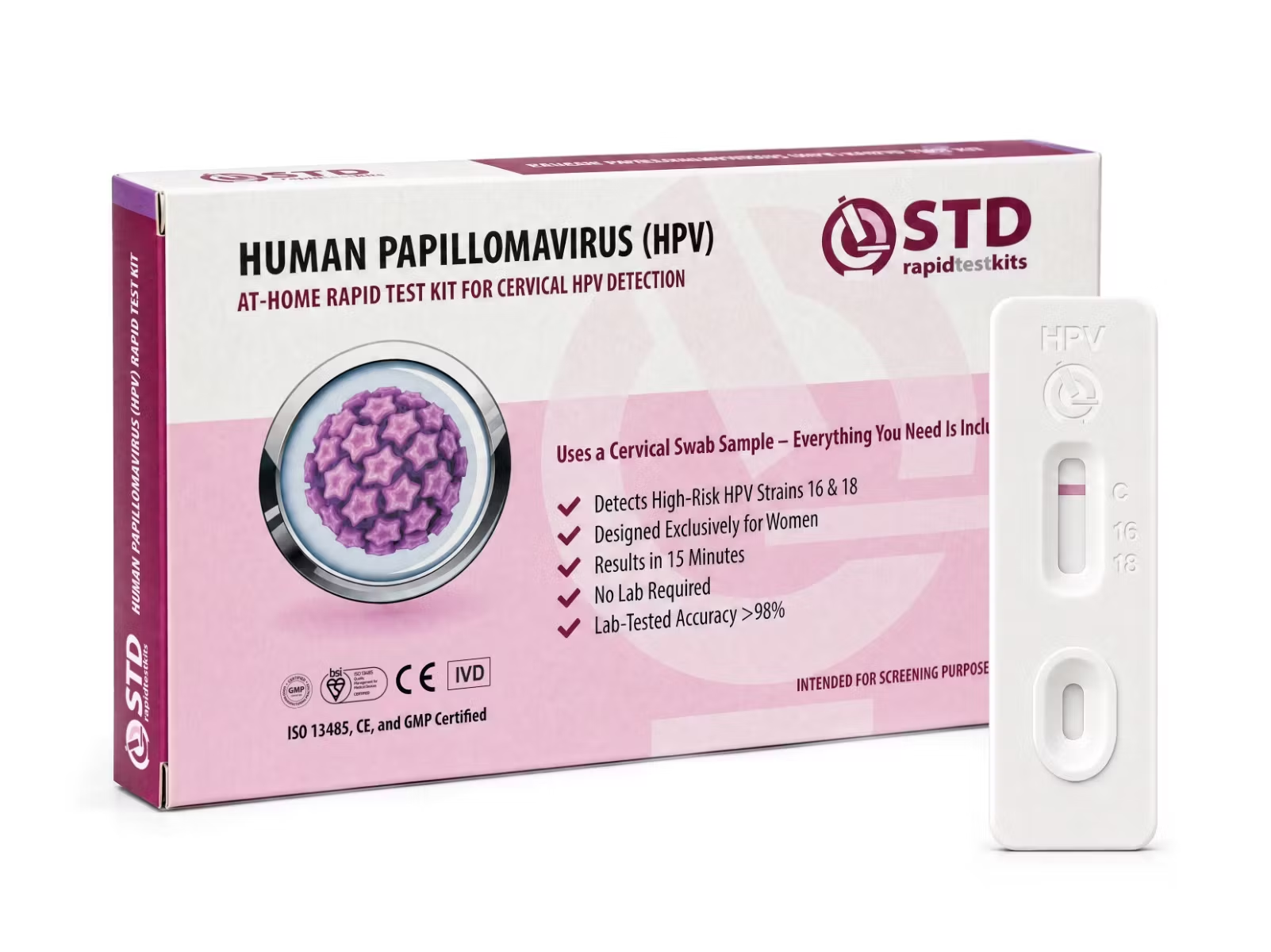
Our at-home HPV swab kit is validated for vaginal self-swab and is therefore for women only. There is currently no FDA-cleared at-home HPV test for people without a cervix; testing for HPV-related concerns in this group means seeing a clinician, who can perform anal or oral swabs when symptoms or risk factors warrant.
stdrapidtestkits.com is a retailer of at-home STI tests; product links in this article go to items we sell.
Handling questions you cannot answer
You may get asked things like "did you give this to me?" or "will I get cancer?" or "does this mean condoms are useless?" You do not need a perfect answer. You are not auditioning to be a clinician.
A useful sentence to keep in your back pocket:
"I am not totally sure, but I can look it up with you."
That single phrase validates curiosity, invites collaboration, and takes the pressure off you to perform expertise. Mayo Clinic and the NHS both have plain-language HPV pages that hold up well in the middle of an emotional conversation (Mayo Clinic: HPV Infection; NHS: HPV). Keep the links handy and pull them up together if the conversation calls for facts neither of you can confidently recall.
Curiosity tends to soften fear. The temperature drops once both people understand that HPV is common, often temporary, and managed through routine care rather than crisis intervention.
Anyone who is sexually active can get HPV, even if you have had sex with only one person. You also can develop symptoms years after having sex with someone who is infected, making it hard to know when you first became infected.
After the conversation
Whether it went well or not, you turned a silent topic into a real one. That is the part you can be proud of, and it is the part the relationship will remember even if the immediate response was awkward.
Concrete next steps that often follow a successful disclosure:
- Test together if it makes sense. If your partner has not been screened recently, this is a natural moment to do it together.
- Talk vaccination. Especially if either of you is under 45 and unvaccinated.
- Set a screening cadence. Pap and HPV co-testing intervals follow professional guidelines, not anxiety. Your provider can help.
- Decide on protection language. Condoms still reduce risk for most STIs. Skin-to-skin viruses are the exception, but condoms remain useful for everything else.
And if the conversation did not land well, give yourself credit for the part that was yours: showing up honestly.
A relationship in which honesty is punished is one worth re-evaluating regardless of the diagnosis that prompted the talk. Give yourself a few days before deciding whether to re-engage. The clarity that comes after the initial reaction often points toward whether the relationship is worth continuing to invest in.
HPV is biology, not character
HPV does not erase your desirability or define your character. It signals that you have encountered a virus that almost every sexually active adult will encounter at some point, and bodies meeting viruses is ordinary biology rather than a moral event. The fact that this particular virus carries cultural weight is a problem with the culture, not with the body that detected it.
People date with HPV every day. People build long marriages with HPV. People have great sex lives, get vaccinated, get screened, and never develop a single symptom from a positive test. That is the ordinary path, not the exceptional one.
The honest, calm conversation you are about to have is the version of disclosure that most reduces stigma. It also tends to be the version that strengthens, rather than ends, relationships worth keeping. If a quiet at-home screen would help you feel more grounded before or after the conversation, the broader rapid-test panel below covers the most commonly co-screened STIs in one kit, for any-gender use.

Frequently asked questions
- Do I have to tell a partner I have HPV?
- Most jurisdictions do not legally require HPV disclosure the way they require HIV disclosure in some states. But ethically, telling a sexual partner before sex respects their right to make informed choices about their own screening, vaccination, and sexual health. Casual partners get a courtesy heads-up. Long-term partners deserve a real conversation.
- What if I already had sex with this person before I knew?
- That is a common situation, since HPV often goes undetected for years. A short, blame-free message after the fact works well: "I just learned from a recent screening that I have HPV. Wanted you to know in case it affects your own check-ups." You did not withhold information you did not have.
- Will my partner definitely get HPV from me?
- No. Transmission depends on the specific HPV strain, the type of contact, and immune-system factors. Many exposed partners clear the virus before symptoms ever appear. Condoms reduce but do not eliminate risk because HPV transmits through skin-to-skin contact. The HPV vaccine adds further protection if your partner has not had it.
- How long does HPV stay in your body?
- For most people, the immune system resolves HPV without treatment within roughly two years. Persistent high-risk strains warrant ongoing cervical screening rather than alarm; clearance happens silently for the majority. A negative result later does not make you immune, since you can encounter different HPV types in the future.
- Can I get the HPV vaccine after a positive result?
- Yes, in many cases. The HPV vaccine (Gardasil 9) protects against nine strains. A positive result for one strain does not change the vaccine's value for the other eight. The CDC recommends routine vaccination through age 26 and shared clinical decision-making for adults 27 through 45.
- Is there an HPV home test for men?
- Not in the U.S. consumer market. There is no FDA-cleared at-home HPV test for people without a cervix. Routine HPV screening is not part of standard preventive care for cisgender men. Visible warts or unusual symptoms warrant a clinician visit, where anal or oral swabs can be performed when risk factors warrant.
- Can I pass HPV without any symptoms?
- Yes. HPV is often most transmissible during silent (asymptomatic) periods. Most people who pass HPV to a partner did not know they had it. This is part of why prevention strategies focus on vaccination and routine screening rather than symptom-watching.
- What if my partner tells me they already have HPV?
- A common reply, given how widespread the virus is. Even when both partners have been exposed, you can pick up different strains from each other, so both vaccination status and follow-up screening remain worth discussing. The disclosure conversation often becomes a shared planning conversation from there.
- U.S. Centers for Disease Control and Prevention. Genital HPV Infection Fact Sheet. General prevalence, transmission, clearance, and partner-history information used throughout this article.
- U.S. Centers for Disease Control and Prevention. HPV Vaccine Recommendations (clinical considerations). Source for ACIP routine vaccination through age 26 and shared clinical decision-making 27 to 45.
- Mayo Clinic. HPV Infection: Symptoms and Causes. Patient-facing overview of HPV symptoms, risk factors, and treatment options.
- UK National Health Service. Human Papillomavirus (HPV). Public-health overview including transmission and the UK cervical-screening program.
- World Health Organization. Cervical Cancer Fact Sheet. Global context on HPV-associated cervical cancer prevention through vaccination and screening.
- National Library of Medicine, MedlinePlus. HPV. NIH consumer-health summary covering HPV basics, testing, and prevention.
