
Published: December 2025 | Last updated: May 2026 | Editorial review and quality control: Martina N.
Looking at a herpes rapid test cassette and trying to read what the lines mean is one of the more anxious moments in at-home health testing. The instructions feel rushed. The bathroom lighting is wrong. The faint line might be real, might be a shadow, might be your imagination. This guide walks through what each pattern on the cassette actually means, when a result is trustworthy, when it is not, and exactly what to do next, without the panic spiral.
The reassurance to start with: most worry around home herpes test reading comes from misunderstanding the timing window, the control line rule, or the meaning of a faint result. None of those require guessing. Each has a clear answer.
Key Takeaways
- A faint test line that appears within the kit's reading window is a positive result. Line darkness does not measure how infected someone is, it simply means antibodies were detected.
- Most HSV IgG antibodies become detectable between three and twelve weeks after exposure, so testing too early is the single most common reason for a false-negative herpes home result.
The Moment You See the Lines
Most at-home HSV rapid tests use a lateral-flow design. A drop of blood from a fingerstick moves across a chemically treated strip and reacts to antibodies, typically HSV-1 IgG or HSV-2 IgG, if they are present. The cassette has two reading zones: a control area and a test area. Both matter, and they do not mean the same thing.
The control line tells you the test ran correctly. It is not a result line. If no control line appears within the instructed window, the test is invalid, no matter what shows up next to it. You repeat with a new kit.
If the control line appears and a test line appears within the reading window (usually 10 to 15 minutes depending on the kit), that is a positive result. Even a faint test line counts. Faint means antibodies were detected at lower levels, not that the result is half-real. The detection threshold is binary: the strip either captures enough antibody to produce a visible line, or it does not. Per the U.S. Centers for Disease Control and Prevention's overview of genital herpes, type-specific antibody testing is one of the standard approaches when no active lesion is available to swab.
What people often confuse with a faint positive is an evaporation line, which can appear after the reading window has closed. Those gray, ghost-like streaks form as the strip dries unevenly. They are not reactive lines and are not diagnostic.
| What You See | What It Means | What To Do Next |
|---|---|---|
| Control line only | Negative result (no detectable HSV antibodies) | If exposure was recent, retest after the window period |
| Control line plus clear test line | Positive result | Confirm with a lab-based type-specific IgG test |
| Control line plus faint test line | Positive result | Confirm with a lab-based type-specific IgG test |
| No control line | Invalid test | Repeat with a new kit, following instructions exactly |
Why Timing Can Change Everything
A herpes rapid test does not detect the virus itself. It detects the antibodies your immune system produces in response to HSV exposure. That distinction matters because antibody production takes time, and the gap between exposure and a reliable result is what the literature calls the window period.
For most people, HSV IgG antibodies become detectable somewhere between three and twelve weeks after infection. The CDC's 2021 STI Treatment Guidelines for genital herpes recommend retesting 12 weeks after the presumed time of acquisition when a recent exposure is suspected, because sensitivity is reduced at earlier stages of infection. Test before antibodies have reached detectable levels and the cassette can read negative even though infection is present. This is the single most common cause of a false-negative home herpes test.
The practical version: a negative result two weeks after a possible exposure is not the same as a negative result twelve weeks out. The earlier number reflects the limit of antibody detection, not the absence of infection. Symptoms in that early window, such as tingling, itching, or anxiety-amplified skin sensations, are not reliable diagnostic signals on their own. Visible lesions can be swabbed for HSV PCR, which is a different and more direct test, but a rapid antibody cassette is not measuring that.
| Time Since Exposure | Likelihood of Detectable IgG | Recommended Action |
|---|---|---|
| Under 2 weeks | Low | Wait and retest later |
| 3 to 6 weeks | Moderate | Testing possible, plan to retest at 12 weeks if negative |
| 12+ weeks | High accuracy | Ideal testing window for an antibody-based test |
Is a faint line on a herpes home test positive?
Yes. If a faint test line appears alongside a visible control line within the kit's instructed reading window (usually 10 to 15 minutes), the result is read as positive. Line darkness does not measure infection severity; it simply reflects antibody concentration at the moment of testing. Confirm any positive rapid result with a lab-based type-specific IgG test.
Common Mistakes That Skew Home Herpes Test Results
Most invalid or confusing herpes rapid results are not caused by faulty kits. They are caused by humans testing under stress, in bad lighting, with rushed reading. Lateral-flow chemistry is precise but unforgiving, and small procedural errors change how the lines appear.
The single most frequent mistake is reading the cassette outside the instructed window. If the kit specifies a 15-minute read, that means at 15 minutes, not at five (line not fully developed yet) and not at 45 (evaporation lines may now appear). After the window closes, the strip continues to dry, and gray streaks can mimic a faint positive. The result is no longer interpretable.
Storage matters more than people expect. A kit that sat in a hot mailbox in summer or froze in a cold porch in winter may have damaged reagents inside. That can produce a weak control line, a no-show control line, or inconsistent test-line behavior. The fix is procedural: store kits at room temperature, away from direct sunlight, and check expiration dates before use.
An absent control line carries no diagnostic information. It does not lean positive or negative. It means the lateral-flow reaction did not run to completion, and the only valid response is to repeat with a fresh kit, paying close attention to blood-sample volume, buffer drops, and timing.
| User Mistake | What Happens | How to Prevent It |
|---|---|---|
| Reading too early | Test line may not have fully developed | Wait the full instructed time before interpreting |
| Reading too late | Evaporation lines can appear and mimic a positive | Only interpret the result inside the reading window |
| Insufficient blood sample | Weak or missing control line | Follow blood-collection steps exactly, use enough sample |
| Improper storage | Damaged reagents, invalid results | Store at room temperature, check the expiration date |
IgG vs IgM: Why Some Results Cause Confusion
Two antibody types come up when people start researching herpes testing online: IgG and IgM. The simplest framing is that reputable home herpes tests detect IgG, and there is a clear clinical reason for that.
IgG antibodies develop more slowly after infection but remain in the body long term. That makes them a reliable signal of past or established HSV infection. IgM antibodies appear sooner but are far less specific. They cross-react with other viruses in the herpes family and produce a meaningful rate of false positives, which is why the CDC's 2021 STI Treatment Guidelines explicitly do not recommend IgM testing for routine herpes diagnosis in adults.
So if a home HSV-1 or HSV-2 test is IgG-based, it is the appropriate format for determining whether the immune system has developed antibodies. What it does not tell you is when infection occurred, how severe the infection is, or how often outbreaks will happen. A positive IgG result reflects that the immune system has recognized HSV. It does not date that recognition. Infection acquired years ago is detected the same way as an infection acquired three months ago.
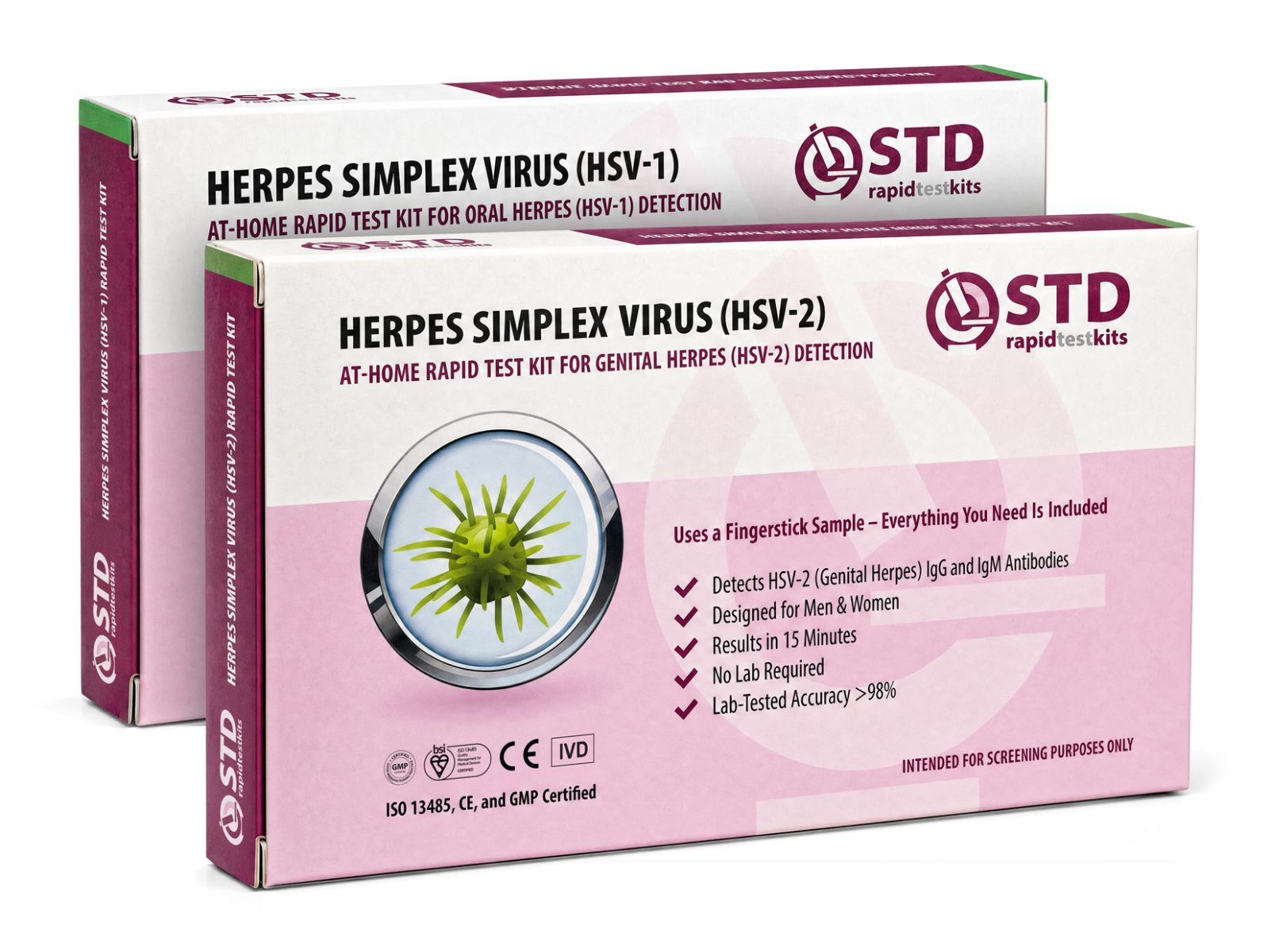
Quick disclosure: stdrapidtestkits.com sells rapid at-home IgG blood antibody tests for HSV-1 and HSV-2; the kit linked directly below is the one relevant to this section, and we recommend products based on fit-for-purpose for the reader's concern, not commercial benefit.
How Accurate Are Home Herpes Tests, Really?
Accuracy of a rapid antibody test depends on three variables: the assay's design, timing relative to exposure, and how carefully the kit is used. IgG-based rapid lateral-flow tests generally report high specificity, meaning false positives are relatively uncommon when the test is run correctly inside the reading window. Sensitivity improves substantially after the full antibody window has passed, which is why testing at twelve weeks or later gives the most trustworthy negative result.
A few important framings: rapid lateral-flow tests are screening tools, not laboratory NAAT or PCR assays. They are useful for confirming antibody presence at home, but a positive rapid result is meant to trigger a confirmatory lab-based type-specific IgG test, especially in someone with no prior history of HSV.
False positives are rarer than false negatives, but they can occur, particularly in people with autoimmune conditions or cross-reactive antibodies. Confirmatory testing is standard practice in every clinical antibody workflow, and reflects how the broader screening system is designed.
The Emotional Aftermath Is Real, But It Is Not Medicine
The minutes after reading a herpes rapid test result can feel physically overwhelming. Chest tightens. Thoughts speed up. Conversations that have not happened yet start playing on loop. Those reactions are about stigma, not biology.
The medical reality is calmer than the cultural reality. According to the World Health Organization's herpes simplex virus fact sheet, HSV-1 affects roughly 64% of the global population under age 50, and HSV-2 affects an estimated 13% of people aged 15 to 49 worldwide. Most carry HSV without dramatic outbreaks. Many never know they have it. None of that translates well in the moment a faint line appears, but the prevalence math is worth holding in the background.
A positive result is information about antibodies, not a verdict on intimacy or partnership. The immediate next step is confirmatory lab testing.
An estimated 3.8 billion people under age 50 (64%) globally have HSV-1 infection, and an estimated 520 million people aged 15 to 49 (13%) worldwide have HSV-2 infection.
Talking to a Partner Without Shame
This part scares people more than the test itself. A confirmed positive result can feel like it demands immediate disclosure before processing has happened, but it does not.
Breathe first. Confirm the result with a lab-based type-specific IgG test before starting any partner conversation, and gather information about transmission risk, antiviral options, and risk reduction first. There is no clock on disclosure, and rushing it before confirmation often means delivering uncertain information to someone who will then carry that uncertainty with you.
Couples navigate HSV successfully with three tools: daily or episodic antiviral therapy, condom use, and consistent communication about prodromal symptoms or active outbreaks. The NHS overview of genital herpes notes that daily suppressive antiviral therapy reduces outbreak frequency, and the CDC's 2021 STI Treatment Guidelines describe daily suppressive valacyclovir as reducing the rate of HSV-2 transmission in serodiscordant heterosexual partnerships, though not eliminating it. Most partners respond with more compassion than the panic phase predicts. If a partner does not, that response is information too, and it is information about the partner, not about HSV.

If Your Result Is Positive, Negative, or Invalid
The three outcomes from a herpes rapid test each have a different next step, and treating them all the same way is where most panic creeps in.
Positive (control plus test line, faint or clear): The next step is confirmatory testing through a lab-based type-specific IgG assay, which can also distinguish HSV-1 from HSV-2 and provide an index value clinicians use to interpret borderline cases. Standard medical guidance, including Mayo Clinic's guidance on diagnosing genital herpes, recommends confirming a positive screening result before starting any treatment conversation.
Negative (control line only): Context matters. If the test was taken within two weeks of a possible exposure, the immune system may not yet have produced detectable antibodies. Mark the exposure date on a calendar and retest at twelve weeks for the most reliable negative. If it has been twelve weeks or longer since the last possible exposure and the result is negative, that is considered highly reliable for IgG-based testing.
Invalid (no control line): Repeat with a new kit. Follow the blood-collection, buffer-application, and timing steps carefully. Invalid results are about test mechanics, not about infection status. They contain no information either direction.
| Your Result | Immediate Step | Follow-Up Plan |
|---|---|---|
| Positive | Stay calm, schedule confirmatory type-specific IgG lab testing | Discuss antiviral options with a clinician if confirmed |
| Negative (under 12 weeks since exposure) | Note exposure date, do not assume all-clear yet | Retest at the 12-week mark |
| Negative (12+ weeks since exposure) | Result is reliable for IgG-based testing | Retest only after a new exposure event |
| Invalid (no control line) | Repeat with a new kit | Follow collection and timing steps carefully |
Retesting Strategy That Actually Makes Sense
Retesting is about precision, not paranoia. If the first test happened less than three weeks after potential exposure, schedule a second one closer to twelve weeks so IgG antibodies have time to reach detectable levels. If the result was invalid, the retest should happen as soon as a fresh kit is available, with extra attention to procedural steps.
If a positive result was confirmed and antiviral therapy was started, retesting is generally not useful. Antibodies remain in the body long term, and a repeat antibody test will not turn negative. Once IgG seroconversion has happened, the test pattern is established. Treatment decisions move to symptom management, transmission reduction, and partner communication, rather than chasing a new test result.
A new possible exposure event resets the clock for that exposure. The window period is counted from the most recent event, not the cumulative history. Each new exposure starts its own twelve-week timeline, and ongoing risk assessment follows the most recent event.

Frequently Asked Questions
- Is a faint line on a herpes home test actually positive?
- The line looks faint, but the chemistry behaves as a yes-or-no signal. The strip either captured enough antibody to produce a visible line, or it did not. Both faint and clear test lines count as positive when they appear within the reading window. Follow up with a lab-based type-specific IgG test before drawing any conclusions about treatment or disclosure.
- What if I checked the test too late and now I see something?
- If a line appeared after the reading window closed, treat it as unreadable, neither positive nor negative. Repeat with a new kit, set a timer, and read at exactly the instructed minute. The first kit's chemistry still ran; you simply lost the interpretable window for it.
- I tested negative but I feel tingling, did the test miss something?
- Tingling on its own is not a diagnosis. Stress can amplify normal nerve sensations, especially while waiting on test results. If the test was taken under two weeks after possible exposure, the body may not have produced detectable IgG antibodies yet, so a retest at twelve weeks is the right next step. If visible lesions develop, those can be swabbed for HSV PCR, which is a different and more direct test.
- Can a herpes rapid test be wrong?
- Any antibody test has limits. False negatives are most common when testing too soon, before IgG levels are detectable. False positives are less common but can happen, particularly with autoimmune conditions or cross-reactive antibodies. That is the entire reason confirmatory lab testing exists after a positive rapid result.
- If a herpes test is positive, does that mean I just got herpes?
- Not necessarily. IgG antibody tests do not date the infection. A positive result means the immune system has recognized HSV at some point. That could be weeks, months, or years ago. Many people acquire HSV without noticing symptoms and only learn about it when they test.
- There is no control line on the cassette, did I mess it up?
- An absent control line means the lateral-flow reaction did not run correctly. Common causes are insufficient blood volume, buffer not absorbed correctly, an expired kit, or temperature damage during storage. Repeat with a new kit, follow the steps carefully, and the next test should run as expected. An invalid test contains no diagnostic information; it is a procedural do-over.
- If I am negative at 12 weeks, can I stop worrying?
- Yes. A negative IgG-based result at twelve weeks or more after the last possible exposure is considered highly reliable. That is the testing window in which most people who would seroconvert already have. Continuing to retest the same exposure event past that point rarely changes the answer.
- Why does any of this feel so overwhelming?
- Because cultural stigma is loud and sex education often skips the nuance. HSV is medically common, manageable with antivirals, and often asymptomatic. If a rapid test is positive, the next concrete step is a confirmatory lab test, not a judgment about who you are.
You Deserve Answers, Not Assumptions
Most of the panic around a herpes rapid test is not really about the virus. It is about the stories attached to it: shame, imagined rejection, the “what does this say about me” spiral. A test result does not answer those questions. It only answers the much smaller, much more answerable question of whether HSV antibodies were detected at the moment of testing.
If the result is positive, the immune system recognized something, and the next step is confirmation through a lab. If the result is negative and the test happened inside the window period, the next step is retesting at twelve weeks. If the result is invalid, the next step is repeating with a new kit. None of those outcomes change the workflow: positive means confirm with a lab, negative inside the window means retest at 12 weeks, invalid means repeat with a fresh kit.
If retesting privately is the better fit, the HSV-1 and HSV-2 Rapid Test Kit is designed to be used on a schedule the user controls, with results in roughly 15 minutes.
How we sourced this article: This guide was developed using current medical guidance from the U.S. Centers for Disease Control and Prevention, the World Health Organization, the U.K. National Health Service, and Mayo Clinic, along with the 2021 CDC STI Treatment Guidelines for genital herpes. It is editorial summary, not personalized clinical advice. For symptoms that concern you or a confirmed positive result, see a licensed clinician.
- U.S. Centers for Disease Control and Prevention. About genital herpes, including transmission, testing, and clinical overview.
- U.S. Centers for Disease Control and Prevention. 2021 STI Treatment Guidelines: Genital Herpes, including the 12-week retesting recommendation, the recommendation against routine IgM testing, and the role of daily suppressive valacyclovir in reducing HSV-2 transmission.
- World Health Organization. Herpes simplex virus fact sheet with global prevalence statistics for HSV-1 and HSV-2.
- U.K. National Health Service. Genital herpes overview, including symptoms, transmission, and the role of suppressive antiviral therapy in reducing outbreak frequency.
- Mayo Clinic. Genital herpes diagnosis and treatment, including the role of confirmatory type-specific antibody testing.
