Published: December 2025 | Last updated: May 2026 | Editorial review and quality control: Martina N.
Was my negative gonorrhea test wrong?
Possibly. At-home rapid tests for gonorrhea report 85% to 95% sensitivity and specificity above 97%. Most false negatives come from testing too early (before day 7 to 14), poor swab technique, or an infection in the throat or rectum a genital kit cannot reach. Retest at day 14, or see a clinic for a lab NAAT.
A negative result feels like a green light. Symptoms ease, anxiety drops, and life moves on. Then a partner gets diagnosed, or the burning comes back, or a follow-up clinic test flips the verdict. Suddenly the question is the same one a lot of people quietly google at 2 a.m.: how reliable was that home test, really?
At-home rapid gonorrhea kits can return useful, accurate answers when they are used correctly and at the right point in time. They can also miss real infections, and the reasons are knowable. This guide walks through every common cause of a false negative, what to do when symptoms outlast the result, and how at-home rapid testing fits alongside (not in place of) clinic-based laboratory testing.
Key Takeaways
- Most false-negative at-home gonorrhea results trace back to one of three causes: testing before day 14 from exposure, an infection in the throat or rectum where a genital swab kit cannot reach, or a co-infection (most often chlamydia) that single-target rapid tests do not screen for.
- If a negative result conflicts with persistent symptoms or a partner's positive, the right next move is a 14-day retest plus a clinic-administered NAAT at the site that was actually exposed, not another rapid test taken sooner.
How at-home rapid gonorrhea tests actually work
An at-home rapid gonorrhea test is a lateral-flow immunoassay. The same chemistry that powers a rapid COVID test or a home pregnancy test, applied to a different target. You collect a sample (a self-swab for our kit, or first-catch urine for some other brands), drop it onto the cassette, and antibodies fixed inside the strip bind to surface proteins from Neisseria gonorrhoeae. If enough bacterial antigen is present, a colored line appears next to the control line within 10 to 20 minutes.
Laboratory testing uses a different technology entirely. The current diagnostic standard is the nucleic acid amplification test, or NAAT, which detects fragments of bacterial DNA rather than whole proteins and amplifies them millions of times so even a low-level infection registers (CDC, gonococcal infection treatment guidelines). NAAT is the lab method clinicians order through public-health labs and commercial diagnostics chains. It is more analytically sensitive than any home rapid test currently sold for self-use.
This matters for one practical reason: a home lateral-flow result and a lab NAAT result are answering related questions with different precision. The home test is fast, private, and useful for screening within its labeled window. The lab NAAT is the confirmation tool, especially when a result conflicts with what the body is telling you.
Lateral-flow rapid: detects bacterial surface proteins (antigens). Fast, private, useful for screening within the right window. Laboratory NAAT: amplifies bacterial DNA millions of times to flag even low-level infection. The lab test is more analytically sensitive and is the appropriate confirmation tool when a home result conflicts with symptoms.
What sensitivity, specificity, and accuracy really mean
The numbers on a product page can feel reassuring without being informative. Three terms keep coming up, and they each measure something different.
Sensitivity is the share of genuinely infected people the test correctly flags as positive. A test with 90% sensitivity misses 1 in 10 actual infections. Specificity is the share of genuinely uninfected people it correctly flags as negative. A test with 99% specificity wrongly alarms 1 in 100 people who are clean. Accuracy as a single number combines both, but it hides which kind of error is more common, so clinicians and regulators avoid using it alone.
Manufacturer validation studies for rapid gonorrhea antigen tests typically report sensitivity in the 85% to 95% range and specificity above 97% (see the at-home gonorrhea kit product page for the specific figures tied to the kit we sell). Those figures come from controlled studies with trained sample collectors, fresh samples, and strict timing. Real-world home use sits somewhere lower because the conditions are messier.
| Metric | What it answers | Typical range, at-home rapid (manufacturer validation) |
|---|---|---|
| Sensitivity | Of all people who are infected, what share does the test correctly catch? | 85% to 95% |
| Specificity | Of all people who are not infected, what share does the test correctly clear? | 97% to 99% |
| Real-world accuracy | Both of the above, in lived testing conditions outside a lab | Generally lower than validation figures |
Why timing changes everything
The single most common cause of a false negative is testing too soon. After exposure, gonorrhea goes through an incubation period: bacteria multiply at the infection site, but bacterial-protein levels are not yet high enough for a rapid test to register. Symptoms usually start around 2 weeks after infection, and they sometimes do not appear for months, if at all (NHS gonorrhoea overview).
For at-home antigen-detection tests, the practical reliable-detection window is roughly 7 to 14 days after exposure. Testing on day 2 or day 3 may feel decisive, but the result is closer to a snapshot of how things stand right now than a verdict on whether you were infected. The bacterial load is simply not high enough yet.
People who tested at day 5 or 6 and felt relief sometimes describe the same trajectory: the test reads negative, days pass, symptoms creep back in or get worse, and a clinic swab confirms the infection that the early home test missed. The test was not broken. The biology had not caught up.
| Days since exposure | Likelihood of accurate detection | What to do |
|---|---|---|
| 1 to 4 days | Low. Bacterial protein not yet at detectable levels. | Wait. If symptoms are severe, see a clinic for a NAAT instead of testing at home. |
| 5 to 10 days | Moderate. Some early infections detectable. | Possible to test, but plan a 14-day retest regardless of result. |
| 11 to 14 days and beyond | High. Standard reliable window for at-home rapid testing. | Best window for a meaningful at-home result. |
The user errors that quietly sabotage results
Even with perfect timing, the test depends on a sample that actually contains enough bacteria to register. Sample collection is where most home users introduce error. The instructions can feel pedantic, and the steps that get skipped are usually the ones that matter most.
The most common mistakes: an external swab pass when the kit calls for an internal vaginal or urethral collection, a swab not held in place long enough to load fully, urine collected mid-stream when first-catch was specified, samples that sit on a counter for an hour before the strip is dropped in, and reading the cassette outside the labeled window (most kits read between 10 and 20 minutes, with anything before or after producing unreliable results).
One pattern shows up repeatedly in user-reported false negatives: the test was taken at a moment of high stress (after a hookup, after a partner's diagnosis, late at night), the instructions were skimmed, the strip was checked early, and the result was filed as negative without a follow-up. The test did its job. The conditions did not.
The fix is simple and feels almost clerical. Read the instructions twice. Set a timer. Wash hands. Treat the test as a small clinical procedure rather than a quick check.
If symptoms are severe, painful, or worsening, do not wait on a home retest. A clinic-administered NAAT can detect lower bacterial levels and is the right tool for early or symptomatic infection. Use the home rapid test for screening and follow-up, not as the deciding answer when something feels acutely wrong.
What that faint line probably means
One of the most-googled cassette questions: there is a faint second line, but it is so light you cannot tell if it is real. Is that positive, negative, or a smudge?
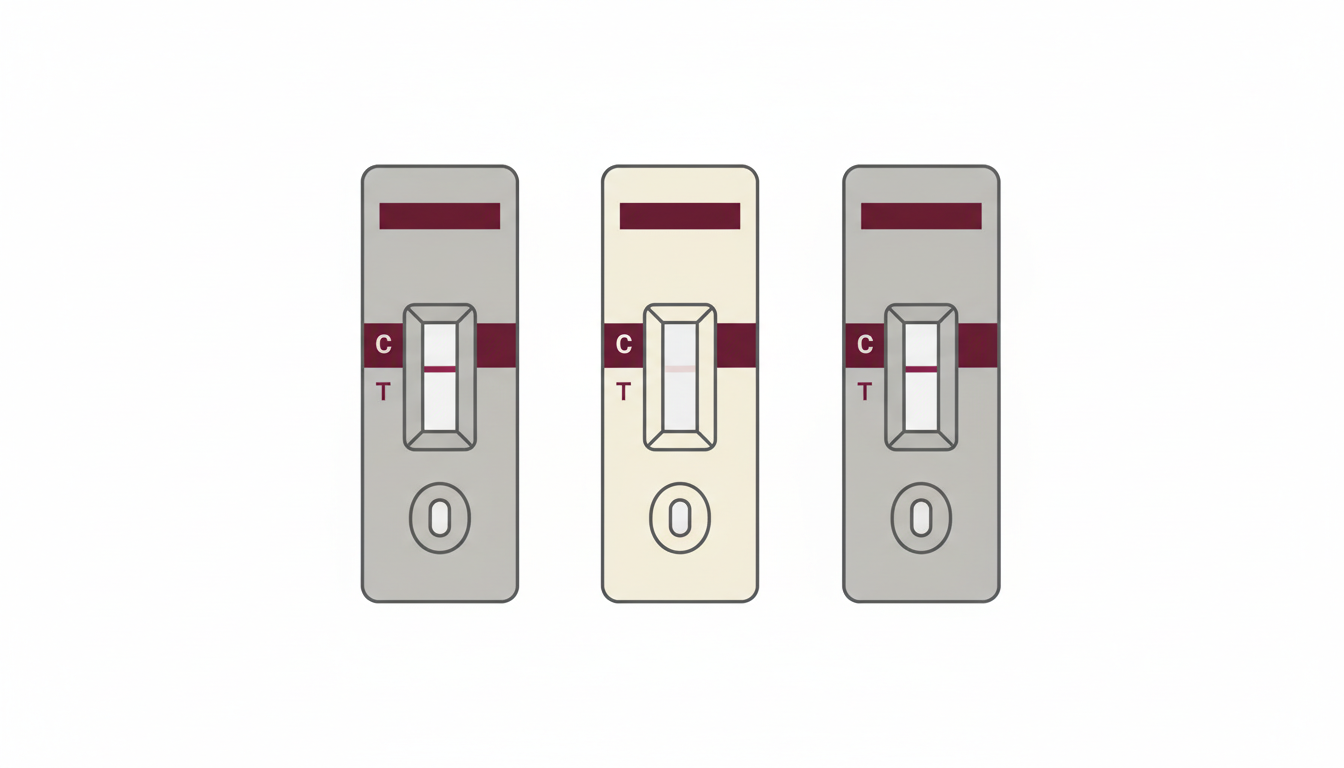
Manufacturer labeling is usually clear on this point. Any visible line at the test region within the labeled read window is a positive result. The intensity of the line reflects how much bacterial antigen was present in the sample, not how serious the infection is. A faint line on a sample collected at day 8 of a real infection looks different from a darker line on the same person at day 14. Both are positive.
Lines that appear after the read window has closed are a different category. Drying artifacts, evaporation marks, and ghost lines can show up after 25 or 30 minutes, and they are not valid results. The rule of thumb: the only line that counts is the one that appeared inside the window printed on the kit instructions. If yours appeared in time, treat it as positive and confirm with a laboratory test.
The sample-site problem: why genital kits miss throat and rectal infections
Here is one of the most consequential limits of at-home gonorrhea testing, and it is also one of the least discussed. Neisseria gonorrhoeae can colonize the cervix or urethra, but it can also colonize the throat (after oral sex) and the rectum (after receptive anal sex). These are called extragenital sites, and the majority of pharyngeal infections are asymptomatic (CDC gonococcal treatment guidelines).
An at-home rapid test that asks for a self-collected genital swab cannot detect a pharyngeal or rectal infection. The bacteria are simply not at the sample site. Someone who tests negative on a home genital kit but had an oral or anal exposure may still be carrying the infection at the site that was actually exposed. The scale of this gap is well documented: urine-only screening misses 83% of infections among men who have sex with men, which is why site-specific sampling is the standard recommendation for any anatomical site involved in the exposure (American Family Physician summary of CDC guidance).
We do not sell pharyngeal swab kits or rectal swab kits. Our genital rapid tests are accurate for the site they sample. For exposures that involved the throat or rectum, the right tool is a clinic visit where a clinician can collect site-specific swabs that go to a lab for NAAT testing.
If your exposure was strictly genital and the test technique was sound, a negative result at day 14 is meaningful. If the exposure included oral or anal contact, a negative genital home test does not rule infection out at those other sites.
Genital (cervix, urethra): at-home rapid lateral-flow swab is appropriate within the day 7 to 14 window. Pharyngeal (throat after oral sex): clinic-collected throat swab processed by laboratory NAAT. We do not sell this kit. Rectal (after receptive anal sex): clinic-collected rectal swab processed by laboratory NAAT. We do not sell this kit.
Co-infections: when the test caught one thing and missed another
Gonorrhea and chlamydia travel together more often than people realize. Public-health surveillance consistently shows that a substantial share of people diagnosed with one of the two carries the other at the same time, and U.S. clinical guidance routinely recommends treating for chlamydia alongside gonorrhea when chlamydia has not been excluded, because the overlap is high enough to make empirical co-treatment the safer default in many settings (CDC treatment guidelines).
Practically, this means the symptoms a person attributes to gonorrhea (burning urination, unusual discharge, pelvic discomfort) might actually be chlamydia, or might be both. A single-target gonorrhea rapid test is doing exactly what it advertises, and missing the other infection in the room. The result reads negative for gonorrhea, the symptoms persist, and the reader assumes the test is broken when in fact the symptoms had a different cause all along.
The same overlap pattern shows up with trichomoniasis (in women), urinary tract infections, and bacterial vaginosis. All can produce symptoms in the discharge-and-burning family, and none of them register on a gonorrhea-specific kit. If symptoms continue after a clean gonorrhea result, the next move is a broader at-home STI panel or a clinic screen, not a repeat of the same single-target test. We publish this guide and also sell at-home rapid lateral-flow kits for gonorrhea and chlamydia; we suggest tests by fit for your concern, not commercial benefit.

When to retest, and what to retest with
Retesting is not paranoia. It is the standard public-health move when an early or borderline result needs confirming. CDC guidance recommends retesting in several specific situations: when symptoms persist after a negative result, when the original test fell inside the early window period, when a partner has tested positive, when the original sample collection may have been compromised, and routinely 3 months after treatment to check for reinfection (CDC clinical retesting recommendations).
The retest does not have to be the same test. In fact, when a home rapid result conflicts with symptoms, the more useful confirmation is a laboratory NAAT through a clinic. NAAT detects bacterial DNA rather than protein, so it can flag infections at lower levels and across more anatomic sites when paired with site-appropriate sample collection.
A reasonable timeline when something feels off after an at-home negative: retest at home around day 14 to 21 from exposure, and book a clinic NAAT (or a telehealth-ordered mail-in NAAT) for the same window. The two together are more decisive than either alone. If you have started antibiotics for any other reason between the first test and the retest, mention it to the clinician, because antibiotic exposure can suppress the bacterial signal without fully clearing the infection.
Retesting timelines also matter after a positive result and a course of treatment. For genital infections, the CDC's three-month rescreen is the workhorse recommendation. For pharyngeal infections, an earlier test-of-cure is sometimes ordered because throat infections clear less reliably than genital ones (American Family Physician). The table below summarizes the common scenarios.
| Scenario | Retest timing | Why it matters |
|---|---|---|
| Standard treatment, genital site | About 3 months later | Catches reinfection, the most common cause of repeat positives within a year. |
| Pharyngeal (throat) infection | 7 to 14 days post-treatment | Throat infections clear less reliably; a test-of-cure confirms it is gone. |
| Symptoms persist after treatment | 2 to 3 weeks later | Rules out treatment failure or a resistant strain. |
| Partner not yet treated | After partner completes treatment, plus 2 weeks | Avoids ping-pong reinfection from an untreated partner. |
What to do if a later test flips to positive
Some readers land here after a sequence that already happened: home rapid said negative, a clinic test flipped positive a few weeks later, and the question now is what to do next. The answer is straightforward, even if the feeling is not.
Gonorrhea is curable. Standard treatment is a single intramuscular dose of ceftriaxone, paired with oral doxycycline if chlamydia has not been ruled out (CDC gonococcal treatment guidelines). The antibiotic course is short, the cure rate is high, and most strains in the U.S. still respond to first-line treatment, although antibiotic resistance is a serious and growing problem that public-health agencies watch closely (WHO gonorrhea fact sheet). Untreated gonorrhea can ascend to cause pelvic inflammatory disease in women, which carries long-term risks of chronic pelvic pain, ectopic pregnancy, and infertility, so prompt treatment matters beyond resolving the immediate symptoms.
Three things matter after a positive: complete the prescribed treatment, notify recent sexual partners (typically anyone from the past 60 days) so they can test and treat, and retest 3 months later to confirm you have not been reinfected. Partner notification can feel like the hardest part. Most U.S. health departments offer confidential partner-notification services, and many states permit expedited partner therapy, where a clinician can prescribe treatment for your partners so they are covered even if a face-to-face conversation is not workable.
None of this is failure on your part. False negatives happen, the biology of the test is what it is, and the right response is the practical one.
Any person who has a positive test for chlamydia or gonorrhea, along with women who have a positive test for trichomonas, should be rescreened 3 months after treatment.
When to trust a negative result, and when to retest
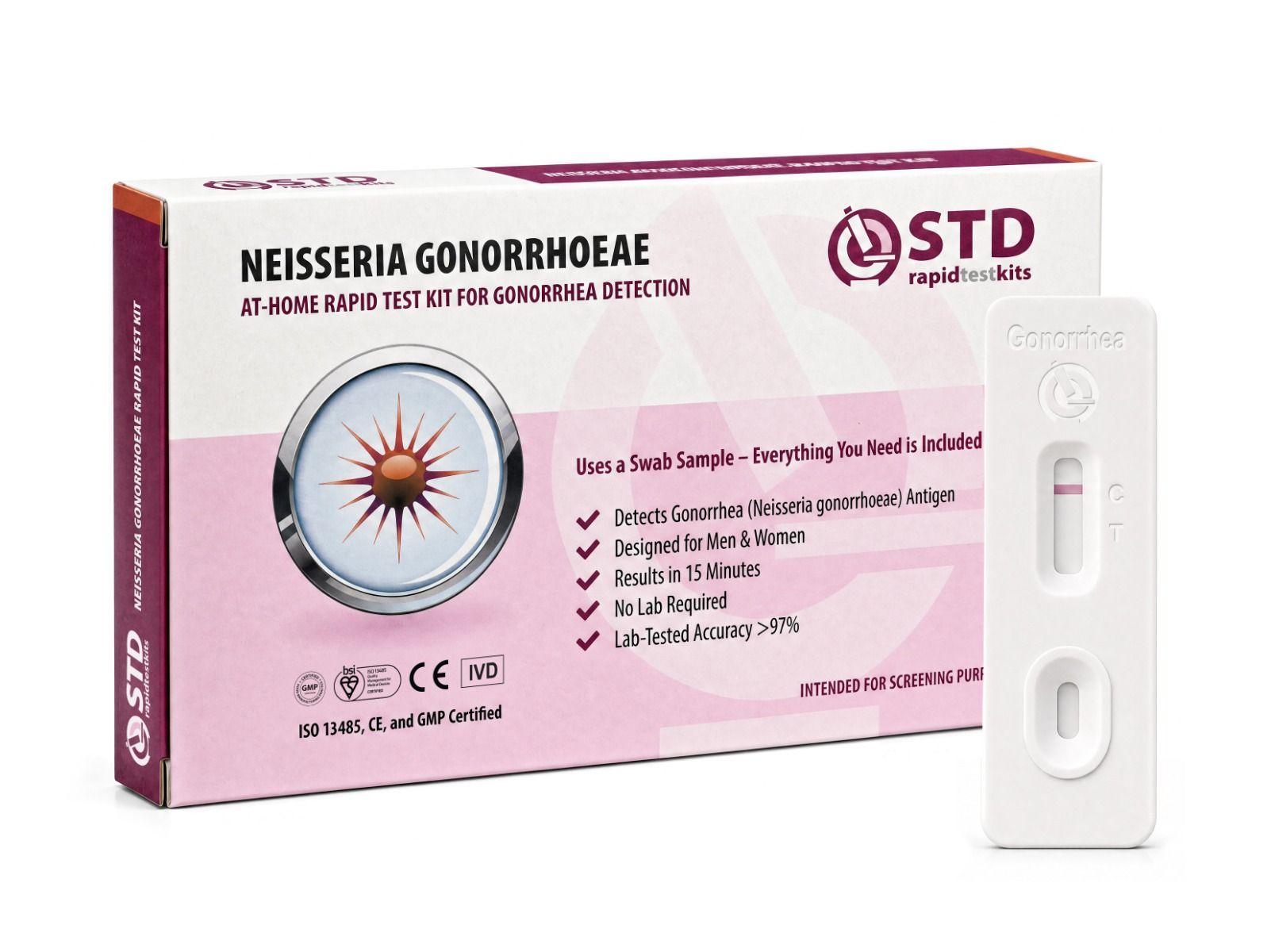
An at-home rapid gonorrhea test is a useful tool. Within its labeled conditions (correct timing, careful sample collection, infection at the genital site the kit covers), it gives a meaningful answer in about 15 minutes from a private bathroom. Outside those conditions, its accuracy drops and a confirming laboratory NAAT becomes the better next step.
If your result was negative but something still feels off, the path is clear: respect the window period and retest at day 14 or later, broaden the screen to include chlamydia if the symptoms could be either, get a clinic NAAT if the exposure included oral or anal contact, and trust your symptoms over a single strip. A clinic NAAT and a second at-home retest together resolve most ambiguous results within two to three weeks. The quick walkthrough below maps your own situation to the right next move.
Should you retest after a negative gonorrhea result?
Did you take the test before day 14 after the exposure?
Yes: The negative may be too early to trust. Retest at day 14 or later; the bacterial load a rapid test needs is often not present in the first one to two weeks.
Did the exposure involve oral or anal contact?
Yes: A genital home swab cannot reach a throat or rectal infection. Book a clinic for a site-specific swab processed by laboratory NAAT, since a clean genital result does not clear those sites.
Do symptoms persist, or did a partner test positive, after a correctly timed genital test?
Yes: Confirm with a clinic NAAT and broaden the screen to chlamydia, the most common co-infection, which a gonorrhea-only kit cannot detect.
No: A negative taken at day 14 or later, with correct technique at a genital exposure site, is a reliable screen. Routine rescreening still applies after any new partner.
Guidance only. A clinician can advise based on your specific exposure and symptoms.
Frequently asked questions
- How long after sex should I wait to test for gonorrhea at home?
- For an at-home lateral-flow rapid test, wait at least 7 days after exposure, with day 14 being the more reliable mark. Testing earlier produces frequent false negatives because bacterial protein levels are not yet detectable. If symptoms are severe before day 7, see a clinic for a NAAT rather than testing at home.
- What does a faint line on a gonorrhea rapid test mean?
- Treat it as a positive. Line intensity reflects how much antigen was in the sample, not how serious the infection is, so even a barely visible second line that appears within the kit's 10- to 20-minute read window is a valid positive result. Any line that shows up after the window closes is an evaporation artifact and does not count. Confirm any home positive with a clinic NAAT before starting treatment.
- Can I have gonorrhea and feel fine?
- Yes. A meaningful share of gonorrhea infections produce no symptoms at all, especially in the cervix, throat, or rectum. Asymptomatic infection is one reason routine screening is recommended for sexually active people in higher-risk groups. A negative test from someone with no symptoms is not the same thing as confirmation of no infection if the sample site or timing was wrong.
- Does an at-home gonorrhea test catch throat or rectal infections?
- No. Standard at-home rapid kits, including the ones we sell, sample the genital site. Pharyngeal (throat) and rectal infections need site-specific swabs collected by a clinician and processed by a lab. If your exposure included oral or anal contact, a negative genital home result does not rule out infection at those other sites.
- Why did I test negative when my partner tested positive?
- The most likely reasons are timing (you may have tested before bacterial levels were detectable), sample collection technique, or an infection at a site your home kit does not sample. Mismatched results between partners rarely mean anyone is hiding the truth. The fix is to align the retest: both partners retest at day 14 or later, and the at-risk anatomical sites get sampled, with a clinic NAAT if oral or anal exposure was involved.
- Will gonorrhea go away on its own if I leave it alone?
- Rarely. Some immune systems do clear it, but most do not, and untreated gonorrhea can cause pelvic inflammatory disease, infertility, epididymitis, and (rarely) disseminated gonococcal infection. Waiting it out is not a sound strategy. If a retest is positive, treatment is short, effective, and worth the visit.
- If I test positive, what is the treatment?
- A single intramuscular ceftriaxone shot, usually given at a clinic or urgent-care visit. If chlamydia has not been excluded, oral doxycycline is added to the regimen. Notify anyone you had sex with in the past 60 days so they can test and treat, then plan a retest 3 months later. Reinfection from an untreated partner is the single most common reason for a repeat positive within a year.
- Can a recent course of antibiotics affect my test result?
- Yes. Antibiotics taken for any reason in the days before testing can suppress bacterial levels enough to dodge detection without fully clearing the infection. If you have been on antibiotics recently, mention it to a clinician and plan a retest at least two weeks after the course ends. Do not assume the original course cleared an unconfirmed gonorrhea infection.
- U.S. Centers for Disease Control and Prevention. Gonorrhea overview, transmission, symptoms, and screening recommendations.
- U.S. Centers for Disease Control and Prevention. STI Treatment Guidelines: Gonococcal Infections Among Adolescents and Adults, including NAAT diagnosis, ceftriaxone treatment, doxycycline co-treatment, and extragenital infection guidance.
- U.S. Centers for Disease Control and Prevention. STI Treatment Guidelines: clinical retesting after treatment, including the three-month rescreen recommendation.
- World Health Organization. Gonorrhoea (Neisseria gonorrhoeae infection) fact sheet, global epidemiology, antimicrobial resistance, and asymptomatic presentation.
- U.K. National Health Service. Gonorrhoea symptoms, incubation period, and testing information.
- American Family Physician. Chlamydial and gonococcal infections: screening, treatment, and follow-up, including site-specific sampling and pharyngeal test-of-cure timing.
