
Published: November 2025 | Last updated: May 2026 | Editorial review and quality control: Martina N.
Asking a partner to get tested for STIs sits in an awkward gray zone for most couples. It can sound clinical, accusatory, or like an interruption to the rest of the night. It does not have to. Done with the right framing, an STD testing date night can feel less like a medical errand and more like a quiet, shared act of care. The goal of this guide is to give you the actual steps: how to bring it up, which test format to use, when in the timeline to test so the result is meaningful, and what to do if the conversation, or the result, goes sideways.
This is a practical playbook, not a sales pitch. Some readers will want to test together at home; others will be better served by a clinic visit. Both are valid. Either way, the same principles apply: lead with care, get the timing right, and keep the experience private.
Key Takeaways
- Frame testing as mutual care, not investigation. The same conversation lands very differently depending on whether you treat it as a shared decision or a demand for proof.
- Window periods matter. Testing too soon after exposure can produce a false negative; for most common STIs, waiting roughly 2 weeks for swab tests and 3 to 12 weeks for blood tests gives a more reliable result.
Testing Together Builds Trust, Not Suspicion
Wanting to know your partner’s STI status is not a sign you distrust them. It signals that you take your own health seriously and that you are willing to have an honest conversation about a part of life that most of us were taught to talk around. According to the U.S. Centers for Disease Control and Prevention, many STIs cause no symptoms at all, so testing is the only way for either of you to actually know your status (CDC: Getting Tested for STIs). That fact alone reframes the conversation: testing is not about catching a partner out, it is about getting reliable information neither of you can collect any other way.
The shift from “Have you been tested?” (interrogative) to “Want to do this together?” (collaborative) is small in language and large in tone. The first version puts your partner on the defensive. The second invites them into a decision. The information you both walk away with is identical; the path you took to get there shapes whether the rest of the relationship gets easier or tenser.
How to Bring It Up Without Killing the Mood
Most awkward STI conversations get awkward because the timing is off. If you raise it in the middle of physical intimacy, the conversation feels like a brake. If you raise it the morning after, it can feel accusatory. The conversations that go best tend to happen in flat moments: over dinner, on a walk, during planning a weekend, or by text earlier in the day.
A working script: “I’ve been thinking about us getting tested before things go further. Want to do it together one evening this week?” That sentence does three things at once. It centers the relationship (“us”), names the action (“get tested”), and proposes a shared time (“together one evening”). There is no accusation, no demand for history, and no diagnostic framing.
If you’re writing this as a text rather than saying it in person, keep it short and warm. Long messages tend to read as defensive. Short messages tend to read as confident. Confidence in the asking is what makes saying yes feel as easy as agreeing to dinner plans.
- Casual evening: “Before things go further, I want us both to get tested together. Could we make a night of it this week?”
- Earlier in the day, by text: “Idea: pick a night this week, order takeout, and do at-home STI tests together. Down for it?”
- If they hesitate: “It’s not about anyone’s history. It’s about both of us starting from a clear baseline.”
Match the script to how you usually talk to each other. The point is to make it feel ordinary, not loaded.
Choose the Right Kind of Test for the Night
The right test format depends on what you’re trying to learn and how soon you need an answer. At-home rapid lateral-flow tests give a result in roughly 15 minutes and require no clinic visit. Mail-in lab kits use the same self-collected sample but are processed at a lab, which adds a few days to the turnaround in exchange for higher analytical sensitivity. Clinic visits are the right choice when symptoms are present, when a particular sample type (a throat or rectal swab, for example) is needed, or when follow-up confirmation is the next step.
For a relaxed, at-home testing evening, rapid lateral-flow kits are the format that fits the format. They are quiet, private, and self-paced. The trade-off is that lateral-flow chemistry is generally less sensitive than the laboratory NAAT (nucleic acid amplification test) used by clinics; a positive home result is worth confirming with a lab test, and a negative home result close to the start of the window period may need to be repeated.
| Testing Method | Privacy | Speed | Best For |
|---|---|---|---|
| At-Home Rapid Lateral-Flow Test | Very High | Result in roughly 15 minutes | Couples testing together at home, post-window-period screening, anxiety relief |
| Mail-In Lab Kit | High | 1 to 5 days after the lab receives the sample | Comprehensive screening, asymptomatic checks, when higher analytical sensitivity matters |
| Clinic Visit | Moderate | Same-day rapid options to about a week for some labs | Active symptoms, specific sample types (throat, rectal), follow-up confirmation, treatment access |
Get the Timing Right (Or You’ll Get a False Negative)
The single most common mistake couples make is testing too soon after the encounter they are worried about. Every STI has a window period: the gap between exposure and the moment a test can reliably detect infection. Test inside that window and the result can come back negative even when infection is present. The CDC recommends testing after appropriate exposure windows, with the specific timing varying by infection; readers should consult the infection-specific fact sheets from the CDC or the NHS for precise per-infection numbers. The table below summarizes the practical ranges drawn from those public guidelines.
If your test night is being scheduled around a specific recent encounter, count forward from that date. If you’re testing as part of routine relationship hygiene with no specific exposure in mind, the timing question matters much less; pick an evening that suits both of you.
| STI | Sample Type at Home | Earliest Reliable Test | More Reliable Window |
|---|---|---|---|
| Chlamydia | Genital swab | About 7 days post-exposure | 14 days or more |
| Gonorrhea | Genital swab | About 5 to 7 days | 14 days or more |
| Syphilis | Fingerstick blood | About 3 weeks | 6 to 12 weeks |
| HIV (4th-generation antigen/antibody) | Fingerstick blood | About 18 to 45 days, kit-dependent | After 45 days; antibody-only tests need longer |
| HSV-2 (antibody) | Fingerstick blood | About 3 weeks | 6 to 12 weeks (outliers to 16 weeks) |
| Trichomoniasis | Vaginal swab (women) | About 7 to 10 days | 14 to 28 days |
From Health Task to Connection Moment
Once timing and format are settled, the experience itself can be much warmer than the “medical” framing suggests. The blocks are simple: a quiet space, the kits laid out, the instruction sheet read together, the wait. Most lateral-flow tests deliver a readable line in 10 to 20 minutes; that wait is not dead time. It is, in the literal sense, the first conversation you’re having about what comes next.
Couples who do this well often report that the night felt closer than they expected. Part of that is biology (shared anticipation creates connection), and part of it is meaning. You both showed up. You both said yes to the same plan. That signal tends to register at a level that words don’t reach.
None of this requires choreography. Soft lighting helps. So does music. So does food that does not require attention. The simpler the setup, the easier it is to repeat the next time.
Most people with an STI do not know they have one. Many sexually transmitted infections have no symptoms or only mild symptoms, so testing is the only way to know if you have one.
What If a Result Comes Back Positive?
Sometimes a test does come back positive, and a relationship has to absorb that. A reactive result on an at-home rapid test counts as a screening signal that needs lab confirmation through a clinician before it qualifies as a diagnosis. The CDC’s STI Treatment Guidelines describe the standard confirmatory and treatment paths for each infection, and they are written for clinicians but accessible to motivated readers (CDC STI Treatment Guidelines).
Many STIs can be present for months or years without symptoms, which means a test taken today may reflect an exposure that predates the current relationship by months or longer. Treating a reactive result as either a confirmed diagnosis or as proof of recent infidelity skips over both of those facts. The most useful response is the same one that produces good outcomes in any health context: confirm the result, get treatment if it’s indicated, and notify recent partners so they can do the same. Most bacterial STIs (chlamydia, gonorrhea, syphilis, trichomoniasis) are curable with antibiotics. Viral STIs (HIV, herpes, HPV, hepatitis B and C) are managed long-term with effective treatments and, in some cases, suppressive therapy that meaningfully reduces transmission risk.
- Confirm with a clinician. A reactive at-home result is a screening signal; a clinic-administered lab test (NAAT, RPR, or confirmatory antibody) is what produces a diagnosis.
- Start treatment if indicated. Bacterial STIs are usually cleared with a single course of antibiotics; viral STIs are managed long-term with established protocols.
- Notify recent partners. Anonymous partner-notification services exist in most regions if direct contact is difficult.
Plan to Retest, Plan to Talk About It Again
Testing once is good. Building a regular cadence is better. The right frequency depends on the relationship structure: if both partners have tested negative and the relationship is exclusive with no new exposures, repeat testing rarely changes the result. For everything else, including new partners, non-monogamy, or any specific concerning exposure, every 3 to 6 months is a defensible default. Planned Parenthood’s STI screening guidance is a useful reference point for what “routine” looks like for different risk profiles.
The conversation is easier the second time. Once both partners have done it once, scheduling another test night becomes a logistics question rather than a relationship question. Tying it to a quarterly anniversary, a vacation, or the start of a new chapter (a move, a milestone) gives the cadence a built-in trigger that doesn’t require either of you to start the conversation cold.
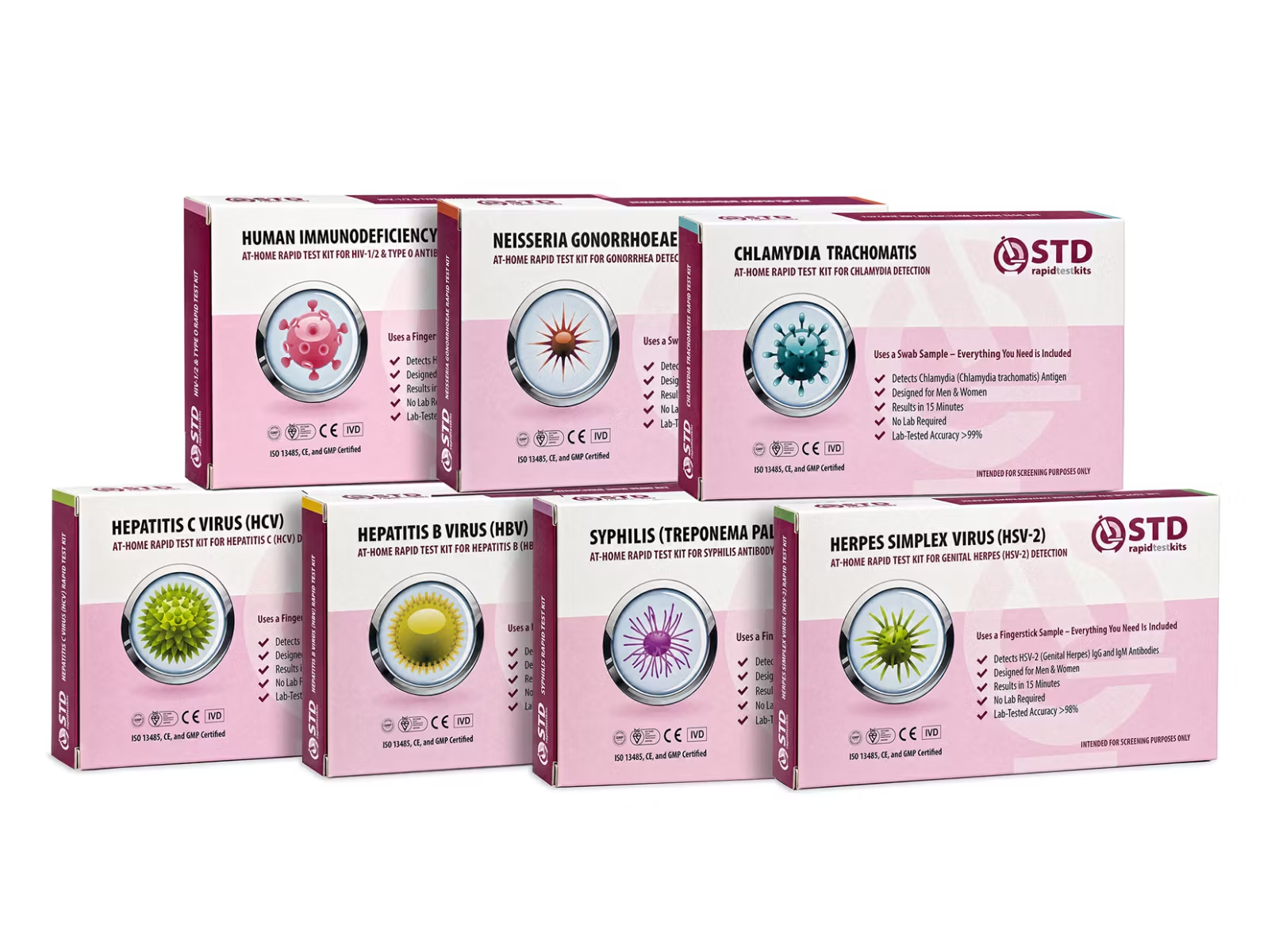
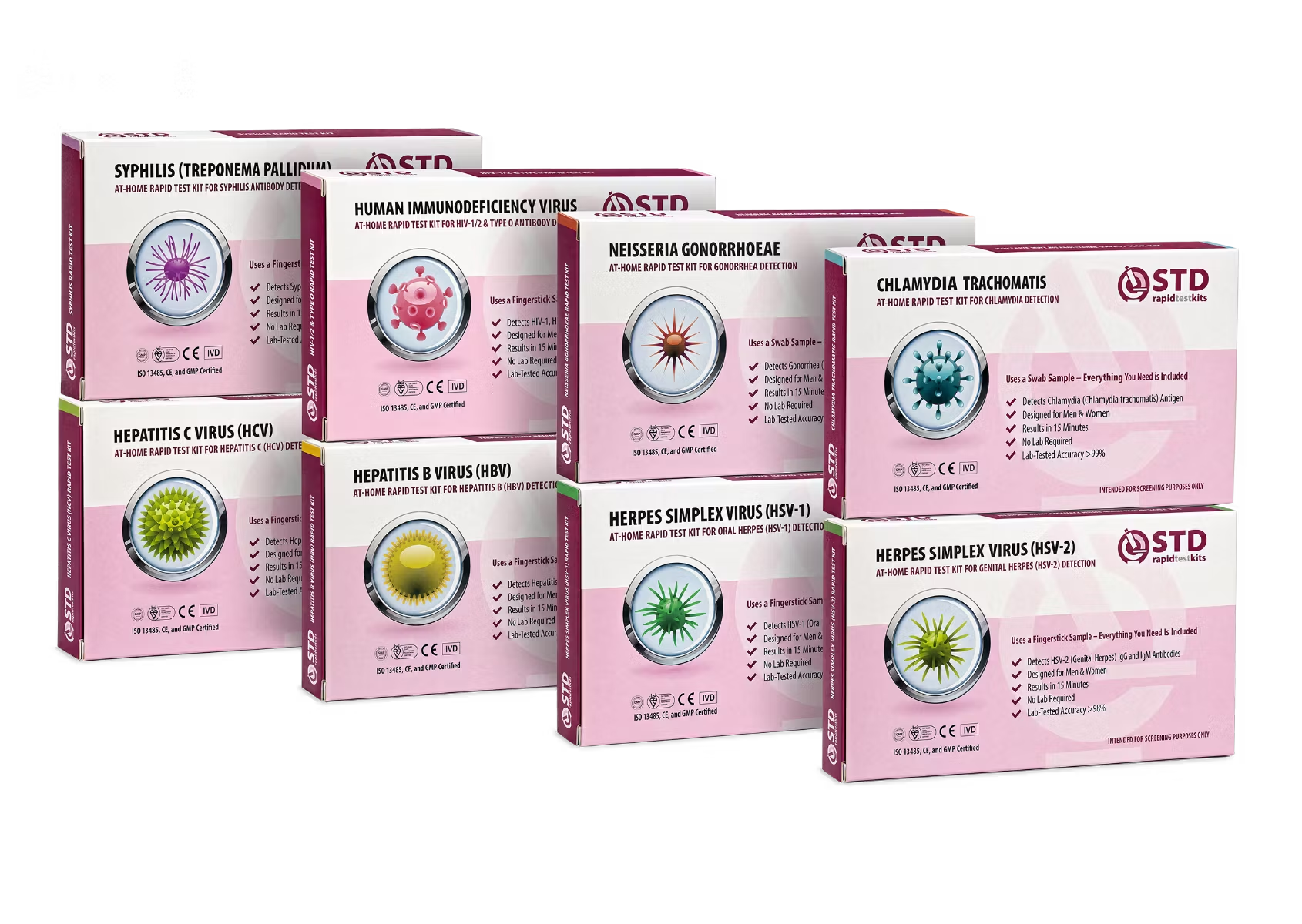
A note on the product mentions that follow: stdrapidtestkits.com publishes this article and sells at-home rapid kits, and the panels described below are recommended for fit-for-purpose against the use case in this guide rather than for commercial weighting.
- Exclusive, both partners tested negative, no new exposures: only when something changes (new partner, condom-break event, symptoms).
- New relationship, or partners outside of an exclusive arrangement: every 3 to 6 months.
- After a specific concerning exposure: count forward from the exposure date through the relevant window period, test, and retest at the end of the longer window for blood-based infections.
Why Privacy Makes At-Home Testing Easier
The other big advantage of testing together at home is that nobody else has to be in the room. There is no front-desk staff, no insurance code on a statement, no shared waiting area. For people who live with roommates, family, or in environments where sexual-health visits feel exposing, that privacy is what makes the test happen at all.
Discreet shipping is part of the same idea. Test kits arrive in plain outer packaging without external branding, and what each of you does with the result stays between you. If a follow-up clinic visit becomes necessary, that visit can happen on your own schedule, and what either of you shares with the other afterward is a conversation rather than a disclosure obligation imposed by the testing process.
The practical effect is that the test gets done in the calmest, most controlled circumstances either of you have available. Stress and rushed handling are two of the more common ways at-home tests produce ambiguous results; a relaxed setting genuinely improves accuracy.
- Plain outer packaging on delivery; no clinic, lab, or brand markings visible to roommates or housemates.
- No insurance claim, no medical-record line item, no electronic health-record entry from the kit itself.
- Sample collection and result reading happen entirely at home; you choose if and when to share the result with a clinician or your partner.
- Follow-up confirmation through a clinician remains available on your own timeline if a result is reactive.
If Your Partner Says No
Sometimes the conversation does not go where you hoped. A partner can react to the suggestion of testing with humor, deflection, defensiveness, or refusal. None of those reactions on their own prove anything. People who have had bad experiences with healthcare, who carry shame from past partners, or who are simply scared of what a result might say sometimes resist the idea of testing for reasons that have nothing to do with what they are or are not currently carrying.
That said: your health is not negotiable. You are allowed to say that testing matters to you, and you are allowed to make decisions about your own body based on how the conversation actually goes. If the refusal is rooted in fear, asking gently what specifically feels uncomfortable can open up a real exchange. If the refusal is firm and dismissive of your concerns entirely, that is information about the relationship, not a personal failure on your part.
One workable middle path: offer to test yourself first, share your result, and revisit the conversation. That removes any sense that one partner is being singled out and makes mutual testing feel like the obvious next step rather than a confrontation.
If your partner pushes back, try offering to test yourself first and share the result openly. The point is to lower the perceived stakes:
- It signals you’re not asking them to prove anything you wouldn’t prove yourself.
- It puts a real result on the table, which often makes mutual testing the obvious next step.
- If they still refuse after seeing your result, the refusal is now a piece of information about the relationship to weigh openly.
Make Testing Part of Your Sexual Health Habits
The biggest cultural shift here is normalizing testing as a routine input rather than an emergency response. Most of us were taught to think about STIs only when something has gone wrong, which is exactly when the conversation is hardest to have. Couples who fold testing into the regular rhythm of their relationship, alongside contraception conversations, routine physicals, and dental appointments, find it stops carrying the weight it carries when it only comes up in a crisis.
Treating periodic testing as a standard health habit lowers the temperature of every conversation that follows. If both partners agree that periodic testing is part of how you take care of each other, the second test night is logistics rather than negotiation. The CDC reports that millions of new STI infections occur in the United States every year, and that many produce no symptoms (CDC: About Sexually Transmitted Infections). Most are short medical events when caught and treated; problems start when they go undetected for years.
- Chronic pelvic pain and infertility (untreated chlamydia and gonorrhea).
- Increased risk of HIV acquisition and transmission (untreated bacterial STIs increase mucosal susceptibility).
- Cervical, anal, and oropharyngeal cancers (persistent high-risk HPV infection).
- Adverse outcomes during pregnancy, including stillbirth and neonatal infection (untreated syphilis, herpes, HIV).
Most of these complications are preventable with timely screening and treatment.
Frequently Asked Questions
- Can an STI testing date night actually feel intimate?
- It can, when both people show up willingly and the framing is collaborative rather than investigative. Couples often describe the wait between collecting the sample and reading the result as one of the calmest, most direct conversations they’ve had with each other. The closeness comes from making the decision together rather than from anything in the kit itself.
- How soon after a recent encounter is a test reliable?
- It depends on the infection. Chlamydia and gonorrhea are reliably detectable on a swab around 14 days post-exposure. HIV detection windows depend on the test generation, ranging from roughly 18 to 90 days. Syphilis and HSV-2 antibody tests need around 3 weeks at the earliest, with more confidence at 6 to 12 weeks. Always consult the infection-specific CDC or NHS fact sheet for the exact window.
- Can two people share one test kit?
- No. Test cassettes, swabs, and lancets are single-use. Sharing risks cross-contamination and unreliable results. If cost is the concern, look for two-pack or multi-test bundles rather than reusing components.
- Are at-home rapid tests accurate?
- Lateral-flow rapid tests are useful screening tools when used after the correct window period. Sensitivity varies by infection and kit; consult each product’s data sheet for the specific figures. They are generally less sensitive than lab-based NAAT testing, so any positive result is worth confirming through a clinician.
- What if one of us tests positive at home?
- A reactive at-home result tells you it’s time to schedule a clinician for confirmatory testing. Lab confirmation, treatment if indicated, and partner notification are the standard next steps. Many STIs can be present for years asymptomatically, so a reactive result on either partner can reflect an exposure that predates the current relationship. The CDC’s STI Treatment Guidelines describe the standard care path for each infection.
- Can we be intimate while waiting for results?
- If you are within an active concern window, the cautious answer is to use barrier protection or to wait. If both of you have just tested after a meaningful window period and the results are negative, the practical risk is low for the infections covered by the panel, with the standard caveat that no single panel covers every STI.
- How often should couples retest?
- Exclusive couples who have both tested negative typically don’t need frequent retesting unless something changes. For non-monogamous arrangements, new partners, or after any specific concerning exposure, screening every 3 to 6 months is a defensible default.
- What if my partner refuses to test?
- Refusal is information. People who have had bad experiences with healthcare, or who carry shame from past relationships, sometimes resist testing for reasons unrelated to current infection. Asking gently what specifically feels uncomfortable often opens up a real conversation. Offering to test yourself first and share the result can lower the perceived stakes; if the refusal is still firm and dismissive after that, the relationship itself is worth weighing openly.
- U.S. Centers for Disease Control and Prevention. Patient-facing guidance on getting tested for sexually transmitted infections, including who should be tested and how to access testing.
- U.S. Centers for Disease Control and Prevention. STI Treatment Guidelines, the standard reference for confirmatory testing and treatment of common STIs.
- U.S. Centers for Disease Control and Prevention. Background page on STI infection volume and the prevalence of asymptomatic infection in the United States.
- U.S. Centers for Disease Control and Prevention. Prevention strategies for sexually transmitted infections, including barrier methods and vaccination.
- World Health Organization. Fact sheet on sexually transmitted infections covering global epidemiology, transmission routes, and prevention.
- UK National Health Service. Patient-facing overview of sexually transmitted infections, symptoms, and testing pathways, including infection-specific window-period guidance.
- Planned Parenthood. Sexual health information hub covering STI screening, prevention, and access for different relationship structures.
