Here's the first thing worth knowing: what syphilis actually produces in its earliest stage isn't really a blister at all. It's something more specific, more deceptive, and far easier to miss, which is exactly why so many cases go undetected until the infection has already advanced. This article explains what the syphilis sore genuinely looks like, where it appears, how it differs from other sores, and when to test.
02 October 2024
20 min read
20260
Last updated: April 2026
A sore appears somewhere it definitely wasn't before, on or around the genitals, inside the mouth, near the anus, and the first instinct is to Google it. The search term "syphilis blister" gets typed millions of times a year by people trying to figure out if what they're looking at is serious.
The sore that marks the first stage of syphilis is called a chancre. It's firm, round, and, crucially, almost always painless. That last detail is the reason most people who have one don't realize what they're dealing with. A blister stings, itches, and demands attention. A syphilis chancre sits quietly, heals on its own within a few weeks, and leaves the person thinking the problem resolved itself. It didn't. The bacteria are still there, still multiplying, and without treatment, the infection will move to its next stage whether or not the sore is still visible.
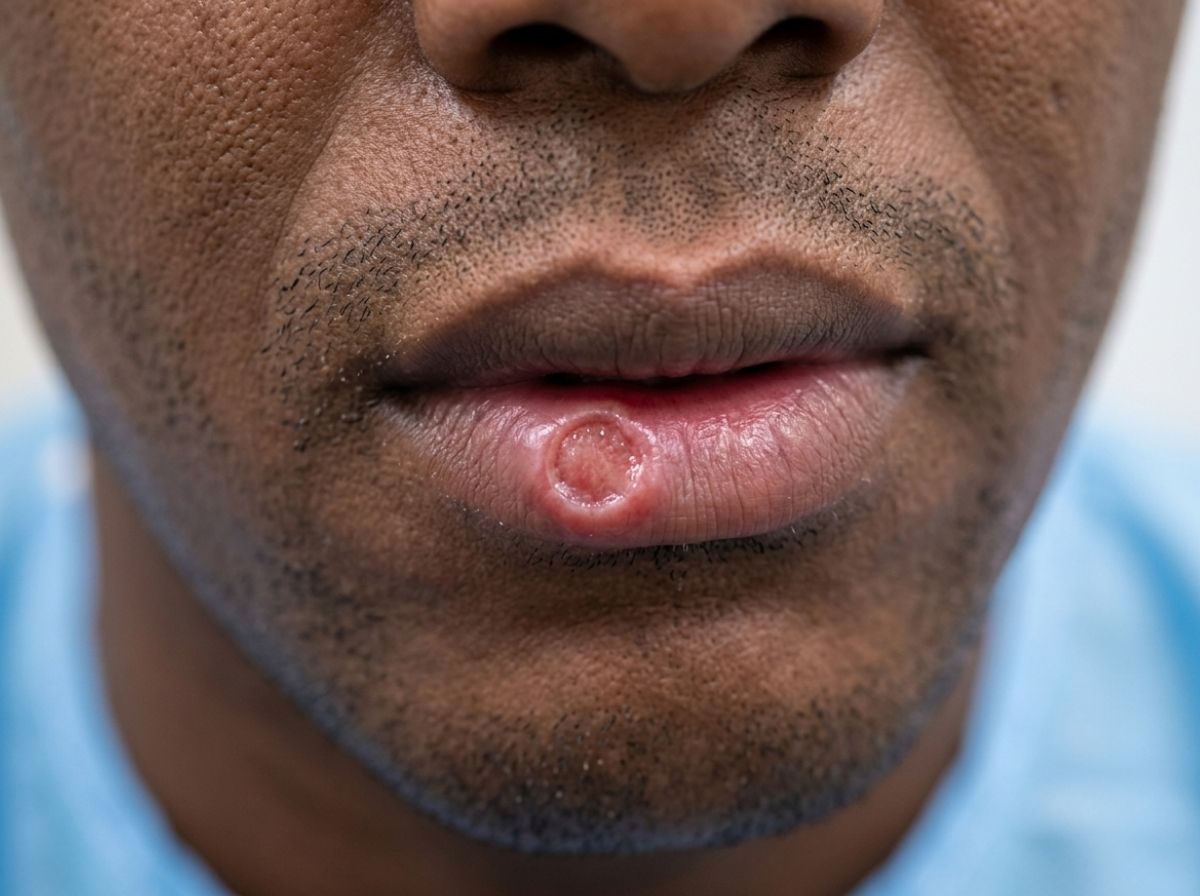
The word "blister" is understandable shorthand for any unusual sore in the genital area, but it's technically wrong when applied to the primary syphilis sore, and that inaccuracy has real consequences. A blister is a fluid-filled sac sitting on the surface of the skin. It's raised, often translucent, and usually causes discomfort. The syphilis chancre is none of these things. It's an ulcer, an open, crater-like wound with clean, defined edges, and it penetrates the full thickness of the skin rather than sitting on top of it. Pressing on it feels firm, almost like a small button beneath the surface. It doesn't weep fluid the way a herpes blister does.
Most chancres are between 1 and 2 centimetres in diameter, though they can be smaller and are sometimes barely visible. They typically appear as a single sore; syphilis doesn't usually produce clusters the way herpes does. The base of the chancre is smooth and clean rather than crusted or scabbed. The edges are raised and clearly defined, giving it a punched-out appearance. On lighter skin tones, the sore tends to look pinkish-red or flesh-coloured. On darker skin tones, it can be harder to spot because the contrast is less obvious, which is one reason syphilis is more likely to be missed in people with darker complexions.
The painlessness is the defining trap. Because there's no burning, no itching, and no throbbing, most people who develop a chancre either don't notice it at all, especially if it's in a location that's hard to see, or notice it briefly and conclude it must be a minor irritation, an ingrown hair, or a friction sore from sex. According to the CDC, syphilis sores are usually firm, round, and painless, and because the sore is painless, it often goes unnoticed entirely. That's not a minor footnote; it's the core reason syphilis continues to spread silently through communities.
Where Syphilis Sores Appear, and Where They Hide
The chancre forms wherever the Treponema pallidum bacteria entered the body, which means it can appear in a surprisingly wide range of locations depending on the type of sexual contact involved. The genitals are the most common site: the shaft or head of the penis, the labia, the vaginal opening, or the cervix (where it's almost never visible without a speculum exam). But syphilis is also transmitted through oral and anal sex, which means chancres turn up on the lips, tongue, inside the mouth, in the throat, around the anus, inside the rectum, and occasionally on the fingers.
The hidden locations are where the real diagnostic problem lies. A chancre on the outside of the penis is at least visible. A chancre inside the vagina, on the cervix, inside the rectum, or deep in the throat is functionally invisible, the person has no idea it's there, it heals on its own, and they move into the secondary stage of infection without ever having had a reason to test. This is not an edge case. A substantial proportion of syphilis diagnoses happen at the secondary stage or later, precisely because the primary sore was never detected. The CDC notes that syphilis sores in the vagina, anus, mouth, or under the foreskin can be hard to see, which is one of the central reasons routine testing matters so much more than symptom-watching.
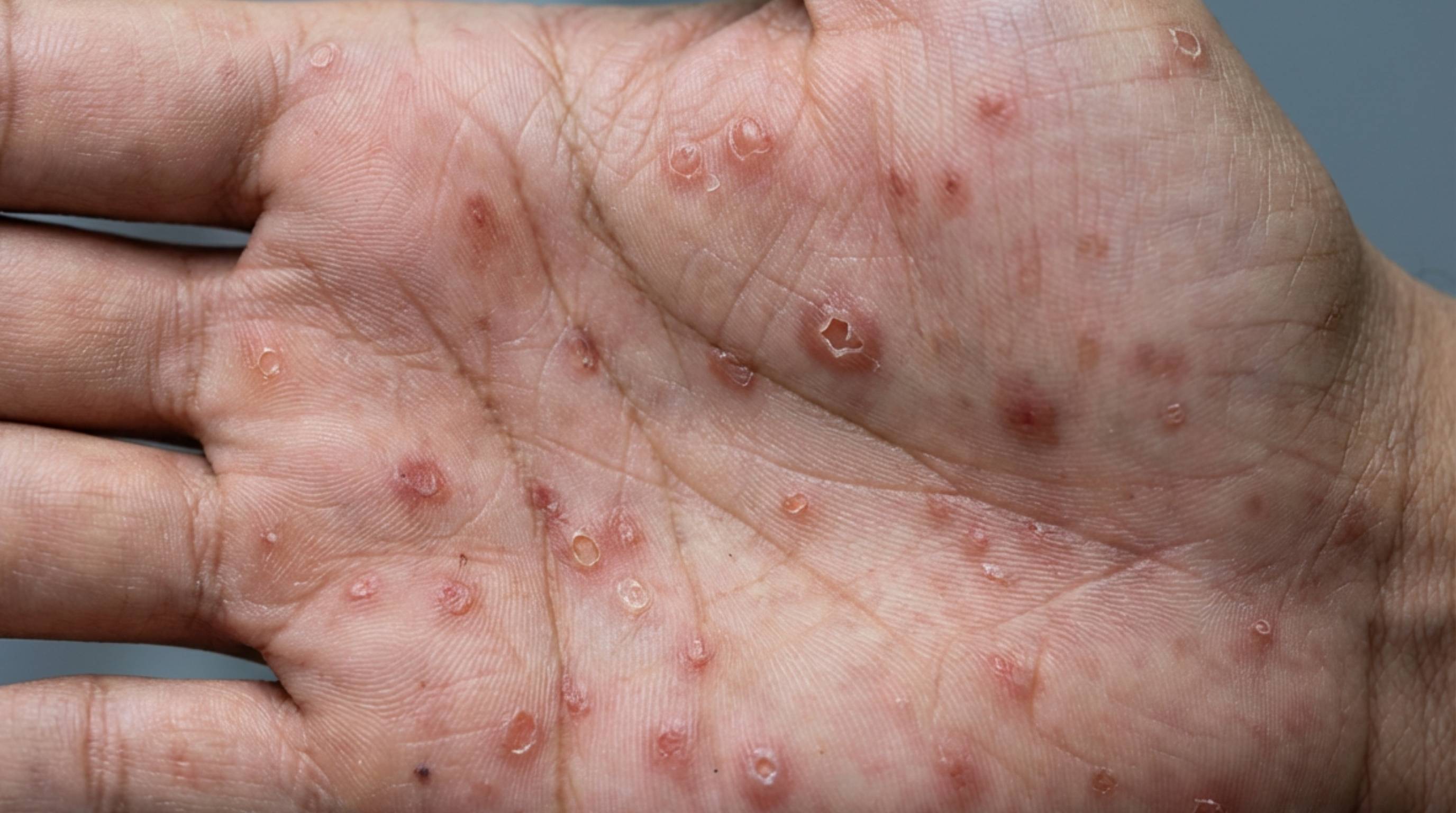
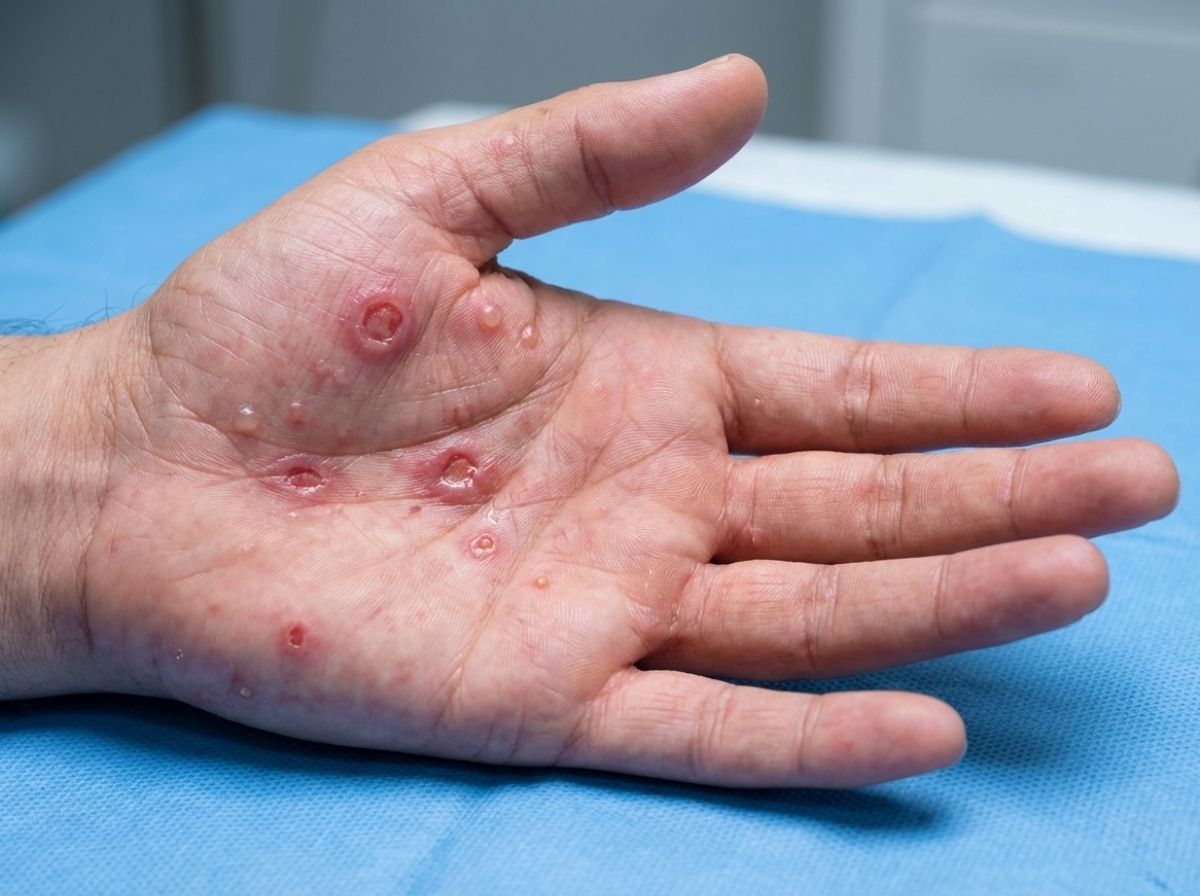
The secondary stage introduces a different set of skin changes, not the same chancre, but a widespread rash and sometimes mucous membrane sores. The famous secondary syphilis rash classically appears on the palms of the hands and soles of the feet, which is one of the most reliable identifying features since very few other conditions produce that specific pattern. It can also appear on the trunk, arms, face, and elsewhere. Unlike the primary chancre, the secondary rash is usually not painful or itchy either, making it easy to dismiss as dry skin, an allergic reaction, or a heat rash without context about recent sexual exposure.
Table 1. Where Syphilis Sores and Skin Changes Appear by Stage
Syphilis Sore vs. Herpes Blister: The Key Differences
This is the comparison most people are actually trying to make when they search for a "syphilis blister." Both infections produce sores in the genital area. Both can appear after sexual contact. Both can show up on the genitals, around the anus, or in the mouth. And neither can be definitively diagnosed by looking at a picture on a phone screen, which is important to say upfront, because the internet is full of people trying to do exactly that. What comparing the two can do is give you enough information to understand what you're probably dealing with and how urgently to act.
The most important difference is pain. Herpes sores are typically painful, often described as burning, stinging, or throbbing, and the outbreak is usually preceded by warning signs like tingling, itching, or nerve sensitivity in the area before the blisters even appear. The syphilis chancre, by contrast, is almost always painless. If a sore is causing significant discomfort, herpes is more likely the explanation. The second major difference is appearance: herpes produces small, fluid-filled blisters, often in clusters, that rupture and leave shallow, moist ulcers with a crusted base as they heal. The syphilis chancre is a single, dry, clean-based ulcer with firm, defined edges and no fluid.
Timing and healing pattern also differ meaningfully. Herpes blisters typically appear two to four days after exposure, whereas a syphilis chancre takes an average of three weeks, and can take up to 90 days, to appear after infection. Herpes sores heal within one to two weeks but return periodically because the herpes virus lives permanently in nerve tissue. The syphilis chancre heals in three to six weeks and does not come back, but that disappearance is deceptive, because the bacteria have simply moved deeper into the body and begun the next stage of infection. The sore going away is not good news if you haven't been tested and treated.
Table 2. Syphilis Chancre vs. Herpes Blister, Side-by-Side Comparison
Feature
Syphilis Chancre
Herpes Blister
Pain level
Usually painless
Usually painful, burning, stinging
Appearance
Firm, round, clean-based ulcer; no fluid
Small fluid-filled blisters; rupture and crust
Number of sores
Usually one
Usually multiple, clustered
Size
Up to 2–3 cm
Very small, 1–3 mm each
Warning signs before sore
None
Tingling, itching, or nerve pain beforehand
Time to appear after exposure
Average 3 weeks; up to 90 days
2–4 days; up to 12 days
How long it lasts
3–6 weeks, then heals
1–2 weeks, then recurs
Does it come back?
No, but infection progresses
Yes, recurring outbreaks for life
Curable?
Yes, with antibiotics
No, managed but not cured
One more thing worth saying plainly: co-infection is possible. Syphilis and herpes share transmission routes, and having one doesn't protect against the other. Some people develop both simultaneously, which can make visual identification even more unreliable. If you've had a potential exposure and sores are appearing, the right answer is always to test for both, not to try to rule one out based on how it looks.
How the Sore Changes as Syphilis Progresses
One of the most important things to understand about syphilis is that the sore going away is not the same as the infection going away. The chancre heals on its own within three to six weeks regardless of whether treatment has been received. The bacteria don't leave with it, they spread through the bloodstream and begin attacking the body systemically. This is why syphilis has earned the nickname "the great imitator": by the time it reaches its secondary stage, it can mimic a wide variety of other conditions and has often moved well beyond the point where the person connects their current symptoms to a sore they had weeks earlier.
Secondary syphilis typically begins six weeks to three months after the chancre first appeared. The most recognizable feature is the rash, rough, reddish-brown spots that frequently appear on the palms of the hands and soles of the feet, a combination that is relatively distinctive and clinically significant because it's unusual for common rashes like eczema or allergic reactions to follow that pattern. The rash can also appear on the torso, face, and limbs. Secondary syphilis can also produce flu-like symptoms, fever, fatigue, swollen lymph nodes, sore throat, muscle aches, alongside the skin changes. Flat, wart-like lesions called condyloma lata can develop in moist areas like the genitals and anus.
After the secondary stage resolves, again, on its own, without any treatment, syphilis enters the latent stage. There are no symptoms. Nothing visible. The person feels fine. This can last for years, sometimes decades. Without treatment, roughly one-third of people with latent syphilis will eventually develop tertiary syphilis, which is where the infection becomes genuinely life-threatening, causing damage to the heart, brain, nervous system, and other organs. Tertiary syphilis can lead to blindness, paralysis, dementia, and death. The entire trajectory from that first quiet painless sore to catastrophic organ damage is preventable with a single course of antibiotics, but only if the infection is caught and treated.
You've noticed a sore. Maybe it's already gone. Maybe you're not even sure what you saw, but the timing relative to a recent sexual encounter is nagging at you. This is the moment to test, not to keep watching and waiting to see if anything else develops. The single most dangerous feature of syphilis is how effectively it disguises itself as nothing. Every stage produces symptoms that are easy to explain away, and the latent stage produces no symptoms at all. Testing is the only thing that removes the guesswork entirely.
The testing window for syphilis is 6 weeks after exposure for a reliable first result. Syphilis tests detect antibodies, proteins the immune system produces in response to the Treponema pallidum bacteria, and it takes the body time to generate detectable levels after infection. Testing in the first week or two after a potential exposure is likely to return a negative result even if infection is present, which creates a false sense of reassurance. At 6 weeks, the test becomes meaningfully accurate. This is the number to work with. Not "a few weeks." Not "when symptoms appear." Six weeks after the exposure in question.
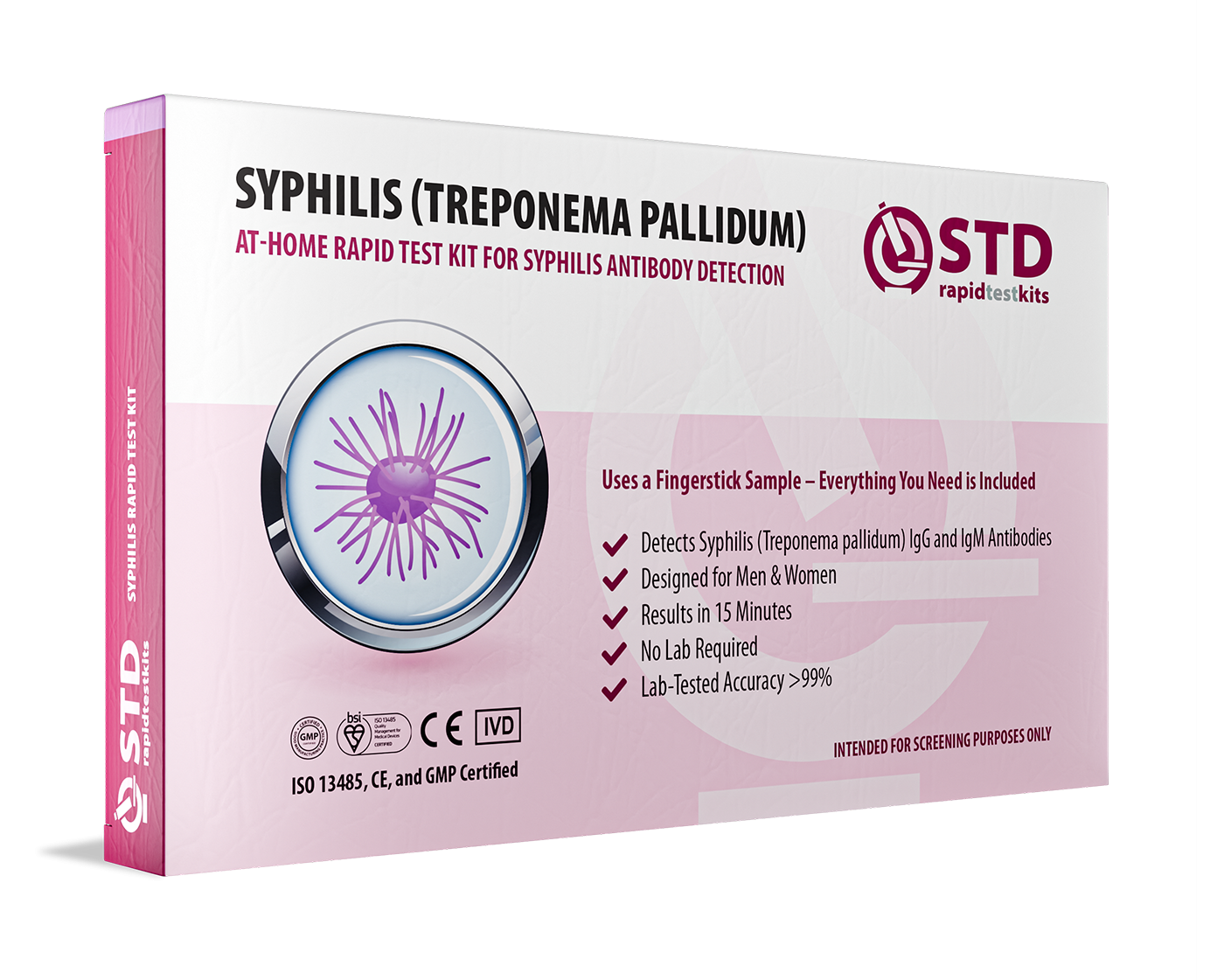
The Syphilis At-Home Rapid Test Kit from STD Rapid Test Kits delivers results in minutes with 99.4% accuracy, no clinic visit, no waiting room, complete privacy. A simple finger-prick blood sample is all it takes. If the result is positive, that's the starting point for treatment, not a catastrophe, syphilis caught at the primary or secondary stage is completely curable. If you suspect the exposure involved multiple STIs, the Chlamydia, Gonorrhea & Syphilis 3-in-1 Kit covers the three most common bacterial STIs in a single test. And if you want the most comprehensive picture of your sexual health, the 7-in-1 Complete At-Home STD Test Kit includes syphilis alongside HIV, HSV-2, chlamydia, gonorrhea, hepatitis B, and hepatitis C.
One practical point: if you're looking at a sore right now and it appeared within the last few days, that does not mean you should wait six weeks to do anything. See a healthcare provider, a fresh chancre can sometimes be swabbed directly and examined for syphilis bacteria using dark-field microscopy, which provides results faster than waiting for antibody levels to develop. The six-week window applies to blood-based antibody testing. Either way, don't wait for the sore to heal and then forget about it.
What Happens If Syphilis Goes Untreated
The risks of not treating syphilis are real, and the current state of syphilis in the US makes this even more important. The CDC's 2023 surveillance data show that there were more than 209,000 cases of syphilis in the US that year. This is the highest number of cases reported in a single year since 1950. The rates of primary and secondary syphilis have been going down for two years in a row, which shows real progress in public health. But the overall burden is still huge. For twelve years in a row, congenital syphilis, which is when a pregnant person passes the infection to their baby, has been on the rise, reaching almost 4,000 cases in 2024. That number is almost 700% higher than it was in 2015. These numbers are not just numbers. They show what happens when an infection that can be easily treated goes undetected.
At the individual level, untreated syphilis progresses through the latent stage into tertiary disease over a timeline of years to decades. Tertiary syphilis causes gummas, destructive, tumor-like lesions that can form in the skin, liver, bones, and other organs, along with cardiovascular syphilis (which can damage the aorta and heart valves) and neurosyphilis (which affects the brain, spinal cord, and nervous system). Neurosyphilis can cause personality changes, memory loss, blindness, paralysis, and dementia. These are not rare worst-case outcomes reserved for extreme cases, they are the documented trajectory of untreated infection in roughly one-third of people who reach the latent stage without treatment.
The good news, and it is genuinely good news, is that syphilis remains one of the most treatable STIs in existence. Caught at the primary or secondary stage, it is curable with a single course of antibiotics. Treatment in the latent or tertiary stage can stop further progression, though it cannot reverse damage that has already occurred. Early testing is not just about peace of mind. It's the difference between a completely resolved infection and permanent organ damage. The sore disappearing is not treatment. Testing and treating is treatment.
Check Your STD Status in Minutes
Test at Home with Remedium 6-in-1 STD Rapid Test Kit
Not in the way most people picture a blister. The primary syphilis sore, called a chancre, is a firm, open ulcer with clean, defined edges. It doesn't contain fluid and isn't raised like a typical blister. People often describe it as a painless, round sore that looks almost like a small crater in the skin. The confusion comes from the fact that genital sores of any type get loosely called "blisters," but the syphilis chancre has a very specific appearance quite different from a fluid-filled herpes blister.
2. Does a syphilis sore hurt?
Usually not, and that's exactly what makes it so easy to miss. The primary syphilis chancre is almost always painless. There's no burning, no itching, and no throbbing. Some people notice a very mild tenderness if the sore is pressed, but most describe it as completely asymptomatic. This is one of the defining features that distinguishes it from a herpes sore, which tends to be noticeably painful from the start.
3. How long does a syphilis sore last before it goes away?
The primary chancre typically heals on its own within three to six weeks. This happens whether or not the person receives treatment, which is one of the most deceptive features of syphilis. The healing of the sore does not mean the infection has cleared, it means the bacteria have moved deeper into the body and are progressing toward the secondary stage. Anyone whose sore has healed but who hasn't been tested should still get tested.
4. Can a syphilis sore appear in the mouth?
Yes, and this is more common than most people realize. Oral chancres can appear on the lips, tongue, gums, inside the cheeks, or at the back of the throat, and they result from oral sexual contact with a person who has syphilis. Oral chancres are often mistaken for canker sores or minor mouth irritations. They look and behave the same as genital chancres, firm, round, painless, but their location makes them even easier to overlook.
5. What's the difference between a syphilis sore and a herpes blister?
The key differences are pain, appearance, and number. Herpes blisters are typically painful, small, fluid-filled, and appear in clusters. The syphilis chancre is usually painless, firm, dry, and appears as a single sore. Herpes sores are also preceded by warning sensations like tingling or burning before they appear. The syphilis chancre arrives with no warning signs. Both require testing to confirm, visual identification alone is not sufficient for diagnosis.
6. Can you have syphilis without ever seeing a sore?
Yes, and this is very common. Many people with syphilis never notice the primary chancre at all, it may be located somewhere not easily visible (inside the vagina, on the cervix, inside the rectum, or in the throat), or it may be so small that it goes unnoticed. A significant proportion of syphilis cases are diagnosed at the secondary stage or later, when the rash or other symptoms prompt testing, because the primary sore was never detected.
7. When should I test for syphilis after a potential exposure?
Test at 6 weeks after the exposure for a reliable first result. Syphilis blood tests detect antibodies, and the body needs time to produce detectable levels after infection. Testing too early, in the first week or two, can return a false negative even if infection is present. Six weeks is the window to use. If a sore is currently visible, a healthcare provider may also be able to swab it directly for faster identification.
8. Does syphilis produce a rash as well as a sore?
Yes, but at a different stage. The primary sore (chancre) appears first, during the initial stage of infection. If untreated, secondary syphilis develops weeks to months later and typically produces a rash, rough, reddish-brown spots that classically appear on the palms of the hands and soles of the feet, though it can spread across the whole body. The rash is usually not itchy. These are two separate symptoms from two separate stages of the same infection.
9. Can you get a syphilis sore more than once?
Syphilis does not produce recurring chancres the way herpes produces recurring blisters. However, syphilis infection does not confer immunity, a person can be reinfected with syphilis after being treated and cured. A new infection would produce a new primary chancre at the site of the new exposure. People with past syphilis infections who remain sexually active should continue regular STI testing.
10. If the syphilis sore heals on its own, do I still need treatment?
Absolutely yes. The chancre healing is not the same as the infection resolving. The Treponema pallidum bacteria remain in the body and will continue to progress through the stages of infection, into secondary syphilis, then latent syphilis, and potentially tertiary syphilis with serious organ damage, regardless of whether the original sore is still visible. Treatment with antibiotics is the only thing that actually eliminates the bacteria. A healed sore with no treatment is not a resolved case.
Get Tested, A Sore That Comes and Goes Isn't a Problem That Comes and Goes
Syphilis is one of the easiest STIs to treat, and one of the hardest to catch without testing, because it's specifically designed by biology to look like nothing serious. A painless sore that heals in a few weeks, followed by a rash that doesn't itch, followed by years of no symptoms at all. Every stage is built to be dismissed. The people who catch it early and treat it quickly are the ones who test, not the ones who wait for something dramatic enough to act on.
The Syphilis At-Home Rapid Test Kit (99.4% accuracy) gives you a clear result in minutes from home. If the exposure involved more than one potential risk, the Chlamydia, Gonorrhea & Syphilis 3-in-1 Kit covers all three major bacterial STIs together, because unprotected sex rarely comes with a selective exposure. For a complete picture of your sexual health status, the 7-in-1 Complete At-Home STD Test Kit screens for seven infections including syphilis, HIV, herpes, chlamydia, gonorrhea, and both hepatitis strains in a single kit.
Testing isn't a dramatic step. It's a ten-minute process that either gives you peace of mind or gives you the information you need to act while the infection is still easily treatable. Visit STD Rapid Test Kits and find the right test for your situation.
How We Sourced This: Our article was constructed based on current advice from the most prominent public health and medical organizations, and then molded into simple language based on the situations that people actually experience, such as treatment, reinfection by a partner, no-symptom exposure, and the uncomfortable question of whether it "came back." In the background, our pool of research included more diverse public health advice, clinical advice, and medical references, but the following are the most pertinent and useful for readers who want to verify our claims for themselves.
Dr. F. David, MD is a board-certified infectious disease specialist focused on STI prevention, diagnosis, and treatment. He writes with a direct, sex-positive, stigma-free approach designed to help readers get clear answers without the panic spiral.
Reviewed by: Rapid STD Test Kits Medical Review Team | Last medically reviewed: April 2026
This article is for informational purposes and does not replace medical advice.







 For Men & Women
 Results in Minutes
 No Lab Needed
 Private & Discreet