Published: August 2025 | Last updated: May 2026 | Editorial review and quality control: Martina N.
The condom shifted, you felt something wrong, and now you are sitting somewhere scrolling for an answer. Take a breath. A condom slipping off during sex is one of the most common reasons people search for STI information at 2 a.m., and most of the time the situation is more manageable than your brain is currently telling you. The risk is real, but it is also specific. It depends on what kind of contact happened, how long the slip went unnoticed, and what either partner's actual STI status might be.
This guide walks through the same questions a clinician would ask: where the condom ended up, whether ejaculation happened, what kind of sex you had, and which infections you actually need to think about. From there, it covers when to test (the part most people get wrong) and what to do in the first 72 hours when timing genuinely matters. By the end you will have a clear plan instead of a panic spiral.
Key Takeaways
- A condom slip is a possible STI exposure, not a guaranteed infection. Risk depends on contact type, duration of unprotected contact, and whether your partner has an active untreated infection.
- Testing right away gives a false negative. Each infection has its own detection window, ranging from about 2 weeks for gonorrhea to 12 weeks for HIV confirmation.
How risky is it when a condom slips off?
The risk depends on what actually happened after the condom moved, not on the fact that it moved. A condom that slipped late, was noticed in seconds, and ended sex immediately is a very different exposure from one that came off early and stayed off for several minutes without anyone realizing. STIs spread when infectious fluid or infected skin gets direct access to mucosal tissue: the lining of the urethra, vagina, cervix, rectum, mouth, or throat. The duration and surface area of that direct contact are what shape the risk, far more than the slip itself.
Infections also behave differently from each other. Gonorrhea and chlamydia spread efficiently through infected genital fluids contacting the urethra, cervix, rectum, or throat, which is why a brief but fluid-positive exposure still counts. Herpes and syphilis are trickier because they can spread through direct contact with an infected sore or shedding skin in the surrounding area, which is one reason condoms reduce risk substantially but do not eliminate it entirely, as the CDC overview of condom effectiveness for HIV and STIs describes. In plain English: a condom protects the area it is covering. Once it slips, that protection only applies to whatever part is still covered.
The next factor is where the condom ended up. A condom that slipped completely off and stayed inside the vagina or anus while sex continued involves a longer interval of fully unprotected contact, plus the possibility of pooled fluid sitting against tissue. A condom that slipped partway and was noticed in the same motion sits at the other end of the spectrum. Most real-life slips fall somewhere in the middle: caught within seconds to a minute, with some genital contact but no extended unprotected intercourse. That middle band still counts as a possible exposure, but it is not the worst-case scenario the internet will make it sound like.
Condoms, when used consistently and correctly, are highly effective in preventing the sexual transmission of HIV and reduce the risk of other sexually transmitted infections.
Does the timing of the slip change your risk?
Yes, but maybe not the way you would guess. A condom that slipped before ejaculation still counts as a possible exposure, because pre-ejaculate and genital secretions can carry infectious organisms for several STIs depending on what is present in the partner. A condom that slipped at or after ejaculation adds a clearer fluid-exposure question on top of that, particularly for infections that transmit efficiently through semen, vaginal fluid, rectal secretions, or blood. So the phrase "no ejaculation" is not a magic free pass, even though it does change the risk profile for fluid-heavy transmission routes.
The type of sex matters too. Vaginal and anal intercourse involve mucosal surfaces that are more vulnerable to transmission, because those tissues are thin, well-vascularized, and easier for pathogens to cross than the skin on, say, your forearm. Anal tissue is especially fragile because it lacks the protective layer that the vaginal wall has, which is why receptive anal exposure is generally considered higher risk per act than receptive vaginal exposure for several infections. Oral sex transmits a narrower set of infections (gonorrhea, syphilis, herpes, and sometimes chlamydia), and at lower per-act rates, though it is not zero, as the NHS overview of sex activities and STI risk details.
What about a slip that only lasted a few seconds? Brief contact lowers the cumulative dose and the per-act probability, but it does not push the risk to zero. If infectious fluid touched a vulnerable tissue surface, exposure occurred. The useful question is not whether the slip was quick enough to be safe; it is whether it created enough contact to justify a testing plan at the right window. In most real-life slips, the answer is yes, even when transmission is unlikely, because clarity is worth the price of one test.
| Scenario | What it means biologically |
|---|---|
| The condom slipped at the very end and sex stopped right away | A shorter interval of unprotected contact means a possible exposure, but less cumulative contact than if intercourse continued without protection. |
| The condom slipped early and sex continued | A longer period of direct mucosal and fluid contact increases the chance that an infection, if present, had access to tissue where transmission can happen. |
| The condom stayed partly on | Protection becomes incomplete rather than absent, which means some tissues may still have been exposed even if part of the penis remained covered. |
| The condom came off inside the partner | This usually means there was at least some fully unprotected contact and possible fluid exposure before the problem was noticed. |
What to do in the first hour after a condom slips
The first thing is also the most obvious one people sometimes skip: stop sex and remove the condom if it is still partly attached or trapped inside. In the moment, embarrassment and the hope that it is "probably fine" can talk people into continuing, but every additional minute of unprotected contact extends the exposure window. If the condom stayed inside the vagina or anus, remove it gently. If you cannot reach it after a few attempts, that is a brief medical visit, not an emergency, but it should be handled the same day rather than left in place.
Second: do not try to wash the risk away. Douching, deep rinsing, or putting soap inside the vagina or anus does not prevent STIs and can irritate the very tissues you are trying to protect, which is the opposite of helpful. External washing for comfort is fine. If pregnancy is a concern after vaginal sex, this is also when emergency contraception comes into play, and it is most effective the sooner it is taken. The NHS specifically recommends seeking help after a condom split or slip for exactly these two reasons: contraception decisions and STI testing planning.
Third: think in plan mode, not panic mode. The single time-sensitive medical question is whether you may have been exposed to HIV from a partner who is HIV-positive and not virally suppressed (or whose status is unknown but considered higher risk). Nonoccupational post-exposure prophylaxis (nPEP) is a 28-day course of HIV medication that, when started within 72 hours of exposure, substantially reduces the chance of HIV taking hold, according to the CDC's current nPEP clinical guidance. The earlier within that window, the better; ideally within 24 hours. Sources for nPEP include emergency departments, urgent care, sexual health clinics, and many telehealth services. For every other infection on the list, the smartest move is to mark the date of the slip and plan to test at the correct biological window rather than running out for a test that cannot detect anything yet.
If there is any reasonable chance your partner is HIV-positive and not on suppressive treatment, do not wait to see how you feel. Contact a clinician, urgent care, or sexual health service within 72 hours and ask specifically about nPEP. Once that window closes, nPEP is no longer recommended, and your only remaining option is the standard testing timeline below.
When should you actually get tested?
This is where most people go wrong. Testing the morning after a condom slip and getting a negative result feels like proof, but biologically it is not. Every STI has a window period: the minimum number of days the infection needs to replicate (for a bacterial swab) or to provoke a detectable immune response (for an antibody blood test) before any test on the market can pick it up. Test before that window, and a negative result reflects testing too early, not absence of infection. That is what creates the most common pattern seen after condom failures: people test on day 3, feel reassured, then come back at week 4 with a confirmed infection that was already replicating during that "negative" test.
The window is different for each infection because each one behaves differently. Chlamydia and gonorrhea are bacterial and are usually detected by a NAAT (nucleic acid amplification test) on a swab from the site of exposure (vaginal, penile, rectal, or pharyngeal). HIV, syphilis, hepatitis, and herpes are detected via blood tests that measure either the pathogen itself or the antibodies your immune system produces in response. Different detection biology, different timeline. Table 2 lists the window the CDC and major guidelines support for each infection so you can plan rather than guess.
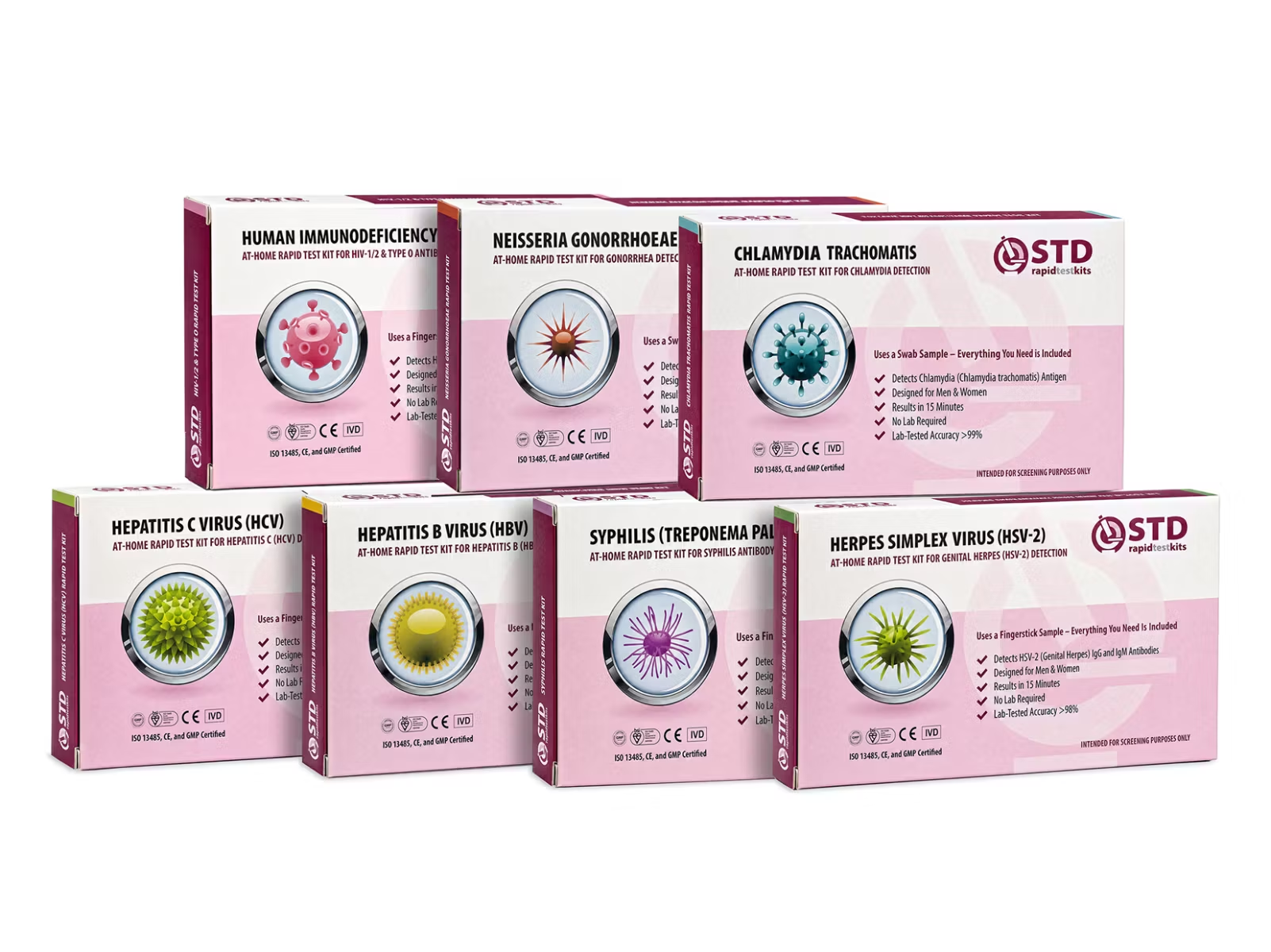
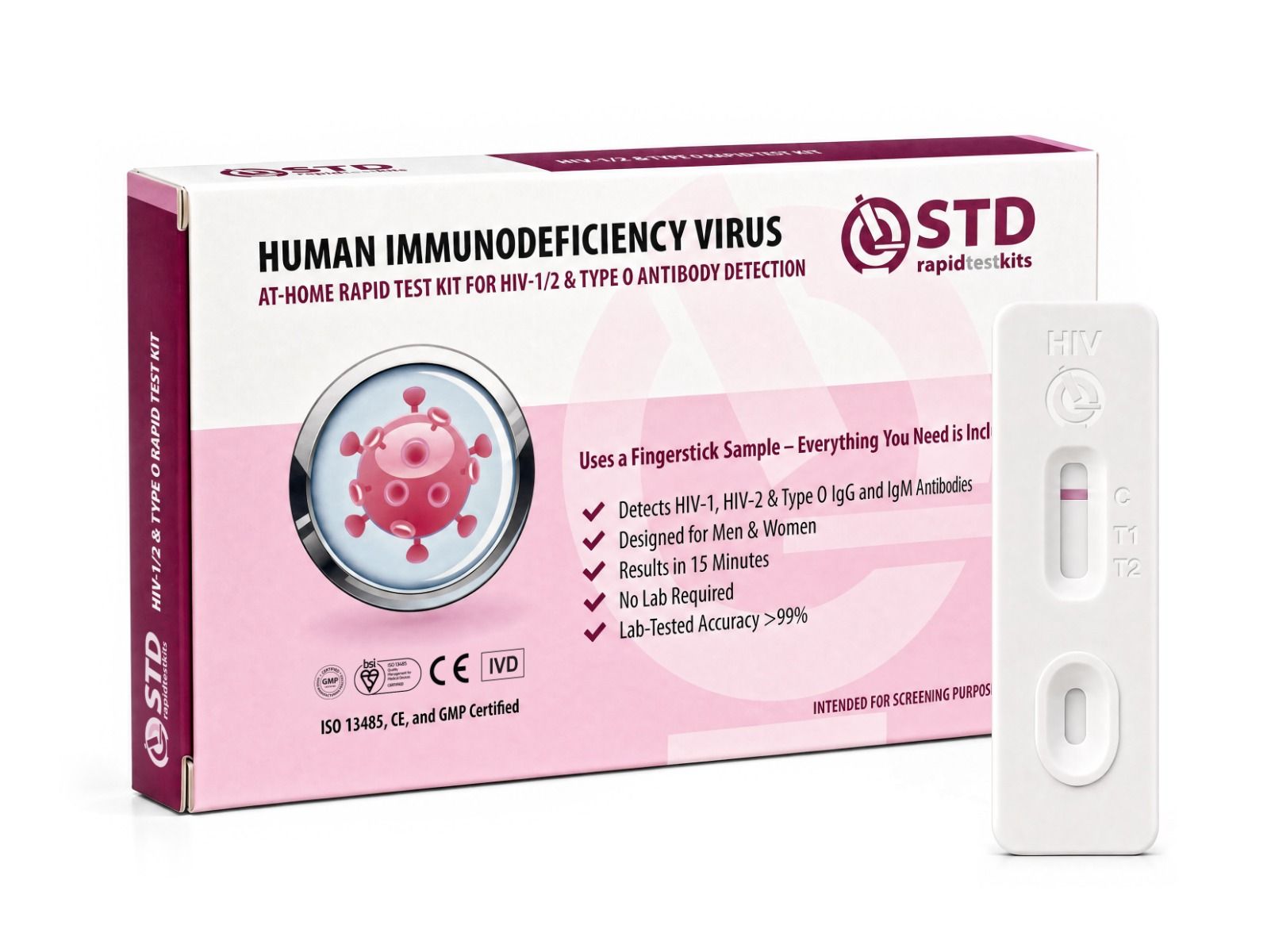
One more piece of biology worth understanding: a negative result before the window means almost nothing, but a positive result at any time means something. If a test turns positive early, it has detected real signal (replicated pathogen or antibody response), and that result still needs medical follow-up regardless of how soon after exposure it was taken. The asymmetry is on the negative side, not the positive side. That is also why retesting exists for HIV in particular: the standard blood markers can detect most infections by week 6, but a small subset of people take longer to seroconvert, which is why a 12-week retest converts "probably negative" into "confirmed negative." This site sells at-home rapid lateral-flow STI test kits; the multi-infection panel below is one structured way to plan testing across the windows in Table 2.
| Infection | When to test for accurate detection |
|---|---|
| Chlamydia | Test from 14 days after exposure (NAAT on a site-specific swab) |
| Gonorrhea | Test from about 2 weeks after exposure (NAAT on a site-specific swab); some guidance allows 1 to 3 weeks depending on the assay |
| Syphilis | Test from 6 weeks after exposure (blood antibody test) |
| HIV | Test at 6 weeks for the first indicator, retest at 12 weeks for full certainty |
| Herpes (HSV-1 and HSV-2) | Test from 6 weeks for an initial read; a negative at 6 weeks should be retested at 12 to 16 weeks, as herpes antibody seroconversion is slower and more variable than other infections |
| Hepatitis B | Test from 6 weeks after exposure (blood antibody/antigen test) |
| Hepatitis C | Test from 8 to 11 weeks after exposure (blood antibody test) |
What symptoms could show up after exposure?
Most STIs do not announce themselves with obvious symptoms in the first days after a possible exposure. Infections need time to establish, multiply, and provoke a response large enough for you to notice. This is the disconnect that catches people out: they feel completely normal at day 3, conclude they were lucky, and only learn months later that an infection was quietly replicating during what felt like a fine stretch. Symptoms are unreliable in the early window.
Chlamydia and gonorrhea are the clearest example. Both infect mucosal cells in the urethra, cervix, rectum, or throat, and in many cases (especially in women, and at rectal or pharyngeal sites in any gender) the early replication phase produces no noticeable irritation or discharge at all. When symptoms do show, they can include burning during urination, unusual discharge, pelvic discomfort, or rectal pain, but those are inconsistent and often arrive after the infection has already spread further into the reproductive or urinary tract. Reliance on symptoms as a screening strategy misses most of the infection burden.
Viral infections follow a different pattern but lead to the same conclusion. Herpes can produce blisters or sores, but only after the virus has entered nerve endings and begun replicating locally, which can take a week or two from initial exposure, and many first infections are mild enough to be mistaken for irritation. Syphilis often starts with a single painless sore (the chancre) at the site of exposure, which is exactly why it gets missed: it does not hurt, it does not look dramatic, and it heals on its own even while the infection continues spreading. HIV and the hepatitis viruses typically produce no specific early symptoms, or only a brief flu-like illness during seroconversion that most people attribute to something else. Testing at the correct window is the only reliable signal.
| Infection type | Why symptoms may not appear early |
|---|---|
| Bacterial (chlamydia, gonorrhea) | Initial replication occurs in mucosal cells without immediate inflammation, delaying noticeable symptoms. |
| Viral systemic (HIV, hepatitis B, hepatitis C) | Virus spreads through the bloodstream before triggering a strong immune response that would cause symptoms. |
| Skin-contact infections (herpes, syphilis) | Lesions may form later or in less visible areas (cervix, anus, mouth), making them easy to miss during early stages. |
How likely is transmission, really?
A condom slip does not equal infection, because transmission requires a chain of conditions: one partner has an active, untreated infection at the time of exposure, the pathogen is present in sufficient quantity in the relevant fluid or skin, and it reaches a susceptible tissue surface in the other person. If any link in that chain is missing, transmission does not happen. That is why many real-life exposures, even with no protection at all, do not result in infection. Per-act transmission probabilities for most STIs are well under 50 percent, and for HIV from a single unprotected vaginal or anal exposure with an untreated source, the per-act risk is typically a small fraction of a percent (see the CDC's HIV transmission overview for current per-act estimates by route and partner status).
This does not mean a slip is nothing. It means the right mental model is probability, not certainty. If the partner has tested negative recently, has had no exposures since, and is not in a high-prevalence sexual network, the baseline probability of infection in them is low, which mathematically makes the probability of transmission to you low even with imperfect protection. If their status is unknown or they have recently been in higher-risk situations, the calculation shifts. You do not have to assume the worst; you do have to make decisions based on the actual situation rather than an abstract one.
The type of exposure matters here too. Insertive partners face a different risk profile than receptive partners, because the receptive partner has more vulnerable mucosal tissue absorbing more fluid for longer. Oral exposure carries a different profile again, and a lower one for most infections than vaginal or anal exposure, though herpes and syphilis can transmit orally without a slip ever entering the equation. These distinctions are why a one-size-fits-all "you need every test on the planet" response is usually wrong, and a targeted plan based on the specific exposure tends to be both more accurate and less stressful.
Three things must all be true for an STI to transmit during a slip: (1) your partner has an active untreated infection at the time of exposure; (2) the pathogen is present in sufficient quantity in the fluid or skin involved; and (3) it reaches a susceptible mucosal or broken-skin surface in you. Per-act transmission for most STIs is well under 50 percent; for HIV from a single unprotected vaginal or anal exposure with an untreated source, it is typically a small fraction of a percent. A slip is a possible exposure, not a likely infection.
How to make slips less likely next time
Most condom slips are not random luck; they trace back to one of three things: fit, friction, or technique. A condom that is too loose at the base will roll off during movement, especially if the erection softens during longer sex. A condom that is too tight can also fail by creating uneven pressure that works it loose at the base. Brands and sizes are not interchangeable, and if a standard size has slipped on you more than once, it is worth trying a snugger or wider option until you find one that stays put without needing constant adjustment.
Friction is the second factor. Condoms slip more often during long or vigorous sex when natural lubrication has run out, because dry friction tugs at the latex with each thrust. A water- or silicone-based lubricant compatible with the condom type cuts that drag and helps the condom maintain stable contact along the shaft. This matters most for anal sex, where natural lubrication is essentially absent, but it also reduces slips during longer vaginal sex sessions. Oil-based lubricants are the exception: they degrade latex and can cause breakage and slipping, so they should not be combined with standard latex condoms.
Technique is the third and most underrated factor. Roll the condom all the way down to the base before any genital contact begins, not partway. Pinch the tip while rolling to leave a small reservoir for ejaculate. After ejaculation, hold the base of the condom against the shaft during withdrawal so it cannot stay behind inside the partner. These three habits sound minor, but they account for the majority of preventable slips, and once they become automatic they stop being a conscious step at all.
Three prevention principles
- Fit: a condom should sit snugly at the base without pinching or feeling loose. If a standard size has slipped more than once, try a snugger or wider option.
- Friction: use a water- or silicone-based lubricant for longer sex (and always for anal sex). Skip oil-based lubricants with latex; they degrade the material.
- Technique: roll it all the way down to the base before any genital contact, pinch the tip while rolling, and hold the base during withdrawal.
FAQs
- A condom slipped during sex. Should I be worried?
- Pay attention to it, but you do not need to spiral. A slip creates a possible exposure, not a confirmed infection. The actual risk depends on whether your partner has an untreated infection, what kind of contact happened, and how long the slip went unnoticed. The right next steps are mapping the type of exposure to a testing window and, if HIV is on the table, evaluating nPEP within 72 hours. That is a plan, not a catastrophe.
- Does this count as unprotected sex?
- For the time the condom was off, biologically yes. What that means in practice depends on how long that window was and what contact happened during it. A slip noticed within seconds with no fluid exchange is a very different exposure from one that came off early and went undetected for several minutes. Both deserve a testing plan, but the level of concern is not identical.
- The condom slipped right at the end. Does that still matter?
- It can. Transmission does not require long exposure: if infectious fluid reaches a vulnerable tissue surface, exposure has occurred. A brief late slip generally carries lower risk than an early failure where sex continued, but lower is not zero. The conservative move is to test at the correct window for fluid-borne infections like chlamydia, gonorrhea, and HIV, even if everything probably went fine.
- There was no ejaculation. Does that change my risk?
- It lowers some risks, but it does not eliminate exposure. Pre-ejaculate can carry chlamydia, gonorrhea, and HIV in transmissible quantities, and genital secretions from the receptive partner carry organisms regardless of whether ejaculation happened. No ejaculation is a real factor that moves the dial down, particularly for HIV. It is not a clean pass.
- I feel completely fine. Does that mean nothing happened?
- No. Most STIs are biologically silent in the first days to weeks after exposure. Chlamydia produces no symptoms in the majority of women and a significant share of men. Early syphilis presents as a painless sore that often goes unnoticed. HIV typically causes no consistent early symptoms tied to detection timing. Feeling fine is not a reliable signal of being uninfected; only a test taken at the correct window is.
- Should I test as soon as possible?
- Any test taken before the window period closes is reading a blank page, not a clean one. The detection window varies by infection because the biology differs: chlamydia needs at least 14 days for the bacteria to be detectable on a swab, while hepatitis C antibodies can take 8 to 11 weeks to develop. Testing earlier produces a negative result that reflects timing, not infection status. See Table 2 above for the per-infection breakdown, then plan your test at the right window for what you are trying to rule out.
- What about emergency contraception if vaginal sex was involved?
- If pregnancy is also a concern, emergency contraception is most effective the sooner it is taken after the slip. Levonorgestrel pills (Plan B and equivalents) work best within 72 hours, ulipristal acetate (ella) within 120 hours, and a copper IUD up to 5 days after the exposure as the most effective option overall. A pharmacist or clinician can talk you through which fits your situation; timing matters more than brand.
- My partner says they tested recently and everything was fine. Can I trust that?
- It is useful context, but only if the test was comprehensive, recent, and there have been no new exposures since. A test from six months ago with new partners in between is not a current clean bill of health. Some infections are also missed if the right sites were not tested (rectal or pharyngeal chlamydia and gonorrhea require swabs at those sites, not a urine sample). Your own test result is the only one that confirms your own status.
- U.S. Centers for Disease Control and Prevention. How condoms reduce the risk of HIV and other sexually transmitted infections, including the limits of protection for skin-contact infections like herpes and syphilis.
- U.S. Centers for Disease Control and Prevention. HIV testing overview, including the window-period concept and the rationale for 6-week and 12-week test points after a possible exposure.
- U.S. Centers for Disease Control and Prevention. Guidelines for nonoccupational post-exposure prophylaxis (nPEP), including the 72-hour window and 28-day regimen for HIV prevention after a possible exposure.
- UK National Health Service. Overview of sexual activities and STI risk, including per-route differences for vaginal, anal, and oral exposure.
- World Health Organization. Sexually transmitted infections (STIs) fact sheet covering global epidemiology, transmission, and prevention.
- U.S. Centers for Disease Control and Prevention. HIV transmission overview, including per-act and per-route risk context for unprotected exposure with an untreated source.
