
Published: November 2025 | Last updated: May 2026 | Editorial review and quality control: Martina N.
How much does an at-home chlamydia test cost in 2026?
Expect $25 to $59 for a rapid lateral-flow swab with a 15-minute result, $69 to $129 for a mail-in NAAT lab kit (<a href="https://www.uspreventiveservicestaskforce.org/uspstf/recommendation/chlamydia-and-gonorrhea-screening" target="_blank" rel="noopener noreferrer">the USPSTF-recommended diagnostic method</a>), or $149 to $299 for a multi-STI panel covering 4 to 10 infections. Free kits are available through public-health programs in many states.
Two at-home chlamydia kits sit side by side on a search results page. One costs $25. The other costs $249. Both promise to detect chlamydia. Both arrive in plain packaging. Neither price tag tells you the real difference, which is why cost is the most-confused part of at-home STI testing in 2026.
Price tracks the test chemistry, the service layers bundled around it (lab time, telehealth, partner notification, customer service), the privacy and logistics handling, and the regulatory clearance behind the brand. This guide breaks down each tier, explains how test chemistry drives accuracy and price, identifies the warning signs of a kit that is too cheap to trust, covers free options most search results miss, and helps you match the right kit to your actual situation.
This article is published by stdrapidtestkits.com, which sells at-home rapid lateral-flow STI testing kits. Recommendations below reflect fit-for-purpose for the reader's concern, not commercial benefit.
Key Takeaways
- Rapid lateral-flow swab kits ($25 to $59) give a 15-minute result at home; mail-in lab kits ($69 to $129) ship your sample to a CLIA-certified lab for NAAT and return results in 2 to 5 days. Multi-STI panels run $149 to $299.
- Price reflects test chemistry and service tier more than accuracy alone. Free kits through public-health programs like TakeMeHome.org use the same lab analysis as mid-tier commercial brands, and HSA or FSA cards cover most at-home kits at checkout.
Why a $25 kit and a $249 kit are not the same product
Most price confusion comes from comparing tests that share a category label but use different chemistry, different processing, and different support. The cheapest tier (roughly $25 to $59) is a rapid lateral-flow swab cassette. You collect a sample at home, drip it onto a strip, and read a colored line within 15 minutes. No laboratory, no technician, no built-in follow-up unless you pay separately. These tests work as screening tools with generally lower analytical sensitivity than lab-based testing, especially for early or low-bacterial-load infections.
The middle tier (roughly $69 to $129) is a mail-in lab kit. You collect the sample at home, ship it in a prepaid mailer, and a CLIA-certified lab (Clinical Laboratory Improvement Amendments, the federal quality standard for diagnostic labs) runs nucleic acid amplification testing, abbreviated NAAT. The USPSTF gives screening with NAAT a Grade B recommendation and names it as the diagnostic method clinicians should use. Results land in a secure portal in 2 to 5 days, and if you test positive, the platform usually links you to a telehealth prescriber.
The top tier (roughly $149 to $299) is a multi-STI panel. The same NAAT chemistry runs on additional samples for gonorrhea, trichomoniasis, syphilis, HIV, hepatitis B, or hepatitis C. On a per-infection basis, the price often drops below $30. For a recent unprotected exposure with multiple potential pathogens in play, this is frequently the most cost-effective option.
Price also reflects what does not appear on the box: discreet packaging, customer service, a digital portal that stays out of your insurance claims feed, telehealth consultations, anonymous partner notification, and app-based result tracking. Some of those layers genuinely help. Others are markup with a marketing budget attached. Brands bundle these differently, which is part of why two kits with similar lab chemistry can sit $80 apart on the same checkout page.
| Price Tier | Test Type | Result Time | Lab Involved? | Best For |
|---|---|---|---|---|
| $25 to $59 | Rapid lateral-flow cassette (single infection) | 15 to 20 minutes | No | Fast at-home screening, asymptomatic |
| $69 to $129 | Mail-in lab NAAT (chlamydia only or 2-in-1 with gonorrhea) | 2 to 5 days after lab receives sample | Yes (CLIA-certified) | Higher-confidence result, symptoms, known exposure |
| $109 to $199 | Rapid lateral-flow multi-STI panel (4 to 8 infections) | 15 to 20 minutes per test | No | Broad at-home screening, no lab wait |
| $149 to $299 | Mail-in lab NAAT multi-STI panel (4 to 10 infections) | 2 to 5 days after lab receives sample | Yes (CLIA-certified) | Diagnostic-grade multi-infection screening |
| $0 (free) | Mail-in lab NAAT through public-health programs | 2 to 7 days | Yes (CLIA-certified) | Uninsured, under 25, eligible state residents |
How test accuracy and price connect
The chemistry inside the test drives both the cost and the confidence level of the result. A lateral-flow rapid cassette runs at room temperature with a single buffer solution. The supply chain stays simple, and the unit cost stays low. Sensitivity is adequate for screening but measurably lower than lab-based testing, particularly for early infections or low bacterial loads.
Mail-in NAAT amplifies bacterial DNA from the sample. The CDC's STI Treatment Guidelines name NAAT as the most sensitive available test and the recommended diagnostic for chlamydia in nearly every clinical scenario. Sample options include self-collected vaginal or penile swabs and urine, depending on the kit design (MedlinePlus). Lab equipment, calibrated reagents, and CLIA-certified technicians produce that higher analytical sensitivity, which is the core reason these kits cost $69 to $129 rather than $25 to $59.
For someone testing two or more weeks after a known exposure with no symptoms, a rapid lateral-flow cassette gives a preliminary answer in minutes that is correct for most truly infected individuals. For someone who is symptomatic, recently treated, or retesting after a prior inconclusive result, the higher sensitivity of lab NAAT justifies the higher price and the longer wait. Knowing which chemistry matches the situation prevents both overspending on a lab kit when a rapid screen would suffice and underspending on a rapid cassette when the clinical stakes call for NAAT.
Neither price tier is automatically right or wrong. A positive rapid result is worth confirming with a clinician. A negative rapid result in someone with symptoms or a recent exposure should be treated as preliminary, not final.
How Test Chemistry Drives the Price
- Lateral-flow cassettes run at room temperature with one buffer solution. No lab, no technician, no return shipping. That keeps wholesale unit costs under $10, which is how a kit can retail for $25 to $59 and still function.
- NAAT instruments amplify bacterial DNA, requiring calibrated reagents, temperature cycling, and CLIA-certified lab staff. Each sample costs $12 to $45 to process, forming the core of the $69 to $129 retail price.
- The CDC names NAAT as the recommended diagnostic for chlamydia. A rapid lateral-flow result is a screening tool; a lab NAAT result is a diagnostic-grade answer.
- A cheaper rapid test is not automatically wrong. For routine screening by an asymptomatic person past the window period, a lateral-flow cassette can do the initial job at a fraction of the lab cost.
Where the dollars go
When you pay $99 for a mail-in chlamydia kit, only a small slice goes to the plastic in the box. The bulk pays for services attached to the test that you only notice when something goes wrong: a leaking sample, a positive result, a customer-service call at 11 p.m. on a Sunday.
Industry estimates for the underlying costs help explain the spread. Sample collection materials (swab, lancet, transport vial) typically run $3 to $15 wholesale. Lab processing on a NAAT instrument adds $12 to $45 per sample. Two-way shipping, especially with overnight return labels, pulls another $6 to $18. Telehealth consultations included in the kit price generally cost $20 to $75. Platform overhead, including the secure results portal, customer service, and HIPAA-compliant data storage, runs another $5 to $25 per kit. Discreet packaging and brand experience add $3 to $10.
That math explains why an ultra-cheap rapid kit can land at $25 (it cuts everything except the cassette and reagent) while a multi-STI panel with telehealth treatment built in can hit $249 without anyone padding margins. It also explains traps shoppers fall into. A $69 list price that becomes $129 once a required post-result consultation is added, because that is the only way to view the lab data. A $42 kit that does not include a return mailer, then $15 in shipping plus $35 for telehealth after a positive result, ending up at $92 total for a less-comprehensive test than the $99 kit they almost ordered. Subscription enrollments tucked into a checkout checkbox that auto-bills monthly unless you cancel are another pattern to watch.
| Cost Component | Typical Range | Skipped on Cheap Kits? |
|---|---|---|
| Sample collection materials | $3 to $15 | No |
| Lab processing (NAAT) | $12 to $45 | Yes (rapid kits skip lab entirely) |
| Two-way shipping | $6 to $18 | Sometimes (buyer pays return) |
| Telehealth consult | $20 to $75 | Yes (often paid separately) |
| Secure portal + customer support | $5 to $25 | Yes (rapid kits, marketplace sellers) |
| Discreet packaging + brand experience | $3 to $10 | Sometimes |
One infection or a full panel: which makes financial sense
Most people searching "chlamydia test cost" are thinking about one infection. The biology rarely cooperates. Chlamydia and gonorrhea co-infect frequently and present with similar symptoms, which is why a 2-in-1 swab usually costs only $20 to $40 more than a chlamydia-only kit. The USPSTF screens for both infections together in sexually active women 24 and younger, which is a useful signal that you should think about them as a pair. For a recent unprotected exposure, that small price gap is almost always worth closing.
The math gets better with broader panels. A 6-in-1 panel covering chlamydia, gonorrhea, syphilis, HIV, and hepatitis B and C brings the per-infection cost down to roughly $22. Three single-target tests bought separately at $59, $59, and $79 total $197 for three infections; a 3-in-1 combo panel covering the same three runs $89 to $149, saving $48 to $108 and reducing three separate sample collections to one. If you are weighing several singles against one combo, run the per-infection number. Our combo STI test kits bundle multiple rapid tests into a single shipment, bringing the per-infection cost well below what individual kits would run.
The exception is targeted testing. If a partner has told you they tested positive for chlamydia specifically, and you have no other risk factors, a chlamydia-only or 2-in-1 kit is reasonable. Match the kit to the actual risk profile rather than ordering the broadest option out of anxiety.
Multi-STI panels come in two formats. Mail-in lab kits use NAAT for the highest sensitivity (the $149 to $299 tier in the table above). Rapid lateral-flow bundles, including our 6-in-1 kit below, give results at home in 15 minutes per test without mailing a sample, at a price that competes with many lab-panel offerings. Both formats cover the same infections; the difference is chemistry, turnaround, and where the sample gets processed.
| Kit Scope | Infections Covered | Typical Price | Per-Infection Cost |
|---|---|---|---|
| Chlamydia only | 1 | $29 to $79 | $29 to $79 |
| Chlamydia + Gonorrhea | 2 | $49 to $99 | $25 to $50 |
| 3-in-1 (adds Syphilis) | 3 | $89 to $149 | $30 to $50 |
| 6-in-1 panel | 6 | $129 to $179 | $22 to $30 |
| 7-in-1 to 10-in-1 panel | 7 to 10 | $179 to $299 | $20 to $35 |
Free and low-cost paths most people miss
Sticker shock keeps a lot of people from testing at all, which is the opposite of what public-health departments want. Untreated chlamydia can lead to pelvic inflammatory disease and fertility complications, which is why free testing programs exist in the first place. There are more free or sliding-scale options in 2026 than most search results show, and they are real lab tests, not gimmicks.
TakeMeHome.org partners with city and state health departments to mail free at-home kits, often using the same NAAT chemistry sold by mid-tier commercial brands. State-funded programs run under different names depending on where you live: California's TakeMeHome, Washington's I Know Mine, and similar initiatives in roughly 20 other states. Eligibility usually skews toward people under 25 or those without insurance, but plenty of programs accept anyone who lives in a participating ZIP code.
Title X-funded clinics offer free or sliding-scale STI testing in person. The CDC's Get Tested locator maps both free and reduced-cost clinics nationwide. Planned Parenthood runs sliding-scale pricing in most cities. University and college health services typically include STI testing in student health fees, which means it costs nothing additional at the point of service. The American Sexual Health Association maintains a current directory of at-home STI testing options, including free-program listings worth checking before ordering a paid kit.
Watch for two patterns that look free but are not. First, programs that ship the kit free but charge $15 to $25 for return shipping or results-portal access. Second, services that cover the test but require you to pay $35 to $75 for treatment if you test positive. Read the fine print before assuming the total cost is zero.
If you are uninsured and under 25, the time cost of researching free options usually pays off. A $0 kit through a public-health program runs the same lab analysis as a $99 kit on a commercial site.
- TakeMeHome.org: partners with city and state health departments to mail free NAAT kits in roughly 20 U.S. states.
- CDC Get Tested locator (gettested.cdc.gov): maps free and sliding-scale clinics nationwide.
- Title X-funded clinics and Planned Parenthood: sliding-scale STI testing in person.
- University and college health services: STI testing usually included in student health fees at no extra cost.
- ASHA at-home testing directory: state and nonprofit free-program listings updated regularly.
The window-period problem and why timing saves money
The price of a single test is misleading if you tested too early. Chlamydia has a window period: the gap between exposure and when the infection becomes detectable. Most rapid kits and lab tests reliably detect chlamydia starting roughly 1 to 2 weeks after exposure, sometimes earlier with NAAT chemistry but with reduced sensitivity. Test before the window closes and a negative result cannot rule out infection.
This is where budget testing turns into double-spending. A $42 rapid test taken 5 days after a hookup is likely to come back negative regardless of true infection status. Two weeks later, when symptoms arrive, you order a second test. Now you have spent $84 or more for the result a single well-timed test would have produced.
The CDC also recommends retesting roughly 3 months after treatment, because reinfection rates are high, frequently because a partner was not treated at the same time. That follow-up test is a cost you should budget for upfront if you tested positive on the first round. Most platforms do not discount the second kit, so retesting at three months means another full-price purchase unless you switch to a free program.
Budget for the full testing arc, not just the first kit. An exposure test at the 2-week mark ($25 to $79 for a rapid cassette, or $69 to $129 for a lab kit) plus a possible 3-month retest means total testing costs after a single exposure could run $50 to $258. Switching to a free public-health program for the retest can cut that arc significantly.
If you are tempted to pay $30 to $60 extra for same-day shipping or a 24-hour lab turnaround, consider whether you are past the window period first. Speed upgrades shorten the wait, not improve accuracy. Even the fastest rapid test will not reliably detect chlamydia within the first few days of exposure because there is not enough bacterial material.
- Same-day shipping ($15 to $35 extra): kit reaches you 1 to 2 days sooner.
- 24-hour lab turnaround ($20 to $50 extra): result lands roughly 2 days sooner once the lab receives the sample.
- Inside the window period (less than 2 weeks post-exposure): no upgrade fixes this. The bacterium has not replicated enough to detect reliably.
Does a higher price buy more privacy?
For many readers, privacy is the actual reason they are shopping at home instead of walking into a clinic. The ability to swab in a private bathroom, seal a vial in a plain envelope, and skip the front-desk conversation has real value, and brands know it. The privacy layer varies a lot across price tiers.
At the lower end, expect basic discretion: plain packaging, no "STD" stamp on the label, a generic return address. At the mid and upper tiers, brands often add encrypted result portals, clear data-retention policies (a stated retention limit in days or months, not "indefinitely"), the option to delete records after results are reviewed, and explicit promises not to share data with marketing partners or insurers. Some brands also disclose how the lab handles the physical sample after testing.
The same care applies to email receipts and credit-card descriptors, which vary by brand. Some sellers use a generic company name on the statement; others display the product name. If your credit card statement is shared with a household member or a benefits administrator, check what the line item will say before ordering.
- A stated retention limit on results (days or months, not "indefinitely").
- An explicit opt-out from third-party marketing or data sharing.
- An account-deletion option that removes results from the seller's portal on request.
- Disclosure of how samples are handled at the lab and whether the physical specimen is destroyed after testing.
- Plain, unbranded shipping with a generic return address; sender name and tracking notifications free of STI language.
HSA, FSA, and the insurance question
Most over-the-counter at-home STI tests are not directly billed to insurance. They are sold as consumer health products, which means insurers do not pay them at the point of sale even when the chemistry matches what your clinic would order.
HSA and FSA cards are the most practical route for most readers. Diagnostic kits typically qualify as eligible medical expenses, and platforms flag eligibility at checkout. Pay with the benefits card, keep the receipt, and you have used pre-tax dollars on a private test that your employer's benefits administrator does not see linked to a specific diagnosis. Some plan administrators ask for a Letter of Medical Necessity even for clearly diagnostic items, so save the itemized receipt.
Some health plans also reimburse at-home tests after the fact. Submit the receipt and a brief letter of medical necessity (your platform may generate one automatically). This is more common with high-deductible plans and HSA-eligible insurance products. Success rates vary by carrier, so read your plan documents before counting on reimbursement.
If you have insurance and access to a clinic you trust, in-clinic testing is sometimes free under the Affordable Care Act's preventive services rules, especially if you meet the screening criteria the USPSTF uses (sexually active women 24 and younger, or anyone at increased risk). The catch is downstream lab fees, which can arrive weeks later as a surprise bill even when the visit itself was covered.
HSA or FSA card at checkout. Most major at-home STI test brands flag eligibility on the product page. Pay with the benefits card and keep the itemized receipt.
Post-purchase reimbursement. Submit the receipt and a brief letter of medical necessity to your benefits administrator. More common with high-deductible plans and HSA-eligible insurance products. Carrier success rates vary, so confirm your plan covers diagnostics before counting on it.
Red flags when shopping online
The chlamydia test market in 2026 includes legitimate FDA-cleared and CE-marked products and a long tail of knockoff, drop-shipped, or repackaged tests sold through marketplace platforms. The cheap kits that work are real medical devices made by companies listed in the FDA's database. The cheap kits that do not work tend to share specific patterns, often visible on the product page itself.
A kit that fails to name its test chemistry (lateral-flow, antigen detection, or NAAT) or the CLIA-certified lab partner that processes mail-in samples is the first red flag. Any "results in 5 minutes" claim for chlamydia is a second one: the bacterial load required for a 5-minute lateral-flow read is unrealistic in early infections, so a strip that promises that timeline is overstating what the cassette can do. Customer support that lives on a Gmail address or delivers results by SMS to a personal phone number rather than through a secure portal is the third pattern to watch.
Marketplace listings with stock photos, generic product names like "STD Test Strip 5-Pack," and shipping origins from outside the U.S. or EU are higher risk. Unbranded kits, expired stock resold at discount, and unregulated imports cycle through certain platforms, particularly during peak testing windows in early January and after spring break. If reviews mention invalid results, missing components, or "no control line showed up," treat those as disqualifying.
A reasonable kit always documents clear sample-collection steps, a stated accuracy timeframe relative to exposure, a contact method for support if the result is unreadable, and a total price that includes shipping and any required lab processing.
Skip the kit if you cannot find:
- A named test chemistry (lateral-flow, NAAT, antigen) on the product page
- A named CLIA-certified lab partner (for mail-in kits)
- FDA listing, CE mark, or equivalent regulatory clearance
- A real customer-service phone or chat (not just an email)
- A secure results portal (not SMS to a personal phone number)
- A total price that includes shipping and any required lab processing
Choosing the right kit for your situation
The right price tier depends on how quickly you need a result, how much privacy you need beyond plain packaging, whether the concern is one infection or several, and whether you want treatment guidance built in. Most readers fall into one of a few situations.
Known exposure, no symptoms, want to confirm. A rapid lateral-flow swab kit ($25 to $59) gives you a fast preliminary answer at home. Time the test at least 14 days after exposure for the most reliable read. If positive, follow up with a clinician for treatment. If negative and symptoms develop later, retest with a lab-processed kit.
Symptoms, recent unprotected sex, want clinical-grade certainty. A 2-in-1 chlamydia and gonorrhea swab kit ($49 to $99) covers the most likely co-infection pair. If symptoms could plausibly point to other STIs (sores, rash, swollen lymph nodes), a 6-in-1 panel ($129 to $179) is the better spend.
Routine screening, annual checkup, or new relationship. A 4-in-1 to 7-in-1 panel ($109 to $199) covers the infections that most often present asymptomatically. Per-infection cost is lowest in this tier, and the broader screen catches infections you might not have suspected.
If money is genuinely tight, do not skip testing. Order a free kit through TakeMeHome.org or a state health department program.
Which Kit Fits Your Situation?
Did a partner recently test positive for chlamydia specifically, with no other STI concerns?
Yes: A chlamydia-only rapid swab ($25 to $59) or a 2-in-1 chlamydia and gonorrhea kit ($49 to $99) covers the likely need. Test at least 14 days after exposure for the most reliable result.
Do you have symptoms like unusual discharge, burning during urination, or pelvic pain?
Yes: A 2-in-1 chlamydia and gonorrhea kit ($49 to $99) covers the most common co-infection pair. If symptoms could indicate other STIs, consider a 6-in-1 panel ($129 to $179).
Are you screening routinely, starting a new relationship, or unsure of your full exposure?
Yes: A 6-in-1 or 7-in-1 panel ($129 to $199) gives the broadest coverage at the lowest per-infection cost. Use an HSA or FSA card at checkout to pay with pre-tax dollars.
No: If cost is the main barrier, check TakeMeHome.org or your state health department for a free at-home kit before paying out of pocket.
Use these questions to narrow the right price tier. For a specific diagnosis, see a clinician.
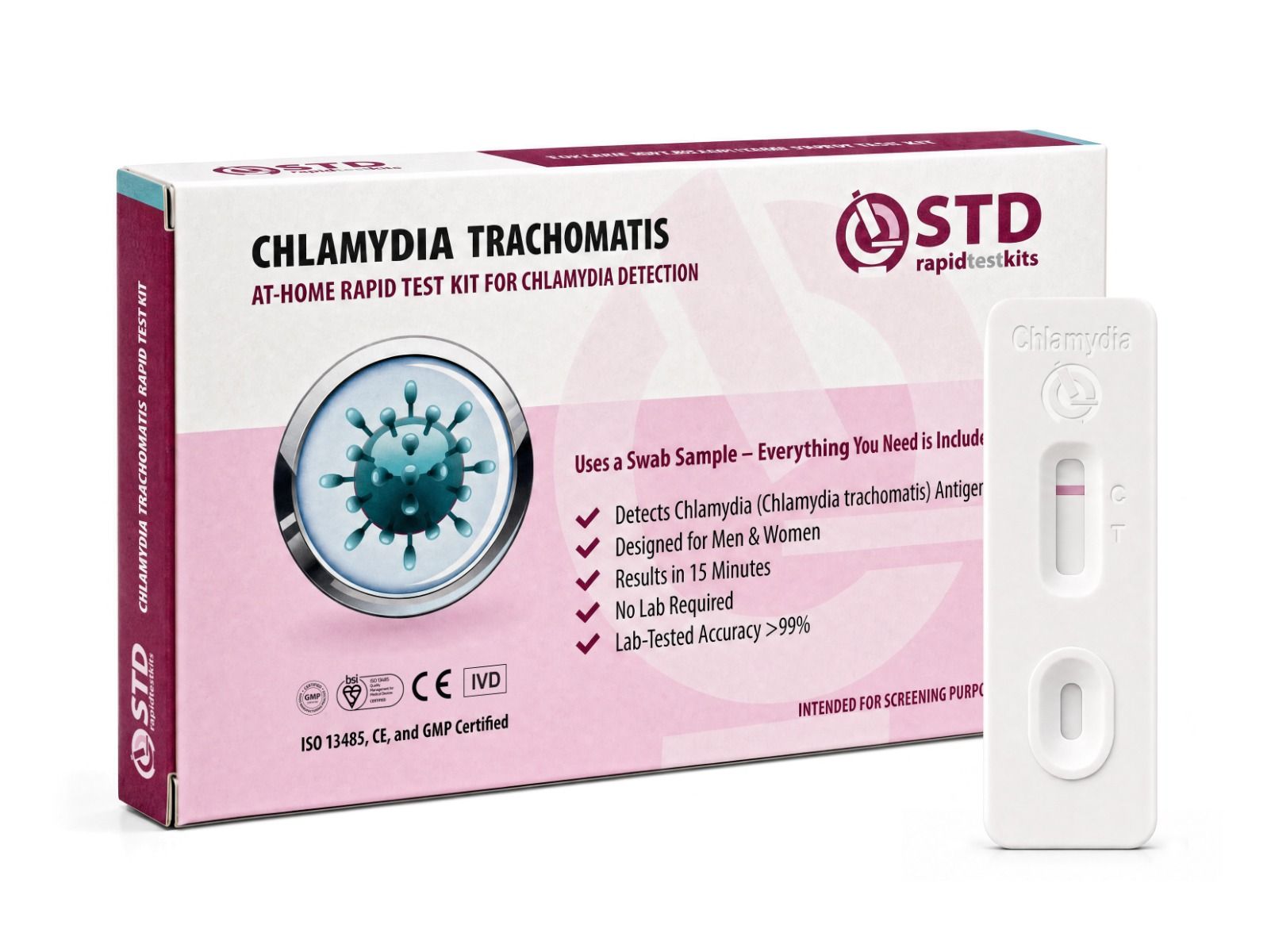
NAATs are the most sensitive tests for these specimens and are the recommended test for detecting C. trachomatis infection.
Frequently asked questions
- How much should I expect to pay for an at-home chlamydia test?
- Rapid lateral-flow swab kits start around $25 to $59 and give a 15-minute at-home result. Mail-in NAAT lab kits run $69 to $129 for diagnostic-grade sensitivity. Multi-STI panels covering 4 to 10 infections range from $149 to $299, though the per-infection cost drops well below $30 on broader panels. Free kits through TakeMeHome.org and state public-health programs are a real option for anyone under 25 or without insurance. Budget separately for treatment if you test positive: telehealth typically costs $25 to $75, plus $10 to $30 for generic antibiotics.
- What is the difference between a rapid test and a mail-in lab test?
- A rapid test runs entirely at home in about 15 minutes using lateral-flow chemistry similar to a pregnancy test. A mail-in test sends the sample to a CLIA-certified lab that runs nucleic acid amplification testing (NAAT). NAAT is more sensitive, especially within the optimal window after exposure. Rapid tests are faster and cheaper; lab tests produce diagnostic-grade results.
- Can a cheap test under $30 be legitimate?
- Sometimes, but verify before trusting it. Check for FDA clearance or CE marking, an actual return policy, a working customer service contact, and reviews that do not flag invalid results or missing parts. Marketplace listings without those safeguards are often expired stock, unregulated imports, or counterfeits. The discount is not worth a result that cannot be acted on.
- Can I use my HSA or FSA card?
- Yes, in most cases. Major at-home STI test brands flag HSA and FSA eligibility at checkout, and diagnostic kits typically qualify as eligible medical expenses. Keep the itemized receipt; some benefits administrators ask for a Letter of Medical Necessity even for clearly diagnostic items.
- Do I need to test for more than just chlamydia?
- Often, yes. Chlamydia and gonorrhea co-infect frequently and present with similar symptoms, so a 2-in-1 swab usually costs only a small premium over a chlamydia-only kit. For a recent unprotected exposure or multiple partners, a 4-in-1 or 6-in-1 panel adds gonorrhea, trichomoniasis, HIV, and syphilis at a meaningful per-test discount versus buying single tests.
- When should I retest?
- Two timing windows matter. For a new exposure, test no sooner than 14 days after contact for the most reliable result; earlier tests can miss low bacterial loads. After a positive result and treatment, retest at the 3-month mark even if you feel fine. Reinfection is common when a partner was not treated simultaneously. Free retesting through a public-health program can cut the cost of that follow-up.
- What does it cost if I test positive?
- Treatment is generally inexpensive. Generic chlamydia antibiotics (doxycycline or azithromycin) cost roughly $10 to $30 with most pharmacy discount cards. Some at-home test platforms include or sell a telehealth consult for $25 to $75 that prescribes treatment without requiring a separate clinic visit.
- Where can I find a free chlamydia test kit?
- Start with your state or city health department website, then check the CDC's Get Tested locator at gettested.cdc.gov, which maps both free and sliding-scale clinics. National programs like TakeMeHome.org mail at-home kits free in many participating states, especially to people under 25. The American Sexual Health Association keeps a current directory of at-home options. University health services and Planned Parenthood also offer low-cost or sliding-scale testing.
- U.S. Centers for Disease Control and Prevention. About Chlamydia: overview covering symptoms, transmission, complications, asymptomatic infection rates, and annual screening guidance for sexually active women under 25.
- U.S. Centers for Disease Control and Prevention. STI Treatment Guidelines, Chlamydial Infections: NAAT named as the most sensitive and recommended diagnostic test, retesting at 3 months after treatment, and screening windows.
- U.S. Preventive Services Task Force. Chlamydia and Gonorrhea Screening recommendation (Grade B): NAAT as the diagnostic method, screening for sexually active women 24 and younger and anyone at increased risk.
- Mayo Clinic. Chlamydia trachomatis: symptoms, causes, diagnosis, and treatment options for the most commonly reported bacterial STI.
- MedlinePlus, U.S. National Library of Medicine. Chlamydia Test: patient-facing guide to testing methods, sample types (swab and urine), and result interpretation.
- U.S. Centers for Disease Control and Prevention. Get Tested: national locator for finding free and sliding-scale STI testing clinics by ZIP code.
- American Sexual Health Association. Testing for STIs at Home: directory of at-home STI testing options, including free state and nonprofit programs updated regularly.
- National Health Service (UK). Chlamydia: overview of complications including pelvic inflammatory disease and fertility risks from untreated infection.
