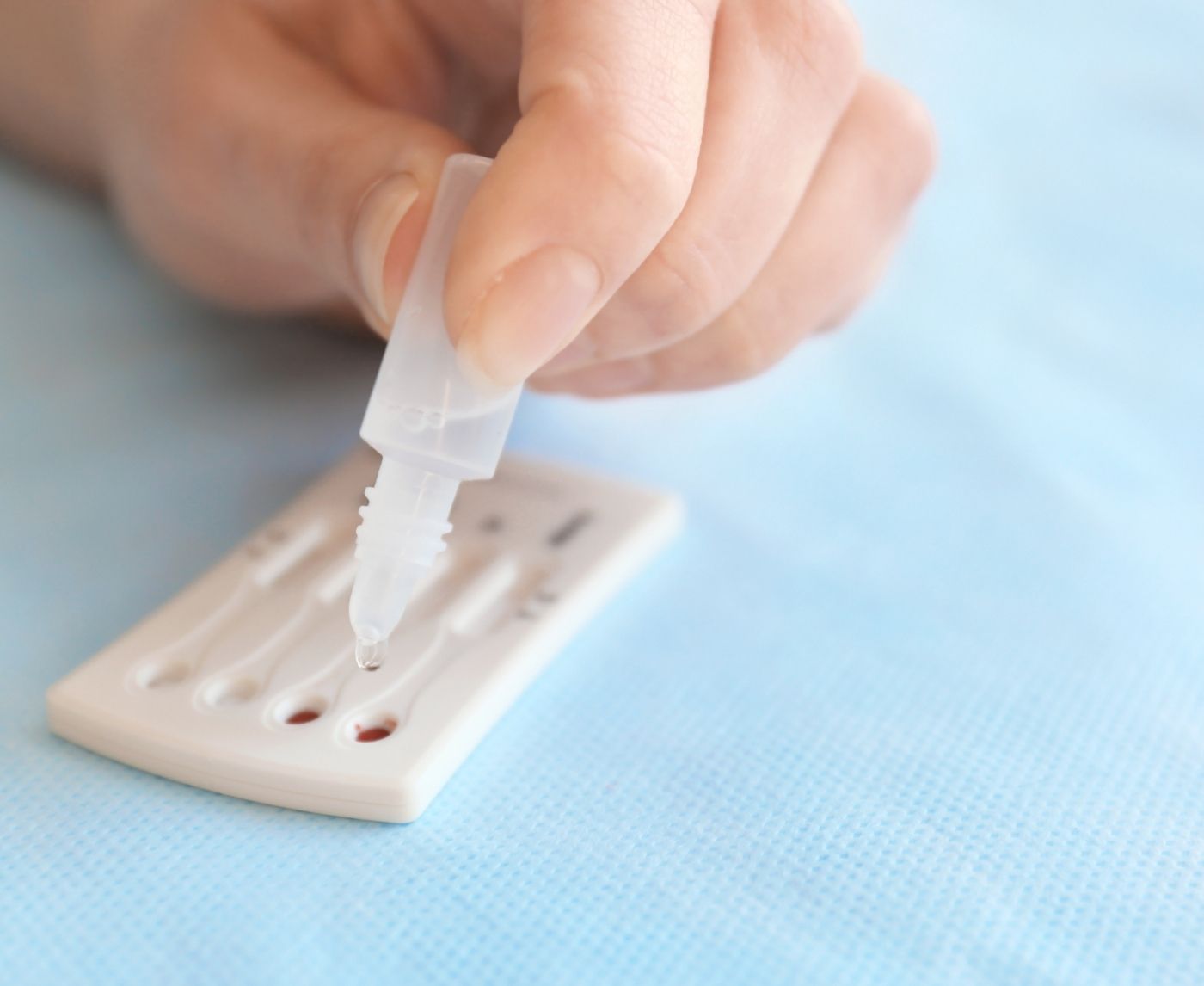
Published: December 2025 | Last updated: May 2026 | Editorial review and quality control: Martina N.
Few moments are as nerve-wracking as squinting at a rapid test, trying to decide if that ghost of a second line counts as positive. With HPV the question feels even harder, because the infection often hides without symptoms, the timing of when you read the strip really matters, and the difference between a real faint positive and an evaporation artifact comes down to a few visual details. This guide walks through what each line pattern means, why faint results happen, and what to do next without spiraling into worst-case mode.
You will see how lateral-flow rapid tests actually work, how to tell a faint positive apart from an evaporation line, what our at-home HPV kit is and is not designed to answer, and exactly what your follow-up should look like if your reading is still ambiguous after a careful retest.
Key Takeaways
- A faint but pigmented second line that appears within the kit's stated reading window (usually 15 to 20 minutes) is read as a positive result, not as a fluke.
- A grayish or colorless mark that appears after the reading window is almost always an evaporation line, not a real result. Confirm any uncertain reading with a fresh kit or a clinic-based HPV DNA test.
Why a rapid HPV test can show a faint line
Rapid at-home HPV tests are lateral-flow immunoassays. A small sample (in our kit, a self-collected vaginal swab) is mixed with a buffer and applied to a strip pre-treated with capture reagents. If the target marker is present, it binds to dye-tagged reagents as it migrates across the strip and forms a visible band at the test line. A second band, the control line, confirms the strip itself worked.
The intensity of the test line depends on how much target marker the strip captures. A strong reaction creates a bold pink or purple stripe. A weaker reaction, with less target to bind, produces a paler stripe in the same place. That is the basic chemistry behind a faint line: the marker is present in low enough quantity that the dye reaction is muted, but the band is still real.
Two framings matter for the rest of this article. First, our at-home kit is a screening tool. It is not the same technology as a clinical lab HPV DNA or HPV mRNA test, which uses molecular amplification (typically PCR or hybrid capture) and runs in a lab on a cervical sample collected by a clinician. Lab-based molecular tests are the reference standard for cervical cancer screening, and any positive home result, especially a faint one, is worth confirming with that pathway. Second, our HPV rapid kit is validated for vaginal self-swab only. We do not offer a male-compatible version. People with a penis who need an HPV evaluation should see a clinician, not retrofit a women's kit (CDC HPV overview).
Pigment in the right position equals a real signal. The band looks paler because less target marker bound to the dye reagents on the strip, not because the kit malfunctioned. Color and timing are the two checks that tell you a faint positive apart from an artifact.
Faint line vs. evaporation line: how to tell the difference
An evaporation line is the most common reason a negative test gets misread as a faint positive. As the buffer fluid travels across the strip and starts to dry, residual salts and proteins can leave a faint shadow in the test line position. That shadow has no pigment because no antibody-dye binding actually happened. To the unaided eye, it looks like a thin gray or colorless streak, sometimes a faint depression in the strip where the fluid pooled and receded.
Two visual checks separate the two reliably. The first is color. A real faint positive carries pigment, usually pink, purple, or red depending on the dye chemistry the brand uses. The line is paler than a strong positive but the hue is unmistakable when you compare it to the boldly colored control line right next to it. An evaporation mark looks gray, beige, or shadow-like, with no hue at all. The second check is timing. Manufacturers specify a reading window, usually 15 to 20 minutes after sample application. A line that is clearly visible within that window is your result. A mark that only appears after the window has closed is interpreted as invalid, regardless of color.
| What you see | Color | When it appears | How to interpret it |
|---|---|---|---|
| Faint test line | Pale but pigmented (pink, purple, or red) | Within the kit's reading window (often 15 to 20 minutes) | Read as a positive result. Confirm with a fresh kit or a lab HPV DNA test. |
| Evaporation line | Gray, beige, or colorless shadow | After the reading window has closed | Read as invalid. Do not interpret as positive or negative. Retest with a new kit. |
| Strong test line | Bold pink, purple, or red, similar to the control line | Within the reading window | Read as a positive result. Plan a clinical follow-up. |
| Control line only | Bold pink, purple, or red | Within the reading window | Read as a negative result on this kit. If your exposure was very recent, a retest after the kit's stated re-test interval is reasonable. |
Does a faint line mean I have HPV?
Most of the time, yes. A faint line that is clearly pigmented (pink, purple, or red, not gray) and that appeared within the kit's reading window is read as a positive result. Confirm any positive home result, faint or bold, with a clinic-based HPV DNA test or your next cervical screening. A grayish mark that only appears after the reading window has closed is an evaporation line, not a result.
The reading window: why timing decides everything
Lateral-flow tests have a narrow window in which the chemistry has had enough time to develop a real result but not enough time to start drying out and producing artifacts. For most rapid HPV cassettes that window is 15 to 20 minutes, but it can vary by brand, so always read the instruction leaflet for your specific kit before you start the timer.
The clearest signal in the timing rule is what counts as invalid. If a second line appears at minute 5, before the kit's stated minimum reading time, the chemistry has not finished and you should not interpret it yet. If a second line only appears at minute 35, after the kit's stated maximum, that line is an evaporation artifact and is not your result, even if it looks faintly pink in the wrong light.
Set a phone timer the moment you apply the sample. At exactly the kit's recommended reading time, take a photograph of the result window, then put the cassette away. The photograph is your record. Looking at the cassette an hour later and second-guessing what you saw is the most common way at-home users get confused about a faint line.
Why your line might be faint, even with the kit used correctly
A faint pigmented line within the reading window is a real positive, but the question of why it is faint and not bold has a few answers worth understanding. Knowing the reason helps you decide whether to retest right away or wait a few days before retesting.
The most common reason is a low marker level in the sample. That can happen if the infection is early and the body has not had time to build up a strong antigen presence, if the sample collected was light on cells from the part of the cervix where HPV markers concentrate, or if your immune system is keeping the viral activity suppressed. None of these scenarios mean the test was wrong; they all mean the kit picked up a small but real signal.
The other family of reasons is procedural. Storing the kit somewhere hot or humid can degrade the test chemistry. Using a kit past its expiration date can do the same. Not collecting enough sample, or not following the swab rotation instructions, can mean fewer cells make it onto the strip. Letting the swab sit too long before mixing it with the buffer can dry out the cells. None of these is a catastrophe on its own, but they stack up.
| Possible cause | Effect on the test | Reasonable next step |
|---|---|---|
| Low marker level (early infection or immune suppression) | Faint but real pigmented line | Treat as positive; confirm with a clinic-based HPV DNA test or next Pap |
| Light sample (insufficient cells on the swab) | Faint or absent test line | Retest with a fresh kit, following the swab instructions carefully |
| Kit stored in heat or humidity | Altered chemistry, unreliable color development | Use a fresh kit kept at room temperature; do not retest with the same brand from the same batch if both kits failed |
| Reading the cassette outside the time window | Evaporation marks read as faint positives | Retest and read at exactly the kit's recommended time |
| Expired kit | Degraded reagents, weak or no signal | Use an in-date kit |

What our at-home HPV kit can and cannot answer
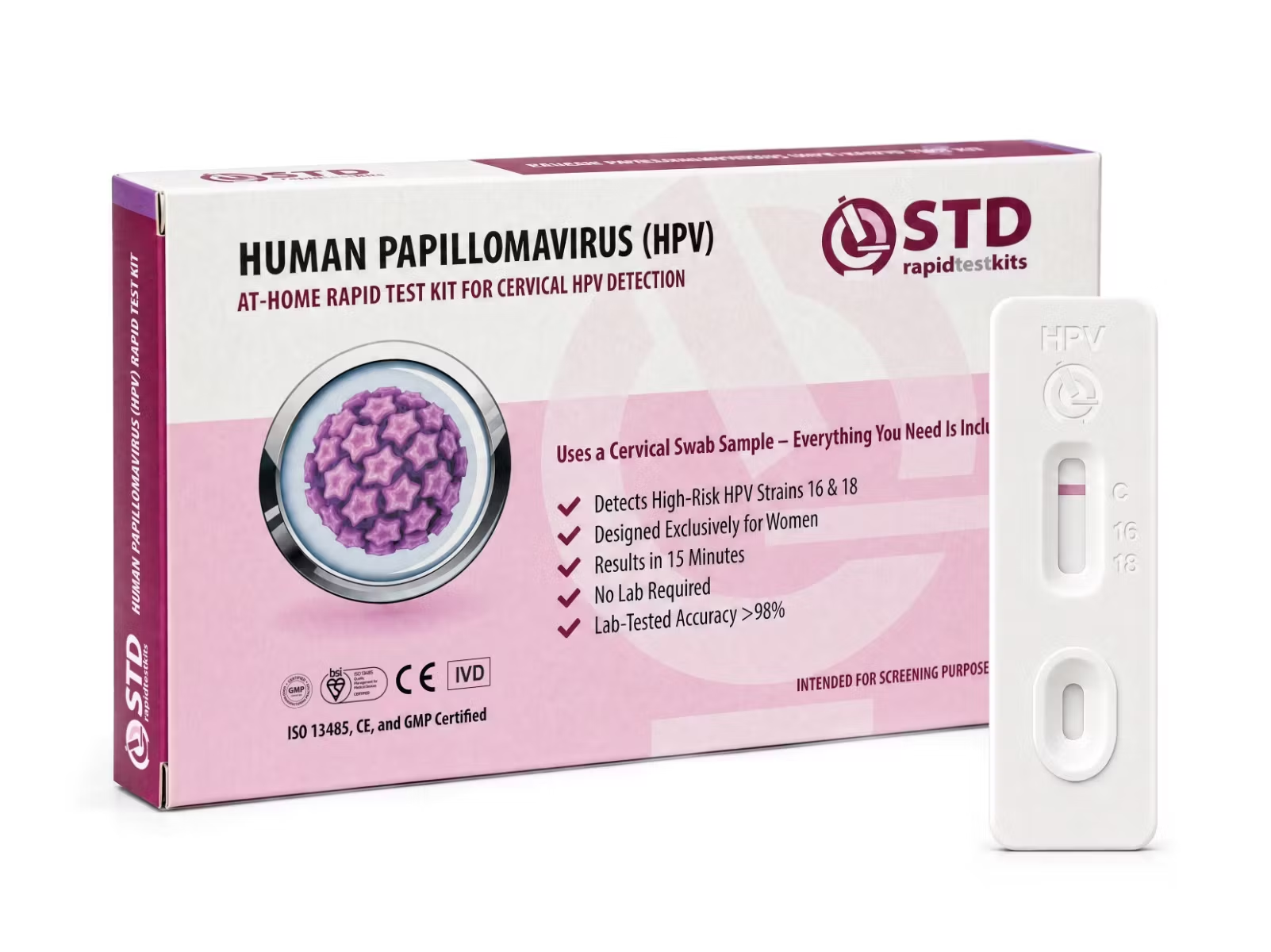
This site sells the at-home HPV rapid test described below, and our recommendations are based on fit-for-purpose for the reader's concern, not on commercial benefit. Our HPV rapid kit is a lateral-flow screening test designed for self-collected vaginal swab samples. It is validated for women's anatomy only. We do not currently offer a male-compatible HPV home test. People with a penis who want an HPV evaluation should ask their clinician about clinical examination and, where appropriate, dermatologist-led wart assessment; there is no FDA-cleared at-home HPV swab kit for male anatomy.
For the right person, the kit answers a useful question quickly and discreetly: is there detectable HPV marker in the sample I just collected? It does not type the strain (it does not tell you whether you have HPV-16, HPV-18, or another high-risk type), it does not measure how long the infection has been present, and it does not assess whether cervical cells have started to change. Those questions belong to a Pap smear, a clinical HPV DNA test, or a colposcopy depending on your individual screening history (CDC cervical cancer screening guidance).
Read the kit as a screening signal, not a diagnosis. A negative on the rapid test is not a substitute for routine cervical cancer screening on the schedule your clinician recommends. A positive on the rapid test, faint or bold, is a prompt to bring the result to a clinician and complete the appropriate follow-up.
Step by step: what to do after a faint line
If your faint line was pigmented and appeared within the kit's reading window, the most useful framing is to treat it as a presumptive positive. That does not mean panic. It means the result is real enough to act on, and the action is straightforward.
Start with a clean retest. Open a fresh kit, ideally from a different production batch if you have one, store it at room temperature beforehand, and follow the swab instructions to the letter. Time the reading carefully and take a photo at the recommended minute. If the second kit also shows a faint or bold pigmented line within the window, your screening signal is consistent and the next step is clinical confirmation.
Clinical confirmation for an HPV-positive home result usually means one of three things, depending on your age, screening history, and what your clinician thinks fits. Most often it is a clinic-based HPV DNA test on a cervical sample, sometimes paired with a Pap smear (called co-testing). For people with abnormal Pap history or persistent high-risk HPV, the next step may be colposcopy, where a clinician examines the cervix with magnification and may take a small biopsy. None of those steps is a treatment; they are about getting a precise picture of what is going on so any necessary management can be planned.
1. Retest with a fresh kit, ideally from a different production batch, and read it at exactly the recommended minute.
2. If the second kit also shows a pigmented line within the window, book a clinic-based HPV DNA test or a Pap (co-testing if your clinician recommends it).
3. Bring the photographed result to the appointment so the clinician can see what you saw at the right time.
When to skip the retest and call a clinic right away
The retest-then-confirm pathway works for most people who see an unclear faint line on a routine self-test. There are situations where it is more useful to skip the at-home retest and book a clinical visit immediately.
The first is symptoms. Unusual vaginal bleeding between periods, bleeding after sex, pelvic pain that is new and persistent, or unexplained changes in discharge are all worth a clinic visit on their own merits, regardless of what your home test showed. These symptoms have many possible causes, most of them benign, but they deserve a clinical evaluation rather than another screening test.
The second is screening history. If your last Pap was abnormal, if you are due for a Pap or HPV co-test on the schedule your clinician set, or if you have ever been told you have high-risk HPV that needed follow-up, a faint line on a home test is not the end of the conversation. Bring the result to your clinician and let them place it in the context of your full history.
The third is timing relative to a known exposure. If you took the test very soon after a possible exposure, the marker may not yet be detectable in any kit, rapid or lab-based, and a clinical conversation about appropriate timing is more useful than another rapid retest.
Nearly everyone who is not vaccinated will get HPV at some point in their lives.
One faint line, one piece of a bigger picture
HPV is the most common sexually transmitted infection. The CDC describes it as something nearly every sexually active person who is not vaccinated will encounter at some point, which means a positive result on any HPV test is shared by tens of millions of other people in the same year. That context matters, because the right response to a positive HPV result depends on whether the infection clears on its own (most do, usually within one to two years per the National Cancer Institute) or persists long enough to cause cell changes that could progress over years.
The screening pathway is built around exactly that question. Routine cervical cancer screening, with Pap smears, HPV DNA tests, or co-tests on the schedule appropriate for your age, is designed to catch persistent high-risk HPV and any associated cell changes early enough that treatment is straightforward. A faint line on an at-home test is one early signal that may push that conversation forward; it does not change the underlying screening pathway.
If you are eligible and have not been vaccinated, the HPV vaccine is recommended for routine vaccination through age 26, with shared clinical decision-making for adults aged 27 through 45 who may benefit (CDC HPV vaccination guidance). Vaccination does not change the result of a current home test, but it does change the long-term risk picture for any future exposure, and it is worth raising with your clinician at the same visit where you discuss your home result.
FAQs
- Is a faint line on my rapid HPV test a real positive?
- Within 15 to 20 minutes and pigmented (pink or purple, not gray) means treat it as positive, then confirm with a lab HPV DNA test or your next Pap. Faintness alone is not a reason to dismiss the result; the intensity of the line reflects how much marker the strip captured, not whether the test worked. A bolder line means more marker; a paler line means less, and either can come from a real infection.
- How is a faint line different from an evaporation line?
- Two checks: color and timing. A real faint positive carries pigment, the same hue as the control line right next to it, just paler. An evaporation mark has no pigment and looks gray, beige, or shadow-like. A real result also appears within the kit's reading window (often 15 to 20 minutes). A mark that only appears later than the window is interpreted as invalid.
- Can I skip the retest if my faint line was clearly within the window?
- You can, especially if you are already overdue for cervical screening or have symptoms that warrant a clinic visit. In that case the most useful next step is a clinic-based HPV DNA test or Pap, not another rapid kit. Many people prefer to retest first for a personal cross-check, and that is reasonable too.
- Does the HPV rapid kit work for men?
- No. Our HPV rapid kit is validated for self-collected vaginal swab samples and is intended for women's anatomy only. There is currently no FDA-cleared at-home HPV swab kit for male anatomy. Men with a concern about HPV should see a clinician for a clinical examination.
- I am vaccinated against HPV. Why am I still seeing a positive line?
- The HPV vaccines protect against the highest-risk strains responsible for most cervical cancers, but they do not cover every HPV type and they do not treat infections you may have acquired before vaccination. A positive result after vaccination is possible and does not mean the vaccine failed.
- How soon after a possible exposure can a rapid HPV test detect anything?
- There is no universally agreed window-period number for rapid HPV tests the way there is for blood-based STI tests. The marker has to build up enough to register on a lateral-flow strip, which can take weeks to months in some people. If you tested very early after exposure and saw a faint or negative result, retest after a few weeks or move directly to a clinic-based test.
- Should I tell my partner if my result was a faint line?
- It is generally a good idea, especially if the line was clearly pigmented within the reading window. Most adults will encounter HPV in their lifetime, and an honest, unalarmed conversation lets your partner think about their own screening on their own timeline. You can confirm your own result clinically before or after that conversation, whichever feels right.
- Will a positive home result affect my insurance or medical record?
- An at-home rapid test you took on your own is not part of your medical record unless you choose to share it with a clinician. Bringing the result to a follow-up appointment is what creates a clinical paper trail, and the clinical follow-up itself (Pap, HPV DNA, colposcopy) is what would appear in standard records, not the home cassette.
Calm next steps beat anxious guesswork
A faint line on a rapid test feels like the worst kind of cliffhanger. The most useful thing you can do is take it as a prompt for a small, definite plan: confirm the timing and the color of the line you saw, retest cleanly with a fresh kit if you want a personal cross-check, and bring any pigmented within-window line to a clinician for confirmation. The clinical pathway for HPV is well established, and the faster you get a clear answer, the faster you can put the question down.
Three concrete actions today
- Confirm the color and timing: was the line pigmented (pink or purple, not gray) and visible within the kit's stated reading window?
- Retest with a fresh kit if you want a personal cross-check, ideally from a different production batch, read at exactly the recommended minute.
- Bring any pigmented within-window line to a clinician for a confirmatory HPV DNA test, Pap, or co-test on the schedule appropriate for your age.
- U.S. Centers for Disease Control and Prevention. About HPV, including the prevalence statement that nearly everyone who is not vaccinated will get HPV at some point in their lives.
- U.S. Centers for Disease Control and Prevention. Cervical cancer screening guidance, including recommended use of Pap and HPV DNA tests.
- World Health Organization. Cervical cancer fact sheet, including the role of persistent high-risk HPV in cervical cancer.
- National Health Service (UK). Human papillomavirus (HPV) overview for patients.
- U.S. National Cancer Institute. HPV and cancer, including infection clearance rates and the role of viral persistence over years.
- U.S. Centers for Disease Control and Prevention. HPV vaccination guidance, including routine vaccination through age 26 and shared clinical decision-making for adults 27 through 45.
