Published: December 2025 | Last updated: May 2026 | Editorial review and quality control: Martina N.
A red bump showed up in your genital area a few days after shaving, and now you are staring at it trying to decide whether it is herpes or just a razor mishap. You are in good company. Most of these bumps turn out to be irritated hair follicles or minor folliculitis, but a small share are early herpes lesions that look almost identical at first glance. The visual overlap is genuine, which is why even experienced clinicians often need a swab or blood test to be certain.
This guide walks through what each condition usually looks and feels like, the timing patterns that pull them apart, when at-home testing makes sense, and the citations behind every claim. The goal is not to push you into a panic test. The goal is to give you enough information to decide whether the bump on your skin warrants action, watchful waiting, or a quiet swab in the privacy of your bathroom.
Key Takeaways
- A single bump that appears within a day or two of shaving and resolves in a week is almost always an ingrown hair or folliculitis, not herpes.
- Bumps that begin with tingling or itching, blister with clear fluid, or recur in the exact same spot every few months are more typical of genital herpes and worth testing for.
Why ingrown hairs and early herpes can look so similar
Genital skin is sensitive. It deals with friction, moisture buildup, and the small mechanical traumas of shaving, waxing, and tight clothing. Any of those can produce a single red bump that looks alarming when you find it the morning after a date. Early herpes lesions begin in the same kinds of places: the pubic mound, inner thigh, labia, scrotum, and around the base of the penis. During the first 24 to 48 hours of an outbreak, a herpes papule can be visually almost indistinguishable from an inflamed hair follicle.
Three things separate them more reliably than appearance alone: the timing relative to shaving or sexual contact, what the bump does over the following week, and whether it returns to the same anatomic spot. Ingrown hairs follow mechanical irritation. Herpes follows a sensory nerve pathway, which is why repeat outbreaks tend to recur in the same patch of skin.
Timing: ingrown hairs appear within 1 to 2 days of shaving; herpes lesions appear 2 to 12 days after exposure or reactivation.
Progression: ingrown hairs stay as a single inflamed bump that drains or resolves; herpes follows a vesicle to ulcer to crust arc over 7 to 14 days.
Recurrence: ingrown hairs only return when shaving continues in the same area; herpes recurs in the exact same anatomic spot every few months because it follows a sensory nerve pathway.
How a herpes lesion progresses through its stages
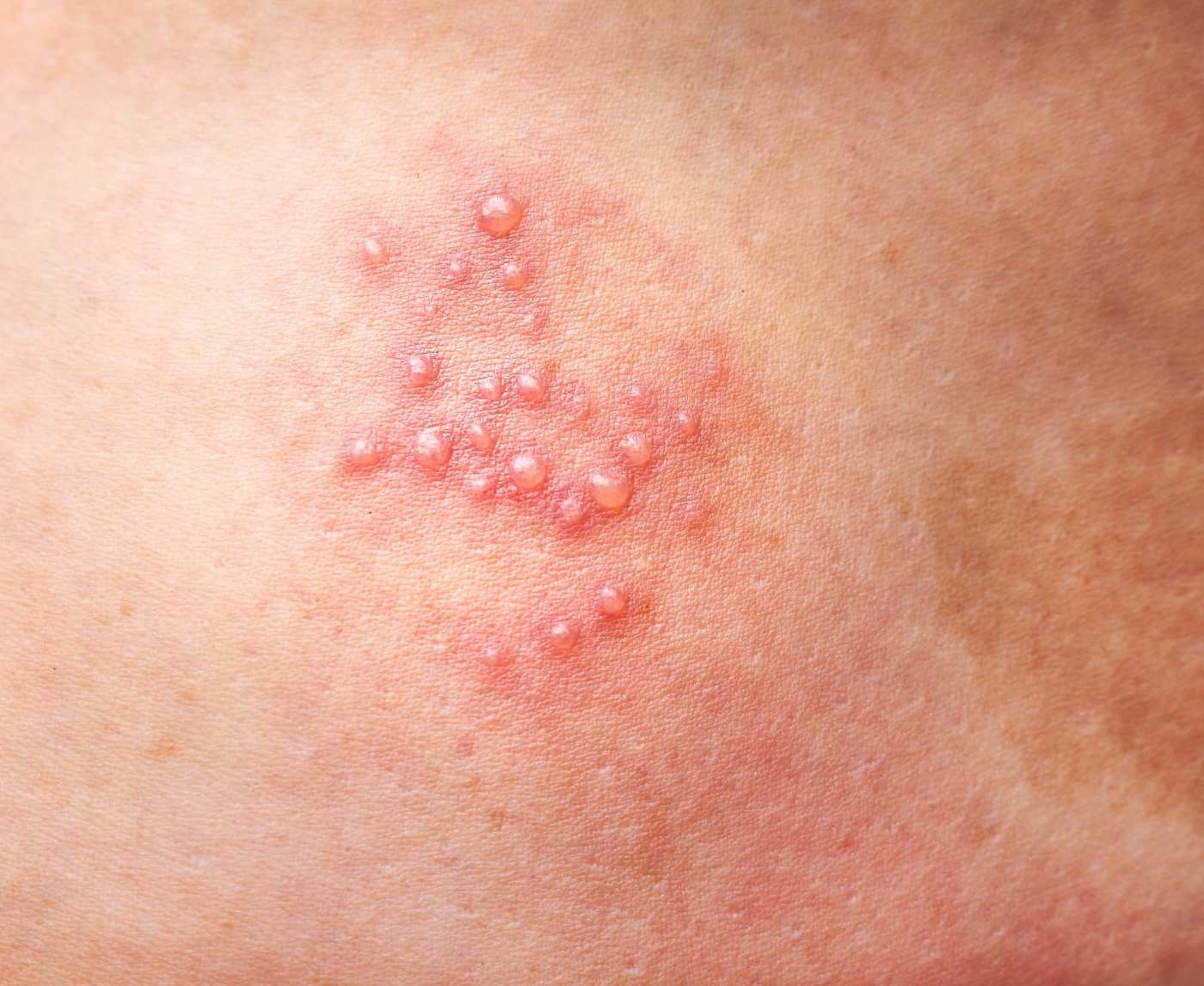
A typical herpes outbreak follows a predictable arc. About one to two days before any visible bump appears, many people feel tingling, itching, or a faint burning sensation in the affected area. This prodrome stage is one of the strongest clues that what you are dealing with is herpes rather than friction. The Mayo Clinic's genital herpes page describes this prodromal period as a recognizable warning sign for people who have had previous outbreaks.
One to three days after the tingling starts, small clear-fluid-filled blisters appear. These vesicles often cluster in groups of three to five, although a single lesion is also possible, especially in recurrent episodes. Over the next several days the blisters break open, leaving shallow ulcers that crust over and heal without scarring in most cases. The full cycle from tingle to fully healed runs roughly 7 to 14 days for a recurrent outbreak per the Mayo Clinic, and longer for a first outbreak. Ingrown hairs do not follow this staged progression. They get inflamed, drain or resolve, and they are done.
Side-by-side: the timing and pattern differences
The table below summarizes the most useful clinical and behavioral differences between the two conditions. The most reliable distinguishing features are the prodromal tingling, the staged blister-to-crust progression, and the recurrence pattern in the same anatomic spot. Appearance alone rarely settles the question.
| Feature | Ingrown hair / folliculitis | Genital herpes |
|---|---|---|
| Onset | Within 1 to 2 days of shaving, waxing, or friction | 2 to 12 days after exposure or reactivation |
| Warning signs before bump appears | None | Often tingling, itching, or burning 1 to 2 days before |
| Pain pattern | Mild local tenderness | Burning sensation, often worse with urination |
| Appearance over time | Single red bump, sometimes with visible hair or whitehead | Cluster of small clear blisters that break, ulcerate, then crust |
| Healing time | 3 to 7 days, no scab phase | 7 to 14 days for recurrence, with distinct scab stage |
| Recurrence | Only with continued shaving in the same area | Often recurs in the exact same spot every few months |
| Systemic symptoms | None | Possible fever, body aches, swollen lymph nodes (first outbreak) |
When to test, and how the timing math works
Two factors decide which test is worth ordering and when. The first is whether you have an active visible lesion. The second is how long ago the suspected exposure happened.
If you have an active blister or ulcer right now, a swab-based PCR test of the lesion is the most definitive option, and it is most reliable in the first 48 to 72 hours after the lesion appears. After that the lesion begins healing and the viral load detectable by swab drops sharply. This kind of test is typically done in a clinic.
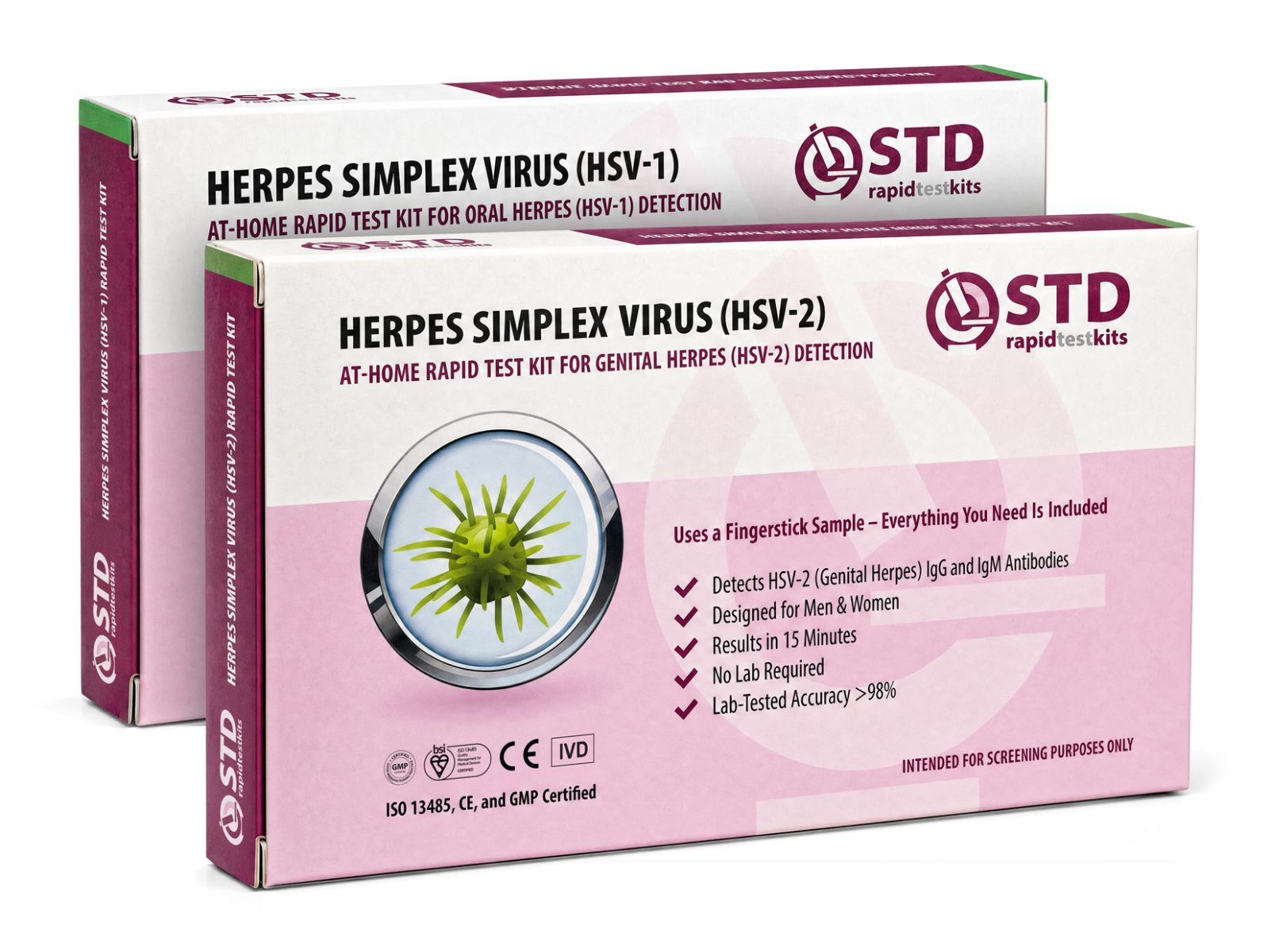
If the lesion has already healed, or you never had a visible lesion but want to know your status after a possible exposure, the relevant test is a blood antibody test for HSV-1 or HSV-2. Antibodies take time to develop after a new infection. The CDC's herpes treatment guidelines recommend repeat type-specific antibody testing 12 weeks or more after the presumed time of acquisition. Testing earlier than that risks a false negative because your immune system has not yet produced the antibodies the test is looking for. (Disclosure: stdrapidtestkits.com sells the at-home antibody kit described below; product recommendations reflect test-type fit, not commercial priority.)
Yes, oral sex really can transmit genital herpes
Herpes simplex virus type 1, traditionally associated with cold sores around the mouth, is now a common cause of new genital herpes infections, particularly in people under 30. The mechanism is simple: oral-to-genital contact transfers the virus from the mouth of one partner to the genitals of another. Per the World Health Organization, transmission can happen even when no visible cold sore is present, because the virus sheds intermittently from the lips and oral mucosa without symptoms.
That means a red bump near your genitals after oral sex, even brief contact and even with no penetration, is biologically plausible as a herpes lesion. Recent shaving in the area increases the risk further because microscopic skin abrasions give the virus an easier route in. Brief skin contact in the genital area is enough for transmission to occur.
Asymptomatic shedding: HSV-1 sheds from the lips and oral mucosa even when no visible cold sore is present.
Recent shaving or waxing: microscopic abrasions in the genital skin give the virus an easier entry point.
Direct skin-to-skin contact: the virus does not need penetration, fluid exchange, or extended contact to transmit.
How visibility differs by anatomy
Both herpes and ingrown hairs occur across all anatomies, but where the lesion appears and how easy it is to see varies. In people with vulvas, herpes can appear inside the labia, vaginal opening, or on the cervix, where it is harder to see in a mirror. The first sign is often discomfort, burning, or a sharp localized pain like a paper cut, sometimes with painful urination as urine passes over the lesion. In people with penises, herpes typically appears on the shaft, scrotum, foreskin, or around the base, where it is more readily visible during showering or grooming.
For all anatomies, the prodromal tingling or itching usually starts before any visible lesion. If you have ever had a cold sore, the sensation is the same; only the location changes. That sensory cue is one of the most reliable clinical clues clinicians use to differentiate a herpes outbreak from straightforward friction or razor burn.

Why so many herpes cases never get diagnosed
Herpes is one of the most under-diagnosed sexually transmitted infections in the United States. According to the CDC's herpes overview, the majority of people with genital HSV-2 infection have not received a diagnosis, often because their symptoms were mild, were attributed to skin irritation, or did not appear at all. People who do not know they carry the virus can still transmit it to partners, particularly during periods of asymptomatic viral shedding.
The practical consequence is that a confirmed herpes diagnosis is often more about clarifying what is already true than about catching something new. Many people who test positive have been carrying the virus for months or years. The benefit of testing is access to antiviral medication that reduces outbreak severity and frequency, and the ability to have honest, informed conversations with current and future partners.
Most people with genital herpes do not know they have it. Many people who have genital herpes have very mild symptoms or do not have any symptoms at all. Health care providers can diagnose genital herpes by simply looking at symptoms, but they may also take a sample from a sore and test it.
Testing options compared
The right test depends on what you have to work with: an active lesion, a memory of an old encounter, or general peace-of-mind screening after a new partner. The table below summarizes the three main options.
| Test type | What it detects | Best timing |
|---|---|---|
| Lesion swab (PCR or culture) | Active virus shedding from a sore | Within 48 to 72 hours of the lesion appearing, before it crusts over |
| Type-specific blood test (IgG antibodies) | Past or established HSV-1 or HSV-2 infection | 12 weeks or more after suspected exposure for highest accuracy |
| At-home rapid antibody kit | HSV-1 and HSV-2 antibodies via fingerstick blood | 12 weeks or more after exposure or first outbreak; not for diagnosing an active lesion |
What a positive result means inside a relationship
A new herpes diagnosis inside a monogamous relationship can feel like a betrayal until the timeline is considered carefully. Herpes can lie dormant for years between outbreaks, and people regularly seroconvert long before they notice symptoms. A positive test today does not establish when the virus was acquired, only that it is present. The NHS guidance on genital herpes emphasizes this point: many partners discover one of them carries the virus only because the other has a first symptomatic outbreak, and neither person can pinpoint when transmission occurred.
Suppressive antiviral therapy, condoms during outbreaks, and avoiding skin-to-skin contact during prodromal symptoms substantially reduce transmission risk between partners. Many serodiscordant couples (one positive, one negative) live together for years without transmission. Testing both partners gives the relationship a real baseline to work from, and removes the guesswork that fuels resentment.
Bottom line: clarity beats spiraling
Most red bumps in the genital area are mechanical irritation, not infection. The features that should pull your attention toward herpes are tingling or itching that precedes the bump, clustered clear-fluid blisters rather than a single firm papule, a crust phase as the lesion heals, and recurrence in the same spot every few months. Anything that follows the ingrown-hair pattern (single bump, no warning sensation, resolves in a few days, no recurrence without continued shaving) is far more likely to be exactly what it looks like.
If the timing or pattern does not fit the ingrown-hair story, an at-home antibody test taken at the right window-period gives you a clear answer without a clinic visit. Knowing your status takes the bump off your mind and frees you to make practical decisions about partners and care.
Test now if
- The bump was preceded by tingling, itching, or burning a day or two before it appeared.
- Clear-fluid blisters appeared in a tight cluster, then opened into shallow ulcers and crusted over.
- A red bump has returned to the exact same spot two or more times without a clear shaving trigger.
- Wait and watch if the bump appeared within 1 to 2 days of shaving, has no warning sensation, and is resolving on its own within a week.
Frequently asked questions
- Can an ingrown hair really look like early herpes?
- Yes. In the first 24 to 48 hours, a single inflamed hair follicle and an early herpes papule can look almost identical. The clearer differences emerge over the next few days. Herpes typically progresses into clear-fluid blisters, then ulcerates, then crusts. Ingrown hairs stay as a single inflamed bump that drains or resolves without a scab phase. Timing relative to shaving and any tingling sensation beforehand are usually the most useful clues.
- Does herpes always come with pain?
- No. Pain levels vary widely. First outbreaks are often more painful and may include flu-like symptoms, while recurrent outbreaks can be barely noticeable. The CDC notes that many people with genital HSV-2 have very mild symptoms or none at all, which is part of why so many cases go undiagnosed. The absence of pain does not rule herpes out.
- How soon after a possible exposure can I test for herpes?
- The answer depends on whether you have a visible sore right now. For antibody testing without a visible lesion, the CDC's treatment guidelines recommend waiting 12 weeks or more after the suspected exposure before testing, because antibodies need that time to build up to detectable levels. If you have an active lesion right now, a clinic swab can be taken immediately, ideally within the first 48 to 72 hours after the lesion appears.
- Can oral sex transmit genital herpes even if there was no visible cold sore?
- Yes. HSV-1 sheds intermittently from the lips and oral mucosa even when no cold sore is visible, and the WHO confirms transmission can occur during these asymptomatic shedding periods. Brief oral-to-genital contact is enough, and recent shaving in the genital area increases the risk by giving the virus easier entry through microscopic skin abrasions.
- If I only ever get one bump, could it still be herpes?
- It can. Recurrent herpes outbreaks sometimes produce only a single lesion rather than the textbook cluster of vesicles. The pattern that should raise concern is recurrence: if the same single bump returns to the same anatomic spot every few months, especially with a tingling sensation beforehand, herpes is more likely than an unusually persistent ingrown hair.
- Do ingrown hairs form a scab the way herpes does?
- Usually not. Uncomplicated ingrown hairs resolve without a distinct crust phase, although they may leave behind a darker mark for several weeks. If an ingrown hair gets secondarily infected with bacteria, it can produce pus and a thin crust, but it does not follow the staged vesicle-to-ulcer-to-crust progression that defines a herpes outbreak.
- Should I pop the bump to figure out what it is?
- No. Squeezing a herpes vesicle spreads viral fluid across the skin and slows healing, and forcing an inflamed follicle increases the risk of bacterial infection. For genuine ingrown hairs, the Mayo Clinic recommends warm compresses and stopping shaving in the area for a week. If you cannot tell what the bump is, a swab or antibody test gives a real answer faster than self-surgery.
- What if my home test was negative but I still have symptoms?
- A negative antibody test taken too early after a recent exposure can miss a true infection because antibodies have not yet built up. If symptoms continue or recur, retest at the 12-week mark or later from the suspected exposure. If you have a visible active lesion, a clinic swab is more sensitive than an antibody test for confirming an active outbreak.
- U.S. Centers for Disease Control and Prevention. About Genital Herpes: prevalence, undiagnosed rates, transmission patterns, and symptom variability.
- U.S. Centers for Disease Control and Prevention. STI Treatment Guidelines for Genital HSV: diagnostic recommendations, antibody window period, and antiviral therapy options.
- World Health Organization. Herpes Simplex Virus Fact Sheet: HSV-1 and HSV-2 epidemiology, asymptomatic shedding, and oral-to-genital transmission.
- U.K. National Health Service. Genital Herpes: clinical presentation, recurrence patterns, and partner-management guidance.
- Mayo Clinic. Genital Herpes Symptoms and Causes: lesion progression, prodromal symptoms, and healing timeline.
- Mayo Clinic. Ingrown Hair Symptoms and Causes: typical presentation, healing pattern, and self-care recommendations.
- Mayo Clinic. Folliculitis Symptoms and Causes: clinical pattern, distinction from other follicular conditions, and treatment.
- Planned Parenthood. Herpes overview: patient-facing summary of symptoms, testing, and management.
