How Long Do STDs Live on Towels, Sheets, and Skin?
What surfaces pass on infections, what they do not, and when a test helps.



- Most STIs survive only minutes to a few hours outside the body, and infection through towels, sheets, toilet seats, or shared surfaces is documented as rare in real-world data.
- The genuine exceptions involve direct skin-to-skin genital contact, shared unwashed sex toys, and visible sores. Each has a clear testing window if you want certainty.
Published: December 2025 | Last updated: May 2026 | Editorial review and quality control: Martina N.
Maybe you didn't have penetrative sex. Maybe it was a damp towel left behind by a roommate, a shared blanket at a friend's place, or a hookup that ended in some skin contact and not much else. Now you are wondering whether a piece of fabric, a toilet seat, or a passing touch could have given you something. The short answer is almost always no, but the long answer is worth understanding so you can stop spiraling and start making clear-headed decisions.
Most sexually transmitted infections are surprisingly fragile outside the human body. They need warmth, moisture, and direct access to cells they can infect. A towel does not give them that, neither does a bench at the gym, and neither does a quick hug. There are a few narrow exceptions, and we will walk through them with concrete numbers, not surface-level reassurance, so you know exactly when to relax and when a test is worth the peace of mind.
Key Takeaways
- Most STIs survive only minutes to a few hours outside the body, and infection through towels, sheets, toilet seats, or shared surfaces is documented as rare in real-world data.
- The genuine exceptions involve direct skin-to-skin genital contact, shared unwashed sex toys, and visible sores. Each has a clear testing window if you want certainty.
Survival outside the body is not the same as transmission
This is the distinction that trips most people up. A virus or bacterium might technically stay viable on a surface for a few minutes or hours, but viability is not the same as the ability to cause an infection. To do that, the pathogen has to be present in a high enough quantity, reach the right kind of tissue (usually a mucous membrane or a small break in the skin), and avoid being killed by air, soap, dryness, or the immune defenses already on your body's surface.
Take herpes simplex virus. Lab studies suggest HSV can remain detectable on plastic or metal surfaces for a few hours under ideal conditions of warm temperature and residual moisture. But the U.S. Centers for Disease Control and Prevention notes that herpes is transmitted through direct skin-to-skin contact with an infected area, typically during oral, vaginal, or anal sex. The infectious dose required, plus the need for direct mucosal access, makes indirect transmission from a towel or seat vanishingly rare.
HIV is even more fragile. The virus loses the vast majority of its infectivity within minutes of being exposed to air, and any residual virus on a dry surface is not capable of causing infection through casual contact. CDC guidance lists the documented routes of HIV transmission as condomless sex with someone who has detectable HIV, sharing needles or syringes, and mother-to-child transmission during pregnancy, birth, or breastfeeding. Towels, sheets, toilet seats, and shared surfaces are not on that list, and there are no documented cases of HIV transmission through them.
Lab studies measure whether a pathogen is alive on a surface. Transmission requires a high enough dose reaching mucosal tissue before drying or air exposure kills it. The gap between those two thresholds is why real-world surface cases are documented as rare even when lab viability is measured in hours.
How long can each STD actually survive outside the body?
Below is a snapshot of what laboratory studies and public-health agencies report about surface survival times for the most common sexually transmitted infections. Two columns matter most. The "viable on a surface" column reflects whether the pathogen has been detected as alive in controlled experiments. The "real-world transmission risk" column reflects what happens in everyday life, where dryness, air exposure, the infectious dose required, and the need for mucosal contact dramatically reduce the chance of transmission.
Numbers like "up to 24 hours" or "up to several hours" come from optimal lab conditions: a specific temperature, a specific humidity, a specific surface material, and an inoculation dose far higher than what would realistically end up on a towel after normal use. In the messy real world, the practical survival time is usually a fraction of that, and the chance of enough live pathogen reaching the right tissue to cause infection drops to near zero.
| STI | Detected viable on a surface? | Surface survival in lab conditions | Real-world transmission risk via surfaces |
|---|---|---|---|
| Herpes (HSV-1 / HSV-2) | Yes, briefly | A few hours on moist surfaces | Very low. Spreads through direct skin-to-skin contact, not towels. |
| Trichomoniasis | Yes | Up to about 24 hours in moist conditions | Theoretical via shared wet items; documented surface cases are rare. |
| Chlamydia | Limited | Minutes to about an hour | No confirmed transmission through fabric or surfaces. |
| Gonorrhea | Limited | Up to a few hours in controlled lab conditions | Needs mucosal contact. No realistic risk from a towel or seat. |
| HIV | Very fragile | Loses most infectivity within minutes of air exposure | No documented transmission through towels, sheets, or skin contact. |
| HPV | Possible briefly on surfaces | Survival data is limited; transmission requires direct skin contact | Spreads through genital skin-to-skin contact, not shared fabric. |
Towels, sheets, underwear, and what fabric really does
Fabric, especially when warm and damp, can theoretically hold onto microorganisms for a short period. But "holds onto" is not the same as "transmits." Studies on Trichomonas vaginalis, the parasite that causes trichomoniasis, have shown the organism can remain viable on moist surfaces for several hours and, in some lab conditions, up to about 24 hours. The CDC describes trichomoniasis as transmitted through sexual contact, with surface transmission considered theoretical rather than documented in everyday life.
Why such a wide gap between "viable in a lab" and "almost never happens in real life"? Several things have to align. The pathogen has to remain in a quantity large enough to cause infection. It has to reach internal mucosal tissue, not external skin (the outer layer of dry skin is a strong barrier on its own). And it has to arrive there before drying, air exposure, or normal hygiene reduces it below the infectious dose. A damp towel that has been sitting for a few hours is already a much less hospitable environment than the original fluid was.
What can live on fabric long enough to matter? Pubic lice and scabies mites, which are parasites rather than classic STIs, can survive on bedding, towels, and clothing for one to three days. Both are treatable with over-the-counter or prescription topical medications, and laundering items in hot water plus a high-heat dryer kills them reliably. The NHS recommends washing affected fabrics at 50 degrees Celsius or higher when treating pubic lice.
- Enough viable pathogen has to remain on the fabric. Lab inoculation doses are far higher than what shows up on a normally used towel.
- It has to reach internal mucosal tissue. External dry skin is a strong barrier by itself.
- It has to get there before drying or air exposure reduces it below the infectious dose. Even on a damp towel, that window is short.
Skin contact, friction, and the difference between dry and intimate touch
Casual touch (a handshake, a hug, brushing past someone in a crowded room) carries essentially zero STI risk. STIs do not transmit through unbroken external skin. The pathogens involved need access to mucous membranes (the inside of the mouth, genitals, throat, or rectum) or to small breaks in the skin where they can encounter immune cells and replicate.
Skin-to-skin contact during sexual activity is different. Herpes simplex (HSV-1 and HSV-2), human papillomavirus (HPV), and syphilis during its primary chancre or secondary rash stage can all transmit through direct contact with infected genital, oral, or perianal skin, even without ejaculation or fluid exchange. This is why condoms reduce but do not eliminate the risk of these specific infections; the condom does not cover all of the potentially infectious skin. The CDC's overview of sexually transmitted infections categorizes these as the main skin-to-skin STIs.
Transmission still requires the right kind of contact. Friction during genital-to-genital rubbing, oral sex, or anal sex creates micro-abrasions and brings infectious skin into prolonged contact with mucosal tissue. A casual hand on a thigh, even through thin clothing, does not. Here is a rough breakdown of how various contact scenarios stack up against real transmission risk:
| Contact scenario | STI transmission possible? | Why |
|---|---|---|
| Hand-to-hand contact | Extremely unlikely | Unbroken skin is a strong barrier; no mucosal access. |
| Dry grinding through clothes | Low | Friction is present but barriers reduce direct skin contact. |
| Genital skin-to-skin rubbing without barriers | Moderate | Herpes, HPV, and syphilis can transmit if one partner is infectious. |
| Kissing someone with an active cold sore | Moderate to high | HSV-1 spreads readily through oral-to-oral contact. |
| Hug, handshake, brushing past in public | None | No mucosal contact and no infectious dose involved. |
| Sharing a damp towel right after use | Very low | Most pathogens are no longer viable in a usable quantity. |
Sex toys, showers, and shared bathrooms
Sex toys are the genuine exception to the "STIs do not really transmit on surfaces" rule. Unlike towels or counters, toys come into direct contact with internal mucosal tissue, hold moisture and fluids, and are sometimes stored in conditions that do not actively kill pathogens. Several STIs, including trichomoniasis, gonorrhea, chlamydia, and HPV, have been documented as transferable through shared toys that were not cleaned between users or between body sites.
If a toy is shared between partners or used on multiple body sites in one session, the safest practice is to put a fresh condom on the toy for each use, then wash with warm soapy water, and follow with a toy-safe disinfectant or a wipe of 70 percent isopropyl alcohol on hard non-porous surfaces. Porous materials (jelly, TPE, certain silicone blends) cannot be fully sterilized; if you share porous toys, condoms are the only practical barrier.
Showers, pools, and hot tubs are not realistic transmission environments. Water dilutes pathogens, chlorine and other pool disinfectants degrade them quickly, and skin contact under flowing water lasts seconds rather than the prolonged frictional contact STIs require. Shared locker rooms, gym benches, and saunas can carry skin fungi (athlete's foot, jock itch) and occasionally scabies, but these are not STIs and respond to topical antifungals or prescription scabicide.
Note: stdrapidtestkits.com publishes this article and sells the rapid at-home tests linked below. We recommend products based on fit for the reader's concern, not commercial benefit.
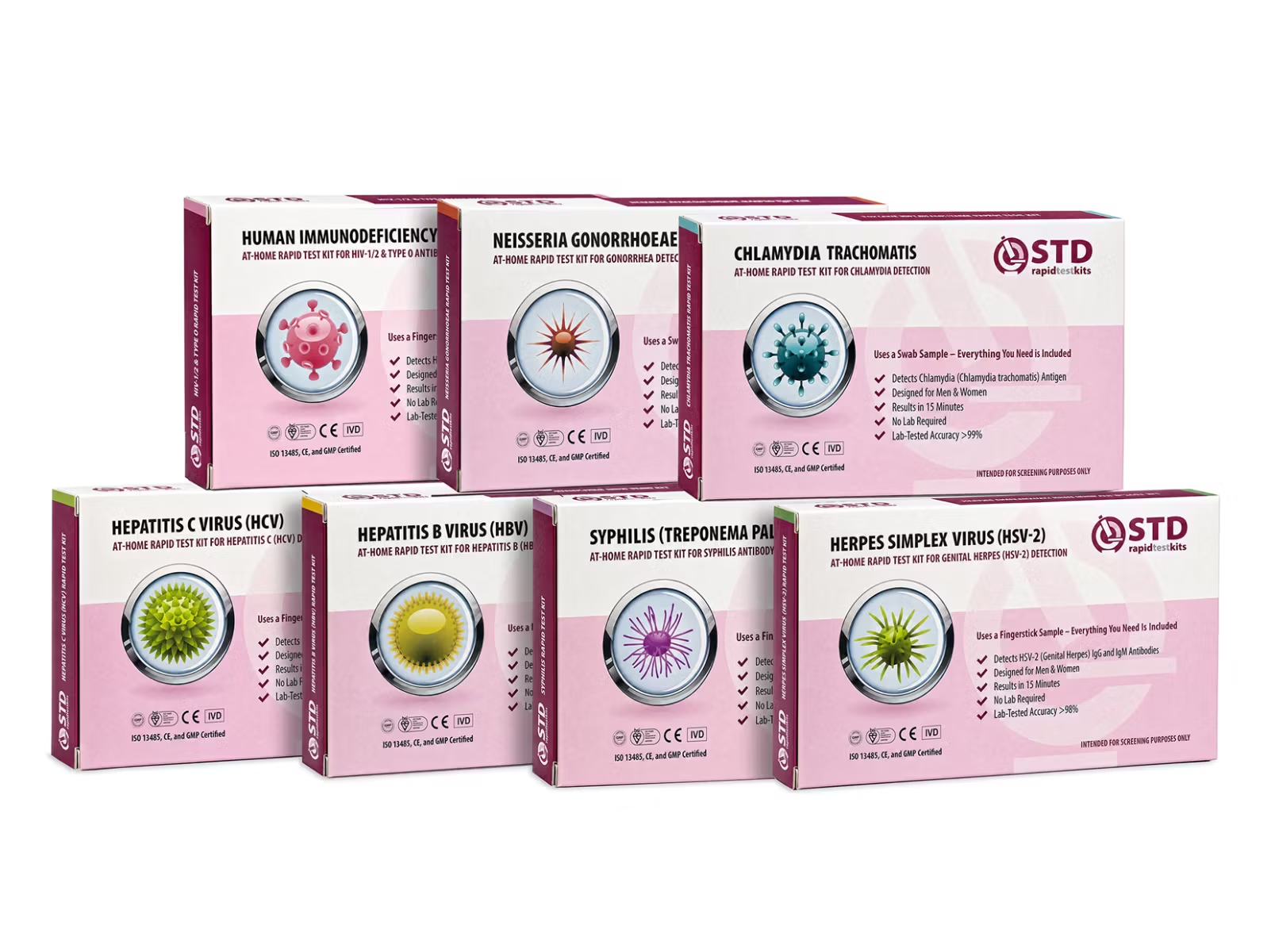
If a toy was used by another person and you used it shortly afterward without cleaning, treat that the same way you would treat unprotected sexual contact. The window-period table below applies, and a multi-infection screening panel after the appropriate wait is the cleanest way to get certainty.
Why some pathogens die fast and others linger
STIs fall into three broad categories: viruses (HIV, hepatitis B, hepatitis C, HSV, HPV), bacteria (chlamydia, gonorrhea, syphilis), and parasites (trichomoniasis, pubic lice, scabies). Each behaves differently once it is outside the human body.
Viruses like HIV and HSV have no protective outer wall of their own and depend entirely on host cells for replication. Without a living cell, they degrade quickly. HIV in particular is one of the most fragile STIs once exposed to air. Bacteria like Neisseria gonorrhoeae and Chlamydia trachomatis can survive slightly longer in controlled lab conditions, but they still rely on mucosal tissue to establish infection and rarely survive long enough on a dry surface to do that.
Parasites are the most surface-resilient. Trichomonas vaginalis (a single-celled parasite) can stay viable in moist environments for several hours, and pubic lice and scabies can persist on fabric and skin for one to three days. Even with parasites, though, the route of transmission usually requires direct contact rather than passive surface contact.
The factors that lengthen or shorten survival outside the body are predictable:
- Moisture: wet or damp surfaces support longer survival than dry ones.
- Material: smooth nonporous surfaces (plastic, silicone, metal) hold viable pathogens slightly longer than porous fabric.
- Temperature: warmth can briefly extend survival, but extreme heat (a high-heat dryer cycle) kills them.
- Sunlight and UV: destroys most pathogens quickly.
- Soap, alcohol, chlorine, and air exposure: all reduce viability fast. Standard household cleaning is enough.
You will not get herpes from toilet seats, bedding, or swimming pools. You also will not get it from touching objects, such as silverware, soap, or towels.
When to test after a worrying exposure
If a possible exposure has happened and you want certainty, testing is the answer. But testing too early can produce a falsely reassuring negative. Every STI has a "window period," the gap between when exposure happened and when a test can reliably detect the infection. Testing inside the window is not useless, but a negative result there should always be followed by a confirmatory test once the window has passed.
The windows below align with the CDC's 2021 STI Treatment Guidelines and current product-page guidance for at-home rapid lateral-flow tests. A few notes on how to read them:
- Bacterial infections (chlamydia, gonorrhea, syphilis) have shorter windows because they reproduce relatively quickly in mucosal tissue and become detectable within one to three weeks.
- Viral infections like HIV and herpes are detected through the body's antibody response, which takes longer to develop. A definitive antibody test is most reliable several weeks after exposure.
- Rapid lateral-flow tests are screening tools, not lab NAATs. They are quick and private and well-suited for an initial answer, but a clearly positive result is worth confirming with a lab test, and persistent symptoms deserve a clinic visit regardless of the rapid result.
If the timing of a possible exposure falls inside the window period for an infection you are worried about, you can take a baseline screening test now, and plan a confirmatory test after the window has cleared.
| STI | Recommended wait before testing | Why the wait matters |
|---|---|---|
| Chlamydia | About 1 to 2 weeks after exposure | Testing earlier risks a false negative as bacterial load is still low. |
| Gonorrhea | About 1 to 2 weeks after exposure | Needs enough mucosal infection to be detectable on a rapid screen. |
| Trichomoniasis | About 1 to 4 weeks | Parasite detection depends on organism load and sample timing. |
| Syphilis | About 3 to 6 weeks for antibody-based tests | Antibodies to T. pallidum take several weeks to rise. |
| Herpes (HSV-1 / HSV-2) | Swab a visible sore within days; antibody blood test reliable around 12 weeks | Antibody response takes weeks to months to fully develop. |
| HIV | Antibody rapid tests reliable around 90 days after exposure | Earlier antibody tests can miss recent infection; consider lab NAAT if urgent. |
How to clean, disinfect, and stop spiraling
Once the worry settles, a little focused hygiene is enough to handle almost any surface concern. Wash shared towels, sheets, pillowcases, and underwear in hot water with regular detergent. If you want extra reassurance, add bleach (for whites) or run a high-heat dryer cycle. The combination of detergent, heat, and time is what kills most pathogens, including pubic lice and scabies if those are a possibility.
For sex toys, clean immediately after use. Warm soapy water plus a toy-safe disinfectant works for hard non-porous materials (silicone, glass, stainless steel, ABS plastic). Porous toys cannot be fully sterilized and should be used with a fresh condom each time if shared. Battery-powered or motorized toys often cannot be submerged; check the manufacturer's instructions and wipe down with a 70 percent isopropyl alcohol cloth on the non-electrical surfaces.
For shared bathrooms, kitchens, and common surfaces, standard cleaning products are sufficient. Soap and water, alcohol-based wipes, bleach solutions, and hydrogen peroxide all break down the kinds of pathogens that might briefly be present. You do not need hospital-grade disinfection for a roommate's bathroom; you need consistent basic hygiene.
And then there is the emotional cleanup. Many people who land on an article like this are not just looking for a fact sheet; they are looking for permission to stop replaying the moment. The science gives that permission. If anything genuinely unsafe happened, testing after the appropriate window will give you a clear answer.
You are not "dirty," you are paying attention
The fact that you read this far is not paranoia; it is exactly the kind of curiosity that keeps people informed and helps them make decisions instead of stewing in fear. Most surfaces, most fabrics, and most casual contact are not how STIs spread. The contact that does spread them is well understood, and the testing windows for each infection are predictable.
If the worry came from genuine intimate contact, a test after the appropriate window is the cleanest way to know. If it came from a damp towel or a shared blanket, the data above is the answer. A single test after the right wait time gives you a definitive result and closes the question.
FAQs
- Can I really catch an STD from a shared towel?
- Realistically, no. Most STIs lose viability quickly once they are outside the body, and the quantity that ends up on a towel is far below what is needed to cause infection. The towel would also have to deliver the pathogen to a mucous membrane or a fresh skin break, which dry skin and normal use do not accomplish. Trichomoniasis has the longest documented surface survival in lab conditions, but real-world surface cases are rare.
- How long can herpes survive on bedsheets?
- HSV can stay detectable on moist surfaces for a few hours under ideal lab conditions. On a typical dry sheet, viability drops quickly. The CDC consistently describes herpes transmission as requiring direct skin-to-skin contact with an infected area, not contact with bedding. If you are worried about a specific exposure, a swab of a visible sore within days is the most direct test; a blood antibody test is most reliable around 12 weeks after possible exposure.
- Can I get chlamydia from sitting on a public toilet?
- No. Chlamydia trachomatis needs mucosal tissue (the inside of the genitals, throat, or rectum) to establish infection, and it does not survive long on cool dry surfaces like a toilet seat. There are no documented cases of chlamydia transmission from toilet seats.
- My partner used a sex toy then I did without cleaning it. Should I worry?
- Yes, more than you would for a towel. Sex toys are the genuine surface-transmission exception because they carry residual fluids directly to mucosal tissue. Trichomoniasis, gonorrhea, chlamydia, and HPV have all been documented as transferable through shared unwashed toys. Treat it like an unprotected sexual exposure: take a baseline screening test now if you want, and a confirmatory test after the window period has passed.
- Can I catch HIV from a surface or a shared drink?
- No. HIV is one of the most fragile sexually transmitted viruses outside the body. It loses most of its infectivity within minutes of air exposure, and it cannot be transmitted by surfaces, shared drinks, kissing, hugging, or casual contact. CDC guidance lists the documented routes as condomless sex with a partner who has detectable HIV, shared needles, and mother-to-child transmission.
- Is there any STI risk from a hot tub, swimming pool, or shared shower?
- Essentially none. Water dilutes pathogens, chlorine and other disinfectants degrade them quickly, and skin contact under flowing water lasts only seconds. Shared locker rooms can occasionally pass on skin fungi or scabies, but these are not STIs and are handled with topical treatments.
- I tested before the window period closed and got a negative. What now?
- A negative result inside the window period is not a clear result; it just means the infection had not yet become detectable when you sampled. The fix is to repeat the test once the window has fully passed. The specific wait time for each infection is in the testing-window table above. If symptoms appear at any point, a clinic visit takes priority over waiting out the window.
- Does washing clothes really kill STIs and parasites?
- Yes. Hot water plus detergent plus a high-heat dryer cycle reliably kills the pathogens that occasionally end up on fabric, including pubic lice and scabies mites. You do not need bleach for most loads; bleach is an extra layer if you are dealing with parasites. The NHS specifically recommends washing affected fabrics at 50 degrees Celsius or higher when treating pubic lice.
- U.S. Centers for Disease Control and Prevention. Genital herpes overview covering HSV-1 and HSV-2 transmission and the explicit statement that herpes is not caught from toilet seats, bedding, swimming pools, or touching objects like silverware, soap, or towels.
- U.S. Centers for Disease Control and Prevention. How HIV is transmitted, including documented routes and clarification that surface or casual contact does not transmit HIV.
- U.S. Centers for Disease Control and Prevention. Trichomoniasis overview describing sexual contact as the route of transmission.
- U.S. Centers for Disease Control and Prevention. About Sexually Transmitted Infections, with categories of STI transmission including skin-to-skin and fluid-based routes.
- U.S. Centers for Disease Control and Prevention. 2021 STI Treatment Guidelines home page, used here for window-period and testing-cadence guidance.
- U.K. National Health Service. Pubic lice treatment guidance, including the recommendation to wash affected fabrics at 50 degrees Celsius or higher.