Published: August 2025 | Last updated: May 2026 | Editorial review and quality control: Martina N.
You called the clinic and got a recorded message. The next available appointment is three weeks out. Or you walked in and the wait pushed you back into your car. The door you needed is shut, and the worry behind your reason for going is not.
This guide is for that moment. It walks through which at-home tests exist, what each one actually detects, how long after a possible exposure they start giving a useful answer, and what to do once a result is sitting in your hand. The aim is not replacement for a clinic visit. It is a way to take a useful first step while you wait for one or while you decide whether you still need to book one at all.
Key Takeaways
- At-home rapid tests deliver a result in 15 to 20 minutes. Fingerstick blood is used for HIV, syphilis, hepatitis, and herpes; a self-collected swab is used for chlamydia, gonorrhea, and trichomoniasis.
- The window period for each infection matters more than the brand on the box. A negative result taken before the window closes is not yet a final negative.
Why Clinic Access Got Harder, and Who Feels It Most
Public-health STI clinics have been under strain for several years. Funding for state and local STI programs has not kept pace with rising case counts, and the U.S. has lost a meaningful share of its Disease Intervention Specialist workforce in recent budget cycles, which narrows clinic capacity at the same time as cases climb (CDC STI surveillance overview). Reported cases of chlamydia, gonorrhea, and syphilis sit at historically high levels in the most recent CDC surveillance data, while clinic appointment availability in many counties has not expanded to match.
The closures and reduced hours are not evenly distributed. Rural counties often sit more than an hour from the nearest dedicated STI clinic. Shift workers cannot reach a 9-to-5 clinic without losing pay. College students without cars rely on student health, which routinely runs a multi-week wait at the start of a semester. People with anxiety about being seen at a small-town clinic, or people whose previous clinic visits ended badly, may quietly skip the appointment altogether.
Waiting is not free. A delay between exposure and treatment can let a bacterial infection get worse, can extend the period when transmission to a partner is possible, and, for some infections, can make the eventual treatment more complicated. The point of an at-home test is to give you another door when the first one is closed; it does not replace the medical system you may still need afterward.
Reported cases of syphilis (including congenital syphilis) and gonorrhea sit at multi-decade highs in the most recent CDC STI surveillance summary, while many state and local STI programs report flat or shrinking budgets. The result is more demand chasing fewer publicly funded clinic slots, especially outside large metro areas.
What At-Home STI Testing Actually Looks Like
There are two distinct paths once you decide to test from home, and they are easy to confuse.
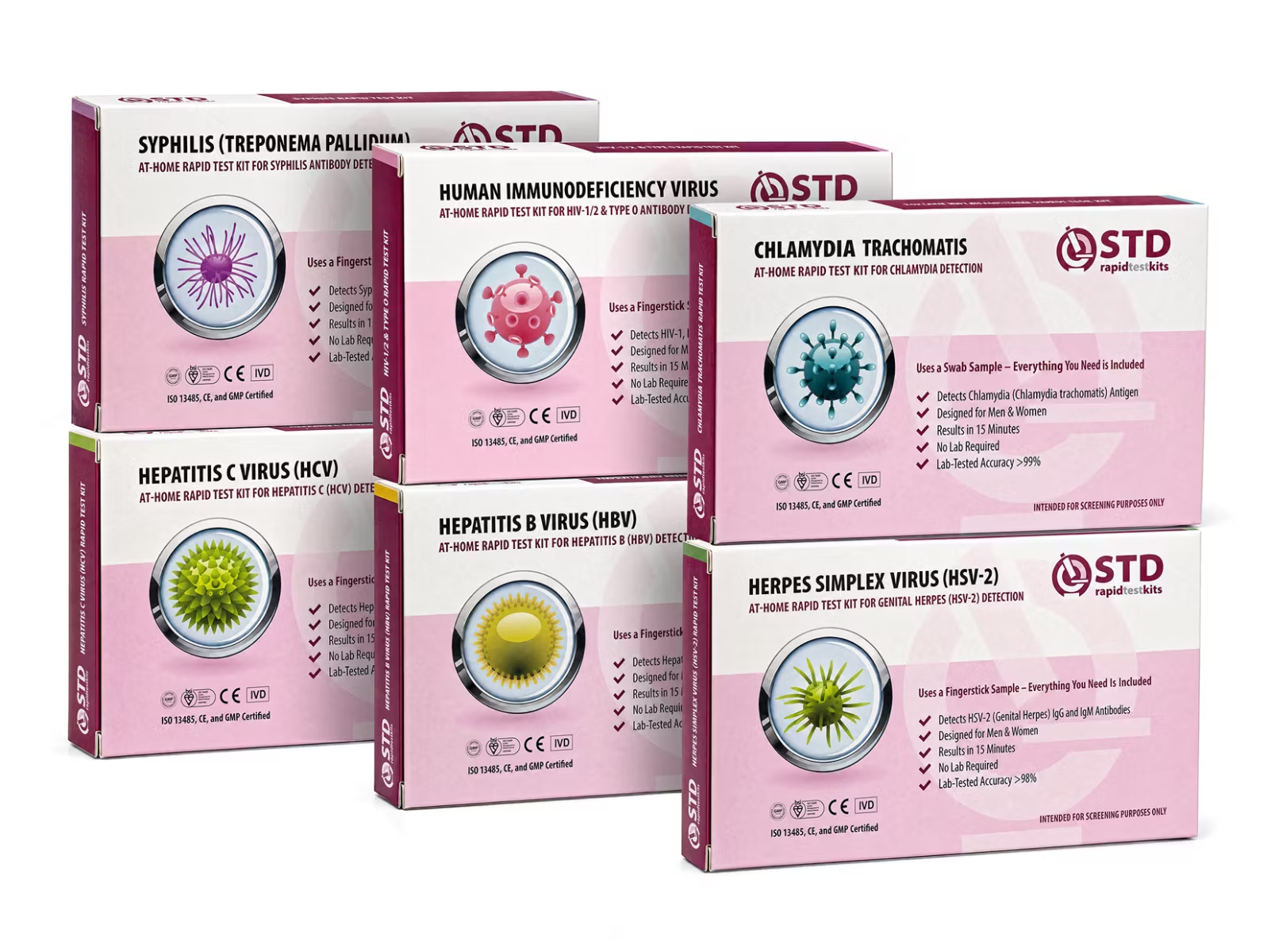
The first is a rapid lateral-flow test that you read at home. You collect a small fingerstick blood drop or a self-collected swab, drop it onto a test cassette with a buffer, and read the result roughly 15 to 20 minutes later. These are screening tests. They use the same lateral-flow chemistry that has run home pregnancy tests for decades, applied to STI antigens or antibodies. They are not the same chemistry as a laboratory NAAT (the gold-standard test for chlamydia and gonorrhea), and their analytical sensitivity is meaningfully lower than a lab test, especially in early infection. They are useful for two reasons: they are private, and they are fast.
The second is a mail-in collection kit sold by some third-party services. You collect the sample at home and ship it to a lab; the lab runs a NAAT or another lab-grade assay; results come back in 2 to 5 days. The FDA has now granted marketing authorization for the first at-home collection kit for chlamydia, gonorrhea, and trichomoniasis (FDA marketing authorization, 2023), and several other at-home collection services exist for additional infections.
Our store sells the rapid lateral-flow kits described in the first path. We do not sell mail-in lab collection kits. If your situation calls for an FDA-authorized lab NAAT (for example, you need a result that is acceptable in a clinical setting or you are trying to confirm an ambiguous lateral-flow reading), a third-party mail-in service or a clinic visit is the right route, and we will say so plainly.
| Path | Sample | Where the result is read | Result speed | Best for |
|---|---|---|---|---|
| Rapid lateral-flow at home | Fingerstick blood or self-collected swab | Cassette read at home | 15 to 20 minutes | Private screening, fast first answer |
| Mail-in lab NAAT (third-party) | Self-collected sample shipped to a lab | Online portal | 2 to 5 days | Higher analytical sensitivity, lab-grade documentation |
| Clinic visit | Provider-collected sample to a lab | Provider portal or visit follow-up | Hours to days | Symptoms, treatment in the same visit, pregnancy |

Window Periods, the Most Important Number on the Box
Every STI has a window period: the time between possible exposure and the point at which a test can reliably detect the infection. Test before that window closes and a negative result is not yet final. The window depends on what the test is looking for (the pathogen itself, an antigen the pathogen produces, or your antibody response to the pathogen) and it differs from one infection to the next, per published CDC window-period and screening guidance.
A few practical anchors. Chlamydia and gonorrhea NAATs in a lab can typically detect infection from about 1 to 2 weeks after exposure; the rapid lateral-flow swab needs closer to 2 weeks for a reliable read. HIV antibody tests from a fingerstick typically detect seroconversion from about 3 weeks, with most infections detected by 12 weeks; lab antigen-antibody combo tests close that window earlier, often around 18 to 45 days. Syphilis treponemal antibody tests start to detect from roughly 3 weeks, with reliable results by 6 weeks. HSV-2 antibody tests can take 2 to 16 weeks to turn positive, with a median around 6 weeks.
A test taken inside the window is still useful: it gives you a baseline. A reactive (positive) result inside the window is meaningful and should be confirmed. A non-reactive (negative) result inside the window is not yet final, and a retest after the window closes is the responsible follow-up.
| Infection | Earliest reliable detection (rapid at-home) | Best detection window |
|---|---|---|
| Chlamydia (swab) | About 14 days | 14 days and beyond |
| Gonorrhea (swab) | About 14 days | 14 days and beyond |
| Syphilis (blood antibody) | About 3 weeks | 6 weeks and beyond |
| HIV (rapid antibody) | About 3 weeks | 12 weeks for full sensitivity |
| HSV-2 (blood antibody) | About 3 weeks | 6 to 16 weeks |
| Hepatitis B (HBsAg) | About 4 weeks | 6 to 12 weeks |
| Hepatitis C (antibody) | About 8 weeks | 11 weeks median, up to 6 months |
How soon after exposure can a rapid at-home STI test give a useful answer?
Rapid at-home swab tests for chlamydia and gonorrhea give a useful answer from about 14 days after exposure. Rapid blood tests for HIV and syphilis are typically reliable from about 3 weeks, with peak sensitivity at 6 to 12 weeks. Tested earlier than that, a clear (negative) result is a baseline, not a final answer; plan a retest after the window closes.
Should You Test Now or Wait?
The right answer depends on how many days have passed since the exposure that worries you. Three rough zones help.
Inside the first week. A rapid test now will mostly tell you about your status before this exposure. Take it if a clear baseline will help you sleep, but plan a follow-up test once the relevant window has closed.
Two to four weeks out. Swab tests for chlamydia and gonorrhea become useful in this range. Blood antibody tests for HIV and syphilis start giving meaningful results, though acute HIV infections in this window are why CDC recommends a 12-week confirmation test. If only one infection worries you, target it; if multiple infections are in play, a multi-infection rapid kit is more efficient than running individual ones.
Six weeks and beyond. Most rapid blood antibody tests are at or near peak sensitivity. This is the right time for a definitive HIV antibody and syphilis check, and a useful time for HSV-2 and hepatitis B if those came up in the same exposure.
Visible symptoms within two weeks of an exposure (genital pain, ulcers, unusual discharge, fever, pelvic pain) deserve an in-person clinical exam, not a self-test in isolation. The same is true if you are pregnant, regardless of symptoms. An at-home test is fine to run alongside a clinic visit, but it should not be the only data point in those situations.
Reading a Positive Result, the Next Hour and the Next Day
A reactive line on a rapid test does two things at once. It gives you information you can act on. It also lands hard. Both are normal.
The first practical step is to confirm. A reactive lateral-flow test should be followed up with a confirmatory lab test before treatment decisions are made on it alone. For HIV, the confirmation pathway is typically a lab antigen-antibody combo plus a differentiation assay. For syphilis, a non-treponemal titer (RPR or VDRL, blood tests that measure disease activity) plus a treponemal confirmation test (which detects antibodies specific to the syphilis bacterium). For chlamydia or gonorrhea, a NAAT collected at a clinic or via a mail-in lab kit. Several telehealth services now accept a photograph of an at-home test result and will order the confirmatory lab themselves.
The second step is treatment. Most bacterial STIs clear with one or two doses of an antibiotic. Herpes is managed with antiviral medication. HIV is treated with antiretroviral therapy that, when started early and taken consistently, brings the virus to an undetectable level and removes the risk of sexual transmission to partners (CDC HIV basics). Hepatitis B and C have specific treatment paths that depend on whether the infection is acute or chronic.
The third step is partner notification. Several free anonymous notification tools exist; clinics and many telehealth services can help with the conversation if it is hard to start. The framing that helps most readers: telling a partner is not a confession, it is information your partner needs in order to take care of themselves.
- Confirm. Send the result to a clinician or telehealth service so they can order a confirmatory lab test.
- Treat. Start the medication your clinician prescribes for the specific infection.
- Notify. Tell recent partners so they can test and treat in parallel; anonymous notification services can carry the message if direct contact is not safe.
Retesting Without Spiraling
Two common retest mistakes inflate anxiety without adding clarity.
The first is retesting too soon after treatment for a bacterial STI. Antibiotics clear the infection, but residual bacterial DNA can persist in the urogenital tract for weeks and may show up on a sensitive NAAT. Clinicians generally recommend waiting at least 3 to 4 weeks after completing treatment for chlamydia or gonorrhea before a test of cure is meaningful, to allow residual DNA from killed organisms to clear from the specimen. CDC also recommends a routine repeat test about 3 months after treatment because reinfection from an untreated partner is common (CDC, next steps after a positive test).
The second is retesting before the window has closed. A second negative result on day 14 does not give you more confidence than the first one did; the same window applies to both tests. The right second test is taken after the window closes, not before.
If anxiety is louder than your symptoms, that is a real signal worth respecting. It often does not mean the answer is more tests. It means the answer is one well-timed test plus a conversation with a clinician about what the test result actually rules in or out.
Privacy: What Actually Arrives at Your Door
At-home rapid kits ship in plain padded mailers. There is no medical branding on the outside; the return address typically reads as a generic shipping or fulfillment label. The kit itself is inside an unmarked inner box. None of the outer packaging identifies what the kit screens for.
Result handling is your call. The cassette is read by you in your home. There is no automatic patient portal, no clinic record, no medical-billing line item. If you bring a result into a clinic for confirmation or follow-up, that is your decision, not a default.
For people who live with parents, roommates, partners they are not ready to talk to, or in conservative communities and small towns where being seen entering a sexual-health clinic carries social weight, that privacy is not a marketing perk. It is the thing that makes the test possible at all.
Plain mailer on the outside. No clinic record on the inside. No medical-billing line item. No automatic patient portal. The result is read by you in your home, and any further sharing is your choice.
Why Some People Skip Clinic Visits Entirely
Three patterns show up over and over in patient stories shared in public-health surveys and in advocacy reporting on STI testing access.
The logistics pattern. Hours, transit, parking, time off work, childcare. None of these are about shame. They are about the gap between when a clinic is open and when a person's life can fit a clinic visit in. An at-home test that can be ordered at 11 p.m. and run on a Saturday morning closes that gap.
The privacy pattern. Small-town clinic staff who are also a cousin, a neighbor, a teacher. A partner who would notice a clinic charge on a shared insurance statement. A parent who would notice a missed afternoon. Privacy concerns are not paranoia; they are realistic risk assessments of what disclosure would cost.
The past-experience pattern. A previous clinic visit where a symptom was dismissed without testing, where a provider made an assumption, or where the visit ended with a wrong diagnosis. People who have had that experience do not return easily, and many do not return at all. An at-home test is one route back into the loop on their own terms.
| Reason for skipping a clinic visit | What an at-home rapid kit changes |
|---|---|
| Clinic hours conflict with work shifts | Order any time, run the test on your schedule |
| Fear of being recognized in a small community | Plain unbranded packaging, result read at home |
| Past dismissive clinic experience | The reading is yours; you choose the next step |
| Distance from the nearest STI clinic | Ships to a residential address, no drive required |
| Insurance billing concerns | Single fixed price, no claim filed, no shared statement |
Take the First Step Without Waiting for Permission
You do not need a clinic to give you permission to start. An at-home kit is a first step; the work is matching the right test to the right window and acting on the result.
If a possible exposure is recent, mark a calendar reminder for the day the relevant window closes and plan the retest before you forget. If symptoms are present, see a clinician (telehealth or in-clinic) and use the at-home result as a parallel data point, not a replacement for an exam. If anxiety is the primary symptom and the exposure is well past the window, take the well-timed test and stop running additional ones until something changes.
If today's clinic appointment is not available, an at-home rapid kit can give you a useful first answer while you wait. Plan the retest for the day the relevant window closes, and book the clinic visit you may still need for confirmation, treatment, or symptoms that do not match a clean test result.
Many sexually transmitted infections have no symptoms, so the only way to know your status is to get tested.
FAQs
- Can I trust a test I run in my own bathroom?
- Yes, when the kit is from a manufacturer with FDA clearance or CE marking and you run it inside its intended window period. The chemistry of a good lateral-flow test is the same chemistry that has been used in pharmacy pregnancy tests for decades, applied to a different target. The two ways an at-home result goes wrong most often are user technique (the swab was not held in place long enough, the buffer was diluted, the result was read outside the read-time window) and timing (the test was run before the window closed). Read the instructions, set a timer, and time the test relative to your exposure date.
- How soon after sex can I take an at-home test?
- It depends on the infection. Swab tests for chlamydia and gonorrhea become useful from about 14 days after exposure. Rapid blood tests for HIV and syphilis become useful from about 3 weeks, with peak sensitivity at 6 to 12 weeks. HSV-2 antibody tests can take 2 to 16 weeks to turn positive. Testing earlier than the relevant window gives you a baseline; the result is not a final clear until the window has passed.
- What if my test is negative but I still feel something is wrong?
- Trust the symptom and follow up. A negative at-home test does not rule out every cause of a symptom and does not rule out infections still inside their window period. If a symptom (pain, sore, unusual discharge, persistent itch) is present, see a clinician. If the symptom is absent and the test was run before the window closed, plan a retest after the window. The test is a screening tool, not a diagnosis.
- Do I need to tell a partner if my test is positive?
- Yes. The framing that helps most people is that the conversation is not a confession; it is information your partner needs to take care of themselves. Free anonymous notification tools exist (Tellyourpartner.org and similar services), and some telehealth providers can help with the conversation. Telling a partner faster makes their treatment faster and lowers the risk of reinfection coming back to you.
- How does a rapid at-home test actually work?
- A lateral-flow rapid test uses an antibody-coated test strip. You collect a fingerstick blood drop or a self-collected swab and apply it to the cassette with a buffer. The buffer carries your sample across the strip; if the target antibody (or antigen) is present, it binds to a colored reagent and produces a visible test line. A separate control line confirms the test ran correctly. The whole reaction takes 15 to 20 minutes.
- Will the package look like an STD test?
- No medical branding, inside or out. The outer mailer is a plain padded envelope with a generic sender label, so no one handling the package or seeing it on a porch can tell what is inside. The kit components are clearly labeled once you open the inner packaging, so you can tell which kit is which when you go to run it.
- Is at-home STI testing safe during pregnancy?
- Yes, and CDC recommends STI screening in pregnancy specifically because untreated STIs can affect the pregnancy. If you are pregnant and test positive on an at-home kit, share the result with your prenatal-care provider. Your provider will confirm with a clinic-grade test and treat with pregnancy-appropriate medication; many treatments for the most common bacterial STIs are pregnancy-safe (<a href="https://www.cdc.gov/sti/testing/index.html" target="_blank" rel="noopener">CDC STI testing guidance</a>).
- Is at-home testing cheaper than a clinic visit?
- Often, yes, especially for people without insurance or with high-deductible plans. A clinic visit can include an exam fee, a lab fee, and a follow-up fee; the at-home kit is a single fixed price. Some plans cover at-home kits through HSA or FSA accounts. The cost worth weighing is not just dollars: time off work, transit, and follow-up appointments often add up to more than the kit itself.
This guide draws on current testing and screening guidance from the U.S. Centers for Disease Control and Prevention, the U.S. Food and Drug Administration, and the Mayo Clinic. Window-period figures match published CDC and CDC-cited data; the rapid at-home kits described are lateral-flow immunoassays, not laboratory NAATs, and we say so where the difference matters for the reader's decision.
- U.S. Centers for Disease Control and Prevention. Sexually Transmitted Infections Surveillance, used here for current U.S. case-rate context.
- U.S. Centers for Disease Control and Prevention. Getting Tested for STIs, used here for who should test, sample types, and screening pathways referenced in the FAQ.
- U.S. Centers for Disease Control and Prevention. Next steps after testing positive for gonorrhea or chlamydia, used here for the 3-month repeat-test recommendation after a positive result.
- U.S. Centers for Disease Control and Prevention. Screening Recommendations Referenced in STI Treatment Guidelines, used here for routine screening frequency and treatment-guidelines context.
- U.S. Centers for Disease Control and Prevention. HIV Basics (testing, treatment, undetectable equals untransmittable), used here for HIV treatment and U=U context.
- U.S. Food and Drug Administration. Marketing authorization for the first at-home test for chlamydia, gonorrhea, and trichomoniasis, used here for the regulatory context of mail-in collection kits.
- Mayo Clinic. STD Testing Overview, used here for general background on screening pathways and follow-up.
