
Published: December 2025 | Last updated: April 2026 | Editorial review and quality control: Martina N.
The absence of a warning is not the same as the absence of risk. Public-health dashboards are slow, partner notifications get ghosted, contact-tracing budgets are thin, and many of the most common sexually transmitted infections cause no symptoms at all in the people carrying them. If you have had a new partner, a condom failure, or any encounter that left a question mark in your head, the right time to think about testing is now, rather than after a headline tells you so.
Should I test for an STI even when I have no symptoms and no one warned me about exposure?
In most cases, yes. Chlamydia, gonorrhea, trichomoniasis, and early HIV often produce no noticeable symptoms, and the CDC recommends routine STI screening for sexually active adults plus targeted testing after any new partner or unprotected encounter. For most bacterial STIs a test is reliable from roughly two weeks after exposure; HIV and syphilis need 6 to 12 weeks for highest accuracy. Public surveillance data lags reality by months, so your awareness of what happened, rather than a public alert, is the more useful trigger.
Key Takeaways
- Most common STIs are silent: chlamydia, gonorrhea, and early HIV often cause no noticeable symptoms, so feeling fine is not evidence of being infection-free.
- Test timing decides whether the result is meaningful: bacterial STIs become detectable around two weeks post-exposure, while HIV and syphilis need 6 to 12 weeks for a reliable read.
When Public Data Goes Quiet, the Risk Stays Loud
STI surveillance is built to track the past, not the present. State and county health departments report case counts to the CDC on a quarterly cycle, and the most recent published numbers you see in a dashboard may already be six to nine months behind what is happening in your community right now. Clinics that lose funding stop testing. Lab reporting backlogs hide recent spikes. Not every diagnosis gets logged, and not every positive case ends with the patient calling former partners.
The result is a quiet dashboard that looks reassuring without being accurate. A college town with declining chlamydia counts can mean fewer infections, or it can mean fewer students testing because the campus health center cut hours. A neighborhood with no reported gonorrhea cluster may simply be a neighborhood where stigma keeps people out of clinics. Surveillance methodology notes published alongside CDC annual STI reports acknowledge gaps in testing access and reporting consistency as ongoing factors that limit how well the data reflect real-time risk (CDC STI surveillance overview).
Real protection comes from your own awareness, not from a county map. When the public reporting system runs slow, the most reliable risk signals are the ones you can generate yourself: who you have been with, what protection you used, and what your body has been doing in the days and weeks since.
STI surveillance data is reported on a quarterly cycle, with additional lab and clinic-level lag stacked on top. The most recent published case counts in a county or state dashboard may sit six to nine months behind current community transmission, and unfunded or backlogged clinics often go uncounted entirely.
No Symptoms Does Not Mean No Infection
The biggest reason people delay testing is the assumption that an infection would announce itself loudly. It usually does not. Public-health agencies describe many STIs as silent for a clinical reason: the body's immune response often stays small enough that nothing feels off.
CDC's published guidance on chlamydia describes the infection as frequently asymptomatic and notes that it can cause serious health problems even without symptoms, which is why screening rather than symptom watching is the only reliable way to detect it (CDC About Chlamydia). Most pharyngeal and rectal gonorrhea infections are also asymptomatic. Trichomoniasis frequently produces no noticeable symptoms in carriers. Even acute HIV can present as a vague, flu-like episode that fades in a week and gets blamed on stress or seasonal allergies.
The downstream consequence is significant. The WHO estimates that more than one million curable sexually transmitted infections are acquired worldwide every day, and the bulk of onward transmission happens from people who do not know they are carrying anything (WHO STI fact sheet). The reasoning loop is unforgiving: if symptoms are the only trigger to test, an entire population of asymptomatic infections never gets caught.
If you have ever told yourself, "I would know," that is the assumption to retire. Knowing requires data, and data here means a test taken at the right time, rather than the way your body feels on a Tuesday morning.
How quietly STIs travel
- Chlamydia is frequently asymptomatic and can cause serious health problems even without symptoms, per CDC guidance.
- Most pharyngeal and rectal gonorrhea infections produce no noticeable symptoms.
- Trichomoniasis often presents with no noticeable symptoms in carriers.
- Acute HIV may show as a brief flu-like episode that resolves in a week and is easily mistaken for a virus.
Window Periods: Why Timing Decides Whether the Test Works
Every STI has a window period, the time between exposure and the earliest moment a test can reliably detect it. Test before the window closes and you can get a falsely reassuring negative; test inside the most reliable band and the result actually means something. The numbers below track CDC and NHS clinical guidance and represent the typical detection windows for the assays used in both lab and at-home testing (NHS STI overview).
| Infection | Earliest reliable test | Most reliable testing window |
|---|---|---|
| Chlamydia | About 7 to 14 days | 2 weeks after exposure |
| Gonorrhea | About 7 to 14 days | 2 weeks after exposure |
| Trichomoniasis | About 7 to 14 days | 2 to 4 weeks after exposure |
| HIV (4th-gen Ag/Ab lab assay) | About 18 to 45 days | 45 to 90 days for highest accuracy |
| HIV (rapid antibody test) | About 23 to 90 days | 12 weeks after exposure |
| Syphilis | About 3 weeks | 6 to 12 weeks after exposure |
| Hepatitis B / C | About 3 to 6 weeks | 8 to 12 weeks after exposure |
| HSV-2 antibody test | About 4 to 6 weeks | 12 to 16 weeks after exposure |
Situations That Justify Testing, Even With Zero Symptoms
You do not need a confirmed exposure to justify a test. Some of the most common reasons people end up testing fall into a small set of recurring scenarios, and clinicians treat each of them as a legitimate trigger to screen.
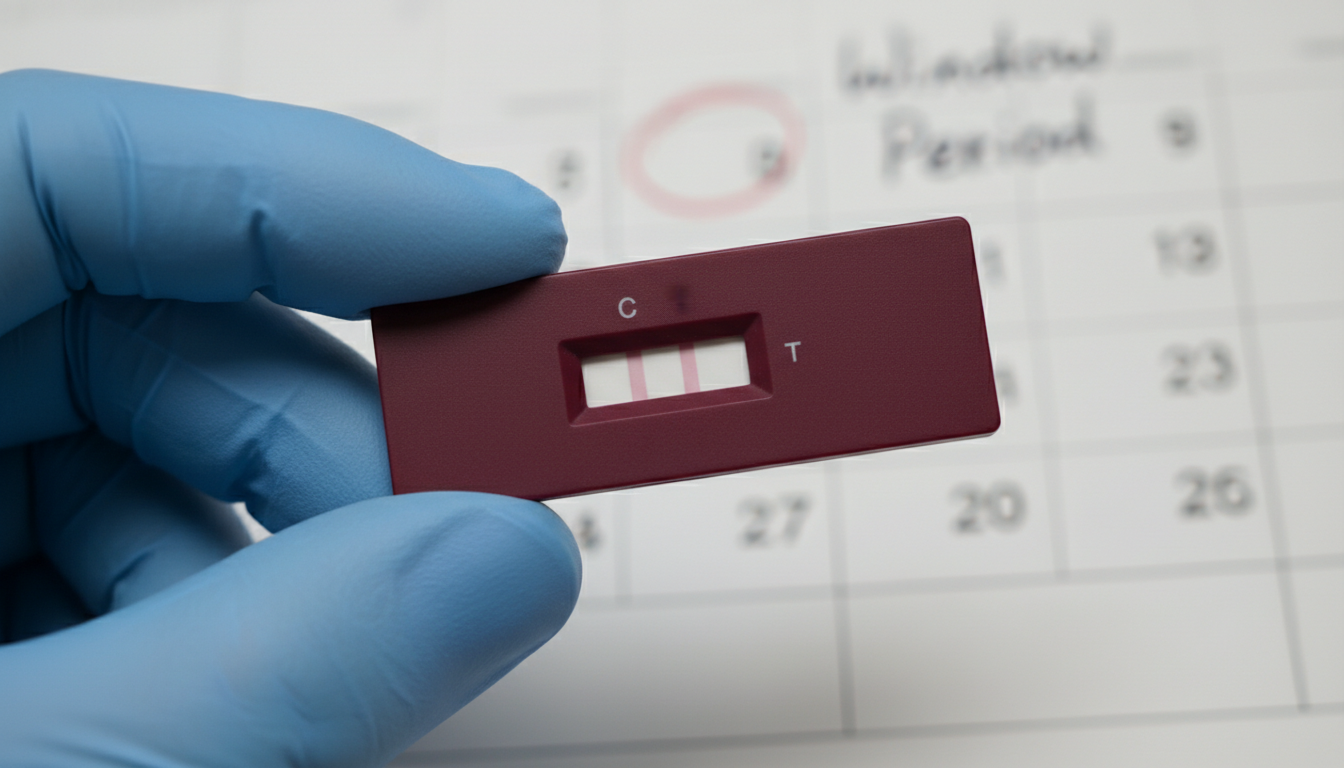
| Situation | Why testing is reasonable |
|---|---|
| A new sexual partner in the last 1 to 3 months | You have no reliable way to verify their recent testing history. |
| Unprotected vaginal, anal, or oral sex | Highest single-event transmission risk for several common STIs. |
| Condom slipped, broke, or came off | Counts as an unprotected exposure; window-period rules apply. |
| A partner disclosed a positive test | Direct, identified exposure; treat as high priority regardless of how you feel. |
| Annual screening, no specific concern | CDC recommends routine screening for sexually active people, especially those under 25. |
"It Was Only Oral" Is Not a Free Pass
Oral sex is widely treated as low risk, and for HIV that characterization is broadly correct. The CDC describes oral sex as an extremely rare route of HIV transmission compared with vaginal or anal sex, with risk further reduced when the partner with HIV is on effective treatment and has a suppressed viral load (How HIV Spreads, CDC). For other infections, the picture is different.
Pharyngeal gonorrhea is mostly asymptomatic and is now a well-documented driver of transmission, particularly because resistant strains tend to circulate in pharyngeal carriage. Oral chlamydia is less common but still possible. HSV-1, the strain most often associated with oral cold sores, can be passed during oral sex and cause genital herpes. Syphilis can transmit through oral contact with chancres or rashes.
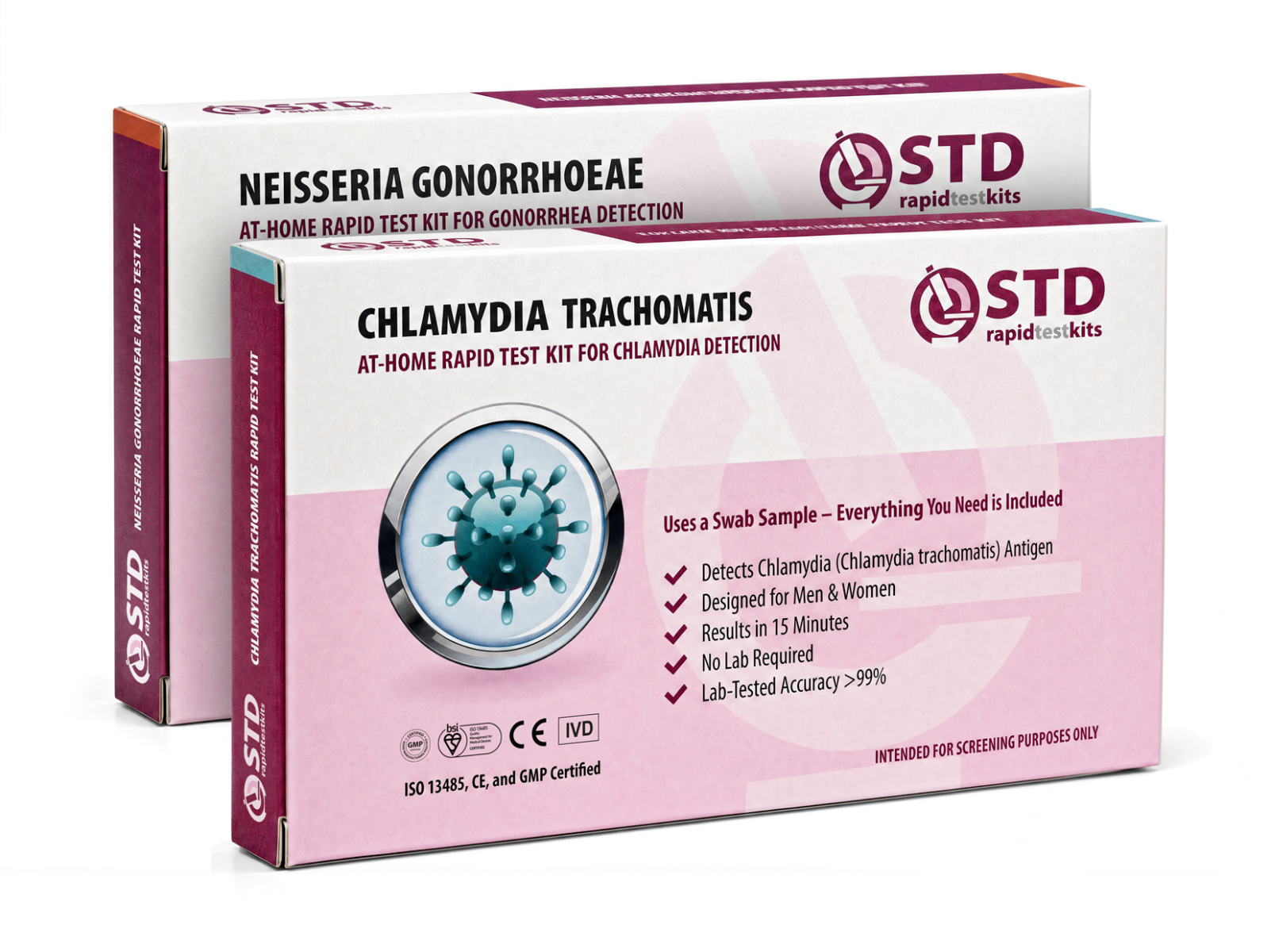
The hard part is that throat infections rarely cause noticeable symptoms, and standard at-home rapid screens do not include a pharyngeal swab. If oral exposure is the specific risk you are sitting with, our home kits cannot answer the throat question directly; that requires a clinic-administered pharyngeal swab and a lab NAAT. What our genital and blood-based screens do answer is whether the same exposure event left anything detectable through urogenital or systemic testing, which is often the more practical first step when you are weighing whether to escalate to a clinic visit.
Disclosure: this site sells the at-home rapid test kits referenced below. Product mentions are limited to kits whose sample type and infection coverage match the situation being discussed.
The Anxiety Loop That Lives in the Absence of Symptoms
There is a specific kind of stress that comes from not knowing. Nothing hurts, nothing looks unusual, and yet your brain keeps circling back to the encounter you cannot stop replaying. That loop is common, and it is also the part of risk that public surveillance data cannot help you with.
Most clinicians who treat sexual-health anxiety describe the same pattern: the loop intensifies when people try to argue themselves out of testing because they have no concrete symptom to point to. The internal monologue says, "You are overreacting, drop it," and then five minutes later it is back. Testing tends to short-circuit that cycle: it replaces the uncertainty with information you can act on, whatever the result turns out to be.
What makes the spiral worse is the way it gets dismissed by people around you. Friends say it is probably nothing. A partner insists they are fine. A clinic receptionist sounds bored. None of those reactions are evidence; they are guesses about your situation made without your data. Your body is the only one running the actual experiment, and a test is the cheapest way to see the readout.
Pick a date on the calendar that lands inside the right window period for the infection you are worried about. Put the test on that date. Until then, treat the loop as a scheduling task you have already handled, rather than a problem you keep needing to solve in your head. People who anchor a test date this way usually report the spiraling drops off well before the date arrives.
What a Negative Test Actually Means
A negative result feels like instant relief, and inside the right window period it usually deserves to. The catch is the calendar. A test taken three days after exposure is not telling you that you are clear; it is telling you that the assay could not yet detect anything, which is what you would expect from a sample taken before the infection has reached detectable levels.
This is where a lot of confusion happens. Readers think in terms of positive versus negative, but the more useful question is whether the test was timed inside the most reliable window for the infection you are worried about. If yes, a negative result is generally trustworthy. If you tested early, the negative needs a follow-up test to be meaningful, typically at the 2 to 4 week mark for bacterial STIs and at 6 to 12 weeks for HIV, syphilis, and herpes antibodies.
Treat the first test as a starting point rather than a final verdict if your exposure was recent. That framing tends to quiet a lot of the second-guessing that otherwise sets in over the following weeks.
Many sexually transmitted infections are asymptomatic. Routine screening is the only way to identify and treat infections early, before complications develop or further transmission occurs.
How Often to Test When You Feel Fine
Outside of a specific concern, the question becomes how often to screen as a baseline. The CDC's published cadence guidance is the cleanest reference point. Sexually active people under 25 should be screened for chlamydia and gonorrhea at least once a year. Anyone with new or multiple partners benefits from screening every 3 to 6 months regardless of age. Men who have sex with men, people on PrEP, and pregnant people each have their own slightly more frequent schedules in the official guidelines.
The simplest framework most clinicians use with patients is to think of STI testing the way you think of a dental cleaning or an annual physical. It is maintenance rather than reaction. The shift from testing because you are scared to testing because you want to stay current changes the whole experience and removes most of the embarrassment people associate with the topic.
CDC screening cadence at a glance
- Sexually active people under 25: at minimum once a year for chlamydia and gonorrhea.
- Anyone with new or multiple partners: every 3 to 6 months, regardless of age.
- Men who have sex with men: typically every 3 to 6 months, with additional pharyngeal and rectal screening per CDC guidance.
- People on PrEP and pregnant people: follow PrEP and prenatal screening schedules in the official CDC guidelines.
When Contact Tracing Fails You
If you have ever waited for a partner to "let you know if anything comes up," you already know how fragile contact tracing can be. Disclosure stalls because of embarrassment, regret, or simple ghosting. Public health systems, even in well-funded jurisdictions, only catch a fraction of the chain. Many local health departments have lost contact tracers since 2023, narrowing the system further.
The practical consequence is that you cannot rely on someone else's call, text, or clinic bulletin to tell you when to act. If your only information is a vague feeling and the silence of the people involved, that is enough information to test. The context may have been a group setting, a brief encounter, or oral contact only. Each scenario still belongs in a calendar of exposure windows you can plan around.
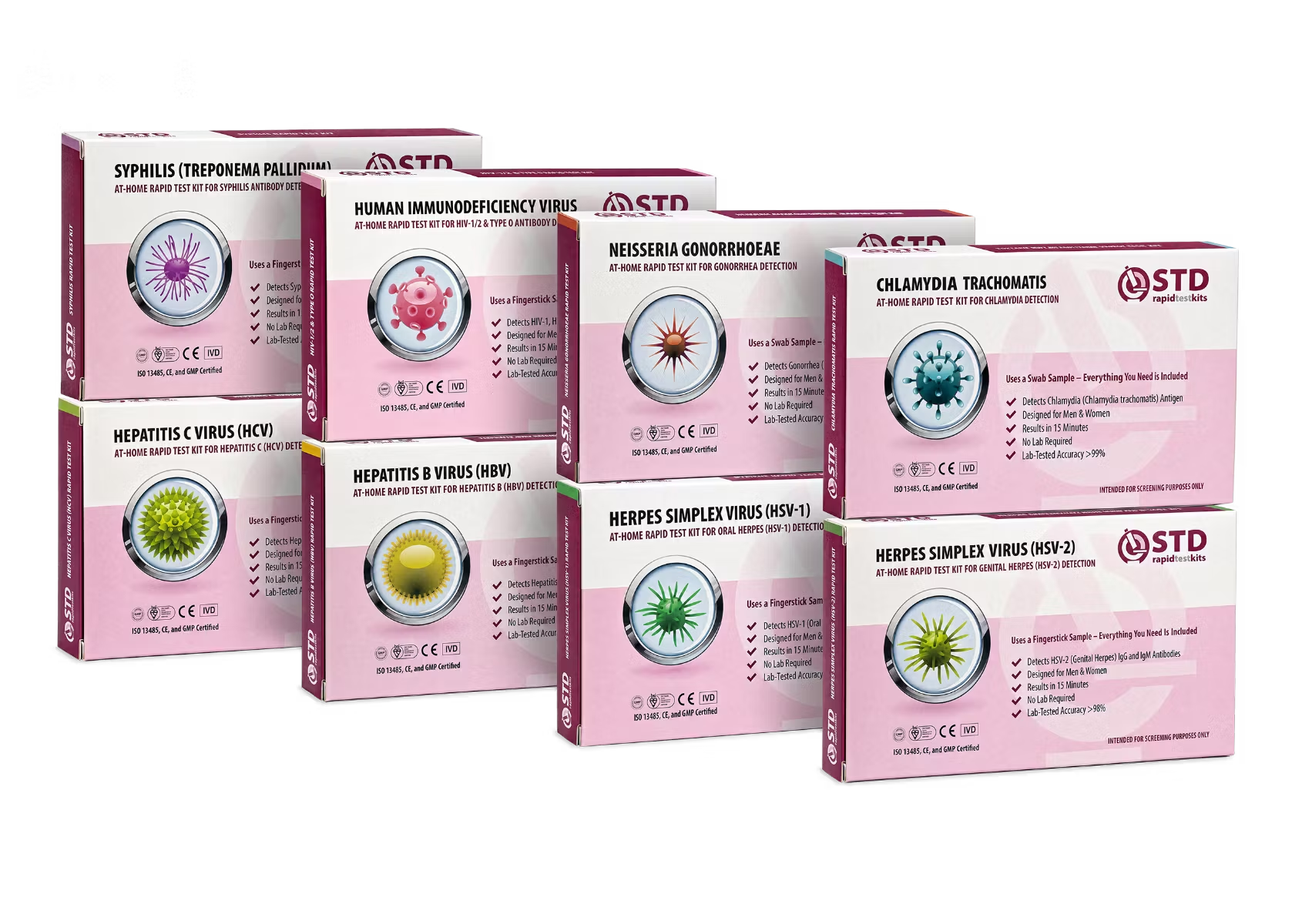
Rapid at-home test kits are most useful in exactly this kind of gap. They let you take the first usable reading without waiting for a system that may never reach you, which is often the difference between acting in the right window and missing it. They remain a screening tool: clinic confirmation through a lab NAAT or fourth-generation HIV assay is still the right next step after any positive result.
Privacy as the Reason People Skip Testing Entirely
Privacy concerns are one of the most under-discussed reasons people put off testing. A pharmacist who knows your face. An insurance log a partner can pull up. A small-town clinic where the receptionist went to high school with your sister. None of those concerns are paranoid; they are practical reasons people delay something they otherwise would have done.
At-home testing was designed around exactly this. The kit ships in plain packaging, the sample never leaves your house, and the result is generated by you on your own timeline. There is no insurance claim attached, no chart note, no waiting room. For people in regions where sexual healthcare carries social or legal weight, that privacy is the difference between testing and not testing.
Pair this with the standard caveat: a positive result still benefits from clinic confirmation, both because lab NAAT or fourth-generation HIV testing is more sensitive than lateral-flow chemistry, and because treatment in most cases is prescription-only.
Plain outer packaging with no medical branding, a generic return-address label, and no item description visible from outside the package. The order does not generate an insurance claim or a chart note, which is the part that matters when shared accounts or household mail are a concern.
If a Test Comes Back Positive Without a Known Exposure
Few experiences mess with your sense of certainty more than a positive result you did not anticipate. No one warned you. No one seemed sick. You tested out of an abundance of caution and the cassette has two lines instead of one. This happens often enough with herpes, chlamydia, and trichomoniasis that the pattern has its own clinical name in patient surveys: incidentally diagnosed asymptomatic infection.
The first practical step is confirmation. Lateral-flow at-home tests are screening tools; their false-positive rates are low but non-zero, and the consequences of treatment make confirmation worth the extra step. For HIV and syphilis specifically, every guideline recommends a confirmatory lab test before starting any treatment. For chlamydia and gonorrhea, confirmation through lab NAAT is also standard.
The second step is partner notification, which is the harder of the two. The CDC offers anonymous partner notification services in many states, and most clinics will help you draft a script if you are unsure. The third step is treatment, which for the bacterial STIs is typically a single course of antibiotics with high cure rates.
None of those steps require a moral reckoning. Treat a positive result as data that tells you what to do next, rather than as a verdict on what kind of person you are.
If a result is positive: three steps
- Confirm: send a sample to a clinic lab for NAAT (chlamydia, gonorrhea, trichomoniasis) or fourth-generation antigen-antibody testing (HIV, syphilis) before starting treatment.
- Notify: tell recent partners directly, or use the CDC's anonymous partner-notification services available in many states.
- Treat: bacterial STIs usually clear with a single course of prescription antibiotics; viral infections are managed long-term with clinician guidance.
Choosing Power Over Panic
The hardest reframe in sexual-health testing is that you do not need someone else's permission to act. No headline. No partner disclosure. No clinic alert. The trigger to test is your own assessment of what happened, paired with a calendar that respects how window periods work. Surveillance data, public alerts, and contact tracing systems are all useful when they show up, and they often do not show up in time. Your own awareness is the part you can rely on.
If there has been a recent exposure, time the test to the right window for the infections you are weighing. If the first test was early, plan the follow-up. If everything reads negative inside the right band, allow yourself to actually trust it and stop replaying the encounter. A test taken inside the right window is the shortest path from uncertainty to a result you can act on.
Three steps to take control
- Time the first test to the right window period for the specific infection you are weighing, rather than testing immediately after exposure.
- Plan the follow-up before you take the first test if the encounter was recent, so an early negative does not become the end of the conversation.
- Trust a negative result that lands inside the most reliable window and stop replaying the encounter; the calendar is the part that did the work.
Frequently asked questions
- Can I have an STI without any symptoms at all?
- Yes, and this is the most common pattern for chlamydia, pharyngeal and rectal gonorrhea, trichomoniasis, and early HIV. CDC guidance on chlamydia describes the infection as frequently asymptomatic and notes it can cause serious health problems even without symptoms. Feeling normal is not evidence of being infection-free; it is just absence of a noticeable symptom.
- How long should I wait to test after a possible exposure?
- For chlamydia, gonorrhea, and trichomoniasis, the most reliable test is around two weeks after the exposure. For HIV, the earliest meaningful test (4th-gen lab assay) is around 45 days; a first at-home rapid antibody test at 6 weeks is reasonable, with a confirmatory re-test at 12 weeks for highest accuracy. For syphilis, plan on 6 weeks with a follow-up at 12 weeks. Testing earlier is fine if you understand that an early negative may still need confirmation later.
- I used a condom the whole time. Do I really need to test?
- Probably lower risk, but not zero. Condoms reduce HIV and chlamydia transmission very effectively when used correctly. They cover less of the skin involved in herpes and HPV transmission, and slip or breakage is more common than people think. If the question is bothering you enough to read this, the test usually quiets the loop faster than the worry does.
- What if it was only oral sex?
- Pharyngeal gonorrhea is usually asymptomatic and is a real transmission concern. Oral chlamydia is possible but less common. HSV-1 and syphilis can both transmit through oral contact. At-home rapid kits do not include pharyngeal swabs, so a complete answer for an oral-only exposure may need a clinic visit. The genital and blood-based screens still cover the systemic and urogenital risk from the same encounter.
- I tested negative early. Do I still need to retest?
- Yes if the first test was inside the window period. A negative result two or three days after exposure is not a clear answer; it is the assay being unable to detect anything yet. Plan a follow-up test at the right window for the infection you are screening for, typically 2 to 4 weeks for bacterial STIs and 12 weeks for HIV antibodies.
- How often should I test if I have no current concerns?
- At minimum once a year for sexually active people under 25, per CDC chlamydia and gonorrhea screening guidance. Every 3 to 6 months for anyone with new or multiple partners, regardless of age. People on PrEP and men who have sex with men have their own more frequent schedules in the official CDC guidelines.
- Are at-home rapid tests reliable when I have no symptoms?
- Lateral-flow rapid tests detect infection regardless of symptoms; the assay does not care how you feel. Reliability depends on timing more than anything else. Used inside the right window, modern at-home rapid kits are screening-grade tools whose results can be confirmed with lab NAAT or fourth-generation antigen-antibody testing if needed.
- What does an unexpected positive result actually mean?
- It means the screening assay detected an infection signal. The next step is confirmatory lab testing, especially for HIV and syphilis, since lateral-flow tests have low but non-zero false-positive rates. After confirmation, most bacterial STIs clear with a single course of antibiotics, and viral infections are managed long-term. A positive result is data to act on, rather than a moral verdict.

- U.S. Centers for Disease Control and Prevention. STI screening recommendations for chlamydia, gonorrhea, syphilis, and HIV across age and risk groups.
- U.S. Centers for Disease Control and Prevention. About chlamydia, including asymptomatic presentation and long-term health consequences when untreated.
- U.S. Centers for Disease Control and Prevention. Annual STI surveillance data, methodology, and limitations of state-level reporting.
- U.S. Centers for Disease Control and Prevention. Getting tested for STIs, including general guidance on when and how to test.
- U.S. Centers for Disease Control and Prevention. How HIV spreads, including oral sex transmission risk and the role of viral suppression in prevention.
- World Health Organization. Sexually transmitted infections fact sheet, including the daily incidence figure for curable STIs and asymptomatic-transmission patterns.
- National Health Service (UK). Sexually transmitted infections clinical overview, including testing and confirmation guidance for general audiences.
